A flat pouch, a box cosmetic bag and a train case can use the same color, fabric and logo yet deliver completely different customer experiences. Their geometry changes what fits, how contents are found, whether bottles stay upright, how the bag packs into a parcel, and how many production operations must be controlled.
Planning an order? Send the payload and structure details already known. Include the program and channel, item list with dimensions and weight, candidate bag format, usable opening, materials and support layers, components, quantity, destination and required date.
This guide compares the three structures as product systems rather than styling labels. It is designed for beauty brands, retailers, travel programs, gift-with-purchase teams and promotional buyers choosing a manufacturable format. Explore LUCKYSTAR’s custom cosmetic bag options, evaluate potential partners with How to Choose a Cosmetic Bag Manufacturer, and use our Custom Bag Manufacturer pillar guide for the wider sourcing process.
Quick answer: which cosmetic bag structure should you choose?
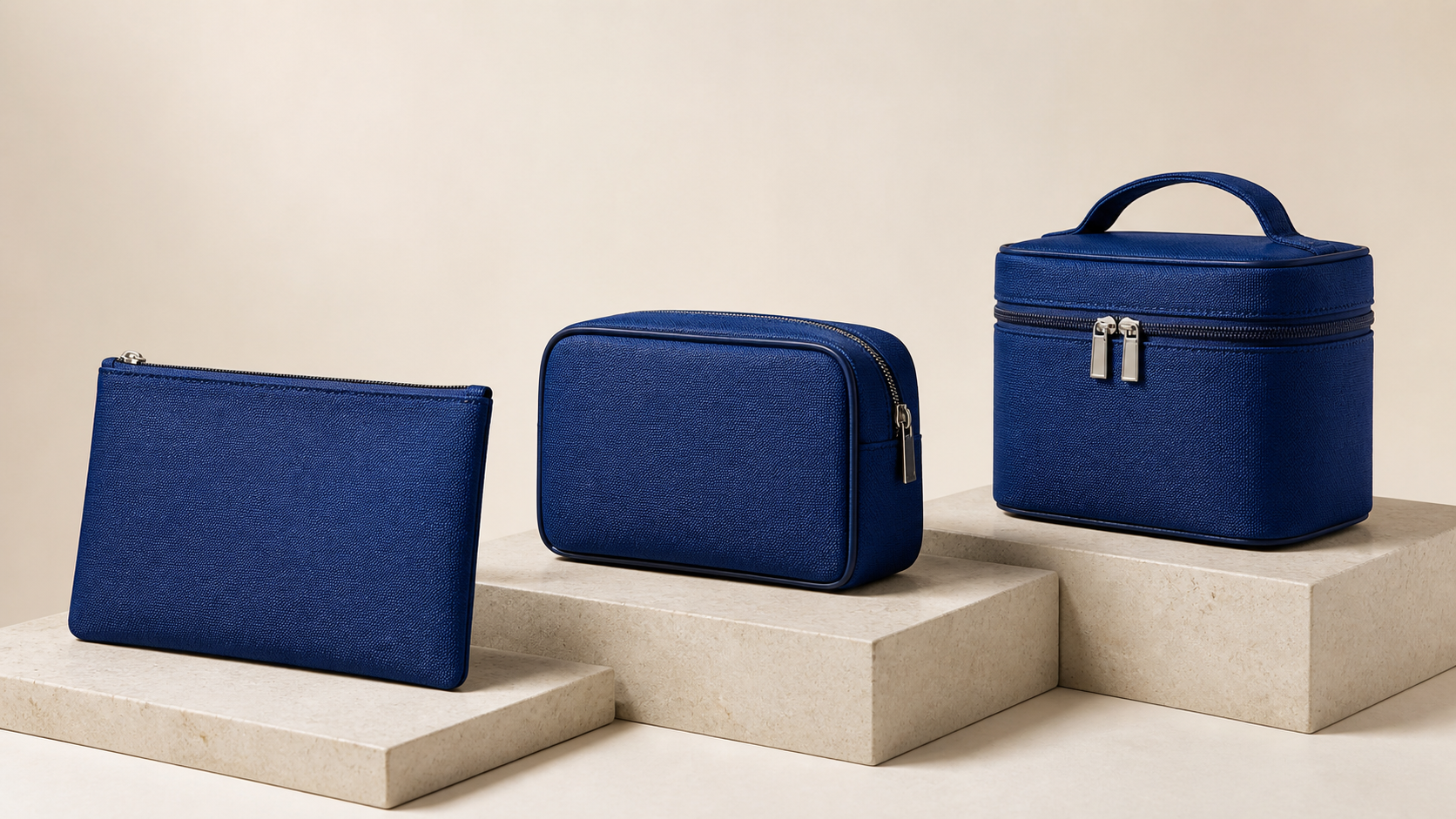
Choose a flat pouch when packability, light weight, a large logo panel and efficient distribution matter most.Choose a box cosmetic bag when the brief needs a self-standing base, useful depth and everyday access without the full bulk of a case. Choose a train case when protection, wide opening, internal organization and a premium reusable impression justify more components, space and assembly work.
| Decision | Flat pouch | Box cosmetic bag | Train case |
|---|---|---|---|
| Best payload | Compact makeup, sachets, brushes and slim tubes | Mixed daily cosmetics and medium bottles | Larger jars, upright skincare,tools and divided assortments |
| Access | Simple top zipper; items may stack | Wider cavity with usable standing access | Hinged or clamshell opening exposes most contents |
| Protection | Low unless padded | Moderate with structure layers | Highest potential with foam,piping and dividers |
| Packing cube | Lowest; nests or compresses well | Moderate fixed depth | Highest; shape may need support |
| Development load | Lowest | Medium | Highest |
| Typical role | Promotion, entry retail, travel secondary pouch | Core retail or beauty-set organizer | Premium retail, hero GWP or professional kit |
1. Define the three structures before requesting prices
“Pouch,” “box bag” and “train case” are often used loosely. A factory may call a deep gusset pouch a box bag, or use “vanity case” for several unrelated constructions.Quotations become comparable only after the buyer defines the panels, opening path, base, structure and interior.
A flat pouch usually has two main faces with little or no permanent depth. A box cosmetic bag creates a three-dimensional cavity through gussets, a boxed base or separate side panels. A train case is a more structured container with a lid or wide zipper opening, usually a handle and optional organization. Put the actual construction route—not only the marketing name—into the cosmetic bag tech pack.
| Structure | Minimum construction definition | Variation to clarify |
|---|---|---|
| Flat pouch | Front, back and one zipper opening | Truly flat, bottom dart, small gusset, lined or unlined |
| Box cosmetic bag | Defined width, height and depth with stable base | Boxed corners, U-gusset, separate base or wrap panel |
| Train case | Structured body plus lid/opening and carrying feature | Top lid, clamshell, double zip, divider, mirror or trays |
2.Start with the payload profile
List the real contents by quantity, diameter, height, weight, closure type and leak sensitivity. A palette and two brushes create a thin payload; three pump bottles create a tall payload; jars and tools create a dense mixed payload. Selecting structure by target audience alone leaves the most important geometry undefined.
Flat pouches favor thin items but make deep stacks. Box bags accept a more varied daily mix. Train cases work when contents benefit from zones or upright orientation. The detailed measuring method in our Cosmetic Bag Size and Capacity Guide helps convert the payload into external dimensions and a physical fit test.
| Payload pattern | Strongest option | Reason | Watch-out |
|---|---|---|---|
| Slim makeup and sachets | Flat pouch | Uses little empty depth | Small items collect at the bottom |
| Mixed daily routine | Box bag | Balances depth,visibility and footprint | Opening may narrow at corners |
| Tall bottles | Box bag or train case | Stable base supports vertical layout | Confirm cap clearance |
| Large mixed skincare set | Train case | Wide access and divider options | Loaded weight and carton cube |
| Brushes plus liquids | Train case | Separate clean and spill-risk zones | Lid depth and brush-panel contact |
3. Opening geometry changes access
A bag can have enough volume and still feel difficult to use. The top zipper of a flat pouch provides direct access, but the user often removes items to reach the bottom.A box bag can offer a longer opening and visible cavity, although the zipper ends may restrict hand access. A train case can expose nearly the full plan area when the lid opens far enough.
Specify the usable opening length, zipper path, stop position and maximum lid angle. Test with the largest item and an adult hand. Our Cosmetic Bag Zipper and Hardware Guide explains how the slider, teeth, tape and opening path work as one system.
| Access test | Flat pouch | Box bag | Train case |
|---|---|---|---|
| See all contents | Low when filled deeply | Medium | High with wide-opening lid |
| Retrieve largest item | Check zipper mouth against product width | Check corner constriction | Check divider and lid clearance |
| One-hand use | Bag may collapse or lift | Stable when base is filled | Stable, but lid must stay open |
| Fast pack-out | Fast for flat items | Fast for mixed bottles | More placement decisions |
4. Compare usable capacity, not geometric volume
Length × height × depth produces a theoretical number, not guaranteed usable capacity. Rounded corners, zipper tape, binding, foam, lining ease and dividers consume space. A flat pouch also gains variable depth when loaded, changing its external footprint. A train case may appear large but reserve substantial volume for structure and organization.
Use an identical payload to compare prototypes. Record what fits comfortably, what can be removed without emptying the bag and whether the closure operates without pressure. This product-level test is more useful than comparing three supplier dimension charts.
| Capacity loss | Flat pouch effect | Box bag effect | Train case effect |
|---|---|---|---|
| Zipper seam | Reduces mouth width | Can taper upper corners | Creates perimeter track |
| Structure layers | Usually limited | Moderate wall thickness | Substantial foam/board allowance |
| Interior features | Pocket can create bulk | Elastic loops use side volume | Dividers and lid panels divide cavity |
| Corner radius | Small effect | Affects base corners | Affects all structured edges |
5. Stability and upright storage
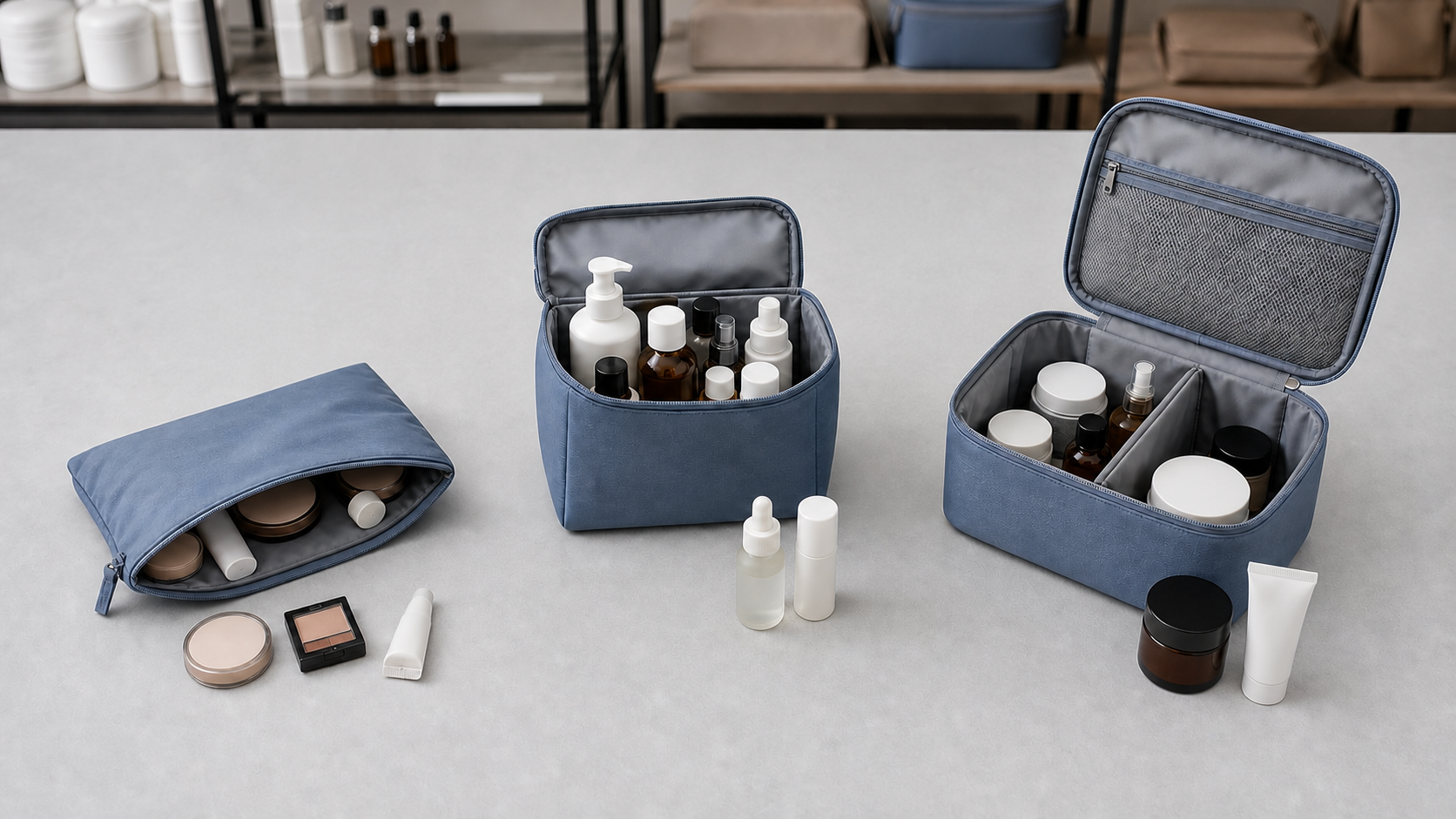
A flat pouch usually follows the contents rather than controlling them. This is useful in a crowded tote or suitcase, but it does not keep bottles upright on a bathroom counter. A box bag can stand when the base, proportions and loading are balanced. A train case is the most stable option when walls, base and lid are engineered as a coherent shell.
| Stability factor | Flat pouch | Box bag | Train case |
|---|---|---|---|
| Empty state | Collapses or lies flat | May stand with backing | Should retain shape |
| Part-loaded state | Contents shift | Can lean if height/base ratio is poor | Stable if dividers and base are balanced |
| Counter use | Requires opening and searching | Good everyday access | Functions as a portable organizer |
| Tip-risk control | Not a core requirement | Base width and payload center | Base rigidity, lid weight and handle position |
6. Protection follows the structure stack
The silhouette does not guarantee protection. A train case made with soft walls may deform more than a compact box bag with controlled foam. Define the protection target: scratch separation, light compression resistance, shape retention, impact buffering or leakage containment. Then build only the necessary layers.
Material selection and structure should be reviewed together through our custom cosmetic bag material guide. Avoid promising “protective” performance based only on a thick-looking sample.
| Protection need | Flat pouch route | Box bag route | Train case route |
|---|---|---|---|
| Surface separation | Lining or thin padding | Lining plus moderate backing | Lined compartments |
| Shape retention | Not usually prioritized | Panel backing and stable base | Foam/board,piping and bound seams |
| Item separation | One pocket at most | Loops or side pockets | Divider, trays or lid panel |
| Compression resistance | Low | Medium | Highest potential, subject to test |
7. Packability and nesting
Flat pouches are efficient before and after purchase. They can nest, stack or compress, which supports mailers, event cartons and consumer luggage. Box bags occupy more fixed depth but may still nest if shipped open or partially collapsed. Train cases normally retain their full cube and may need tissue or an insert to protect shape.
| Packing behavior | Flat pouch | Box bag | Train case |
|---|---|---|---|
| Factory storage | Very efficient | Depends on collapsibility | High cube |
| Master-carton density | Highest | Medium | Lowest |
| Consumer suitcase | Fills irregular gaps | Creates predictable block | Protective but space-demanding |
| Shape support | Rarely needed | Sometimes tissue | Often tissue, insert or closed-form packing |
8. Shipping and retail packaging are part of the structure decision
A lower ex-factory price can be offset by fewer units per carton or a larger e-commerce parcel. Build a pack-out using the real finished sample, any tissue or insert, the unit pack and the master carton. If the cosmetic bag contains beauty products, test that complete loaded configuration rather than the empty bag.
The Custom Cosmetic Bag Packaging for Beauty Brands guide shows how to connect bag form, product payload and channel packaging.
| Channel pack | Flat pouch advantage | Box bag consideration | Train case consideration |
|---|---|---|---|
| Direct mailer | Low thickness and weight | Parcel depth increases | May require a box |
| Retail shelf | May need hanger or support | Can stand or front-face | Strong presence but large footprint |
| Gift set | Works as flexible outer/inner pouch | Holds a compact assortment | Can become the presentation case |
| Event carton | High unit count | Moderate handling ease | Low unit count and heavier handling |
9. Retail presentation and perceived value
Customers often read geometry before inspecting materials. A flat pouch communicates simplicity and portability. A box bag communicates useful capacity and daily organization. A train case can communicate a higher-value accessory because it resembles a portable storage product, but poor alignment or unstable walls make that promise collapse quickly.
Perceived value must match the channel and price position. Review the commercial distinction in Retail Cosmetic Bags vs Promotional Cosmetic Bags before using “premium” as a construction requirement.
| Value cue | Flat pouch | Box bag | Train case |
|---|---|---|---|
| Silhouette | Minimal and graphic | Practical and substantial | Hero accessory |
| Opening moment | Direct and quick | Visible everyday cavity | Reveal and organization |
| Hardware visibility | Single zipper/puller | Longer zipper path | Double slider, handle and fittings |
| Finish sensitivity | Panel and zipper straightness | Symmetry and base shape | Piping, lid alignment and wall uniformity |
10. Promotional and gift-with-purchase programs
Promotional does not automatically mean flat. A mass sampling event may favor the pouch’s efficient cube and logo panel. A beauty gift-with-purchase can use a box bag to provide visible value without dominating the kit. A train case can serve as a premium threshold gift, influencer presentation piece or loyalty reward when the reuse story supports the added cost and logistics.
| Program | Recommended starting point | Why |
|---|---|---|
| High-volume event | Flat pouch | Fast distribution and compact cartons |
| Beauty sample bundle | Flat or box bag | Match actual samples and mailer depth |
| Prestige GWP | Box bag or train case | Higher perceived utility |
| PR/influencer kit | Train case | Presentation and organized reveal |
| Loyalty reward | Any, based on points/value promise | Commercial expectation determines structure |
11. Travel and professional use
Travel users care about pack shape, spills, weight and access in a small bathroom. Professionals care about rapid retrieval, visible organization, cleaning and repeated transport. A flat pouch can separate categories inside a larger case. A box bag works as a compact independent organizer. A train case becomes a workstation, but only if the handle, divider and opening remain stable under load.
| Use case | Flat pouch role | Box bag role | Train case role |
|---|---|---|---|
| Weekend travel | Makeup or cable/brush sub-pouch | Main compact toiletries bag | Often more case than needed |
| Long trip | Category separation | Core routine | Full skincare/makeup organizer |
| Counter storage | Low visibility | Accessible daily bin | Portable compartment system |
| Professional artist | Tool/category inserts | Focused kit | Primary structured case if load-tested |
12. Materials must behave on the chosen geometry
A fabric that looks clean on a flat panel may wrinkle around a box corner or delaminate along a train-case zipper path. Soft textiles can be reinforced; PU can be backed; clear materials need compatible joining. Approve the finished sample rather than assuming the material name determines the result.
The lining must also follow the form. Loose lining may be acceptable in a soft pouch but can reduce usable space or catch the zipper in a case. Use the Cosmetic Bag Lining Guide to define layer, construction and cleaning requirements.
| Material behavior | Flat pouch priority | Box bag priority | Train case priority |
|---|---|---|---|
| Drape/hand | Pleasant flexibility | Enough body to stand | Works with reinforcement |
| Corner forming | Limited | Clean gusset/base corners | Consistent radii and binding |
| Creasing | Visible on large faces | Visible on packed panels | Critical at lid and curved zipper path |
| Backing compatibility | Optional | Often useful | Essential to layer design |
13. Zipper routes grow in difficulty
A straight zipper on a flat pouch is relatively easy to set and inspect. A box bag may require the zipper to travel around corners or join a top gusset. A train case can use two sliders around a long three-dimensional track, with tight relationships between lid, piping, binding and walls.
| Zipper control | Flat pouch | Box bag | Train case |
|---|---|---|---|
| Path | Straight | Straight top or partial curve | Long U-shape/perimeter |
| Slider count | Usually one | One or two | Often two |
| Key defect | Wave or end mismatch | Corner resistance | Lid misalignment and uneven opening |
| Approval | Closed profile and cycle check | Loaded opening check | Full-track cycling under load |
14. Interior organization should earn its space
Every pocket, elastic loop and divider consumes capacity and adds operations. A flat pouch usually benefits from one simple pocket at most. A box bag can use side pockets without losing the central cavity. A train case can support a lid panel or removable dividers, but fixed cells can make the case incompatible with future product ranges.
| Feature | Best fit | When to include | Failure risk |
|---|---|---|---|
| Flat slip pocket | Flat or box bag | Small items need separation | Opening too tight after loading |
| Elastic loops | Box bag or train case | Known bottle/brush diameters | Wrong tension or position |
| Lid mesh pocket | Train case | Thin tools or sachets | Contents collide with base items |
| Removable divider | Train case | Payload changes between uses | Weak attachment or wasted space |
15. Branding surfaces are different
The flat pouch offers a broad uninterrupted face, excellent for print or embroidery when the logo method matches the fabric. A box bag splits the identity across front, top and sides. A train case can use a lid, front panel, handle or hardware detail, but the brand should not compete with every seam and component.
| Brand objective | Flat pouch | Box bag | Train case |
|---|---|---|---|
| Large campaign graphic | Strongest | Use main front panel | May be interrupted by structure |
| Subtle premium mark | Small embroidery/label | Front or top detail | Debossed patch,plate or puller if appropriate |
| All-over artwork | Easy to visualize | Requires seam matching decisions | Complex across multiple panels |
| Long-term reuse | Keep logo wearable | Balance visibility and utility | Let form carry part of the value |
16. Manufacturing operations increase with form
A flat pouch can be made from a small pattern set and a straight assembly flow. A box bag adds gussets, base shaping, more alignment points and possibly backing. A train case adds structured panels, piping or binding, a long zipper, handle reinforcement, lid alignment and interior components. More operations do not guarantee quality; they create more interfaces to control.
| Operation group | Flat pouch | Box bag | Train case |
|---|---|---|---|
| Pattern parts | Few | Moderate | Many |
| Structure preparation | Minimal | Backing/base support | Foam/board lamination and formed panels |
| Alignment | Logo, zipper and side seams | Gusset,base and zipper symmetry | Lid, walls, handle, piping and zipper track |
| Finishing | Turned or bound seams | More corners and lining joins | Extensive binding and interior finishing |
17. Compare cost drivers without relying on a generic price
Structure affects material consumption, cutting yield, operation count, hardware, reinforcement, packaging and freight. A train case is not expensive only because it is larger; it has more parts and more controlled assembly. A box bag often occupies the useful middle ground. A flat pouch can still become premium through material, artwork and hardware choices.
For budgeting, use How Much Do Custom Cosmetic Bags Cost? and then apply the quality-preserving cost reduction method to the chosen structure rather than simplifying blindly.
| Cost driver | Flat pouch | Box bag | Train case |
|---|---|---|---|
| Main material | Low area | Added depth panels | Largest panel/layer system |
| Labor | Shortest route | More shaping and alignment | Longest multi-stage route |
| Hardware | One zipper/puller | Longer zipper,optional handle | Double sliders, handle and fittings |
| Packing/freight | Most efficient | Moderate | Highest cube |
18. MOQ and sampling risk
Simple structure can reduce some development work, but MOQ still depends on fabric color, print setup, zipper, labels and SKU fragmentation. Train cases add more components that may each have a minimum. They also need more sample decisions, so late comments can affect both pattern and material consumption.
Plan the route using the Cosmetic Bag MOQ and Production Time guide and the sample development process. Approve the structure before multiplying colors.
| Development risk | Flat pouch | Box bag | Train case |
|---|---|---|---|
| Pattern revision | Usually localized | Can alter base/gusset and capacity | Can cascade across lid,walls and zipper |
| Component MOQ | Few components | Moderate | Multiple specialty components |
| Sample comments | Short list | Shape and access interactions | Many linked decisions |
| Color multiplication | Manageable if base is shared | More lining/zipper coordination | Highest trim and packing exposure |
19. Quality control must follow the form
Do not apply one generic cosmetic bag checklist. A flat pouch is judged through panel appearance, zipper straightness, seam finish and dimensions. A box bag adds base stability, corner symmetry and standing shape. A train case adds lid alignment, handle load, piping, divider fit, opening balance and structure retention.
Build style-specific checkpoints with the Cosmetic Bag Quality Control Checklist and define performance evidence through Which Tests Should Custom Cosmetic Bags Pass?.
| Critical check | Flat pouch | Box bag | Train case |
|---|---|---|---|
| Shape | Panel flatness and edge line | Base,depth and corner symmetry | Wall/lid form and perimeter alignment |
| Closure | Straight cycling | Corner cycling under load | Double-slider full-track cycling |
| Load | Seam and mouth stress | Base stability and handle if used | Handle, divider and structure retention |
| Interior | Clean seam/lining | Usable cavity and pocket position | Binding, lid panel and divider fit |
20. Can the three structures share one collection platform?
Yes, if the shared elements are chosen deliberately. A collection can use one outer material, lining palette, zipper family, puller and logo language while changing geometry.The flat pouch can be an entry style, the box bag the core organizer and the train case the hero. Do not force identical proportions or pocket systems across all three.
The How to Design a Cosmetic Bag Collection guide explains how to share a product DNA without creating redundant SKUs.
| Platform element | Share across styles? | Reason |
|---|---|---|
| Outer material/color | Often | Creates collection recognition and volume leverage |
| Zipper family | Often,with different lengths/sliders | Consistent feel and finish |
| Logo method | If every surface supports it | One method may distort on tight structure |
| Internal organization | No | Each geometry needs its own usable-space plan |
| Packaging footprint | No | Structure creates different cube and protection needs |
21. Use a weighted decision scorecard
Score the criteria that matter to the actual program, not an imaginary universal winner. A mail-order campaign may weight parcel thickness and unit count heavily. A premium retail case may weight access, shape retention and internal organization. Document the evidence behind every score using prototypes and pack-out trials.
| Criterion | Suggested weight | Evidence |
|---|---|---|
| Payload fit and retrieval | 25% | Loaded-use test with exact products |
| Channel/consumer experience | 20% | Retail,GWP or travel brief |
| Packing and freight cube | 15% | Unit pack and master-carton trial |
| Target protection | 15% | Defined performance checks |
| Cost/MOQ feasibility | 15% | Normalized supplier quotation |
| Manufacturing/QC risk | 10% | Sample findings and control plan |
Why choose LUCKYSTAR for custom cosmetic bag structures?
LUCKYSTAR helps buyers move from a visual reference to a structure that works in production. We review the target contents, opening, usable capacity, material stack, zipper route, interior organization, branding, packaging and quality checkpoints together.This is especially important when a sketch appears simple but geometry makes the manufacturing route complex.
We can develop a flat pouch for efficient campaigns, a box cosmetic bag for an everyday retail line, a structured train case for a premium program, or a coordinated family using shared materials and hardware. Our process keeps sample comments, production decisions and inspection references connected. Browse our complete Product Range or review the custom cosmetic bags product page.
| LUCKYSTAR support | Practical output | Why it matters |
|---|---|---|
| Structure review | Recommended pouch,box or case route | Geometry follows payload and channel |
| Material engineering | Layer stack and finished swatches | Appearance and shape develop together |
| Sample development | Controlled prototypes and loaded-use review | Decisions are made on evidence |
| Pack-out planning | Unit and carton configuration | Landed cost includes physical cube |
| Bulk quality control | Style-specific checkpoints | Structure-sensitive defects are visible early |
RFQ checklist for a flat pouch,box bag or train case
| RFQ field | Information to send |
|---|---|
| Commercial role | Retail, promotional, GWP, travel, professional or beauty-set packaging |
| Payload | Item list, dimensions, weights and orientation |
| Structure | Flat/gusset route, box construction or train-case opening and layers |
| Dimensions | External points of measure plus required usable opening |
| Materials | Outer, backing, foam, lining,binding and cleaning expectation |
| Components | Zipper, slider count, puller, handle, pockets and dividers |
| Branding | Artwork, size, position, color and method |
| Program data | Quantity by color, target cost basis, testing, packaging and delivery date |
Frequently asked questions
Is a box cosmetic bag always more spacious than a flat pouch?
No. Capacity depends on actual dimensions and construction. The box bag uses defined depth more predictably, while a flexible pouch can expand around contents. Compare both with the same payload and access requirements.
Is a train case the best option for travel?
It is best when organization and protection justify the cube. A traveler with a compact routine may prefer a box bag, while several flat pouches can use irregular suitcase space efficiently.
Can a flat pouch be premium?
Yes. Material, hand feel, lining, zipper, artwork, finish and precision can create premium value without adding depth. Premium should describe the complete execution, not the number of pattern pieces.
What is the main manufacturing risk in a box cosmetic bag?
Shape inconsistency often comes from gusset, base, zipper and reinforcement relationships. Approve clear dimensions and a standing reference, then inspect symmetry and corner behavior.
What should be tested on a train case?
In addition to general material and workmanship checks, evaluate the handle under the intended load, full zipper path, lid stability, divider retention, structure recovery, interior contact and packed transport.
Can one factory manufacture all three structures?
Some can, but review construction evidence. Straight-zip pouches, three-dimensional box bags and bound structured cases require different pattern, sewing, reinforcement and quality-control capability. Confirm relevant samples and process knowledge.
Choose the structure that makes the payload easier to use
The flat pouch wins on flexibility and distribution efficiency. The box cosmetic bag balances access, usable depth and everyday form. The train case earns its place when organization, protection and presentation create enough value to justify greater space and manufacturing work. The correct answer comes from the payload, channel and evidence—not from the most impressive silhouette.
When buyers search Flat Pouch vs Box Cosmetic Bag, the missing third option is often a Train Case Cosmetic Bag built for a different level of access and structure. Compare potential factories against the construction evidence and production controls in our cosmetic bag manufacturer selection checklist.
For broader supplier qualification and production planning, revisit our complete custom bag manufacturing guide. To compare structure options for a real program, contact LUCKYSTAR for a custom quotation with your product list, target dimensions, reference images, quantities and delivery date.

Request a structure comparison for your payload
Include the program and channel, item list with dimensions, weight and orientation, candidate bag format, external and usable opening dimensions, materials and support layers, zipper, handle and organization, branding, quantity split, packaging, destination and required date.
Send your project details through the contact form, or Email a project brief with this comparison already referenced. The email link opens a draft for your review before sending.
Structure, capacity, protection, materials, samples, MOQ, prices, testing, capacity, schedule and delivery terms are subject to specification and written confirmation.