Top 10 Woven PP Shopping Bag Manufacturers in 2026
Last reviewed: September 16, 2026
Woven polypropylene shopping bags are bought as finished carriers, but their quality begins with a multilayer system: extruded PP tapes, woven fabric, optional BOPP film, inks and lamination, cut panels, edge binding, handles, thread and sometimes a bottom insert. Two quotations can both say “120 gsm laminated woven PP bag” while describing products with very different strength, appearance and reuse potential.
For 2026 sourcing, ten companies worth investigating are Zhejiang Hongyang Packaging, Wenzhou Mou'an Packaging, Fei Fei, CPC Vietnam, Sapphire Packaging, WEPAC, K-Packings, Cady Bag Company, PEMA Verpackung and Baya Polypack. This is a practical procurement shortlist, not a claim that one supplier is universally better than another.
Editorial method and limitations: LUCKYSTAR reviewed first-party manufacturer and product pages on September 8, 2026. Inclusion reflects visible woven-PP capability, a useful sourcing angle and enough public detail to frame an RFQ. We did not conduct comparative factory audits, laboratory tests or purchase trials. Website statements—including factory ownership, certification, capacity, recycled content, load performance, MOQ and lead time—remain supplier claims until verified for the legal entity, production site, document scope and exact order.
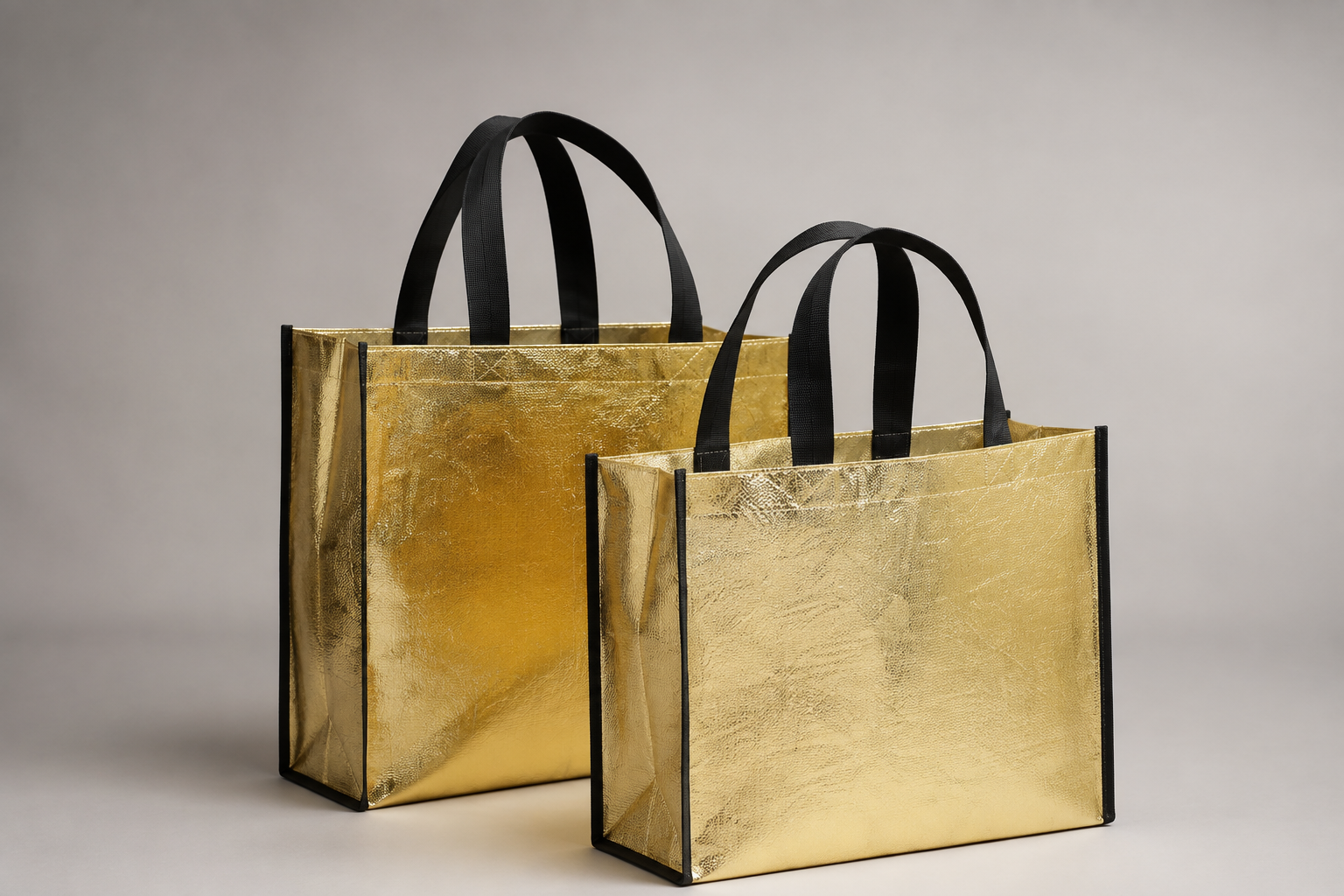
AI-assisted cleanup of real LUCKYSTAR company-catalog product photography. Historical catalog graphics and surrounding samples were removed while the selected gold laminated woven-bag form was retained. The image is illustrative and does not prove polymer identity, fabric weight, recycled content, load capacity, certification or current availability.
Need woven-PP bag quotations based on the same finished construction? Send the use and target load, finished dimensions, base-fabric GSM, coating and film, lamination and print route, seams, handles and reinforcement, quantity by SKU, required evidence and tests, packing, destination and date. LUCKYSTAR can return an order-specific route, evidence gaps and written commercial assumptions.
Page role: This page is responsible for woven polypropylene fabric, lamination, printing, conversion and test planning. For a cross-material comparison, use the worldwide shopping bag manufacturer guide; for a project-specific RFQ, review the custom shopping bag collection.
The 10 manufacturers at a glance
| Company | Location presented on its website | Woven-PP angle worth investigating | First buyer verification |
|---|---|---|---|
| Zhejiang Hongyang Packaging | Wenzhou, Zhejiang, China | Woven fabric, conventional sacks, laminated woven bags and retail shopping-bag formats | Confirm which plant and lines will make the fabric, lamination, print and finished carrier |
| Wenzhou Mou'an Packaging | Wenzhou, Zhejiang, China | PP woven fabric, BOPP-laminated bags and custom reusable shopping bags | Request a layer-by-layer construction and current production-site evidence |
| Fei Fei | China | Laminated and unlaminated PP woven shopping bags within a broader custom-bag range | Establish which material and converting steps are internal for the quoted SKU |
| CPC Vietnam | Southern Vietnam | Woven PP/PE, lamination, printing and sewn reusable shopping-bag programs | Name the contracting entity, assigned factory and order-specific process route |
| Sapphire Packaging | Vietnam | PP woven, PP non-woven, RPET and cooler-bag development | Verify the source of woven fabric and the exact printing/lamination configuration |
| WEPAC | Hung Yen Province, Vietnam | Retail-oriented PP woven carriers with BOPP film and gravure-print options | Validate finished GSM, test method and whether stated product parameters fit the custom design |
| K-Packings | Vietnam | Woven PP shopping bags across broad fabric-weight and closure choices | Resolve which legal manufacturer and workshop will execute the order |
| Cady Bag Company | Georgia, USA | Vertically integrated woven-PP fabric and BOPP consumer-packaging capability | Confirm whether it will convert the requested retail tote or source part of the program |
| PEMA Verpackung | Sick, Germany | Laminated woven-PP shopping bags with closure and finish options | Confirm manufacturing origin, converter, print route and scope of PEMA's control |
| Baya Polypack | India | PP woven fabric, bags and sacks for retail and other sectors | Ask for evidence of consumer-carrier sewing, handle attachment and print capability |
The numbering below is navigational. The right supplier depends on destination market, order volume, artwork, construction, testing, due date and the level of traceability your claim requires. Our Custom Bag Manufacturer guide explains the broader difference between a product catalog and an auditable production plan.
What “woven PP shopping bag” should mean in an RFQ
Polypropylene resin is melted and extruded into tapes. Those tapes are oriented and woven into a grid-like fabric. A retail bag may use the fabric unlaminated, extrusion-coated, or laminated to a reverse-printed BOPP film. Panels are then cut and sewn, handles attached, edges bound and accessories added. The finished construction—not the base polymer name alone—determines the bag's behavior.
| Component | Decisions to specify | Why it affects the finished bag | Evidence to retain |
|---|---|---|---|
| Base woven fabric | Polymer, color, tape specification, weave density and base-fabric GSM | Controls hand feel, coverage, tear propagation and dimensional stability | Material specification, roll identification and approved swatch |
| Print film or coating | Film resin, thickness, matte/gloss finish and print side | Affects color, abrasion, moisture response and end-of-life composition | Layer declaration, artwork proof and approved printed reference |
| Lamination | Adhesive or extrusion route, bond level and treatment | Weak bonds can bubble, tunnel, peel or delaminate at folds | Process parameters, peel criterion and defect limit |
| Bag geometry | Finished width, height, gusset, hem, seam allowance and tolerance | Changes usable volume and stress concentration | Signed drawing or controlled tech pack |
| Handles | Material, width, length, attachment position and reinforcement | Usually forms a critical load path | Handle specification and pull/cycle test record |
| Sewing and binding | Thread, stitch type, stitches per length, piping and back-tack | Influences seam opening, fraying and appearance | Golden sample and workmanship standard |
| Bottom support | None, sewn base, PP board or other insert | Changes stability and may add another material to disclose | Component list and assembly sample |
If your team is still deciding between spunbond and woven construction, compare Woven PP vs Non-Woven PP Shopping Bags and the separate sustainability and performance comparison.
1. Zhejiang Hongyang Packaging Co., Ltd.
Zhejiang Hongyang Packaging presents a Wenzhou-based operation covering PP woven fabric, standard woven bags, BOPP-laminated woven bags, paper-plastic composite constructions and woven shopping bags. Its website shows retail-style reusable carriers alongside industrial packaging, which makes it relevant when a buyer wants to examine both upstream woven-material control and downstream conversion.
The useful sourcing question is not simply whether the company “makes woven bags.” Ask which facility extrudes tape, weaves fabric, prints film, laminates, cuts and sews the exact shopping-bag SKU. Request a process map, dated equipment list and a sample-traceability explanation. If the proposal mentions recycled PP or a certification, verify the current certificate, holder, site, product scope and transaction documents instead of relying on a product-page label.
Best-fit investigation: high-volume BOPP-laminated retail carriers or projects that benefit from reviewing the fabric-to-bag route. Verify before nomination: legal seller, assigned plant, film and ink structure, seam specification, actual capacity window and finished-bag test plan.
2. Wenzhou Mou'an Packaging
Mou'an Packaging describes PP woven fabric rolls, woven bags, BOPP-laminated bags and reusable shopping bags from Wenzhou. Its retail product page discusses reverse-printed BOPP film laminated to woven PP and offers custom dimensions and printing, making the company a logical technical comparison for graphic-heavy grocery or promotional carriers.
Treat online values for material weight, mesh, load, MOQ, lead time and print colors as starting points rather than commitments. A useful RFQ should identify whether GSM refers to base cloth or the finished laminate, whether film thickness is included, the print cylinder and plate assumptions, edge construction, handle anchoring and tolerances. For repeat business, ask how the supplier stores color references, cylinder data and construction revisions.
Best-fit investigation: custom laminated shopping bags with broad image coverage. Verify before nomination: current manufacturing site, which operations are internal, lamination-bond acceptance, color tolerance, cylinder ownership and terms for repeat orders.
3. Fei Fei
Fei Fei's woven-PP product page presents both laminated and unlaminated polypropylene woven shopping bags within a wider custom-bag portfolio. That breadth can be useful to a brand comparing woven PP with non-woven, polyester, cooler-bag or other carrier routes through one commercial contact.
Portfolio breadth does not prove that every process is controlled at one facility. Buyers should ask where fabric is woven, where printed film is produced, who laminates it and where the final sewing occurs. A factory video is helpful, but an order-linked flow chart, approved sample, inspection plan and production records are stronger. Confirm the bag's intended use rather than accepting broad claims such as “waterproof” or “recyclable” without a defined construction and test basis.
Best-fit investigation: brands that want to compare multiple bag materials before locking the specification. Verify before nomination: process ownership, material traceability, sample-to-bulk controls and order-specific compliance evidence.
4. CPC Vietnam
CPC Vietnam publicly describes woven PP or PE, non-woven PP, RPET and other reusable bag routes, with weaving, lamination, printing and assembly among the processes referenced on its site. Its multi-site narrative may suit large retail programs or sourcing strategies that seek Vietnamese production.
Multiple sites also increase the importance of allocation control. The purchase contract, audit, material approval and inspection must refer to the same named legal entity and assigned factory. Do not infer that every capability, audit or certificate shown online applies to every CPC location. Ask who controls resin or fabric procurement, whether film printing and lamination occur at the assigned site, and how subcontracting or overflow would be approved.
Best-fit investigation: scaled woven-PP shopping-bag programs requiring coordinated material and conversion stages. Verify before nomination: factory allocation, certificate site scope, production capacity for the requested month, process subcontracting, social-compliance documentation and final inspection responsibility.
5. Sapphire Packaging
Sapphire Packaging describes PP woven, PP non-woven, RPET, cooler and other reusable bag categories manufactured through its Vietnamese operation. It may be relevant to buyers who want one development conversation across different reusable-carrier structures.
The category list should lead to a construction comparison, not a sustainability conclusion. For woven PP, request the base-cloth specification, print-film and lamination structure, gusset format, piping, thread and handle reinforcement. If recycled content or a certification appears in a proposal, check the certificate holder, valid dates, material category, site and order-level transaction evidence. A certificate logo on a website is not enough to support a claim on your bag.
Best-fit investigation: multi-material retail programs or buyers comparing woven PP against RPET and non-woven options. Verify before nomination: exact woven-fabric source, internal versus external processes, certificate applicability, load-test method and defect limits.
6. WEPAC Joint Stock Company
WEPAC's PPW01 product page identifies PP woven material, a stated weight range, gravure printing, matte or glossy BOPP film and handle options. Its public material is clearly oriented toward reusable retail shopping bags rather than only industrial sacks.
The published ranges are useful for scoping but too broad to purchase against. Convert them into one controlled SKU: finished dimensions, base-fabric weight, film thickness, total weight, handle construction, seam allowance, artwork coverage and test load. If a product page states a load range, request the test fixture, dwell time, number of cycles, conditioning and failure definition before repeating that number in marketing.
Best-fit investigation: BOPP-laminated grocery and retail bag programs with detailed graphic decoration. Verify before nomination: selected SKU construction, lot traceability, stated load evidence, color-control method and actual production slot.
7. K-Packings
K-Packings presents Vietnam-based woven PP shopping bags with various fabric weights, weave densities, top and bottom finishes, printing and customization choices. The detailed parameter menu can help an importer recognize how many variables sit behind one product name.
Some stated specifications span light retail carriers and much heavier packaging. Require the supplier to identify a specific reference construction that matches your use, then verify the legal contracting entity and manufacturing workshop. Claims about ISO, SGS, UN or environmental performance must be checked for document type, certificate holder, product scope, site and validity; a broad table entry is not an order-level approval.
Best-fit investigation: projects needing broad woven-PP construction choices from Vietnam.Verify before nomination: entity and site, shopping-bag conversion experience, quoted specification boundaries, certificate files and realistic tolerance/test criteria.
8. Cady Bag Company
Cady Bag Company states that it manufactures woven polypropylene fabrics and bags in the United States and describes BOPP consumer-packaging capability. Its vertical material experience is a useful benchmark for North American buyers, especially where domestic fabric conversion, shorter communication routes or industrial-scale BOPP expertise matters.
However, Cady's public portfolio is broader than handled retail totes, and its site also describes a global sourcing network. A buyer should therefore ask whether the requested shopping bag is manufactured in-house, converted by a partner or sourced as a finished product. Confirm retail handle attachment, gusset and binding capability instead of assuming that woven sacks and consumer carriers use the same equipment.
Best-fit investigation: North American programs seeking woven-PP and BOPP packaging expertise. Verify before nomination: actual retail-tote route, country of origin, sourced components, decoration options, MOQ and production timeline.
9. PEMA Verpackung GmbH
PEMA Verpackung's laminated woven-PP shopping-bag page lists matte or gloss lamination, custom sizing, flexographic printing and optional closures such as press studs, zippers or hook-and-loop fastening. The company can be relevant when European account support and customized carrier details matter.
The page does not by itself establish where every converting step takes place. Ask PEMA to identify the manufacturing origin, legal producer, printing method for the proposed artwork and how it qualifies or inspects the converter. Also confirm whether flexographic printing is applied directly or through another structure, because that affects achievable graphics and approval controls.
Best-fit investigation: European buyers prioritizing regional project management and closure customization. Verify before nomination: production country, converter identity, artwork process, inspection ownership, documentation and order-specific commercial terms.
10. Baya Polypack
Baya Polypack describes Indian manufacture of PP woven fabric, bags and sacks for sectors that include retail and shopping. Its base-fabric and sack experience makes it a candidate where material production and cost-efficient woven structures are important.
A shopping carrier has different failure points from a commodity sack. Ask for current examples of handled retail bags, then examine binding, top hem, side seams, bottom geometry, handle attachment and surface decoration. Request a finished-bag test report rather than relying only on base-fabric tensile data. If the artwork requires photographic coverage, establish whether BOPP reverse printing and lamination are available internally or through a named partner.
Best-fit investigation: India-based woven-PP sourcing with upstream fabric capability. Verify before nomination: consumer-bag conversion, print/lamination route, handle reinforcement, inspection method and export-packing experience.
Match the supplier to the project—not to the longest capability list
| Buying situation | Supplier capability to prioritize | Evidence that reduces risk |
|---|---|---|
| Full-coverage retail artwork | Controlled BOPP reverse printing, lamination and color approval | Printed film proof, signed sample, Pantone/LAB target and bulk color record |
| Heavy weekly grocery load | Stable weave, appropriate GSM, reinforced handles and robust seams | Cyclic load, static hold, handle-pull and seam-opening results on finished bags |
| Tight repeat-order consistency | Revision control, retained reference and repeatable material sourcing | Controlled tech pack, material code, color master, cylinder file and reorder record |
| Multi-country retail rollout | Site allocation, scalable QC and consistent packing | Named factory, capacity confirmation, shared inspection plan and carton specification |
| Evidence-sensitive sustainability claim | Traceable inputs and claim review | Valid certificate where applicable, scope, transaction evidence and qualified wording |
| Short European or US response route | Regional account support or local production/sourcing | Country-of-origin statement, process map and written responsibility split |
Do not award points merely for more logos, machines or certifications on a website. Score only what the bidder proves for your construction. Our guide on How to Choose a Custom Shopping Bag Manufacturer provides a broader supplier-evaluation framework.
Build a woven-PP RFQ that produces comparable quotations
Define the use case and geometry
State the contents, target net load, frequency of use, carrying distance, retail environment and desired service life. Give finished width, height and gusset; handle length and drop; top and bottom construction; seam allowances; insert requirements; folding method and dimensional tolerance. A photograph is not a dimensioned specification. Use How to Prepare a Custom Shopping Bag Tech Pack to create one controlled revision.
Separate base-fabric GSM from finished laminate weight
Ask for base woven-fabric GSM, film thickness or GSM, coating/adhesive contribution and total finished material weight. “120 gsm” may refer to different measurement points. Also define permitted variance and how incoming or in-process checks will be recorded. Material weight affects strength, cost, carton mass and environmental assessment; see How Material Weight Affects Shopping Bag Environmental Performance.
Freeze the print and lamination route
For photographic artwork, reverse printing on BOPP film followed by lamination is common. Define film finish, number of colors, artwork coverage, color standard, registration tolerance, barcode or fine-text requirement, scuff expectation and approval sequence. For simpler graphics, ask whether direct flexographic or screen printing is technically and commercially more suitable. Compare routes in Printing Methods for Woven PP Shopping Bags and our broader Custom Shopping Bag Printing Methods guide.
Put the load path into the specification
The handle, attachment stitches, top hem, side seam, gusset and bottom seam must carry the load together. Specify handle material and width, attachment depth, stitch pattern, reinforcement, thread and edge binding. A high-GSM body can still fail early at a short handle overlap or poorly secured seam.
Define inspection and acceptance before production
Agree on sampling level, defect classes and measurable criteria for dimensions, print, contamination, odor, lamination, stitching, handle location, packing and tests. Our Shopping Bag Printing Quality Control Checklist and printing-defect prevention guide help convert subjective comments into checkpoints.
Finished-bag tests to discuss with shortlisted suppliers
| Test or check | Example setup to define | Typical failures it can reveal | Important reporting details |
|---|---|---|---|
| Static load hold | Agreed distributed mass for an agreed duration | Seam creep, handle elongation, panel distortion | Actual load, duration, conditioning and pass/fail limit |
| Cyclic lift | Repeated lifting at target or safety-factor load | Progressive stitch damage and handle fatigue | Cycle count, lift speed, fixture and failure definition |
| Handle pull | Controlled pull on each handle/attachment | Webbing break, stitch tear-out or laminate cracking | Pull direction, peak force and failure location |
| Drop test | Filled bag dropped from an agreed height and orientation | Bottom-seam failure, insert shift and corner rupture | Fill material, height, repetitions and orientations |
| Lamination peel/flex | Agreed peel or fold protocol | Delamination, bubbling and edge lifting | Test width, rate, conditioning and acceptance value |
| Print rub/scuff | Dry or qualified wet rub method | Ink transfer, film scuffing and loss of legibility | Load, cycles, medium and rating scale |
| Dimensional inspection | Measurement against signed drawing | Capacity loss, uneven gussets and handle misalignment | Sample size, points measured and tolerance |
| Odor/appearance review | Defined conditioning and evaluation method | Strong odor, contamination, color variation and stains | Environment, panel, rating and defect classification |
A “pass” has no meaning without a method and limit. Test production-intent samples and, where risk warrants, pull verification pieces from bulk. The Reusable Shopping Bag Durability and Reuse Testing guide explains how to define cycles and failure; our longer-service-life design guide connects those tests to handles, gussets and seams.
Normalize quotations before comparing price
| Cost line | What may be hidden behind a low unit price | Normalization question |
|---|---|---|
| Material | Lower base GSM, thinner film, different resin or wider tolerance | Is every bidder quoting the same layer structure and finished weight? |
| Printing | Fewer colors, lower coverage or a different process | Are cylinder/plate costs, proofs and artwork changes included? |
| Construction | Narrower handles, shorter attachment or simpler binding | Are seam, reinforcement and accessories identical? |
| Testing | Supplier-only visual check versus defined finished-bag tests | Which tests and inspection sample size are included? |
| Packing | More pieces per carton, stronger folding or no protective separation | Are carton dimensions, gross weight and deformation risk comparable? |
| Logistics | EXW, FOB, CIF or DDP presented without equivalent assumptions | What exact Incoterm, port, duty and destination costs apply? |
| Reorders | New cylinders, color redevelopment or changed material source | Which tooling and references are retained, by whom and for how long? |
Bulky carriers can be freight-sensitive even when each bag is light. Confirm fold pattern, pieces per carton, carton size, compression risk and maximum gross weight before approval. See Shopping Bag Packaging and Carton Optimization for Lower Shipping Impact.
Treat “reusable,” “recyclable” and recycled-content claims separately
Claim boundary reviewed 16 September 2026: define the base resin, recycled percentage and calculation basis, film/ink/adhesive/handle composition, traceability documents, intended service life, finished-bag reuse test and the collection or reprocessing route available in the destination market. “Reusable” does not prove practical recyclability; a resin code or supplier certificate does not by itself prove recycled content for the shipment; and lamination, mixed components or contamination can change the end-of-life route. Approve the exact wording only after the evidence and complete construction are reviewed.
Woven PP can be engineered for repeated service, but “reusable” should be supported by a defined use scenario and finished-bag durability evidence. “Recyclable” depends on the complete construction and an accessible collection/reprocessing route; a laminated, bound, printed bag may be harder to process than a single-material resin label suggests. Recycled content is a different claim again and requires traceability for the claimed percentage and components.
Do not turn a supplier's website badge into your brand's claim. Check the legal holder, site, material category, scope, validity and any order-level transaction document. Use qualified language that names the product and evidence. Review Recyclable vs Reusable Shopping Bags, How to Verify Recycled Content in Custom Shopping Bags and Shopping Bag Sustainability Certifications Explained. The greenwashing guide provides a final copy check.
Company-claim and route boundary: the following LUCKYSTAR section is publisher self-description and a commercial custom-supply option. It does not independently prove factory ownership, resin or recycled content, certificate status, lamination or load performance, capacity, MOQ, price, timing or superiority over a ranked company. The legal seller, assigned material and conversion sites, construction, evidence, samples, test and inspection plan, packing, schedule and delivery terms are subject to the exact order, final specification and written confirmation.
Why choose LUCKYSTAR for a custom woven-PP shopping bag project?
LUCKYSTAR supports global brands, importers, retailers and distributors with custom-bag development. On this website, the operating entity is Ningbo Luckystar Commodities Co., Ltd. Our role is to translate the buyer's brief into a controlled product and coordinate suitable production, sampling, quality and export packing. We do not imply that every material or process is performed in one LUCKYSTAR-owned facility.
We start with the application, not a stock description
A grocery carrier, event tote and home-storage bag face different loads, abrasion, artwork and folding demands. We define contents, geometry, use target, woven structure, lamination, handle, seams, print and packing before asking production partners to quote. Browse our custom shopping bags to see the broader development scope.
We make quotations technically comparable
LUCKYSTAR can structure an RFQ around one bill of materials and one controlled drawing. Base cloth, film, print, lamination, binding, thread, handles, reinforcement, inserts, tolerances and testing are separated instead of compressed into one vague GSM line. Final availability, MOQ, tooling, price and lead time remain subject to the approved specification and written quotation.
We coordinate approval gates
Artwork approval does not approve construction, and a material swatch does not approve a finished bag. A risk-based route can include material and color references, digital artwork, printed-film proof, physical sample, pre-production reference, in-process controls and pre-shipment inspection. Our custom shopping-bag manufacturing process explains the sequence.
We protect repeat-order consistency
Woven cloth, laminate tone, ink, handle webbing and sewing can drift between production lots. We can coordinate retained references, material codes, artwork revisions, color standards, tooling records and approved construction details. Read How to Maintain Logo and Color Consistency Across Shopping Bag Reorders.
We keep claims evidence-bound
LUCKYSTAR does not present GRS, GOTS, BSCI, ISO, REACH, RoHS or FSC as blanket certifications covering all shopping bags. When a customer needs a material, social-compliance or product claim, the relevant holder, site, scope, validity and order evidence must be confirmed. Testing, certification and commercial terms are product- and order-specific and subject to written confirmation.
Twelve questions to send every shortlisted supplier
- What is the full legal name of the seller, manufacturer and exporter?
- Which named facility will weave, print, laminate, cut, sew, inspect and pack this SKU?
- Which processes are subcontracted, and how will a subcontractor change be approved?
- Does the quoted GSM refer to base fabric, laminated sheet or the complete finished bag?
- What are the base cloth, film, ink, adhesive/coating, binding, thread, handle and insert materials?
- Which printing route is proposed, and what artwork limitations or tooling charges apply?
- What construction tolerances and defect limits will appear in the purchase specification?
- Which static, cyclic, pull, drop, rub and lamination tests are included, using what methods?
- Which certificates or reports apply to the exact entity, site, material and order, and can they be verified?
- How will color, material and construction references be retained for reorders?
- What carton size, quantity, gross weight, folding method and shipping terms are quoted?
- What change-control process applies after sample approval?
Frequently asked questions
Is woven PP the same as non-woven PP?
No. Woven PP is made from interlaced polypropylene tapes, while common spunbond non-woven PP forms a sheet from bonded filaments. They differ in appearance, load distribution, converting and print options. Neither is automatically more sustainable without comparing mass, service life, reuse and end of life.
Is BOPP lamination necessary?
No. It is useful for high-coverage, photo-like reverse printing and for modifying surface behavior. It also adds a layer and a lamination process. Simple artwork, tactile preference or end-of-life goals may support an unlaminated construction. Decide from the project requirement.
Which GSM should a woven PP shopping bag use?
There is no universal optimum. Size, load, weave, film, seams, handles, inserts and target life all matter. Ask suppliers to quote one defined construction and validate it with a finished-bag test rather than selecting GSM in isolation.
Can woven PP shopping bags be printed in photographic quality?
Reverse gravure printing on BOPP film followed by lamination is commonly proposed for broad, detailed artwork. Actual color, registration, fine detail, scuff behavior and finish should be approved through production-representative proofs and samples.
Are woven PP bags waterproof?
Do not use that absolute claim without a product-level method. A laminated panel can resist liquid penetration, while stitch holes, open tops, seams or closures may still allow water entry. Specify the exposure and test criterion you need.
Are woven PP shopping bags recyclable?
Polypropylene may be technically recyclable, but a finished bag can include film, inks, adhesive, thread, webbing, binding and inserts. Local collection and processing determine practical recyclability. Describe the complete construction and avoid unqualified disposal claims.
How should a buyer verify recycled PP content?
Request the claimed percentage and whether it applies to base cloth, film, handles or the whole bag. Verify the supplier chain, valid certificate scope where relevant, input/output records and order transaction evidence. Do not infer recycled content from color or appearance.
What should be approved before mass production?
Approve the controlled specification, artwork, layer structure, color reference, construction sample, tolerance table, test method, defect standard, packing and change-control rule. Record which approval governs if references conflict.
Develop a woven PP bag around evidence, not assumptions
The best sourcing result is not the supplier with the longest public capability list. It is the team that converts your use case into one buildable specification, proves the critical performance, controls changes and supplies claim evidence that matches the shipment.
Send LUCKYSTAR your target size, contents/load, quantity, artwork, destination, launch date, preferred finish and any testing or documentation requirement. We can review the brief and propose a project route. Material, MOQ, tooling, pricing, lead time, testing, production site and certifications remain subject to the final specification and written confirmation.

Request a specification-controlled woven PP bag quote
Use one written specification for every candidate so fabric, coating, film, printing, lamination, seams, handles, evidence, QC, packing and delivered-cost assumptions can be compared on the same basis.
Review LUCKYSTAR custom shopping bag options, then send your controlled RFQ through the contact form or Email a project brief. The email link opens a draft for your review before sending.
Material and conversion route, claims and certificates, testing, capacity, availability, price, MOQ, sample cost, packing, schedule and delivery terms are subject to current order-level verification, final specification and written confirmation.