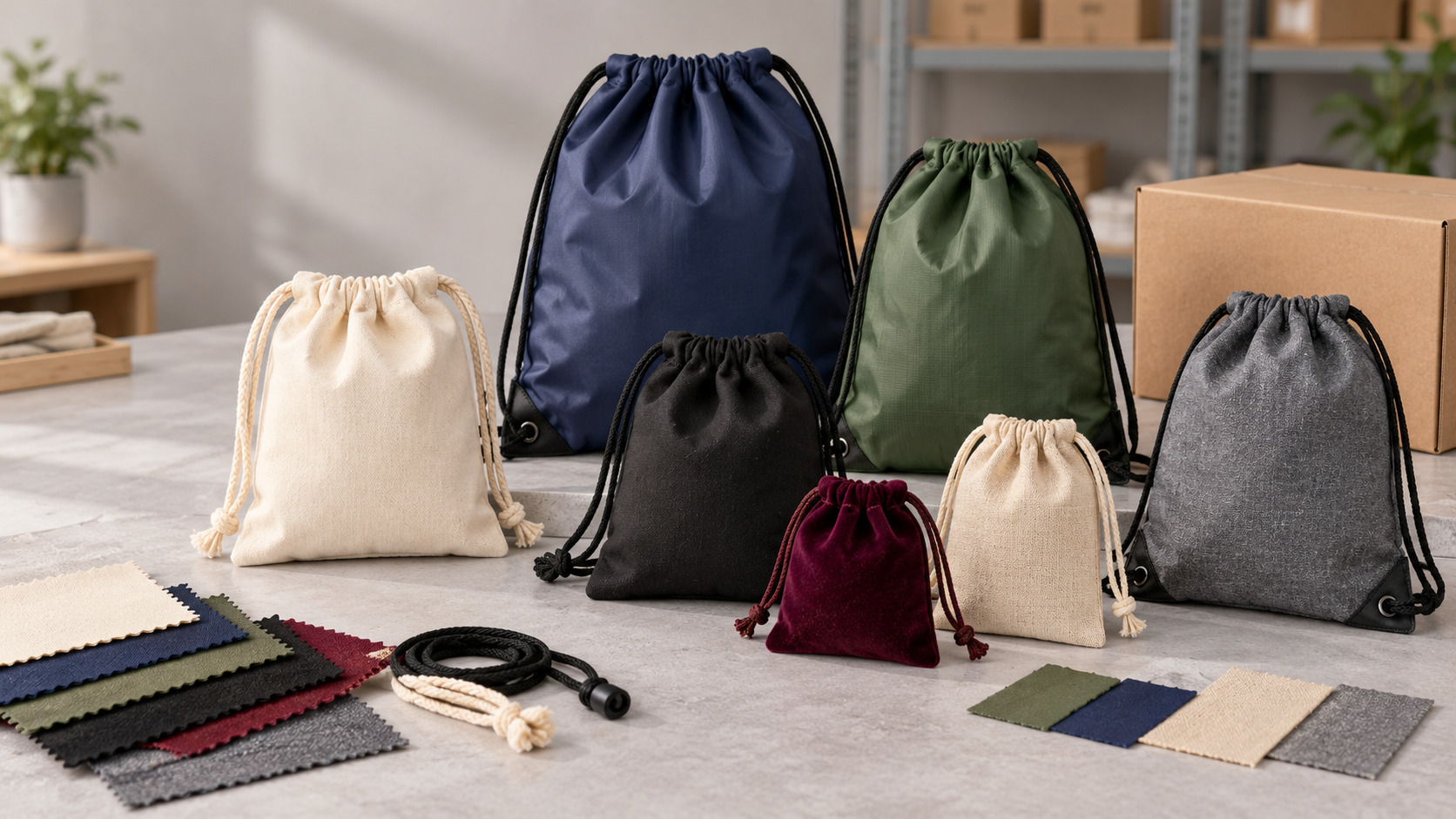
A shopping bag tech pack should tell four different teams the same story. Costing needs measurable consumption and process assumptions. The sample room needs geometry, materials and a decision list. Production needs construction and artwork instructions. Quality and logistics need test methods, SKU identity, folding and carton data. If any team has to reconstruct the product from emails, the pack is incomplete.
This guide explains How to Prepare a Custom Shopping Bag Tech Pack for paper, non-woven PP, laminated woven PP, jute, cotton/canvas, mesh and clear-film retail carriers. It does not repeat the all-category Custom Bag Tech Pack guide or the compartment-heavy Cosmetic Bag Tech Pack guide. The focus here is the retail operating system: shopping basket, checkout opening, gussets, handles, converted artwork, store allocation and flat-pack logistics.
Review possible directions on LUCKYSTAR's custom shopping bag product page. If supplier selection is still open, use How to Choose a Custom Shopping Bag Manufacturer and the wider Custom Bag Manufacturer Guide.
Planning an order? Send the minimum Tech Pack inputs for review. Include the retail use, product basket, dimensions, material route, handles, artwork, quantity by SKU, quality scope, packing, destination and required date.
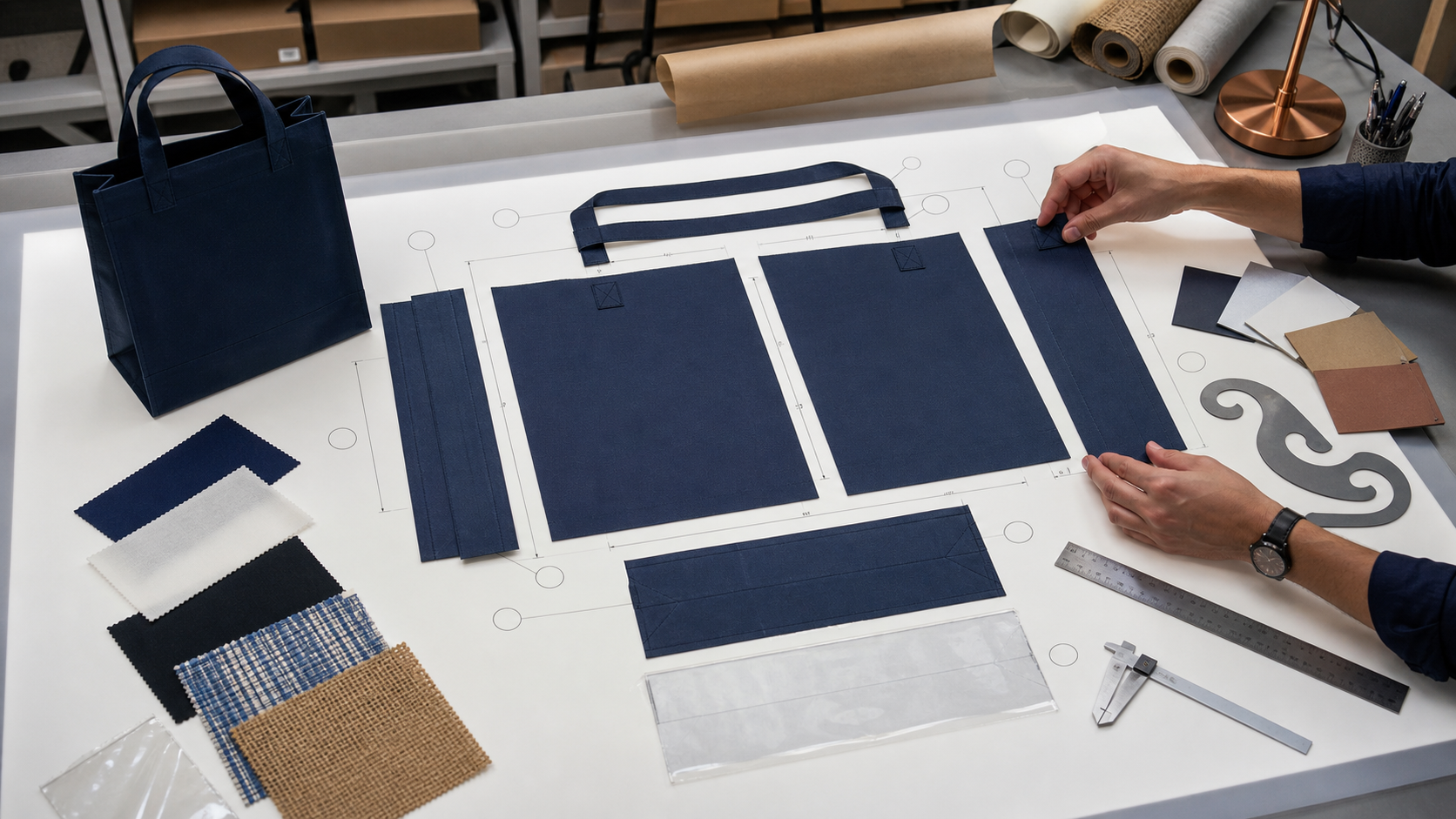
A factory-ready pack connects the assembled carrier to every physical panel, fold, handle and reinforcement that creates it.
Page role: This implementation guide owns the factory-ready shopping bag tech pack: retail-use brief, production-route drawings, points of measure, BOM, artwork maps, test methods, SKU allocation, packing and revision control. Use the worldwide shopping bag manufacturer guide for a supplier shortlist, and the custom shopping bag collection for specification and quotation planning.
What belongs in a shopping bag tech pack?
Do not begin with a 30-page template. Begin with the decisions the assigned factory must make. A straightforward stock-color non-woven shopper may need a concise pack. A full-print woven-PP grocery bag with several store artworks needs film maps, gusset registration, handle/reinforcement and allocation pages.
| Tech-pack module | Shopping-bag-specific content | Primary user | Decision it controls |
|---|---|---|---|
| Cover and revision | Project, style/SKU, route, version, date, owner and decision status | All teams | Which instructions are current |
| Retail operating brief | Products, normal/max basket, checkout station, carry and storage | Design/engineering | Size, opening, load path and fold |
| Route and drawings | Paper conversion, PP bond/sew/lamination, cut-and-sew or clear-film joining | Costing/sample/production | Dieline/pattern, tooling and operations |
| POM and tolerance | Finished dimensions, gussets, handle drop/spacing, opening, base and reinforcement | Sample/quality | How the bag is measured |
| BOM and sections | Body, film/finish, handles, patches, binding, board, adhesive/thread and packing | Purchasing/production | What the bag is made from |
| Artwork and colorways | Print surfaces, folds/gussets, safe areas, color standard and SKU mapping | Prepress/production | What appears on each converted bag |
| Quality and test plan | Checkout/load method, measurements, appearance, print, seam/bond and defect rules | Quality/inspector | How conformance is judged |
| Packing and allocation | Fold, bundles, protection, cartons, labels, store/warehouse quantities and CBM data | Packing/logistics | How usable goods arrive |
1. Establish document control before adding drawings
Assign one style code and one pack owner. Put the revision on every exported page and attachment, not only the cover. A filename such as “final-final2” cannot tell a cutting room whether the handle update belongs with the latest artwork.
Keep three statuses separate: for costing, for sample and released for bulk. Early costing may contain visible assumptions. Sample versions convert assumptions into testable choices. Bulk release should contain no silent open point; any unavoidable sample-to-bulk difference needs an owner and first-off approval gate.
Maintain a short change log: version, page/component changed, reason, old instruction, new instruction, approver and effect on price/MOQ/timing. The related Custom Shopping Bag MOQ and Production Time guide explains why apparently small material or artwork changes can reopen an upstream batch or schedule.
2. Put the retail job on page one
The factory does not need a marketing persona before it knows what the bag carries. List the normal basket, maximum sensible basket and awkward product. State whether the carrier is free packaging, a sold reusable item or a promotional giveaway. Describe how staff take, open, fill and store it.
| Retail brief field | Minimum useful entry | Tech-pack consequence | Evidence during development |
|---|---|---|---|
| Normal basket | Named items, dimensions, mass and loading order | Usable W × H × gusset and mouth | Filled-bag photos/observations |
| Maximum sensible basket | Largest/heaviest intended single-bag combination | Body, base, handle and reinforcement design | Documented load-path trial |
| Checkout station | Counter width, staff motion, storage and expected opening behavior | Fold direction, top stiffness and handle lay | Representative checkout trial |
| Carry context | Hand/shoulder use, clothing, walking duration and comfort priority | Handle drop, width/diameter and edge feel | Carrying review with named load |
| Brand view | How graphics should read flat, filled and carried | Artwork orientation and converted safe area | Flat and filled approval photos |
| Store/logistics model | SKU quantities, bag storage, units/carton and destinations | Colorway matrix, labels, fold and carton plan | Pack-out and allocation reconciliation |
Give the largest real product or an accurate dummy to the sample review. Exterior dimensions alone do not reveal whether a rigid box catches on a gusset or a bottle makes the base unstable.
3. Select the production route before finalizing the drawing set
“Shopping bag drawing” means different things to different factories. A paper carrier needs a converting dieline with glue lap, turns, folds, handle holes/patches and bottom sequence. A direct-print non-woven bag needs cut or roll-fed geometry and bond/seam widths. Laminated woven PP needs the printed film layout connected to the converted gusset. Jute/canvas needs grain/warp-aware patterns and seam allowances. Clear film needs cut and joining sections.
| Route | Required drawing views | Critical section/detail | Do not leave as “standard” |
|---|---|---|---|
| Paper carrier | Finished front/back/side/base plus flat converting dieline | Top turn, glue lap, base fold, handle attachment and reinforcement | Paper direction, handle patch and finish at creases |
| Bonded non-woven | Finished views plus roll/cut panel and handle geometry | Ultrasonic/heat bond width, intersections and die-cut handle | Bond overlap, reinforcement and gusset formation |
| Sewn non-woven | Panel pattern, gusset/base, top and handles | Seam allowance, stitch route, turn-in/binding and handle patch | Thread, stitch density and stress-point method |
| Laminated woven PP | Converted views, continuous film map, panel cut and binding plan | Lamination structure, artwork meet, top/bottom binding and webbing | Film side, laminate basis and registration datum |
| Jute/canvas/mesh | Pattern pieces with orientation, notches, seams and reinforcement | Raw/frayed edge control, seam type, base and handle attachment | Usable width, orientation and natural-material allowances |
| Clear PVC/TPU | Cut film, opening, trim/binding and handle/zipper views | Weld/seam width, overlap, protective film and trim interface | Film face, joining method and scratch-protection stage |
Use solid lines for cut edges, a consistent convention for folds and clear sections for hidden construction. Include a datum for dimensions and print registration. The factory may refine the final dieline or marker for its machinery; the buyer should approve the changed geometry before artwork or material consumption is frozen.
4. Build a shopping-bag points-of-measure chart
A sketch with W × H × D is not enough. State whether measurements are taken flat, lightly opened or filled; whether gusset depth is fold-to-fold; and whether handle drop is measured vertically from the top edge to the inside of the handle.
| POM | Measurement method | Why it matters in retail | Related construction |
|---|---|---|---|
| Finished width | Top opening edge-to-edge or specified datum, bag flat | Product entry and front artwork scale | Panel/cut width and side folds |
| Finished height | Top finished edge to base datum, excluding handles | Containment, product exposure and carry proportion | Top turn/binding and bottom fold/seam |
| Side/bottom gusset | Opened depth between defined fold/seam points | Usable capacity and standing base | Gusset panel or converting fold |
| Mouth/opening | Usable clear opening under normal hand action | Checkout speed and rigid-product loading | Top stiffness, closure and handles |
| Handle drop | Vertical inside drop from finished top edge to handle inside apex | Hand/shoulder clearance and comfort | Handle cut length and attachment |
| Handle spacing/position | Center-to-center and top/side datum per face | Balanced carry and visual symmetry | Hole, patch, stitch/bond or glue fixture |
| Reinforcement/base insert | Finished size, coverage and position from named datum | Load distribution and standing | Patch, board, folded layer or insert pocket |
| Folded pack size | W × H × thickness after defined stack/hold | Under-counter storage and freight cube | Fold sequence, handle lay and compression |
Assign tolerances by function and process instead of copying one value across every POM. Paper, bonded PP, sewn natural fiber and flexible clear film have different controllability. Confirm the manufacturer’s proposed method during sampling, then freeze it with the approved reference.
5. Write the BOM as a route-specific recipe
The bill of materials should identify every input that changes performance, appearance, compliance, cost or packing. “Blue fabric, rope handle” is not a specification. Add supplier/internal code, composition/grade, weight or thickness, color/physical standard, finish, placement, source status and approval reference.
| BOM line | Shopping-bag specification fields | Approval evidence | Bulk control |
|---|---|---|---|
| Body substrate | Paper grade/basis weight; PP composition/gsm; fabric construction/weight; film type/thickness | Signed swatch and measurable source reference | Incoming identity, weight/thickness, shade and surface |
| Print/laminate/finish | Method, ink/film side, color standard, coverage, gloss/matte, bond/coating | Physical strike-off and converted sample | First-off color/registration/adhesion and lot checks |
| Handle | Material, width/diameter, cut length/drop, color, finish and end treatment | Installed handle section and complete sample | Identity, position, symmetry and attachment |
| Reinforcement/base | Patch/board material, thickness/gsm, size, position and attachment | Section sample and loaded result | Presence, placement and surrounding workmanship |
| Assembly input | Adhesive, thread, binding, zipper/trim or weld/bond process consumable | Construction sample and process description | Approved source/process parameters and workmanship |
| Packing material | Interleaf/bag, bundle closure, master carton, label and pallet protection | Physical pack-out trial | Count, identity, carton dimensions and condition |
If the project specifies responsibly sourced paper, recycled PP or recycled textile content, keep the claim, approved material and supply-chain evidence aligned. Use FSC chain of custody to verify the certificate holder, validity, product scope, claim and sales documentation for the actual order. For recycled-content claims, consult GRS 5.0 and its transition information; verify the certificate holder and product scope, then obtain shipment-level transaction evidence where applicable. A certification logo in a Tech Pack is not order-level proof.
6. Draw construction sections that reveal the load path
Show what a front view hides. For a rope-handle paper bag, section the top turn, cord end, reinforcement patch and panel. For ultrasonic non-woven, section the bond width and intersection. For a sewn gusset, show seam allowance, turn direction, binding and reinforcement. For clear film, show overlap and joining method.
Every product load travels from the base/body through seams, bonds or folds into the handle attachment. Mark that system, not just a body gsm. Specify whether reinforcement sits inside or between layers, how far it extends, and what operation secures it.
Use a callout identifier that links drawing, BOM line and quality checkpoint. If the supplier proposes an alternate construction, add it as a new revision rather than overwriting the original intent in a chat.
7. Map artwork on the converted bag
Artwork must be placed on the final route-specific dieline or pattern. Indicate front, back, both gussets, base, glue lap, binding, top turn, seams and handle zones. Set the print direction and the visual datum for placement.
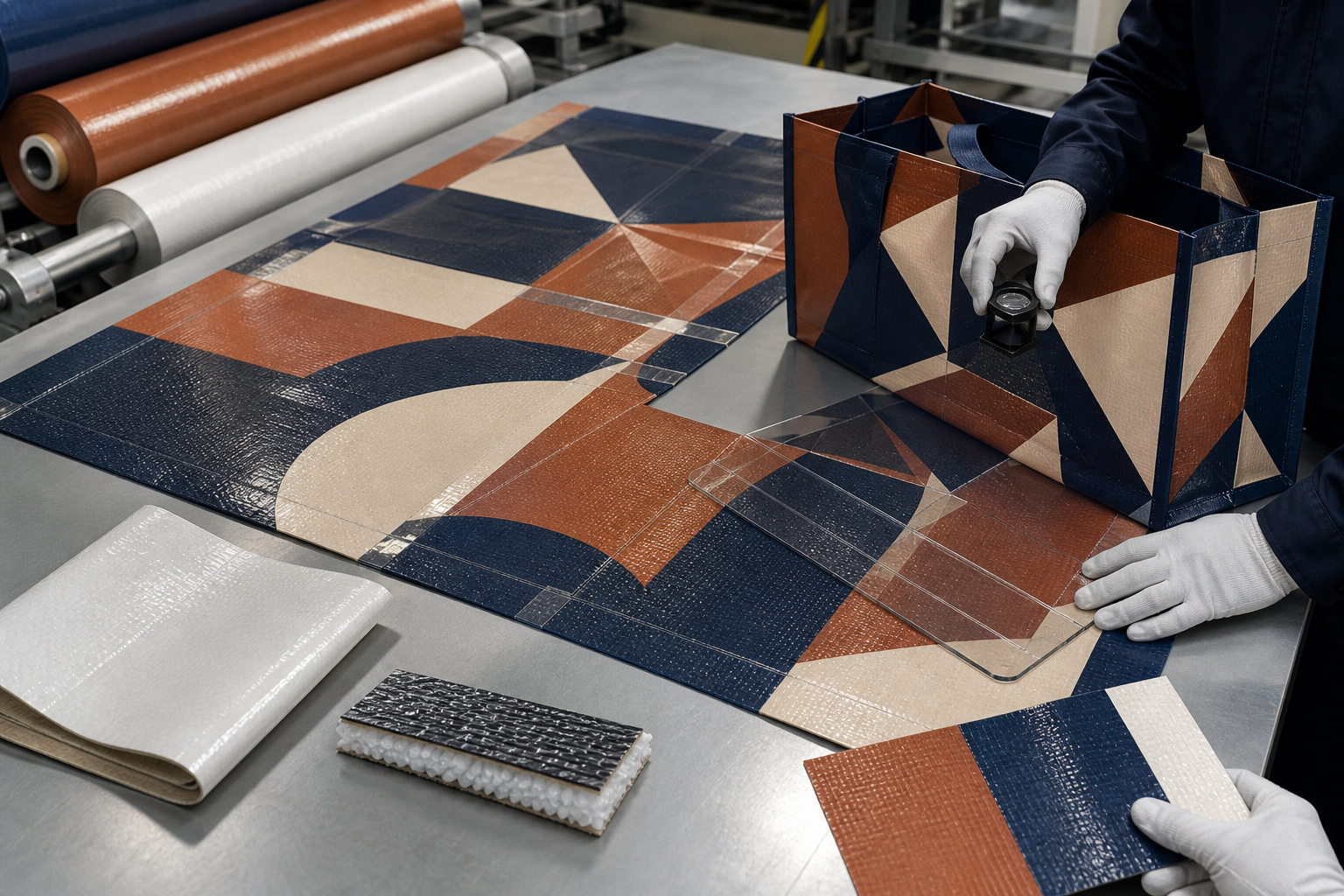
A continuous graphic should be approved on both the flat print layout and the opened converted gusset; the two views answer different questions.
| Artwork control | What to place in the pack | Conversion risk | Approval evidence |
|---|---|---|---|
| Print boundary/bleed | Printable area, bleed, safe area and no-print zones from factory dieline | Cut, fold, glue, seam or binding removes/marks graphics | Prepress proof on final geometry |
| Placement datum | Logo center/edges measured from stable cut/fold references | “Centered” changes when a gusset opens | Measured converted sample |
| Wrap/gusset meet | Front-to-side-to-back transition and accepted break/overlap logic | Film/panel stretch and assembly registration create mismatch | Flat film plus opened-gusset sample |
| Color standard | Physical target, substrate, process, finish, lighting and decision rule | Screen appearance changes after ink absorption or lamination | Signed physical strike-off/press reference |
| Barcode/2D code | Data owner, symbol, size, quiet zone, color, position and verification need | Folds, graphics, edges and gloss can impair scanning | Scannable converted sample and controlled data |
| Colorway/SKU matrix | Body, handle, artwork and store/market mapping by unique code | Right artwork printed or packed with wrong variant | Approved matrix and carton-label reconciliation |
If a retail barcode is required, follow the applicable GS1 specification for that symbol, data and scanning environment. GS1 barcode implementation guidance addresses size, contrast, quiet zones, placement and verification. The Tech Pack should identify the data owner, symbol, scan environment, placement and verification responsibility rather than inventing a code inside the artwork file.
8. Define quality as methods and defect decisions
“Good quality” cannot guide an inspector. Define the reference, method and decision. For dimensions, name the POM and conditioning. For load, name the filler, mass, distribution, lift/cycle or duration and failure rule. For print, name color/placement reference, lighting and adhesion/rub method as appropriate. For packing, name fold, count and carton evidence.
ISO 2859-1:2026, published as the third edition in January 2026, provides AQL-indexed lot-by-lot sampling schemes for inspection by attributes. It does not define the bag's defects, test methods, tolerances or commercial acceptance terms. The Tech Pack or purchase quality agreement must still classify critical, major and minor defects and state methods, limits and rejection/corrective-action rules.
9. Treat packing and store allocation as product specifications
A rope handle can emboss a laminated paper panel; jute can transfer lint; clear film can scratch; thick seams can increase folded cube. Specify the fold diagram, handle position, interleaving or protection, units per bundle/carton and acceptable compression. Require the packed-carton dimensions and gross weight to come from a physical trial.
Separate product SKU from destination allocation. Identical bags sent to 50 stores remain one production SKU but require controlled carton labels and quantities. If body color, size, handle or artwork changes, create a distinct SKU and map it to the correct inner/master label.
| Release checkpoint | Tech-pack instruction | Required evidence | Owner |
|---|---|---|---|
| Quotation | Route, size, BOM, artwork coverage, quantity matrix, packing and trade basis | Cost assumptions and open-point list | Buyer + supplier costing |
| Sample request | Revision, intended/substitute inputs and decisions to close | Identified dummy/strike-off/prototype | Development team |
| Production reference | Frozen POM, BOM, artwork, function and packing | Signed sample plus controlled data pack | Buyer + factory production |
| Bulk first-off | Remaining sample-to-bulk differences and process checks | Approved first sheet/panel/film and assembled bag | Factory production/quality |
| Final inspection | Sampling, defects, measurements, function, assortment and packing | Inspection report tied to lot/SKUs | Named quality party |
| Shipment handover | Carton map, labels, dimensions, weights and document requirements | Packing list and released carton identity | Logistics/receiving |
10. Connect the tech pack to sampling and bulk
The tech pack is not completed once and filed away. During development, every approved change should update its source page. The related Custom Shopping Bag Sample Development Process shows how dimension dummies, material/handle kits, print proofs, checkout trials and production-reference samples close different decisions.
Before bulk, reconcile four items: signed sample, pack revision, supplier BOM/material orders and production work instructions. If they disagree, stop and resolve the source. After bulk, retain the inspection, packing and shipment records with the same style/revision for repeat-order comparison.
Company-claim boundary: LUCKYSTAR statements in this section are publisher self-description, not third-party verification, engineering sign-off or proof that one manufacturing route is available for every inquiry. Confirm the contracting entity, assigned production site, subcontracting, material and process route, drawings, sample evidence, quality scope, price, MOQ, packing and schedule for each order.
How LUCKYSTAR describes its shopping bag Tech Pack review
The public custom shopping bag collection presents paper, reusable PP, jute, mesh, canvas and transparent directions that buyers can use to frame a route-specific Tech Pack. LUCKYSTAR states that its project team can discuss retail use, dimensions, route, POM, BOM, construction, artwork, quality, packing and revision controls, subject to specification and written confirmation.
- Route decision: align the drawing set with paper converting, PP bonding/lamination, cut-and-sew or clear-film joining.
- Costing inputs: expose dimensions, finishes and SKU splits that affect material yield and setup.
- Sample linkage: convert prototype results into controlled POM, BOM and artwork revisions.
- Retail-use brief: retain product fit, checkout opening, carrying and storage criteria.
- Bulk handoff: connect the approved reference to first-off, inspection and pack-out evidence.
- Campaign coordination: connect the bag brief to the stated Product Range where relevant.
Send the minimum Tech Pack inputs for a project-specific review: product basket, reference dimensions, route/material, handles, artwork, quantity per SKU, quality scope, packing, destination and required date.
Frequently asked questions
Do I need a complete tech pack before contacting a manufacturer?
No. A clear retail brief, dimensions or reference, material direction, artwork, quantity split and destination are enough for an initial feasibility review. Mark unknowns. The supplier can help finalize route-specific dielines and production details, but the approved revision must eventually capture them.
How many pages should a shopping bag tech pack contain?
As many as needed to remove risky interpretation—often roughly 8–20 for a focused style, plus artwork and allocation attachments. A complex full-print multi-SKU program may require more. Page count matters less than revision control and usable detail.
Can I use a photo or existing shopping bag as the specification?
Use it as a reference, not the complete instruction. Measure the desired outcome, identify which features to copy or change, and create route-specific drawings, BOM, artwork, tests and packing. Photos hide material grade, reinforcements, glue/seams and tolerances.
Should paper and reusable shopping bags use the same template?
They can share document control and retail-use sections, but the technical pages must differ. Paper needs converting folds/glue/handle patches; bonded PP needs bond geometry; laminated PP needs film maps; jute/canvas needs patterns and seams; clear film needs joining and protection.
Who should create the final dieline?
The buyer supplies design intent and required finished geometry. The assigned manufacturer or converter should normally issue or validate the production dieline for its equipment. The buyer then approves the geometry before final artwork is released.
How should tolerances be selected?
Choose them by function, route and process capability. Tighten dimensions that control product fit, handles or artwork only where necessary. Agree the measurement method during sampling; a tolerance without a datum and conditioning method is ambiguous.
Is an approved sample enough for bulk production?
No. The sample shows the accepted physical outcome. Bulk teams also need POM/tolerances, BOM, artwork/color reference, construction, test methods, SKU allocation and packing. Reconcile the sample and written pack before release.
What files should accompany the tech pack?
Include editable and reviewable drawings, print-ready vector artwork, color references, SKU matrix, sample/revision log, test requirements and packing/label files. Use controlled filenames and list every attachment on the cover or document register.
Build a specification that works at checkout and on the line
A useful Shopping Bag Specification Sheet is not a decorative design deck. It translates the retail job into route-specific geometry, components, converted artwork, functional methods and packing. The final test is simple: can a costing engineer, sample maker, line supervisor and inspector reach the same product without guessing?
Review the custom shopping bags product page, use the shopping bag manufacturer selection guide and connect the file to the wider Custom Bag Manufacturer Guide. When your starting brief is ready, request a LUCKYSTAR tech-pack review.

Send a quote-ready shopping bag Tech Pack brief
You can start before every page is complete. State the retail use, dimensions, route, materials, handles, artwork, SKU matrix, sample status, quality scope, packing, destination and required date; mark every unresolved field as an open decision.
Review LUCKYSTAR custom shopping bag options, then send your project details through the contact form or Email a project brief. The email link opens a draft for your review before sending.
Factory and subcontracting, materials, process route, drawings, tolerances, claims, samples, testing, inspection, price, MOQ, packing, schedule and delivery terms are subject to due diligence, specification and written confirmation.