Woven PP vs Non-Woven PP Shopping Bags: Which Is More Sustainable?
Last reviewed: September 15, 2026
Buyer quick answer: neither woven polypropylene nor non-woven polypropylene is automatically the more sustainable shopping-bag choice. The answer changes with the finished bag mass, material and conversion route, print or laminate stack, packaging and freight, durability, number of completed carrying uses, cleaning, failure rate, and the real recovery route in the destination market. A lighter non-woven bag can be efficient for a controlled campaign if it completes the required service. A heavier woven PP bag can perform better per completed carry when its added material enables substantially more real reuse. Either proposition can fail if the bag is overbuilt, rarely reused, difficult to recover, or supported by weak data.
This guide shows brand and sourcing teams how to compare two finished bag systems on equal service, rather than choosing a winner from a material label. For the underlying construction, printing, seam, MOQ and quality differences, first read Woven PP vs Non-Woven PP Shopping Bags. This page deliberately does not repeat that product-selection guide. It owns the narrower question: what evidence is needed before one route can be called environmentally preferable?
LUCKYSTAR can use the same retail brief to develop and compare order-specific custom shopping bag routes. Final material, recycled content, claims, minimums, pricing, timing and test scope remain subject to the confirmed specification, assigned production route, order and destination market.
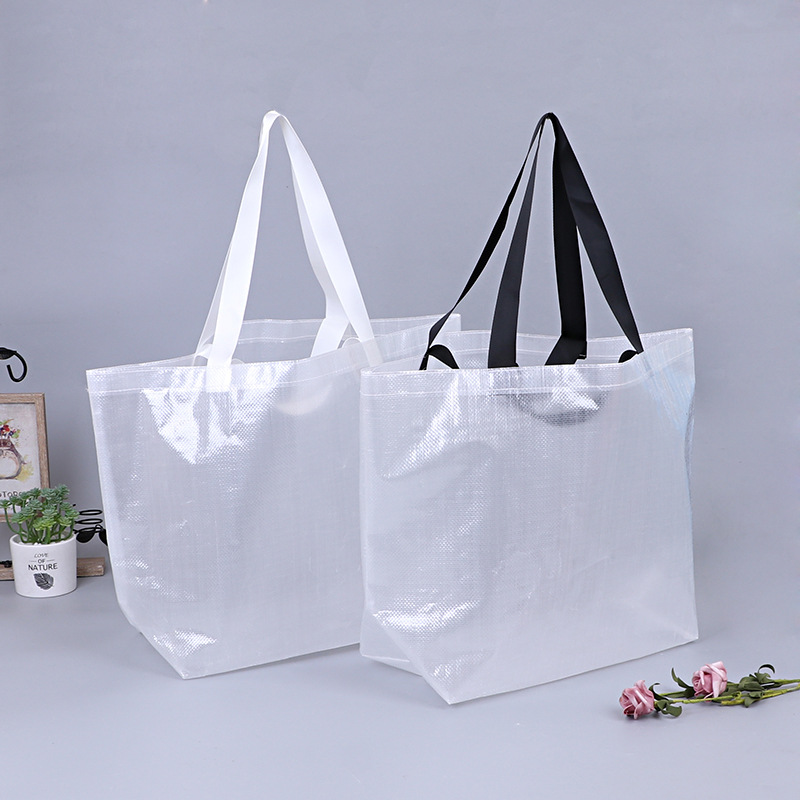
A PP woven shopping-bag reference shown on a LUCKYSTAR public international sales channel. The visible weave, bag shape and handle options provide real product context; the photograph alone does not prove resin origin, finished mass, recycled content, service life, test performance or environmental superiority.
Need a woven-versus-non-woven PP RFQ comparison? Send the common carrying task, dimensions and payload, component construction and finished weight for each route, target reuse scenario, artwork and lamination, packing and freight assumptions, quantity, destination, evidence requirements and required date. LUCKYSTAR can return missing comparison fields, sample checkpoints and commercial questions for written review.
Sustainability starts with a fair comparison
Comparing one bag per one bag is usually unfair. A small promotional non-woven carrier and a laminated woven grocery shopper may have different baskets, loads and expected lives. Comparing one kilogram of material is also insufficient because a shopper buys a carrying service, not a kilogram of PP.
The ISO 14040 life-cycle assessment framework starts with goal and scope, inventory, impact assessment and interpretation. ISO 14044 provides the related requirements and guidelines. Those principles point to a disciplined sequence: define the decision, compare the same function, gather route-specific inputs, test the sensitivity of important assumptions and report limitations.
The UN Environment Programme review of single-use plastic bags and alternatives reached a similarly important conclusion from multiple life-cycle studies: alternatives do not outperform in every impact category, and outcomes depend on the full life cycle. That does not identify a universal winner for the two PP constructions. It explains why a buyer needs a transparent model.
For the broader framework behind functional units, life-cycle stages and decision boundaries, use Shopping Bag Sustainability: A Life-Cycle Decision Guide for Brands.
Use one functional unit for both proposals
A functional unit is the reference service against which inputs and results are normalized. For a retail bag program, a useful formulation is:
Deliver the defined shopping basket from checkout to destination, intact and safely carried, over the program's stated service period.
The accompanying reference flow then states how many bags, replacements, cleaning events and transport units are needed to provide that service. This keeps a large woven shopper from receiving credit for capacity the program never uses, and keeps a light non-woven bag from looking efficient if it needs frequent replacement.
Define at least the basket contents, normal and upper load, volume, carry distance, hand or shoulder mode, checkout environment, expected distribution model, geography and evaluation period. If the two proposals do not serve the same basket, report them as different products rather than forcing a false comparison.
| Comparison field | Woven PP route: question to answer | Non-woven PP route: question to answer | Fair-comparison evidence |
|---|---|---|---|
| Carrying function | Does the structure add useful load, shape or service life for this basket? | Does the lighter or softer format complete the same carrying job? | One reference basket and the same pass/fail definition |
| Finished material | What are the woven substrate, coating/film, binding, handles and reinforcement masses? | What are the bonded web, laminate if any, handles, seams and reinforcement masses? | Component bill of materials plus finished-bag mass distribution |
| Reuse | How many qualifying carries are designed, tested and actually achieved? | How many qualifying carries are designed, tested and actually achieved? | Separate design target, test result and observed-use records |
| Freight | What flat dimensions, carton count, gross weight and container utilization apply? | Does lower stiffness or bulk improve pack density without causing damage? | Approved pack-out and shipment-level cube/weight data |
| End of life | Can the complete layer-and-component stack enter an identified PP recovery route? | Can the complete bonded web and attachments enter an identified route? | Current market/operator acceptance and disposal instructions |
| Claim | Which narrow comparative statement follows from the measured boundary? | Which narrow comparative statement follows from the measured boundary? | Reviewed calculation, assumptions, limitations and approval owner |
Same polymer family does not mean the same inventory
Both routes may be described as polypropylene, but that shared family name hides different material architecture and process steps. Woven PP generally starts with film converted into tapes, oriented and interlaced. A retail shopper may then add coating, printed film, lamination, binding, webbing handles, stitching and reinforcement. Common non-woven PP shopping-bag stock is formed as filaments laid into a web and bonded; the finished product may be direct printed, laminated, ultrasonically joined or sewn.
The environmental comparison therefore needs the actual production route and bill of materials, not a generic database label applied to both. Do not use the photo, hand feel or supplier product name to fill data gaps. Ask for the order specification and identify which values are measured, supplier-specific, secondary-data estimates or unresolved.
Build the inventory from the finished bag backwards
Start by weighing the complete approved sample, then reconcile that mass to components. GSM is useful for material control, but it is not finished-bag mass. Panel area, gussets, overlaps, trims, seam allowances, handles and reinforcement determine how much material leaves the line in one saleable unit. The guide to shopping bag material weight and environmental performance explains why GSM alone cannot support an impact claim.
Record material yield as well as net product mass. Offcuts, print setup, edge trimming and rejected components may differ by route and layout. State whether scrap is internally reused, sold to a recycler, downcycled, recovered for energy or discarded. A generic statement such as “ production waste is recycled” is not a numeric allocation rule.
| Inventory block | Minimum order-specific fields | Why the field can change the result | Evidence status to record |
|---|---|---|---|
| Body and components | Polymer/material identity, source, mass, dimensions, coating/film, handles, binding, thread, reinforcement, labels | Added layers and attachments change production input, durability, packed bulk and recovery compatibility | Measured / supplier document / secondary estimate / unknown |
| Conversion | Tape or web formation route, bonding, weaving, coating, lamination, printing, cutting, sewing or ultrasonic joining | Different routes use different energy, heat, setup and yield | Assigned-site process map and period-matched data |
| Waste and quality loss | Setup loss, cutting yield, rejects, rework and treatment route | Net bag mass can understate the material needed for a conforming unit | Production record with a stated allocation method |
| Distribution | Primary pack, cartons, units per carton, gross weight, dimensions, origin, destination and freight mode | A light but bulky bag can move more air; a dense pack can still be heavy | Approved pack specification and route assumption |
| Use | Issued bags, qualifying carries, loss, premature failure, replacement and cleaning | Potential durability has value only when it becomes completed service | Test record plus pilot or field measurement |
| End of life | Collection access, accepted item form, component separation, sorting, reprocessing and residual route | “ PP” does not prove that a finished bag is accepted or recovered | Market- and date-specific operator or authority evidence |
Do not award a reuse benefit before it happens
The most sensitive variable is often the denominator: how many valid carries the bag actually completes. Keep three figures separate.
Design target
This is the service life intended by the brief. It guides reinforcement, seam, handle, print and care decisions. It is not evidence of performance or behavior.
Qualification result
This is the number of cycles or events survived under an agreed protocol. It answers whether controlled samples met the defined acceptance criteria. It does not establish how frequently consumers will remember, retain or reuse the bag.
Achieved reuse
This is observed service from a pilot, customer study, deposit/return system or another defensible measurement. Define what counts as a qualifying carry, how loss and damaged units are handled, the observation period and the uncertainty. Read Reusable Shopping Bag Durability and Reuse Testing for a repeatable-cycle method, and use Which Tests Should Reusable Shopping Bags Pass? to select construction-specific tests.
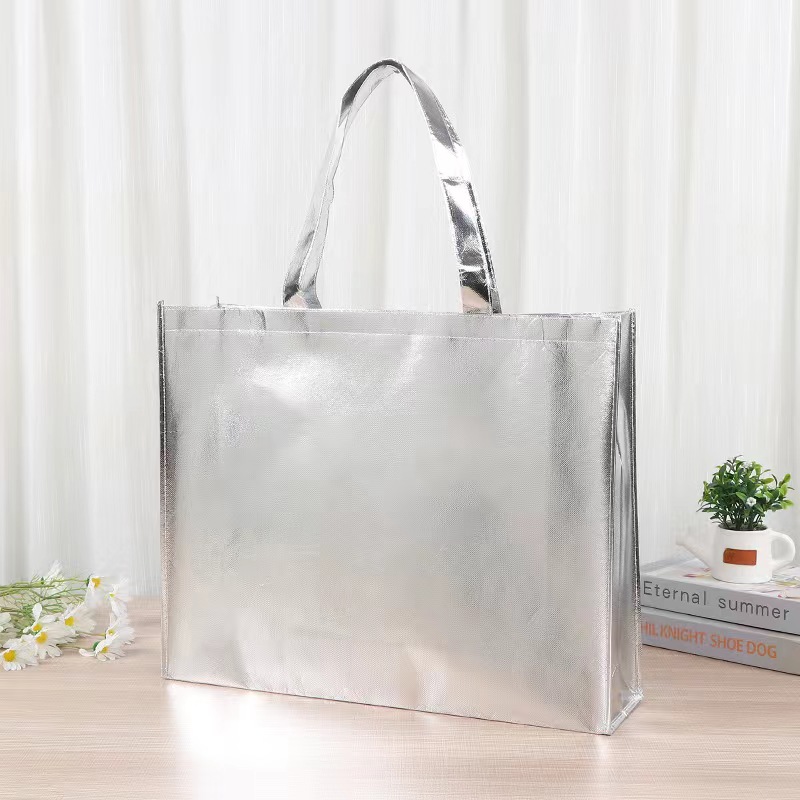
A laminated non-woven shopping-bag example from a LUCKYSTAR public Alibaba channel. Its reflective surface makes the added finish visible, but the image does not establish the base-web mass, film chemistry, bond, durability, recyclability or impact.
Compare results per completed carry
A practical screening equation is:
Result per completed carry = (production + decoration + packaging + outbound freight + cleaning + replacements + end-of-life terms) ÷ qualifying completed carries
Use the equation for each impact category, not only greenhouse-gas emissions. Energy, water, resource use, waste and other categories can respond differently. Avoid subtracting an assumed recycling credit unless the method, collection scenario and allocation rule are explicit.
The equation also shows why “ heavier is always worse” and “ more durable is always better” are both incomplete. Added mass increases the numerator. If it delivers enough additional completed service, it can reduce the result per carry. If users treat it as a one-off promotional item, the extra material remains without the expected denominator.
Find the break-even point, then test whether it is credible
If a study compares one specific woven design with one specific non-woven design, its break-even reuse point can be expressed without inventing a universal number. Let the allocated life-cycle burden before use be W for the woven bag and N for the non-woven bag. Let uW and uN be the qualifying carries, including replacements where relevant. Add cleaning or return burdens only when they belong to the studied system.
The routes are equal for a category when W ÷ uW = N ÷ uN after all boundary terms are aligned. Solve for the unknown reuse value, then ask whether the result fits the test data and observed customer behavior. A mathematical break-even that depends on perfect retention, no loss and more uses than the bag survives is not a credible business case.
Publish the assumptions next to any break-even statement. Never lift a reuse number from an unrelated country, bag weight, electricity mix, freight route or consumer study and present it as LUCKYSTAR product performance.
Material weight and reinforcement need optimization, not minimization
The sustainable design task is to find the lowest material system that reliably completes the intended service, not simply the lowest GSM. Extra material can be valuable at a tear-prone handle attachment or base corner while adding little value across an unstressed panel. Conversely, a thick body cannot compensate for a weak seam or poorly distributed handle load.
Prototype targeted options: a lighter body with localized reinforcement, a heavier body without unnecessary laminate, alternative handle widths, revised gusset proportions or a lower-area print. Validate changes on converted bags carrying the reference basket. The Shopping Bag Handle Guide helps connect attachment design to real carrying performance.
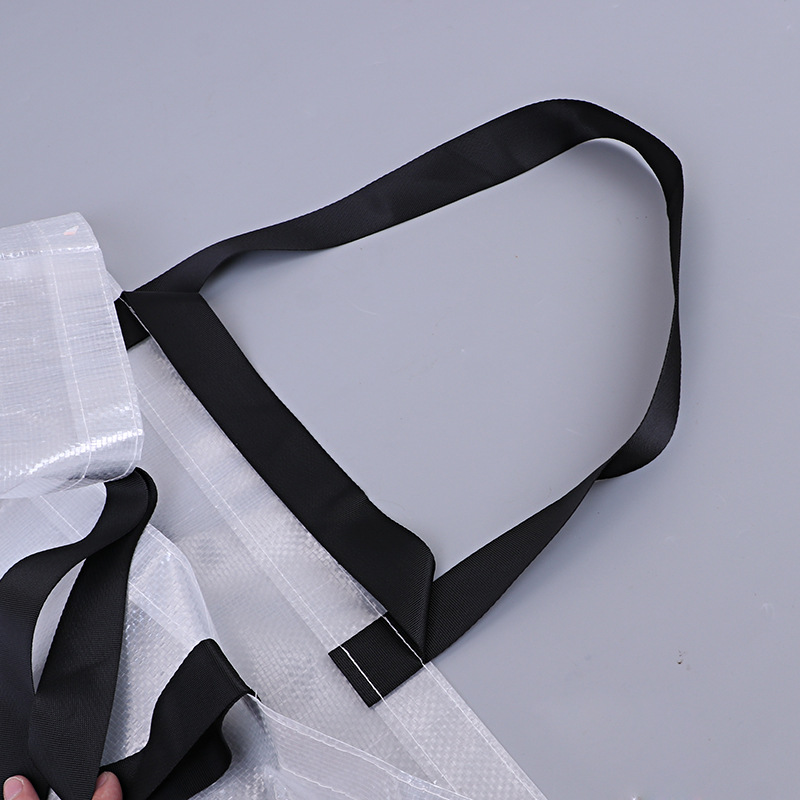
A close product view from a LUCKYSTAR public international sales channel shows how handles, attachment zones and body material form one system. Visual inspection can identify construction questions; performance still requires a specified finished-bag test.
Lamination can change several stages at once
Lamination is not a sustainability grade. It can support graphics, stiffness, wipe behavior or surface protection, but it adds material and processing, may change folding cube, and can affect recovery compatibility. Compare a laminated woven bag with an unlaminated non-woven bag only when those finishes are genuinely needed for the same brand and service brief.
Identify the base substrate, film or coating, tie/adhesive system, print position, side coverage and component masses. Then test whether the finish extends useful service in the real scenario. The laminated vs unlaminated non-woven shopping bag guide covers surface architecture and approval risks. For woven graphics, use Printing Methods for Woven PP Shopping Bags rather than assuming every full-color route has the same layer stack.
Printing belongs inside the system boundary
Logo method, ink coverage, treatment, curing and rejected print all belong in the product comparison. A small direct mark is not equivalent to full-coverage reverse-printed film. Large graphics may also encourage retention and brand use, but that behavioral benefit must be observed rather than assumed.
Freeze the artwork and colorway matrix when comparing quotes. Otherwise one route may be modeled with a stock body and one spot color while the other carries custom color, six artworks and full coverage. Use the Shopping Bag Printing Quality Control Checklist to keep print evidence connected to the approved substrate and bulk controls.
Packing density can reverse a simple weight comparison
Finished weight is only one logistics variable. Measure folded dimensions, nesting, compression limits, units per inner pack, carton count, gross weight and carton cube. A soft non-woven bag may pack efficiently; a structured laminated woven bag may occupy more volume. Yet a poorly planned soft bag can arrive creased or blocked, creating rejects, repacking and extra transport.
Model the actual freight lane and mode. Avoid multiplying a generic “ per kilogram” factor when the shipment is constrained by volume. For multi-market programs, keep origin-to-distribution-center transport separate from domestic allocation so the model can be updated without rebuilding every stage.
Cleaning and maintenance can add burden or preserve service
Do not assume that a bag is washed after every use or never washed. Describe the communicated care method and build low, base and high cleaning scenarios. A wipe, hand wash and machine wash are different events. Cleaning can add water, energy and detergent, but it may also keep the bag acceptable and in service longer.
Validate the care instruction on the finished construction. Check shrinkage or distortion, laminate bond, print rub, seam behavior and handle integrity. If no method has been validated, communicate conservative care rather than using “ washable” as a generic benefit.
End of life depends on the complete bag and local system
A resin family does not prove that the finished shopping bag will be collected, sorted and reprocessed. Handles, thread, film, adhesives, labels, printing and contamination can affect the route. Ask whether the facility accepts flexible PP bags in the product form and size being sold, whether components must be removed, and whether collection is accessible to the intended customers.
Current ISO 14021:2026 guidance for self-declared environmental claims connects a recyclable claim with available processes and programs that collect, process and return material to use. The broader buyer lesson is simple: “ technically recyclable” is not a substitute for market-specific recovery evidence. The article Recyclable vs Reusable Shopping Bags: What Brands Should Know develops this distinction in detail.
Recycled content is a separate claim
A woven or non-woven bag can contain virgin resin, recycled material or a documented combination. Recycled content may change the upstream inventory, but it does not automatically prove lower impact, durability, recyclability or certification.Record the percentage basis, pre-consumer/post-consumer definition where relevant, product/component scope, calculation method, chain-of-custody evidence and batch/order connection.
Do not state or imply that all LUCKYSTAR PP bags are certified or contain recycled resin. Certification and recycled-content evidence must be verified for the named product and supply chain. For RPET— not PP— use the separate GRS-certified RPET shopping bag verification guide. It illustrates why certificate holder, scope, validity and transaction-level evidence cannot be replaced by a logo.
Run sensitivity analysis before choosing a winner
A result is decision-useful only if the conclusion survives plausible changes in the assumptions. ISO/TS 14074:2022 provides examples of interpretation practices including sensitivity, completeness, consistency and uncertainty checks. Apply that logic to the variables the buying team can influence.
| Variable to test | Low-case question | Base-case question | High-case question | What a reversal means |
|---|---|---|---|---|
| Achieved reuse | What if many recipients use the bag once or lose it? | What does the pilot or closest measured program support? | What if retention and repeat use reach the defensible upper bound? | The selection depends on behavior; improve the reuse system before making a broad claim |
| Finished mass and yield | What if optimization removes unused panel mass? | What do approved sample weights and cutting records show? | What if reinforcement, coating or reject rate rises in bulk? | Control the bill of materials and yield at production level |
| Durability and replacement | What if the lower-mass design meets all cycles? | What failure pattern appears in qualification? | What if attachments fail early in the field? | Target failure points rather than treating route name as durability evidence |
| Freight | What if dense sea shipment is achieved? | What are the approved carton and route? | What if air freight or low carton utilization is required? | Schedule and pack engineering may matter more than a small material difference |
| Cleaning | What if no cleaning is needed? | What care behavior is supported? | What if frequent washing is necessary? | Publish a conditional result and improve care instructions |
| Recovery | What if no suitable collection exists? | What does the target-market route accept now? | What if a managed take-back system is implemented? | A recyclabilityconclusion must be market- and system-specific |
If the preferred route changes across reasonable scenarios, do not publish a categorical “ more sustainable” claim. State the conditions under which each route performs better and identify which missing measurement would reduce uncertainty most.
Match the route to the program, not the adjective
A controlled short campaign
A right-sized non-woven PP bag may be a practical starting point when the basket is light, distribution is time-limited, pack density matters and the bag can reliably complete the intended service. The sustainability work is to avoid oversizing, protect attachment performance, prevent print rejects and be honest about likely reuse.
A repeat grocery or membership program
A woven PP construction may justify additional material when the program is designed for repeated heavy baskets, the handles and base are qualified, customers actually bring the bag back, and replacement is low. The business should support reuse with visible care instructions, storage convenience, incentives or membership behavior— not rely on thickness alone.
A brand-led laminated program
Either substrate can receive added surface layers. Choose the build that satisfies the visual and service brief with the fewest necessary materials and process steps, then verify the resulting durability, pack-out and end-of-life route. A finish selected only because it “ looks eco” is not a sustainability strategy.
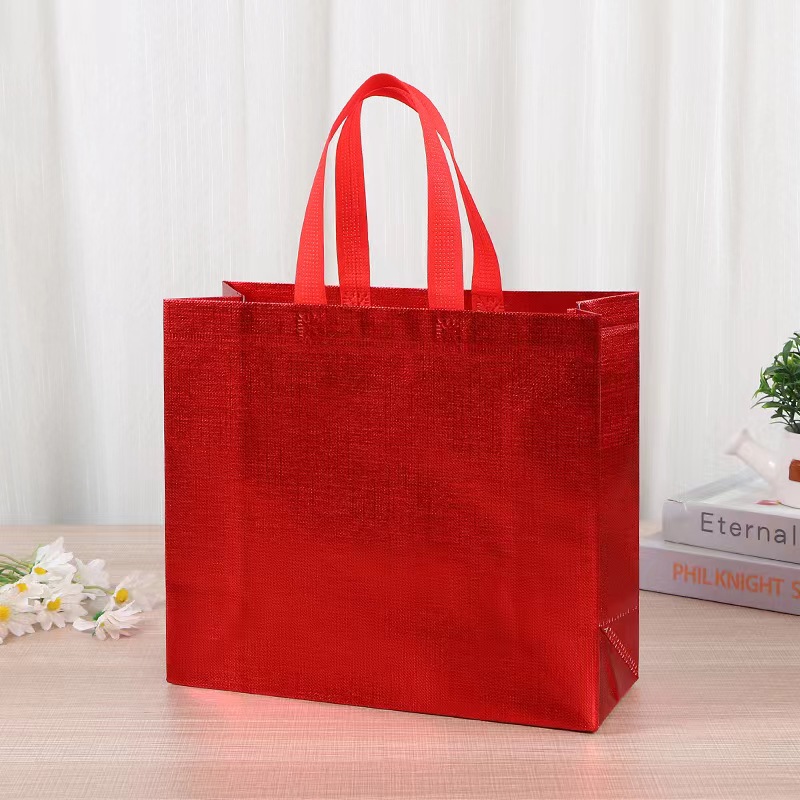
A red laminated non-woven shopping-bag reference from a LUCKYSTAR public Alibaba channel. It shows a real gusseted format and reflective finish; it does not prove environmental performance or suitability for a particular market.
Turn the comparison into a defensible claim
Comparative environmental claims create more risk than descriptive product statements because they can imply a measured advantage across the whole life cycle. Define the compared SKUs, impact category, functional unit, geographic and time boundary, data sources, allocation, reuse scenarios, uncertainty and limitations. For public comparative assertions, obtain appropriate legal/technical review and consider whether the chosen LCA standard and market require independent review.
Avoid these shortcuts:
- “ Woven PP is greener because it is stronger.” Strength potential is not achieved service or a life-cycle result.
- “ Non-woven PP is greener because it is lighter.” Lower mass can be outweighed by short use, replacement, inefficient conversion or freight.
- “ Both are recyclable because they are PP.” The complete bag and local collection route determine whether the claim is supportable.
- “ Certified eco-friendly PP.” A certificate must be current, relevant, correctly scoped and linked to the claim; “ eco-friendly” remains an overly broad conclusion.
- “ Reusable 100 times” based only on a design target or isolated test. Observed reuse and controlled test survival answer different questions.
Use How to Make Defensible Sustainability Claims for Reusable Shopping Bags to build the substantiation file and approval workflow.
Buyer release gate for a woven-versus-non-woven conclusion
| Gate | Release question | Evidence that should exist | If the answer is no |
|---|---|---|---|
| Comparable function | Do both bags deliver the same basket, load and service period? | Written functional unit and reference flow | Reframe as two different product options; do not rank them |
| Product definition | Are both finished BOMs, masses, yields, print and pack systems frozen? | Approved samples, specifications and route maps | Complete sampling and measure the saleable units |
| Service evidence | Are design target, qualification result and achieved reuse separated? | Test reports plus pilot/field method and data | Publish scenarios only, with clear limitations |
| Life-cycle model | Are boundaries, data quality, allocation and uncertainty documented? | Version-controlled calculation and source register | Do not make a comparative environmental assertion |
| Claim scope | Does the wording name the SKUs, category, market, period and conditions? | Claims matrix with technical and legal approval | Use neutral specification language instead |
| Change control | Will material, factory route, print, pack or market changes trigger review? | Revision rule linked to PO and production records | Treat the conclusion as expired after a relevant change |
Company-claim boundary: the following section is LUCKYSTAR publisher self-description. It does not prove environmental superiority, product footprint, resin origin, recycled content, certification, recyclability, achieved reuse, test performance, or current material/capacity availability for either route. Data, modeling, construction, tests, claims, documentation, MOQ, price, schedule and delivery are subject to the actual order, qualified review, final specification and written confirmation.
Why choose LUCKYSTAR for the comparison
LUCKYSTAR's useful role is not to declare one PP route the universal winner. It is to connect product development with the evidence the buyer needs to make and defend an order-level decision.
- One retail brief, two comparable proposals. We can begin with the same basket, dimensions, load, artwork, destination and distribution plan so the woven and non-woven options are priced and assessed against one job.
- Component-level specification. Body material, surface layer, handles, reinforcement, joining, printing, labels and packing can be separated instead of hidden behind a single GSM or material name.
- Sample-to-bulk controls. A controlled approval path can connect swatches or print proofs to a converted sample, performance checks, pre-production approval and production inspection.
- Order-specific evidence language. Recycled content, certification, performance, recyclability and impact statements are reviewed for the named product and supply chain rather than extended to the whole range.
- Cross-category sourcing context. When PP is not the best fit, LUCKYSTAR's shopping-bag range enables a buyer to compare alternative bag directions without pretending that one material serves every campaign.
Supplier qualification still matters. Use the Custom Bag Manufacturer Guide for the wider sourcing framework and How to Choose a Custom Shopping Bag Manufacturer for shopping-bag-specific process, sampling, quality and evidence questions.
Send an RFQ that makes the sustainability comparison possible
Send LUCKYSTAR the intended products, normal and upper basket weight, dimensions, carry method, target uses, distribution model, destination markets, artwork, decoration coverage, quantity by SKU, packing, freight plan and required arrival date. State which environmental claim— if any— is being considered and what evidence the brand's review process requires.
Ask for each route to identify:
- finished bag and component masses;
- base substrate, surface layers, handles, reinforcement and joining;
- recycled-content basis and evidence, if requested;
- sample, performance and quality plan;
- finished folding, carton quantity, gross weight and dimensions;
- production waste/yield information available for the study;
- process and facility data that can be supplied or must use secondary sources;
- exclusions, unresolved fields and quote validity.
Prepare one controlled specification using How to Prepare a Custom Shopping Bag Tech Pack. Commercial conditions are subject to the final specification and written confirmation.
Frequently asked questions
Is woven PP always more sustainable because it lasts longer?
No. It may offer a higher durability ceiling, but a valid comparison needs the actual finished mass, construction, test result and achieved reuse. Added material only improves the per-service result when it produces enough additional completed carrying service within the defined boundary.
Is non-woven PP always lower impact because it is lighter?
No. Lower mass can reduce material and freight inputs, but the result also depends on yield, decoration, failure, replacement, use and recovery. Compare complete bags performing the same job.
How many times must a woven PP bag be reused to beat a non-woven bag?
There is no universal number. Calculate the break-even point from the two specified bags, impact category, supply routes, cleaning assumptions and end-of-life scenarios. Then check whether qualification and observed-use evidence make that number credible.
Can GSM determine which PP bag is more sustainable?
No. GSM is mass per unit area of a material. Finished dimensions, gussets, overlaps, trims, handles, laminate and reinforcement determine finished mass, while useful service and recovery determine how that mass performs in the system.
Does lamination automatically make either route less sustainable?
Not automatically. Lamination adds material and processing and can affect pack cube and recovery, but it may also protect graphics or extend useful service. Model the actual layer stack and test whether the benefit occurs in the intended program.
Are woven and non-woven PP bags recyclable together?
Do not assume so. The complete constructions, components, local collection channel, sorting capability and reprocessor rules matter. Verify the item form and market, then write disposal instructions and claims to that evidence.
Does recycled PP make one route the winner?
Recycled content changes one part of the inventory. It does not prove durability, recyclability, lower impact across every category or certification. Verify percentage, basis, scope and chain-of-custody evidence for the order, then include it in the same-service comparison.
What is the most important data to collect first?
Start with the functional unit, finished-bag mass/BOM and achieved reuse scenario. Those fields often determine whether the comparison is meaningful. Add production, freight, cleaning and end-of-life data with a transparent quality status.
Can LUCKYSTAR provide a universal LCA result for all woven and non-woven bags?
No universal result would be defensible. LUCKYSTAR can help define comparable order-specific constructions, samples, measurements and supplier records. A formal comparative LCA or public assertion may require a qualified practitioner, appropriate methodology, market review and independent review depending on its use.
Final recommendation
Choose the route that provides the required carrying service with the best supported result— not the material name with the greener reputation. Normalize the basket, measure the complete products, separate potential durability from achieved reuse, include decoration and freight, verify the real end-of-life route and test the conclusion against plausible scenarios.
If the result stays stable, communicate the exact boundary and conditions. If it changes when reuse or freight assumptions move slightly, treat the comparison as a design question: reduce unnecessary mass, strengthen the real failure point, improve packing, and build a reuse system customers will actually use.

GET A QUOTE for an order-specific woven PP and non-woven PP comparison based on your basket, construction, artwork, quantity, destination, evidence requirements and delivery plan.
Request an order-specific PP bag comparison
Use one carrying task and matched market boundary for both proposals so pricing, sampling and environmental questions compare equivalent service.
Review LUCKYSTAR custom shopping bag options, then send your woven and non-woven comparison brief through the contact form or Email a project brief. The email link opens a draft for your review before sending.
Materials, finished weights, process/freight data, tests, achieved reuse, recycling outcomes, certificates, environmental conclusions/claims, availability, price, MOQ, packing, schedule and delivery terms are subject to evidence review, final specification and written confirmation.