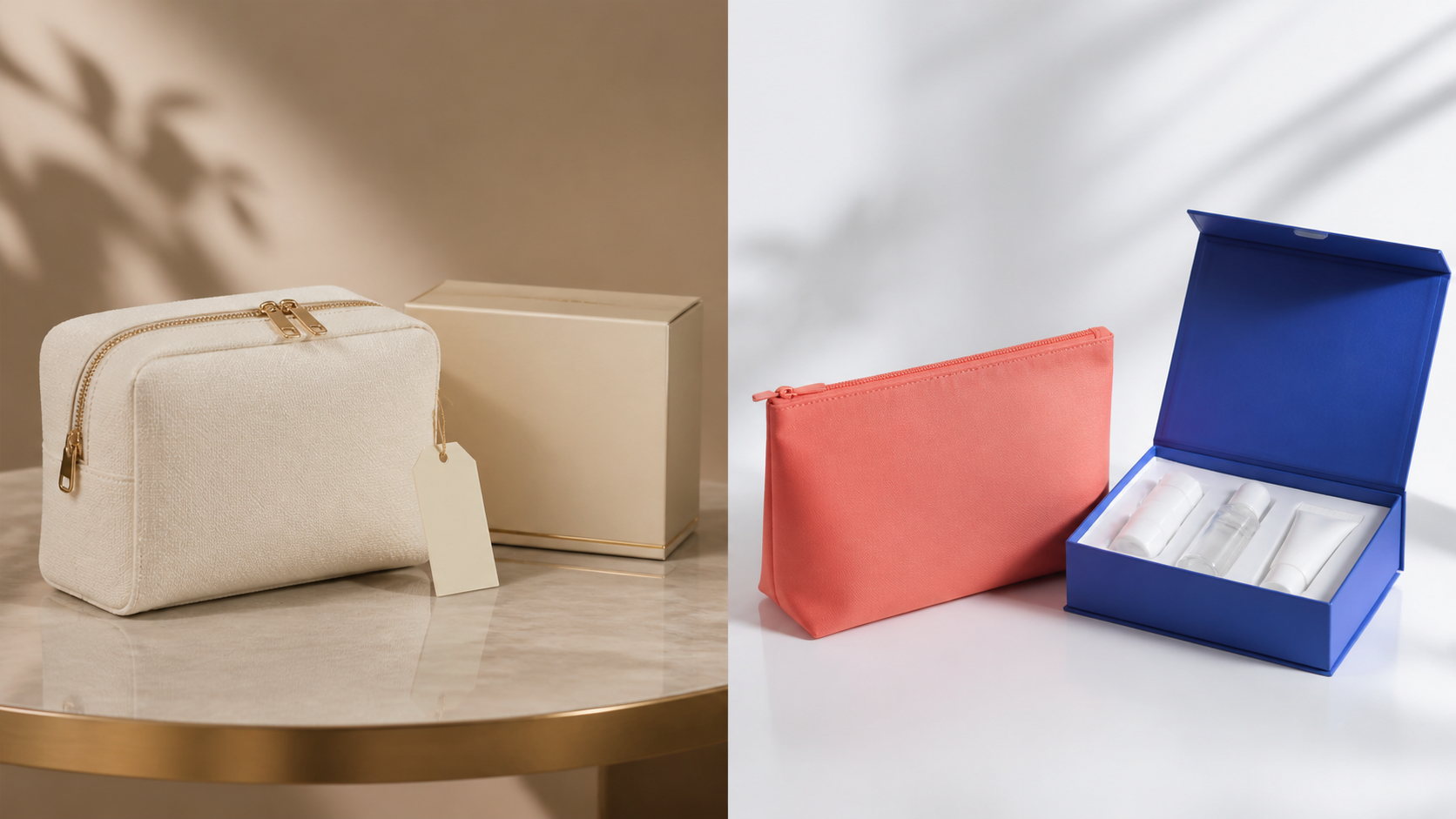
A retail cosmetic bag and a promotional cosmetic bag can share the same zipper, material and factory, yet they are not the same product brief. One must earn a purchase. The other supports a campaign, gift, bundle or brand interaction. That difference changes how buyers should define value, features, packaging, cost, timing and quality evidence.
Planning an order? Start by identifying the retail or promotional route. Include the audience and channel, intended contents, bag format, materials and features, branding and pack-out, quantity by SKU or market, destination and required date.
The common mistake is to assume “retail” always means premium and “promotional” always means cheap. Some entry-price retail pouches are intentionally simple. Some promotional bags are the hero of a luxury gift-with-purchase program. The correct specification follows the commercial job and customer promise, not the label alone.
This guide compares retail cosmetic bags and promotional cosmetic bags from a sourcing and product-development perspective. Explore LUCKYSTAR’s custom cosmetic bag options, evaluate production partners with How to Choose a Cosmetic Bag Manufacturer, and place the project within our broader custom bag sourcing framework.
Quick answer: retail product or promotional program?
Choose a retail brief when the customer selects and pays for the bag as a distinct item or a clearly valued part of a retail set. Choose a promotional brief when distribution depends on a campaign rule—gift with purchase, event giveaway, sampling kit, loyalty reward, subscription inclusion or PR program. If the same design serves both channels, write separate commercial and quality assumptions for each version.
| Decision | Retail cosmetic bag | Promotional cosmetic bag | Buyer implication |
|---|---|---|---|
| Primary job | Generate revenue and satisfy a chosen purchase | Support campaign participation,product trial or brand recall | Write the commercial objective first |
| Consumer decision | Customer compares and selects the item | Recipient qualifies for or receives the item | Different expectation and value cues |
| Financial lens | Margin, sell-through, returns and inventory | Program cost, eligible kits, pack-out and deadline | Do not compare unit cost alone |
| Design priority | Shelf/e-commerce appeal, function and repeat use | Campaign fit, message visibility,scale and distribution | Premium is possible in either channel |
| Packaging | Consumer information, merchandising and protection | Kit assembly, assortment accuracy and shipping efficiency | Develop the real pack-out |
| Quality | Supports price, claims and direct customer expectations | Protects campaign, brand and high-volume consistency | Promotional does not mean uncontrolled |
1. Start with the commercial transaction
Ask who pays, what they believe they are buying and when ownership changes. A standalone beauty accessory has its own price, product detail page and return context. A pouch inside a paid gift set may still function as a retail component because it helps justify the set price. A free pouch triggered by a skincare purchase is promotional even if it looks luxurious.
The transaction also identifies the project owner. Retail bags may be led by merchandising or product teams.Promotional bags may be led by marketing, customer acquisition, trade marketing or key-account teams. Sourcing should align those stakeholders before the first factory request.
| Program format | Likely classification | Critical question |
|---|---|---|
| Standalone bag with SKU and selling price | Retail | Why will a customer choose this over alternatives? |
| Bag as a defined part of a priced beauty set | Retail component | How much value must the bag add to the set? |
| Gift after meeting a purchase threshold | Promotional/GWP | What purchase rule and eligible volume drive quantity? |
| Event or conference giveaway | Promotional | How will units be transported, distributed and carried? |
| Influencer or PR kit | Promotional communication asset | Does the bag improve presentation and content creation? |
| Loyalty redemption with points | Program-specific hybrid | What value and service expectation has been promised? |
2. Measure success differently
Retail performance is usually evaluated through sell-through, gross margin, return reasons, ratings, repeat demand and inventory health. A promotional program is more likely to track the number of correctly packed offers, cost per eligible distribution, on-time delivery, redemption, product trial or campaign-specific engagement. The bag itself should not be credited with a result that the complete campaign created.
Write the success metric before approving features. A retail interior divider may support a higher selling proposition.The same divider may add little to a one-week sampling program.A custom print can be central to campaign visibility but too seasonal for a repeat retail SKU.
| Metric | Retail interpretation | Promotional interpretation |
|---|---|---|
| Unit economics | Landed cost relative to selling price, fees and returns | Complete program cost per correctly distributed offer |
| Demand | Sell-through and reorder by SKU | Eligible volume, redemption or distribution plan |
| Quality signal | Ratings, returns and customer service themes | Kit accuracy,complaints and recipient response |
| Timing | Stock availability and replenishment | Non-negotiable campaign or event window |
| Lifecycle | Seasonal carryover, markdown and repeat line | Campaign end, leftover plan and artwork relevance |
3. Write two different product briefs
A retail brief begins with the target customer, price position, competitive set, use scenario, assortment and channel. A promotional brief begins with campaign audience, offer mechanism, eligible volume, kit contents, distribution points, messaging hierarchy and fixed activation date. Both still need exact dimensions, materials, construction, logo, packing and quality requirements.
Keep the product specification separate from the commercial brief. The factory needs both: one explains why decisions matter; the other controls what must be made. The cosmetic bag tech pack guide shows how to convert the chosen direction into drawings, BOM, tolerances and approvals.
| Brief field | Retail version | Promotional version |
|---|---|---|
| Audience | Named customer segment and price expectation | Campaign audience, qualification and distribution location |
| Contents | Likely personal cosmetics and tools | Exact samples, bundle or event items inserted |
| Channel | Store, e-commerce, marketplace or wholesale | Counter, mailer, event,subscription or PR delivery |
| Quantity logic | Forecast by SKU and replenishment | Eligible units plus pack-out and contingency basis |
| Timing | Launch and reorder calendar | Activation start, event or drop-dead delivery date |
| End-of-life plan | Carryover, markdown or replenishment | Leftover, artwork expiration and redeployment plan |
4. Design for customer choice or recipient acceptance
Retail customers actively judge silhouette, color, material, organization and value against competing products. Every visible detail can influence selection. Promotional recipients may not have chosen the pouch, so immediate usefulness becomes especially important. A bold campaign bag that does not fit anything useful is unlikely to be kept.
For both channels, map the first impression and the second week of use. The retail bag must continue to justify its price after purchase.The promotional bag should remain useful after the samples are removed. Our cosmetic bag collection design process helps turn audience and channel into a coherent product system.
| Experience moment | Retail design question | Promotional design question |
|---|---|---|
| First sight | Does it earn attention at the target price? | Does it communicate the campaign without looking disposable? |
| Opening | Does the interior reinforce quality? | Are samples presented and removed easily? |
| First load | Does organization match promised use? | Can the recipient reuse it for common essentials? |
| Repeated use | Do zipper, shape and lining support reviews and returns expectations? | Will the branding remain welcome after the campaign? |
| Storage/travel | Does it deliver the advertised function? | Is it compact and practical enough to keep? |
5. Size and capacity follow different payloads
A retail bag should accommodate the use stated on the product page without relying on one proprietary beauty set. A promotional bag may be engineered around exact sample bottles, cards or launch products. This precision can reduce waste, but the bag should still have a useful life after the kit is unpacked.
Test the opening as well as the internal volume. Promotional packers need fast insertion and correct assortment; retail users need repeated access. Use the cosmetic bag size and capacity method to define measuring points, usable volume and a loaded-fit test.
| Capacity decision | Retail route | Promotional route | Approve |
|---|---|---|---|
| Payload | Representative customer assortment | Exact campaign contents and quantities | Named list or test blocks |
| Clearance | Comfortable access during ongoing use | Efficient insertion without forcing products | Loaded opening/closing trial |
| Post-campaign use | Core product promise | Secondary reuse value | Common personal-item fit |
| Pack footprint | Shelf, parcel and storage efficiency | Kit, shipper, counter or event carton fit | Real pack-out dimensions |
6. Material and structure should match the promise
Retail construction often needs to communicate value at the selling price: controlled shape, pleasant hand feel, clean lining, balanced hardware and repeat-use durability. Promotional construction may prioritize a clear graphic surface, light shipping weight, efficient production and campaign fit. A prestige GWP can reverse that pattern and use premium material as the promotional message.
Do not choose by channel label. Write the required appearance, function, cleaning behavior and lifespan, then compare systems in the custom cosmetic bag material guide.
| Construction level | Retail use | Promotional use | Risk |
|---|---|---|---|
| Unlined flat pouch | Entry price or minimalist utility | Sampling, events and compact mailers | Interior finish and perceived thinness |
| Lined soft pouch | Versatile everyday accessory | Mid-value GWP and branded kits | Loose lining,zipper capture and stain behavior |
| Structured case | Premium retail and travel organization | Prestige gift, PR or launch hero | Pack volume, creasing and higher assembly complexity |
| Clear or mesh organizer | Visibility-led retail function | Sample presentation and fast assortment check | Seam method, finish and claim accuracy |
7. Zipper, lining and organization are channel signals
A retail customer experiences the closure repeatedly and can compare it with the selling price. A promotional program may use a simpler zipper, but it still needs reliable opening through packing, distribution and reuse. The safe saving is standardization and appropriate specification—not an untested component.
Interior pockets support organization but add material, labor and inspection. Keep them when they contribute to the retail proposition or secure campaign contents. The zipper and hardware guide and lining, construction and cleaning guide provide component-level decisions.
| Feature | Retail decision | Promotional decision |
|---|---|---|
| Zipper platform | Hand feel and repeated-use expectation | Reliable stock platform and campaign color |
| Puller | Can be a signature value cue | Standard puller, branded tab or campaign shape if volume supports it |
| Lining | Supports cleanability,finish and product story | Protects samples and presents the kit cleanly |
| Pockets/dividers | Justify with daily organization | Use only when they secure or display campaign contents |
| Handle/wrist strap | Lifestyle and convenience feature | Event carry or reusable benefit |
8. Branding should work after the sales moment
Retail branding may be restrained because the product’s design and material carry the identity. Promotional branding may need immediate recognition at a counter or event. However, oversized campaign messaging can reduce long-term reuse if recipients do not want to carry it later.
Create a hierarchy: brand mark, campaign message, collaboration detail and any legal or product information. Decide what belongs on the bag, hangtag, sleeve, insert or outer box. Test the logo on the production-intended surface, not a generic swatch.
| Brand element | Retail role | Promotional role | Control |
|---|---|---|---|
| Main logo | Product identity and perceived refinement | Campaign recognition and visibility | Size, position,color and method |
| Seasonal artwork | Creates collection risk if demand is uncertain | Can make a limited campaign distinctive | Artwork expiry and leftover plan |
| Message/copy | Usually belongs on removable packaging | May explain or amplify the offer | Readability and long-term reuse impact |
| Collaboration mark | Supports retail story and scarcity | Supports campaign partnership | Rights, exact artwork and placement |
9. Packaging has a different job in each channel
Retail packaging helps the product travel, display, communicate and scan.Depending on the channel, it may need a barcode, SKU, origin or customer-required information, care guidance, protective insert, tamper approach or e-commerce presentation. Promotional packing is more likely to manage kit assembly, sample protection, offer identification, assortment count and rapid distribution.
Free distribution does not mean packaging can be improvised. A promotional bag packed with liquids needs leak and contact planning. An event carton must be practical for staff to open and count. Develop the complete system with the cosmetic bag packaging guide for beauty brands.
| Pack function | Retail | Promotional |
|---|---|---|
| Presentation | Merchandising, product story and opening experience | Campaign reveal and sample hierarchy |
| Identification | SKU, barcode and channel-required information | Campaign, market, kit and assortment control |
| Protection | Shelf, warehouse and parcel condition | Bulk movement,insert contact and event handling |
| Assembly | Usually unit packing after bag production | May include cards, samples and country-specific components |
| End-user disposal | Consumer-facing material and claim decisions | High-volume simplicity and clear separation where needed |
10. Cost models are not interchangeable
A retail bag needs enough margin to cover landed cost, channel fees, warehousing, marketing, markdown and returns. A promotional bag needs a complete campaign budget that includes development, bag, inserts, sample assembly, packing, freight, distribution and contingency. A low bag unit price can be irrelevant if kit assembly or shipping volume is poorly designed.
Use the custom cosmetic bag pricing guide for a normalized quotation, then apply the value-engineering methods in reducing cosmetic bag cost without quality loss when the design exceeds its target.
| Cost line | Retail emphasis | Promotional emphasis |
|---|---|---|
| Product | Features and quality supporting selling price | Campaign value within cost per recipient |
| Development | Amortized across forecast and repeat orders | Charged to a defined activation volume |
| Packaging | Merchandising and consumer delivery | Kit components, insertion and campaign handling |
| Inventory | Sell-through,storage and markdown exposure | Offer expiry and leftover campaign stock |
| Failure | Returns, ratings and replacement | Repacking, short kits, event disruption and brand impact |
11. MOQ and SKU planning follow different demand signals
Retail quantity should be divided by style, size, color and reorder forecast. Promotional quantity should begin with eligible recipients, distribution locations, pack-out loss, seeding, replacement and any regional split. Both can be affected by material, print, zipper, hardware and packaging minimums.
A promotional program often concentrates volume behind one artwork, making custom options efficient. A retail line may fragment a similar total across many SKUs. Our cosmetic bag MOQ and production-time guide explains component-level minimums and quantity splits.
| Quantity question | Retail answer | Promotional answer |
|---|---|---|
| Demand basis | Forecast, channel allocation and reorder | Campaign eligibility and distribution plan |
| Color split | Assortment strategy and sell-through risk | Campaign artwork or regional differentiation |
| Extra quantity | Samples, replacements and channel stock | Seeding,kit assembly loss and contingency |
| Repeat order | Expected if the SKU performs | May be impossible after campaign/artwork expiry |
| Leftover plan | Markdown, outlet or carryover | Redeploy, donate, recycle where feasible or controlled disposal |
12. Timing risk is often higher for promotions
A retail launch can also be fixed, but replenishment and phased channel releases may create options. A promotional bag linked to a holiday, product launch, media drop or physical event can lose most of its value if it arrives late. Work backward from the in-market date through distribution, final assembly, transport, inspection, bulk production, materials and sample approval.
Freeze artwork and kit contents early. One late sample bottle change can alter pockets, bag size, insert and carton. Record who supplies inserted products and whether the bag factory, another packer or the destination warehouse assembles the kit.
| Milestone | Retail risk | Promotional risk |
|---|---|---|
| Brief freeze | Assortment and channel drift | Offer,artwork and kit contents remain open |
| Sample approval | Product page and photography wait | Campaign creative and pack-out wait |
| Bulk completion | Launch stock shortfall | Assembly window becomes compressed |
| Final pack-out | SKU or label error | Missing sample, card or market-specific component |
| Delivery | Late listing or stockout | Missed activation/event with little recovery value |
13. Sampling should reproduce the real channel
Do not approve an empty retail sample if it will be photographed and sold as a structured organizer. Do not approve a promotional pouch without the actual sample kit.The same bag can look and operate differently when loaded, folded, inserted into a box or shipped under compression.
The custom cosmetic bag sample development process explains stage approvals. Add a channel-specific proof: a retail shelf/e-commerce pack or a fully assembled promotional kit.
| Approval sample | Retail evidence | Promotional evidence |
|---|---|---|
| Material/trim board | Selling-price appearance and continuity | Campaign color, print and volume availability |
| First prototype | Shape, access, organization and hand feel | Exact kit fit,logo visibility and reuse |
| Decoration proof | Refinement and durability | Message hierarchy and high-volume repeatability |
| PP sample | Production product and consumer pack | Production pouch plus every inserted component |
| Packed conditioning | Shelf/parcel presentation after storage | Campaign carton, contact and shape after transit |
14. Quality plans emphasize different failures
Retail inspection may place more emphasis on appearance consistency, dimensions, function, packaging information and shelf-ready condition because the buyer pays directly for the item. Promotional inspection may prioritize campaign color, logo position, kit assortment, cleanliness, quantity and distribution packing. Functional failures matter in both channels.
High volume increases the consequence of a small recurring defect. Approve defect definitions, sample size and rework responsibility before production.Use the cosmetic bag quality-control checklist to build the base plan, then add channel-specific release points.
| Control point | Retail focus | Promotional focus |
|---|---|---|
| Appearance | Color, symmetry, surface and selling-price consistency | Campaign match and logo visibility across large volume |
| Function | Repeated customer use and claims | Packing, distribution and intended reuse |
| Measurements | Product listing and assortment consistency | Exact insert/kit and counter-display fit |
| Packaging | SKU, barcode,label and consumer condition | Correct samples, cards, quantities and market pack |
| Release | Saleable stock and channel readiness | Campaign-complete kits at the required locations |
15. Promotional does not mean exempt from safety requirements
A product distributed free of charge can still be supplied in the course of a commercial activity. For example, the EU General Product Safety Regulation defines making a product available broadly enough to include supply for payment or free of charge. In the United States, the CPSC specifically tells promotional-product suppliers and distributors to understand and comply with applicable federal consumer-product safety laws.
Artwork and marketing can affect intended-user classification. CPSC guidance warns that decorating a general-use item in a way primarily appealing to children 12 or younger can change compliance responsibilities. The correct test and documentation plan depends on destination, materials, intended user, claims and customer requirements—not on whether the recipient paid for the bag.
Use the custom cosmetic bag testing guide to build a risk-based plan.This sourcing article is not legal advice; brands and importers should confirm current obligations with qualified laboratories or compliance advisers.
| Compliance input | Retail project | Promotional project |
|---|---|---|
| Destination | Countries and sales channels | Countries, event locations and distribution channels |
| Intended user | Product design, listing, packaging and advertising | Audience, artwork, event and campaign communications |
| Materials/decoration | Production BOM and claims | Production BOM plus campaign-specific print/ink |
| Traceability | SKU,batch and responsible operator | Campaign, market, batch and pack-out location |
| Evidence | Applicable reports, labels and documents | Same principle; “free” is not the test scope |
16. Reorders and lifecycle planning
Retail products benefit from repeatable materials, color standards, patterns, artwork and approved samples because successful SKUs may need replenishment. Promotional programs may be one-time, but the brand can still create a reusable platform for future campaigns. Keep the base pattern and validated components while changing removable packaging, color or artwork.
Plan leftovers before production. Retail stock can sometimes move through controlled markdown or alternative channels. Campaign-dated promotional items may become unusable quickly. Avoid printing dates or narrow messages on the bag when the same communication can sit on a removable insert.
| Lifecycle asset | Retail value | Promotional value |
|---|---|---|
| Base pattern | Repeat SKU and seasonal color | Reusable campaign platform |
| Material standard | Continuity across reorders | Faster future promotion development |
| Zipper/lining platform | Consistent function and quality | Shared purchasing across campaigns |
| Artwork layer | Brand or collection identity | Keep time-limited copy removable where possible |
| Approval records | Repeat-order verification | Learning for the next activation |
17. Can one platform serve both markets?
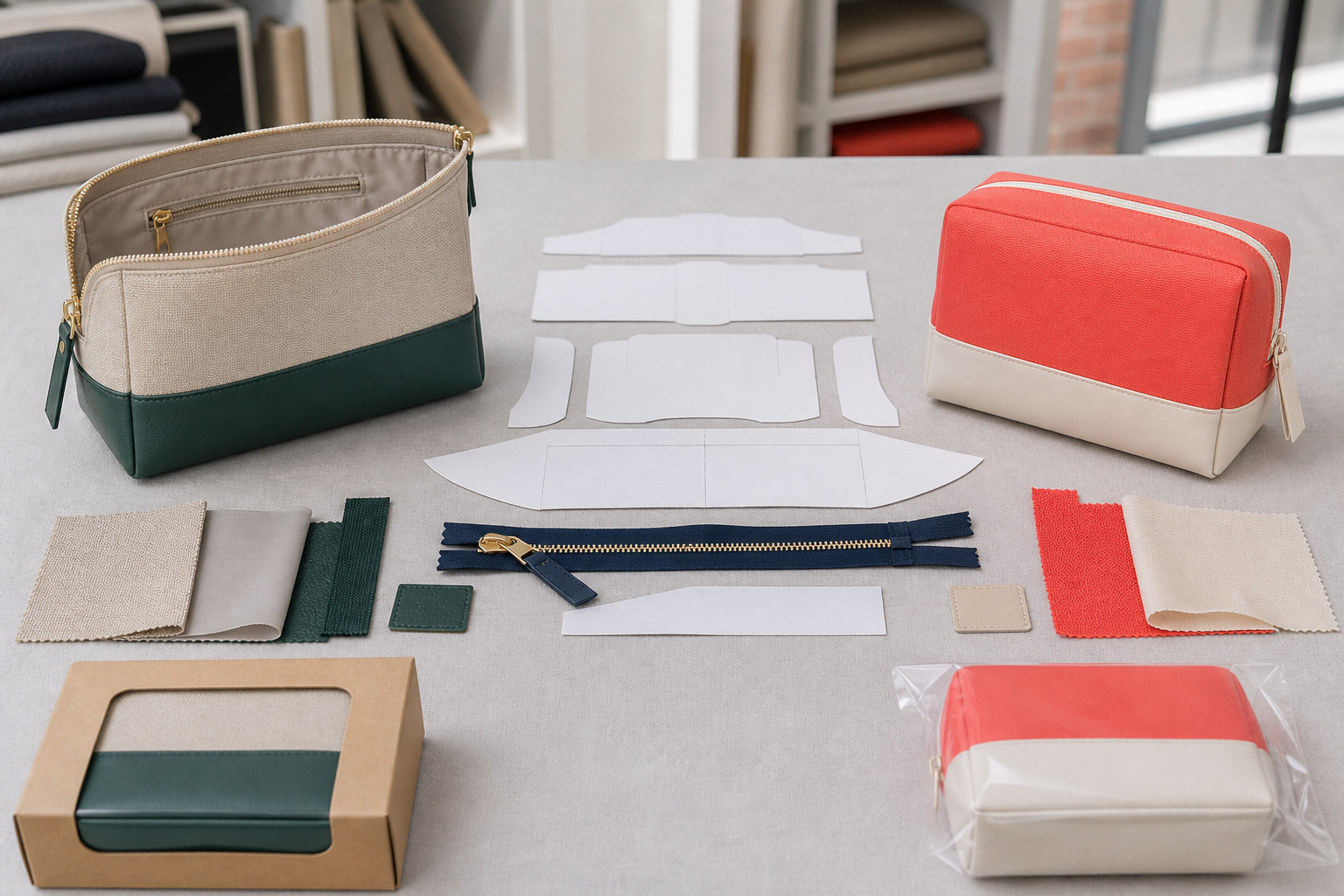
Yes, if the shared platform protects the required functions and each variant has a controlled specification. A common body pattern, zipper gauge, lining platform and reinforcement can reduce development and purchasing complexity. Retail may add structure, interior organization, signature hardware and consumer packaging. Promotional may use simpler pockets, a campaign color and efficient kit packing.
Do not treat the promotional version as an undocumented downgrade. Give it its own BOM, sample and quality criteria. The common platform should be a deliberate design system, not permission to substitute parts.
| Platform layer | Shared core | Retail adaptation | Promotional adaptation |
|---|---|---|---|
| Geometry | Validated body/opening pattern | Added structure or organization | Exact kit and pack-out fit |
| Closure | Proven zipper chain/slider | Signature puller or finish | Stock finish or campaign pull tab |
| Interior | Tested lining family | Pockets/dividers for daily use | Simplified interior or sample retention |
| Branding | Controlled decoration area | Subtle permanent identity | Campaign color and message hierarchy |
| Packaging | Protection principles | Retail presentation/information | Kit assembly and efficient distribution |
18. Retail vs promotional cosmetic bags: decision scorecard
Use the scorecard to frame a cross-functional meeting. If most answers point toward direct product choice, margin and ongoing assortment, use a retail brief. If they point toward eligibility, campaign timing, sample pack-out and a one-time audience, use a promotional brief. A hybrid needs both sets of controls.
| Question | Retail signal | Promotional signal |
|---|---|---|
| Does the customer choose and pay for the bag? | Yes, directly or as a valued retail-set component | No, receipt depends on an offer or distribution rule |
| What drives quantity? | Forecast and sell-through | Eligible recipients and campaign coverage |
| What is the hardest deadline? | Launch and stock availability | Activation,event or media drop |
| What must packaging do? | Merchandise and inform | Assemble and distribute the offer |
| What happens to leftovers? | Carryover or controlled markdown may exist | Time-specific artwork can remove reuse options |
| What does failure look like? | Poor sales, returns or reviews | Incomplete kits, missed timing or brand disappointment |
Why choose LUCKYSTAR for retail and promotional cosmetic bags?
LUCKYSTAR can develop cosmetic bags from the commercial job backward. For retail, that means connecting customer, target position, material, organization, packaging and repeat-order requirements. For promotions, it means connecting campaign audience, exact kit contents, artwork, quantity, assembly, delivery date and post-campaign reuse.
The same manufacturing knowledge supports both routes: material comparison, pattern development, component selection, logo sampling, pack-out review and bulk quality control. More importantly, LUCKYSTAR can help brands identify which elements should be shared and which must remain channel-specific, so cost savings do not blur the product promise.
Explore the wider Product Range. Our manufacturer evaluation checklist explains what to verify before choosing any supplier, while the Custom Bag Manufacturer Guide connects development, production and repeat orders across categories.
RFQ checklist for retail or promotional cosmetic bags
| Commercial information | Product specification | Approval and delivery |
|---|---|---|
| Retail SKU, priced set, GWP, event, loyalty or PR use | Finished dimensions and intended contents | Sample stages and decision owner |
| Audience, channel and target position | Shell, lining, support and construction | Artwork/color references and approval method |
| Quantity by color, artwork, market and SKU | Zipper, puller, pockets, handle and reinforcement | Testing,inspection and compliance inputs |
| Budget basis or selling-price position | Logo method, size, position and campaign copy | Pack-out trial and retained reference |
| Launch/activation and destination | Unit pack, inserted items, labels and carton | Required delivery date, trade term and leftover plan |
Frequently asked questions
Are promotional cosmetic bags lower quality than retail cosmetic bags?
Not necessarily. Quality should match the promise and use. A simple event pouch may have fewer features, while a prestige gift-with-purchase can equal or exceed an entry retail bag. Both need controlled materials, workmanship, function and applicable compliance.
Can the same cosmetic bag be sold and used as a promotion?
Yes, but confirm the commercial position, packaging, labels, quantity, quality criteria and rights for each channel. A shared base product can use different artwork or packing, provided every version has a controlled specification.
What makes a cosmetic bag retail ready?
It needs a clear customer/use proposition, channel-appropriate appearance and function, controlled specification, saleable packaging and information, consistent quality, product photography readiness, inventory identity and a repeat-order plan.
What makes a good promotional cosmetic bag?
It should fit the campaign contents, communicate the brand clearly, pack and distribute efficiently, arrive on time and remain useful after the offer. Simplicity can be valuable when it is intentional rather than a hidden downgrade.
Do free promotional bags need compliance testing?
Free distribution does not automatically remove product-safety responsibilities. Requirements depend on destination, materials, intended user, artwork, claims and other facts. Obtain market-specific advice and test against the applicable scope.
Should a promotional bag include interior pockets?
Only when pockets secure the campaign products or improve meaningful reuse. They add material, sewing, inspection and packing considerations. Test the exact kit before deciding.
Which channel normally has the higher MOQ?
There is no universal answer. Promotions can concentrate high volume in one design, while retail volume can split across many SKUs. Material, dye, print, zipper, hardware and packaging minimums determine the practical quantity.
How should brands compare quotations?
Align dimensions, materials, construction, decoration, quantity split, packaging, inserted items, testing, inspection, trade term and delivery basis.A lower number is not comparable if it omits the channel-specific work.
Choose the channel first, then engineer the bag
The best retail vs promotional cosmetic bag decision begins before material selection. Define the transaction, audience, success metric, payload, channel and timing. Those choices reveal which features create value, which controls protect the brand and where a shared platform can reduce complexity.
See LUCKYSTAR’s custom cosmetic bag collection, or send your retail or promotional brief for a project quotation.

Request the right route for your channel
State whether the bag is a retail product, gift with purchase, event item, loyalty reward, PR set or another program. Add the audience, contents, dimensions, materials and features, branding and pack-out, quantity split, budget basis, destination and required arrival date.
Send your project details through the contact form, or Email a project brief with this comparison already referenced. The email link opens a draft for your review before sending.
Product route, specification, packaging, testing, applicable requirements, MOQ, price, capacity, schedule and delivery terms are subject to project and written confirmation.