The outside sells the first impression, but the lining handles the daily reality of a cosmetic bag. Powder settles into corners. Foundation touches pockets. A loose cap leaks near a seam. Brushes rub the same area repeatedly, and the lining passes close to the zipper every time the bag closes.
Planning an order? Discuss the lining for your cosmetic bag. Start with the details you know; undecided specifications can be discussed.
For a beauty brand, lining is not simply “polyester inside.” It is a system made from a face material, possible coating or lamination, pattern shape, seam construction, pockets, attachment points and approved cleaning method. Each choice affects appearance, usable capacity, stain behavior, production consistency and customer care.
This cosmetic bag lining guide shows how to select and specify that system without confusing wipe-clean performance with leak containment or whole-bag waterproofing. Explore LUCKYSTAR’s custom cosmetic bags, compare suppliers with How to Choose a Cosmetic Bag Manufacturer, and place lining decisions within our main OEM/ODM sourcing guide.
Quick answer: what is the best lining for a cosmetic bag?
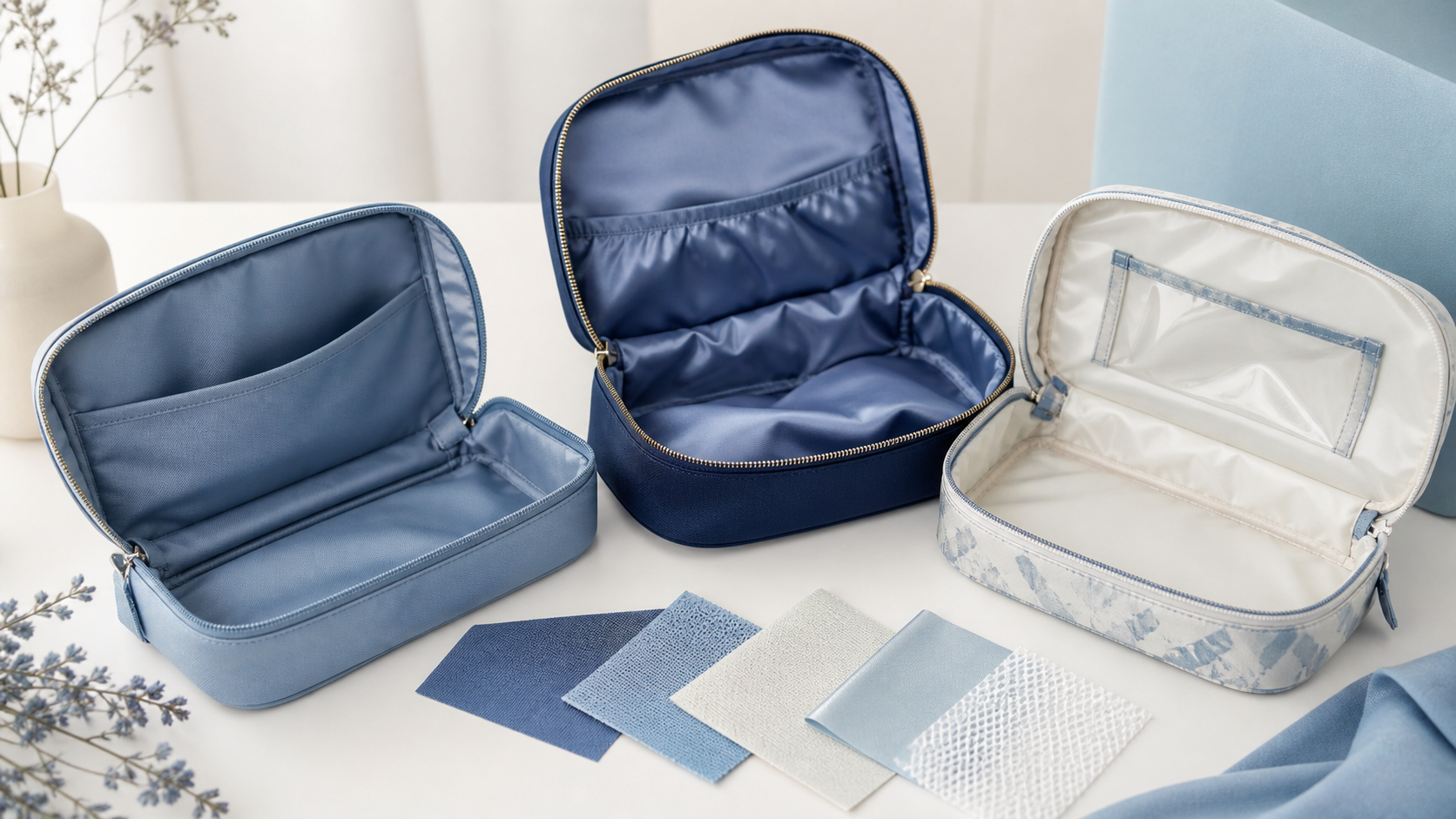
There is no single best lining. A general retail pouch may use a stable woven polyester. A travel case carrying liquids may need a coated or laminated surface and a more deliberate seam design. A premium gift bag may prioritize a smooth, refined hand feel. The right choice depends on the intended contents, cleaning instruction, spill exposure, desired structure, interior details, budget and target market.
Start by ranking five requirements: appearance, cleanability, moisture management, construction compatibility and durability under intended use. Then compare physical swatches, build the actual interior and test representative stains on the finished sample.
| Decision | Question for the brand | Evidence to approve | Common mistake |
|---|---|---|---|
| Surface | Should it feel textile-like, silky, technical or film-like? | Physical swatches and finished interior | Choosing from a material name only |
| Cleaning | What stains and care method are realistic? | Written test using representative contaminants | Calling every coated lining wipe clean |
| Moisture | Is the goal easier wiping, splash resistance or spill containment? | Whole-interior construction test | Treating material barrier as finished-bag proof |
| Construction | How will the lining be formed, attached and kept clear of the zipper? | Section detail and sewn sample | Approving only loose fabric |
| Care | What can customers safely do to the complete bag? | Approved care instructions and validation | Assuming the outer and lining share one cleaning method |
1. Define the job of the lining before selecting a material
Write a short lining brief that identifies the bag program, expected contents, likely stains, cleaning frequency, customer expectation and target price position. A gift-with-purchase pouch carrying dry samples has a different risk profile from a travel organizer holding full-size liquids. A bag sold as a retail accessory may need the inside to remain visually refined after repeated use.
State which requirement matters most. “Premium and waterproof” is too broad.“Smooth light-colored interior, easy to wipe after foundation transfer, with no loose lining near the zipper” is more actionable. If spill containment is essential, define exposure and test method rather than relying on a marketing word.
| Program | Likely lining priority | Possible direction | Validate |
|---|---|---|---|
| Promotional/GWP pouch | Presentation, budget and clean basic finishing | Light woven or coated woven lining, or unlined where appropriate | Assortment fit and perceived value |
| Daily retail makeup bag | Stain management, hand feel and pocket function | Stable woven or easy-clean coated lining | Powder, foundation and repeated access |
| Travel toiletry case | Liquids, cleanability and interior organization | Coated/laminated textile with compatible seams | Defined spill and wipe procedure |
| Premium beauty case | Appearance, tactile quality and controlled structure | Fine woven, satin-like or custom printed lining | Snagging, staining and finished drape |
| Professional organizer | Repeated cleaning, visibility and replaceable organization | Robust coated lining or removable cleanable insert | Actual tools, cleaning and high-frequency use |
2. Treat lining as a material system, not one fabric name
A lining may contain a woven or knitted substrate, color treatment, print, coating, film lamination, backing and bonding adhesive.Two products both described as “polyester lining” can have different weight, weave, finish, flexibility, surface energy and cleanability. Ask the supplier to identify the complete construction and intended face side.
Where TPU-, PEVA- or other film-related descriptions are used, confirm whether the material is a standalone film, a laminate, a coating or a trade description. The name alone does not explain thickness, bonding, sewing behavior or finished-bag performance. Approve a physical production-quality sample.
| System layer | What it controls | What to specify |
|---|---|---|
| Face/substrate | Texture, drape, strength, color and sewing behavior | Fiber, construction, weight/thickness and color |
| Coating | Surface feel, cleanability and moisture behavior | Coating type/side, finish and performance target |
| Lamination/film | Barrier direction and film-like surface | Composition, thickness, bond and face orientation |
| Print/color | Interior identity, visibility and stain perception | Artwork, process, color reference and fastness target |
| Backing/adhesive | Bonding, stiffness and layer stability | Application, compatibility and aging review |
3. Compare common cosmetic bag lining directions
The table below is a decision map, not a universal ranking. Actual performance depends on the selected grade, finish, supplier and construction. A plain textile can be durable yet absorb visible stains.A laminated surface may wipe more easily but show creasing or bond failure if poorly matched to folding and sewing.
| Lining direction | Why brands consider it | Potential limitation | Best sample question |
|---|---|---|---|
| Woven polyester | Broad sourcing, stable appearance and versatile construction | Plain woven surface may retain some stains or moisture | Does the chosen finish meet the actual cleaning brief? |
| Woven nylon | Smooth technical hand and lightweight options | Feel and coating vary widely by grade | How does it sew, wipe and age in this bag? |
| Coated woven textile | Textile support with an easier-clean surface direction | Coating may mark, crack or change hand if unsuitable | Does repeated flexing affect the surface? |
| Film-laminated textile | Stronger surface barrier and wipe-focused presentation | Bonding, crease whitening, peeling and sewing holes | Do folds, seams and corners remain stable? |
| Standalone flexible film | Smooth visible surface and direct wipe access | Noise, stiffness, seam method, odor or surface blocking | Does it suit the complete bag and target market? |
| Satin-like woven lining | Soft gloss and premium visual impression | Snags, visible marks and limited stain handling in some grades | Will the actual cosmetics and tools damage appearance? |
| Cotton/twill direction | Natural tactile character and print potential | Can absorb stains and require careful cleaning guidance | Is natural feel more important than wipe behavior? |
The cosmetic bag material comparison explains how inner layers work with the shell. For two common outer directions, use our separate PU and polyester comparison.
4. Separate wipe-clean performance from spill containment
A surface can wipe clean yet allow liquid to pass through sewing holes or seams. A lining can resist liquid penetration for a period while still staining. A removable insert can contain a small spill more effectively than a fully sewn interior, but it changes capacity and appearance. Define the precise objective.
For spill management, inspect the lining face, seams, corners, zipper ends and pocket attachments as one system. Bound edges and multiple needle penetrations can create paths through a barrier layer. If the brand requires a performance claim, test the finished bag under a defined setup. The Waterproof Cosmetic Bag Manufacturing covers whole-bag resistance in more detail.
| Requirement | What it means | What it does not prove | Useful evidence |
|---|---|---|---|
| Easy to wipe | A stated contaminant can be removed by an approved wipe method | Leak containment or machine washability | Repeatable stain-and-clean test |
| Water-repellent surface | Drops tend to remain on the surface initially | Seam or whole-bag resistance | Material test plus constructed sample review |
| Barrier material | Selected layer resists passage under stated conditions | Seams, zipper and attachments are sealed | Material and assembled-section results |
| Spill containment | Finished interior retains a defined exposure | Unlimited duration or all liquids | Whole-bag test with acceptance criteria |
| Machine washable | Complete construction tolerates a defined wash procedure | Any cycle, detergent or drying method | Full-product wash validation |
5. Choose a construction method that supports the lining job
Material selection and assembly method are linked. A lining may be formed as a separate interior bag, inserted and attached at the opening, turned with the shell, bound into shared seams, bonded to panels or made as a removable insert. Each route changes appearance, repair access, raw-edge control, structure and leakage paths.
| Construction route | How it works | Potential benefit | Watch carefully |
|---|---|---|---|
| Bagged-out/turned | Shell and lining are joined and turned through an opening | Clean enclosed appearance | Turning point, corner bulk and lining control |
| Drop-in lining | Separate lining unit is inserted and attached near the opening | Distinct interior assembly and possible repair access | Loose body, anchoring and top-edge finish |
| Shared bound seams | Shell and lining edges are joined and enclosed with binding | Defined technical finish and visible raw-edge control | Needle holes, binding bulk and corner neatness |
| Bonded/laminated panel | Lining acts as the reverse face of a composite panel | Controlled layer movement and structure | Bond strength, creasing and seam exposure |
| Removable insert | Separate tray or pouch can be taken out | Cleaning access and replaceable organization | Attachment, lost space and customer handling |
6. Control lining ease, anchoring and usable capacity
The lining pattern is not always an exact copy of the shell. It needs enough allowance to sit naturally after turning and loading, but too much loose material can wrinkle, hide products or enter the zipper. Too little can pull the exterior inward, stress seams and reduce capacity.
Define where the lining is anchored: opening, base, corners, pocket points or selected seams. The right approach depends on bag geometry and construction.Check the inside empty, partly loaded and fully loaded. Our size and usable-capacity worksheet helps connect those inner layers to the space available for products.
| Lining behavior | Too loose | Too tight | Sample check |
|---|---|---|---|
| Opening zone | Fabric approaches zipper teeth/coil | Top edge pulls or rolls | Repeated opening with pockets loaded |
| Base | Wrinkles hide small products | Shell base distorts inward | Press into corners and load rigid items |
| Sides/corners | Excess gathers and inconsistent appearance | Seams carry unintended strain | Turn interior gently and inspect attachment |
| Pockets | Loaded pockets sag or collide | Pocket opening becomes difficult | Test named products in every compartment |
7. Keep the lining away from the zipper path
Lining capture is often blamed on the zipper, but the root cause may be excessive lining ease, poor anchoring, a pocket placed too near the chain or thick binding that pushes fabric inward. Establish a keep-clear zone around the slider path and show the lining attachment in a section drawing.
Review straight sections, corners and zipper ends. A lining can remain clear on a flat opening yet rise toward the chain where a padded curve compresses. The Cosmetic Bag Zipper and Hardware Guide explains how slider, chain and opening geometry work as one system.
| Zipper-area control | Specify | Verify |
|---|---|---|
| Keep-clear distance | Minimum lining/pocket distance from chain travel | Measure on finished sample |
| Top attachment | Seam, facing, binding or anchor route | Pull gently inward and operate zipper |
| Corner behavior | Ease and bulk treatment at radius | Open/close around every curve |
| Pocket placement | Top edge relative to zipper path | Load pocket and repeat operation |
| End treatment | Lining, tape and stop enclosure | Inspect slider travel and exposed edges |
8. Design pockets, dividers and binding as part of the lining
Interior organization should use materials that support its function. A mesh pocket improves visibility but may snag some caps. Elastic brush loops need recovery and appropriate loop sizes. A transparent film pocket can show contents but introduces new edge and surface behavior. Binding must enclose raw edges without adding excessive bulk.
Specify every interior feature by material, finished dimensions, position, edge treatment and attachment. Test it with the intended cosmetics rather than approving an empty pocket.
| Interior feature | Lining-related decision | Functional review |
|---|---|---|
| Slip pocket | Face material, ease, top edge and backing | Access and sag when loaded |
| Mesh pocket | Mesh type, stretch direction and binding | Retention, snagging and cleaning |
| Transparent pocket | Film composition, thickness and edge enclosure | Clarity, tack, folding and seam stress |
| Brush loops | Elastic width, pitch, backing and attachment | Small/large tool retention and cleaning access |
| Divider | Layer stack, covering and removable attachment | Stability, edge finish and space loss |
| Binding | Material, finished width, joint and visible side | Raw-edge coverage and corner consistency |
9. Choose interior color for visibility, branding and stain perception
A light lining makes dark cosmetics and tools easier to find but may show foundation and pigment more clearly. A dark lining can hide some marks yet make black compacts, pencils and small caps difficult to see. Mid-tone or patterned interiors can balance these issues, but print must remain stable under the intended care method.
Color can support brand identity through contrast, repeat motifs or a subtle logo. Approve artwork on the actual lining construction because coating, weave and lamination change color and detail. If multiple bag sizes share one lining, check pattern scale and placement for every SKU.
| Color direction | Advantage | Trade-off | Approval check |
|---|---|---|---|
| Light neutral | Interior visibility and clean presentation | Some cosmetics appear more obvious | Representative stain and clean test |
| Dark neutral | Can reduce visibility of some marks | Small dark products may be difficult to find | Loaded-use visibility |
| Mid-tone color | Balanced visibility and brand expression | Must coordinate with shell and zipper | Complete colorway component board |
| Printed lining | Strong interior identity and pattern camouflage | Artwork repeat, fastness and visual clutter | Actual-size strike-off and finished bag |
10. Write a cleaning requirement before writing care instructions
The safest cleaning method depends on the complete bag: outer material, lining, foam, adhesives, logo, zipper, hardware and removable parts. A lining may tolerate wiping while the outer print or bonded structure does not tolerate soaking. Machine washing should never be assumed from the lining fiber alone.
For development, define the least aggressive method that meets the intended use: dry powder removal, damp wiping, spot cleaning or another validated procedure. State cleaning agent, concentration if relevant, cloth, motion, duration, rinsing, drying and number of repetitions. Customer instructions should reflect only what the complete product has been reviewed to tolerate.
| Care route | Possible use | Whole-bag concern | Evidence before claim |
|---|---|---|---|
| Dry removal | Loose powder and dust | Pigment may spread if rubbed | Defined brush/vacuum/wipe method |
| Damp wipe | Compatible coated or laminated interior | Moisture may reach seams, outer or backing | Complete interior wipe test |
| Spot clean | Localized marks on compatible textiles | Rings, shade change or coating damage | Material and finished-bag trial |
| Hand wash | Only when full construction is designed for it | Foam, adhesive, hardware and drying behavior | Defined complete-product wash cycle |
| Machine wash | Only for specifically validated washable designs | Distortion, delamination, print and component damage | Full wash/dry protocol with acceptance limits |
11. Build a realistic stain-and-clean test
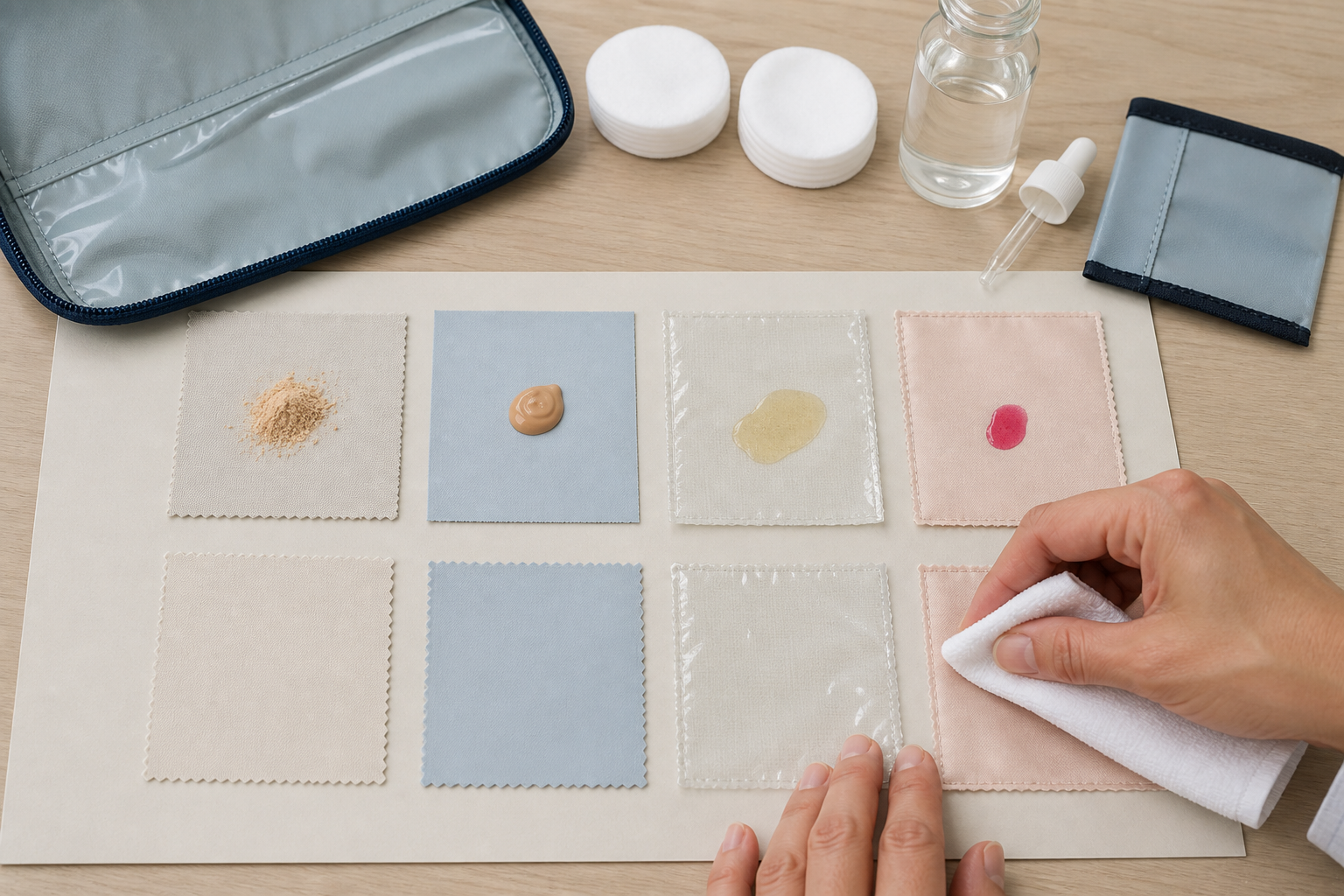
Select representative contaminants from the intended product assortment. Useful categories may include loose powder, pigmented cream, oil-based balm and a colored water-based liquid. Use brand-provided products or controlled substitutes, but identify them consistently. Record the amount, contact time, temperature, cleaning method and evaluation time.
Evaluate more than visible stain. Check shade change, gloss, tack, odor, coating transfer, swelling, cracking, print loss and whether residue remains in seams. A lining that looks clean immediately may change after drying. Repeat wiping may reveal surface wear that one cycle misses.
| Test field | Record | Why it matters |
|---|---|---|
| Contaminant | Product/category, color and lot/reference | Different cosmetic chemistries behave differently |
| Application | Amount, area and spreading pressure | Creates a repeatable challenge |
| Dwell | Contact time and condition | Immediate wiping may overstate performance |
| Cleaning | Agent, cloth, strokes/pressure and rinse/dry method | Results depend on procedure |
| Evaluation | Stain, shade, gloss, tack, odor and surface integrity | Clean appearance alone is incomplete |
| Repetition | Number of stain/clean or wipe cycles | Shows cumulative surface change |
12. Check seams, corners and pockets—not only flat swatches
Flat material testing is efficient for comparing options, but stains and liquid collect at the constructed interior’s lowest points. Test a sewn corner, bound seam, zipper end and representative pocket. A surface may release foundation easily while a textured binding or thread retains pigment.
Inspect behind the lining when possible. A clean visible surface does not prove that liquid failed to reach foam or backing.If the bag must contain spills, define what constitutes failure and how hidden layers will be assessed.
| Constructed zone | Why it is different | Review |
|---|---|---|
| Base corner | Collects liquids and contains multiple seam allowances | Staining, penetration and cleaning access |
| Bound seam | Binding, thread and needle holes interrupt the surface | Pigment retention and moisture path |
| Zipper end | Complex intersection and difficult wiping access | Residue, exposed edges and hidden wetting |
| Narrow cavity and multiple material layers | Turn/access, cleaning and drying | |
| Logo/print area | Colorants and surface process may respond differently | Color transfer, fading and abrasion |
13. Evaluate aging, bonding and material compatibility
A laminated lining can look excellent when new and later show edge lifting, bubbles, clouding, whitening at folds or a tacky surface if the construction is unsuitable. A printed lining may transfer color to light products. A clear pocket may block against another coated surface during warm storage.
Identify likely shipping and use conditions and choose relevant conditioning. Compare the lining with the outer shell, foam, adhesive, binding, labels and packaging. If the product will be stored folded or tightly packed, inspect the same contact points after conditioning and recovery.
| Compatibility risk | Possible sign | Development control |
|---|---|---|
| Lamination/bond aging | Bubbles, edge lift or peeling | Fold, conditioning and seam-section review |
| Surface blocking | Layers stick after pressure/storage | Packed-contact trial under relevant conditions |
| Color migration/transfer | Shade moves to light material or product surface | Contact test with intended adjacent materials |
| Fold whitening/cracking | Visible line or surface break at repeated bend | Flex the actual corner and opening geometry |
| Odor change | Unacceptable odor when unpacked or conditioned | Material and packed-product evaluation |
| Adhesive interaction | Stain, stiffness, bleed or bond loss | Approve the complete layer system |
14. Turn the approved cleaning route into customer care
Care instructions should be clear, conservative and supported by the finished product. Avoid vague claims such as “washable” without a method. State what the user should do, what to avoid and how to dry the bag. If the lining and exterior require different handling, write instructions for the whole item rather than treating them independently.
Consider whether removable parts should be taken out, zippers opened, hardware protected or the bag reshaped during drying. Do not recommend aggressive solvents because a stain test showed one surface could tolerate them once; care guidance must protect every component.
| Care-instruction element | Define | Avoid |
|---|---|---|
| Method | Dry removal, damp wipe, spot clean or validated wash route | “Clean as needed” without direction |
| Cleaning agent | Approved mild/neutral direction if supported | Unrestricted chemicals or solvents |
| Water/temperature | Any defined limitations | Assuming hot water is harmless |
| Drying | Open, reshape and air-dry direction if validated | Unapproved tumble or high heat |
| Warnings | Known restrictions for bleach, immersion, ironing or machine washing | Generic symbols inconsistent with written care |
15. Specify the lining in the tech pack and BOM
The BOM should identify the lining material system, composition, construction, weight or thickness, color/print, finish, coating or lamination side, supplier reference and placement. Give pockets, mesh, elastic, binding and removable parts separate codes. Draw the lining construction and attachment rather than listing it in one cell.
Add the approved care method, stain test, color reference and physical swatch to the approval package. Record these items with the drawings, POMs and revision history described in our factory-ready cosmetic bag specification guide.
| Specification field | What to record | Reference |
|---|---|---|
| Material identity | Fiber/film, construction, weight/thickness and supplier code | Labeled production-quality swatch |
| Surface system | Coating/lamination type, face side and finish | Cross-section or layer note |
| Color/print | Physical color, artwork, repeat and orientation | Approved strike-off |
| Pattern/attachment | Seams, ease, anchors, binding and keep-clear zones | Technical views and PP sample |
| Performance/care | Test procedure, acceptance and customer instruction | Test record and care artwork |
16. Approve the lining from swatch to bulk
Begin with material swatches, but do not release production until the lining has been reviewed inside the actual bag. The first sample should answer drape, capacity, zipper clearance, pockets and seam access. A cleaning trial should then use intended or representative contaminants. The PP sample should use production-intended lining, components and pack-out.
In bulk, inspect identity, color, coating/lamination appearance, wrinkles, seam finishing, binding, pocket position, zipper clearance, marks, odor and the packed condition. Follow our cosmetic bag sampling workflow for stage approvals, then use the interior quality-control checklist during production review.
| Stage | Lining evidence | Release question |
|---|---|---|
| Material selection | Labeled swatches and surface construction | Does the direction meet use, appearance and sourcing needs? |
| First sample | Complete interior with pockets, binding and zipper | Does it fit, drape and operate correctly? |
| Stain/care test | Recorded contaminant, cleaning and evaluation | Are claims and instructions supported? |
| PP sample | Production-intended lining, labels and packing | Are all open issues closed and references frozen? |
| Bulk inspection | Identity, appearance, construction, operation and pack-out | Does production match approved evidence? |
17. Balance cost, MOQ and cleaning performance
Plain stock lining may support lower quantities and faster sampling. Custom dyeing, print, specialty coating, film lamination or removable inserts can introduce material minimums, setup, samples and additional lead time. The lining material MOQ may be different from the finished bag MOQ.
Compare quotations on the same construction. “Polyester lining” could mean an uncoated stock fabric in one quote and a custom coated, printed material in another. Use our cosmetic bag pricing breakdown to align quote assumptions, and check MOQ and production scheduling before committing to a custom lining.
| Lining level | Development impact | Best fit | Confirm |
|---|---|---|---|
| Stock woven lining | Simpler sourcing and color choice | Promotions and first-market tests | Actual grade, finish, stock continuity and cleaning limits |
| Stock coated/laminated lining | Additional surface function without full customization | Wipe-focused travel and retail cases | Bonding, color, hand and available quantity |
| Custom color/print | Strike-off, color approval and material minimum | Signature collections and repeat programs | Print fastness, repeat and batch tolerance |
| Custom performance system | More sampling and whole-bag testing | Defined spill or care requirement | Test method, claim, MOQ and repeat supply |
Common cosmetic bag lining mistakes
- Writing “polyester lining” only. Record construction, weight/thickness, coating or lamination, color and placement.
- Confusing easy wiping with waterproofing. Test seams, corners and the whole bag for any performance claim.
- Approving loose swatches. Review drape, wrinkles, pockets and zipper clearance in a complete sample.
- Ignoring lining ease. Too much can catch in the zipper; too little can distort the shell.
- Choosing black automatically. Test whether customers can see dark cosmetics and small tools.
- Testing one stain immediately. Define contaminant, dwell, cleaning, drying and repetition.
- Writing care from the lining fiber. Validate the entire construction, including foam, logo, zipper and hardware.
- Forgetting pack-out contact. Check blocking, creasing, color transfer and odor after storage.
Why choose LUCKYSTAR for cosmetic bag lining development?
LUCKYSTAR can review the lining together with the outer shell, structure, zipper, internal organization and packaging. That system-level approach helps reveal issues a swatch cannot show: coating that creases at the corner, lining that catches in the slider, a pocket that is difficult to clean or a material that changes after packed storage.
Brands may begin with a simple stock lining, a target cleaning brief, an existing sample or a fully specified custom system. LUCKYSTAR can compare representative materials, develop the interior construction, coordinate stain and care reviews, and connect approved results to production references. Explore the wider Product Range; our manufacturer selection article lists the development evidence worth requesting from any supplier.
The best lining is the one that supports the product’s real contents, customer behavior and commercial position without making unsupported promises. Connect the interior decision to the broader Custom Bag Manufacturer Guide; then use our beauty-brand packaging guide to protect the approved surface during delivery.
RFQ checklist for cosmetic bag lining
| Use and appearance | Construction and performance | Commercial and approval |
|---|---|---|
| Program, customer and intended contents | Lining material system and face side | Quantity and SKU/color breakdown |
| Desired hand, color, print and visibility | Coating/lamination, seams, binding and anchors | Stock or custom material expectations |
| Likely stains and cleaning frequency | Pockets, dividers and zipper keep-clear zone | Material MOQ, sample stages and timing |
| Target care instruction and claims | Stain, spill, flex and compatibility tests | Target market, destination and packing conditions |
Frequently asked questions
Is polyester the best makeup bag lining material?
Polyester is a versatile starting point, but performance depends on weave, weight, finish, coating and construction. A plain woven polyester, coated polyester and film-laminated polyester are different systems. Choose and test the grade that fits the product’s actual use.
What is a wipe clean cosmetic bag lining?
It is a lining system reviewed for removing defined stains using a stated wiping method.The phrase should not be used without specifying the material, contaminant, cleaning procedure and acceptable result. It does not automatically mean leakproof, waterproof or machine washable.
Can TPU or PEVA lining make a cosmetic bag waterproof?
Not by material name alone. Construction, film or laminate grade, seams, needle holes, zipper and attachments all affect the finished bag. Confirm the exact material and test the complete construction against a defined requirement.
Should a cosmetic bag lining be light or dark?
Light colors improve visibility but can show pigment more clearly. Dark colors may hide some marks while making small products harder to find. Test the intended contents, branding and cleaning behavior before deciding.
Why does lining get caught in the zipper?
Possible causes include excess lining ease, weak anchoring, pockets placed too near the path, corner bulk or an unsuitable relationship between slider and interior construction. Establish a keep-clear zone and test the loaded sample repeatedly.
Can customers machine-wash a lined cosmetic bag?
Only if the complete product has been designed and validated for a defined machine-wash procedure. Lining fiber alone cannot determine this because outer fabric, foam, adhesives, print, zipper, hardware and drying behavior also matter.
What should be approved before bulk production?
Approve material identity, color/print, surface construction, lining pattern and anchors, pockets, binding, zipper clearance, representative stain-and-clean results, care instructions, PP sample and packed condition.
Create an interior customers can use, clean and trust
A successful lining is quiet engineering. It sits smoothly, keeps clear of the zipper, supports pockets, presents the brand well and responds predictably to the approved care method. When material, construction and cleaning are developed together, the inside of the bag becomes a repeatable product feature rather than an afterthought.
See LUCKYSTAR’s available cosmetic bag constructions, or request a lining review and project quotation using your intended contents and care brief.

Discuss the lining for your cosmetic bag
You do not need a complete specification to start a conversation. Include these details in your message:
- Intended contents and likely spills or stains.
- Preferred lining, pockets and cleaning method if known.
- Bag reference, approximate quantity and destination.
Discuss the lining for your cosmetic bag using the contact form, or Email a project brief with this article already referenced. The email link opens a draft in your email app; you can add artwork or a specification before sending.
MOQ, pricing, sample arrangements and delivery terms are subject to specification and written confirmation.