Non-Woven Drawstring Bags: GSM and Construction Guide
Last reviewed: September 28, 2026
The right GSM for a non-woven drawstring bag cannot be selected from bag weight alone. GSM measures fabric mass per unit area; it does not tell you whether the web is uniform, how strongly it is bonded, which polymer it contains, how the seams are made or whether the cord anchors will survive use. A lighter fabric with a sound seam and reinforced corners can outperform a heavier fabric with weak bonding or excessive needle perforation.
For most sourcing projects, choose GSM only after defining the load, use frequency, bag dimensions, closure design, print method and failure criteria. Then approve the fabric and the complete bag through measured samples and production controls. This guide shows procurement teams how to turn “I need a non-woven drawstring bag” into a construction-ready specification.

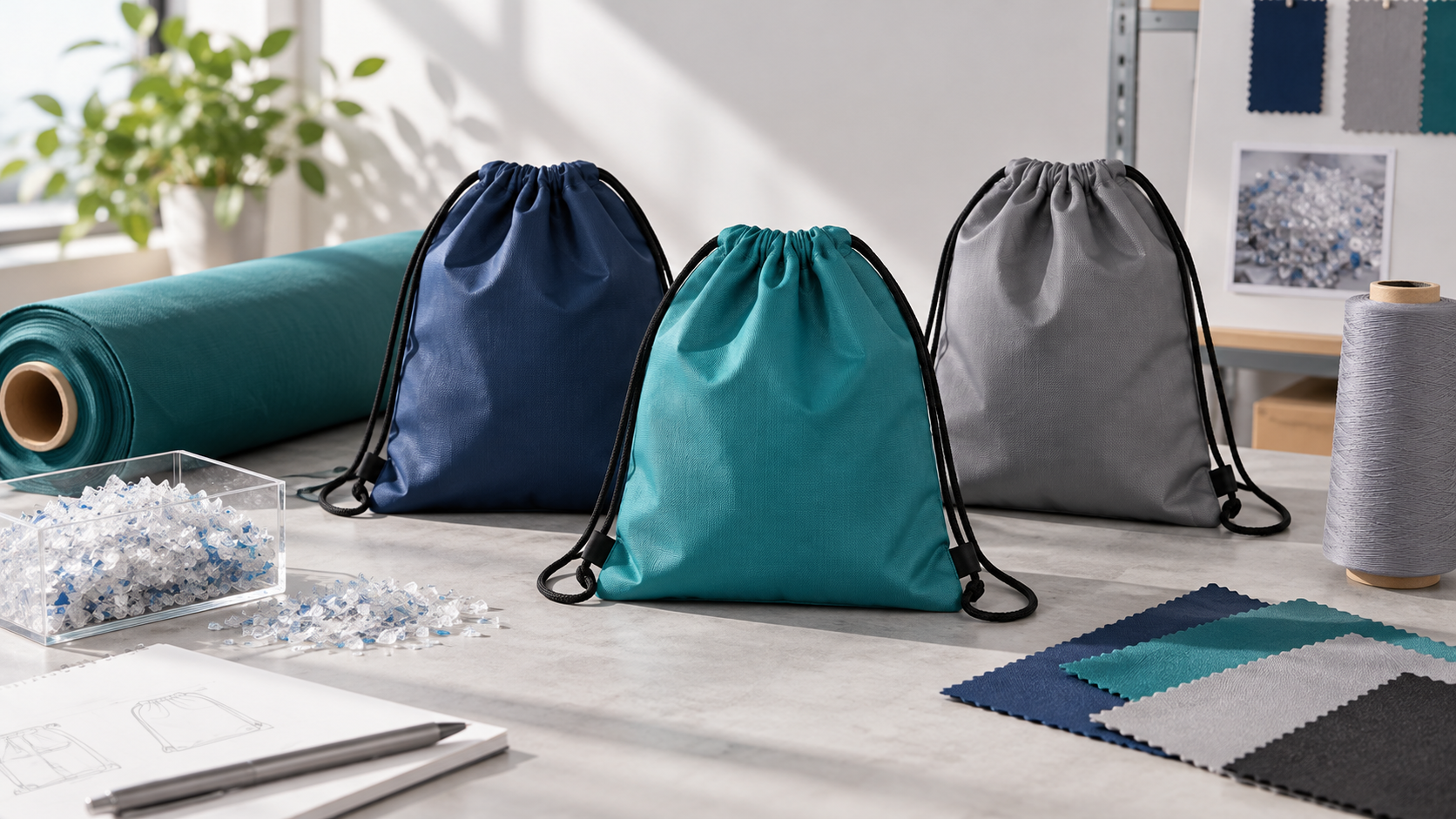
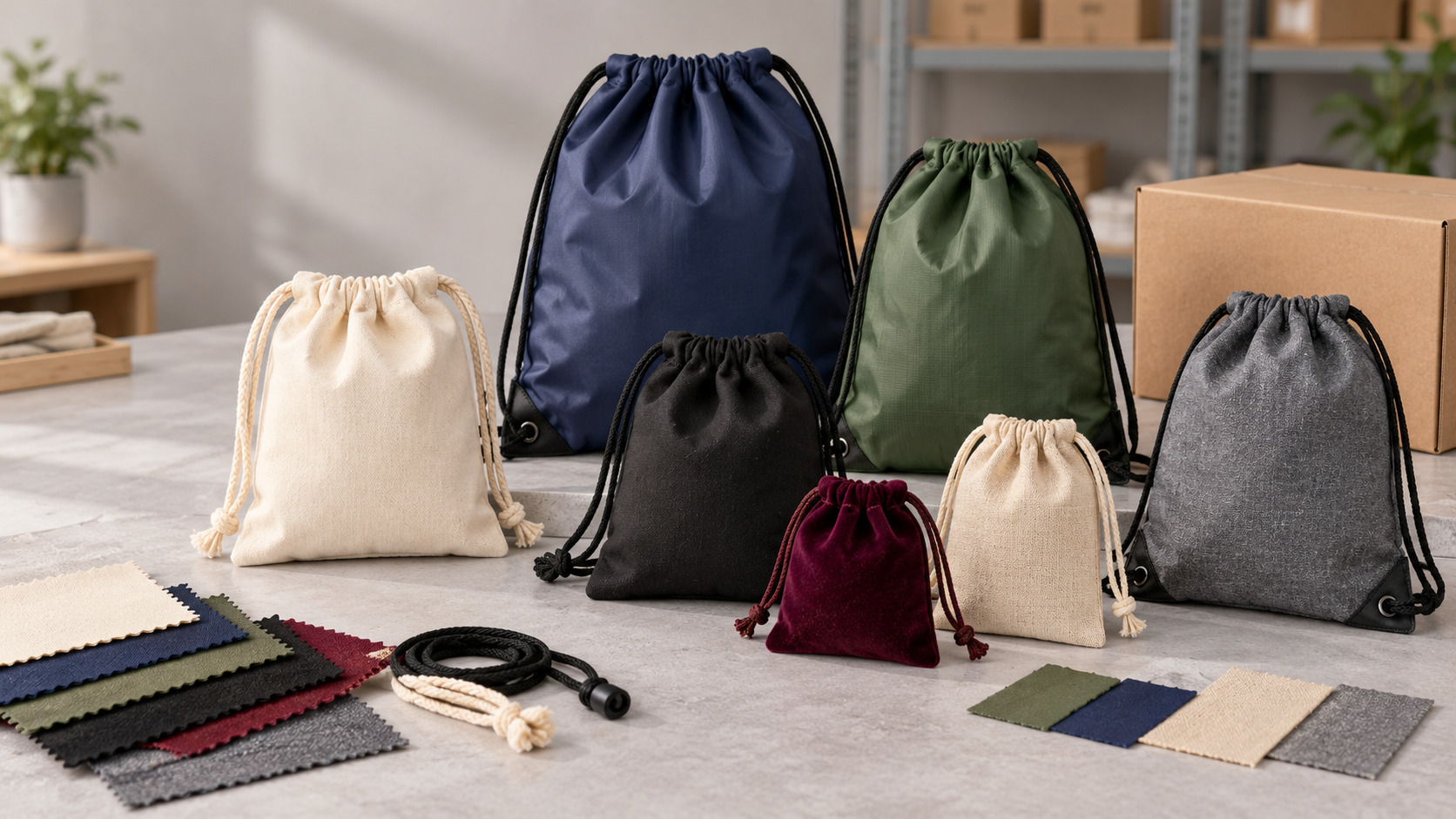
Reference-guided, AI-generated quality-control scene based on unbranded company-channel product construction and non-woven surface references. The bag, swatches and tools illustrate GSM and seam inspection; they do not establish a material grade, load rating, test result or current SKU.
Direct answer: which GSM should you choose?
Treat GSM bands as RFQ starting points, not load ratings.Lightweight event bags may begin around 70–80 GSM, general promotional drawstring projects often investigate approximately 80–100 GSM, and programs seeking a fuller hand or more repeated handling may evaluate 100–120 GSM or above. Those ranges are not interchangeable across suppliers, because web formation, bonding, polymer, width direction, finish and construction can change performance at the same nominal GSM.
| Sourcing direction | Practical starting question | Main risk to test | Do not assume |
|---|---|---|---|
| Lower-GSM concept | Can the bag meet the agreed load and cycle requirement with minimal material? | Local thin spots, seam perforation and cord-anchor pull-through | “Lightweight” automatically means weak or lower impact |
| Mid-range concept | Does the chosen fabric balance hand, print coverage and assembly strength? | Roll variation, show-through and closure-channel wear | A familiar GSM will match a previous supplier’s fabric |
| Higher-GSM concept | Does added mass improve the actual failure mode enough to justify cost and packing volume? | Stiff drawcord channel, bulky folds and poor heat-seal settings | More GSM always produces a stronger or better bag |
The final specification needs a nominal GSM, an agreed tolerance, a sampling method and finished-bag performance tests. Explore available development directions on the custom drawstring bags product page. Material availability, minimum quantity, price, sample timing and production schedule must still be confirmed for the selected construction.
What “non-woven” means in a bag specification
INDA defines a nonwoven as a fibrous assembly—other than traditional paper, woven or knitted material—engineered to have structural integrity by physical and/or chemical means. That definition matters because “non-woven” describes a broad manufacturing family, not one universal fabric.
Polypropylene spunbond is a common route for promotional bags, but buyers should not infer polymer or process from appearance. Polyester, recycled inputs, staple-fiber webs, spunlace, needle-punched materials, laminates and other constructions can also be called nonwoven in suitable contexts. Specify the actual material and bonding route offered.
| Specification field | What to record | Why it changes the bag |
|---|---|---|
| Polymer/fiber | PP, polyester or another verified composition | Affects heat response, hand, density and claim language |
| Web formation | Spunlaid/spunbond, drylaid or other declared route | Influences fiber/filament arrangement and uniformity |
| Bonding | Thermal, mechanical, chemical or combined | Influences integrity, drape, edge behavior and print surface |
| Nominal mass | GSM with tolerance | Controls material input but not strength by itself |
| Thickness | Value plus test pressure/method | Helps describe bulk and hand; not equivalent to GSM |
| Direction | Machine direction and cross direction | Strength and elongation may differ by orientation |
| Surface/finish | Calender pattern, coating, lamination or treatment | Changes appearance, printing, sealing and end-of-life discussion |
Use the Best Materials for Custom Drawstring Bags guide when non-woven, polyester, nylon, cotton or canvas are still competing options. If the project is specifically comparing fabric families, the existing Canvas vs Nonwoven Drawstring Bags buyer guide provides a higher-level decision framework.
GSM is mass per unit area—not thickness or strength
GSM stands for grams per square metre. The current published edition of ISO 9073-1:2023 specifies a method for determining the mass per unit area of nonwoven fabrics. EDANA and INDA also maintain harmonized Nonwovens Standard Procedures, including mass, thickness, tensile and tear procedures.
The basic relationship is simple:
GSM = specimen mass in grams ÷ specimen area in square metres
The measurement still needs controlled sampling, specimen dimensions, conditioning, balance resolution and reporting. A supplier’s nominal label is not a substitute for measuring received material.
A worked shell-weight estimate
Suppose a flat bag uses two rectangular panels, each 350 mm × 450 mm, cut from nominal 80 GSM material. Ignoring the folded channel, seam allowance, trimming and reinforcements:
- Panel area: 0.35 m × 0.45 m = 0.1575 m²
- Two-panel area: 0.315 m²
- Estimated shell input: 0.315 m² × 80 g/m² = 25.2 g
That result is an estimating tool, not the finished bag weight. Add the top-channel fold, seam allowances, corner patches, cord, eyelets, print, label and any packing components.Production waste also matters for material purchasing but should not be counted as product mass.
Why two fabrics with the same GSM perform differently
GSM tells you how much material occupies a square metre. It does not show how effectively that mass is distributed or bonded.
| Variable at equal GSM | What may change | Buyer verification |
|---|---|---|
| Web uniformity | Local thin spots, pinholes and visual cloudiness | Transmitted-light review and multi-position GSM samples |
| Filament/fiber structure | Tensile behavior, softness and fuzz | Supplier specification plus relevant material tests |
| Bonding pattern | Stiffness, integrity and tear propagation | Surface comparison and mechanical testing |
| MD/CD orientation | Directional strength and elongation | Cut and test specimens in both directions |
| Calender temperature/pressure | Fusion quality, surface gloss and brittleness | Approved sample and controlled lot inspection |
| Additives/color masterbatch | Hand, opacity and process response | Material declaration and shade/process trial |
| Lamination/coating | Printability, water behavior and recyclability discussion | Layer-by-layer BOM and adhesion checks |
| Roll variation | Inconsistent panels within one order | Incoming inspection across width and roll length |
This is why purchase orders should not say only “100 GSM non-woven.” They should identify the approved supplier article or a fully defined equivalent, color, finish, bonding appearance, measured tolerance and performance requirements.
Specify GSM tolerance and sampling—not just a target
An exact number without an agreed tolerance creates false precision. The acceptable band should reflect the material process, bag performance and commercial agreement. For illustration, an 80 GSM target with a ±5% tolerance would create a 76–84 GSM acceptance band; this is arithmetic, not a recommended universal tolerance.
Define the following before the first material arrives:
- Nominal GSM and permitted deviation.
- Referenced test method and specimen area.
- Conditioning requirements.
- Number of rolls and locations sampled.
- Whether acceptance uses individual values, the mean, range or another statistic.
- Rounding and balance-resolution rules.
- Action for out-of-tolerance rolls.
| Sampling location | Problem it can reveal | Suggested record |
|---|---|---|
| Left, center and right across the roll | Cross-width nonuniformity | Individual GSM plus roll position |
| Beginning, middle and end of selected rolls | Process drift over length | Roll/lot ID and longitudinal position |
| Different production rolls | Lot-to-lot variation | Roll number, color batch and supplier batch |
| Cut panels at the line | Wrong roll or material substitution | Work order and bundle ID |
Do not average away a critical weak zone. If the bag’s side panel is cut from a consistently light edge, an acceptable roll average may still hide a finished-product risk.
Measure thickness separately
Thickness depends on material structure and the pressure used by the measuring instrument. Two nonwovens can have the same GSM but different loft, compressibility and perceived hand. A buyer comparing thickness data should require the same method and pressure.
Higher thickness is not automatically better. A bulky web may resist neat folding at the top channel; a compact web may look thin but have strong bonding. Evaluate thickness alongside GSM, tensile/elongation, tear behavior and assembly tests.
Control machine direction and cross direction
Nonwoven properties can be directional.The machine direction (MD) follows production travel; the cross direction (CD) runs across the web. Orientation and bonding may give different tensile strength or elongation in each direction.
Bag pattern orientation therefore matters. If the cord-pull or lower anchor loads the weaker direction, changing the cutting layout can change failure behavior even when material, GSM and dimensions remain unchanged.
| Pattern-control question | Why procurement should care |
|---|---|
| Is roll direction marked on the fabric or cutting plan? | Enables repeatable panel orientation |
| Was the approved sample cut in the same direction as bulk? | Prevents a hidden performance change |
| Are material tests reported for MD and CD? | Avoids approving only the stronger direction |
| Can nesting rotate pieces to improve yield? | A cost-saving rotation may alter strength direction |
Record orientation in the tech pack when tests show that it affects the intended load path.
Choose the top drawcord-channel construction
The top channel closes repeatedly and concentrates bending and sliding.Its geometry influences draw force, opening width, material wear and available print area.
| Channel construction | Advantages | Risks/checks | Best used when |
|---|---|---|---|
| Folded shell channel | Efficient, clean and common | Fold consumes height; stitch line can perforate a weak web | Shell can fold without cracking or excessive stiffness |
| Separate channel band | Allows a different reinforcement or color | Extra seam, material and alignment control | Closure needs local reinforcement or design contrast |
| Heat/ultrasonic bonded fold | Avoids sewing thread where compatible | Seal width and energy must suit polymer/GSM; brittle or incomplete welds can occur | Material and equipment have been validated together |
| Sewn channel with bound edge | Better edge control in some designs | More components, thickness and cost | Raw-edge appearance or wear needs improvement |
Specify the finished channel height, turnback depth, stitch/seal position and cord diameter. A narrow channel can bind; an oversized channel can look loose and reduce usable bag height.
Select the drawcord and routing as a system
Cord choice changes both usability and structural load. Record composition, diameter or width, construction, color, hand, elongation and cut-end treatment. Then confirm how it enters the top channel and attaches at the lower corners.
| Cord variable | Possible effect | Approval check |
|---|---|---|
| Diameter | Closure friction and shoulder comfort | Cycle the actual channel and cord combination |
| Braided vs flat tape | Hand, printability and knot security | Pull, abrasion and user trial |
| Surface smoothness | Draw force and channel wear | Open/close cycles on production-intent fabric |
| Elasticity | Bag stability and fit | Loaded-use evaluation |
| End treatment | Fraying and knot retention | Inspect after cyclic pulling |
| Color | Rub transfer and visual match | Relevant colorfastness test |
The two-cord backpack route should be diagrammed, including cord lengths before knotting. A visual sample alone may not preserve cord consumption or symmetry for reorders.
Reinforce lower cord anchors deliberately
The lower corner is often the first structural failure point. Cord tension can tear the nonwoven, pull out an eyelet or cut through a narrow attachment tab. Added GSM in the body may not solve an anchor geometry problem.
| Anchor option | Construction control | Failure mode to test |
|---|---|---|
| Cord through punched shell | Hole position and edge distance | Hole growth and material tear-out |
| Metal/plastic eyelet in shell | Eyelet size, washer, setting and substrate support | Pull-out, sharp edge, corrosion or cracking |
| Reinforcement patch plus eyelet | Patch material, dimensions and attachment | Patch peel, stitch perforation and eyelet pull |
| Sewn webbing/fabric loop | Loop length, fold, stitch box and seam capture | Stitch rupture or loop pull-out |
| Cord captured in side/bottom seam | Capture length and seam construction | Seam opening under angled load |
Test the finished corner assembly, not an isolated fabric strip. The load path includes cord, knot, hardware, patch and seam.
Sewn versus ultrasonic or heat-bonded seams
Both routes can work when engineered for the material.Neither should be selected from price alone.
Sewn construction
Sewing accommodates many shapes and reinforcements and provides a familiar appearance. However, each needle penetration creates a hole. Excessively dense stitching can behave like a perforation line, while sparse or poorly balanced stitches can open under load.Define seam allowance, stitch type, stitch density, thread, backtack/reinforcement and edge treatment through a sealed sample.
Ultrasonic or thermal bonding
Thermoplastic nonwovens may be joined by controlled energy, pressure and tooling. The result depends on polymer, GSM, bonding pattern, layers, horn/anvil design, speed and machine setup. An attractive weld line can still have low peel or burst resistance. Validate seal width and strength on the exact material and color.
| Decision factor | Sewn seam | Ultrasonic/thermal seam |
|---|---|---|
| Shape flexibility | High | Depends on tooling and access |
| Visible line | Thread and needle holes | Weld/embossed track |
| Main process risk | Perforation, tension and skipped stitches | Incomplete fusion, cut-through or brittleness |
| Material compatibility | Broad, subject to needle/thread choice | Requires compatible thermoplastic response |
| Change sensitivity | Needle, thread, stitch and operator setup | Material, color, energy, pressure and tooling |
| Verification | Seam strength and workmanship checks | Peel/burst/assembly strength plus visual checks |
Do not promise that one method is universally stronger.Compare production-intent specimens under the load mode the bag will experience.
Flat, gusseted and reinforced bag bodies
A flat two-panel sack is efficient and folds compactly. A bottom or side gusset increases three-dimensional capacity but creates additional folds and seam intersections. A separate base or corner patch can target a local load without increasing GSM across the entire body.
| Geometry | Main benefit | Construction risk |
|---|---|---|
| Flat two-panel | Simple, compact and print-friendly | Bulky contents concentrate stress at seams |
| Bottom gusset | Improved depth and standing volume | Fold alignment and bottom-seam loading |
| Side gussets | More usable width for irregular contents | Extra seams and print-placement constraints |
| Boxed corner | More defined base shape | Multiple layers at the seam and tolerance stack-up |
| Local reinforcement | Adds strength where needed | Patch edge, stiffness transition and recycling complexity |
State dimensions in a fixed order—width × height × gusset—and define whether measurements are flat, external or usable internal dimensions. Show channel and seam allowances separately.
Prepare a construction-complete tech pack
A useful tech pack removes interpretation from the cutting and assembly stages. Include front/back drawings, cross-sections of the top channel and lower anchors, BOM, measurement table, tolerances, material direction, seam details, artwork, packing and inspection criteria.
| Tech-pack section | Non-woven-specific field |
|---|---|
| Shell material | Composition, web/bonding route, nominal GSM/tolerance, thickness method and color |
| Cutting | MD/CD orientation, panel dimensions and edge quality |
| Top | Turnback/channel height, seam/weld path and opening clearance |
| Cord | Composition, diameter, route, finished length, knot/end treatment |
| Corners | Patch/loop/eyelet detail, dimensions and attachment method |
| Seams | Type, allowance, stitch/weld parameters and reinforcement zones |
| Decoration | Method, artwork size/position, cure/heat limit and appearance criteria |
| Quality | Material sampling, functional cycles, load method, AQL and defect classes |
Build those fields with How to Prepare a Custom Drawstring Bag Tech Pack. For sourcing clarity, the Custom Bag Manufacturer Guide also explains how specifications, samples and inspections connect across a custom-bag project.
Approve samples in stages
A white sample made from an available nonwoven may confirm dimensions but cannot approve bulk color, GSM, bonding pattern, print response or seam strength. Label every approval by purpose.
| Sample stage | What it can approve | What remains open |
|---|---|---|
| Paper/pattern mockup | Size, shape and feature position | Fabric hand, seam and performance |
| Construction prototype | Channel, cord route and anchor geometry | Bulk article, shade and printing if substituted |
| Print strike-off | Ink/transfer appearance on nominated material | Complete bag assembly and packing |
| Pre-production sample | Production-intent materials, dimensions and workmanship | Bulk consistency and shipment inspection |
| Shipment sample | Actual bulk appearance | Lot acceptance still follows the agreed inspection plan |
Use the Custom Drawstring Bag Sample Development Process to record gates and revisions.The signed or digitally approved sample should reference the same specification revision used for the purchase order.
Match printing to the actual surface
Nonwoven texture, color, bonding points and surface treatment influence print coverage. Screen printing is frequently evaluated for simple artwork, while transfer, flexographic or other methods may be considered depending on design and production route. Never approve a method without trialing the specified material.
Check:
- color opacity on the selected bag shade;
- ink/adhesive compatibility and cure conditions;
- edge definition across bonded surface texture;
- cracking or delamination when the bag is folded and drawn closed;
- rub transfer, blocking and odor after packing;
- artwork distortion near seams, folds or gussets; and
- the effect of heat on PP or any lamination.
Print area must account for the top channel, seam allowances and natural gathering. Keep critical text away from zones that crease when closed.
Build a test plan around real failure modes
GSM inspection is only the first material gate. Performance approval should reproduce how the bag closes, carries and is packed.
| Test/control | Purpose | Essential method details to agree |
|---|---|---|
| Mass per unit area | Confirms GSM distribution | Standard/method, conditioning, specimen positions and acceptance rule |
| Thickness | Describes bulk/hand | Pressure, foot area, conditioning and locations |
| MD/CD tensile or grab strength | Compares directional material behavior | Specimen orientation, gauge, rate and reporting |
| Tear or puncture | Assesses propagation/local damage | Method and relevance to real failure mode |
| Seam or weld strength | Tests assembly rather than raw web | Seam type, specimen width and load direction |
| Corner/cord pull | Evaluates the highest-risk anchor | Fixture, loading rate/cycles and failure definition |
| Closure cycling | Checks draw force and channel wear | Cord, load state, number of cycles and inspection points |
| Loaded carry/drop | Evaluates complete bag under agreed use | Load distribution, duration, lift/drop sequence and acceptance |
| Print rub/flex | Checks decoration after handling | Dry/wet condition,cycles and rating scale |
| Dimensional/workmanship inspection | Controls production consistency | Measurement method, AQL and defect classification |
Report the material lot,color, construction revision and sample identity. A passing result from a different GSM, seam or corner design should not be transferred to the current order.
Define visual defects for non-woven bags
Create defect photographs or written boundary samples for web thin spots, holes, hard bonded areas, color streaks, contamination, crushed surfaces, poor cuts, distorted welds, skipped stitches and incorrect folding.
| Defect | Likely control point | Buyer-facing risk |
|---|---|---|
| Local low-basis-weight area | Incoming roll inspection | Tear, show-through or inconsistent appearance |
| Unbonded/weak web | Material production and incoming check | Fiber release or low integrity |
| Overbonded/brittle area | Material bonding process | Crack or tear initiation |
| Misaligned channel | Cutting/folding/assembly | Uneven closure and poor appearance |
| Seal cut-through | Ultrasonic/thermal setup | Immediate seam failure |
| Excess stitch perforation | Sewing setup | Tear line beside the seam |
| Weak corner attachment | First-piece and process testing | Cord pulls free during use |
| Print blocking or transfer | Drying/packing | Stacked bags mark one another |
Apply the broader Custom Bag Quality Inspection Checklist to quantity, packaging and shipment controls as well.
Optimize cost without hiding risk
Reducing GSM is only one possible cost lever, and it can be the wrong one.Better options may include simplifying the gusset, standardizing color, reducing SKU fragmentation, choosing a suitable print method, resizing the artwork, improving cutting yield or reinforcing only the critical corner.
Evaluate cost per accepted bag rather than material cost alone. A lower-GSM fabric that requires extra patches, higher rejection or rework can cost more in the final program.
| Cost change | Possible benefit | Verification before approval |
|---|---|---|
| Lower GSM | Less shell mass and possibly lower material cost | Repeat material, seam, corner and use tests |
| Smaller dimensions | Less area, ink and carton volume | Confirm usable capacity and artwork fit |
| Flat body instead of gusset | Fewer operations | Check contents and seam loading |
| Local reinforcement | Targets material at failure point | Validate stiffness transition and attachment |
| Fewer colors/SKUs | Better material and production consolidation | Protect campaign requirements |
| Simpler print | Lower setup and handling | Approve brand appearance on actual material |
The drawstring bag cost-reduction guide provides a broader value-engineering process. Obtain a complete quantity-based quote rather than comparing a fabric price in isolation.
Plan MOQ and lead time by material route
MOQ and timing may be driven by available stock fabric, custom color, roll minimums, printing setup, assembly method, testing, inspection and packing. A higher GSM is not automatically harder to source, and a standard color is not guaranteed to be in stock.
Use the Custom Drawstring Bag MOQ and Production Time guide to separate material, sample, approval and production milestones. Commercial estimates in the 2026 drawstring bag pricing guide should be replaced by a current project quotation before a purchase decision.
Do not turn PP or non-woven into an automatic environmental claim
Material weight can affect input and transport mass, but “less material” does not alone prove a lower overall environmental impact. Durability, number of uses, printing, lamination, production waste, packing, transport and real disposal systems also matter.
Similarly, polypropylene identity does not prove recycled content, recyclability in a target market, biodegradability or safety for every use. Support each claim with a defined boundary and current evidence.A certification for an upstream input or another company cannot be advertised as a universal LUCKYSTAR certificate.
If recycled polyester is being considered instead of PP non-woven, use the separate RPET Drawstring Bags certification checklist. Do not transfer its evidence language to conventional non-woven PP.
Why choose LUCKYSTAR for non-woven drawstring bags?
LUCKYSTAR supports custom bag projects from requirement clarification and sampling through production coordination, quality control and export packing. For non-woven drawstring bags, the useful starting point is not a generic GSM menu. It is a structured brief connecting GSM to polymer, web/bonding route, bag geometry, drawcord channel, lower anchors, decoration and test criteria.
Our team can help normalize quotations so suppliers are compared on the same fields, organize sample revisions, freeze a production-intent reference and build incoming, first-piece, in-process and pre-shipment checks. That reduces the chance that two “80 GSM bags” arrive with different hand, dimensions or corner strength.
LUCKYSTAR should not be described as owning every manufacturing site or holding universal environmental and quality certifications. Production route, factory/site, material, test, certification, MOQ, price and schedule are confirmed for the order. This evidence-aware approach is a practical reason to choose LUCKYSTAR when the buyer needs a custom specification rather than an off-the-shelf claim.
For the complete supplier-selection framework, read How to Choose a Custom Drawstring Bag Manufacturer. The custom drawstring bag manufacturing process explains how the specification becomes a sample, bulk order and shipment. Buyers comparing development models can also review OEM vs ODM Drawstring Bag Manufacturing.
RFQ checklist for non-woven drawstring bags
| RFQ field | Buyer input | Supplier confirmation |
|---|---|---|
| Use | Contents, maximum intended load, frequency and user group | Construction recommendation and limitations |
| Dimensions | Width × height × gusset and usable opening | Drawing, measurement points and tolerances |
| Fabric | Composition, formation/bonding route, color, GSM/tolerance and finish | Exact article, availability and test data |
| Orientation | Required MD/CD layout if performance-relevant | Cutting-direction control |
| Top channel | Construction, height, seam/weld and opening | Closure trial and dimensional details |
| Cord | Material, diameter, length, color and end treatment | Nominated article and cycle behavior |
| Lower anchors | Patch/loop/eyelet design | Construction drawing and pull-test plan |
| Seams | Sewn or bonded route and reinforcement | Process settings/specification and sample |
| Branding | Artwork, size, position, colors and method | Proof, tolerance and performance trial |
| Quality | GSM sampling, functional/load tests,AQL and defects | Inspection and reporting plan |
| Quantity | Units per color/style and reorder outlook | MOQ basis and price breaks |
| Packaging | Fold, unit pack, carton,labeling and shipping terms | Pack-out and carton proposal |
| Change control | No-substitution fields and approval contact | Written escalation process |
International buyers can combine this with How to Import Custom Drawstring Bags from China to plan order documents, inspection and delivery.
Frequently asked questions
Is 80 GSM strong enough for a drawstring bag?
It can be suitable for some designs and light-use programs, but GSM cannot answer the question alone. Test the exact fabric, dimensions, seams, channel and lower cord anchors with the intended load and use cycle.
Is 100 GSM always better than 80 GSM?
No. A higher-GSM web may feel fuller, but bonding, uniformity, direction and assembly can dominate performance. Compare complete production-intent samples against the same acceptance tests.
What tolerance should I use for GSM?
There is no universal tolerance for every bag. Agree the target, method, sampling positions, acceptance statistic and allowed deviation with the supplier. Confirm that the tolerance still protects finished-bag performance.
Can I estimate bag weight from GSM?
Yes, for planning: multiply total fabric area in square metres by GSM, then add folds, seams, reinforcements, cords, hardware, print and labels. Treat the result as an estimate until a finished sample is weighed.
Does fabric thickness tell me the GSM?
No. Thickness depends on structure and measurement pressure.Two fabrics at the same GSM may have different thickness, and two similar-thickness materials may have different mass.
Are sewn non-woven bags stronger than ultrasonic-welded bags?
Neither method is universally stronger. Sewing can create perforation lines; bonding can be incomplete or brittle. Validate the exact material, seam geometry and process through assembly tests.
Which corner construction is best?
Choose from the actual cord load and desired cost/appearance. A reinforced patch, loop or supported eyelet may outperform a hole through the shell, but only testing can confirm the specific design.
Can non-woven bags be called recyclable or eco-friendly?
Not from the material name alone. The full construction, additives, printing, local collection/reprocessing route and claim rules matter. Use precise, supportable language instead of broad environmental adjectives.
Should the pre-production sample use the exact bulk GSM?
Yes when it approves hand, print, seam and performance. If a substitute is unavoidable for an early structural prototype, mark the limitations and approve a production-intent sample before bulk release.
What should I send LUCKYSTAR for a quote?
Provide use, dimensions, intended load, preferred material/GSM, color, cord and anchor design, artwork, quantity by SKU, tests, packing, destination and required date. LUCKYSTAR can then identify open questions and prepare a specification-based quotation subject to written confirmation.
Specify the failure mode before choosing the GSM
A successful non-woven drawstring bag is a system: web, mass, orientation, channel, cord, anchor, seam, print and packing. Select the lowest or highest GSM only after deciding what the bag must survive and how that requirement will be verified. Preserve those fields through sampling, bulk conversion and reorder approval.
Send LUCKYSTAR your reference bag or drawing, dimensions, intended contents, target GSM, color, cord route, print file, quantity by style, test expectations and destination. We can help translate the request into a controlled sample and RFQ.
Email a prefilled non-woven bag brief

GET A QUOTE FOR YOUR CUSTOM NON-WOVEN DRAWSTRING BAG PROJECT
Technical source review date: September 11, 2026. Confirm current test-method editions, product specifications and destination-market requirements when the order is placed.