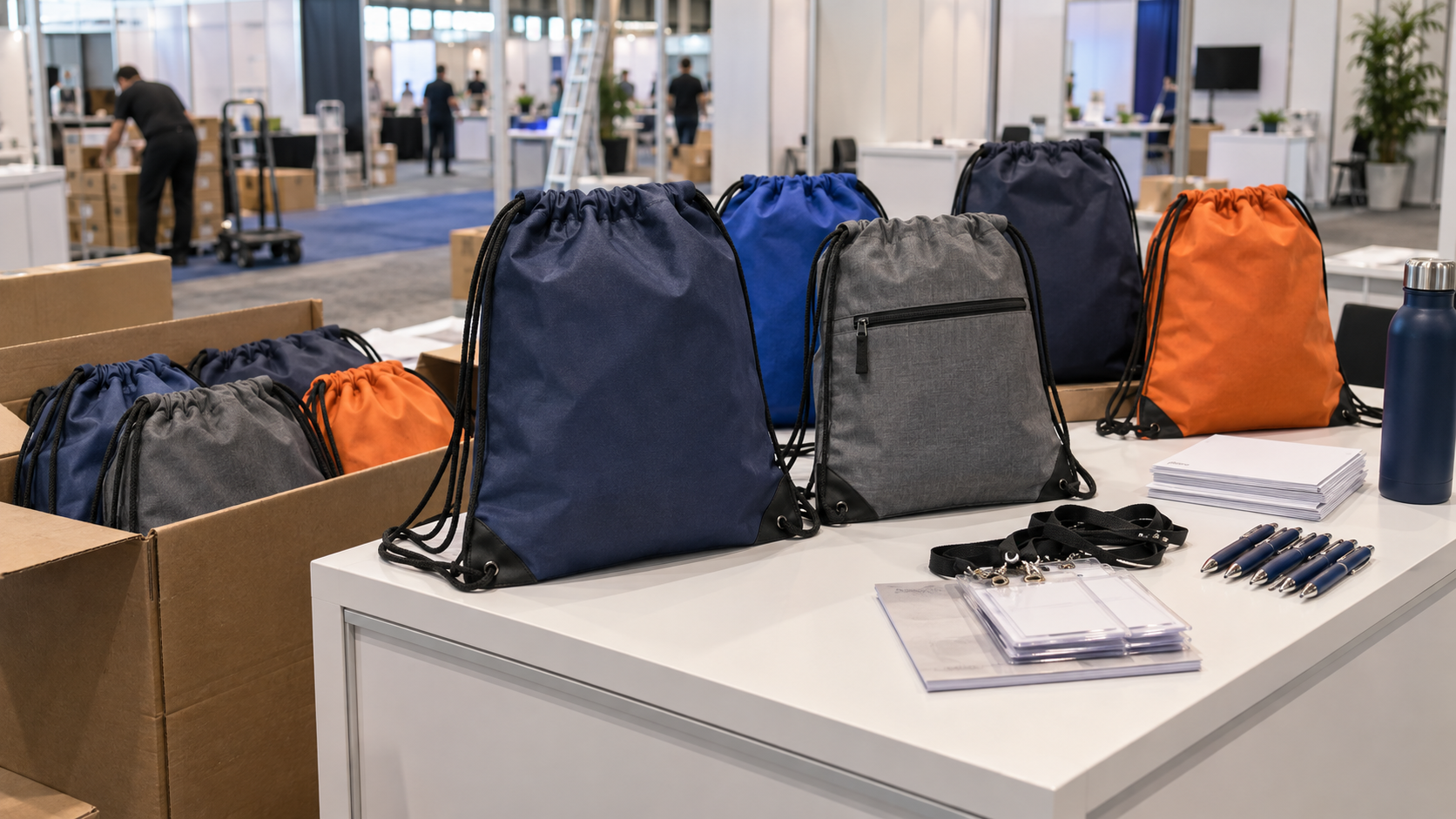
Which Tests Should Custom Drawstring Bags Pass?
Custom drawstring bags should pass the tests that address their material, construction, decoration, intended contents, carrying method and destination-market risks. There is no single universal test package or pass value for every pouch and backpack. A velvet jewelry pouch, a cotton gift bag and a coated polyester sports sack do not fail in the same way, so they should not inherit the same laboratory menu.
The practical answer is to combine three layers: material tests where a fabric property matters; component and assembly tests for cords, channels, seams and anchors; and finished-bag use simulations based on the real load and handling pattern. Every test request should identify the method, specimen, conditioning, number of samples, acceptance value and reporting format before sampling begins.
LUCKYSTAR's custom drawstring bag range provides starting points for material, size, closure and branding discussions. The guide below helps buyers turn those choices into a defensible test plan. Test scope, laboratory, cost, sample quantity and acceptance criteria remain subject to the final specification and written confirmation.
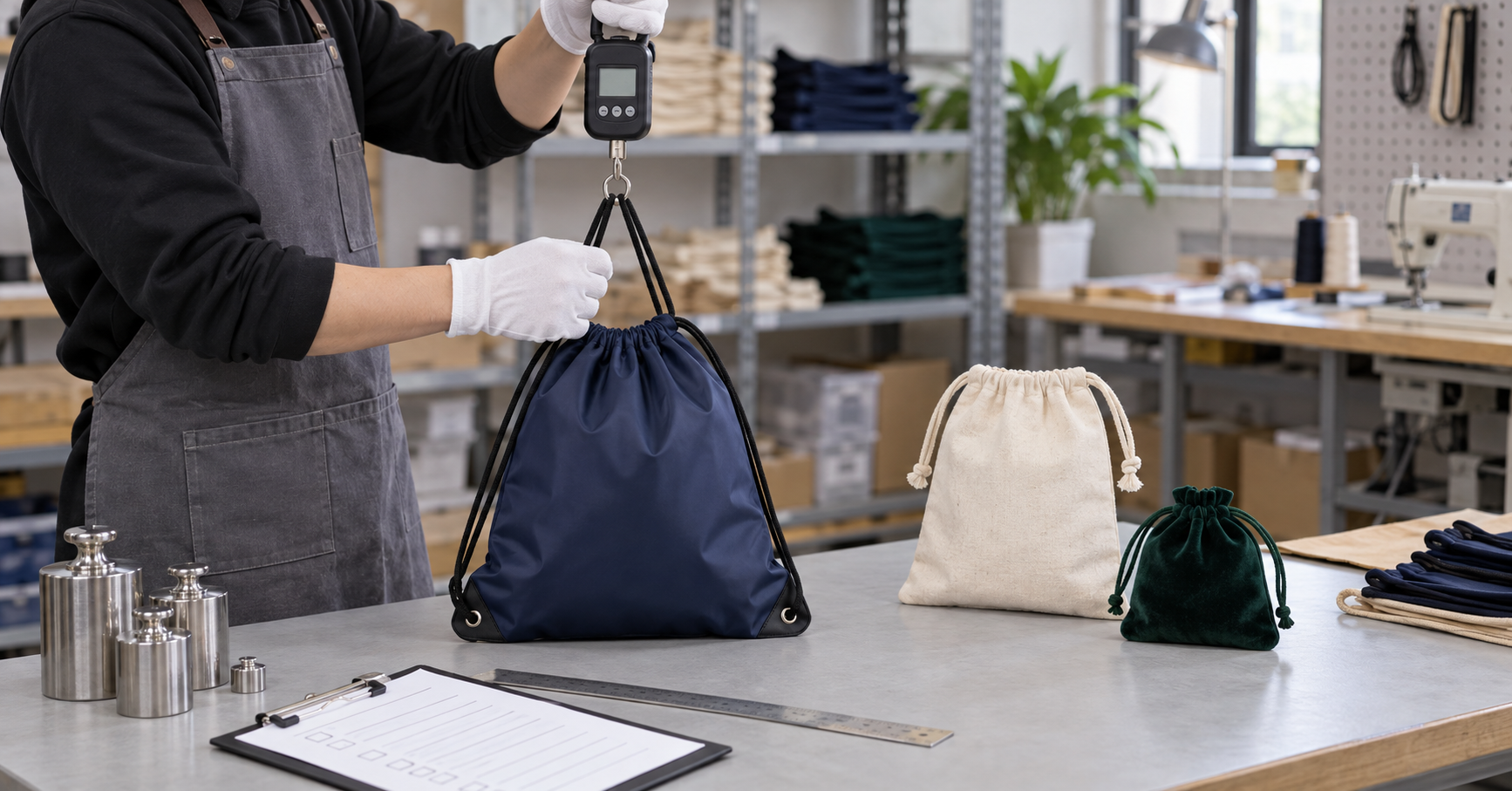
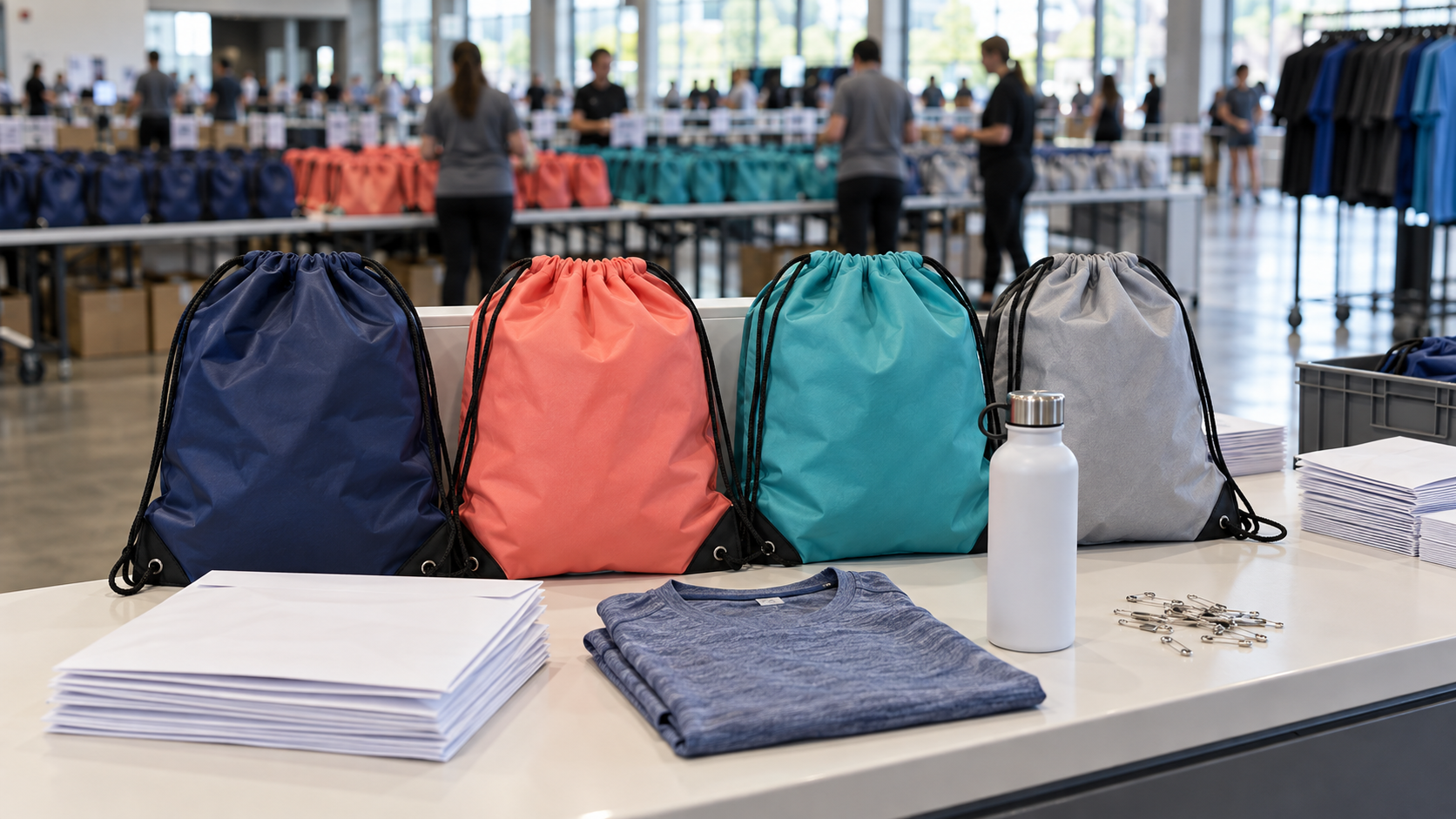
Editorial visualization based on common drawstring-bag constructions. It is not a photograph of a LUCKYSTAR laboratory, customer order or certified test.
Quick answer: the drawstring-bag test matrix
As a practical minimum, a custom drawstring bag should be checked for material and dimensional conformity, seam integrity, cord and closure function, color transfer, decoration durability and fit for the intended contents. A bag designed to carry weight should also receive an agreed finished-bag load-path test covering the cords, channels, anchors and seams. Wash, abrasion, water-resistance, chemical or certification testing should be added only when the intended use, claim, destination market or buyer policy makes it relevant.
Start with a pre-production sample and ask what could make the intended user reject, damage or misuse the bag. Then select tests from the matrix below. “Recommended” means relevant to the described risk—not automatically mandatory in every market or order.
| Risk area | What to test | Usually relevant when | Output to record |
|---|---|---|---|
| Material identity | Composition, construction, weight and finish against specification | A material claim, performance promise or consistent reorder matters | Method, specimen ID and measured result |
| Fabric strength | Tensile and/or tear behavior | The shell carries a load or can tear from a cut edge | Direction, method and force result |
| Seam and anchor | Seam rupture, seam slippage or whole-bag pull/load test | Cords or contents load stitched joints | Failure mode, force/load, duration and location |
| Closure function | Open/close cycles, cord travel, knot retention and stopper function | Any repeatedly operated drawcord closure | Cycle count and observed change |
| Abrasion | Surface or cord wear | Sports, shoe, travel or reusable carrying use | Method, cycles/end point and appearance |
| Color transfer | Dry/wet rubbing; wash fastness where applicable | Dyed/printed fabric contacts garments, hands or contents | Gray-scale or agreed rating |
| Decoration | Adhesion, cracking, abrasion, color and registration | Screen print, transfer, foil, embroidery or labels | Process-specific result and photos |
| Cleaning | Dimensional change, appearance and function after defined care | The bag will be marketed as washable or repeatedly cleaned | Care procedure, cycles and before/after data |
| Water claim | Fabric water penetration plus whole-bag exposure if relevant | Coated or treated bags carry a water-resistance claim | Method, pressure/exposure and leakage location |
| Product fit | Insertion, closure, contact and removal with actual contents | Pouches hold boxes, shoes, bottles, jewelry or kits | Product/surrogate ID and fit decision |
| Packing/transit | Pack-out, compression or agreed distribution simulation | Creasing, hardware damage or carton handling is a concern | Pack configuration and post-test inspection |
| Chemical/regulatory | Only the applicable restricted-substance or safety scope | Destination, material, age group or buyer policy requires it | Product, component, edition, lab and report scope |
Four terms are often confused in sourcing discussions:
| Term | What it answers | What it does not prove by itself |
|---|---|---|
| Test method | How a specimen is prepared, conditioned, tested and reported | That a particular result is acceptable for the buyer's use |
| Acceptance criterion | The numeric limit or approved-reference rule used for a pass/fail decision | That the chosen method covers every real-use failure mode |
| Production inspection | Whether sampled units from a stated lot match the approved requirements | Long-term durability or regulatory compliance unless those checks are included |
| Certification or test report | What the named document supports for its stated holder, product, sample, scope and period | Every LUCKYSTAR product, future order, colorway or destination market |
The article on Custom Drawstring Bag Quality Control Checklist explains how to inspect production lots. This article has a different job: it explains which qualification and performance tests to select before the inspection checklist is finalized.
1. Begin with intended use—not a supplier's standard package
A sensible test plan starts with six questions: What goes inside? How heavy, rigid, sharp or delicate is it? Is the bag carried, stored or presented? How often is the closure operated? Will it contact light-colored textiles or sensitive finishes? What exact claims will appear in marketing or packaging?
A buyer who only requests “standard testing” may receive a neat report that does not address the dominant failure mode. For example, high fabric tensile strength does not prove that a bottom eyelet will remain seated. A coating test does not prove that water cannot enter through an open drawstring mouth. A print rub test does not prove that a heat-transfer edge will survive laundering.
| Product example | Dominant risks | Priority tests |
|---|---|---|
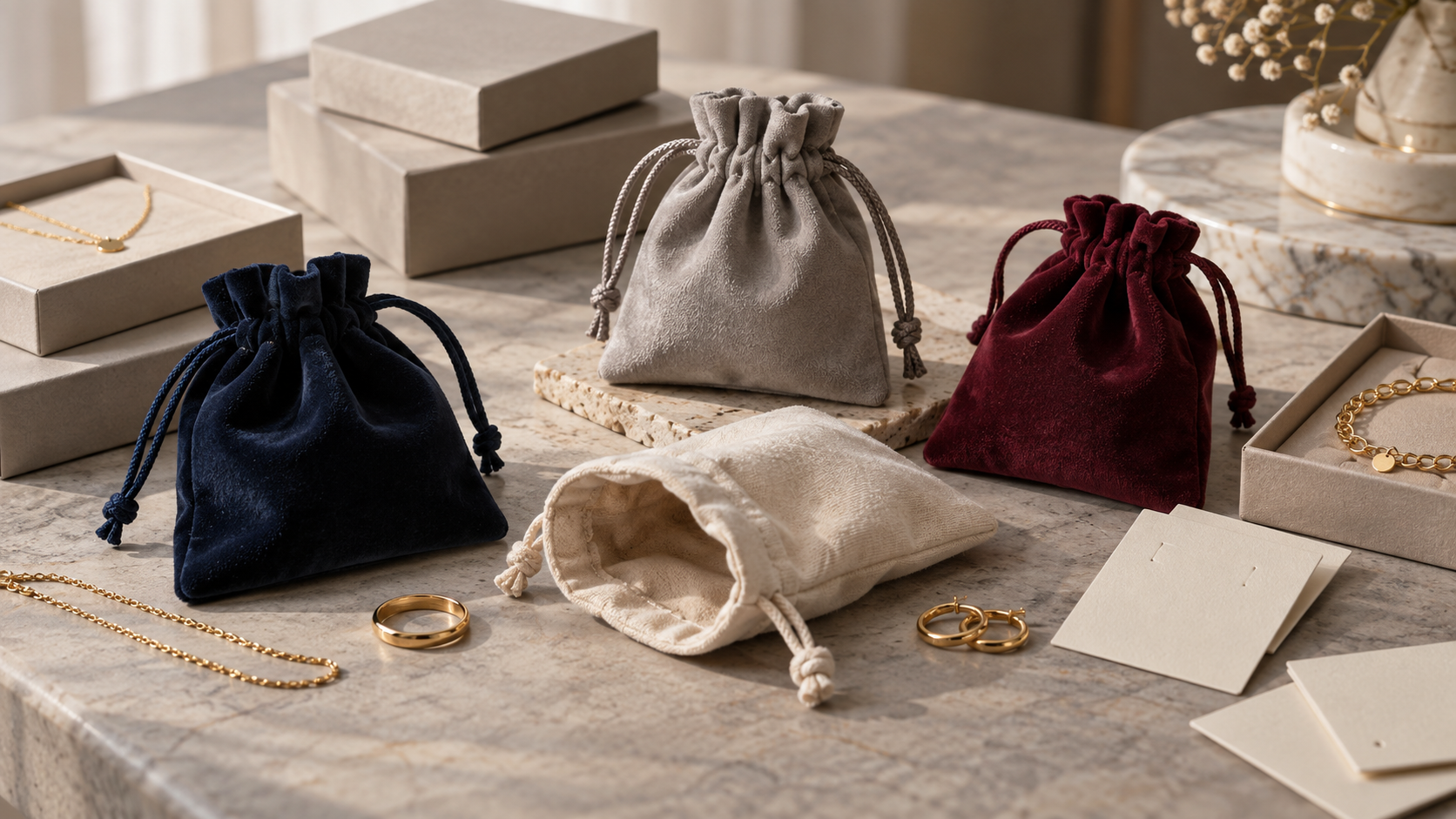
| Small velvet jewelry pouch | Surface marking, lint, color transfer, closure feel, snagging | Contact-surface review, dry/wet rubbing where relevant, draw cycle, actual-item fit |
| Cotton gift pouch | Size after care, cord shrinkage, print change, seam opening | Defined wash/dry trial if washable, dimensional change, print/color checks, seam review |
| Polyester gym sack | Corner/eyelet failure, cord wear, seam rupture, abrasion, load distribution | Whole-bag loaded use, anchor pull, closure cycles, seam and abrasion tests |
| Coated shoe sack | Coating damage, odor, water-resistance claim, print adhesion | Coating/abrasion review, odor protocol, claim-specific water test, decoration adhesion |
| RPET promotional bag | Traceability claim plus functional performance | Order-specific recycled-content evidence plus the same performance tests required for the construction |
Do not confuse a certification, material transaction document or factory audit with product performance. Each answers a different question. LUCKYSTAR's knowledge base specifically requires environmental, chemical and certification statements to remain tied to the named material, product, report, applicant, scope and validity period.
2. What does “pass” mean for a custom drawstring bag?
A drawstring bag passes only when an identified specimen, tested under an agreed method and conditions, meets a written acceptance criterion. A laboratory result without a predefined limit is a measurement—not a complete purchasing decision.
Testing an undefined sample produces an undefined result. The request should reference the approved bill of materials, finished dimensions, fabric direction, color, coating, cord, hardware, stitch construction, decoration process and sample revision. If the production bag later changes from round cord to flat tape or from sewn corner patches to metal eyelets, the relevance of the earlier result must be reviewed.
Every test line needs a complete instruction:
| Field | What to state |
|---|---|
| Purpose | The risk or claim the test supports |
| Test item | Fabric, printed panel, seam specimen, cord assembly or finished bag |
| Method | Named standard and edition, buyer method or fully written internal protocol |
| Conditioning | Temperature/humidity or wet/dry state when the method requires it |
| Samples | Quantity, direction, colorway, lot and whether destructive |
| Procedure | Load, rate, cycles, duration, care process and inspection points |
| Acceptance | Numeric limit or approved-reference rule agreed before the test |
| Report | Raw values, average/range, failure mode, sample photos and deviations |
“Pass” is not a property of the method alone. A standard normally defines how to test; the buyer, regulation or product specification defines the acceptance level. Never copy a competitor's number without confirming that the material, unit, specimen geometry and intended use are comparable.
The drawstring bag tech-pack guide shows where these fields belong, while the sample-development process explains when to freeze the approved sample.
3. Verify material identity, weight and construction
Begin with the specification: fiber composition when claimed, woven/nonwoven/knitted construction, nominal fabric weight, coating or lamination, color and face orientation. The verification method must fit the claim. A GSM check cannot prove fiber content, and a burn test is not a substitute for an accredited composition method when a formal claim is needed.
Measure the property on a representative pre-production or production material sample, not on an unrelated swatch. Record the actual roll or lot link. For laminated and coated fabrics, distinguish total composite weight from base-fabric weight. For a finished bag, seams, hems and decoration can distort a simple cut-and-weigh result, so specify where specimens come from.
The material decision itself is covered in Best Materials for Custom Drawstring Bags. Here, the quality question is narrower: does the test specimen match the approved material definition for this order?
4. Select tensile and tear tests that fit the fabric
Fabric tensile testing measures resistance to an applied pulling force under a defined specimen geometry. ISO 13934-1:2013 covers maximum force and elongation using a strip method and notes that it is mainly applicable to woven fabrics; it is not normally applicable to every nonwoven or coated construction. That limitation matters for drawstring bags, which can use woven cotton, nylon, polyester, nonwoven PP or coated composites.
Tear testing addresses propagation after a cut or defect begins. ISO 13937-2:2000 covers a single-tear method using trouser-shaped specimens. Tensile and tear results are not interchangeable: a fabric may resist a straight pull yet propagate a tear quickly from a needle hole or cut edge.
Use substrate tests to compare materials and lots, but do not treat them as proof of whole-bag carrying capacity. Stitch holes, seam allowance, cord exits, eyelets, corner patches and product shape redistribute stress. A finished assembly test is still needed when the bag carries a load.
5. Test seams, slippage and the complete load path
For sewn products, the seam can rupture, the thread can break, the fabric can tear beside the seam, or yarns can slip and open the joint. Record the failure mode, not only the peak value. ISO 13935-1:2014 is listed for determining maximum force to seam rupture using a strip method. Seam tests require representative stitch type, density, thread, seam allowance and fabric orientation.
Then test the assembled product under an order-specific loaded-use protocol. A gym sack should be loaded with the agreed mass and distribution, closed, lifted or cycled as intended, and inspected at the channel, side/base seams, eyelets or patches, knots and cords. A pouch for a rigid box should be tested with that box or a dimensionally faithful surrogate because point pressure and insertion clearance matter more than hanging mass alone.
| Finished-bag protocol field | Example of a complete instruction |
|---|---|
| Contents | Named product or approved surrogate with dimensions and mass |
| Loading | Even fill, localized rigid corner or specified distribution |
| Carry orientation | Suspended by both cords, one side, base support or storage only |
| Sequence | Close, lift, hold, walk/swing or repeated pull as agreed |
| Duration/cycles | Buyer-defined value tied to intended use |
| Observations | Seam opening, yarn slippage, eyelet movement, cord damage, deformation |
| Acceptance | No loss of function plus stated cosmetic allowance |
LUCKYSTAR should be asked to confirm the proposed sample construction and test protocol in writing. This is more useful than accepting an unsupported generic load rating.
6. Test cords, channels, knots and hardware as one system
A cord's nominal breaking strength does not predict the behavior of the closure assembly. The cord may be strong but too large for the channel, too smooth for the knot, too abrasive for the eyelet or too narrow for comfortable shoulder use. Test it in the production-intent channel and anchor design.
Open and close the bag through an agreed number of cycles in both empty and loaded states. Observe initial and changing operating force, jamming, twist, fraying, cord migration, tail-length imbalance, knot movement, stopper grip and damage at exits. If hardware is present, inspect burrs, plating damage, eyelet rotation and hole elongation. For sewn corners, examine whether the load reaches the reinforcement or concentrates at one stitch row.
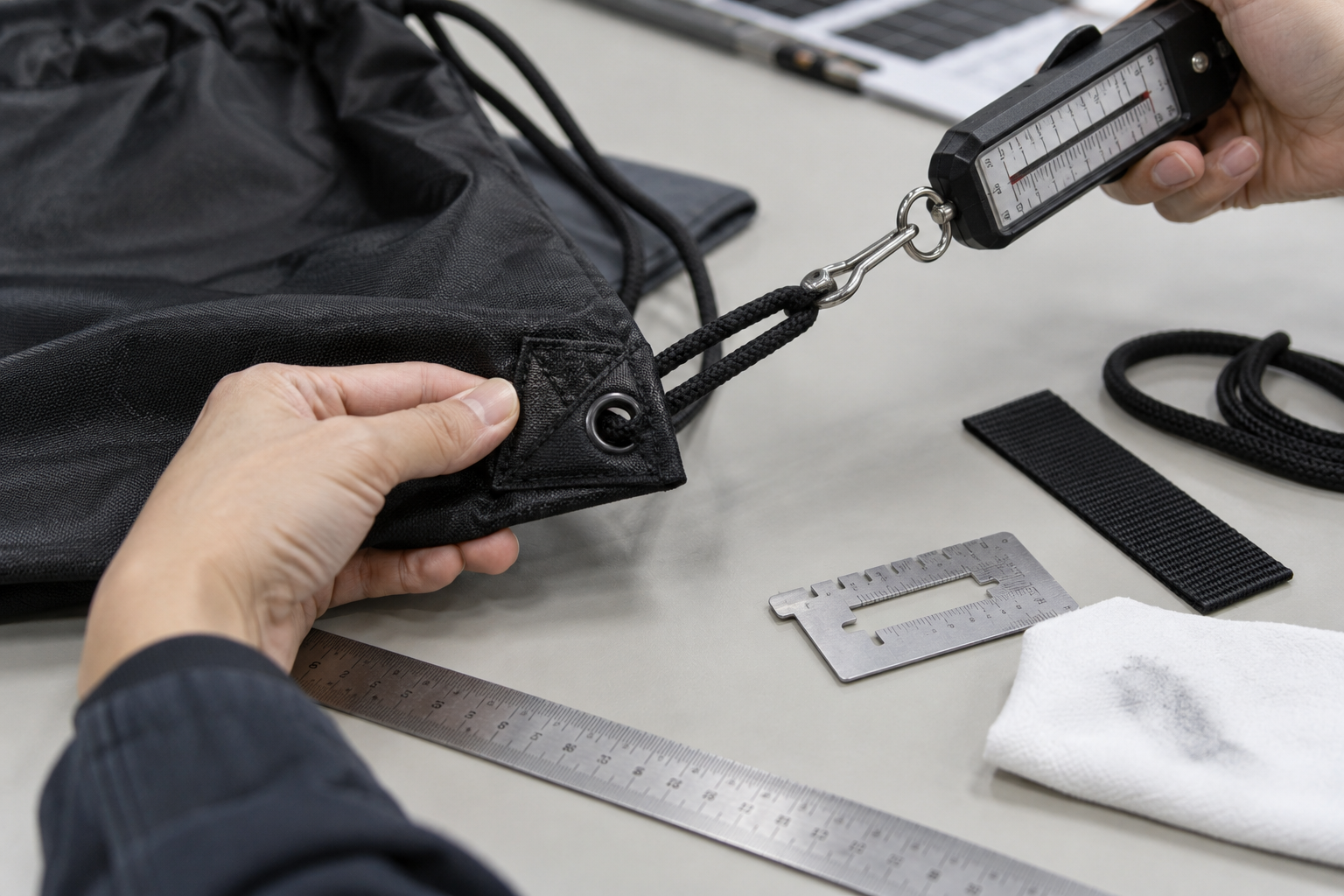
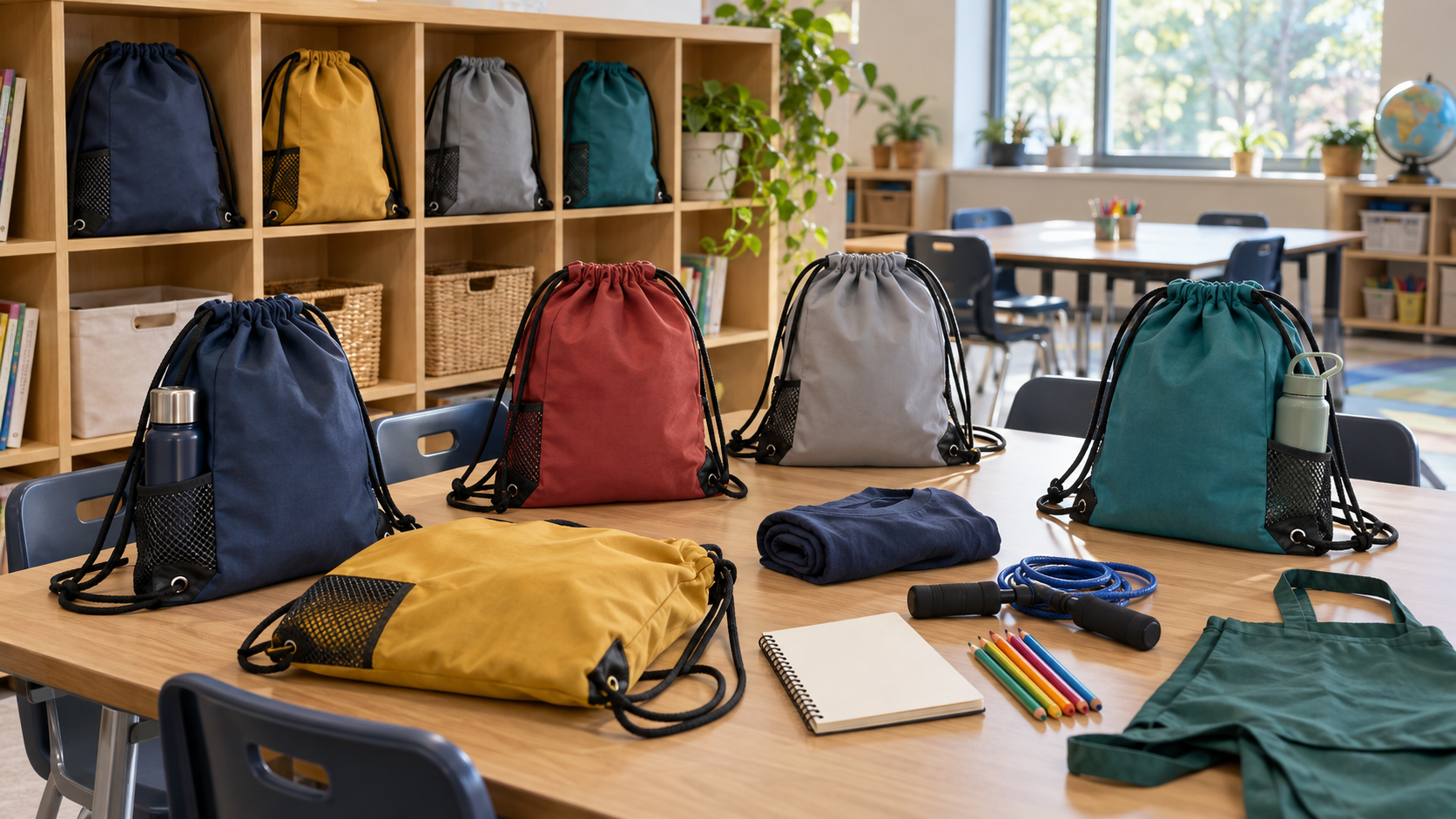
Editorial visualization of test planning, not evidence of an actual LUCKYSTAR test result or certified laboratory procedure.
Use Drawstring Cord, Eyelet and Reinforcement Guide to choose the construction and How to Improve Drawstring Bag Shoulder Comfort to define carrying-contact risks. Testing should confirm the chosen system, not reopen design choices after bulk production.
7. Evaluate abrasion where repeated contact matters
Abrasion can thin a shell, polish a pile, damage a coating, fuzz a cord or wear through a printed surface. The relevant contact depends on use: a gym sack rubs against clothing and floors; a velvet pouch rubs against its contents and pack-out; a cord rubs repeatedly against its channel or eyelet.
ISO 12947-2:2016 describes determination of fabric specimen breakdown using the Martindale method and notes that it is applicable to many textile fabrics, including nonwovens, but not to coated fabrics when the coated surface itself is the subject. This is another reason not to prescribe one test blindly. A coated surface may need an appropriate coated-fabric method, while cord/channel wear may need a custom component cycle.
State the abrasive, pressure, cycles or end point, specimen face and acceptance rule. Include before/after photos and note pilling, gloss, coating loss, yarn breakage or color change separately.
8. Check dry and wet color transfer
Dark cords, saturated fabrics and printed panels can transfer color to clothing, hands, pale products or adjacent bags. ISO 105-X12:2016 specifies a method for evaluating resistance to rubbing off and staining; dry and wet rubbing can be assessed. The method applies broadly to dyed or printed textiles, but it does not establish a universal grade for every bag.
Specify which surfaces are tested: shell face, lining, cord, print and any pile fabric. State the agreed rating and whether color change, staining or both control the decision. If a dark pouch holds a light leather, coated metal or cosmetic item, add a direct compatibility trial because a standard white rubbing cloth cannot reproduce every product finish.
9. Match decoration tests to the actual process
Screen print, heat transfer, sublimation, foil-effect decoration and embroidery fail differently. A screen print can crack or lose adhesion; a transfer can lift at an edge; sublimation can migrate or show shade variation; foil can rub or crease; embroidery can pucker, abrade contents or expose uncomfortable backing.
| Decoration | Useful test questions | Avoid this shortcut |
|---|---|---|
| Screen print | Adhesion after cure, flex/crack, dry/wet rub, color and coverage | Testing only a flat ink drawdown |
| Heat transfer | Edge lift, bond after flex/heat/care, surface distortion | Assuming fabric adhesion from another substrate |
| Sublimation | Shade, ghosting, migration, image registration and wash/rub behavior | Using a screen-print criterion without review |
| Foil-effect finish | Transfer completeness, rub, fold/crease and pack-out marking | Calling decorative foil “metallic” performance evidence |
| Embroidery | Stitch security, puckering, backing, abrasion and interior contact | Treating thread color approval as durability approval |
For method selection, see Custom Drawstring Bag Printing Methods. For artwork and location, use Drawstring Bag Logo Placement and Print Size Guide. The test sample should reproduce the final fabric color, finish, artwork size and cure or bonding conditions.
10. Add wash and dimensional-change tests only to a defined care claim
If the product is sold as washable, specify the washing machine type, temperature, detergent, drying procedure and number of cycles. ISO 6330:2021 provides domestic washing and drying procedures for textile testing and makes clear that a complete procedure combines washing and drying. ISO 105-C06:2010 covers color fastness to domestic and commercial laundering under defined test conditions.
After each specified care sequence, measure dimensional change and inspect color, print, coating, embroidery, cord shrinkage, knot position, channel function, seam puckering and overall shape. A fabric-only wash result cannot show whether a polyester cord shrinks differently from a cotton shell or whether a transfer bridges a gathered area.
Do not claim “machine washable” merely because a single sample survived an informal wash. Publish the care instructions that match the tested procedure and confirm labeling requirements for the destination market.
11. Test water-related claims at fabric and finished-bag levels
“Water-resistant fabric” and “waterproof bag” are not equivalent. ISO 811:2018 specifies a hydrostatic-pressure method for resistance of fabrics to water penetration. It can support a fabric-level comparison when appropriate. It does not prove that an open drawstring mouth, stitched seam or eyelet prevents entry.
If water exposure matters, define a finished-bag exposure that represents expected use: direction, duration, water intensity, closure position, contents and acceptable ingress. Report where water enters. Avoid an absolute waterproof claim unless the complete construction, test method and acceptance requirement support it.
The Waterproof Drawstring Bag Materials Explained article covers material and seam choices. In this test plan, water testing is optional and claim-driven—not a default badge for every coated bag.
12. Treat chemical and certification testing as scope-specific
Restricted-substance and safety requirements depend on the destination, product components, end user and buyer policy. Prepare a component list covering shell, lining, coating, ink, adhesive, cord, stopper, metal eyelet, label and packaging. Ask the compliance owner or qualified laboratory to identify the applicable rule and current edition.
LUCKYSTAR's records include historical or sample-limited reports; they must not be generalized. In particular, the knowledge base notes that 2021 REACH/RoHS reports cover a specific cotton drawstring-bag sample, not the current product line or every order. GRS, GOTS, BSCI, ISO, REACH or RoHS must never be presented as a current company-wide certification without verifying holder, scope, product, number and validity.
| Evidence type | What it can support | What it cannot support by itself |
|---|---|---|
| Material certificate | The stated material and scope for the named holder/period | Finished-bag performance or every supplier |
| Transaction certificate | Order/batch traceability within the scheme scope | Generic company certification for future orders |
| Chemical test report | Listed sample, components, method and substances | Other colors, components, lots or regulations |
| Factory/social audit | Conditions/systems assessed in that report | Product safety, fabric strength or customer-logo rights |
| Inspection report | Observed lot attributes at the stated time | Ongoing certification or every future shipment |
Request documents early enough to resolve gaps before bulk. If the order requires a current third-party report, state who selects the sample, who pays, which laboratory is acceptable and what happens if a component changes.
13. Separate qualification, production control and final inspection
The same check should not be repeated at the wrong stage while a more important risk is missed. Qualification asks whether the design and materials can work. Production control asks whether the process remains consistent. Final inspection asks whether the completed lot matches the approved requirements.
| Stage | Typical tests or checks | Decision |
|---|---|---|
| Material/design qualification | Composition/weight, tensile/tear, seam prototype, colorfastness, decoration, loaded use | Approve or redesign the specification |
| Pre-production sample | Finished dimensions, product fit, closure cycles, load path, appearance and pack concept | Freeze the approved reference |
| Incoming/first article | Identity, color lot, production-intent assembly and decoration | Release materials and line setup |
| In-process | Seam/channel/anchor trend, measurements, print and function | Correct drift and contain affected units |
| Final inspection | Random lot inspection plus specified functional checks | Accept, hold, rework or reject under agreed rules |
| Periodic/reorder verification | Risk-based requalification after material, supplier, process or claim change | Confirm evidence still applies |
The Custom Drawstring Bag Manufacturing Process explains these gates from design to delivery. The custom bag manufacturer guide gives the broader sourcing context.
14. Build a buyer-ready test request
Send the supplier a short matrix rather than a list of standard numbers. For every requested test, link the result to the product revision and the commercial decision it controls.
| Test ID | Risk | Specimen | Method/conditions | Quantity | Acceptance | Timing/owner |
|---|---|---|---|---|---|---|
| T-01 | Bottom anchor movement | Finished navy gym sack | Agreed loaded-use sequence | ___ | ___ | PPS / ___ |
| T-02 | Cord fraying/jamming | Finished bag, production cord | Open/close cycle protocol | ___ | ___ | PPS + bulk / ___ |
| T-03 | Dark color transfer | Shell and cord | Agreed dry/wet rub method | ___ | ___ | Material approval / ___ |
| T-04 | Print edge lift | Decorated production fabric | Flex/care/adhesion protocol | ___ | ___ | Strike-off / ___ |
| T-05 | Product fit | Actual item or approved surrogate | Insert, close, handle, remove | ___ | ___ | Sample approval / ___ |
| T-06 | Pack-out damage | Final packed carton | Agreed compression/transit sequence | ___ | ___ | Pre-shipment / ___ |
Fill every blank before the test is commissioned. If a third-party laboratory will issue the report, confirm sample sealing, report language, accreditation expectation and whether photographs and raw results are required.
Why choose LUCKYSTAR for a test-defined drawstring bag project?
LUCKYSTAR offers custom drawstring bag formats across materials, sizes, cord arrangements and decoration routes. The useful sourcing advantage is the ability to discuss the bag specification, sample, branding, intended contents and test evidence as one project instead of treating testing as paperwork added after production.
Ask LUCKYSTAR to review your risk matrix during quotation: which tests apply; whether they are material, component or finished-bag tests; how many samples are needed; whether a third-party laboratory is required; and which results must be approved before bulk. This helps align construction choices with measurable release criteria.
For buyers, the value of this specification-first workflow is practical: the quotation can identify the intended construction; sample approval can freeze the relevant bag revision; testing can be assigned to the correct material, component or finished product; and production inspection can check the attributes that remain after destructive qualification tests are complete. This creates a clearer evidence trail than asking for a generic “quality certificate.”
This is a project-planning proposition, not a claim that every test is performed in-house, every product is certified, or every bag carries the same load. MOQ, price, sample fee, testing cost, timeline, laboratory, standards and acceptance values are subject to specification and written confirmation. Use How to Choose a Custom Drawstring Bag Manufacturer to evaluate supplier responsibilities before ordering.
RFQ checklist: send the test plan with the design brief
Include intended contents, product dimensions and mass, bag dimensions, material and weight, lining/coating, cord and reinforcement, artwork, quantity/color breakdown, destination market, care claim, water claim, required documents and target delivery. Then request a test-response table that states feasibility, proposed method, sample quantity, laboratory, timing, price and evidence supplied.
Avoid asking “Can this bag pass all tests?” Ask instead: “Can this exact revision meet these agreed criteria, and what evidence will be supplied before bulk and shipment?”
Tell LUCKYSTAR about your drawstring bag, intended use and testing requirements. The team can respond against the actual specification rather than a generic performance promise.

The GET QUOTE image opens LUCKYSTAR's contact form. Sampling, testing, compliance, pricing, MOQ and production terms require written confirmation for the final order.
Frequently asked questions
What are the minimum tests for a custom drawstring bag?
The usual baseline is specification and dimension verification, seam integrity, cord and closure function, color-transfer review, decoration durability and actual-product fit. Add a finished-bag loaded-use test when the bag carries weight. Add wash, abrasion, water, chemical or certification tests only when a defined use, claim, market rule or buyer requirement calls for them.
Does every custom drawstring bag need laboratory testing?
No. The required evidence depends on risk, claim, destination and buyer policy. Basic dimensions and closure function may be checked during sample approval and inspection, while regulated claims, material properties or high-risk performance may justify third-party laboratory work. Write the rationale for each test.
Is a fabric tensile result enough to state the bag's load capacity?
No. Fabric tensile testing does not reproduce seams, holes, eyelets, reinforcement, cord routing, shape or load distribution. Use it to characterize fabric, then validate the finished load path with an agreed whole-bag protocol.
How many open-and-close cycles should the cord pass?
There is no universal number in this guide. Select a cycle target based on expected reuse, construction and buyer requirement. Define the motion, load, speed, observations and pass rule so results are repeatable.
Should a cotton drawstring bag always be wash-tested?
Only when the care claim or intended use requires it. If it will be marketed as washable, test the complete bag—including cord and decoration—using a defined wash and dry procedure. Do not infer washability from fiber type alone.
Can one colorway's report cover every color?
Not automatically. Dyes, pigments, coatings and prints may change by color. Use a risk-based bracketing plan approved by the buyer or test the relevant colorways, especially dark shades and different decoration systems.
Who should choose the laboratory?
The purchase specification should say whether the buyer nominates the lab, the supplier proposes it, or either party may use an agreed qualified facility. Confirm accreditation, method edition, report holder, sample identification and payment before submission.
When should testing be repeated for a reorder?
Review evidence whenever material source, construction, color, coating, cord, hardware, ink, laboratory requirement, regulation or intended claim changes. Even without a known change, the buyer may define periodic requalification based on risk and order history.
Final takeaway
The best test plan is not the longest. It is the one that connects each important failure mode to a suitable specimen, method, acceptance rule and production decision. For custom drawstring bags, prioritize the complete system: fabric, seams, cord path, anchor, decoration, actual contents and finished-bag handling. Freeze the requirements before testing, retain traceable evidence and re-evaluate results whenever the product changes.
Use LUCKYSTAR's custom drawstring bags as a configuration starting point, then turn your intended use into a written test matrix before sample approval.