A handle is the smallest part of a shopping bag that the customer feels for the longest time. It decides whether the bag can be lifted from the checkout counter, carried in one hand or on a shoulder, kept level around rigid boxes and delivered without the attachment tearing through the body. It also changes the bag’s silhouette, brand impression, production route and folded carton volume.
This Shopping Bag Handle Guide treats the handle as a complete carry system. It compares twisted and flat paper handles, cotton or polyester rope, ribbon, die-cut openings, non-woven loops, self-fabric handles and woven webbing. It also explains usable drop, grip comfort, spacing, reinforcement, attachment, finished-bag validation, quality control and packing.
Explore possible body-and-handle combinations through LUCKYSTAR’s custom shopping bag range. When the project moves from component selection to supplier review, apply the questions in our shopping-bag manufacturer selection article and the category-wide manufacturer sourcing pillar.
Planning an order? Send a handle-system brief. Include normal and maximum basket, hand or shoulder carry, bag body construction, handle material/width or diameter/drop/spacing, attachment and reinforcement, artwork conflicts, condition/load/comfort tests, quantity by variant, packed presentation, destination and required date.
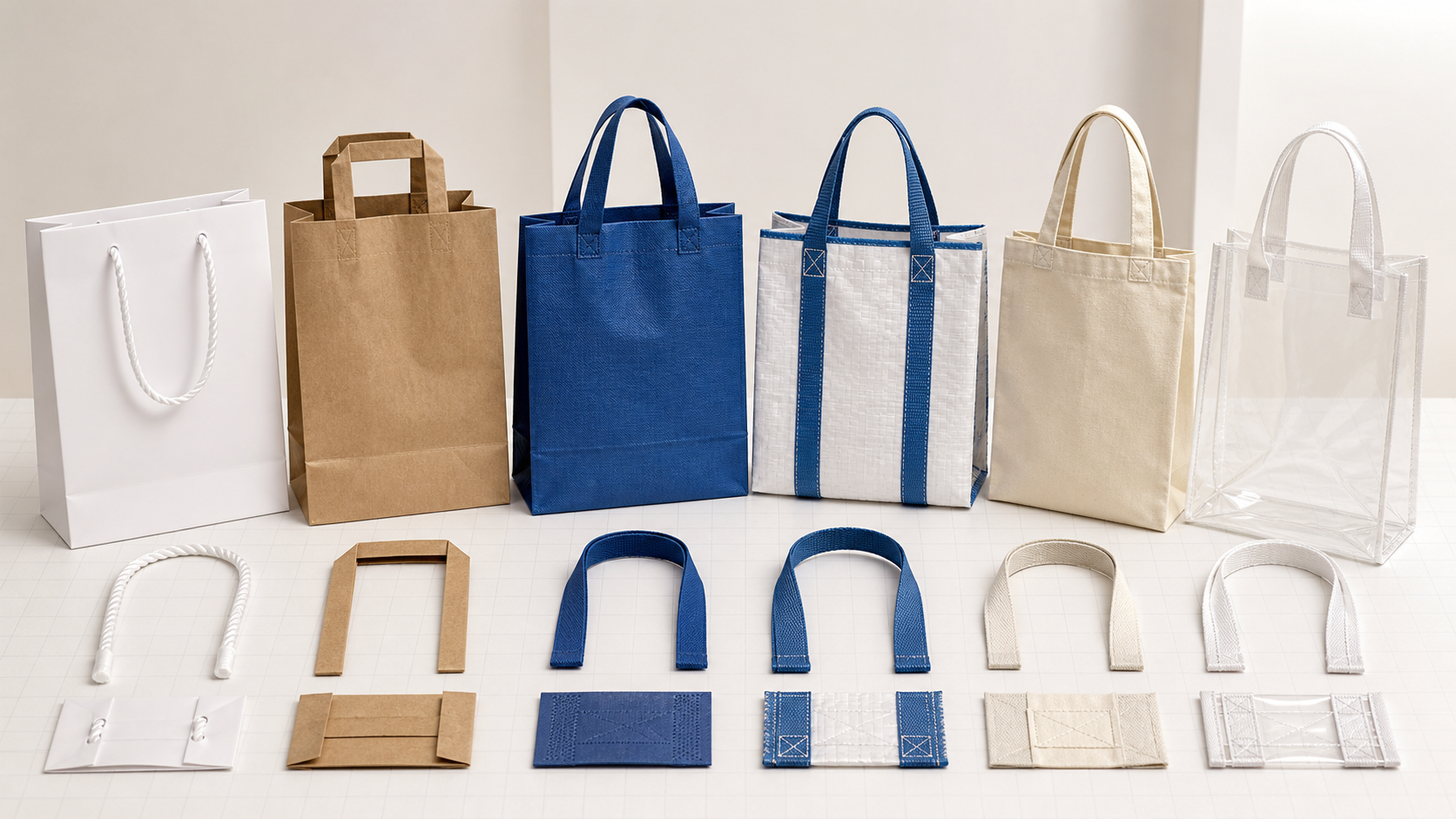
Compare the handle, attachment and bag body together; a loose handle sample cannot prove the installed carry system.
1. Start with the retail carrying job
A boutique paper carrier holding a fragrance box faces a different job from a woven-PP grocery bag holding bottles. The boutique bag may prioritize a soft hand, short controlled drop and premium color match; the grocery bag needs a wider contact surface, repeat-load durability and efficient flat stacking. A shoulder-carry shopper must clear the user’s arm and clothing, while a small hand-carry gift bag should not let a rigid product swing too far below the grip.
Write down the normal contents, heaviest sensible basket, largest rigid item, carry duration, hand or shoulder use, user group, season, store handling and whether the bag is sold or given away. Add the intended after-use: a paper bag may serve as premium retail packaging, while a fabric or PP bag may be expected to return to the store repeatedly.
Do not begin with “premium rope” or “strong webbing.” Begin with the load and interaction. The same rope can feel comfortable on a light paper carrier and become painful on a heavy bag. The same webbing can work as a hand grip and still be too short or stiff for a winter-coat shoulder.
2. Compare Shopping Bag Handle Types
The visible name describes only part of the system. Twisted paper handles can be made in different widths, paper structures, colors and folding profiles. Rope varies by fiber, braid/twist, diameter, core, softness and end construction. Webbing varies by fiber, weave, thickness, edge and elongation. Ask the supplier to identify the actual component and its attachment rather than approving a generic category.
| Handle type | Typical brand / use direction | Primary advantage | Main risk to resolve |
|---|---|---|---|
| Twisted paper handle | Kraft and printed paper retail carriers | Paper-based visual language, familiar machine-made route and good hand opening | Twist consistency, adhesive patch, moisture response and surface roughness |
| Flat folded paper handle | Food, pharmacy, mass retail and cost-controlled paper bags | Flat packing, broad contact and efficient automated attachment | Fold edge comfort, delamination, patch coverage and handle standing direction |
| Cotton or polyester rope | Premium fashion, beauty and gift carriers | Soft tactile cue, broad color choice and distinctive drape | Hole/eyelet wear, knot or end-anchor security, bulk and fiber/color transfer |
| Ribbon or tape handle | Gift, confectionery, cosmetics and seasonal packaging | Refined color/finish and compact visual profile | Edge pressure, slipping knots, fraying, twist and low resistance to a heavy basket |
| Die-cut / punched opening | Paper, plastic-film and non-woven promotional carriers | No separate handle component and efficient stacking | Corner tear, insufficient hand clearance, hard edge and weak reinforcement |
| Non-woven loop handle | Promotional, exhibition and light reusable bags | Can share body color/material and support bonded or sewn production | Bond/seam consistency, local perforation and narrow grip under load |
| Self-fabric handle | Cotton, canvas, polyester and foldable shoppers | Coordinated appearance and flexible dimension/construction choices | Fold/seam layers, fraying, stretch, attachment bulk and sample-to-bulk drop |
| Woven webbing handle | Woven PP, jute, canvas, clear-film and higher-load reusable bags | Controlled width, stable handling and robust sewn attachment options | Hard edges, color mismatch, excessive stiffness, needle damage and carton bulk |
3. Match the handle to the bag body
The bag body determines which attachment processes are realistic. Paper normally uses glued handle patches, holes with internal anchors, eyelets or reinforced die cuts. Spunbond non-woven can use an ultrasonic or heat-bonded loop, sewn loop or reinforced punched opening. Woven PP, cotton, polyester, canvas, jute and mesh usually rely on sewing, binding and reinforcement. Clear PVC or TPU may use welded tabs, sewn binding or textile patches designed around the selected film.
A handle can be stronger than the surface carrying it. When a narrow webbing end is attached to a weak panel, stress concentrates at the last stitch, bond edge or patch corner. Adding body weight everywhere may be less efficient than enlarging the attachment area, changing the reinforcement direction or carrying the webbing farther through the bag.
| Bag-body route | Practical handle directions | Attachment interface | First failure to investigate |
|---|---|---|---|
| Paper carrier | Twisted/flat paper, rope, ribbon, die-cut | Glued patch or turn-in, holes, eyelets, knot/T-end and local reinforcement | Patch peel, hole elongation, top-turn split or anchor pull-through |
| Spunbond non-woven PP | Bonded loop, sewn loop, webbing or die-cut | Ultrasonic/heat bond, sewn overlap or reinforcement patch | Interrupted bond, heat damage, tear from bond end or perforated stitch line |
| Laminated woven PP | PP/polyester webbing or compatible self-material handle | Sewn overlap, box-X/bar pattern, top binding and optional extended webbing | Tape-yarn distortion, laminate split, binding miss or end pull-out |
| Cotton / canvas / polyester | Self-fabric, cotton tape or woven webbing | Turned/folded handle, boxed-X, bar tack, patch or continuous underbody route | Seam rupture, fabric tear, needle damage, fray or uneven handle length |
| Jute / mesh | Cotton rope, padded/self handle or webbing | Large patch, lining capture, bound edge or webbing distributed across closed weave | Yarn pull-out, opening growth, patch delamination or abrasive hand contact |
| Clear PVC / TPU film | Textile webbing, bound handle, film handle or molded grip where suitable | Welded tab, textile patch, sewn binding or hybrid joint | Film tear at hard corner, weld peel, stitch perforation or trim incompatibility |
| Foldable lightweight shopper | Light self-fabric or low-bulk webbing | Distributed sewn/bonded attachment that nests within the fold map | Strong handle creates excessive packed bulk or crosses the pouch seam |
Review material-specific routes on LUCKYSTAR’s shopping bag collection. For compact products, connect handle length and layer stack to the Foldable Shopping Bag Manufacturing Guide before freezing the pouch and carton.
4. Specify usable drop, spacing and grip—not cut length alone
Handle cut length is a manufacturing input; usable drop is the customer-facing dimension. A rope disappears into holes and knots. A paper handle loses length in folded ends and patches. A sewn webbing handle loses length in the attachment overlap. The tech pack must show both the component length and the finished measurement.
Define handle drop as a named finished distance—for example, the vertical inside distance from the top edge or opening datum to the relaxed handle apex. State whether the bag lies flat, stands open or carries a reference load. Define spacing center-to-center or inside-to-inside and identify the face. Without datums, inspectors may produce different results from the same bag.
For a shoulder route, do not choose drop from an old tote alone. Test access with the intended bag width, opening stiffness, user clothing and product load. A wide stiff bag needs more arm clearance than a soft narrow bag; additional drop can also increase swing and leverage on the attachment.
| Specification field | What to state | Why it changes use or production | Approval evidence |
|---|---|---|---|
| Finished usable drop | Datum, relaxed/loaded state, measurement direction and tolerance | Controls hand, elbow or shoulder access and affects leverage | Measured finished sample plus real carry trial |
| Handle spacing | Center-to-center or inside distance from named top/side datums | Controls bag balance, opening access, logo clearance and patch placement | Dimensioned face drawing and spacing jig |
| Width or diameter | Finished value, tolerance, compression method and construction | Changes contact pressure, hand feel, attachment area and packing bulk | Physical component master and finished-bag review |
| Thickness / stiffness / softness | Component article, weave/twist/core, finish and signed tactile reference | Affects edge pressure, drape, opening behavior and carton recovery | Conditioned swatch and filled carry comparison |
| Attachment overlap / insertion | Length inside bag, seam/bond/glue area and distance from top edge | Determines load transfer and usable handle length | Cross-section, destructive section and first-off measurement |
| Pair symmetry | Difference allowed between handles and between bag faces | Unequal handles tilt the filled bag and overload one side | Both handles measured on the same unit |
| Hand clearance | Usable opening with the bag filled and handle in carrying position | Prevents the top edge or rigid contents trapping fingers | Representative user and checkout pickup trial |
Record these points of measure using the shopping-bag tech-pack instructions. Include front, side and cross-sectional views; a single face view cannot explain a hidden patch, knot, top turn or sewing overlap.
5. Evaluate comfort with the real filled bag
Comfort is not a property of material name alone. It depends on load, contact width, edge profile, stiffness, moisture, handle rotation, carry time and whether both handles share the load. A round rope can feel soft but concentrate pressure if its diameter is small. Wide webbing can distribute pressure but feel harsh when its edge is stiff or when it bunches. A flat paper handle can provide broad contact yet develop a hard folded edge.
Conduct a short structured trial with production-intent handles on the intended bag. Use representative products, not only smooth weights. Ask whether the bag lifts cleanly from the counter, stays level while walking, allows a normal hand posture, clears sleeves or a shoulder, rolls or twists, and leaves uncomfortable pressure before the expected journey is over.
Separate subjective comfort from structural release. A handle may pass a strength test and still be rejected for poor grip. Conversely, a plush rope may feel excellent at the sample meeting while its attachment is weak. Record both decisions.
6. Engineer the attachment and reinforcement as one load path
Load leaves the handle and enters the bag through a finite area. The attachment should spread that transition without creating a hard edge that starts a tear. Reinforcement material, fiber direction, patch size, top-turn depth, stitch or bond geometry, adhesive coverage and distance from a cut edge all affect the result.
For sewn systems, a large stitch pattern is not automatically stronger. Needle size, thread, stitch density, seam allowance, body material and reinforcement must work together. Too many penetrations can perforate thin non-woven or coated film. A box-X can distribute load on a stable woven structure, while another material may need a different pattern or larger patch. Bar tacks concentrate stitches and require suitable substrate and reinforcement.
Paper rope handles may use a knot, T-end or another concealed anchor through a reinforced hole. Flat and twisted paper handles are often supplied as assembled units with patches for gluing inside the bag. Die-cut openings need rounded geometry, sufficient clearance from folds and reinforcement sized beyond the crack-starting corners.
| Attachment architecture | Critical parameters | Typical failure mode | Evidence to retain |
|---|---|---|---|
| Paper handle with glued patch | Patch size/material, adhesive, coverage, pressure, cure and top-turn relationship | Patch peel, paper delamination, handle-end release or distorted top edge | Component lot, glue setting, first-off section and conditioned pull result |
| Rope through hole with internal anchor | Hole/eyelet, rope diameter, end type, anchor size and reinforcement | Hole elongation, eyelet cut, knot slip or anchor pull-through | Cross-section, anchor master and loaded-cycle sample |
| Reinforced die-cut handle | Opening radius, hand clearance, patch/turn coverage and edge finish | Corner crack, layer separation, uncomfortable edge or hand trap | Dieline, reinforced section and filled pickup trial |
| Ultrasonic / heat-bonded loop | Material compatibility, bond area, energy, pressure, time, horn/anvil and cooling | Narrow/interrupted bond, heat embrittlement, peel or tear from bond end | First-off bond, parameter record and production trend samples |
| Sewn overlap / box-X | Overlap, stitch path, needle/thread, density, patch and edge distance | Stitch rupture, body tear, webbing pull-out, puckering or seam slippage | Signed installed section and first-off pull/load result |
| Bar-tack reinforcement | Length/width, stitch count, thread, substrate build and position | Perforation, local heat/needle damage or tear at tack end | Machine program reference, section and controlled destructive check |
| Extended / continuous webbing | Path, intersections, base relationship, seam capture and alignment | Uneven load, twist, binding conflict, bulk or hidden missed stitches | Full path drawing and open-bag inspection before closing operations |
7. Keep handles out of the artwork and opening
Handle position affects the visible face. Rope or ribbon can cross a logo when the bag is carried. Webbing sewn down the face can divide a graphic. A concealed patch may show through light paper, and a dark rope can transfer color to a pale laminated panel during storage. Place handle holes, patches, stitches and the natural carried drape on the final artwork file.
Also protect checkout access. Handles that collapse inward can obstruct fast loading; very short handles can pull the top edges together around a box; long stiff webbing may not fall flat for storage. Review the bag empty, held open by staff, filled and carried. The same front elevation can look different in every state.
8. Qualify component color, finish and contamination risk
Color-matched handles need a physical approval under agreed lighting. Cord and webbing can vary by fiber, dye lot, texture and sheen even when a digital color reference is identical. For pale bags, evaluate dry and damp color transfer where relevant. For natural cotton rope, approve shade and fiber variation; for dyed components, connect colorfastness evidence to the final color and process.
Check odor, loose fiber, fraying, oil or machine marks, sharp ends, eyelet burrs, plastic tips and exposed adhesive. A premium paper bag can be visually perfect until rope fibers shed onto a cosmetic carton. A reusable bag can pass load testing while a rough webbing edge irritates the hand.
9. Test the handle system, not only the loose material
There is no single universal “shopping bag handle test” that fits every material, bag and claim. Write the test around the retail job. State conditioning, sample construction, filler shape and distribution, mass, lift point, direction, loading rate or cycle, hold time, number of cycles and failure rule. Decide whether temporary elongation, permanent deformation, patch peel, hole growth, stitch opening, comfort loss or visual damage counts as failure.
Coupon data helps select inputs but does not release the finished bag. ISO 1924-2:2008 remains current and measures tensile properties of paper and board; it does not prove a glued handle patch or pierced top edge. ISO 9073-3:2023 measures tensile strength and elongation of nonwovens by a strip method; it does not prove a bonded loop attachment.
For suitable woven textiles, ISO 13934-1:2013 determines peak force and the elongation at that point through a strip procedure. The grab procedure in ISO 13935-2:2026 determines the peak force at rupture for straight sewn seams. That seam standard has explicit scope limits: it is not normally intended for nonwovens, coated textiles or polyolefin tape-yarn fabric, among other structures. Have a qualified laboratory select the method, then relate the result to the installed handle and complete carrier.
| Handle check | Variables written into the procedure | Evidence observed | Release question answered |
|---|---|---|---|
| Incoming component check | Material, width/diameter, length, mass, construction, color and end treatment | Lot variation, twist/weave defects, fray, stiffness, shade and contamination | Accepts the handle lot before installation |
| Single attachment pull | Grip, direction, rate/hold, body restraint, conditioning and stop rule | Anchor, patch, bond, stitch, hole and surrounding body failure | Compares attachment builds and process first-offs |
| Paired-handle static load | Filler, mass/distribution, lift geometry, hold time and deformation limit | Bag balance, permanent drop change, top/body/base and both attachments | Confirms one controlled loaded condition |
| Cyclic lift / carry | Mass, stroke, speed, cycle count, rigid contents and failure rule | Progressive hole/bond/seam growth, webbing movement and imbalance | Represents repeated checkout pickup and walking |
| Comfort / grip trial | User group, load, duration, carry mode, clothing and rating questions | Pressure, edge bite, rolling, twist, slip, clearance and control | Selects width/diameter, hand and drop |
| Moisture / temperature conditioning | Environment, duration, test timing and recovery state | Paper/adhesive loss, handle stiffness, dye transfer, film/trim response | Supports route and destination conditions |
| Packed-storage recovery | Fold, handle position, pressure, time, temperature and unpack interval | Panel embossing, cord set, webbing spring, color transfer and opening obstruction | Releases bundle/carton method and presentation |
Use the broader Reusable Shopping Bag Test Guide to place handle evidence inside the full body, gusset and base validation plan.
10. Control the handle installation in production
The approved sample must become a repeatable setup. Incoming handles are identified by material, color and dimensions. Paper converting controls hole position, patch identity, adhesive, pressure and cure. Bonded non-woven controls material orientation, horn/anvil condition and process settings. Sewing lines control prepared handle length, overlap, fixture position, needle/thread and stitch route.
Approve a first-off bag at line start and after a relevant change. Measure both handles, both faces and the installed reinforcement. Perform a suitable quick pull or functional check where the quality plan requires it. If an attachment drifts, contain the production window since the last verified result; checking only the next finished carton cannot locate the affected units.
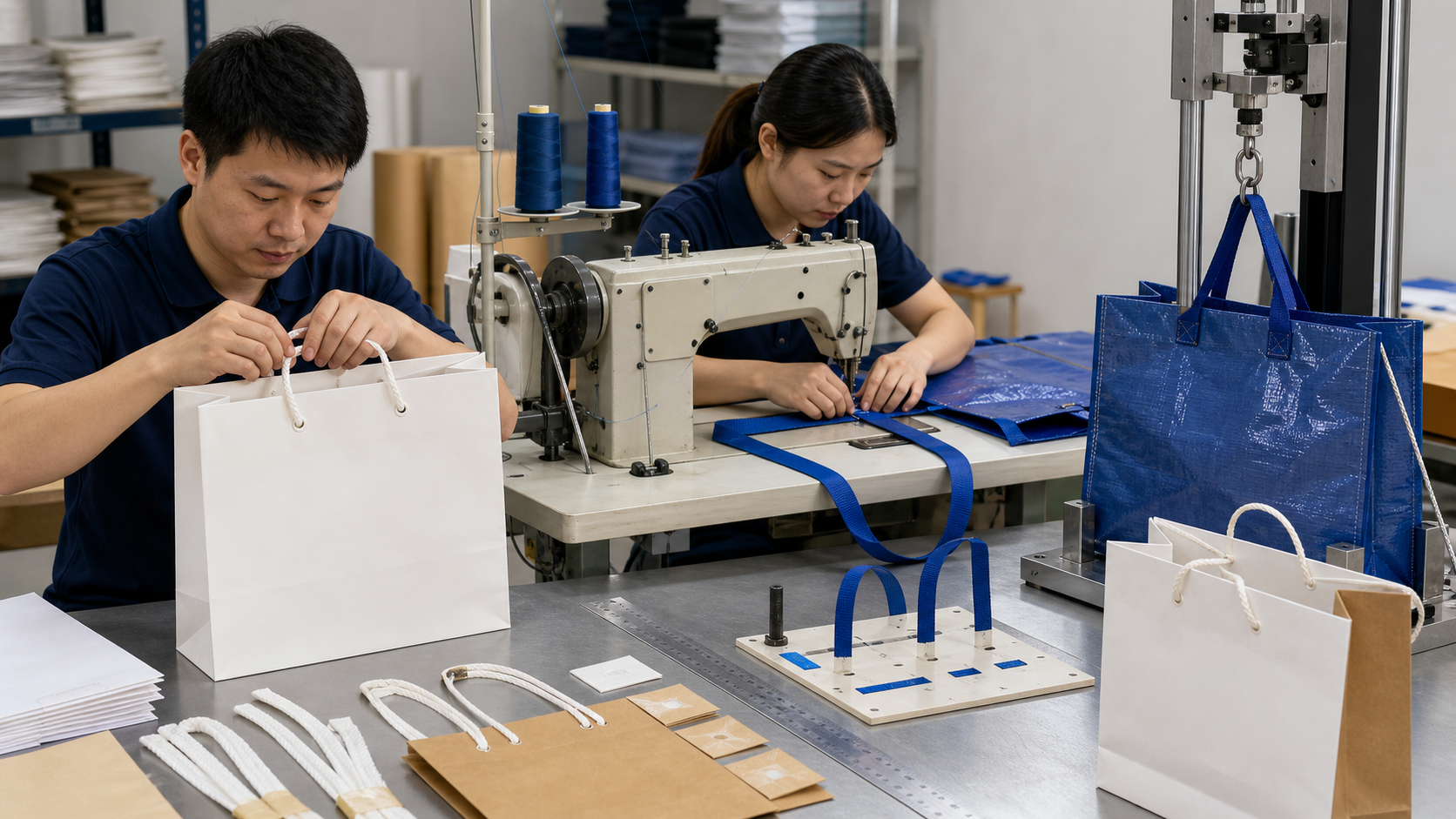
Handle installation needs dimensional, process and functional first-off evidence for each production route.
11. Inspect handle defects by probable cause
A useful defect library distinguishes appearance, measurement, construction and function. A slightly rotated rope end may be cosmetic; a rope anchor cutting into the hole under load is structural. Uneven drops can make the bag tilt and overload one attachment even if both handles remain connected. Classify defects before final inspection so the factory and buyer understand the decision.
| Observed handle defect | Likely process source | Immediate check | Prevention point |
|---|---|---|---|
| Unequal drop or asymmetric spacing | Prepared length, hole/patch fixture, sewing guide or stretch during handling | Compare both handles and faces against the same datums | Component cut control and first-off positioning jig |
| Paper patch peeling | Adhesive amount/type, contamination, pressure, cure or paper surface | Open a section; compare top, center and edge adhesion | Glue/patch setup and conditioned first-off pull |
| Hole elongation / top tear | Insufficient reinforcement, sharp hole/eyelet, low edge distance or anchor geometry | Inspect crack origin and both sides of reinforcement | Dieline, patch and complete loaded prototype |
| Bonded loop releases | Energy/pressure/speed drift, horn/anvil wear, material variation or contamination | Compare bond width/continuity and material damage | Parameter control and in-line verification frequency |
| Webbing pulls out / body tears | Short overlap, missed stitches, weak patch, stitch concentration or wrong direction | Open the attachment and map where load left the webbing | Pattern/fixture, sewn first-off and destructive section |
| Handle twists or rolls in use | End orientation, component torque, soft unsupported width or uneven pairing | Lift the intended basket and observe natural grip position | Carry trial before construction release |
| Color/lint/pressure transfer | Dyed component, loose fiber, trapped moisture, high carton pressure or wrong lay | Inspect bag faces and packed positions after controlled hold | Component approval and physical carton trial |
Connect this handle-specific defect library to the Custom Shopping Bag Quality Control Checklist so incoming, first-off, in-line and final decisions share the same approved sample and defect language.
12. Plan handle packing before the quotation is final
Rope, webbing and stiff folded handles can occupy more carton volume than the bag body. A rope can emboss laminated paper; eyelets can scratch adjacent surfaces; long webbing can spring outside a bundle; flat paper handles can crush if they are forced against the gusset. The pack-out should specify which direction each handle lies, whether it folds inside or outside, bundle orientation, interleaving, pressure and unpacking expectation.
Run a physical carton trial with production-intent handles. Measure the closed carton, weight and unit count after a representative hold. Then open bags from the top, middle and bottom and check handle set, print transfer, panel marks, twisted loops and checkout readiness. A small unit-price saving can disappear if the handle reduces carton count or requires labor to reshape in store.
13. Understand MOQ, cost and lead-time effects
Handle cost includes material, custom color, preparation, end treatment, patch/reinforcement, installation and inspection. Rope, ribbon and webbing can have component minimums separate from the bag body. A small total order split across several handle colors may create multiple dye or weaving lots even when the bags share one body.
Attachment route changes labor and capital. A machine-attached flat paper handle has a different commercial structure from manually inserted rope, sewn continuous webbing or a hybrid welded tab. Custom tips, eyelets, molded grips and branded hardware add suppliers, approvals and timing. Normalize quotations to the same handle specification, attachment, tests and pack-out using How Much Do Custom Shopping Bags Cost?.
14. What should a handle RFQ contain?
Send more than a front-view reference. A manufacturer needs the filled load, carry mode, finished bag dimensions, body material, handle material direction, drop, width/diameter, spacing, color, attachment concept, artwork, test expectation and packed presentation. If a decision is open, name the performance priority and ask for comparable options rather than allowing silent substitution.
| RFQ field | Useful buyer input | Manufacturer response expected | Approval milestone |
|---|---|---|---|
| Basket and carry mode | Products, normal/maximum mass, rigid edges, duration and hand/shoulder use | Handle/attachment direction and complete-bag validation proposal | Filled functional prototype |
| Bag-body route | Paper/film/fabric grade, weight/thickness, construction and finish | Compatible joining, reinforcement and known process limits | Installed material/handle section |
| Handle component | Type, composition, construction, width/diameter, hand and color reference | Exact component code, source status, MOQ, tolerance and substitute rules | Signed loose and installed masters |
| Finished geometry | Drop, spacing, datum, symmetry, opening clearance and tolerance | Achievable measurements, fixtures and method | Measured complete sample |
| Attachment / reinforcement | Preferred or open route, hidden/visible finish and artwork conflicts | Section drawing, materials, process settings/control and failure risks | Approved cross-section and functional result |
| Testing / QC | Condition, static/cyclic load, comfort, defect categories and report needs | Suitable procedures, development stage, equipment, check frequency and known limits | Approved evidence package and handle-specific production controls |
| Quantity / packing | Units by size × bag color × handle color, destination and presentation | Component MOQ, timeline, handle lay, carton count, measured cube and commercial basis | Released variant matrix and successful pack-out sample |
Company-claim boundary: LUCKYSTAR statements in this section are publisher self-description, not third-party verification, a test result or assurance that one handle is strongest, more comfortable, lower cost, lower impact, suitable for every bag, or available at a fixed MOQ or delivery time. Confirm the contracting entity, assigned production site and subcontracting; exact handle/body/reinforcement materials; attachment process; production sample; methods and limits; packing; and release terms for each order.
15. How LUCKYSTAR describes its handle-system review
LUCKYSTAR states that its project team can translate an intended basket and carrying mode into a complete handle-system comparison, subject to specification and written confirmation. The review can connect usable drop, grip, attachment area, reinforcement, artwork, finished-bag tests and carton arrangement rather than approve a loose trim alone.
- Use and geometry: record contents, normal/maximum mass, hand or shoulder mode, bag opening, drop datum, spacing, clearance and tolerance.
- Component identity: define material, construction, width/diameter, hand, color, end treatment, lot and substitution controls.
- Attachment: approve the hole, patch, bond, stitch, weld or continuous path together with the actual body and reinforcement.
- Complete-bag evidence: combine relevant material/joint tests with symmetric, asymmetric and cyclic load, rigid-content and post-test inspection.
- Comfort and access: test grip pressure, edge bite, twist, slip, opening obstruction and user clearance with a filled production-intent sample.
- Pack-out: validate handle lay, set, transfer, surface marks, carton count, recovery and retail presentation.
Review the public custom shopping bag options. Teams still qualifying suppliers can use the manufacturer selection guide and Custom Bag Manufacturer Guide. Then send the basket, carry geometry and attachment requirements for a project-specific review.
Frequently asked questions
Which shopping bag handle is strongest?
No handle type is always strongest after installation. High-strength webbing can tear a weak body; strong rope can pull through a small paper patch; dense stitching can perforate thin non-woven material. Compare the complete handle, attachment, reinforcement and bag-body load path under the intended basket.
Are rope handles better than paper handles?
Rope can create a softer premium feel and broader color choice. Flat or twisted paper handles can support a coordinated paper-based appearance, efficient production and flatter packing. Use, brand, moisture exposure, attachment, comfort, cost and packing determine the better option.
How is handle drop measured?
Define a specific finished datum—commonly a vertical inside distance from the finished top edge/opening to the relaxed handle apex. State whether the bag is flat, open or loaded, and measure both handles. The method matters more than copying an undefined number.
What handle length is suitable for shoulder carrying?
There is no universal length. The usable drop must account for bag width, opening stiffness, user clothing, shoulder/arm clearance, contents and desired stability. Test a dimensioned prototype with the target user and basket instead of approving a loose loop.
Does a wider handle always feel more comfortable?
Not always. Greater contact width can distribute pressure, but stiff edges, bunching, twist or a poor hand angle can still cause discomfort. Evaluate width together with thickness, edge profile, flexibility, load and carry duration.
What is the best attachment for a reusable shopping bag?
It depends on the body. Sewn woven bags may use a boxed-X, bar tack, large patch or extended webbing; non-woven may use bonding or sewing; transparent film may need welded or textile-reinforced tabs. Choose the route that transfers load without damaging the actual body material.
How should handle strength be tested?
Define the filler, mass, distribution, grip/lift geometry, conditioning, hold or cycle, number of samples and failure criteria. Test individual attachments where useful, then test the complete filled bag under static and repeated carrying. Component tensile data alone is insufficient.
Can handle color affect bag quality?
Yes. Handle shade, sheen and texture affect the brand match; dyed cord or webbing may transfer color under moisture, friction or packed pressure. Approve a physical color standard and check the intended component lot in the finished pack.
Why do handles increase freight cost?
Rope knots, eyelets, stiff webbing and thick attachment layers increase folded thickness and can prevent bags from nesting evenly. Verify units per carton with a physical pack-out rather than estimating from the flat body alone.
Choose the carry system, not a trim sample
Good Shopping Bag Handles make the bag feel simple because the difficult decisions are already resolved. The handle type, usable geometry, grip, reinforcement, attachment, artwork and pack-out must all describe the same intended basket. That is the difference between a decorative loop and a controlled carry system.
For supplier governance across every bag category, continue with LUCKYSTAR’s complete Custom Bag Manufacturer pillar. To develop this handle system, send us the carrier size, body route, actual products, load, carrying mode, preferred grip, artwork, variant quantities and destination.

Request a complete shopping bag handle proposal
Compare the handle, attachment, reinforcement, bag body, user comfort and pack-out as one carry system.
Review LUCKYSTAR custom shopping bag options, then send your project details through the contact form or Email a project brief. The email link opens a draft for your review before sending.
Factory assignment, material identity, strength, comfort, colorfastness, attachment, load, artwork, samples, testing, inspection, price, MOQ, packing, schedule and release terms are subject to due diligence, specification and written confirmation.