A shopping bag is a short-lived package with a very public job. It must open quickly at checkout, accept the intended basket, carry the load without tearing, present the artwork correctly and arrive flat enough for store staff to use. A final inspector who only counts loose threads or compares color can miss the failures that customers notice first: a rope handle pulling through its patch, a paper base opening under load, a gusset hiding part of a logo or a carton whose compressed bags will not stand open.
This Custom Shopping Bag Quality Control Checklist turns those retail risks into inspection evidence. It is also a practical Shopping Bag Inspection Checklist for paper carriers, bonded and sewn non-woven PP, laminated woven PP, jute, cotton/canvas, mesh and clear PVC/TPU bags. The central idea is simple: control the complete load path and retail presentation, then apply route-specific checks to the material and joining method.
If the manufacturing route is not yet decided, compare options on LUCKYSTAR's custom shopping bags product page. Use How to Choose a Custom Shopping Bag Manufacturer for supplier qualification and the broader Custom Bag Manufacturer Guide for the full OEM/ODM sourcing framework. Buyers working across other bag categories can also review our general custom bag inspection checklist.
Planning an order? Send the quality-plan inputs with the RFQ. Include the bag route, intended basket/load, dimensions, material/claim, artwork, quantity by SKU, test methods, defect rules, inspection scope, packing and destination.
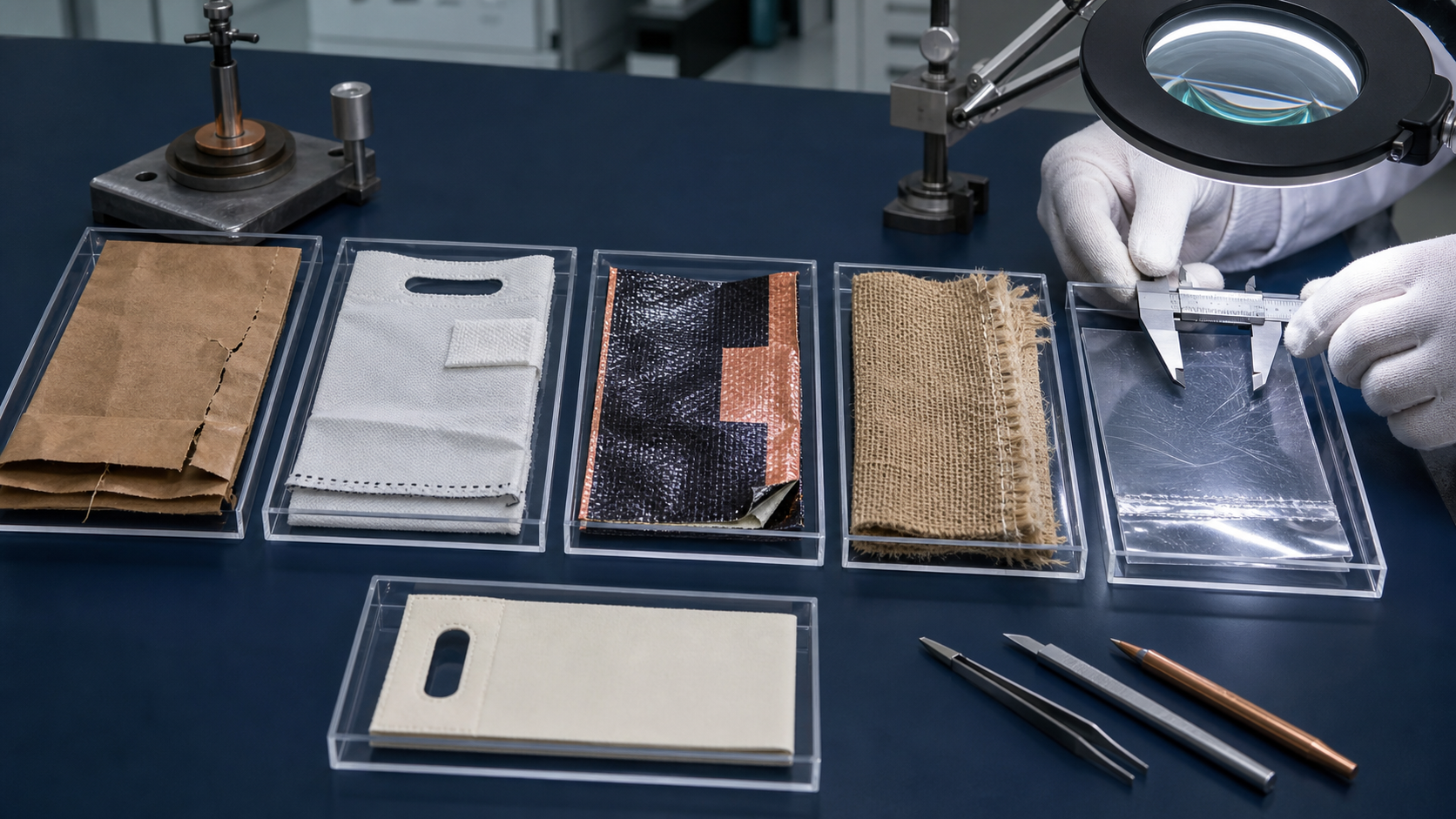
Route-specific defect standards help inspectors distinguish a process problem from harmless material character.
1. Build the quality plan around decision gates
A long checklist is not a control plan unless each check has an owner, timing, sample basis, acceptance rule and response. Put the highest-risk decisions before irreversible work. Detect a wrong paper grain direction before scoring, a weak non-woven roll before handle bonding and a print registration error before thousands of laminated panels are converted.
| Control gate | Evidence to review | Owner / timing | Required reaction |
|---|---|---|---|
| Reference release | Tech pack, approved sample, artwork proof, material standards, defect library and packing example | Buyer and factory before procurement or bulk release | Close open points or identify a first-off approval; never rely on an undocumented exception |
| Incoming material | Lot identity, shade, weight/thickness, width, surface, components and claim documents | Warehouse/QC before value is added | Accept, segregate, retest or reject by identified lot |
| Print and conversion first-off | Color, registration, finish, crease/fold, bond/seam and converted artwork position | Production and QC at line start and after setup change | Sign the first-off or correct settings before normal output |
| In-line process control | Trend checks on critical dimensions, handle attachment, bottom, bond/seam and recurring appearance defects | Line QC at defined frequency | Stop, contain the time window, correct the cause and verify restart |
| Finished function and presentation | Measurements, opening, standing/folding, loaded carry cycle and filled graphic view | QC on finished production units | Hold affected SKU/lot if the retail job is not met |
| Final lot and pack-out release | Random inspection result, quantity/SKU reconciliation, carton condition, labels and shipment samples | Authorized final inspector before dispatch | Pass, fail or hold for a documented buyer decision |
The factory's custom shopping bag manufacturing process should show where these gates sit in the real route. A control point placed after the next process has already hidden or damaged the feature is too late.
2. Freeze a reference package that inspectors can use
Give production and inspection the same version of the style code, SKU matrix, approved production sample, bill of materials, measurement chart, artwork, color standards, construction sections, tests, defect rules and packing instructions. Mark temporary prototype substitutions clearly. An approval sample made with stock handles cannot silently become the standard for bulk handle color or attachment.
For each critical feature, connect four things: the requirement, the method, the limit and the decision. “Strong handle” is not inspectable. A useful instruction names the representative load, loading pattern, grip or fixture, cycle or duration, conditioning if relevant, observations and pass/fail criteria. The exact values must come from the bag's intended basket and risk assessment, not from a universal internet number.
The Custom Shopping Bag Tech Pack guide explains how to draw gussets, handle patches, folds, seams and converted artwork. The Custom Shopping Bag Sample Development Process explains how to turn the approved result into a sealed bulk reference.
3. Inspect incoming materials by production route
Incoming checks should identify the actual lot, not merely read the supplier label. Sample across rolls, sheets, bundles or component cartons according to the risk and agreed plan. Preserve roll/lot references so a later shade, adhesion or strength problem can be contained without holding unrelated material.
| Route / input | Incoming checks | Simple evidence | Typical consequence if missed |
|---|---|---|---|
| Paper carrier | Grade/basis weight, grain direction, moisture/condition, caliper, shade, coating and clean printable surface | Lot sample versus signed standard; measurement record; trial score/fold where needed | Cracked folds, poor stiffness, curl, weak base or inconsistent print |
| Non-woven PP | Composition, actual gsm, usable width, shade, formation, holes, surface treatment and roll consistency | Cross-roll samples, weight/thickness readings and print/bond trial | Weak weld, patchy ink, size drift or mixed shade |
| Laminated woven PP | Woven substrate, printed film identity, laminate bond, gloss/matte, weave alignment and roll registration | Edge peel review, reference comparison and converted first-off | Delamination, distorted bag, gusset misregistration or finish variation |
| Jute / cotton / canvas / mesh | Composition, construction/weight, usable width, orientation, skew, shade range, odor, contamination and fraying tendency | Mapped lot swatches and cutting/sewing/print trials | Twisted panels, mismatched natural shade, seam loss or poor print edge |
| Clear PVC / TPU film | Specified film type/thickness, clarity, tint, blocking, odor, scratches, protective layer and joining compatibility | Illuminated surface inspection, thickness record and weld/seam trial | Cloudy joints, migration, tack, visible scratches or split welds |
| Handles, patches and assembly inputs | Material, diameter/width, cut length, shade, finish, end treatment, adhesive/thread/binding identity | Component sample linked to purchase and receiving lot | Unbalanced carry, pull-out, abrasion, visible mismatch or weak bond |
Sustainability paperwork is also part of identity control when a product claim is sold. Use FSC chain of custody to verify the certificate holder, validity, product scope, claim and sales documentation for the actual order. For recycled-content claims, consult GRS 5.0 and its transition information; verify the certificate holder and product scope, then obtain shipment-level transaction evidence where applicable. A logo copied into a specification is not evidence.
4. Release printing and conversion from a signed first-off
A flat print proof cannot predict every converted-bag effect. Creases can fracture ink, side gussets can swallow copy, lamination can change color and gloss, and handle holes can move close to artwork. Check the first complete converted unit under agreed viewing conditions, then identify it by line, machine, artwork version, material lot, date and approver.
| First-off checkpoint | What to compare | How to judge it | Restart trigger |
|---|---|---|---|
| Color and finish | Approved physical standard, substrate and finish | Agreed light/source, gloss/matte and documented instrumental tolerance where specified | Ink batch, substrate/film lot, coating or lamination setting changes |
| Artwork registration | Datum, panel, fold, gusset, base and handle clearance | Measure critical positions on the converted bag, both flat and opened | Plate/cylinder/digital file, web tracking, cut or fold setting changes |
| Ink/foil/film adhesion | Specified decoration and finished surface | Approved rub, tape or bend method appropriate to the construction | Surface treatment, curing, foil, adhesive or laminate changes |
| Fold and score | Dieline, grain/orientation and approved sample | Open/close the gusset and base; inspect coating/ink cracking and fold accuracy | Paper lot, score rule, pressure or folding setup changes |
| Bond, seam or glue joint | Specified width, overlap, stitch route, adhesive coverage and approved section | Visual section plus process-appropriate peel/pull/load verification | Machine, operator, material, adhesive, temperature/energy or speed changes |
| Handle and reinforcement | Spacing, drop, symmetry, patch/turn placement and orientation | Measure both faces and inspect the complete load path before normal output | Fixture, cord/webbing lot, patch, glue, stitch or bond setup changes |
Keep approved and rejected first-offs. A clear rejected sample often teaches the line faster than a paragraph. During production, trend a few decisive variables at a useful frequency instead of performing a superficial full checklist on every unit.
5. Use a route-specific defect library
Material character and manufacturing defects are not the same. Natural jute may have an agreed shade range; a cut yarn at the handle seam is a defect. Clear film may show a controlled visual texture; an unprotected scratch in the logo viewing area is different. Photograph buyer-approved boundaries and show where each rule applies: front viewing zone, side gusset, base, inside or hidden reinforcement.
| Shopping-bag route | High-value defect checks | Likely process source | Containment question |
|---|---|---|---|
| Paper | Score cracking, glue-lap opening, false folds, bottom opening, cord/patch pull-out, foil scuff and laminate lift | Paper condition/grain, crease setting, glue application, handle insertion or finish conversion | Which paper lot, glue station, shift and carton range are affected? |
| Bonded non-woven PP | Interrupted/too-narrow ultrasonic line, burned bond, weak die-cut handle, off-center patch, pleat/gusset drift and print rub | Energy/pressure/speed, horn/anvil condition, roll tension or fixture setup | When was the last verified bond check and which machine produced the units? |
| Sewn non-woven / fabric | Skipped stitches, open seam, low seam allowance, broken/backtack failure, puckering, raw edge and handle-position asymmetry | Needle/thread, feeding, operator method, notches, seam guide or reinforcement operation | Can the fault be isolated by operator, machine, bundle and time? |
| Laminated woven PP | Film misregistration at gusset, delamination, trapped contamination, binding misses, weave distortion and webbing pull-out | Web/film tracking, laminate bond, cut datum, binding guide or handle fixture | Is the problem tied to a film roll, laminate run, cut stack or assembly line? |
| Jute / cotton / canvas / mesh | Excessive skew, frayed edge, seam slippage, uneven panel, print breakup beyond standard and contamination/odor | Material lot, orientation, cutting, edge control, seam construction or ink/substrate interaction | Is it natural variation within the approved range or a controllable defect? |
| Clear PVC / TPU | Scratch, blocking, clouding, bubbles, inconsistent weld, split seam, trim migration and exposed sharp edge | Film protection/storage, heat/RF setup, contamination, trim compatibility or handling | At which operation was the protective surface exposed? |
6. Measure the finished carrier and its retail presentation
Define the measurement state. A soft gusseted bag measured stretched flat will not match one measured lightly opened. State the datum, conditioning, whether the bag is empty, how much force is permitted and whether handle drop is the vertical inside distance from the finished top edge to the handle apex. Include finished width, height, side/bottom gusset, usable mouth, handle drop and spacing, reinforcement position, artwork position and folded pack dimensions.
Then inspect the bag as store staff and customers see it. Does it separate and open without a struggle? Does the base settle? Do handles lie in the intended direction? Does the intended basket enter without catching the gusset? Does the logo read on the opened and filled geometry? Can the empty bag return to the specified fold and stack without springing or blocking?
Record results by SKU, not only as an order average. Different sizes, colors, artworks and handle systems may share one purchase order but create different defect opportunities.
7. Test the complete load path, not an isolated handle
A handle can be strong while the bag still fails at its patch, top turn, panel, side seam or base. Load the complete finished carrier with a representative product arrangement. Use uniform weights only when they reasonably represent the intended distribution; rigid boxes, bottles and sharp corners change local stress and stability.
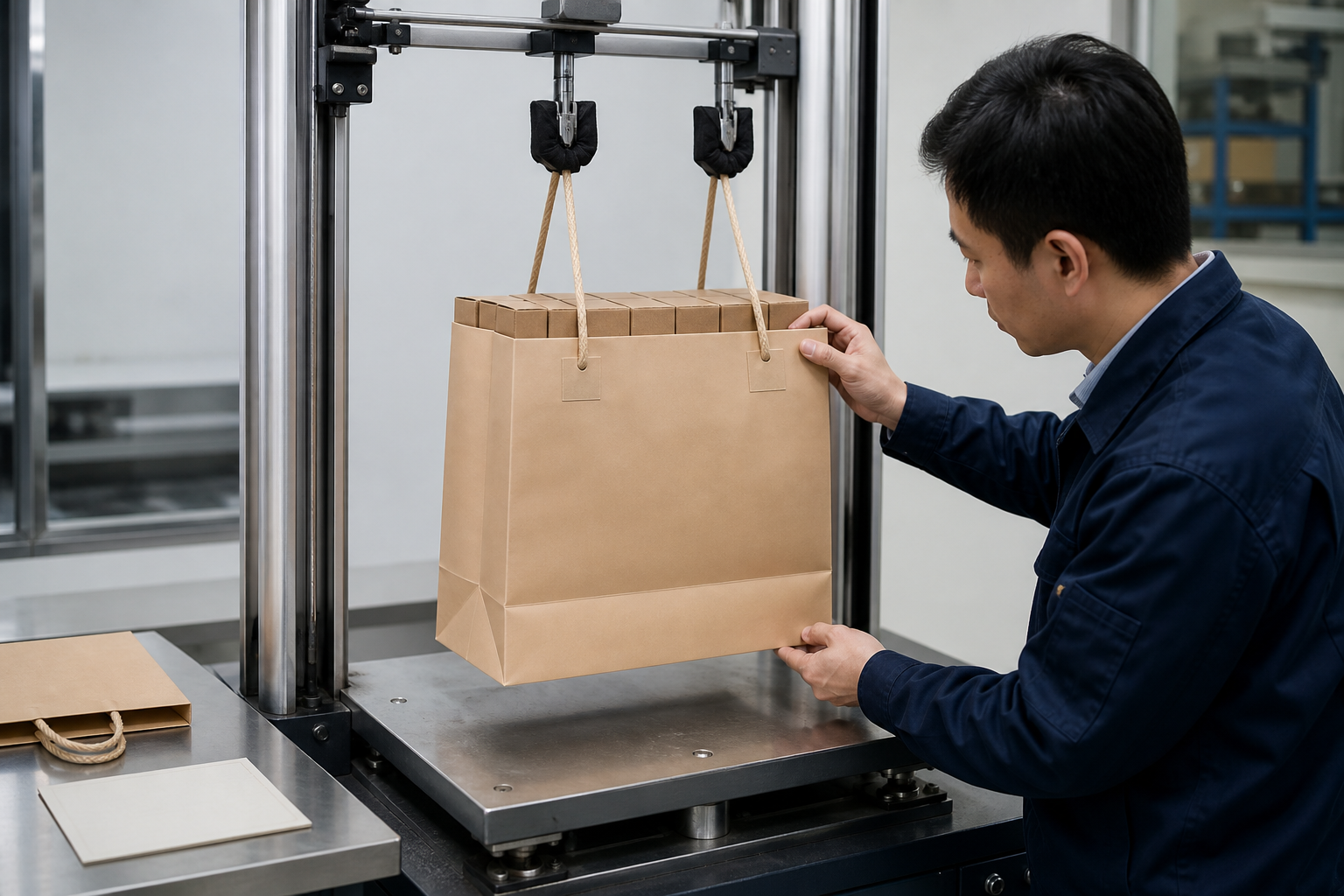
Functional testing should show where the retail load travels, not merely whether the handle material itself is strong.
| Functional check | Method fields the buyer must define | Observe during and after | Best production use |
|---|---|---|---|
| Checkout loading trial | Named basket, loading order, bag opening action and maximum product dimensions | Mouth access, gusset snagging, product containment, base stability and staff handling | Sample approval and first production confirmation |
| Static loaded hold | Load distribution, mass, duration, suspension/support and conditioning | Creep, glue/seam opening, handle movement, panel tear and permanent distortion | Development and defined lot verification |
| Dynamic lift/carry cycle | Load, lift distance, rate/cycles, grip geometry and stop condition | Progressive patch lift, hole elongation, stitch/bond damage, fold opening and base fatigue | Route qualification, change validation and risk-based production testing |
| Handle comfort/clearance | Intended hand/shoulder use, representative load, clothing and user range | Edge pressure, twisting, hand clearance, shoulder fit and bag balance | Sample/retail trial rather than final random inspection alone |
| Opening and fold recovery | Storage compression, separation method, opening attempts and refold sequence | Blocking, paper cracking, handle tangling, stack stability and folded thickness | Pack-out approval and periodic in-line check |
| Print/finish use resistance | Contact material, pressure, strokes/cycles and dry/wet condition where relevant | Ink transfer, abrasion, foil loss, laminate whitening and visible scuffing | First-off, process change and agreed production frequency |
Do not invent generic kilograms or cycle counts after the goods are made. Agree the target and failure definition during development. Destructive checks also need a planned frequency and replacement/quantity allowance, because the tested unit cannot return to saleable stock.
8. Classify defects by consequence, then choose the sample plan
Defect severity belongs to the buyer's risk model. A loose sharp metal part may create a safety concern; a base opening or wrong SKU may make the carrier unusable; a small mark in a hidden base zone may be cosmetic. The same visual mark can change class by location, size, frequency and customer promise.
| Decision class | Shopping-bag example | Why it matters | Pre-agreed decision needed |
|---|---|---|---|
| Critical | Buyer-defined safety/legal failure, exposed sharp component, prohibited contamination or materially false identity/claim | Potential harm, legal exposure or fundamental trust failure | Zero-tolerance/stop-and-escalate rule and affected-lot containment |
| Major | Handle pull-out, open bottom, failed seam/bond, unusable opening, wrong size/SKU, unreadable required mark or major logo error | Normal retail use, saleability or brand function is materially impaired | Acceptance number, rework/sort authority and retest condition |
| Minor | Small workmanship or appearance departure that does not impair intended use and remains within the buyer's defined zone/limit | Still affects presentation and consistency if repeated | Visual boundary, zone, size/frequency limit and acceptance number |
| Observation / trend | Result within limit but moving toward it, such as handle position drift or rising fold scuff | Early process warning before units become defective | Control-chart or escalation trigger for process adjustment |
ISO 2859-1:2026, published as the third edition in January 2026, provides AQL-indexed lot-by-lot sampling schemes for inspection by attributes. It does not choose the bag's defect definitions, retail tests, severity classes, test methods or commercial acceptance terms. Record the lot size, inspection level, sampling plan, AQL values, sample size and accept/reject numbers used; do not put only “AQL passed” in the report.
Randomize across available cartons, pallet positions, production times and SKU quantities. If materially different routes, substrates, artworks or lines are pooled into one inspection lot, a passing result can hide a concentrated problem. Keep the lot definition consistent with traceability and risk.
9. Verify pack-out, carton resilience and store usability
The bag is not finished when it leaves the sewing or converting line. Folding, interleaving, bundling, compression, carton moisture and transit abrasion can create new defects. Approve a pack-out using production-equivalent bags, then test the packed system against the actual distribution route.
| Release item | Checklist | Evidence in the report | Reason to hold |
|---|---|---|---|
| Fold and bundle | Correct sequence, handle lay, count, protection, bundle security and recoverable opening | Photos of open bag, fold stages and finished bundle | Creasing damage, blocking, tangling, wrong count or unusable store stack |
| SKU and assortment | Style/size/color/artwork identity, inner/master quantities and destination allocation | Count sheet and sampled label-to-product reconciliation | Mixed or wrong SKU, inaccurate assortment or incomplete allocation |
| Label and barcode | Released copy, position, readability, barcode data/scan and destination mark | Clear label images and scan result where required | Wrong data, non-scanning code or mismatch with contents |
| Master carton | Material, dimensions, gross/net weight, closure, marks, condition and internal void/compression | Measured carton, weight and six-side photographs | Burst/crush, moisture, unsafe weight, excessive movement or bag deformation |
| Distribution validation | Representative bag/carton, route hazards, test objective, damage criteria and change status | Protocol/version, sample identity, result photos and deviations | Test damage beyond the agreed product/package allowance |
| Final report and retain samples | Lot definition, sample plan, defect counts/images, functional results, quantity, disposition and retained units | Signed report tied to PO/SKU/lot/cartons | Missing evidence, unresolved corrective action or unauthorized deviation |
For packaged-product distribution validation, the International Safe Transit Association advises users to select tests with the real distribution environment in mind, use production-representative product and packaging, define damage/degradation criteria in advance and document results. Its design and testing guidance also calls for current procedures and consideration of changes. This scope is different from a shopping bag checkout load/carry trial; define each method and claim separately.
10. Close failures with traceability and corrective action
A failed result is the start of a decision, not the end of the report. First contain the suspected window by material lot, machine/line, operator/shift, first-off, time and carton range. Confirm the defect with the same method used for acceptance. Then distinguish correction—sorting or reworking current goods—from corrective action that removes the process cause.
After repair or process adjustment, inspect the repaired feature and look for secondary damage. Re-gluing a paper base can stain the exterior; reworking a sewn handle can leave extra holes; reheating clear film can distort or cloud it. Define the retest scope and who can authorize shipment. Preserve failed and corrected samples where they will help prevent recurrence.
Use the same discipline for change control. A new paper mill, non-woven gsm, laminate adhesive, print system, handle supplier, sewing line, ultrasonic horn, carton compression or packing pattern can affect approved performance. Route the change through targeted first-off and validation checks rather than assuming the old report still applies.
Company-claim boundary: LUCKYSTAR statements in this section are publisher self-description, not third-party verification, an inspection result or proof that one quality plan fits every assigned factory. Confirm the contracting entity, production site, subcontracting, material/process route, sample reference, test methods, inspection authority, lot definition, defect rules, packing and release terms for each order.
How LUCKYSTAR describes its shopping bag quality-plan review
The public custom shopping bag constructions present paper, reusable PP, jute, mesh, canvas and transparent directions that buyers can use to frame route-specific controls. LUCKYSTAR states that its project team can discuss reference packages, incoming identity, first-off approval, in-line checks, finished function, lot sampling, packing and corrective-action evidence, subject to specification and written confirmation.
- Route-specific controls: match material and joining risks to paper conversion, bonding, lamination, sewing or clear-film construction.
- Complete load path: connect body, base, seams/bonds, reinforcement and handles in one defined test.
- Converted artwork: inspect placement and appearance on the filled/formed bag.
- Traceable decisions: tie results to PO, SKU, lot, line/time window and approved reference.
- Pack-out release: verify fold, count, protection, labels, cartons and destination allocation.
- Campaign coordination: connect the bag brief to the stated Product Range where relevant.
Send the quality-plan inputs for a project-specific review: bag route/reference, intended basket/load, dimensions, material/claim, artwork, quantity by SKU, test expectations, defect rules, packing, destination and required date.
Frequently asked questions
What should be checked first on a custom shopping bag?
Confirm the controlled style/SKU, approved sample and material lot before judging workmanship. If the inspector has the wrong revision or mixed material, later measurements and appearance decisions cannot be trusted.
Is AQL inspection enough for shopping bags?
No. AQL sampling can organize a lot-acceptance decision, but the buyer still must define defects, severity, measurements and functional methods. Strong incoming and in-line control is also needed because final sampling may find a problem only after the whole order is complete.
How should shopping bag carrying capacity be tested?
Test the complete finished carrier with a representative load arrangement and a pre-agreed static or dynamic method. Define load, distribution, conditioning, grip/fixture, duration or cycles, observations and failure criteria. Check handles, attachment, panel, gussets, seams/bonds/folds and base together.
What are the most common paper shopping bag defects?
Priority checks often include cracked scores, inaccurate folds, insufficient or misplaced glue, bottom opening, cord/patch pull-out, print or foil scuffing, laminate lift and compressed pack-out. The actual defect list must reflect the approved paper, finish, construction and retail use.
What should be inspected on non-woven shopping bags?
Verify actual material identity/gsm/shade, surface print behavior, ultrasonic bond or sewn seam, gusset formation, handle and reinforcement position, finished dimensions, load path, fold recovery, SKU identity and carton condition. Bond continuity is more informative than appearance alone.
Should every shopping bag receive a load test?
Not necessarily. Load testing may be destructive and should use a risk-based frequency agreed before production. Process checks and non-destructive appearance/measurement inspection can occur more often, while representative functional tests verify the design, setup, changes and production lot as specified.
What information belongs in a final inspection report?
Include PO/style/SKU, lot definition, available and inspected quantities, carton selection, sampling plan, defect classification/counts, measurements, functional results, photographs, packing/label checks, deviations and authorized disposition. Results should be reproducible, not summarized only as “passed.”
When should a shopping bag shipment be held?
Hold the affected lot when critical defects appear, major defects exceed the agreed rule, a required function fails, identity/quantity is uncertain, evidence is incomplete or an unauthorized change is found. Release after containment, correction, root-cause action and the agreed reinspection or buyer waiver.
Turn retail risk into measurable evidence
The best shopping bag inspection is not the one with the most tick boxes. It is the one that catches the right problem at the cheapest responsible moment and leaves evidence another person can reproduce. Define the retail job, map the route, protect the load path, control converted artwork and verify the packed delivery—not just the loose bag on a table.
For a wider supplier assessment, return to How to Choose a Custom Shopping Bag Manufacturer or the Custom Bag Manufacturer Guide. Then send LUCKYSTAR the bag reference, intended basket, quantities, destination and known quality risks so the team can build a route-specific quotation and control plan.

Request a route-specific shopping bag quality plan
Define the reference, material/process route, load method, measurements, artwork, defect rules, lot, sampling, packing and release authority before production begins.
Review LUCKYSTAR custom shopping bag options, then send your project details through the contact form or Email a project brief. The email link opens a draft for your review before sending.
Factory and subcontracting, materials, process route, claims, samples, testing, inspection, AQL, price, MOQ, packing, schedule and release terms are subject to due diligence, specification and written confirmation.