A reusable shopping bag does not earn its name by surviving one careful lift in a sample room. It must repeat the job for which it was sold: open at checkout, accept a realistic basket, carry it through acceleration and set-down, resist abrasion and moisture, keep its graphics legible and remain usable after the care procedure the brand communicates. The correct tests depend on the material route, construction, claim, market and failure cost.
This Reusable Shopping Bag Testing guide answers Which Tests Should Reusable Shopping Bags Pass? for sewn cotton/canvas and jute bags, bonded or sewn non-woven polypropylene, laminated woven polypropylene and mesh constructions. It focuses on design qualification and change validation—not routine workmanship inspection. For production gates, defect classification and final lot release, use the separate Custom Shopping Bag Quality Control Checklist.
The Reusable Shopping Bag Test Standards referenced below are method examples, not a universal mandatory list. Combined with buyer-defined finished-carrier protocols, they create route-specific Reusable Shopping Bag Durability Tests that can support real sourcing decisions.
Explore construction options on LUCKYSTAR's custom shopping bags product page. If the supplier has not yet been selected, start with How to Choose a Custom Shopping Bag Manufacturer and the broader Custom Bag Manufacturer Guide.
Planning an order? Send the test-plan inputs with the RFQ. Include the bag route, size, intended basket and carrying mode, reuse/care claim, material and print, destination, applicable rules, test methods or limits already known, lab/report needs, packing and quantity by SKU.
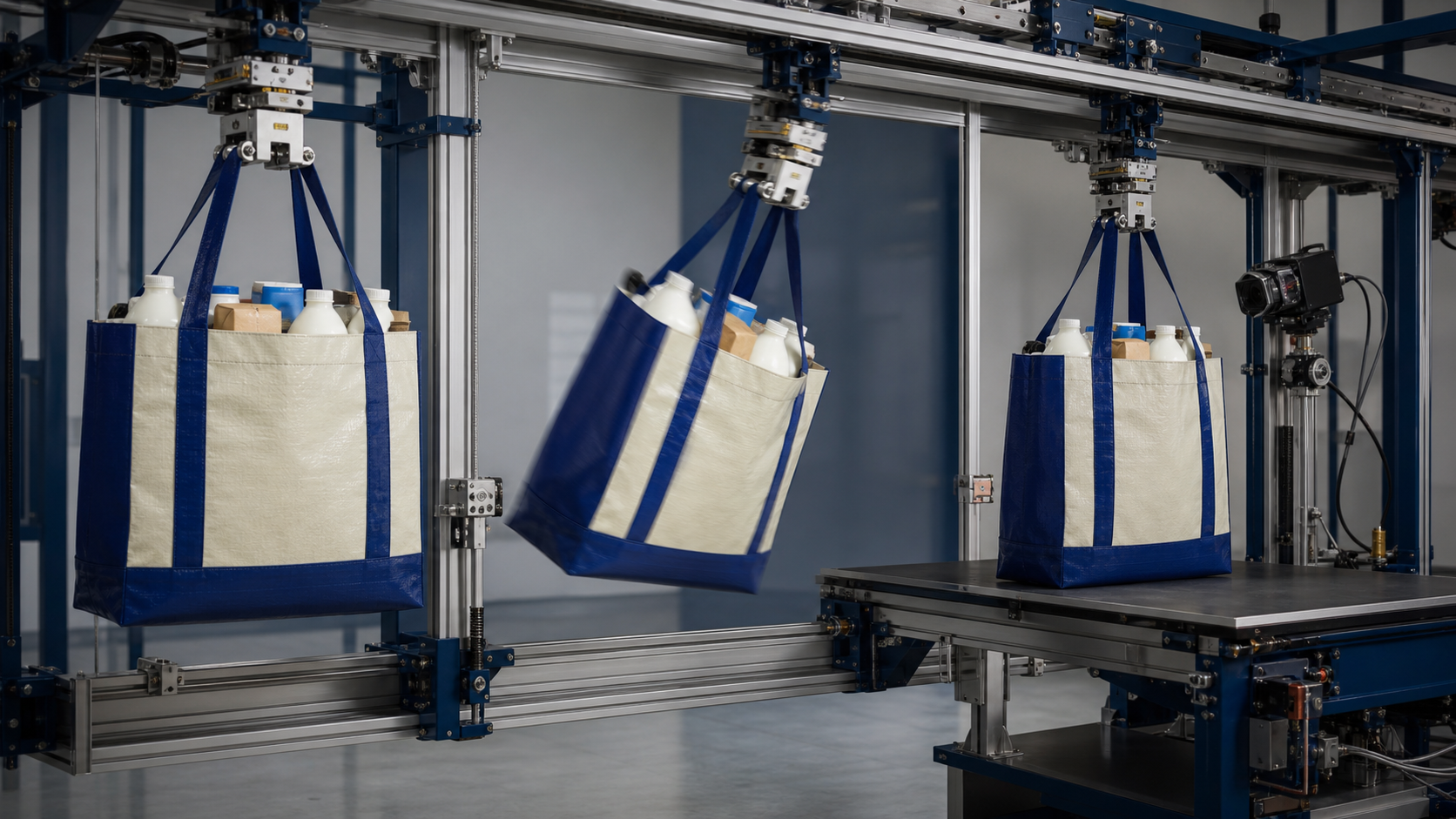
Repeated-use testing should reproduce the transitions that load a bag—not only a motionless suspended weight.
1. Start with the reuse claim and the real carrying system
“Reusable” is incomplete as a test brief. A foldable promotional non-woven bag, a sold canvas market tote and a laminated woven-PP grocery carrier face different products, reuse frequency, cleaning expectations and failure modes. Define the normal basket, maximum sensible basket, awkward item, carry distance, hand or shoulder use, checkout method, storage, weather exposure and communicated care.
Then map the entire load path: contents into base, base into body and gussets, body through seams/bonds/folds, reinforcement into handle attachment and attachment into the handle. A strong body fabric cannot compensate for a narrow heat seal; a high-strength webbing cannot save a weak stitch pattern or a die-cut handle that tears from its corner.
| Use-profile input | Failure question | Test family to consider | Evidence needed before setting a limit |
|---|---|---|---|
| Normal and maximum basket | Will the base, side, attachment or handle progressively fail? | Checkout loading, static hold and cyclic lift/carry/set-down | Named products or accurate dummies, mass, dimensions and loading order |
| Sharp or rigid contents | Will a corner puncture, initiate a tear or abrade the coating? | Puncture/penetration, tear propagation and localized finished-bag trial | Corner radius, contact zone and realistic movement |
| Hand/shoulder carry | Will handles twist, cut into the user, slip or become unbalanced? | Handle clearance/comfort, attachment symmetry and loaded carry review | Handle mode, clothing, representative users and carry duration |
| Repeated floor/counter contact | Will the base, binding, print or laminate wear through? | Surface abrasion plus finished-bag set-down/carry cycles | Expected surfaces, dirt/moisture and contact frequency |
| Cleaning or wet use | Will the bag shrink, distort, bleed, delaminate, corrode or retain odor? | Specified wash/wipe exposure followed by dimensions, appearance and function | Exact care instruction and consumer-use scenario |
| Brand and sustainability claims | Is the claim supported by the correct product, documents and performance evidence? | Material identity/chain evidence, claim-specific validation and durability | Destination, wording, certification scope and product configuration |
This risk map should be completed during concept and sampling. The Custom Shopping Bag Sample Development Process explains how to use mock-ups, material proofs and production-intent samples to answer different questions instead of expecting one prototype to do everything.
2. A named test method is not a pass criterion
A standard method tells a laboratory how to prepare a specimen, operate equipment and report a result. It usually does not know your basket, brand promise or acceptable risk. “Test to ISO” is therefore not a complete purchase requirement. State the current edition, specimen source, direction, conditioning, deviations, repetitions, units, endpoint and acceptance rule.
The finished-bag methods often need a buyer-defined protocol because a carrier is a system rather than a flat fabric coupon. Make it reproducible enough that a factory laboratory and an independent laboratory can obtain comparable evidence. Avoid language such as “heavy load,” “many cycles,” “no obvious damage” or “wash normally.”
| Protocol field | What to write | Why ambiguity changes the result | Example of useful evidence |
|---|---|---|---|
| Objective | The decision the result will support: screen, qualify, compare, audit or release | A severe screening method may rank designs but not predict a service life | “Confirm handle system after webbing supplier change” |
| Sample identity | Style/SKU, version, material lots, print, line and production status | A lab sample made differently from bulk cannot qualify bulk | Photos plus traceable component and production records |
| Preconditioning | Atmosphere, duration/status and any wash, wet, aging or flex exposure | Textile moisture and polymer temperature/history affect performance | Recorded conditioning environment and sample mass stability where required |
| Setup and load | Fixture/grip, load shape/distribution, rate, distance, duration/cycles and rest | Sharp blocks and uniform weights stress a bag differently | Diagram, apparatus photos and calibrated equipment ID |
| Observations | Which locations and changes are measured during and after exposure | A bag can remain suspended while a seam progressively opens | Handle movement, seam opening, strain, tear, coating and residual deformation |
| Acceptance | Numeric limit and/or controlled visual boundary, specimen rule and rounding | A mean can hide one unsafe or unusable specimen | Individual results, summary statistic and explicit disposition |
3. Qualify the sample before the test begins
Test pieces must represent the product decision. Early material coupons are useful for comparing options, but they do not prove handle attachment, seam intersections or a finished base. A handmade sample may use different stitch equipment, ultrasonic energy, laminate cure or edge binding than the production line. Record those differences and repeat the relevant test on production-intent units.
Conditioning is part of the method, not waiting time without documentation. ISO 139:2005, confirmed current in 2025, defines standard atmospheres for conditioning and testing textiles. Follow the chosen method and material requirements rather than forcing textile conditions onto every polymer or coated structure.
Test order matters. A pristine sample measures initial performance. A washed, flexed, abraded or aged sample measures retained performance. If several destructive tests use one specimen, the first test changes what the second means. Allocate separate samples unless the sequence intentionally models use.
| Sample group | Condition / sequence | Question answered | Common misuse |
|---|---|---|---|
| A: material comparison | Identified conditioned coupons before conversion | Which substrate/weight/finish better resists the named mechanism? | Claiming coupon strength proves the finished carrier |
| B: pristine finished bag | Production-intent bag, conditioned, no prior destructive exposure | Initial geometry, load path and surface performance | Testing a sample-room construction that bulk will not reproduce |
| C: care-exposed bag | Specified wash/wipe/soak and dry sequence, then recondition and retest | Retained dimensions, color, print, seam/bond and load function | Using a care cycle that differs from the label or claim |
| D: aged or abrasion-exposed bag | Defined environmental/flex/abrasion exposure followed by target test | Whether coating, laminate, print or attachment loses performance over time | Stacking unrelated severe exposures without a decision objective |
| E: production verification | Random traceable units from stable bulk output | Whether qualified construction was reproduced | Treating a small final sample as design qualification |
| F: change-validation set | Old and new configurations tested side by side where practical | Whether a source/process/design change altered risk | Comparing results from different methods, labs or environments |
4. Select material tests by construction route
There is no universal “bag fabric strength test.” The method must suit the substrate and failure mechanism. A woven canvas strip, a spunbond non-woven sheet and a laminated polyolefin tape fabric do not behave the same in jaws or during tear propagation.
For example, ISO 13935-2:2026 measures maximum force to rupture straight sewn seams using a grab method, but its scope says it is normally not applicable to nonwovens, coated fabrics or polyolefin tape yarns. That limitation is directly relevant to shopping bags. Use a route-appropriate published method or a clearly documented buyer method rather than keeping a familiar standard number after the material changes.
| Construction route | Material mechanisms to screen | Published method examples | Finished-bag evidence still required |
|---|---|---|---|
| Cotton / canvas / woven jute | Tensile, initiated-tear propagation, seam rupture/slippage, abrasion and wet-state change | ISO 13934-1 strip tensile; ISO 13937-2 trouser tear; ISO 13935-2/ISO 13936 where scope fits | Handle pattern, seam intersections, gusset/base and complete loaded carrier |
| Spunbond non-woven PP | Machine/cross direction tensile, trapezoid tear or penetration, bond continuity and heat damage | ISO 9073-3:2023 tensile; ISO 9073-4:2021 trapezoid tear; method appropriate to penetration risk | Ultrasonic/sewn seams, die-cut or loop handles, intersections and repeated loaded cycles |
| Laminated woven PP | Tape/weave behavior, laminate adhesion, coated-surface tear/abrasion, binding and webbing interface | ISO 4674-1:2016 coated-fabric tear as a method candidate; coating-specific adhesion/abrasion method selected by structure | Converted gusset registration, laminate flex at folds, binding and handle attachment |
| Coated canvas or polymer-finished fabric | Coating crack, delamination, surface wear, tear and flex sensitivity | ISO 5470-1:2016 Taber abrasion for coated fabrics; coated-fabric tear/flex methods as applicable | Fold lines, sewn holes, edge binding and post-aging or post-clean load function |
| Mesh / open structure | Snag, opening growth, edge seam, yarn rupture and localized puncture | Method chosen for actual knit/weave and failure; coupon fixture may need agreement | Product escape, checkout loading and concentrated item-corner trial |
| Multi-material reusable bag | Weakest interface among body, coating, binding, patch, thread, adhesive and handle | Component methods plus interface-specific peel/pull/flex protocol | Complete system test before and after relevant exposure |
Coupon results help diagnose and compare materials. They are not interchangeable across methods: strip and grab tensile, different tear geometries and different abrasion equipment create different result meanings. Keep method, direction, specimen width, condition and endpoint attached to every number.
Route-applicability check: ISO 13935-2:2026 and ISO 13934-1:2013 are useful method examples only where their stated scope fits. Their ISO scope pages say they are normally not applicable to nonwovens, coated fabrics or textile-glass/polyolefin tape-yarn fabrics. Non-woven PP, coated constructions and laminated woven PP therefore need route-appropriate methods plus finished-bag evidence; do not copy a woven-textile method into a different construction solely because it is familiar.
5. Qualify the finished bag with repeated-use testing
The finished carrier test should reproduce load transitions: fill, lift, accelerate, carry or swing, set down, unload and recover. Static suspension is useful for creep and gross weakness, but it does not reproduce the peak loads and repeated movement at handle roots, seam intersections and bottom corners.
Use the normal basket and a deliberately defined upper basket. Uniform mass may support repeatability, while shaped dummies or real products support realism. Many programs benefit from both: a controlled engineering comparison followed by a checkout trial with representative contents.
| Finished-bag test | Protocol inputs | Measure / observe | Pass rule should address |
|---|---|---|---|
| Checkout fit and fill | Opening action, product order, basket dimensions and staff motion | Mouth access, gusset snag, base settling, product containment and fill time/effort | Usable loading without product damage or forced distortion |
| Static loaded hold | Load shape/distribution, mass, fixture/support, duration and environment | Creep, seam/bond opening, handle movement, panel tear and residual deformation | No defined functional failure; controlled residual change where allowed |
| Cyclic lift–swing–set-down | Load, grips, lift/swing path, acceleration, rate, cycles, platform and rests | Progressive stitch/bond damage, elongation, abrasion, delamination and base wear | Cycle target plus intermediate and final condition limits |
| Localized corner / puncture trial | Representative object geometry, location, preload and movement | Indentation, penetration, tear initiation and product escape | No unacceptable hole/tear under the intended basket scenario |
| Handle comfort and balance | Representative users, clothing, load, duration and hand/shoulder mode | Pressure, twisting, clearance, slip, bag tilt and contact with body | Buyer-defined comfort and safe/usable clearance—not force alone |
| Fold / storage recovery | Compression, storage time, temperature, separation and opening sequence | Blocking, permanent crease, laminate whitening, handle tangle and openability | Bag remains store-ready and returns to the intended shape |
Instrumented cyclic testing can expose where degradation begins. If only the final survival is recorded, engineering data is lost. Pause at planned intervals to document attachment movement, seam opening, coating damage and residual dimensions without changing the bag beyond the protocol.
6. Test seams, bonds, handles and reinforcement as interfaces
The most informative location is often the interface rather than the strongest component. For sewn canvas, compare fabric break, seam rupture, seam slippage and stitch failure. For ultrasonically bonded non-woven, record bond width, continuity, material thinning/burn and peel or rupture mode. For woven PP, check webbing-to-panel, binding intersections and laminate behavior around needle holes.
Test handles both as received components and after attachment where the source or construction makes either result decision-useful. A webbing tensile certificate cannot prove the stitch box. A handle pull test that clamps the panel unrealistically close to the patch may bypass the same load distribution that the finished bag uses.
Always report failure mode and location. “Maximum force: X” does not tell the engineer whether to change fabric, seam allowance, thread, stitch density, patch size, ultrasonic energy or handle geometry. Photograph progressive changes and preserve representative failed samples.
7. Check abrasion, color and print as separate mechanisms
Reuse creates contact at the base, side panels, fold lines, handles and the user's clothing. Select the abrasion method for the actual surface. ISO 12947-2:2016 determines breakdown of textile fabrics using the Martindale method and explicitly excludes coated fabrics for coated-surface abrasion; ISO 5470-1:2016 addresses coated fabrics with a Taber abrader. Neither automatically reproduces a bag sliding across a checkout counter, so a product-level contact trial may complement the coupon method.
Separate substrate colorfastness from decoration adhesion. ISO 105-X12:2016 evaluates textile color transfer under dry and wet rubbing. Screen print, heat transfer, sublimation, laminated film and coated artwork can need different adhesion, rub, bend/flex, blocking or wash checks. Inspect logo legibility, cracking, transfer, staining and color change in the visible zones where the brand actually appears.
Add light exposure only when the use/display profile justifies it. ISO 105-B02:2014, confirmed current in 2025, evaluates textile color under a xenon source representative of daylight. A lightfastness method does not substitute for outdoor weathering where moisture and temperature cycles are part of the claim.
8. Validate cleaning and moisture claims as a sequence
Never assume a reusable bag is machine washable because the body is cotton. Handles, thread, stabilizers, coatings, printed transfers, metal parts and labels may respond differently. Choose the care procedure first, then expose the complete finished bag and repeat the measurements and functions that matter.
ISO 6330:2021 specifies multiple domestic washing and drying procedures for textile testing; each combination must be selected rather than referred to only as “ISO wash.” ISO 5077:2007 provides a method for dimensional change after an appropriate washing/drying combination. A wipe-clean or rinse-only bag needs a different exposure that matches its communicated care.
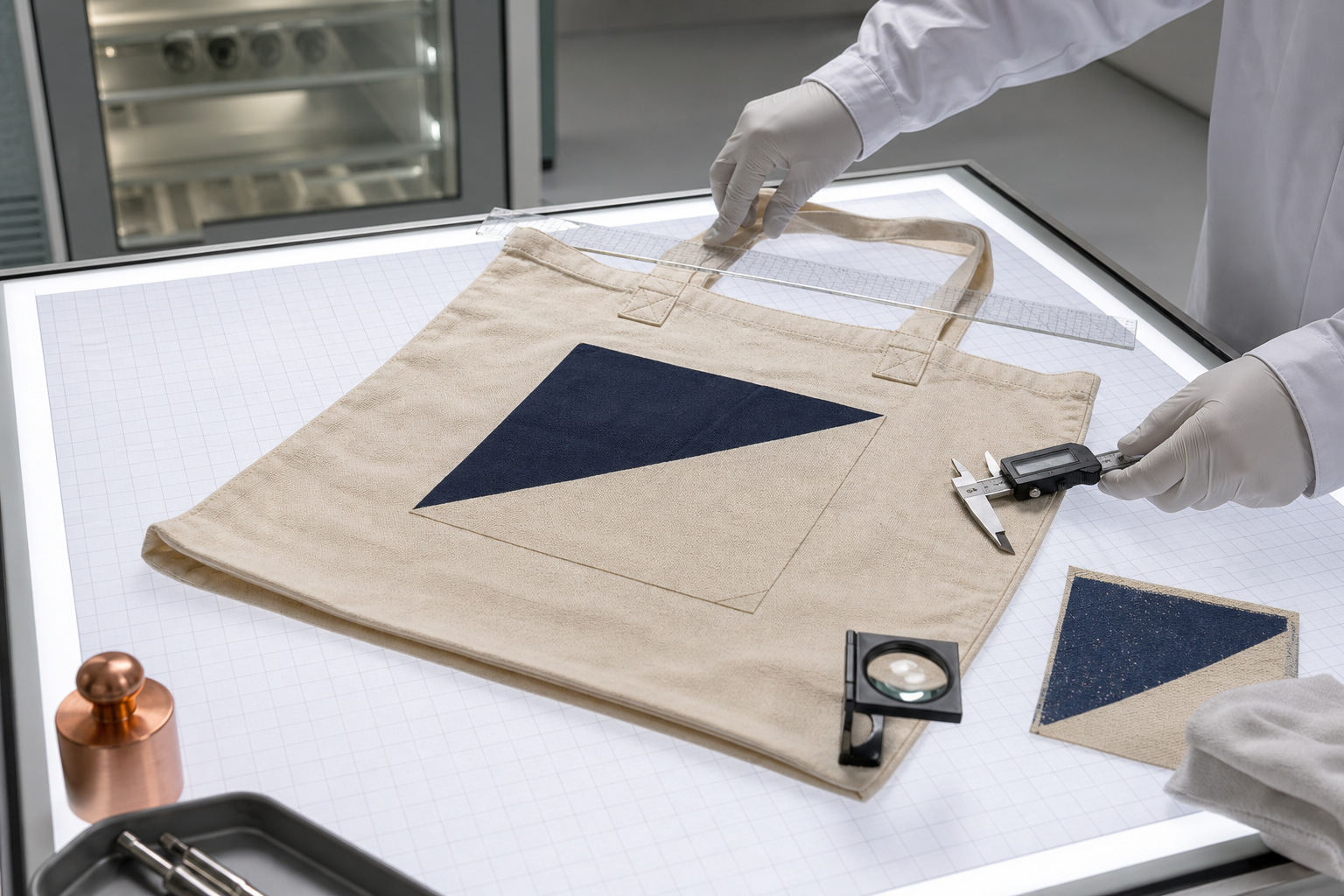
After care exposure, remeasure and retest the complete bag; a clean appearance alone does not prove retained function.
| Exposure / claim | Define before testing | Post-exposure checks | Frequent hidden failure |
|---|---|---|---|
| Machine washable | Washer type, cycle, temperature, detergent, ballast, drying, number of cycles and care label | Dimensions, skew, color/staining, print, seams, handles, hardware and loaded function | Body survives but handle, stabilizer or decoration shrinks differently |
| Hand wash / rinse | Water, detergent, time, agitation/squeeze and drying method | Bleeding, distortion, stiffness, odor, bond/laminate and dry recovery | Undefined wringing or drying produces non-comparable results |
| Wipe clean | Cleaner, cloth, pressure, strokes, area and dry time | Surface gloss, ink transfer, coating tack, staining and seam-edge residue | Cleaner attacks print/finish while substrate appears unchanged |
| Rain / damp groceries | Water delivery, duration, side, pressure/contact and load state | Wet strength, transfer, leakage path, delamination, corrosion and dry recovery | Water-resistant body leaks through seams or needle holes |
| Cold / heat storage | Temperature/humidity, duration, bag state and recovery | Blocking, brittleness, odor, dimensional change, coating crack and handle function | Folded coated panels stick or whiten after reopening |
| Retained durability | Which structural test repeats after the exposure and sample allocation | Compare individual failure mode and performance against pristine baseline/limit | Only appearance is checked, so strength loss remains invisible |
9. Separate product claims, chemical compliance and physical performance
A strength report does not prove recycled content. A transaction certificate does not prove that the handle attachment survives repeated use. A chemical screening report does not prove washability. Build parallel evidence tracks and connect each one to the exact material, color, print, component and destination.
| Requirement track | What it may require | Evidence identity must cover | What it does not prove |
|---|---|---|---|
| Physical reuse performance | Finished-bag cyclic/static, tear/puncture, attachment, abrasion and retained-function tests | Production-intent style/SKU, route and components | Chemical compliance or recycled/fiber claim |
| Chemical / destination compliance | Risk-based restricted-substance plan for substrate, coating, ink, adhesive, trims and metal parts | Material/color/finish/component and applicable market/version | Mechanical durability or fitness for every end use |
| Recycled content / chain claim | Applicable certification/supplier scope, material identity and order-level transaction/traceability records | Claimed input, facility chain and exact order | Bag lifespan, recyclability in every market or lower impact by itself |
| Washable / wipe-clean claim | Exact care procedure followed by appearance, dimensions and retained-function criteria | Complete finished bag with final print, trims and label | Unlimited cycles or every consumer detergent |
| Food-contact-related use | Destination- and contact-scenario-specific assessment where the bag/material is intended for direct contact | Contact layer, food type, conditions and jurisdiction | General carrier strength or suitability for unspecified food contact |
| Packaging / labeling | Required copy, warnings/instructions, barcode/marking and destination language | Final SKU, sales channel and shipment pack | Substrate identity unless supported separately |
Chemical requirements change by market and material. ECHA explains that Candidate List substances in articles can trigger obligations for EU producers, importers and suppliers, while REACH restrictions can apply to substances in articles. Build the laboratory scope from the current destination rules and the bag's bill of materials; do not reuse an unrelated report because the product photographs look similar.
10. Protect qualified performance through packing and distribution
A bag can pass every loose-product test and arrive blocked, creased, abraded or distorted after aggressive folding and carton compression. Approve the fold, handle lay, bundle, interleaf/protection, carton count, moisture protection and pallet pattern with production-equivalent bags.
ISTA advises test planners to understand the actual distribution environment, use representative samples, define damage/degradation criteria before testing and document results. Its design and testing guidance also calls for retesting when product, package or process changes can affect performance. Choose the current appropriate protocol for the real channel instead of adding a generic drop test to every shipment.
After transit simulation or a trial shipment, open the cartons and check what matters at store level: bag separation, fold recovery, print scuff, laminate blocking, handle tangling, odor/moisture, quantity and label/SKU accuracy. If a packed test samples only the outer carton, it misses the product degradation the test was meant to prevent.
11. Put each test at the right decision gate
Screen materials before design freeze; qualify the complete construction on production-intent samples; verify critical setup at first-off; monitor decisive process variables in line; and use a defined sampling plan for final lot acceptance. ISO 2859-1:2026, published as the third edition in January 2026, provides AQL-indexed lot-by-lot sampling schemes for inspection by attributes. It does not define shopping-bag tests, defects, severity classes, durability limits or commercial acceptance terms, and it is not a design-validation standard.
Retest when the change can affect the failure mechanism: body supplier/weight or weave, recycled-content source, coating/laminate, ink/adhesive, handle/webbing, thread, reinforcement, seam/bond geometry, machine/ultrasonic horn, print cure, cleaning instruction, carton count or fold pattern. Use a documented engineering rationale to narrow the scope where appropriate; “same appearance” is not a rationale.
Development time and sample quantities should include destructive and exposure testing. The related Custom Shopping Bag MOQ and Production Time guide shows how route-specific materials and operations affect schedule. Put testing assumptions into the RFQ instead of discovering after the sales sample that extra lab samples or material batches are needed.
12. Read failure modes before changing the specification
When a bag fails, preserve the load, apparatus setting, sample identity, images and failed piece. Identify initiation and progression: Did a needle hole start the tear? Did fabric yarns slip at the seam? Did an ultrasonic bond peel, split through weakened sheet or break outside the bond? Did the webbing survive while the patch lifted? Did a coating crack before the base fabric tore?
Change the cause, then repeat the test with a controlled comparison. Increasing body weight may not solve a handle fixture problem. Adding stitches may perforate a coated material or concentrate stress. A larger patch can improve load distribution but alter fold thickness, print appearance and cost. Treat the bag as one system and verify secondary effects.
Feed the qualified method and observable warning signs into the Shopping Bag Quality Control Checklist. Qualification shows what the design can do under controlled conditions; production control shows whether the factory continues to make that design.
Company-claim boundary: LUCKYSTAR statements in this section are publisher self-description, not third-party verification, a test report, certification or proof that one method applies to every factory or order. Confirm the contracting entity, assigned production site and subcontracting; final SKU/BOM and production sample; test laboratory, current methods, limits and report scope; destination rules; inspection; packing; and release terms for each order.
How LUCKYSTAR describes its test-plan coordination
LUCKYSTAR states that its project team can discuss how intended use, material route, construction, artwork, care communication and packing affect a reusable shopping bag test plan, subject to specification and written confirmation. The public custom shopping bag options can help buyers identify the route before methods and evidence are selected.
- Use profile: define the normal and upper basket, product geometry, carrying mode, reuse target, care and distribution channel.
- Traceable sample: connect the tested unit to the final SKU, material lots, handles, reinforcement, print, process and approved reference.
- Route-specific methods: separate woven textile, non-woven, coated or laminated structures and qualify each interface.
- Decision rules: agree sample quantity, conditioning, setup, observations, limits and disposition before testing.
- Retained performance: repeat relevant appearance, dimensional and functional checks after the defined wash, moisture, abrasion, aging or transit exposure.
- Change control: identify which material, construction, process, care or pack changes trigger targeted or full revalidation.
For sourcing context, review the Custom Bag Manufacturer Guide and shopping bag manufacturer selection guide. Then send a project-specific brief so open test decisions can be identified before sampling or bulk release.
Frequently asked questions
What is the most important test for a reusable shopping bag?
The finished-bag repeated-use test is often the best system-level evidence because it exercises handles, attachments, body, gussets and base together. It should be supported by route-specific material and interface tests that explain why the system passes or fails.
How much weight should a reusable bag carry in testing?
There is no universal value. Define a normal and upper basket from intended products, bag size, customer promise and risk. Specify the load shape/distribution as well as total mass, because rigid corners and bottles create different local stresses from uniform weights.
How many carry cycles should a reusable bag pass?
The buyer must set the target from the reuse claim and validated benchmark. Document lift path, acceleration, swing, set-down, rate, rests and intermediate inspections. A cycle count from a different apparatus or bag type is not directly comparable.
Can fabric tensile strength predict finished-bag strength?
No. It helps compare the substrate under one method, but the complete load path also depends on direction, seams or bonds, reinforcement, handle attachment, gusset/base geometry and localized puncture or tear. Test both material and finished construction.
Should non-woven and canvas reusable bags use the same test?
They can share a finished-bag use protocol when the intended basket is comparable, but coupon and interface methods should suit each route. Non-woven tensile/tear and ultrasonic bonding behave differently from woven fabric tensile, seam rupture and seam slippage.
Does a wash test prove that a reusable bag remains strong?
Not by itself. After the defined wash and dry procedure, inspect dimensions, color, print, coating, seams, handles and hardware, then repeat the critical loaded-function or interface test. Appearance alone can hide retained-strength loss.
When is third-party laboratory testing necessary?
Use an appropriate accredited or buyer-approved laboratory when regulation, customer protocol, specialized equipment, impartial verification or claim substantiation requires it. Factory tests remain valuable for screening, setup and process monitoring when methods and equipment are controlled.
How often should reusable bag testing be repeated?
Repeat at qualified development gates, defined production frequency and whenever a material, component, construction, process, care instruction or package change can affect performance. Document the rationale if a change needs only targeted rather than full retesting.
Specify evidence, not a generic promise
The right question is not whether a reusable shopping bag “has a test report.” Ask whether the tested sample matches the order, whether the method fits the material and use, whether the pass rule was agreed before the result, whether the failure mode was recorded and whether changes trigger revalidation. That evidence makes reuse measurable and gives production a standard it can reproduce.
Review the available custom shopping bag constructions and send LUCKYSTAR your basket, reuse claim, destination and risk priorities. The team can help translate them into a route-specific development and test plan.

Request a route-specific reusable bag test plan
Define intended use, sample identity, construction route, test methods, conditioning, loads/cycles, observations, pass criteria, destination rules, packing and change controls before testing begins.
Review LUCKYSTAR custom shopping bag options, then send your project details through the contact form or Email a project brief. The email link opens a draft for your review before sending.
Factory assignment, materials, claims, samples, testing, reports, inspection, price, MOQ, packing, schedule and release terms are subject to due diligence, specification and written confirmation.