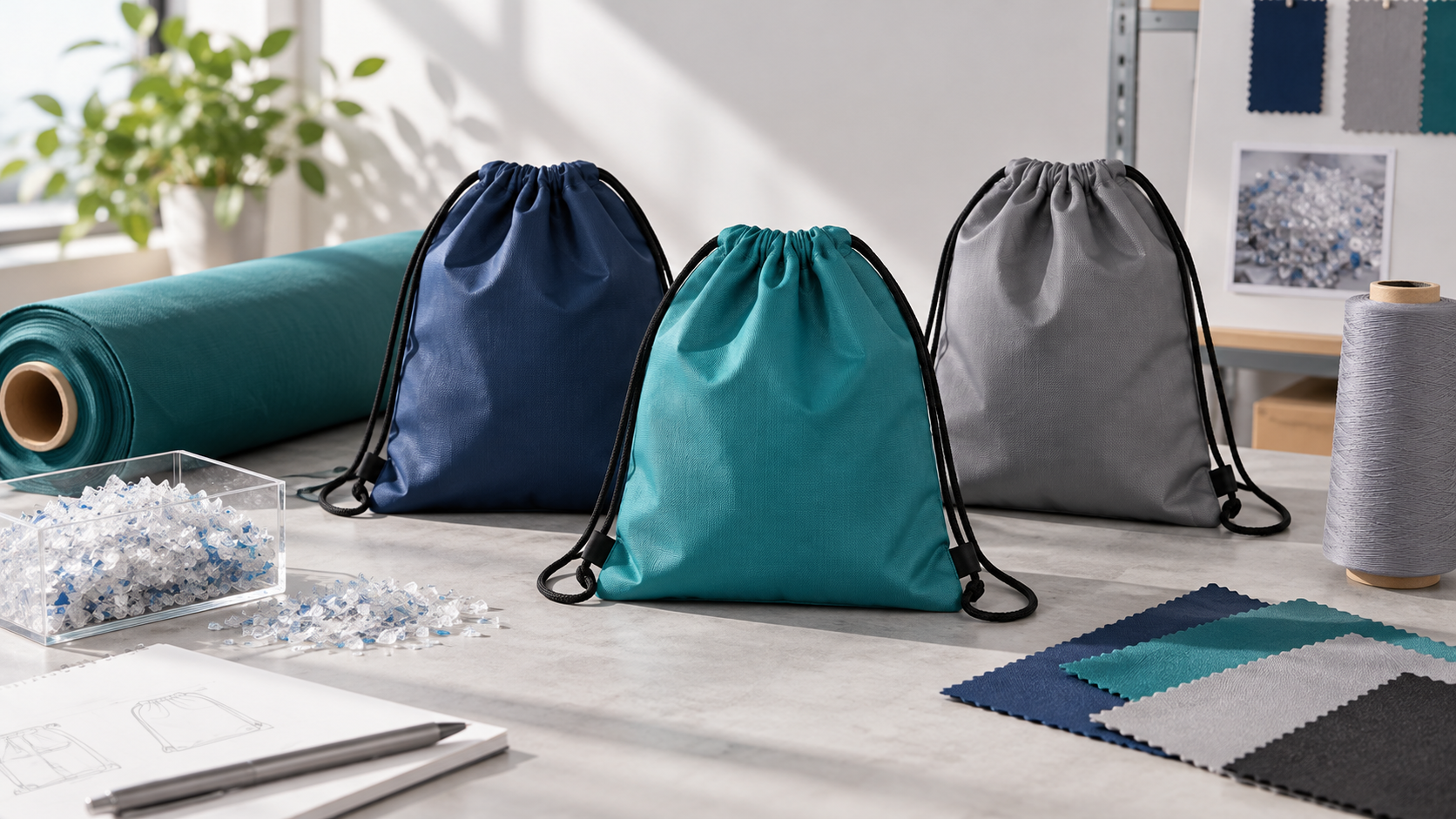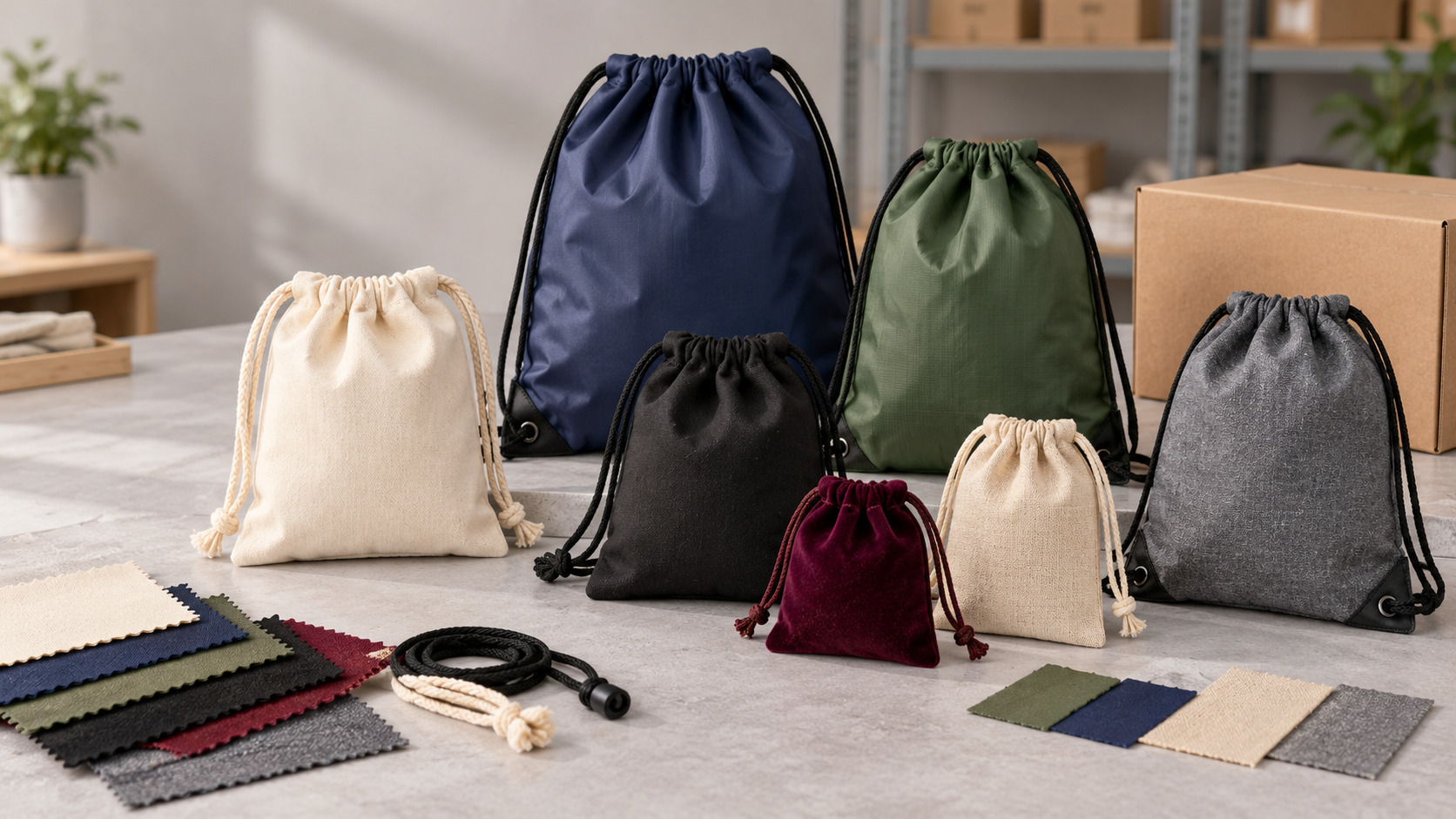
A foldable shopper has to succeed in two opposite states. Opened, it must carry a real retail load without distorting, cutting into the hand or losing its artwork. Packed, it must fit a defined pouch or closure without a wrestling match. The engineering difficulty is not making a thin bag; it is connecting material, pattern, handles, fold path and closure so the same product survives that conversion repeatedly.
This Foldable Shopping Bag Manufacturing Guide focuses on that conversion. It does not repeat the all-material route in the Custom Shopping Bag Manufacturing Process. Instead, it examines integrated self-pouches, separate pouches, elastic and snap systems, open and packed dimensions, fold-line artwork, repeated fold fatigue, closure life, recovery after storage and compact carton planning.
Start with LUCKYSTAR’s custom shopping bags product page. Use the product options together with How to Choose a Custom Shopping Bag Manufacturer and the wider Custom Bag Manufacturer Guide when comparing development, production and quality capabilities.
Planning an order? Send a fold-system brief. Include open and packed dimensions, intended contents/load, body material and finish, handle path, pouch or closure, approved fold sequence, artwork in open and packed states, cycle/load/care requirements, quantity by SKU, packing, destination and required date.
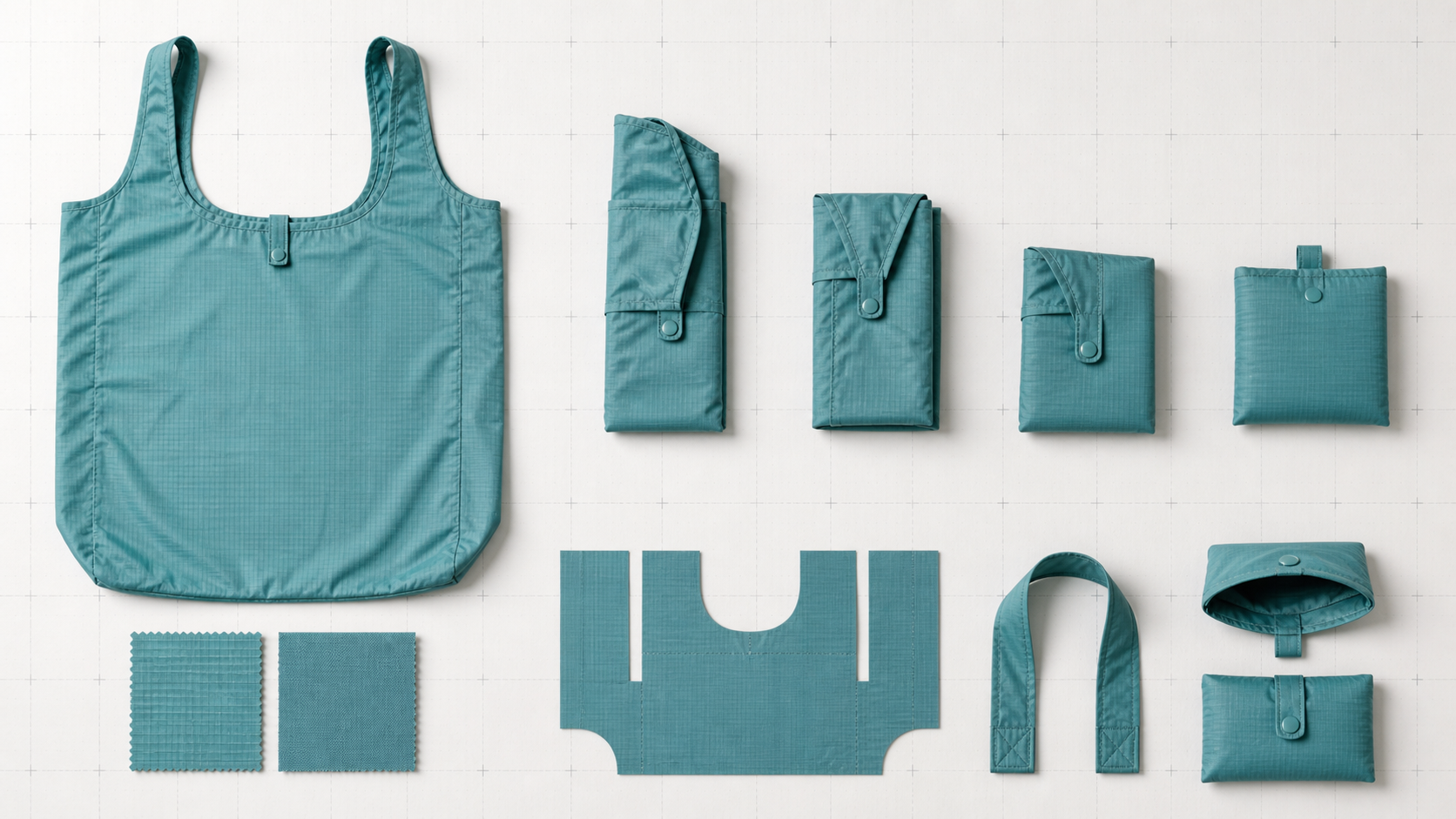
One approved fold sequence should connect the open bag, the packed shape, the pouch dimensions and the artwork position.
1. Choose the fold system before drawing the pattern
“Foldable” describes several different mechanisms. An integrated self-pouch keeps every component together, but the pouch seam and turning operation become part of the bag’s load and bulk. A separate pouch can look neat and allow a cleaner body pattern, yet users can lose it. Elastic and tab systems are fast, though their recovery or snap alignment may become the life-limiting feature. Roll-up designs tolerate less exact folding, but the bundle is usually longer.
The right system follows the user journey. A checkout giveaway should pack quickly at production speed. A travel shopper may need a compact pouch that stays attached. A premium gift-with-purchase bag may place the brand on the packed face. Ask a person who has not seen the sample to open and repack it: if instructions are needed for every cycle, the design is not yet intuitive.
| Fold system | Manufacturing advantage | Primary risk | Sample evidence |
|---|---|---|---|
| Integrated self-pouch | Pouch cannot be separated; packed face can carry visible branding | Entry too tight, attachment puckers, pouch distorts the open bag or seam is overloaded | Timed pack/unpack trials, pouch-entry measurement and loaded open-bag inspection |
| Separate drawstring or zipper pouch | Main body pattern remains simple; pouch can provide premium presentation | Pouch loss, mismatched SKU, added piece count and packing labor | Complete set audit, pouch retention/use trial and pack-out reconciliation |
| Elastic retention band | Fast folding, low component count and flexible bundle size | Elastic relaxes, twists or leaves pressure marks after stored compression | Extension/recovery checks before and after ageing plus repeated wrap cycles |
| Snap tab | Clear closed state and controlled brand-facing panel | Misalignment, pull-through, hard hardware imprint or fatigue at the tab root | Snap alignment, opening-force and attachment-cycle checks on production material |
| Zippered self-pouch | Secure compact pack and protected interior | More bulk, zipper curvature, trapped fabric and extra sewing operations | Loaded zipper cycles, fabric-clearance review and packed-thickness distribution |
| Roll-up with loop or cord | Less dependent on an exact rectangular fold | Long bundle, uneven rolling and loose cord or loop | Roll diameter/length, retention after handling and snag assessment |
2. Select material by foldability and service, not weight alone
Light woven polyester or nylon is common because it can carry useful tensile load at low thickness and pack into a small volume. Ripstop geometry may help control local tearing, but “ripstop” is not a performance grade. Yarn, weave, coating, finish and sewability still need approval. RPET woven fabric can follow a similar route, while its recycled-content claim requires product- and order-level traceability rather than a generic mill logo.
Non-woven PP can be cost-efficient and light, but repeated hard creasing, ultrasonic bonds and handle zones need a construction-specific trial. Cotton offers a familiar hand and printing surface, yet it normally packs bulkier and can retain creases or change dimension after care. Coated fabrics may improve surface behavior while adding stiffness, fold whitening, blocking or delamination risk. Choose an exact article number, mass/area or thickness as appropriate, weave or bond construction, finish and color—not just “polyester” or “recycled fabric.”
| Material route | Foldability profile | Watch point | Useful approval |
|---|---|---|---|
| Light woven polyester / ripstop | Low bulk, stable print options and quick recovery when the finish is suitable | Fraying, needle damage, coating white lines and slippery feeding | Cut-edge trial, seam section, repeated fold/print review and packed hold |
| Light woven nylon | Soft, compact and often strong for its mass | Color/finish variation, heat sensitivity and print adhesion compatibility | Production-lot decoration, seam and heat-contact trials |
| RPET woven fabric | Can use a compact woven construction similar to virgin polyester | Claim scope, lot identity and assuming recycled content proves finished durability | Chain documentation plus the same finished-bag performance plan as any other material |
| Spunbond non-woven PP | Light and economical; can be bonded or sewn | Crease fatigue, bond consistency, perforation and recovery from compression | Fold cycles followed by handle/bond load and surface inspection |
| Cotton or lightweight canvas | Natural hand and broad decoration choice, usually a larger packed envelope | Crease retention, shrinkage, fraying and handle/pouch bulk | Care-condition dimensional change and realistic packed-volume comparison |
| Coated or laminated woven fabric | Can add body, print surface or splash resistance | Cracking, whitening, blocking, delamination and a narrow fold radius | Conditioned fold/ageing sequence plus peel, appearance and unpack recovery |
| Mesh body with solid pouch | Ventilated and visually light; packed bulk depends on edge and handle build | Snagging, mesh distortion and bulky bound seams | Snag simulation, loaded geometry and compact-pack trial |
3. Specify both open and packed dimensions
Open size explains capacity; packed size explains portability and logistics. Both need datums. State whether width includes side gussets, whether height excludes handles, how a soft base is positioned and how handle drop is measured. For the packed state, define the folding sequence, closure state, pressure or hand method, rest time and measurement points. A single tight studio sample is not a bulk tolerance.
Pouch entry and internal capacity require their own dimensions. A pouch can meet its outside width yet remain hard to turn because the opening seam, zipper tape or snap reinforcement steals usable space. The development team should record the largest part that must pass through the entry and the number of fabric layers collected at the last fold.
| Measurement field | How to define it | Bulk risk if vague | Control evidence |
|---|---|---|---|
| Open body width × height | Named flat datums, gusset treatment, top edge and handle exclusion | Bag fits the drawing but not the retail basket | Dimensioned sketch and filled-product trial |
| Side / bottom gusset | Finished depth and the measurement state—flat, opened or filled | Volume and folding stack vary between inspectors | Cross-section drawing and physical reference |
| Handle drop and spacing | Top-edge datum, relaxed state and attachment-center reference | Carry comfort changes and handles do not nest inside the pouch | Paired measurement plus worn/loaded trial |
| Pouch opening and usable cavity | Clear internal entry after seams/hardware and minimum usable depth | Operator must stretch, force or damage the entry | Go/no-go gauge or defined folded stack insertion |
| Packed width × height | Approved fold sequence, closure state, measurement plane and rest time | Retail fixture, mailer or pocket compatibility is uncertain | Sample distribution after repeated folding |
| Packed thickness | Instrument/contact method, location, conditioning and permitted compression | Carton count is estimated from an unrealistically squeezed unit | Stack and carton trial using production-intent units |
| Packed mass | Complete unit including pouch, tab, labels and individual packing | Freight, mailer and giveaway planning use incomplete data | Bulk-lot sample distribution and packed-carton reconciliation |
4. Build a fold map into the pattern and tech pack
The fold map is a manufacturing drawing, not a user-interface afterthought. It should show the order and direction of each fold, the final packed face, accumulated layer thickness, pouch entry direction and closure line. Overlay that map on the cut pattern with seams, reinforcement, handles, labels and artwork. The exercise reveals collisions before cutting.
Keep repeated hard folds away from dense ink, raised transfers, embroidery edges, stiff labels and hardware where possible. A fold across a handle attachment can make the pack lopsided; a snap under a printed face can leave an imprint during carton storage. If artwork must cross a crease, approve it after repeated folding and a packed hold rather than only on a flat strike-off.
| Zone on the fold map | Design decision | Failure to prevent | Factory control |
|---|---|---|---|
| Primary fold lines | Radius/direction and number of accumulated layers | White lines, film cracking, print damage or spring-back | Notches/template plus approved folded sample |
| Pouch attachment | Seam location, orientation, turning allowance and open-bag appearance | Puckering, twisted pouch or stress concentrated into one body point | First-piece alignment and section check |
| Handle nesting path | Where handles lie and whether they cross the final fold | Bulky corners, trapped handles or hard-to-close pack | Full sequence check before marker release |
| Closure footprint | Snap/elastic/zip position and reinforcement size | Misalignment, pressure imprint or pull-through | Position fixture and opening-force sample |
| Open-bag artwork | Safe distance from seams and fatigue folds | Cracked transfer, ink rub or message hidden in a crease | Artwork on the final pattern, not a generic rectangle |
| Packed-face artwork | Orientation after the last turn and closure | Upside-down, off-center or partly covered brand mark | Signed open/packed visual pair |
| Labels / care information | Readable location that does not obstruct packing | Label bunching, discomfort or hidden required information | Packed and opened compliance review |
Organize the drawing, fold map, BOM and tolerances with How to Prepare a Custom Shopping Bag Tech Pack. A short animation can help users, but production still needs numbered physical steps and datums that operators and inspectors can repeat without interpreting a video.
5. Engineer the pouch and closure as working components
An integrated pouch reverses roles. When the bag is packed, it is the container; when the bag is opened, it becomes an interior or exterior pocket, flap or panel. Its seam orientation must look acceptable and avoid catching the contents. Turning the body into the pouch places high local strain at the entry corners, so those corners need enough radius, seam allowance and reinforcement for the chosen textile.
A bigger pouch is not always safer. It reduces packing effort but increases loose bulk when open and may let the pack escape its intended shape. A smaller pouch can look crisp while raising labor time, seam stress and user frustration. Sample at least the nominal construction and a deliberately challenging tolerance combination, such as a slightly heavier body lot with a smaller permissible pouch entry.
Specify elastic by composition/structure, width, initial length and extension/recovery expectation. Specify snaps by type, finish, cap/post geometry, backing and installation setting. Specify a zipper by chain, slider, tape, length and stop construction. Test the closure after packed storage and fold cycles because the weakest condition may appear after the textile has compressed or the attachment has been flexed.
6. Keep the handle load path compatible with compact packing
Long, heavy webbing can make a thin body strong enough to carry but too bulky to pack. Narrow self-fabric handles pack efficiently, yet their folded edges, seam and attachment zone need control. Lightweight webbing may offer a useful compromise. Whatever the choice, the load path runs from the hand through the handle, attachment and body into the base; testing only the body fabric misses the common failure points.
Handle ends should not stack at the same point as the pouch seam, snap reinforcement and final fold. Spread the layers or change the sequence. Verify comfort with the intended mass and typical carry duration. A laboratory maximum-force result cannot describe whether a narrow handle becomes painful or whether a full grocery load swings and twists.
7. Place branding around repeated folds
Foldable bags provide two brand surfaces: the large open body and the compact packed face. They do not have to carry the same message. A restrained open-side logo can be paired with a stronger pouch graphic that remains visible in a handbag, drawer or retail display.
Decoration compatibility depends on the exact fabric and finish. Screen printing can be efficient for bold spot color; heat transfer can support detail but may add a less flexible film; sublimation can suit certain polyester constructions; labels and embroidery add their own layer and edge. Approve color, adhesion, hand and fold survival on the bulk-intent lot. Leave curing or process time before immediate tight packing where the decoration route requires it.
For method fundamentals, compare decoration routes in Custom Tote Bag Printing Methods. The final choice should be verified on the foldable construction because finish, fold radius, stacked pressure and storage temperature can change how a print behaves.
8. Run a foldable-bag-specific manufacturing sequence
The order begins with a frozen open/packed specification and an approved production-intent sample. Incoming fabric is identified, conditioned where required and checked for width, shade, finish, mass or thickness and defects. Pattern pieces are cut with direction, notches and pouch identity controlled. Decoration happens at the stage that keeps the panel flat without later damaging the artwork.
Small parts—pouch, tabs, elastic, zipper units, labels and handles—are prepared first. The line then assembles the body in a sequence that protects thin-fabric feeding and keeps bulk away from the final turning path. First-off approval should include both states: measurements and appearance with the bag open, followed by the exact fold into its pouch or retainer.
| Production gate | Control point | Release evidence | Reaction to drift |
|---|---|---|---|
| Specification release | Open/packed drawings, fold map, BOM, artwork, tolerances and pack-out agree | Revision-controlled file and sealed sample | Do not purchase custom inputs or cut bulk against open comments |
| Incoming material | Identity, lot, width, mass/thickness, shade, finish, defects and claim documents | Receiving record tied to production lot | Hold or segregate the lot; assess sample and pattern consequences |
| Cut and decoration first-off | Direction, notches, pouch piece, print position, cure/adhesion and fold clearance | Signed cut bundle and decorated panel | Correct marker, guide or process before releasing more panels |
| Pouch / closure subassembly | Opening, orientation, reinforcement, elastic length, snap or zipper setting | Measured section plus functional first piece | Contain the component batch and reset fixture/machine |
| Main sewing | Seam allowance, edge control, needle damage, handle placement and load-path layers | Open-bag first-off and in-line trend record | Stop repeated defect, isolate since last accepted check and verify restart |
| Fold-function audit | Sequence, pouch entry, closure, packed dimensions, appearance and time | Selected units folded by a defined method and operator sample | Separate sewing, tolerance, material and instruction causes |
| Final pack-out | SKU, fold orientation, bundle/carton count, pressure, recovery and carton data | Physical carton trial plus final inspection release | Hold affected cartons and correct pack method before shipment |
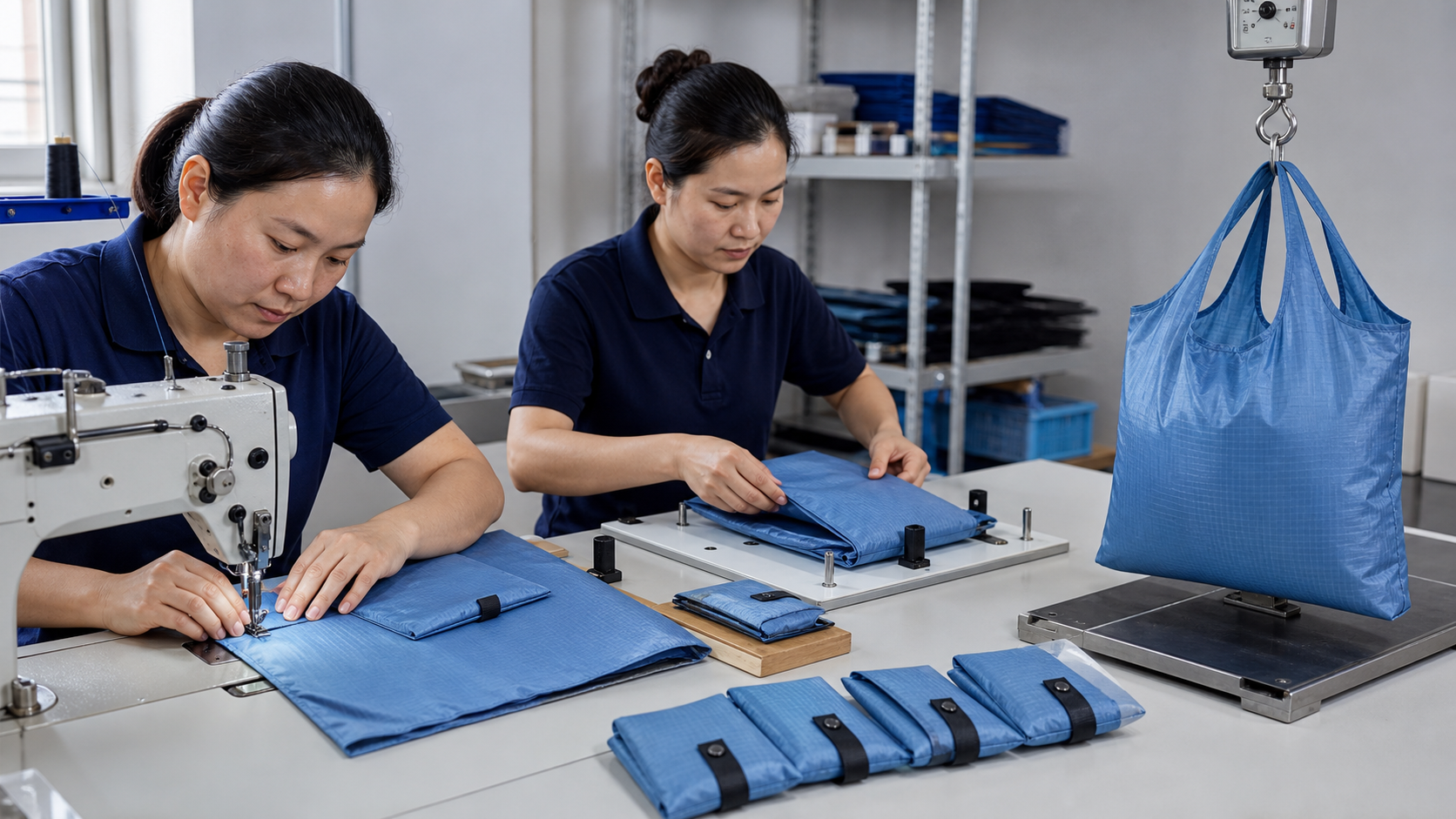
The pouch, folding operation and open-bag load path should be checked on the same production-intent construction.
9. Validate the fold cycle before and after load testing
There is no universal fold-cycle number that makes every shopper “reusable.” The buyer should define a sequence around the intended promise: open the bag, load and carry it, unload it, fold it by the approved steps, close it, store it for a stated period and reopen it. Record cycle count, rate, operator or fixture, conditioning, load and failure rules. A high arbitrary cycle count performed on an empty bag can miss the real stress combination.
Inspect more than catastrophic failure. Track increasing packing time, pouch-entry distortion, seam opening, elastic loss, snap damage, zipper catching, coating whitening, print cracking and persistent creases. Run a load check after cycling to learn whether repeated folding weakened the body, handle attachment or pouch seam. Also test fresh units so the effect of cycling can be separated from normal production variation.
For woven textile candidates, ISO 13934-1:2013 describes a strip method for maximum force and elongation and remains current, while ISO 13935-2:2026 covers maximum force to rupture of straight sewn seams using a grab method. The ISO scope specifically notes important material limitations: the seam method is normally not applicable to nonwovens, coated fabrics or polyolefin tape yarns, among others. A qualified laboratory must therefore confirm whether a cited method fits the actual material and structural question.
| Validation | Method fields to define | What to inspect | Decision use |
|---|---|---|---|
| Pack / unpack cycle | Sequence, count, rate, operator/fixture, conditioning and pauses | Time, effort, misfold, pouch entry, creases, seam and print | Proves usability and identifies fatigue location |
| Closure life | Snap/zip/elastic cycle, direction, opening force or extension and end point | Loss of retention, damage, pull-through, catching and recovery | Selects component and reinforcement rather than hardware appearance alone |
| Complete-bag static load | Filler geometry, mass, distribution, hold, lifts and failure rule | Body, base, seam, pouch attachment, handle and permanent deformation | Confirms one held condition at the intended load |
| Cyclic carry / jerk | Mass, stroke, speed, cycle count and edge shape of contents | Progressive seam growth, handle damage, tear and closure behavior | Represents repeated walking and handling better than a static hold alone |
| Post-fold load | Fold-cycle history followed by the same complete-bag load protocol | Loss versus uncycled controls and failure migration | Connects compact reuse to carrying performance |
| Packed ageing / compression | Time, temperature, humidity, stacking pressure and recovery interval | Blocking, odor, print transfer, hard creases, closure imprint and packed escape | Supports carton and storage decisions |
| Care / color route | Declared care, wash/dry procedure, cycles, dimensional and color assessment | Shrinkage, distortion, coating/print, staining and ability to repack | Supports only the care claim actually communicated |
If the bag carries a washable claim, define the relevant care sequence. ISO 6330:2021 specifies domestic washing and drying procedures for textile testing, and ISO 105-C06:2010 addresses color fastness to domestic and commercial laundering. Neither standard creates a care claim by itself; choose the procedure, assessment and acceptance threshold that match the product, decoration and market.
Build the product-specific matrix alongside Which Tests Should Reusable Shopping Bags Pass? and use the Custom Shopping Bag Quality Control Checklist to place inspection gates in bulk production.
10. Control folding as a production operation
Even when customers repack the bag casually, the factory needs a repeatable first presentation. Define the folding steps, hand direction, handle placement, packed face, closure position and permitted adjustment. A simple board or guide can help operators place the first folds without pulling one side longer. Time the operation during sampling because an awkward pouch creates labor that will appear in the quote or line balance.
Inspect a sample of folded units from different operators and time windows. If one person can consistently pack the bag but others cannot, the design may be relying on technique instead of tolerance. Correct the pouch, layer distribution or fold map before adding more instructions.
11. Pack compactly without damaging recovery
A compact unit does not automatically create an efficient export carton. Snaps, elastics and zipper heads make local high spots; alternating bundle orientation may produce a flatter stack. Measure a physical carton after a representative hold, then reopen bags from the top, center and bottom. Check whether the closed pouch remains neat and whether the open body recovers within the agreed time.
Do not over-compress merely to improve a cube estimate. Pressure and heat can transfer print, imprint hardware, block coated surfaces or set a severe crease. State inner quantity, bundle orientation, interleaf/bagging, carton dimensions, weight, stack limit and environmental protection. The commercial comparison should use verified packed-carton data rather than nominal loose-bag dimensions.
12. Plan MOQ, cost and lead time around the real operations
Foldable bags can look simple while carrying several minimum-order drivers: custom fabric color, printed body, separate pouch print, elastic or hardware color, label version and individual retail packing. Dividing a total quantity across several body colors and artworks creates separate setups and increases assortment risk. A stock material and standard closure may reduce early commitment, provided they meet the approved function.
Cost includes more than material area. Pouch preparation, extra turning, closure installation, fold-check labor and final folding can be significant. A design that saves a small piece of fabric but adds a difficult manual operation may cost more overall. Compare quotes with the same open size, material identity, pouch system, decoration, cycle evidence, packing and delivery basis. For category-specific planning, see Custom Shopping Bag MOQ and Production Time.
13. Make sustainability claims proportional to evidence
Compact shipping may reduce carton volume for a given unit count, but that fact alone does not prove a lower whole-life impact. Material mass, manufacturing loss, durability, actual reuse, cleaning, transport and end-of-life all affect the boundary. Avoid turning “foldable,” “reusable” or “RPET” into an unsupported environmental conclusion.
Define the claim, destination and evidence before artwork approval. Recycled-content documentation should connect the certified scope, material supplier, transaction or order evidence and product claim. Durability language should be backed by a realistic repeat-use sequence. Clear care guidance can help the product remain usable, but it must match verified material, print and closure behavior.
14. What should a useful RFQ contain?
A request for quotation should make uncertainties visible. If packed size is mandatory but material is open, say so. If the bag must carry a particular basket, provide its dimensions and representative contents. Ask the supplier to separate confirmed construction, assumptions, alternatives, test scope and packing data so a low price is not created by silent omissions.
| RFQ field | Useful buyer input | Supplier response expected | Approval milestone |
|---|---|---|---|
| Use and load | Contents, mass, carry duration, reuse context and user group | Recommended body, handles, reinforcement and validation route | Filled/carry concept sample |
| Open and packed size | Datums, target/tolerance, packed interface and measurement method | Achievable dimensions, pouch entry and tolerance assumptions | Measured production-intent sample |
| Fold mechanism | Self-pouch, separate pouch, elastic, snap, zipper or open alternative | Fold map, construction details, operation time and risk notes | Approved pack/unpack sequence |
| Material and color | Performance priority, reference color, care and claim direction | Exact article/grade, mass/thickness, finish, availability and evidence | Lot-intent swatch and complete sample |
| Branding | Vector artwork, color standard, open/pouch placements and packed orientation | Method, printable zone, physical strike-off and fold interaction | Signed decorated and folded sample |
| Test / inspection | Cycle, load, care, destination and acceptance priorities | Applicable methods, lab/fixture, sample stage, reporting and exclusions | Pre-production evidence and bulk control plan |
| Quantity and delivery | Units by size × color × artwork, destination and required arrival | MOQ allocation, sample/bulk milestones, pack-out, verified carton data and trade basis | Frozen SKU matrix and dated production release |
Company-claim boundary: LUCKYSTAR statements in this section are publisher self-description, not third-party verification, a certificate, a test result or assurance of a universal packed size, load, fold life, washability, environmental benefit, price, MOQ or delivery time. Confirm the contracting entity, assigned production site and subcontracting; exact material/finish, pattern, handles, pouch/closure and artwork; production sample; methods and limits; claim evidence; packing; and release terms for each order.
15. How LUCKYSTAR describes its foldable-bag review
LUCKYSTAR states that its project team can translate a use case into a connected open-bag and packed-bag specification, subject to specification and written confirmation. The review can keep the material, handle load path, fold map, pouch entry, closure, open and packed artwork, repeat-use test sequence and carton recovery in one controlled build.
- Two-state geometry: record open datums and tolerances, packed width/height/thickness, measurement pressure, rest time and retail or mailer interface.
- Fold system: approve the exact sequence, fold radii, accumulated layers, pouch entry, handle nesting and closure position.
- Load path: connect handles, attachments, body/base seams and pouch attachment, then test the complete bag before and after the agreed cycle history.
- Artwork: approve both open and packed orientations on production-intent material and inspect fold, pressure, rub and recovery effects.
- Claims: tie fold life, load, care and recycled-content wording to named methods, limits, samples, certificates and order evidence.
- Pack-out: validate operator consistency, individual packing, count, carton pressure, storage conditions and unpack recovery.
Review the public custom shopping bag options. Teams still qualifying suppliers can use the manufacturer selection guide and Custom Bag Manufacturer Guide. Then send the open/packed geometry and validation requirements for a project-specific review.
Frequently asked questions
What is the best material for a foldable shopping bag?
There is no universal best material. Lightweight woven polyester or nylon is a common starting point for low packed bulk, while RPET woven, non-woven PP, cotton, coated fabric or mesh may suit different brand, cost and use requirements. Approve the exact construction after fold, closure, load, print and pack testing.
Is an integrated self-pouch better than a separate pouch?
An integrated pouch is harder to lose and can create a strong packed brand face. A separate pouch can simplify the main body and offer a cleaner presentation. Compare piece control, packing labor, user behavior, open-bag appearance and cycle performance rather than deciding from photographs.
How small can a foldable shopper pack?
Packed size depends on body material, seam and binding layers, handles, pouch, hardware, labels and decoration. Define a measurement method and use several production-intent units after a standard fold and rest period. Do not quote a size achieved by excessive one-off compression.
How many fold cycles should a bag pass?
The target should follow the intended claim and use. Define the complete sequence, count, conditions and failure criteria, then add post-cycle load and appearance checks. An arbitrary empty-bag cycle count is less useful than a realistic open, carry, fold, store and reopen sequence.
Can the logo be printed over a fold line?
Sometimes, but the exact decoration, fabric, fold radius and packed pressure must be tested. Dense ink or a raised transfer may crack, whiten, block or leave a hard crease. Place the artwork on the final fold map and approve it after repeated folding and storage.
Do foldable shopping bags need a separate load test?
Yes. Material data does not prove the complete load path. Test the body, base, seams, pouch attachment, handles and reinforcement as one bag. A useful program includes fresh-unit load validation and a load check after repeated folding.
What causes a self-pouch to be difficult to close?
Common causes include a tight usable entry, heavier-than-sampled fabric, stacked seam and handle layers, inaccurate fold order, elastic or snap position, decoration bulk and sewing drift. Measure the cavity and layer stack, not only the pouch’s outside dimensions.
How should foldable bags be packed for export?
Approve the exact fold, packed face, closure, bundle orientation, protection, inner/master count and carton limits. Perform a physical packed hold, then open units from different carton positions and confirm closure, print, creases, odor, blocking and recovery.
Make compactness a verified function
Good Foldable Shopping Bag Manufacturing is a linked engineering exercise. The open bag, compact pouch, fold map, decoration, load path, production operation and export pack must all describe the same approved product. When the buyer defines measurable states and the factory controls the interfaces, compactness becomes repeatable instead of a sample-room trick.
Return to the core Custom Bag Manufacturer Guide for the wider sourcing framework. Then explore LUCKYSTAR’s custom foldable shopping bag options and send the intended load, open size, packed target, fold system, artwork, quantity and destination for a production review.

Request a fold-system shopping bag proposal
Approve the open bag, packed bag, fold sequence, load path, decoration and carton recovery as one repeatable system.
Review LUCKYSTAR custom shopping bag options, then send your project details through the contact form or Email a project brief. The email link opens a draft for your review before sending.
Factory assignment, material/recycled-content or environmental claims, dimensions, fold life, load, care, artwork, samples, testing, inspection, price, MOQ, packing, schedule and release terms are subject to due diligence, specification and written confirmation.