
A luxury shopping bag is not made premium by adding every available effect. It feels premium when material, structure, colour, touch, reflectivity, hardware and conversion are deliberately coordinated. A muted blind emboss can communicate more restraint than a large metallic panel. A beautiful soft-touch film can become a complaint if it scuffs in transit. A foil logo can look precise on a flat sheet and crack when placed too close to a crease.
This Luxury Retail Shopping Bag Finishing Guide turns visual ambition into a manufacturable finish system. It covers specialty papers, matte and soft-touch laminates, varnish, spot UV, hot and cold foil, digital embellishment, embossing, debossing, texture, edge and handle details, process order, sampling, quality checks, cost and sustainability evidence. The focus is the finish stack—not the basic print-method comparison already covered in the Custom Shopping Bag Printing Methods guide.
Start by reviewing LUCKYSTAR’s custom shopping bag constructions. For supplier qualification, apply the retail-carrier sourcing questions together with the broader OEM/ODM bag supplier guide. The goal is to verify control of the complete decorative and converting sequence.
In practical sourcing terms, luxury shopping bag finishes should be specified as measurable layers and effects. A reliable retail shopping bag finishing brief identifies the substrate, each applied process, its location, appearance master and acceptance method. The same discipline is essential for repeatable luxury paper bag finishing.
Planning an order? Send a finish-stack brief. Include bag size/construction and use; exact paper/grade/shade/grain/caliper; print, coating/laminate, foil, emboss/deboss, varnish or spot-gloss order; artwork/tooling zones; color, gloss, touch and relief references; crease/glue/handle clearances; scuff, adhesion, blocking, fold and packing tests; claims, quantity, destination and required date.

Luxury can be quiet or expressive: textured paper, soft-touch matte surfaces, metallic foil, blind relief and selective gloss each create a different sensory hierarchy.
1. Define what “luxury” must communicate
Luxury is a brand decision before it is a production decision. A jewellery boutique may value restraint, crisp foil and a rigid hand. A cosmetics launch may need saturated colour and a tactile matte surface. A fashion pop-up may prioritise bold seasonal impact. A hotel or spa may favour uncoated texture, neutral colour and a quiet blind mark.
Write the intended sensory hierarchy in plain language. What should the customer notice first from two metres away? What should become visible under moving light? What should the hand feel? Which detail should reward close inspection? Also state the use: store handover, gifting, delivery, event, travel home, reuse or display. The finish should survive that journey.
Limit the hierarchy. When foil, spot gloss, embossing, holographic film, textured stock, coloured edges and metal hardware all compete, the result can feel busy rather than premium. A disciplined system usually gives one hero effect room to work.
| Desired impression | Strong starting route | Supporting detail | Risk to control |
|---|---|---|---|
| Quiet, architectural | Dense uncoated or lightly coated paper with blind emboss/deboss | Tonal handle and restrained edge | Relief too shallow or paper fibres cracking |
| Soft, modern | Matte colour with soft-touch laminate or coating | Small high-gloss or metallic accent | Scuff, fingerprint, blocking and glue compatibility |
| Jewellery-like precision | Smooth stock with crisp hot foil | Registered shallow emboss | Foil fill, pinholes and register at small detail |
| High-impact fashion | Saturated printed or dyed surface | Oversized spot gloss or contrasting foil | Effect competes with folds, handles and logo |
| Craft-led natural | Visible-fibre or textured paper with minimal ink | Blind mark, cotton rope or fabric ribbon | Texture reduces fine detail and colour uniformity |
| Technical or futuristic | Clean coated stock with metallic or diffractive accent | Precise die-cut or gloss contrast | Glare, abrasion and inconsistent visual angle |
2. Design the complete finish stack
A finish is never viewed in isolation. The paper’s colour, smoothness, porosity and stiffness affect ink. Ink affects laminate bond and foil transfer. Lamination changes gloss, colour depth, fold behaviour and glue options. Embossing changes the surface after printing and may distort neighbouring effects. Handles and eyelets are installed after sheet decoration and can cover or mark the finished face.
Ask the manufacturer to write the planned stack and order from paper outward: substrate, primer or treatment, ink, opaque white if relevant, varnish or coating, laminate, foil, emboss/deboss, die cutting and creasing, top turn, glue, reinforcement, handle hardware and final protection. Some processes can change order; the correct sequence depends on equipment, chemistry, material and intended appearance.
Do not approve a finish name without a physical construction. “Matte” can describe paper, ink, coating or film. “Gold” can describe pigment, foil, metallised paper or hardware. “Soft touch” can refer to a film or coating with different feel and durability. The purchase specification should identify the product, supplier reference or approved equivalent, application and signed sample.
3. Let paper character do part of the work
Premium paper can supply colour, grain and tactility before decoration. Smooth coated paper supports sharp print, clean foil edges and high contrast. Uncoated paper offers a dry natural hand but absorbs ink and can reduce apparent saturation. Felt, linen or mould-marked textures create tactile depth but can interrupt fine foil, small type and flat gloss. Dyed-through or coloured paper can hide white cut edges and reduce full-coverage printing, although lot variation and availability must be managed.
Specify more than nominal weight. Confirm paper manufacturer and grade where required, colour or shade, caliper, grain direction, surface, coating side, stiffness, fold performance, recycled or certified content claim, and acceptable lot variation. The same gsm can have a different caliper and hand depending on fibre, coating and bulk.
Grain direction influences creasing and panel shape. Deep embossing or tight folds need a paper that can accept local deformation without surface fracture. Ask for an actual converted blank—not just a flat swatch—because stiffness, top turn and bottom formation contribute to the perceived value.
4. Compare lamination, coating and selective gloss
Film lamination can protect print and create a consistent gloss, matte, satin or soft-touch surface. It also changes colour depth, stiffness, crease behaviour, surface energy, glue selection and end-of-life route. A coating can provide gloss, matte or tactile effect without the same construction as a plastic film, but performance and feel vary widely by chemistry, deposit and curing.
Spot UV or another selective high-gloss coating creates contrast against a matte field. It works best when the gloss shape is purposeful and registration is realistic. Broad solid areas reveal dust, orange peel, pinholes and surface variation more easily. Very fine lines can close, while heavy deposits near creases may fracture. Request route-specific minimum features and clearance from the converter.
| Surface treatment | Primary visual / tactile effect | Best-fit use | Approval focus |
|---|---|---|---|
| Gloss film laminate | High colour depth, reflection and wipeable surface | Bright campaign graphics and clean premium shine | Silvering, curl, bond, scratches, crease whitening and glare |
| Matte film laminate | Low-reflection, even modern surface | Dark solids and restrained luxury systems | Scuff, rub polishing, fingerprints and colour shift |
| Soft-touch film / coating | Velvety drag and low gloss | Close-contact gifting and beauty/fashion retail | Blocking, abrasion, oil/fingerprint marks, glue and foil compatibility |
| Aqueous or UV overall coating | Controlled gloss/matte and print protection | Efficient broad protection where the chosen system is compatible | Cure, odour, rub, yellowing, cracking and subsequent process bond |
| Selective gloss / spot UV | Gloss contrast, pattern and raised visual accent | Tone-on-tone graphics or a controlled focal detail | Register, edge, dust, pinholes, blocking and fold clearance |
| Unlaminated premium paper | Direct fibre, coating or mould-mark tactility | Natural, craft-led or quiet luxury | Scuff, ink rub, water spotting, hand soil and lot variation |
5. Choose the correct foil route
Metallic foil creates a mirror-like or directional reflection that ordinary metallic ink usually cannot duplicate. It can be metallic, pigment, holographic, transparent or patterned. The Foil & Specialty Effects Association’s education resources distinguish hot foil, cold foil, toner digital foil, varnish digital foil and foil substrates. These are different production routes, not interchangeable names for the same result.
Hot foil uses a heated die, pressure and foil transfer. It is well suited to precise premium details and can be paired with embossing, but substrate, laminate, ink/coating, heat, pressure and dwell must work together. Cold foil transfers foil using an adhesive and printing process, often enabling larger or inline areas depending on the equipment. Digital foil routes can be valuable for shorter runs, versioning or no conventional die, but their achievable coverage, relief, substrate and durability depend on the actual system.
Select a physical foil master and review it under more than one light angle. “Gold” varies in hue, brightness, grain and mirror direction. Record the foil manufacturer/reference or approved equivalent, side, colour, gloss, pattern, backing and intended process. Do not approve a metallic colour from a phone photograph.
| Foil route | Strength | Constraint to engineer | Best proof |
|---|---|---|---|
| Hot foil stamping | Crisp premium transfer and strong metallic reflection | Die/tooling, heat/pressure, substrate, coverage and register | Production-stock stamped sheet plus converted bag |
| Cold foil transfer | Potential for larger inline areas and printed-over colour effects | Adhesive laydown, smoothness, process register and press capability | Press proof using intended print/foil/coating sequence |
| Toner digital foil | Short-run or versioned embellishment without conventional stamping die | Toner coverage, media compatibility, size and equipment limit | Device/material sample at final artwork size |
| Varnish / polymer digital foil | Raised effects and digital placement possibilities | Deposit height, edge profile, cure, cracking and production speed | Finished stack and folded sample, not a display swatch |
| Metallised paper or film | Broad metallic field without stamping every visible area | Print opacity, white layers, scratch, crease and recycling route | Printed and converted full sheet/bag |
6.Use embossing and debossing to shape light
Embossing raises a design; debossing presses it inward. A blind effect uses the paper’s own colour. A registered effect aligns the relief with ink or foil. A combination foil emboss creates metallic transfer and relief together. The quality depends on die and counter-die geometry, paper compressibility and strength, relief depth, artwork detail, temperature where involved, pressure and alignment.
Depth should be judged against paper and design, not selected from a generic “deep emboss” request. Too little relief can disappear under diffuse light. Too much can fracture the surface, distort the reverse, weaken a crease or make stacking unstable. Small counters and thin strokes can fill or split. Broad shapes require consistent pressure and a substrate that forms evenly.
Decide whether the reverse-side impression is acceptable, visible inside the bag or covered by a turn-in/reinforcement. Keep relief away from major folds, glue, eyelets and handle patches unless the converter approves the interaction. Check the design under raking light and touch, then inspect the back and the folded bag.
| Relief treatment | Appearance | Good application | Control point |
|---|---|---|---|
| Blind emboss | Raised same-colour form revealed by light and touch | Quiet logo, pattern or tactile panel on suitable paper | Depth, fibre cracking, edge definition and reverse impression |
| Blind deboss | Recessed restrained mark | Minimal identity on dense coloured paper | Floor uniformity, paper bruise and panel distortion |
| Registered emboss | Relief aligned to printed image | Illustration or logo needing colour and dimension | Print-to-relief register and artwork compensation |
| Combination foil emboss | Metallic reflection plus raised form | Small hero marks and premium seals | Foil coverage, relief, heat/pressure and fine counters |
| Multi-level / sculpted relief | Several heights or modelled form | Large controlled features with sufficient substrate and budget | Tooling, make-ready, fibre strain, back impression and consistency |
7. Combine finishes through hierarchy, not accumulation
Use the dominant effect to establish identity and supporting effects to direct attention. For example, a forest-green soft-touch surface can carry a small champagne hot-foil mark. An ivory textured sheet can use a blind deboss and tonal rope. A matte aubergine print can reveal a large pattern only under spot gloss. These systems remain legible because reflection, texture and colour have different jobs.
Prototype finish combinations together. A foil that transfers cleanly on bare paper may fail over a coating or film. A soft-touch surface may change the apparent metallic hue. An emboss applied after lamination may stretch the film or create whitening. Spot gloss can alter friction and blocking inside packed cartons. The complete stack is the test object.
Keep decorative families consistent across sizes. A small bag may not support the same foil scale or emboss depth as a large bag. Instead of shrinking every feature proportionally, preserve the brand hierarchy and develop size-specific artwork within common finish rules.
8. Plan the production order before artwork is final
A typical luxury paper bag may move through printing, drying/curing, overall coating or lamination, foil/embellishment, embossing, die cutting, creasing, top-turn preparation, reinforcement, gluing, bottom formation and handle installation. Actual order varies. Moving one operation can change adhesion, register and surface appearance.
Ask which supplier controls each stage and whether work moves between facilities. Longer routes create more handling, transport and registration points. Assign inspection gates before irreversible steps. A foil register problem should be detected before thousands of sheets are die-cut; a lamination bond problem should be found before the panels are glued into bags.
| Stage | Decision to freeze | Inspect before next stage | Typical downstream consequence |
|---|---|---|---|
| Paper release | Grade, shade, side, grain, caliper and lot | Colour, surface, damage and fold/emboss suitability | Every later effect changes if paper changes |
| Print release | Colour, opacity, image, dry/cure state | First-off, rub, set-off and later-process compatibility | Wrong colour or uncured ink affects laminate and foil |
| Coat / laminate | Product, gloss, feel, adhesive and coverage | Bond, silvering, scratch, curl, blocking and colour shift | Weak bond or surface prevents clean embellishment |
| Foil / spot effect | Reference, location, coverage and register | Transfer, pinholes, fill, edge, adhesion and visual angle | Defects become part of every converted panel |
| Emboss / deboss | Relief type, depth, register and reverse allowance | Cracking, definition, height and sheet distortion | Poor relief can weaken folds or stack unevenly |
| Conversion | Cut, crease, turn, glue, reinforcement and handle details | Finish damage at folds, glue and hardware; final appearance | A perfect flat sheet can become a poor bag |
| Pack-out | Interleaf, handle position, bag/carton count and pressure | Scuff, transfer, indentation, blocking and carton compression | Accepted bags arrive marked at retail |
9. Protect finish zones from folds, glue and hardware
Decorative artwork must follow the final structure. Foil and raised coating can crack or become irregular across a fold. Embossing near a crease changes fibre stress. Film or coating can reduce glue adhesion. Eyelets, knots, handle ends and top reinforcement can obscure or mark the surface. The shopping bag artwork and dieline guide shows how to keep print and finishing plates on controlled layers and map them to the three-dimensional bag.
Obtain route-specific exclusions for cut edges, creases, glue laps, top turns, bottom folds, handle holes and reinforcement. There is no universal safe distance for every material and machine. Show finish masks independently from ink separations and include a marked composite proof.
Handles are part of the finish language. Cotton rope, polypropylene cord, satin/grosgrain ribbon, woven tape, twisted paper and die-cut handles each create a different touch and silhouette. Eyelets, aglets, knots, internal tabs and concealed attachments also influence appearance and recyclability. The Shopping Bag Handle Guide provides the separate engineering and load-path decisions.
10. Approve a physical ladder of finish evidence
A digital rendering communicates design intent but cannot reproduce touch, gloss, metallic reflection, emboss depth or crease behaviour. Use a ladder of physical evidence. Begin with paper, laminate/coating, foil and handle swatches. Move to finish drawdowns or decorated coupons on the actual production substrate. Approve a production-process sheet, then a converted pre-production bag.
The sample-development workflow for retail carriers distinguishes visual prototypes from production-representative approvals. Label every sample with substrate, ink/coating/film, foil, tooling, machine route, revision and date. A loose foil card is not approval for foil over the selected soft-touch laminate.
Review reflective effects under diffuse light and raking/moving light. Compare matte and gloss surfaces for fingerprints and rub polishing. Open the gussets, flex the top and bottom folds, fill the bag and let the handles fall naturally.Place samples together as a retail family, then pack them in the proposed carton to expose transfer or blocking.
11. Inspect finish quality by effect and consequence
Luxury finish defects are often small but highly visible. Define defect language with photographs and location zones. A pinhole in a hero foil logo is different from a tiny speck inside a bottom fold. Set separate criteria for critical brand areas, broad decorative fields, secondary panels and concealed construction zones.
ISO 2836:2021 specifies methods for assessing printed-material resistance to liquid and solid agents, solvents, varnishes and acids across traditional and digital print processes. It does not automatically define the right test programme for a luxury bag. Select relevant exposure and acceptance rules for the actual retail journey, surface and market.
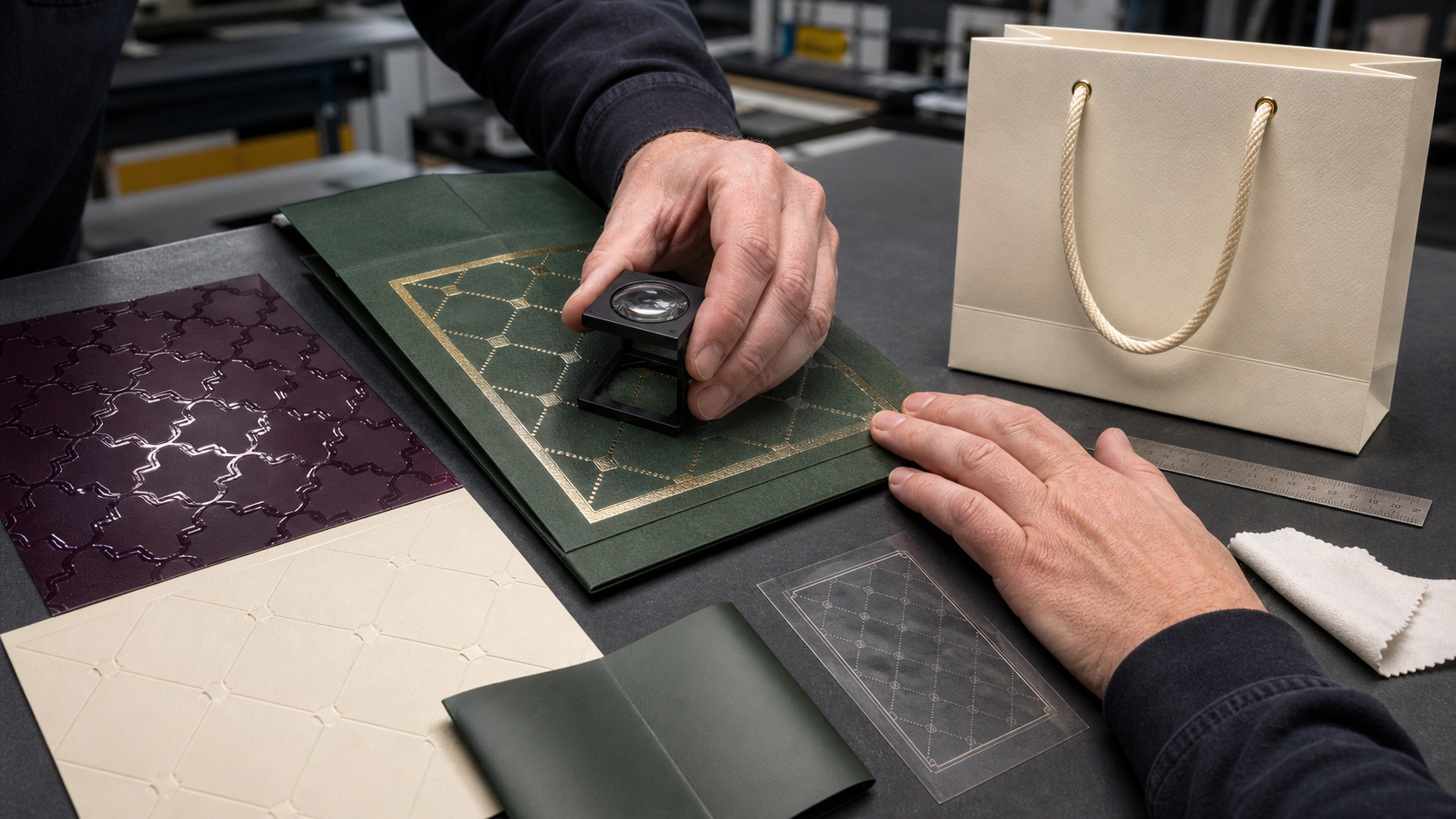
Approval should compare foil transfer, relief, selective gloss, soft-touch surface and crease behaviour on the same production-intent material stack.
| Finish check | Method concept | Look for | Record |
|---|---|---|---|
| Visual / tactile first-off | Compare under agreed diffuse and raking light to signed master | Gloss, hue, touch, relief, contamination and register | Time, machine, lot, tooling and approved sample |
| Foil transfer and adhesion | Inspect magnified edges and use an agreed route-specific adhesion check | Pinholes, fill-in, flaking, incomplete transfer and weak bond | Foil/substrate/film lot and tested location |
| Emboss / deboss relief | Compare height/depth, edge and reverse to approved tool/sample | Shallow areas, double image, cracks, crush and distortion | Die/counter revision and make-ready condition |
| Scuff and rub | Use defined contact material, load/cycles or practical transit simulation | Colour transfer, gloss change, scratches and burnishing | Method, cycles, before/after photographs and rating |
| Crease / flex | Fold and open production creases in defined condition | Film lift, foil/ink cracking, whitening and fibre break | Grain, crease tool, age and environmental condition |
| Blocking / pack pressure | Stack finished surfaces under agreed time, pressure and temperature | Sticking, offset, indentation and gloss transfer | Stack orientation, interleaf and carton simulation |
| Converted-bag review | Fill, carry, open, close and pack the complete bag | Hardware marks, glue staining, finish damage and presentation | Bag lot, component lots and disposition |
The retail-carrier QC planning reference places these finish checks inside the broader material, print, construction, load and packing plan.
12. Diagnose common luxury-finish failures
Foil has pinholes or ragged edges: investigate paper/film smoothness, contamination, foil compatibility, die, temperature, pressure, dwell and artwork detail. Foil fills small counters: the feature may be below practical capability or pressure/heat may be excessive. Registered emboss looks doubled: compare print-to-tool register and sheet movement before adjusting artwork.
Soft-touch surface shows polished marks: rubbing between bags, handles or cartons may be changing gloss. Test interleaf, handle placement, packing count and surface choice. Spot gloss peels or cracks: review cure, surface treatment, coating compatibility, deposit and fold location. Film lifts at creases: investigate laminate bond, paper moisture, crease geometry, grain and conditioning.
Glue opens on a laminated panel: the adhesive may be bonding to an incompatible finished surface, or the intended glue exclusion/stripping was not created.Eyelets scratch the front: hardware protection and packing orientation are inadequate. Dark paper edges look white: consider dyed-through paper, intentional edge treatment or a structure that conceals the cut edge—after confirming cost and process risk.
13. Control colour and finish as separate approvals
A finish changes colour perception. Matte surfaces reduce glare; gloss increases visual depth; soft-touch films can alter density; foil colour changes with angle; embossing creates light and shadow. Approve the base colour and finish interaction, but keep their records distinct so a defect can be diagnosed correctly.
The shopping bag colour matching and bulk approval guide explains the target, drawdown, first-off and monitoring trail. For a luxury bag, add the final finish stack to every colour submission. A drawdown on bare paper may not predict colour after matte film or varnish.
Do not set a universal gloss, colour difference or relief tolerance by copying another project. Define measurement and visual rules with the actual surface, viewing condition, instrument geometry where used, bag location and brand sensitivity.
14. Make sustainability claims about the complete bag
A paper bag is not automatically recyclable in every local system, and a finish name does not prove environmental performance. Paper fibre, coatings, laminates, metallic components, adhesives, inks, reinforcement, handles and hardware all affect the final construction. Collection and mill capability vary by market.
The 4evergreen Circularity by Design Guideline for Paper-Based Packaging evaluates paper-packaging components and decorative metallic routes by compatibility with conventional recycling. Use the relevant current design guideline and, when necessary, representative testing for the target market rather than declaring that all foil or all lamination is acceptable or unacceptable.
If an FSC claim is required, verify scope and transaction evidence. FSC explains chain-of-custody certification as the system that connects certified forest-based material through production and distribution to finished goods. Buying a paper swatch described as FSC certified does not by itself authorise every party to make or apply a finished-product claim.
Reduce waste by choosing a coherent finish hierarchy, approving compatibility before bulk, controlling setup, and avoiding remakes. A simpler finish stack can be more elegant, easier to reproduce and easier to assess at end of life.
15. Understand cost, MOQ and lead-time effects
Luxury finishing adds fixed and variable costs. Fixed costs may include dies, counter-dies, foil tooling, screens/plates, setup, make-ready, minimum foil or film purchase and sampling. Variable costs include material area, coverage, passes, slow running, inspection, interleaf and handling. Large foil fields consume more transfer material; registered combination work demands tighter setup; multi-level embossing uses more complex tooling.
MOQ can come from the paper mill, custom colour, film, foil, handle/hardware or converting route—not just the bag assembly line. Splitting one order into many colours, sizes or artwork versions can multiply setup and approval work. Combine SKUs only when paper, finish and tooling conditions are genuinely shared.
Schedule time for material sourcing, finish feasibility, artwork review, dies/tooling, decorated samples, courier, revisions, production, conditioning and converted-bag approval. Use the retail bag pricing analysis for 2026 for the full cost model and the shopping bag MOQ and production-time guide for programme planning.
Company-claim boundary: LUCKYSTAR statements in this section are publisher self-description, not third-party verification, a finishing-house accreditation, laboratory result, FSC certification, recyclability or food-contact proof, or assurance that a finish is luxury, scratch-resistant, durable, lower impact, available at a stated MOQ, price or delivery. Confirm the contracting entity, assigned production/printing/finishing sites and subcontracting; exact paper and finish stack; tooling, samples, methods and limits; claim/chain evidence; packing; and release terms for each order.
16. How LUCKYSTAR describes its finish-stack review
LUCKYSTAR states that its project team can connect a brand’s sensory intent to a proposed paper-bag construction and sequence of print, coating/laminate, foil, relief, conversion and packing, subject to specification and written confirmation. The review can link design zones, material samples, tooling, decorated production-like sheets, converted prototypes and bulk checkpoints.
- Material and structure: identify paper supplier/grade/shade, caliper, grain, surface, stiffness, bag geometry, creases, glue, reinforcement, handles/hardware and pack-out.
- Finish stack: record primer/treatment, ink/white, coating/varnish, film/adhesive, foil route/reference, emboss/deboss die/counter, cutting/creasing and process order.
- Artwork and tooling: use the current supplier-issued dieline, separate masks, define positive/reverse interpretation, minimum features, register and clearances from folds, glue, cuts and hardware.
- Physical approval: approve named paper, surface, foil, gloss, touch and relief references, then production-like decorated material and a converted bag.
- Use and packing: define scuff/rub, adhesion, crease/flex, blocking, transfer, hand-soil, carton pressure, recovery and presentation checks for the actual route.
- Claims and changes: tie sourcing/recycling/food-contact or performance wording to scoped evidence and require reapproval for material, finish, tool, site or process substitutions.
Review the public custom retail shopping bag range. Teams qualifying suppliers can use the shopping bag supplier-evaluation article and general custom-bag sourcing resource. Then send the bag structure, finish stack and approval requirements for a project-specific review.
17. Send an RFQ that defines the finish
Provide references, but translate them into specifications. Send bag size, quantity by SKU, target market, use, material, base colour, print route, finish sequence, artwork, critical areas, handle/hardware, packing and delivery terms. State which physical sample controls appearance and who can approve changes.
The shopping bag specification-pack tutorial shows how to place finish requirements beside dimensions, construction and quality criteria. The manufacturer should return feasibility notes, process sequence, tooling, MOQ, sample route, inspection plan and any proposed substitutions before the price is treated as comparable.
| RFQ field | Buyer supplies | Manufacturer confirms | Approval evidence |
|---|---|---|---|
| Luxury intent | Sensory hierarchy, reference products, critical viewing and use | Recommended finish system and limitations | Agreed design/finish brief |
| Paper and structure | Size, grade/shade intent, stiffness, construction and handles | Actual paper, grain, caliper, forming and reinforcement route | Material master and structural dummy |
| Surface stack | Print, laminate/coating, foil, gloss, relief and sequence | Compatible products, equipment, order and subcontract stages | Signed stack coupon and process sheet |
| Artwork / tooling | Separate masks, target size, location and current dieline | Minimum features, exclusions, die/counter and register capability | Marked proof and tooling revision |
| Appearance | Physical colour, foil, gloss, touch and relief references | Match route, viewing method and realistic tolerances | Production-process sheet and golden bag |
| Quality / packing | Critical zones, tests, defect criteria, interleaf and carton needs | First-off, sampling, traceability and pack protection | Inspection reports and retained lot samples |
| Claims / change control | Required sourcing, recycling or other market claims and approvers | Evidence, scope, substitutions and reapproval triggers | Transaction documents, change log and signed release |
Frequently asked questions
What finish makes a shopping bag look most luxurious?
There is no single best finish. Luxury comes from a controlled hierarchy. A suitable paper, precise structure and one dominant effect—such as hot foil, blind emboss or soft-touch matte—often look more premium than many competing embellishments.
Is hot foil better than metallic ink?
Hot foil usually provides a stronger reflective metallic surface, while metallic ink is printed and may suit larger or different process areas. The right choice depends on desired reflection, artwork, substrate, coverage, tooling, budget and durability.
What is the difference between embossing and debossing?
Embossing raises the design above the surface; debossing presses it inward. Either can be blind, registered to print or combined with foil. Approve depth, edge definition and reverse-side appearance on the actual paper.
Can foil and embossing be used together?
Yes. A combination foil emboss creates metallic transfer and relief in the same design, while separate registered operations are also possible. Tooling, paper, detail, heat/pressure and alignment must be tested as a complete production route.
Does soft-touch lamination scratch easily?
Performance varies by film or coating, printed surface, handling and packing. Some dark matte surfaces reveal scuffs, fingerprints or rub polishing readily. Approve the exact product and run practical abrasion, blocking and carton simulations.
Can spot UV cross a shopping bag crease?
It may crack, whiten or register poorly depending on deposit, coating, paper and crease. Ask the converter for a route-specific exclusion and approve a folded production sample before placing critical spot gloss across a crease.
Should luxury bags use textured or smooth paper?
Smooth paper supports fine print, clean foil and sharp gloss. Textured paper provides tactile character but may interrupt fine detail. Choose from the brand hierarchy and test the intended decoration on the actual surface.
Are foil and lamination recyclable?
Do not answer from the finish name alone. Compatibility depends on material type, coverage, adhesive, complete bag construction and local recycling route. Use current market guidance and representative assessment where required.
What should be approved before bulk finishing?
Approve the exact substrate and surface stack, colour, foil/finish references, tooling, marked artwork, decorated production-process sheet, converted pre-production bag, defect criteria, pack-out and bulk first-off.
How can luxury finishing costs be reduced?
Use one hero effect, limit coverage, share compatible paper/finish conditions across SKUs, avoid unnecessary passes, simplify fine tooling and approve compatibility early. Remove processes that do not add clear customer-visible value.
Conclusion
Luxury retail shopping bag finishing succeeds when every surface decision supports one sensory hierarchy and survives conversion, handling and delivery. Begin with the paper and structure, document the full finish stack, choose foil and relief routes deliberately, protect artwork from folds and hardware, approve physical production evidence and inspect the finished bag under realistic packing and retail conditions.
For a finish-led programme, compare LUCKYSTAR’s custom retail shopping bag range. Use the shopping bag supplier-evaluation article for category questions and the general custom-bag sourcing resource for wider factory due diligence. The design-to-delivery manufacturing process shows where decoration and approval fit into the complete schedule.

Request a production finish-stack proposal
Define the complete paper, print, coating/laminate, foil/relief, conversion and pack-out sequence before comparing an isolated finish name.
Review LUCKYSTAR custom shopping bag options, then send your project details through the contact form or Email a project brief. The email link opens a draft for your review before sending.
Factory/finishing-site assignment, material/finish stack, tooling, color/touch/relief, durability, sourcing/recycling/food-contact claims, samples, testing, inspection, price, MOQ, packing, schedule and release terms are subject to due diligence, specification and written confirmation.