FSC Paper Shopping Bags: Certification and Chain-of-Custody Guide
An FSC logo on a sample or quotation is not enough to prove that a bulk order of paper shopping bags can be sold as FSC certified. A buyer should verify the certified legal entity and site, the product and process scope, the exact FSC claim on the supplier's sales documents, and the approved on-product artwork. Those records must describe the same bag, order and supply route.
This guide gives procurement, packaging and sustainability teams an order-level method for reviewing custom shopping bags. It does not replace advice from FSC, an accredited certification body or your legal team. It also does not claim that every paper bag, supplier site or LUCKYSTAR project is FSC certified; eligibility must be confirmed for the proposed order.
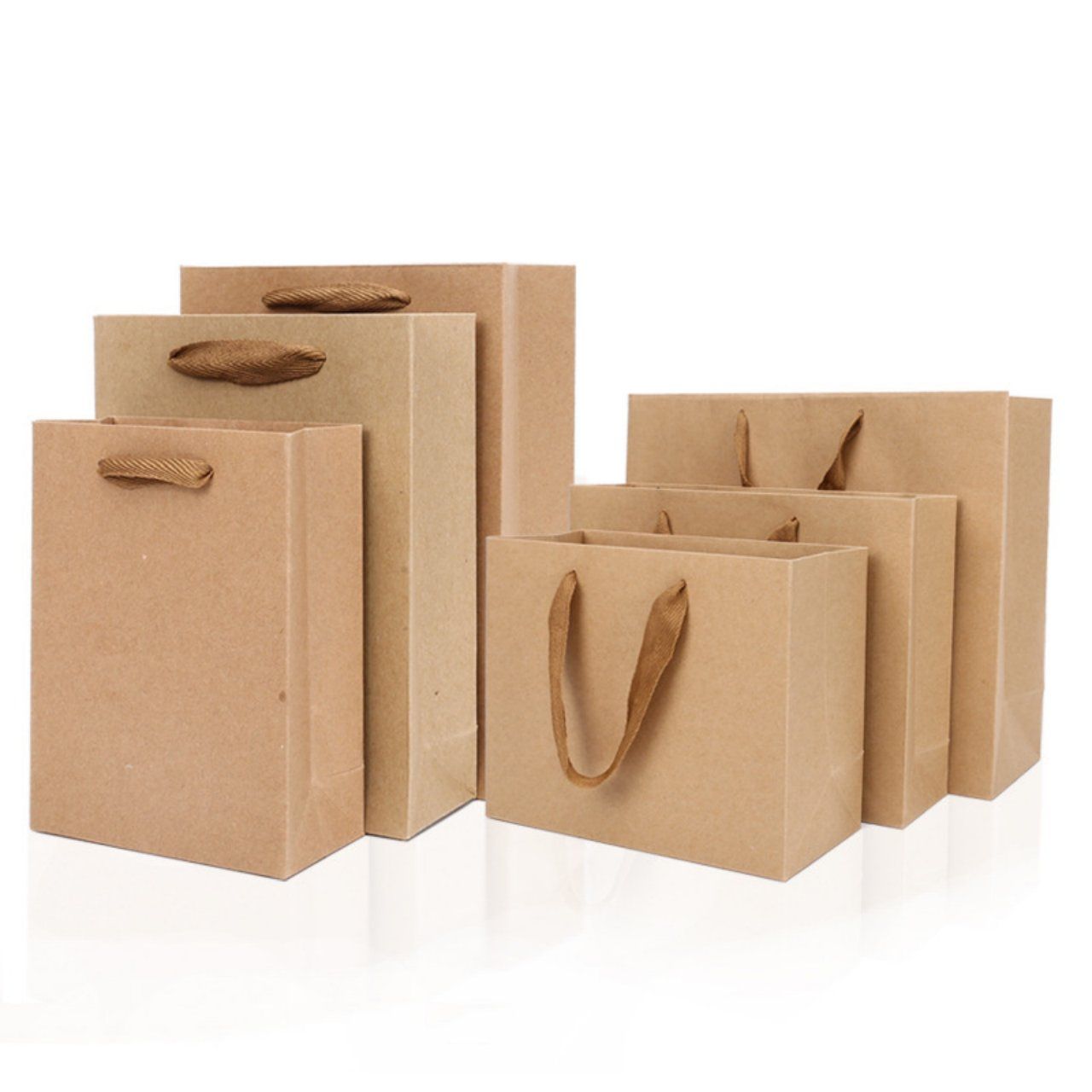
Real paper-bag formats shown on a LUCKYSTAR public product channel. The photo is a construction reference and is not evidence of paper origin, FSC status or certification scope.
Need an FSC-ready paper bag RFQ? Send the buyer and legal seller, bag SKU/specification, paper and non-paper components, proposed FSC claim and label use, intended certificate holder and converter, current FSC record, sales-document claim, quantity, destination and required date. LUCKYSTAR can return project assumptions and missing evidence fields for certificate-holder and buyer review.
The short answer: verify the claim from forest-based input to invoice
FSC chain of custody (CoC) is the system used to identify and control FSC-certified and other eligible forest-based material as it moves through ownership, processing, trading and distribution. FSC's current document centre lists FSC-STD-40-004 V3-1 as the approved core CoC standard. For a paper shopping bag, the practical verification path is:
Approved marketing statement → approved label artwork → finished-bag product group and specification → sales-document FSC claim → certified seller and relevant site(s) → controlled printing/converting route → eligible paper input and purchasing records.
If one link is missing, do not fill the gap with a supplier assurance or a logo copied from another order. Narrow the claim or pause it until the certificate holder or certification body supplies a coherent answer.
| Evidence layer | What it should prove | Buyer check | What it does not prove alone |
|---|---|---|---|
| FSC public record | Certificate holder, code, status, scope and listed sites | Search the exact legal name, certificate code or licence code | That your specific PO is an FSC sale |
| Scope certificate and product groups | Products and activities within the holder's certified system | Match paper/bag category, trading, printing, converting and relevant locations | That every product sold by the organization is certified |
| Purchase and production records | Eligible input entered the controlled route and was assigned to the order | Match supplier, paper grade, quantity, lot, consumption and output | Permission to use the FSC trademarks |
| Sales documents | The seller transfers an eligible FSC claim for identified goods | Match seller, buyer, item, quantity, certificate code and exact output claim | That unrelated components or environmental attributes are certified |
| Trademark/label approval | The exact label and promotional use are authorized | Approve final artwork, licence code, product type and placement | Strength, print quality, recyclability or market compliance |
What FSC chain-of-custody certification covers
CoC certification applies to an organization and the operations included within its certificate scope. It is not a free-standing product test. The FSC chain-of-custody page explains that the standard applies to sourcing, processing, labelling and sale of forest-based products as FSC certified. The certificate holder implements a control system and is audited by an FSC-accredited certification body.
That distinction matters in packaging procurement. A paper mill may be certified to sell eligible paper. A printer may print sheets. A converter may cut, fold, glue and fit handles. A trading company may take legal ownership before the buyer receives the goods. The buyer must understand which organizations need coverage and how any outsourced activities are controlled. A certified mill at the start of the route does not automatically make the finished bag or the final seller certified.
FSC certification also does not establish every other feature a buyer may care about. It is not, by itself, a load test, color standard, food-contact assessment, recycled-content percentage for non-fibre parts, compostability claim or proof that the complete bag can be recycled in a particular city. Manage those questions in separate specification and evidence lanes.
Match the certificate holder to the contracted seller and site
Begin with names, not logos. Record the legal entity on the quotation, purchase order and invoice. Compare it with the certificate holder in FSC Search, then check the address, status, certificate code, licence code, certificate type and relevant scope information. FSC Search supports searches by organization name, licence code or certificate code and allows a time-stamped certificate record to be downloaded.
Do not accept a near match. A brand name, English trading name, related company or email domain may differ from the certified legal entity. If Company A invoices the buyer but Company B holds the certificate, require a documented explanation of legal ownership and the applicable certified chain. If a paper bag is converted or stored at a site not shown in the expected route, ask how that site is covered before approving an FSC claim.

A real product photo can support size, color and handle discussions, but it cannot identify the certified seller or site. Verify those facts in the public record and commercial documents.
Use FSC Search as a live check, not a one-time screenshot
Certificate PDFs can be outdated, incomplete or detached from the current public status. Search the holder when qualifying the supplier, again before artwork approval, and again before accepting final FSC sales documents. Save the date and the record reviewed in the project evidence file.
At minimum, investigate these discrepancies:
- the supplier name differs from the certificate holder;
- the certificate is suspended, terminated or outside its validity period;
- the physical site or activity described by the supplier is not consistent with the scope;
- the certificate product information is too remote from the paper or finished bag being sold;
- the quotation shows one certificate code while the invoice shows another;
- the licence code printed in the artwork belongs to a different organization.
A buyer should not try to resolve a material conflict by choosing whichever document is more convenient. Send the conflict to the certificate holder and, where necessary, its certification body.
Distinguish the certificate code, licence code and FSC claim
These identifiers have different jobs. The certificate code identifies the certified chain-of-custody certificate and is used in certified sales-document claims. The trademark licence code identifies the organization authorized to use FSC trademarks and appears with FSC trademark use. The FSC claim describes the eligible output being transferred, such as an FSC 100%, FSC Mix or FSC Recycled claim in the form permitted by the applicable CoC system.
Do not treat the three as interchangeable. A licence code visible on a bag does not replace the required certificate code and claim on a B2B sales document. A certificate code on an invoice does not by itself show that the label artwork was approved. An FSC claim must be linked to the specific product line, not placed once in a footer where it could appear to cover every item on the invoice.
Read the supplier's sales documents line by line
Clause 5 of FSC-STD-40-004 V3-1 requires sales documents for products sold with FSC claims to contain defined information. For buyers, the most useful check is to reconcile the certified invoice or delivery document with the PO, packing list and received quantity. The product description should be precise enough to identify the paper bags and should carry the applicable FSC claim.
| Sales-document field | What to match | Paper-bag example | Stop signal |
|---|---|---|---|
| Seller name and contact details | Certified organization taking the relevant legal ownership | Seller on invoice matches the certified holder or documented certified route | Certificate belongs only to an unrelated mill |
| Customer identification | Your buying legal entity | Buyer on certified invoice matches the PO | Certificate evidence is addressed to another customer |
| Document date | Production, shipment and certificate timeline | Invoice falls within the applicable certified period | Document was backdated after a claim dispute |
| Product description | SKU, size, paper/construction and order reference | “250 × 320 × 100 mm printed paper shopping bag, PO 123” | “Packaging” with no link to the purchased SKU |
| Quantity | Units or other controlled measure | Invoice quantity reconciles to shipment and material calculation | Certified quantity exceeds the shipped or eligible output |
| FSC certificate code | Seller's relevant CoC code | Code matches the authenticated holder | Only a trademark licence code is shown |
| FSC claim per item | Exact eligible output claim | Claim is adjacent or clearly linked to the bag line | “FSC available” appears as general footer text |
Ask for a corrected document before treating a vague or mismatched invoice as evidence. Do not add an FSC claim to your own downstream paperwork unless your organization and transaction are entitled to do so under the applicable rules.
Check the product group and the exact paper bag
A valid certificate does not mean every paper product from the holder is FSC certified. Confirm that the relevant product group and activities cover the proposed output. Then make the finished-bag specification specific enough to keep the certified and non-certified versions apart.
Your controlled specification should identify paper grade and basis weight; color and coating; bag dimensions and gussets; reinforcement boards; paper, ribbon or cord handles; print route; lamination or varnish; adhesive; label location; packing; and the exact FSC claim requested. The custom shopping bag tech pack guide shows how to freeze these fields, while the sample development process explains how to move from artwork to an approved production reference.
If the supplier proposes a substitute paper, different converter or alternate printing site, reopen the chain-of-custody check. A technically acceptable substitution may still change claim eligibility.
Understand FSC 100%, FSC Mix and FSC Recycled labels
FSC's official label guide describes three on-product labels. FSC 100% identifies material from FSC-certified forests. FSC Recycled identifies products made from 100 percent recycled material. FSC Mix identifies a mixture of material from FSC-certified forests, recycled sources and/or FSC Controlled Wood. Buyers should request the label that corresponds to the certificate holder's eligible output—not select a label because its wording fits a campaign.
| Label | Fibre meaning in FSC's public explanation | Buyer verification question | Common misinterpretation to avoid |
|---|---|---|---|
| FSC 100% | Forest-based material comes from FSC-certified forests | Does the eligible output and approved artwork support FSC 100% for this bag? | “100%” describes every non-paper component or every environmental impact |
| FSC Mix | Eligible mix may include FSC-certified forest material, recycled material and/or FSC Controlled Wood | What exact sales-document claim and control system support the output? | Every fibre came from an FSC-certified forest |
| FSC Recycled | Forest-based material is 100% recycled | Do the output claim, product group and label approval support the finished paper product? | The complete bag, including handles, coatings, inks and adhesives, is 100% recycled |
The label should not be used to imply unrelated properties. For example, an FSC Recycled label is not a guarantee that a coated, laminated or multi-component bag is accepted by local recycling collection. If recycled fibre percentage or recyclability will be promoted separately, collect evidence and legal review for those separate claims.
Approve the exact label and promotional wording
FSC trademarks are controlled intellectual property. Do not download a logo from a search result, redraw it, replace the licence code or place it on a mock-up before the responsible certificate holder confirms the approval route. The exact artwork used in production should be the approved version, with the required elements, legibility, clear space, color and product type.
The timing is especially important in 2026. FSC published FSC-STD-50-001 V3-0 for certificate-holder trademark use with an effective date of July 1, 2026 and a transition end date of January 1, 2029. FSC's transition guidance says certificate holders move to V3-0 through their certification process; not every holder will transition on the same day. Therefore, ask the certificate holder which version currently governs its trademark approvals and keep the approval evidence with the final artwork.

The bags show how size, trim and print area change the artwork layout. They do not display an FSC label; any FSC artwork must come from the responsible approval process.
Map printers, converters, traders and outsourced processes
Paper bags can pass through sheet printing, lamination or coating, die cutting, creasing, gluing, handle fitting, packing and storage. Some activities may be conducted by contractors. The buyer does not need to redesign the certificate holder's management system, but should ask for a simple legal-ownership and physical-flow map and confirm that the certified organization controls the relevant outsourced activities under the applicable FSC requirements.
Use two lines in the map:
- Legal ownership: who buys and sells the certified product at each step?
- Physical handling: which site stores, prints, converts, repacks or labels it?
This exposes gaps that a single supplier name can hide. A certified trader may use a converter; a certified converter may buy through a distributor; a brand may nominate paper. The correct route depends on the real transaction, not a generic diagram from a previous order.
Evaluate the supplier separately with our custom shopping bag manufacturer selection framework. The core custom bag manufacturer guide covers the wider RFQ-to-delivery sequence across bag categories.
Define the paper and non-paper component boundary
A shopping bag is not only a paper body. It may include rope or ribbon handles, paper handle patches, base reinforcement, lamination, foil, ink, adhesive, eyelets and packing materials. Decide what the FSC label refers to and whether the correct product type must be shown so buyers are not misled about non-certified components.
Record each forest-based component in the bill of materials and reconcile it to the eligible input route. Ask the certificate holder how reinforcement paper and other fibre components are treated. Keep non-fibre claims separate. A bag may qualify for an FSC label while still requiring independent checks for color rub, handle strength, adhesive performance, coating, restricted substances or end-of-life messaging.
This is also where design and certification meet. The paper shopping bag wholesale guide covers structure and branding choices; the boutique paper shopping bag guide covers retail performance. Use those pages for bag design decisions and keep this page as the certification-control layer.
Put certification checks into sample, pre-production and shipment gates
Certification evidence should not arrive after the bags are printed. Add it to the project timeline:
- RFQ gate: define the requested FSC claim, markets, artwork use, seller, quantity and required evidence.
- Supplier qualification gate: authenticate certificate status, scope, sites and route.
- Quotation gate: state whether the price and material route include the requested certified output; all commercial details remain subject to specification and written confirmation.
- Artwork gate: approve the exact label and promotional wording through the responsible certificate holder.
- Pre-production gate: freeze paper supplier, product group, converter, label file and bag specification.
- Incoming/production gate: retain paper purchasing, lot, consumption, segregation/identification and substitution records within the certificate holder's system.
- Shipment gate: reconcile the sales document, FSC claim, quantity, PO, packing list and final artwork.
The custom shopping bag quality control checklist can hold the physical inspection criteria. For paper printing decisions, compare flexographic and offset printing, then use the shopping bag printing QC checklist for color, registration and finishing controls. Certification review and physical QC should meet at the same release gates but remain separate evidence tests.

Colorways and handle constructions can share a design while using different materials. The FSC evidence pack must match the specific approved variant and order, not merely a visually similar bag.
Use a red-flag table during supplier qualification
| Supplier statement or evidence | Why it is insufficient | Buyer response | Acceptable close-out |
|---|---|---|---|
| “Our paper supplier is FSC certified” | It does not establish the converter, seller or finished output chain | Map ownership and processing; authenticate each relevant holder | Coherent certified route and eligible output documents |
| Certificate screenshot with no searchable code | Status and scope cannot be reliably checked | Request full code and search the public record | Time-stamped public record matches the supplier evidence |
| “FSC logo can be added for a fee” | Trademark use is not a decoration upsell | Ask who owns the licence code and approves artwork | Responsible certificate holder provides approved final artwork |
| Generic “FSC paper” line in a quote | The exact claim, paper, SKU and output are unclear | Define the output claim and specification | Quote, PO and sales-document plan use consistent wording |
| Certificate legal name differs from invoice seller | The chain may be broken or unexplained | Request legal-ownership map and certification-body clarification | Entity roles and certified transfer are documented |
| FSC claim appears only after shipment | Evidence control started too late | Pause public claim and request corrected, authentic records | Valid sales documents and route support the order |
| Same certificate used for every factory | Scope may not include all sites or activities | Verify each site/process or controlled outsourcing route | Public scope and system explanation match production |
| FSC label paired with “fully recyclable” | FSC does not automatically prove local recyclability | Separate the claims and review the target-market recovery route | Each claim has its own evidence and approval |
Company-claim boundary: the following section is LUCKYSTAR publisher self-description. It is not evidence of current company-wide FSC certification, certificate ownership, product-group scope, a certified paper/converting route, an order-level FSC sales claim, trademark approval, recyclability or material availability. Certificate status, route, claim, label, materials, tests, MOQ, price and timing are subject to current documents, order-level verification, final specification and written confirmation.
Why choose LUCKYSTAR for an evidence-controlled paper bag project
LUCKYSTAR supports custom paper and shopping-bag development by coordinating the buyer's specification, artwork, samples, production checkpoints, inspection criteria and shipment evidence. That workflow is useful for FSC-related projects because certification cannot be managed as an isolated logo request; it must be tied to the actual seller, material route, approved variant and order documents.
Our approach is deliberately specific:
- collect the requested FSC claim, target market and artwork use at RFQ stage;
- distinguish the legal seller from mills, printers, converters and other supply-chain parties;
- treat any supplier certificate as that holder's evidence, not as a LUCKYSTAR company-wide certificate;
- freeze paper, construction, print, handles and label artwork through sample approval;
- connect certification checkpoints with print and bag QC rather than confusing the two;
- build an order file that can include specifications, approvals, inspection records and supplied certification documents.
LUCKYSTAR does not use this article to claim universal FSC certification for every paper shopping bag or company entity. Availability, certificate scope, claim category, label approval, MOQ, price, sample timing and production timing must be confirmed for the exact specification and supply route in writing. For print-method selection before certification artwork is locked, see the custom shopping bag printing methods guide. To protect approved color and artwork on repeat orders, use the shopping bag reorder consistency guide.
Send an FSC-ready paper shopping bag RFQ
Give the supplier enough information to confirm eligibility before pricing and artwork approval:
- buyer legal entity and target sales markets;
- bag dimensions, gussets, paper grade and basis weight;
- handles, reinforcements, coating/lamination, inks, foil and adhesive;
- quantity by SKU, size and color;
- intended FSC claim and whether an on-product label or promotional statement is required;
- exact print artwork, label location and minimum legibility needs;
- contracted seller, proposed converter and any nominated paper source;
- sample, pre-production and bulk approval stages;
- required certificate record, sales-document claim and final evidence pack;
- destination, packing and required delivery date.
Avoid writing only “FSC paper required.” That phrase does not define the claim, certificate holder, product group, label use or documents. A controlled RFQ makes quotations comparable and gives the supplier time to validate the chain before plates, dies or printed stock are committed. If the specification is still developing, the paper bag print-quality material guide can help explain how paper surface and construction affect print results.
Frequently asked questions
Does a certified paper mill make the finished shopping bag FSC certified?
Not automatically. The finished product must move through the required certified or controlled chain, including legal ownership and relevant processing. Confirm the seller, converter, outsourced activities, product group and sales-document claim for the actual order.
Is a scope certificate enough for my purchase order?
No. It establishes the certificate holder's eligible scope and status, not that every transaction is certified. Your PO and shipment need product-specific records and the appropriate FSC claim on the responsible seller's sales documents.
Can a buyer print any FSC label after receiving a certificate PDF?
No. FSC trademarks and label artwork are controlled. Use artwork supplied or approved through the responsible certificate holder's current trademark approval process. Never copy a logo or licence code from another product.
What should appear on an FSC sales document?
Under the current FSC CoC standard, relevant sales documents include the seller's details, customer identification, date, product description, quantity, the applicable certificate code and a clear FSC claim linked to the product. Confirm the exact requirements with the certificate holder and certification body for your transaction.
What changed for FSC trademark use in 2026?
FSC-STD-50-001 V3-0 became effective on July 1, 2026, with transition ending January 1, 2029. Because certificate holders transition through their own certification process, buyers should ask which version governs the holder's current approval and retain that approval with the artwork.
Does an FSC label mean the paper bag is recyclable?
No. FSC addresses forest-based material sourcing and chain of custody; local recyclability depends on the complete construction and available collection and processing systems. Coatings, lamination, handles, adhesives and other components require a separate end-of-life review.
What happens if the paper or converter changes after sample approval?
Treat the change as both a technical and certification deviation. Reconfirm print and construction performance, update the specification, and have the responsible certificate holder verify that the revised material and route remain eligible before production continues.
Turn the certificate request into a controlled order
The strongest FSC paper-bag claim is not the broadest one. It is the one a buyer can trace from approved wording and artwork to a specific bag, sales-document claim, certified seller, covered route and eligible paper input. Authenticate the holder, read the scope, reconcile the invoice, control substitutions and keep physical quality checks in parallel.
Send LUCKYSTAR your bag dimensions, paper and handle preferences, artwork, quantity by variant, target markets, intended FSC claim and evidence requirements. We can review the brief and coordinate a project-specific paper shopping bag proposal, subject to certificate availability, verified scope, specification and written confirmation.

Request an FSC-ready paper shopping bag RFQ review
Send the finished-bag specification, proposed FSC claim, certificate-holder route and sales-document requirement together so eligibility and artwork questions can be checked before production commitment.
Review LUCKYSTAR custom shopping bag options, then send your project and evidence brief through the contact form or Email a project brief. The email link opens a draft for your review before sending.
Certificate holder/site, product group, FSC claim, certified route, label/trademark approval, materials, testing, availability, price, MOQ, packing, schedule and delivery terms are subject to current evidence, final specification and written confirmation.