Should a paper shopping bag be printed flexographically or by offset lithography? The practical answer does not come from a generic quality ranking. It comes from the paper format, artwork, colour system, bag construction, order structure, press route and the point at which the printed paper becomes a bag.
Flexographic vs Offset Printing for Paper Shopping Bags is therefore a manufacturing-route decision. Flexography commonly prints from a web using relief plates and metered liquid ink before inline or nearby bag conversion. Sheet-fed offset commonly prints individual paper sheets indirectly through a blanket, after which the sheets are finished, cut, creased and converted. Both can produce professional retail carriers when the artwork and controls match the chosen process.
For available paper and reusable constructions, explore LUCKYSTAR’s custom shopping bag range. Apply the retail-carrier supplier checklist when qualifying the printer/converter, and use the broader custom bag sourcing guide for factory due diligence.
This article owns the specific comparison between flexographic vs offset printing. It addresses paper shopping bag printing as a complete print-and-convert route and explains when flexo printing for paper bags is the commercially stronger choice.
Planning an order? Send a flexo-versus-offset brief. Include finished bag construction/use, paper grade/format/side/grain, artwork/detail/coverage, spot/process colors and physical target, quantity by SKU and reorder horizon, coating/laminate/foil/emboss sequence, plate/imposition/tool ownership, proof and converted-sample gates, resistance/conversion/packing checks, destination and required date.
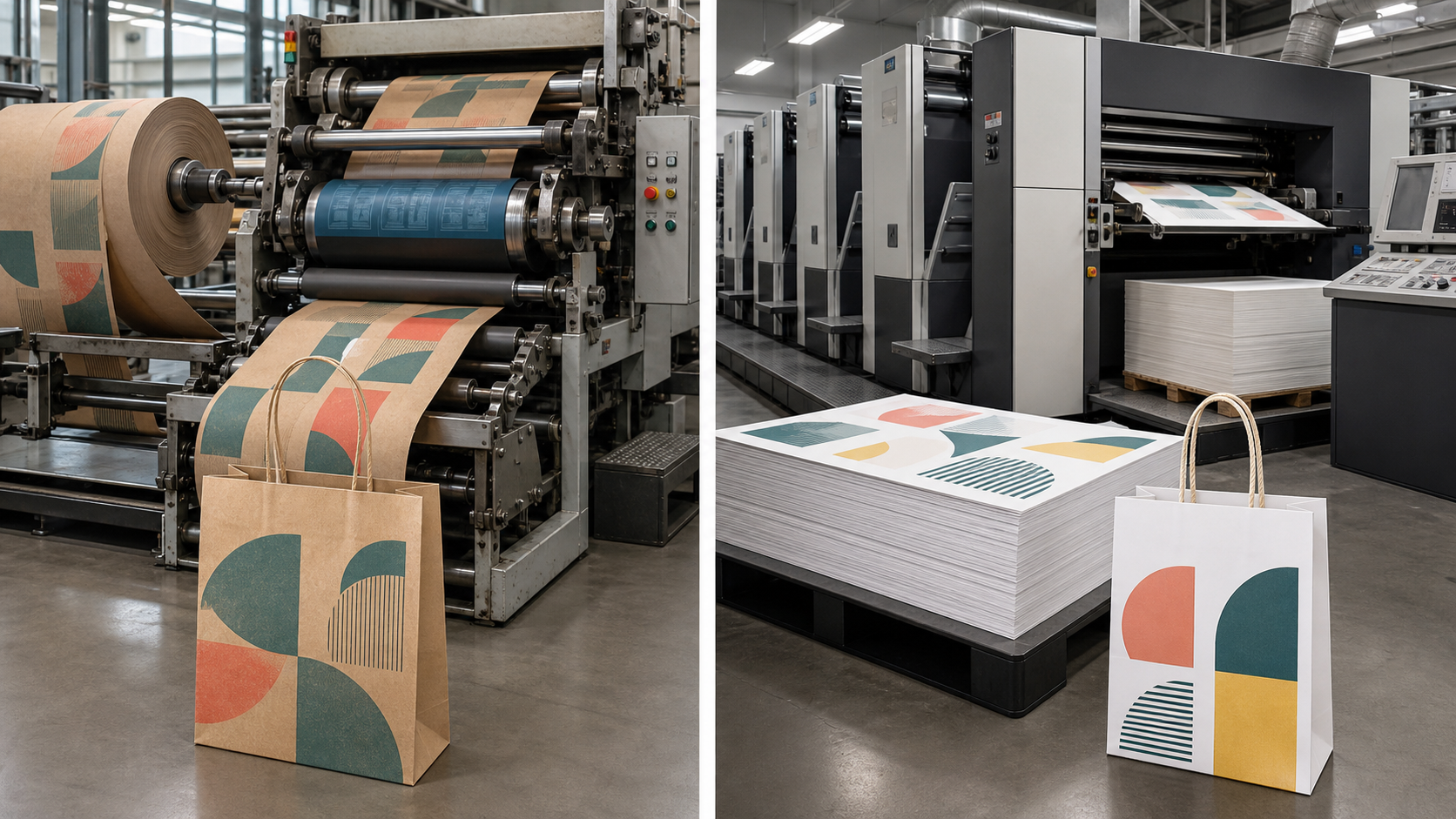
Flexography often begins with a paper web and can flow toward inline bag conversion; offset commonly prints sheets that later move through finishing and conversion.
1. Start with the bag programme, not the press
Define the bag before selecting the print route: finished width, height and gusset; paper grade, colour and surface; handle and top construction; bottom style; quantities by size and artwork; number of colours; image/detail requirements; finish; retail use; destination; packing and launch date. A machine should solve that brief.
A grocery or takeaway programme may need high-volume kraft bags with one or two strong colours, rapid replenishment and efficient web conversion. A fashion or beauty launch may require smooth white paper, photographic colour, fine typography, foil, embossing and a rigid luxury hand. The first brief often favours flexographic web production; the second often favours offset sheet production. Many projects fall between them.
Do not assume that “simple artwork” always means flexo or that “premium” always means offset. High-quality flexography can reproduce controlled process work, while offset can print restrained spot-colour designs. Press age, plate imaging, anilox selection, paper, ink, colour management and operator control matter as much as the process family.
| Programme signal | Flexographic route may lead when… | Offset route may lead when… | Evidence to request |
|---|---|---|---|
| Paper supply | The production paper is qualified in a continuous web format | The chosen premium stock is supplied and handled as sheets | Exact grade, format, side, grain and supplier availability |
| Artwork | Bold spot colours, large shapes and process-compatible screens dominate | Fine type, subtle gradients, detailed images or complex four-colour work dominate | Press fingerprint, sample at comparable paper/detail and preflight limits |
| Volume | Continuous production and inline conversion create useful efficiency | Sheet workflow and downstream finishing fit the order/SKU mix | Total and per-SKU setup, run speed, waste and minimums |
| Finishing | Decoration is mainly print plus efficient bag forming | Lamination, foil, embossing or selective coating require sheet operations | Written process sequence and subcontract map |
| Reorders | A stable high-volume design repeats on the same web route | A premium range changes artwork or uses several sheet stocks/finishes | Tool storage, change-control and repeat-colour history |
| Critical risk | Web tension, repeat, plate/anilox and cut-to-print register dominate | Sheet register, ink/water balance, drying and finish/conversion alignment dominate | First-off and in-process control plan |
2. Understand how each image reaches the paper
Flexography uses a flexible relief printing plate. Raised image areas receive a controlled film of liquid ink, commonly metered by an anilox roll, and transfer it to the paper under impression. Each print station normally carries one colour or functional coating. The paper may travel as a continuous web through several stations and dryers before rewinding or entering bag-making operations.
Offset lithography relies on the different behaviour of image and non-image areas on a plate. The image transfers from the plate to a rubber blanket and then to the paper, so it is an indirect process. Sheet-fed packaging work commonly carries individual sheets through multiple units, then piles them for drying/curing or later finishing and conversion.
These mechanics influence design. Flexographic plate relief and web transport create process-specific distortion, impression and register considerations. The anilox, plate, ink and paper determine ink film. Offset blanket transfer can reproduce fine halftone detail well on suitable sheets, but paper surface, ink setting, fountain solution/press condition and drying still influence the result.
| Process element | Flexographic printing | Offset lithography | Buyer implication |
|---|---|---|---|
| Image carrier | Flexible relief plate mounted to cylinder/sleeve | Lithographic plate transferring through a blanket | Tooling, compensation and remake route differ |
| Ink metering / transfer | Metered liquid ink, commonly through anilox and doctoring system | Ink train plus plate/blanket/paper transfer | Solid density, dot behaviour and colour adjustment use different controls |
| Material movement | Often continuous paper web | Often individual commercial sheets for premium bag work | Repeat/web direction versus sheet/grain and imposition must be defined |
| Drying / setting | Depends on liquid ink system, deposit, paper and dryer configuration | Depends on ink, paper, coating and press drying/curing route | Do not convert, stack or finish before the approved condition is reached |
| Typical handoff | Printed roll or web moving toward roll-fed conversion | Printed sheet moving to coating/lamination, die cutting and assembly | Inspect at the transfer between printing and conversion |
3. Match the route to kraft, coated and speciality paper
Brown kraft is not a neutral white printing surface. Its fibre colour lowers brightness and changes brand hues. An uncoated surface absorbs ink and shows natural formation. Bold spot colours and simplified art can use that character intentionally. Flexographic printers experienced with bag kraft can control web handling and direct print, but the final appearance still depends on paper side, porosity, sizing, moisture and ink system.
Smooth white coated paper supports cleaner dots, fine type and high image contrast, making it a common offset route for premium retail bags. Coating type, brightness, gloss and surface strength affect print. Uncoated premium sheets can also be offset printed, but the profile and visual target must reflect their absorption and texture.
Speciality coloured, metallised or heavily textured papers require route-specific trials. A sheet may look attractive but feed poorly, pick, crack at a fold, resist ink, or create unacceptable colour shift. Confirm that the printer and bag converter have run the intended stock—not merely a paper with a similar marketing description.
| Paper surface | Flexographic considerations | Offset considerations | Finished-bag approval |
|---|---|---|---|
| Brown kraft, uncoated | Web quality, absorption, anilox/plate/ink selection and body-colour effect | If sheet printed, use a condition built for the stock; expect paper character | Judge opacity, colour, mottling, rub and fold on actual kraft |
| White kraft, uncoated | Supports cleaner colour than brown base but retains porous texture | Can reproduce detailed work if stock and process are qualified | Review fibre/show-through and colour after conversion |
| White coated paper | Possible on a qualified web/ink route; surface and dryer compatibility matter | Common fit for fine sheet-fed process colour and later embellishment | Inspect detail, set-off, coating/laminate and crease behaviour |
| Coloured paper | Ink transparency and optional white layer affect colour | Spot/process art may need opaque strategy or deliberate substrate influence | Approve under intended surface finish and lighting |
| Textured paper | Texture can interrupt fine plate contact and solid uniformity | Blanket conformity helps, but fine screens and solids still need testing | Use full-size artwork samples, not a small generic swatch |
| Metallised / speciality surface | Treatment, ink bond, white and web handling are route-specific | Sheet feeding, ink, opaque white/coating and post-process bond require trials | Test scratch, fold, adhesion, view angle and finish stack |
4. Compare real image quality—not stereotypes
Offset has a strong reputation for fine halftones, smooth gradients, small typography and detailed four-colour images on appropriate sheets. Flexography has improved substantially through plate imaging, screening, anilox, ink, mounting, press control and colour management. A capable flexographic plant can produce refined work, especially when artwork is designed for its characterised condition.
The useful question is whether the chosen plant can reproduce the actual file on the actual paper at the required speed. Ask for comparable production samples: same paper family, similar solid coverage, reverse detail, gradients, trapping and bag conversion. A food-service kraft bag with two colours should not be judged from a flexible-film label sample; a premium offset bag should not be judged from a coated magazine sheet.
Look at solid uniformity, dot/tonal reproduction, register, slur/doubling, pinholing, fill-in, dirty print, hickeys, set-off, mottling and colour drift. Then fold the bag. Print that is technically attractive on a flat sheet can move into a gusset, crack at a crease or sit behind a handle.
5. Prepare artwork for the intended printing condition
Do not use one master file without process-specific prepress review. Flexographic artwork may require agreed plate distortion compensation, trap, minimum line/reverse feature, tonal range, screening, spot-colour naming and repeat orientation. Offset artwork needs its own output condition, total area coverage, screening, overprint, trapping, small-type and finishing controls.
FTA’s FIRST programme translates customer graphic requirements into specifications across the flexographic supply chain. Its purpose is predictable and consistent reproduction; it does not prove that any printer automatically meets a given buyer’s job. Ask the plant which FIRST practices, characterisation data and proof conditions it uses.
The paper bag artwork and dieline guide explains how to map print onto front, back, side gussets, bottom folds, glue lap, top turn and handle zones. Keep process separations and technical paths distinct, and require a returned production PDF/marked proof for any printer-side trapping, distortion or imposition changes.
| Artwork feature | Flexographic prepress question | Offset prepress question | Do not assume |
|---|---|---|---|
| Spot-colour solids | Which ink, anilox/deposit and plate combination controls coverage? | Is spot ink, process simulation or another route approved? | A Pantone code predicts appearance on kraft |
| CMYK images | What characterised flexo condition, screening and tonal range apply? | What offset condition/profile and proof target apply? | The same separation prints identically in both processes |
| Gradient / highlight | Where is the stable minimum dot and fade endpoint for this route? | How will fine highlights and shadow coverage reproduce on this stock? | A screen preview predicts the physical fade |
| Small positive / reverse type | What minimums account for plate, impression, paper and register? | What minimums account for paper, screening, ink spread and finishing? | One universal point size or line width is safe |
| Multi-colour register | What trap, web tension and repeat tolerance apply? | What sheet/press register and downstream cut/crease tolerance apply? | Print register equals bag-conversion register |
| Full coverage / heavy solids | Can the ink film dry without mottling, blocking or excessive load? | Can the sheet dry/set without set-off before finishing? | More coverage only changes ink price |
| Fold / glue areas | How will web print align with cut, fold and glue? | How will imposition align with die cut, crease and glue? | Ink is harmless inside every bond area |
6. Control spot colour, process colour and paper influence
Flexography is often selected for strong spot colours on kraft, while offset is often selected for four-colour images on smooth white paper. Those are useful patterns, not absolute rules. Both processes can run spot and process colour within their equipment and characterisation. The substrate remains part of the appearance.
ISO 12647-6:2020 addresses colour-characterisation data, aims, responsibilities and tolerances for four-colour flexographic printing, with guidance for spot colours. ISO 12647-2:2013 specifies process parameters for four-colour sheet-fed and web-fed offset lithography and includes cardboard packaging applications. These standards support process control; they do not make two different papers look identical or replace a signed bag sample.
Establish a target hierarchy, then approve on production paper. Brown kraft may require intentional adaptation rather than a heavier attempt to imitate white-paper colour. White ink is not a routine paper-bag solution in every press route; if proposed, treat it as an additional functional separation with opacity, register and adhesion controls.
The shopping bag colour approval workflow shows how to connect target, substrate-specific drawdown, production print, converted sample and bulk first-off.
7. Consider web repeat, sheet imposition and bag conversion
Flexographic web printing is organised around web width, repeat length, print direction and station sequence. The converter must map that repeat to bag cut length, front/back panels, side gussets, bottom folds and glue. A design that does not respect the production repeat can waste paper or force a different machine route.
Offset sheet printing is organised around sheet size, gripper/press requirements, imposition, finishing marks, die-cut layout and grain. The most economical sheet layout may place several bag panels or blanks together. But printing efficiency is not enough: grain, crease and glue behaviour must still suit the finished carrier.
Ask where printed output is inspected before conversion. On a web line, detect colour and register drift before a long roll becomes bags. On a sheet route, release the printed/finished sheet before die cutting and gluing. Then inspect the converted first-off because panel placement can change even when print itself is correct.
8. Evaluate ink, drying and downstream compatibility
Flexographic paper-bag printing often uses low-viscosity liquid ink systems selected for the press, paper, speed and use. Offset may use paste ink and a chosen drying/curing route. Avoid reducing the decision to “water-based versus oil-based.” Ink formulation, pigment, binder, additives, deposit, dryer, paper absorption and later coating/lamination all affect performance.
Dryness is not merely whether the surface feels dry. Incomplete setting or cure can cause set-off, blocking, odour, rub, poor laminate/coating bond or contamination during bag making. Define the condition and elapsed time before conversion, testing and packing. If the bag may encounter rain, cosmetics, food takeaway, cold surfaces or repeated handling, select relevant resistance tests.
When foil, embossing, soft-touch film or spot gloss is required, cross-check the luxury retail shopping bag finishing guide. The most visually attractive print process can still be the wrong route if the downstream finish does not bond or fit the sheet/web workflow.
9. Compare tools, setup, MOQ and total economics
Flexography may require a plate per colour, mounting, anilox/ink setup, web make-ready and process waste. Offset requires printing plates, press make-ready, sheet waste, drying/curing and offline conversion. Neither process has a universal quantity at which it becomes cheaper. Press width, colours, coverage, paper format, run speed, SKU splits, finishing and bag-making efficiency control the crossover.
A high-volume single design can reward continuous flexographic production. A premium multi-SKU programme may fit a flexible sheet layout and shared offset/finishing route. But changing colours or artwork creates setup in both. Ask for fixed tooling/setup and variable run costs separately, plus paper yield, expected make-ready waste, packing and freight.
Use the paper and reusable bag cost breakdown to compare total programme cost and the shopping bag MOQ and scheduling reference to identify which material or process sets the true minimum.
| Economic factor | Flexographic route | Offset route | Comparable quotation needs |
|---|---|---|---|
| Printing forms | Plate per required separation; mounting and repeat | Plate per separation; sheet setup and imposition | Tool ownership, life, storage and remake triggers |
| Make-ready | Web threading, colour stations, ink/anilox/plate and register | Sheet feed, ink/water/colour, register and pile condition | Hours, waste and cost by artwork/SKU |
| Paper yield | Web width, repeat and trim influence efficiency | Sheet size, imposition, gripper and die layout influence efficiency | Net paper per accepted bag plus planned waste |
| Colour count / coverage | Stations, ink volume, drying and speed | Units/passes, ink, drying and potential coating | Actual separations, spot/process route and coverage map |
| Finishing / conversion | Inline efficiency can be strong if the bag fits the line | Offline embellishment and die-cut sequence can add stages | Full process map, subcontracting, inspection and transport |
| SKU split | Every repeat, plate or colour change can reduce efficiency | Every plate, sheet, colour or finish change adds setup | Per-SKU quantity, shared components and changeover plan |
| Reorder | Stable web route can repeat efficiently after revalidation | Stored files/plates still need paper and condition review | Reorder assumptions, change control and retained masters |
10. Build a proof ladder for the selected process
A soft proof checks content and separations, not paper or ink. A contract proof can predict colour within its defined relationship to a print condition, but it does not recreate kraft texture, flexographic impression, offset set-off or bag folds. A production-process press proof or trial answers different questions again.
ISO/TC 130 guidance on print-production standards links flexographic production to ISO 12647-6 and notes the need to agree distortion for film/forms or define printing conditions for digital files and proofs. Use the current applicable specification and the printer’s declared condition.
The shopping bag sample-development workflow helps separate a colour/design mock-up from a production-representative sample. Require a converted bag because handles, gussets, creases, glue and bottom formation change the visible printed result.
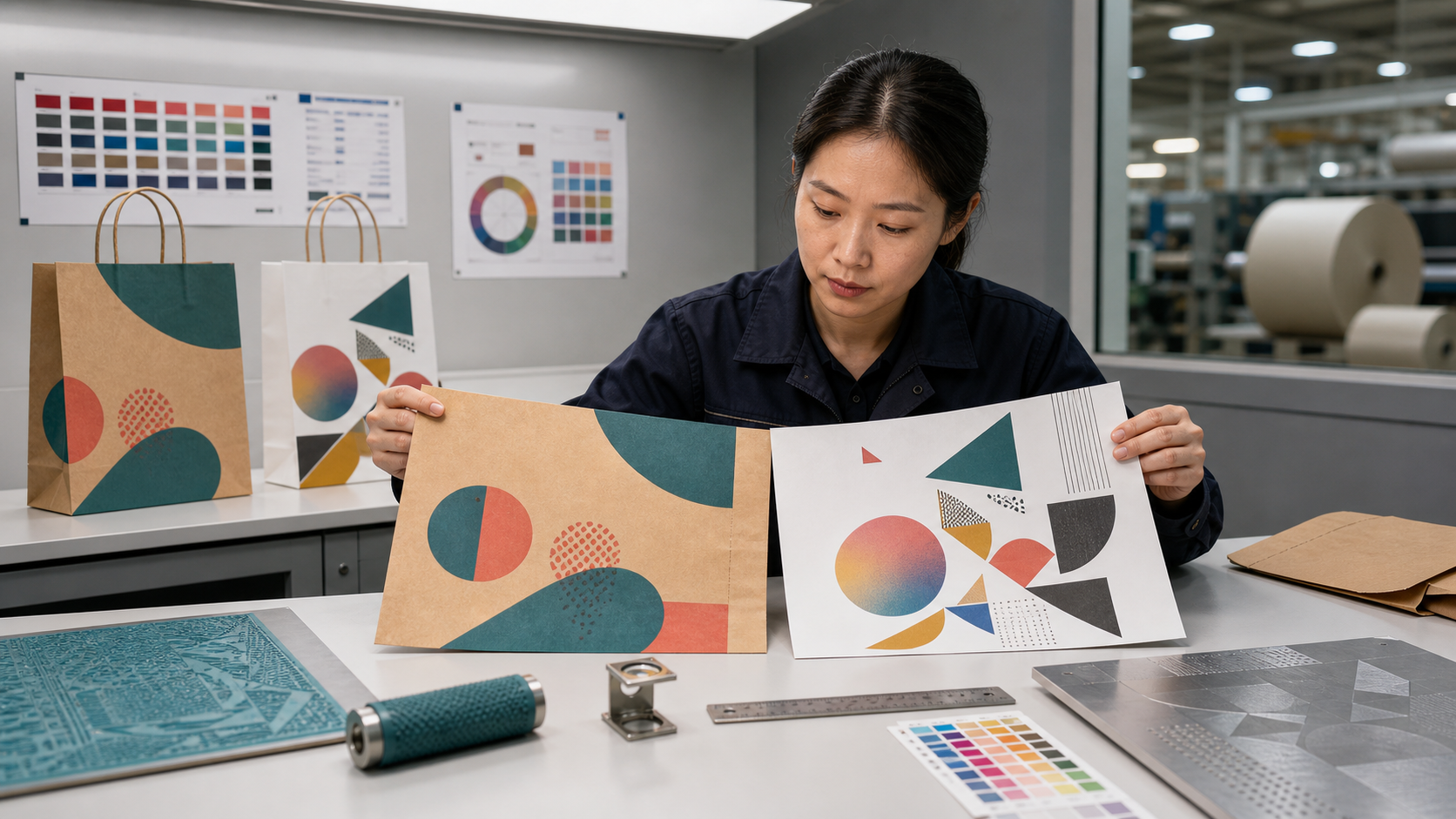
Compare the processes on their intended papers: bold controlled flexographic colour on kraft and fine offset detail on smooth white stock answer different retail briefs.
| Approval gate | Flexographic focus | Offset focus | Decision |
|---|---|---|---|
| Capability sample | Comparable paper, plate/screen, solid, type and repeat | Comparable sheet, image detail, solid, gradient and finish | Shortlist a route/plant; not job approval |
| Preflight / separation proof | Distortion, trap, repeat, spot names, screens and technical layers | Output condition, imposition, trap, overprint and finish masks | Release corrected data for proof/tooling |
| Colour proof / drawdown | Paper-specific spot/process target and proof limitation | Paper-specific contract proof or spot-colour drawdown | Approve colour direction, not conversion |
| Production-process print | Plate/anilox/ink/press/web condition and representative run | Plate/ink/press/sheet condition and representative run | Approve printable result and process settings |
| Converted sample | Repeat-to-cut, folds, glue, handle and kraft behaviour | Sheet-to-die register, creases, finish, glue and handles | Create golden finished-bag master |
| Bulk first-off | Actual paper/ink/plate/anilox/web/bag line | Actual paper/ink/plates/press/finishing/conversion | Release, adjust, hold or remake before full run |
| In-process monitoring | Time/roll/lane, viscosity/deposit, register and repeat | Time/pile, colour, register, drying and sheet defects | Contain drift by traceable lot |
11. Inspect the printed and converted bag
Inspect print before conversion, then inspect the bag. For flexography, track roll, lane, station, plate, anilox/ink and time. For offset, track sheet pile, press, plate, ink, paper lot and time. At conversion, connect those records to bag bundles and cartons.
Use raking and diffuse light for solids and surface defects. Inspect with magnification for small type, dots, dirty print, pinholes and register. Measure colour only with a defined target, condition, backing and method. Fold, open and fill bags; check front/back orientation, gusset continuity, glue zones, handle obstruction and crease cracking.
The retail shopping bag QC reference places print inspection inside incoming paper, conversion, load, pack-out and lot-disposition controls.
12. Diagnose defects by the process stage
Flexographic solid looks weak or mottled: review paper, ink/deposit, anilox condition, plate/impression, viscosity and speed rather than increasing pressure blindly. Fine reverse fills: check artwork capability, plate, ink film and impression. Colour-to-colour register moves: investigate web tension, repeat, mounting, press condition and paper stability.
Offset sheet shows set-off: review ink film, paper, drying/curing, pile and time before handling. Hickeys or spots appear: investigate paper/coating debris, ink/press cleanliness and sheet condition. Colour drifts: review process control, ink/water balance where relevant, density/colour data, paper and press conditions.
Either route prints well but the finished bag looks wrong: trace imposition/repeat to cut, fold, glue and handle placement. The problem may be conversion, not printing. Hold affected lots separately until the cause and scope are identified.
13. Do not confuse ink chemistry with sustainability
A statement such as “water-based flexo” or “vegetable-based offset ink” does not establish the environmental performance of the finished bag. Paper origin, recycled content, print coverage, coatings, laminates, adhesives, handles, reinforcement, process waste, energy, durability, reuse and local recovery all matter.
Compare the actual process plan: substrate yield, make-ready waste, plate/tool use, ink/coating, drying, cleaning, rejected print, conversion loss and pack-out. A process that produces fewer rejected bags may outperform a theoretically attractive option that is poorly matched to the artwork or paper.
Require evidence for paper and finished-product claims. Keep recyclability statements market-specific and avoid claiming that one print process automatically makes the complete bag recyclable.
14. When a hybrid strategy makes sense
A brand may use flexography for high-volume everyday kraft carriers and offset for seasonal or luxury paper bags. That is not inconsistency if the visual system is managed. Create separate substrate/process child standards under one brand colour and layout hierarchy.
Do not demand impossible visual identity across brown kraft direct print and white coated offset. Decide which attributes must match: logo proportion, colour direction, typography, tone or overall family. Approve the bags together under retail light and document acceptable material character.
A hybrid approach may also place a separately offset-printed label, sleeve or insert with a flexographic bag, but this changes assembly, cost, waste and end-of-life. Evaluate the complete retail object rather than assuming extra components improve value.
Company-claim boundary: LUCKYSTAR statements in this section are publisher self-description, not third-party verification, FTA/ISO certification, print-house accreditation, laboratory result, or assurance that flexo or offset is sharper, cheaper, faster, lower impact, available at a stated MOQ, or suitable for the order. Confirm the contracting entity, assigned paper/printing/converting sites and subcontracting; exact paper, ink, finish and construction; press condition, tooling, proofs, samples, methods and limits; claim evidence; packing; and release terms.
15. How LUCKYSTAR describes its flexo-versus-offset review
LUCKYSTAR states that its project team can compare a web-fed flexographic route with a sheet-fed offset route around the same finished paper-bag brief, subject to specification and written confirmation. The review can connect paper format, artwork, color, tooling, process order, converted samples, bulk controls and reorder assumptions.
- Comparable structure: fix bag size/use, paper grade/format/side/grain, handles/reinforcement, finish stack, conversion and pack-out before comparing quotes.
- Artwork route: return separations, screening/tonal range, minimum positive/reverse features, trap, distortion or imposition, repeat/web direction and cut/fold/glue controls.
- Color evidence: define physical target, paper influence, white/spot/process route, viewing condition, proof limitations, production-like printed object and retained reference.
- Tooling and economics: separate plates/mounting/repeat or plates/imposition, make-ready/waste, paper yield, MOQ per SKU/version, storage, remake and reorder terms.
- Conversion and use: test drying/cure, coating/laminate/foil bond, rub/agent exposure, crease/fold, register, glue, handling and carton conditions on finished bags.
- Bulk release: define first-off, in-run sampling, defect limits, paper/ink/tool traceability, substitutions and reapproval triggers.
Review the public custom paper shopping bag solutions. Teams qualifying suppliers can use the paper bag supplier-selection pillar and general custom bag manufacturer resource. Then send one finished specification and both route assumptions for a project-specific comparison.
16. Send an RFQ that lets both routes be compared
A usable RFQ separates the retail requirement from the proposed process. Send the same finished size, bag style, paper performance, artwork, colour references, quantity by SKU, finish, handle, packing and destination to each supplier. Ask each bidder to state the print route and every assumption.
The shopping bag specification-pack tutorial shows how to control dimensions, materials, construction, artwork and inspection. The custom shopping bag design-to-delivery process shows where print approval fits into the broader schedule.
| RFQ field | Buyer provides | Flexographic bidder returns | Offset bidder returns |
|---|---|---|---|
| Bag and paper | Finished size, structure, use, paper target and performance | Web grade/width, side, grain, repeat and bag-line fit | Sheet grade/size, side, grain, imposition and conversion fit |
| Artwork | Files, panels, colour intent, detail and coverage | Separations, distortion, trap, screening and minimum features | Separations, output condition, trap, screening and minimum features |
| Colour | Spot/process targets and physical master hierarchy | Ink/anilox/plate/press condition and proof route | Ink/plate/press/paper condition and proof route |
| Tooling / setup | Order/reorder horizon and change-control needs | Plate/mounting/repeat, setup and storage | Plate/imposition, setup and storage |
| Conversion | Gussets, bottom, top, glue, handle and finish | Inline/offline sequence and repeat-to-cut controls | Finishing/die-cut/glue sequence and sheet-to-cut controls |
| Commercials | Quantity by size/artwork, launch date and Incoterm | MOQ, fixed/variable cost, waste, capacity and lead time | MOQ, fixed/variable cost, waste, capacity and lead time |
| Approval / QC | Approver, sample gates, defect criteria and traceability | Web/roll/first-off monitoring and converted-bag evidence | Sheet/pile/first-off monitoring and converted-bag evidence |
Frequently asked questions
Is flexographic or offset printing better for paper bags?
Neither is universally better. Flexography often fits roll-fed kraft, bold colours and efficient high-volume conversion. Offset often fits smooth sheets, fine process imagery and premium offline finishing. Compare the actual plant, paper, artwork and converted sample.
Can flexography print photographic images on paper bags?
Capable modern flexography can print process images when the press is characterised and artwork is separated for that condition. Paper texture, screening, tonal limits, register and bag viewing distance still determine whether it fits the brief.
Does offset always produce sharper paper bag printing?
Offset commonly performs strongly on fine detail and halftones on suitable sheets, but “always” is too broad. A poorly controlled offset route can underperform a well-characterised flexographic route. Ask for comparable production evidence.
Which process is better for brown kraft paper bags?
Flexography is often efficient for kraft webs and direct bag production, especially with bold spot colours. Offset can print kraft sheets when the paper and press condition are qualified. Approve colour and detail on the exact kraft grade.
Which process is better for luxury shopping bags?
Sheet-fed offset is often selected for detailed images, smooth premium paper and offline foil, embossing or lamination. However, a restrained luxury design may suit another route. Select the full print-and-finish stack, not the prestige of the process name.
Is flexographic printing cheaper than offset?
Not automatically. Cost depends on plates, setup, paper format/yield, colours, coverage, volume, SKU changes, run speed, finishing and bag conversion. Compare fixed and variable costs using one identical finished specification.
Which process has the lower MOQ?
There is no universal winner. MOQ may be set by paper web/sheet purchases, plate/setup, ink, finish, bag line or supplier policy. Ask which component creates the minimum and how artwork splits affect it.
Can the same artwork be used for flexo and offset?
The brand design can be shared, but production files need route-specific prepress. Trapping, screening, tonal range, minimum features, distortion, colour separation, repeat or imposition may differ. Approve each process version separately.
Do I need a physical press proof?
Risk determines the proof ladder. A press/process sample is valuable when paper, colour, fine detail, broad solids or finish are critical. At minimum, approve a production-representative printed and converted bag before bulk release.
How should I compare flexo and offset quotations?
Normalize paper, finished size, construction, colours, coverage, finish, handle, quantity, tooling, samples, QC, packing and Incoterm. Require each supplier to state process, assumptions, exclusions, waste and changeover costs.
Conclusion
Choose between flexographic and offset paper bag printing by following the complete production route. Flexography can make continuous roll-fed kraft programmes efficient and repeatable. Offset can provide fine sheet-fed reproduction and access to premium finishing. The best result comes from matching artwork and paper to a characterised press, approving physical process evidence and controlling the printed material through bag conversion.
To scope the project, compare LUCKYSTAR’s custom paper shopping bag solutions. Use the paper bag supplier-selection pillar for category questions and the general custom bag manufacturer resource for wider sourcing controls.

Request a comparable flexo-versus-offset proposal
Use one finished bag, paper, artwork, finish, validation and pack-out specification so both routes return comparable assumptions.
Review LUCKYSTAR custom paper shopping bag options, then send your project details through the contact form or Email a project brief. The email link opens a draft for your review before sending.
Paper/printing/converting-site assignment, paper/ink/finish, press condition, tooling, color, performance/claims, samples, testing, inspection, price, MOQ, waste, packing, schedule and release terms are subject to due diligence, specification and written confirmation.