A cosmetic bag sample can look attractive on a desk and still fail when a buyer places a tall bottle through the opening, loads the brush panel or closes the zipper around a full kit. Sampling is not a beauty contest. It is the controlled process of turning a brand idea into a physical reference that can be measured, used, corrected and reproduced.
Planning an order? Send the sample-development details already known. Include the current brief or drawing, intended contents and finished size, reference style, material and logo direction, what the first sample must prove, approximate quantity, destination and required arrival date.
The custom cosmetic bag sample development process therefore needs category-specific decisions. Outer dimensions matter, but so do usable internal volume, lining behavior, zipper path, corner bulk, pocket access, surface cleanability, branding on the actual material and the way the finished bag fits its retail packaging.
This guide concentrates on those cosmetic-bag decisions. For the cross-category sampling framework, use the Custom Bag Sample Development Process. For factory capability, communication and evidence, read How to Choose a Cosmetic Bag Manufacturer. The wider sourcing structure sits in the Custom Bag Manufacturer Guide, while current formats can be explored through LUCKYSTAR’s custom cosmetic bags.
Quick answer: what is the cosmetic bag sampling sequence?
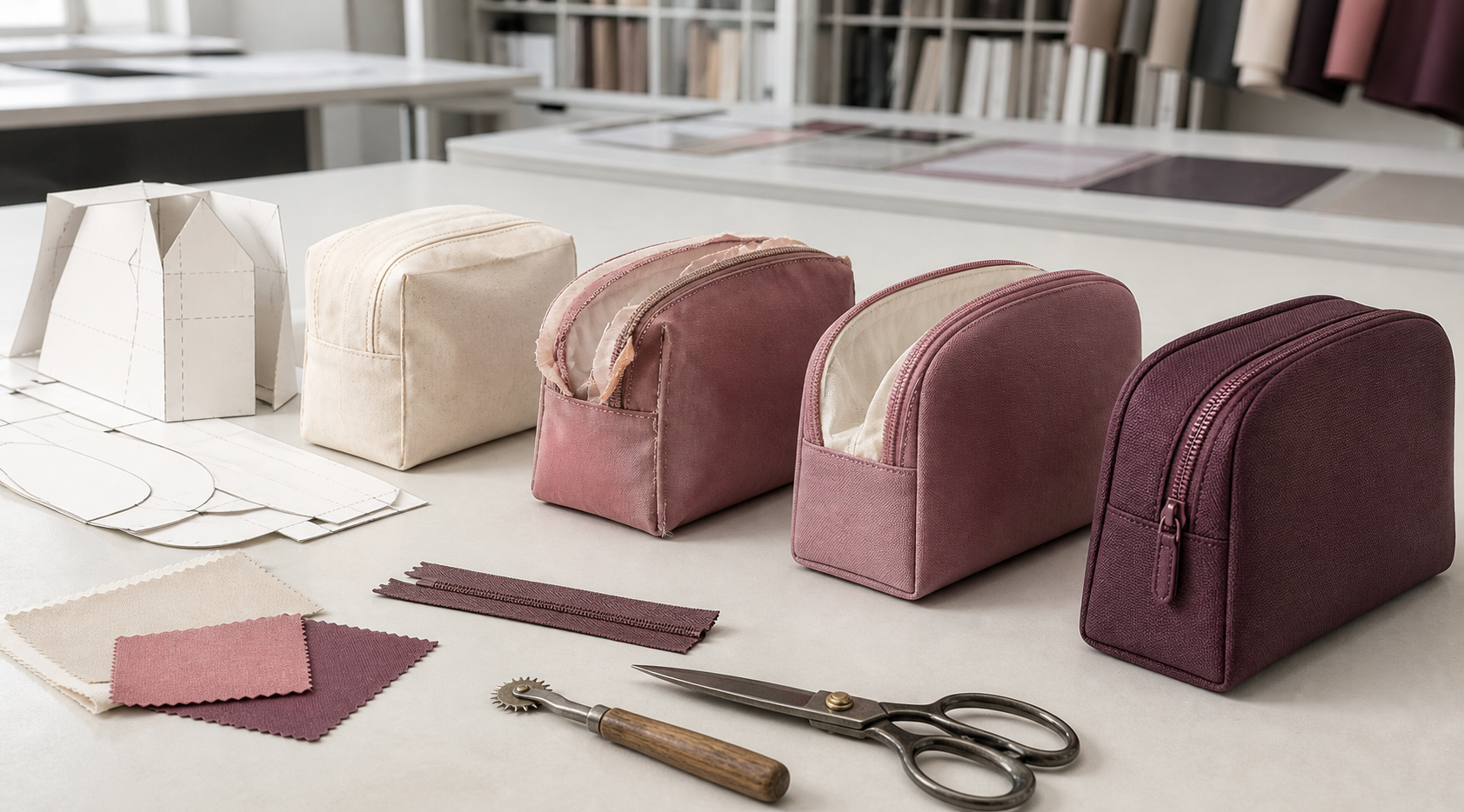
A disciplined route normally moves through six decision layers: define the use and specification; approve material and trim direction; build a functional first prototype; review the bag with real contents; correct the construction and branding; then approve a pre-production sample linked to the written specification. A shipment reference or retained production sample may follow when the program needs it.
The names used by factories vary. “Counter sample,” “development sample,” “approval sample,” “salesman sample” and “PP sample” are not universal standards. Define what each sample must prove instead of relying on the label alone.
| Stage | Physical output | Main decision | Do not approve yet |
|---|---|---|---|
| 1. Brief and feasibility | Annotated drawing, reference review or volume mock-up | Use, size, construction route, target cost and open questions | Bulk material, final color or workmanship |
| 2. Materials and components | Labeled outer, lining, foam, zipper, hardware and logo trials | Material family, finish, compatibility and sourcing route | Finished bag performance from loose swatches alone |
| 3.First functional prototype | Complete sewn or welded bag, sometimes using substitute colors | Proportion, opening, capacity, pockets, lining and assembly logic | Final appearance when approved materials were unavailable |
| 4. Revised approval sample | Corrected bag plus resolved logo and component choices | Comments closed and intended use validated | Mass production if bulk inputs or packing remain different |
| 5. Pre-production sample | Bag made to the frozen production specification | Reference for bulk materials, dimensions, construction, branding and packing | Unrecorded verbal changes after sign-off |
| 6.Production or shipment reference | Retained sample selected from the approved production route | Comparison with bulk output and future repeat orders | Assuming one unit proves every unit is conforming |
1. Choose the development route before requesting a sample
Not every project should begin with a completely new pattern. A promotional pouch may use an available construction with custom color and logo. A retail beauty accessory may need modified dimensions, lining and hardware. A signature vanity case may require full pattern development. The route changes sample cost, number of decisions, tooling exposure and time to approval.
| Development route | What is already controlled | Typical sample focus | Best fit |
|---|---|---|---|
| Private-label or available style | Pattern, basic structure and known production method | Color, logo, trim and packaging application | Fast promotions and lower-development programs |
| Adapted construction | A proven base pattern and assembly route | Changed dimensions, pockets, lining,opening or handle | Brands needing useful differentiation without a new platform |
| Full custom OEM | Buyer brief, tech pack or physical reference | Pattern, proportion, engineering and every visible component | Original retail products with defined requirements |
| ODM development | Use case, brand direction and commercial constraints | Supplier-proposed shapes, materials and feature options | Teams needing design-to-manufacturing support |
Use How to Design a Cosmetic Bag Collection when the project includes several coordinated sizes or styles. Sampling every idea at once is expensive; identify the lead construction and shared components first.
2. Prepare a sample brief that removes avoidable guessing
A reference photo shows visual direction, not a complete product.The sample maker still needs to know what the bag carries, how it opens, whether it must stand, what the inside should do and how it will be sold. Mark which features are fixed, which are targets and where the manufacturer may recommend an alternative.
The brief can be concise, but it must be controlled. If drawings are available, connect every view to a revision number and date. The How to Prepare a Custom Bag Tech Pack guide explains drawings, measurement points, materials, construction and artwork in more detail.
| Brief item | What to provide | Why the sample maker needs it |
|---|---|---|
| Program and user | Retail SKU, GWP, travel kit, subscription box, salon or another use | Sets durability, presentation and budget priorities |
| Actual contents | Dimensions, weights and arrangement of bottles, jars, brushes or samples | Defines capacity, opening and internal organization |
| Finished measurements | Width, height, depth, opening,handle and critical pocket sizes | Creates a measurable pattern target |
| Layer schedule | Outer, backing, foam/interlining, lining and placement | Controls hand feel, shape and sewing bulk |
| Components | Zipper, puller, binding, elastic, mesh, handle and hardware | Confirms compatibility and sourcing assumptions |
| Branding | Vector artwork, dimensions, colors, method, position and safe area | Allows an actual-size logo trial |
| Packing and quality | Fold/shape, tags, insert, retail box, tests, tolerances and defect concerns | Prevents the sample from being approved outside its delivery context |
3.Approve materials and trims as traceable components
A loose swatch should have a supplier reference, composition, weight or thickness, color reference and intended layer. A green outer fabric and green lining can look similar in a photograph while behaving very differently in sewing, cleaning and color transfer. Keep the physical cutting and its written identification together.
For a cosmetic bag, review the outer and lining as a system. The lining may need enough ease to turn and close without pulling, but too much slack can catch in the zipper or feel unfinished. Foam and backing may improve shape while adding corner bulk. The material guide, Best Materials for Custom Cosmetic Bags, helps match the layer schedule to the product’s use.
| Component approval | Check on the loose sample | Recheck on the finished prototype |
|---|---|---|
| Outer material | Color, grain, weight/thickness, backing and surface | Corner behavior, seam marks, wrinkles and finished hand feel |
| Lining | Color, coating, cleanability and print | Slack, pocket access, zipper interference and staining |
| Interlining or foam | Thickness, recovery and bonding | Shape, edge bulk,creasing and carton recovery |
| Zipper system | Chain, tape, slider, puller, color and finish | Curve, end stops, access and operation under load |
| Mesh, elastic and binding | Width, stretch, shade and edge | Product retention, comfort, alignment and seam bulk |
| Metal or molded hardware | Dimensions, finish and attachment route | Noise, pull force, rotation, scratches and surrounding reinforcement |
4. Build the first prototype to answer functional questions
The first prototype should not be expected to prove everything. If final fabric is unavailable, a substitute may be useful for proportion and construction, provided the differences are listed. If the final zipper pull is still in tooling, a standard puller can test the opening. Separating functional and appearance questions prevents a useful prototype from being rejected for details it was never meant to represent.
Before the sample ships, ask the manufacturer to photograph it beside a ruler and show the outside, inside, base, opening, pockets, logo and packing. This does not replace physical review, but it can catch obvious misunderstandings before courier cost and review time are spent.
| First-sample question | Evidence | Possible correction |
|---|---|---|
| Does the silhouette match the intended position? | Front, side and loaded comparison with the drawing | Pattern proportion, gusset, radius or reinforcement |
| Can the user reach the contents? | Largest item through the opening and removal test | Longer zipper, wider mouth or changed internal divider |
| Does the bag stand or fold as intended? | Empty, partially loaded and fully loaded views | Interlining, base geometry,piping or layer weight |
| Does the lining behave correctly? | Inside-out review, pocket access and repeated closing | Lining pattern, attachment, ease or binding method |
| Are stress points supported? | Handle, wrist strap, divider and pocket attachment review | Reinforcement, seam allowance or attachment position |
5. Conduct a loaded-fit review with the real beauty products
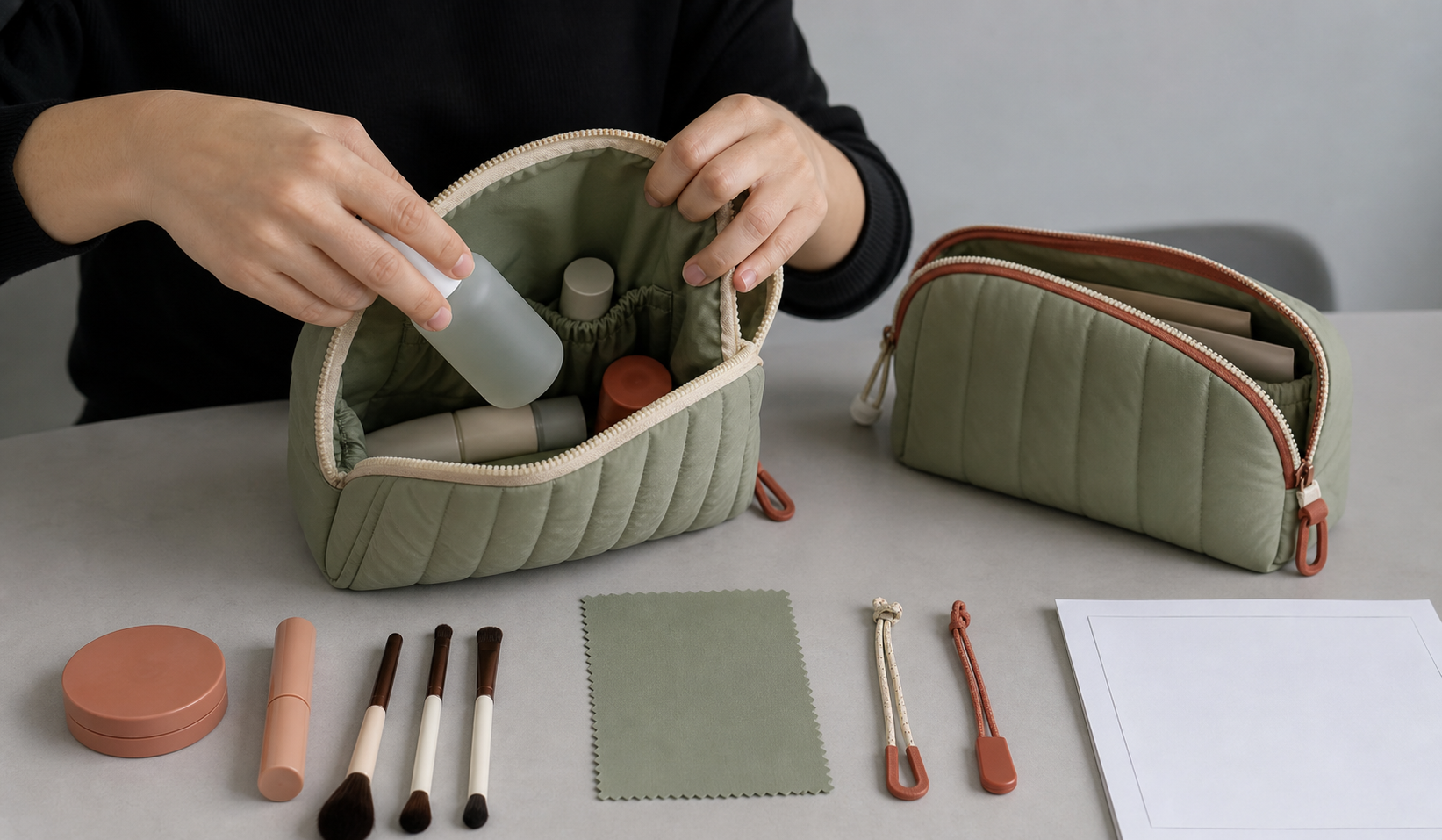
External dimensions do not equal usable capacity. The zipper tape, corner radius, lining, padding and dividers consume space. A bottle may fit inside yet fail to pass through the opening. Brushes may fit when laid flat but bend when the lid closes. Approve the sample with the intended contents in their realistic arrangement.
| Loaded-fit check | How to review it | Failure the empty sample can hide |
|---|---|---|
| Entry clearance | Insert and remove the largest item without forcing the zipper | Adequate volume but an opening that is too narrow |
| Closing clearance | Close slowly while observing contents, lining and zipper path | Bottle cap or brush pushes into the chain |
| Pocket retention | Turn,carry and gently shake the loaded bag | Elastic or mesh allows products to escape |
| Weight distribution | Lift by the intended handle or wrist strap | Bag twists, tips or strains an attachment |
| Partial-load behavior | Repeat with fewer products | Structure collapses or products move excessively |
| Pack-out fit | Place the loaded or empty bag into the intended insert, sleeve or box | Corners crush, logo is hidden or package will not close |
If the requirement involves liquid exposure, distinguish wipe-clean, splash-resistant and a defined water test. A visually convincing sample is not automatically waterproof. Review the construction principles in Waterproof Cosmetic Bag Manufacturing.
6.Approve logo methods through strike-offs before the full sample
A digital mock-up can confirm approximate scale and placement, but not opacity, texture, edge quality, heat response, puckering or color on the chosen material. A strike-off is a small production trial using the intended process and substrate. It can often resolve logo risk before a full revised bag is sewn.
| Logo route | Strike-off review | Finished-bag review |
|---|---|---|
| Screen printing | Color, opacity, edges, hand feel and rub behavior | Position from finished seams and distortion on the loaded bag |
| Heat or digital transfer | Detail, color, film edge, adhesion and surface change | Panel shape, crease zones and proximity to sewing |
| Embroidery | Thread colors, density, detail and backing | Panel puckering,lining coverage and balance on the bag |
| Debossing or foil | Depth, sharpness, foil transfer and surface recovery | Final placement and visibility on curved or padded panels |
| Label, patch or metal plate | Size, color, finish and attachment concept | Alignment, reinforcement, scratches and user contact |
7. Turn sample comments into one controlled revision list
“Make it more premium” is not an actionable sample comment. State the location, observed condition, required result, measurement or reference and whether the change is mandatory. Mark photos directly and give each issue a number. Combine design, merchandising, quality and packaging comments into one approved file before sending them to the supplier.
Every new sample should arrive with a change log: what was requested, what was completed, what remains open and what could not be followed. Review the unchanged areas as well. Correcting the zipper opening must not silently change the finished height, lining or logo placement.
| Comment field | Useful example | Weak example |
|---|---|---|
| Reference | Sample V1 received 18 August; front photo marker 03 | The pink sample |
| Observed condition | Finished zipper opening measures 172 mm and the 55 mm jar catches at the corner | Opening feels small |
| Required result | Increase clear opening to 190 mm minimum without changing finished width | Make it bigger |
| Evidence | Attach loaded-fit photo and measurement point drawing | See previous emails |
| Priority | Mandatory before PP sample | Please improve if possible |
| Supplier response | Pattern change accepted; new opening target 192 mm; no cost change | Okay |
8. Separate design approval from quality acceptance
A sample approval confirms a defined reference; it does not prove that every bulk unit will be identical. Hand-made samples can receive individual attention, and some materials may come from small sample quantities rather than the booked production lot. Bulk acceptance still needs tolerances, defect rules and inspection.
Record which aspects are approved exactly, which have a tolerance and which are visual references. A color swatch may govern the outer shade, a measurement chart may govern size, a logo strike-off may govern artwork and the PP sample may govern overall assembly.The Cosmetic Bag Quality Control Checklist explains how these references support incoming, in-line and final checks.
| Control characteristic | Best governing reference | Bulk verification |
|---|---|---|
| Finished dimensions | Measurement chart with method and tolerance | Measured sample across production lots |
| Outer and lining material | Labeled approved swatch plus specification | Incoming identity,lot and appearance check |
| Color and finish | Approved physical reference under defined viewing conditions | Lot comparison and agreed tolerance |
| Logo | Actual-size strike-off and placement drawing | First-piece and in-line placement/appearance review |
| Construction | PP sample, bill of materials and workmanship notes | First piece, in-line audit and final inspection |
| Packing | Packing specification and approved pack trial | SKU, label, quantity and carton verification |
9.Approve the pre-production sample as a package of evidence
The pre-production sample should reflect the frozen production route as closely as practical: intended materials, color, zipper, hardware, branding, construction and packing. If anything is substituted, list it and state how the bulk version will be approved. Do not write “approved” across unresolved differences.
Approval should identify the exact sample version and date, not merely the style name. The physical sample should be accompanied by the measurement chart, bill of materials, artwork, comments closed, packing instructions and quality criteria. Decide who keeps the buyer sample, factory sample and any third-party inspection reference.
| PP approval item | Required record | Release question |
|---|---|---|
| Version identity | Style code, sample version, date and photographs | Can every team identify the same physical reference? |
| Materials and colors | Approved references and production supplier codes | Are bulk inputs booked to these identities? |
| Measurements | Finished chart,method and tolerance | Do the sample results fall within the agreed limits? |
| Logo and trim | Artwork, position, color/finish and approved trial | Are screens, programs, dies or components production-ready? |
| Function | Loaded-fit and agreed performance results | Does the bag perform its intended job? |
| Packing | Pack sequence, labels, inserts, unit protection and carton data | Has a complete pack-out been trialed? |
| Open deviations | Written list with owner and approval route | Is any unresolved item capable of changing bulk acceptance? |
10.Plan sample time and cost by decision gates
A simple logo trial on an available pouch can move faster than a new structured case with custom-dyed materials and hardware. Sample time includes clarification, sourcing, pattern work, decoration trials, sewing, internal review, courier and buyer response. One late approval can pause the next stage even when the factory has completed its work.
Ask for milestone dates rather than one total. Also separate sample cost from bulk unit cost. A prototype is often cut and sewn individually and may include sourcing or setup that becomes more efficient in production. The How Much Do Custom Cosmetic Bags Cost? 2026 Pricing Guide explains how development fees fit the wider budget, while Cosmetic Bag MOQ and Production Time connects custom components to the production calendar.
| Sample milestone | Planning dependency | Buyer action that controls progress |
|---|---|---|
| Brief review and questions | Depends on brief completeness and the questions still open | Resolve size, use, materials,artwork and sample purpose |
| Material and trim direction | Depends on material availability, custom inputs and approval scope | Approve labeled options or request one focused alternative |
| First functional sample | Depends on the approved brief, available inputs,tooling and construction complexity | Reserve review time and provide real contents |
| Courier and physical review | Route-dependent | Inspect promptly and consolidate stakeholders |
| Revision sample | Depends on the number and scope of controlled changes | Send one numbered comment sheet and freeze new ideas |
| PP sample and pack trial | Depends on production material readiness | Confirm every difference from the prior approval sample |
Ask for an order-specific schedule after the brief, material route and approval stages are confirmed. Actual progress depends on material availability, complexity, tooling, current capacity, courier and buyer response time.
11. Connect the approved sample to bulk production
After approval, freeze the pattern, bill of materials, measurement chart, artwork, packaging and quality plan.The pre-production meeting should walk through the approved references and identify risks at cutting, decoration, zipper assembly, lining insertion, finishing and packing.
Review a first production piece or early line output before the whole order is complete. That step can reveal whether bulk material thickness, machinery or line handling changes the outcome. The broader Custom Bag Manufacturing Process shows how sampling hands off to material booking, cutting, production, inspection and delivery.
Common cosmetic bag sampling mistakes
- Approving from photos only: photographs cannot prove hand feel, capacity, opening access or zipper behavior.
- Using substitute contents: random bottles do not expose the constraints of the actual retail kit.
- Changing several objectives at once: new size, material and logo direction make the cause of improvement or failure unclear.
- Sending fragmented comments: several emails create conflicting instructions and untracked versions.
- Approving a logo from a PDF: color, opacity, texture and puckering must be checked on the real substrate.
- Ignoring the lining: an attractive exterior can hide loose lining, raw edges or inaccessible pockets.
- Skipping pack-out: the bag may crush, crease or hide its logo inside the intended presentation.
- Treating the sample as the entire QC standard: measurements, materials, tolerances and defect rules still need written controls.
- Assuming repeat samples use unchanged inputs: reconfirm current material and component references before a repeat order.
The packaging interaction deserves its own review. Use Custom Cosmetic Bag Packaging for Beauty Brands when the bag is sold in a sleeve, box, beauty set or subscription pack.
Why choose LUCKYSTAR for cosmetic bag sample development?
LUCKYSTAR treats the sample as a controlled decision tool, not merely a sales display. We help define what each round must prove so buyers can explore early, correct efficiently and freeze the right details before bulk production.
- Multiple development routes: available styles, adapted patterns, OEM execution and ODM support can be matched to the project.
- Cosmetic-bag-specific review: opening, usable capacity, lining, compartments, zipper path, structure and pack-out are evaluated together.
- Component coordination: outer, lining, reinforcement, zipper, hardware, logo and packaging decisions remain connected.
- Visible revision control: numbered comments and change logs help prevent earlier approvals from being lost.
- Sample-to-bulk handoff: physical references can be connected to specifications, first pieces, in-line checks and final inspection.
- Commercial awareness: sample choices are reviewed alongside target cost, MOQ and launch timing.
- Coordinated programs: buyers can combine cosmetic bags with selected items from LUCKYSTAR’s Product Range.
Browse the LUCKYSTAR custom cosmetic bag range and send your intended contents, dimensions, use, reference images, material direction, artwork, quantity and delivery window. The supplier evaluation questions in How to Choose a Cosmetic Bag Manufacturer can help your team assess whether the development process is supported by clear evidence.
Recommended buyer workflow
- Define the program, user, actual contents, target cost and launch date.
- Select an available, adapted, OEM or ODM development route.
- Issue one controlled brief with dimensions, construction, artwork and packing.
- Approve labeled material, lining, zipper and hardware directions.
- Confirm what the first prototype is intended—and not intended—to prove.
- Review the physical sample with the real beauty products and intended packaging.
- Send one numbered comment sheet with priorities and measurable requirements.
- Approve branding on the actual substrate and record every open difference.
- Sign off the PP sample together with the final specifications and quality plan.
- Verify first production output before the entire order is completed.
Return to the Custom Bag Manufacturer Guide when connecting sample approval with factory capability, cost, quality, production and repeat-order control.
Frequently asked questions
How long does a custom cosmetic bag sample take?
Sampling time depends on brief completeness, material availability, tooling, structure, logo trials, revision scope, courier and buyer review. Ask for an order-specific schedule after the proposed inputs and approval route are confirmed.
How much does a cosmetic bag sample cost?
The fee depends on pattern work, material sourcing, logo setup, tooling, complexity, number of versions and courier. A made-to-spec prototype is produced outside normal bulk efficiency, so its price should not be treated as the mass-production unit price.
Can I approve a cosmetic bag sample from photos?
Photos are useful for early screening, but physical review is safer for hand feel, color, capacity, opening access, zipper function, lining, structure and pack-out. If remote approval is unavoidable, agree on measured video checks, retained references and the remaining risk.
What is the difference between a prototype and a PP sample?
A prototype helps resolve design and function. A pre-production or PP sample should reflect the frozen production specification and intended inputs as closely as practical. Because terminology varies, define the required evidence for each sample in writing.
Should the sample use the final material?
Preferably when material behavior affects approval. A substitute can be useful for shape or construction if it is clearly identified. Do not use a substitute sample to approve final color, surface, thickness, seam bulk or logo performance.
How many sample rounds are normal?
There is no universal number. A clear adapted style may need one development sample plus a PP confirmation. A new structured design can require several focused rounds. The objective is not to minimize the count at any cost; it is to resolve the defined risks without repeatedly changing the brief.
Does approving a sample guarantee bulk quality?
No. The approved sample is one important reference. Bulk production still needs controlled materials, specifications, tolerances, first-piece review, in-line checks and final inspection.
What should I send with sample comments?
Identify the sample version and date, provide numbered annotated photos, state the observed condition and measurable required result, mark each point mandatory or optional, and request a written response and change log.
Approve a production reference, not just a nice prototype
A strong custom cosmetic bag sample development process moves from open questions to controlled evidence.The physical bag, material references, measurements, artwork, comments, packing and quality criteria must tell the same story before bulk work begins.
Use the inquiry brief to ask LUCKYSTAR which sample route, inputs and approval evidence would apply to the proposed construction.

Prepare a sample-development request
Send the current brief or drawing, intended contents and finished size, reference style, material and logo direction, the decisions still open, what the first sample must prove, approximate quantity, destination and required arrival date.
Send your project details through the contact form, or Email a project brief with this article already referenced. The email link opens a draft for your review before sending.
Sample route, timing, fees, tooling, MOQ, pricing and delivery terms are subject to specification and written confirmation.