A beauty brand can approve an attractive cosmetic bag and still end up with a poor packaging result. The bottles may rattle. The zipper may press against a pump. A folded information card may hide the product. The finished set may look balanced in a campaign photograph but collapse in a retail carton or exceed an ecommerce parcel size.
Planning an order? Send the beauty-set and packaging details already known. Include the program type, product list and filled dimensions, bag direction, presentation components, pack-out location, quantity and SKU split, destination and required arrival date.
Custom cosmetic bag packaging is therefore not just the pouch. It is the complete system that brings the bag, beauty products, labels, presentation components and shipping protection together. The right system depends on whether the bag will be sold empty, filled as a gift set, offered as a gift with purchase, mailed to creators or picked and packed one order at a time.
This guide focuses on packaging engineering and pack-out decisions rather than repeating general advice about cosmetic bag materials or brand exposure. Buyers can browse LUCKYSTAR’s custom cosmetic bag collection for starting shapes and use the Custom Bag Manufacturer Guide when comparing broader sourcing, development and quality responsibilities.
Quick answer: design the bag around the packaging job
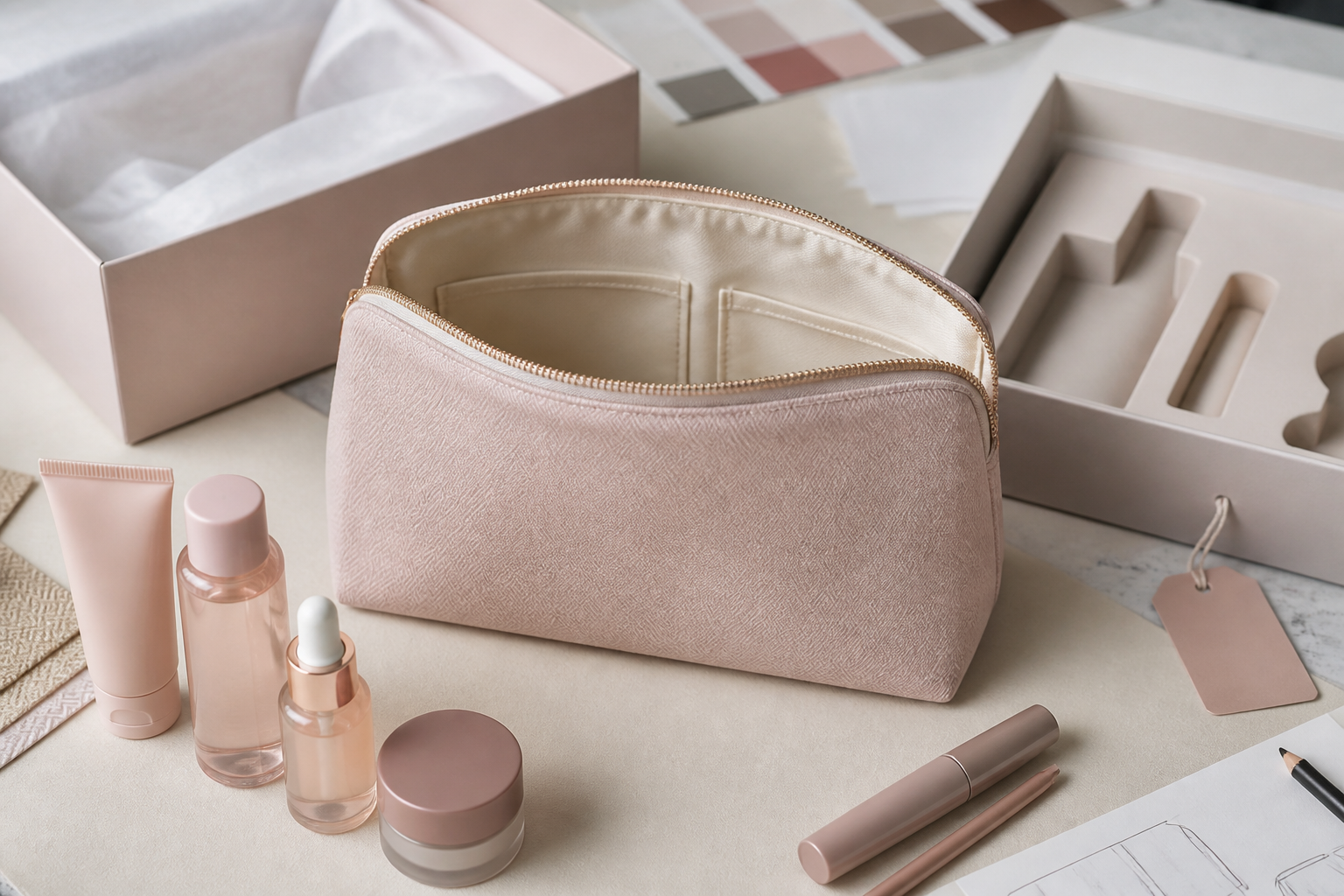
Before choosing fabric, color or logo size, decide what the customer receives and how it travels to them. Record the product list, filled dimensions, weight, closure orientation, presentation sequence, sales channel and shipping unit. Then determine which job belongs to the cosmetic bag and which belongs to the surrounding package.
A fabric cosmetic bag can organize products and create a reusable reveal. It should not be treated as the primary container for a cream, serum or other formula. Each beauty product still needs its own suitable product-contact package and closure. The cosmetic bag and its outer packaging address presentation, organization, handling and selected transit risks.
| Program type | What the cosmetic bag must do | Typical surrounding packaging | First question to resolve |
|---|---|---|---|
| Retail set | Hold a fixed assortment and present consistently on shelf or online | Sleeve, belly band, hangtag, carton or display-ready tray | Must shoppers see the contents before purchase? |
| Gift with purchase | Add perceived value without slowing campaign fulfillment | Simple protective bag, set label or master-carton divider | Will the products be inserted at the factory,warehouse or store? |
| PR or influencer mailer | Deliver a controlled reveal and protect a curated assortment | Presentation box, insert, tissue and shipping carton | Can the set survive parcel handling without losing its layout? |
| Ecommerce bundle | Remain easy to pick, identify and ship across variable orders | SKU label, protective wrap and right-sized mailer or carton | Is the bag pre-packed as one SKU or filled after the order arrives? |
| Empty retail accessory | Keep its intended shape and communicate features without contents | Paper insert, dust protection, hangtag or retail carton | How will the customer understand scale, capacity and function? |
1.Map the complete packaging architecture
A useful packaging brief separates layers. The beauty formula sits in its primary package, such as a tube, jar or bottle. That item may have a folding carton or tamper-evident component. The cosmetic bag groups selected units into a reusable set. A presentation carton or sleeve can provide retail information and stacking. Finally, a transit carton protects one or more sets during distribution.
Not every launch needs every layer. The purpose of mapping is to find duplication. If a rigid gift box already fixes each bottle securely, the cosmetic bag may sit folded beside the products. If the products are packed inside the bag, a molded insert may be unnecessary, but local protection around glass or pumps may still be needed. Remove components only after their job has been identified.
| Layer | Primary job | Design owner or input | Approval evidence |
|---|---|---|---|
| Formula container | Contain and dispense the beauty product | Beauty brand and qualified packaging partners | Final filled component specification and applicable validation |
| Cosmetic bag | Organize, present and carry the assortment | Brand, bag developer and fulfillment team | Approved loaded sample,construction specification and quality standard |
| Retail presentation | Provide merchandising, information and controlled shelf appearance | Brand, artwork team, retailer and packaging supplier | Dieline, artwork proof, barcode scan and assembled sample |
| Transit protection | Reduce damage through packing, distribution and parcel handling | Operations, logistics and suppliers | Pack-out instruction, carton specification and relevant shipment trial |
2. Freeze the product payload before sizing the bag
Nominal bottle capacity is not enough for bag sizing. A 50 ml bottle can be short and wide, tall with a pump, or packed inside its own carton. Ask for physical filled samples or accurate final drawings. Measure the widest condition, including caps, collars, labels, seals and decorative overcaps. Record the actual weight because a set of glass containers changes handle, seam and base requirements.
Decide the allowed orientation. Some products should remain upright. Others can lie flat.If the bag must close around a tall pump, leave controlled headspace rather than pulling the zipper into a curve. If the assortment changes by market, define the largest approved configuration instead of assuming one bag will fit every SKU combination gracefully.
| Payload field | What to record | Common mistake | Sample check |
|---|---|---|---|
| Product envelope | Maximum length,width and height including closures | Using bottle-body dimensions and ignoring a pump or cap | Load final components and close the bag without forced distortion |
| Unit count | Fixed assortment plus any market or seasonal variants | Approving the bag with only the smallest configuration | Run each approved set recipe |
| Orientation | Upright, flat, separated or unrestricted | Letting a heavy jar rest on a fragile dispenser | Tilt and handle the loaded sample as it will be fulfilled |
| Total filled weight | Bag, products,cards and protective components | Testing handles and seams only with an empty bag | Carry, lift and pack with the target load |
| Headspace | Required clearance above closures and zipper path | Adding excessive volume that causes products to tumble | Check closing force, appearance and movement |
3. Select a bag shape that supports pack-out
A flat pouch works well for sachets, compact makeup and small promotional assortments, but it can create pressure points around bulky jars. A box-shaped bag provides a stable base and more predictable capacity. A top-opening case offers visibility during a premium reveal, although it usually requires more components and sewing operations. A transparent window may show shades or contents, but it can also expose scuffing, label rotation and untidy packing.
Evaluate the opening as carefully as the volume. Warehouse operators need enough access to insert products without scraping cartons or catching pumps on the zipper. A customer should be able to remove the largest item without unloading the entire set.If leak control is important, review the construction choices in Waterproof Cosmetic Bag Manufacturing rather than assuming an easy-wipe surface contains every spill.
4. Protect products without turning the bag into a shipping case
The cosmetic bag can reduce movement, but it is soft packaging. Heavy glass, fragile compacts and protruding dispensers may need local protection. Options include a removable divider, elastic loops, a padded wall, a formed paperboard insert or simple tissue arrangement. Choose the least complex component that performs the required job and can be packed consistently.
Interior pockets are useful only when their dimensions match the products. A narrow pocket that looks organized in a rendering may be impossible to load with a filled tube. Elastic loops can hold tools but may print against soft cartons during prolonged compression. Loose tissue can create a premium reveal but is difficult to standardize unless fold count and placement are documented.
| Control option | Best use | Trade-off | Pack-out question |
|---|---|---|---|
| Fixed sewn pocket | Repeat assortment with stable dimensions | Reduces flexibility for later SKU changes | Can operators insert and remove the product without damage? |
| Elastic loop | Brushes,slim tubes or tools | Tension and recovery must suit the actual diameter | Does compression mark labels or folding cartons? |
| Removable divider | Separating glass or preventing side-to-side contact | Adds a component and assembly step | Can it be installed in only one correct orientation? |
| Paperboard insert | Controlled retail presentation or PR reveal | Requires tooling/dielines and may add volume | Will it crease the bag or interfere with the zipper? |
| Tissue or sleeve | Surface protection and presentation | Manual consistency and disposal after opening | Is the fold and placement clear in the work instruction? |
5. Translate brand identity into a repeatable packaging system
Beauty packaging often relies on small differences in tone, finish and spacing. These details need measurable references. Specify bag color by an approved physical standard and record any viewing conditions that matter. Define whether the zipper tape matches the body, the metal finish coordinates with other set components, and the lining is intentionally contrasting or neutral.
Logo approval should include size, position, method, color and tolerance on the finished bag—not only an artwork file. Embroidery can feel tactile but may affect the inner face and does not suit every fine mark. Screen printing can be efficient for simple artwork. Heat transfer can reproduce more detail but must be validated on the chosen surface. A woven label, metal plate or debossed patch adds a component and attachment operation.
If you need a broader material comparison, see Best Materials for Custom Cosmetic Bags and PU vs Polyester Cosmetic Bags.For the strategic value of a reusable bag beyond the initial unboxing, the existing article on custom cosmetic bags as branding tools covers that separate topic.
| Brand element | Specification to release | Packaging interaction to check |
|---|---|---|
| Body and lining color | Approved standard, material reference and acceptable range | Appearance under retail photography, tissue contact and mixed-component lighting |
| Logo | Vector artwork, method, dimensions, coordinates and color | Visibility with belly band, carton window, folds and product loading |
| Hardware | Finish, shape, puller reference and functional requirement | Contact with bottles,carton rub and protective wrapping |
| Hangtag or sleeve | Dieline, substrate, print, finish, attachment and orientation | Barcode access, legal copy ownership and pack-out speed |
| SKU label | Size, stock, adhesive, data field and placement | Scanability, removal, surface marking and market variation |
6. Design for the actual sales channel
The same bag should not automatically receive the same packaging for every channel. Retail teams care about shelf footprint, merchandising, barcode visibility and tamper management. Ecommerce teams care about pick accuracy, parcel size and protection from mixed-order contents. PR teams care about sequence, composition and arrival appearance. Travel retail may add compact display and multilingual information needs.
| Channel | Packaging priority | Useful validation | Frequent failure |
|---|---|---|---|
| Store retail | Shelf/readiness, information hierarchy and stock handling | Display review, barcode scan and shelf/carton fit | Hangtag twists, bag slumps or essential information is hidden |
| Ecommerce | SKU identification, right-sized shipping and mixed-order protection | Pick-pack trial and representative parcel shipment | Excess volume,product movement or bag surface abrasion |
| PR mailer | Reveal, photography and arrival arrangement | Assembled sample photography followed by transit trial | Beautiful studio arrangement becomes disordered in shipping |
| Gift with purchase | Fast assembly, cost discipline and campaign accuracy | Timed packing trial and count reconciliation | Too many manual steps or the wrong insert reaches a market |
| Subscription or sampling | Flexible assortment and repeatable monthly fulfillment | Multiple payload trials and variable-SKU work instruction | One shape fits the launch set but not future assortments |
7.Build a packaging BOM and release pack
A quotation line that says “one cosmetic bag with packaging” is too vague for a beauty launch. Create a packaging bill of materials that gives every component a name, reference, quantity per set, material, dimensions, finish, artwork revision and supplier responsibility. Include small items such as zipper protectors, silica packets where approved, tissue seals, spare labels and carton dividers if they are part of the final method.
The release pack should connect the BOM to visual references and instructions. Include the bag specification, packaging dielines, artwork files, loaded-set photographs, label location, product orientation, tissue fold, carton quantity and sealing method. Market-specific copy and compliance decisions remain with the brand and its qualified advisers; the manufacturing file should clearly identify which approved artwork belongs to each destination.
8. Run a loaded sample and pack-out trial
An empty cosmetic bag sample proves only part of the design. Build the next approval stage with final or dimensionally representative products. Load the set in the intended sequence, close it, place it into any retail presentation, then pack it into the shipment configuration. Photograph every layer before and after the trial.
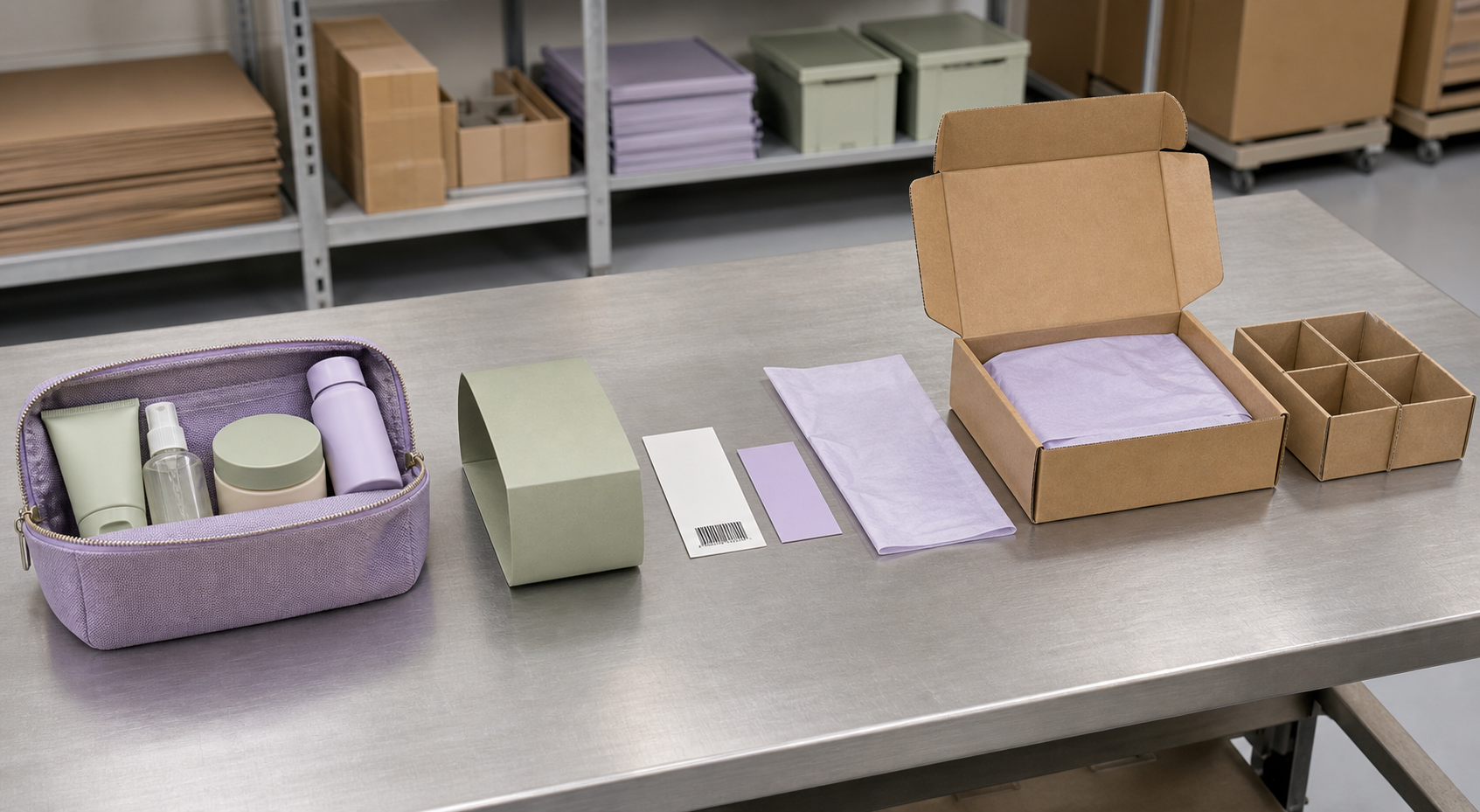
Ask an operator who did not design the sample to follow the draft instruction.Watch for ambiguity. If the divider can face two directions, one may be wrong. If the operator must push hard to close the zipper, the payload or bag pattern needs attention. If the hangtag covers the logo in half the samples, its attachment point is not controlled.
| Trial | What it reveals | Pass record |
|---|---|---|
| First loaded-set review | Fit, product contact, closure strain and presentation | Approved assortment, orientation, photos and sample number |
| Timed assembly | Labor content, difficult steps and realistic line balance | Operator count, units completed, time and noted obstacles |
| Handling simulation | Movement, rattle,rubbing and product-to-hardware contact | Defined movement sequence and observed condition |
| Retail/display review | Shape retention, copy visibility, barcode access and shelf footprint | Approved displayed orientation and store-ready photos |
| Representative transit trial | Carton compression, internal migration and surface damage | Pack configuration, route or method, inspection and corrective actions |
| Unpacking review | Customer sequence, loose parts and disposal burden | Observed opening steps and final presentation condition |
The Custom Bag Sample Development Process explains how to number revisions and prevent a corrected sample from being separated from its approved specifications.
9.Convert the approved pack-out into bulk quality control
Bulk inspection needs two levels: the bag itself and the assembled packaging system. Bag checks include size, appearance, stitching, logo, zipper and function. Pack-out checks include correct assortment, quantity, product orientation, labels, cards, protective components, carton count and scan data.
Define defects according to business risk. A missing beauty product is different from a slightly uneven tissue fold. A wrong-market label can be more serious than a minor cosmetic mark. Use first-piece approval at the start of packing and after any artwork, SKU or shift change. Keep a sealed reference set where practical.
The Custom Bag Quality Inspection Checklist is a starting point for the bag; add program-specific pack-out checkpoints for the filled set.
10. Control cost and MOQ by separating the components
Bag MOQ and packaging MOQ may not be the same. Custom woven labels, printed tissue, formed inserts, specialty zipper pulls and rigid boxes can each have their own minimums. A high leftover quantity of one component can become obsolete when artwork or assortments change. Request a cost breakdown by bag, decoration, internal organizer, retail presentation, labels, individual protection, assembly and master packing.
Value engineering works best when it preserves the job. A belly band may replace a full retail carton if shelf protection is not required. One neutral bag can support several market-specific sleeves.A removable paper divider may be easier to revise than sewn compartments. However, removing a component that controls glass-to-glass contact simply moves cost into damages and rework.
| Cost driver | Why it changes cost or MOQ | Practical control |
|---|---|---|
| Custom bag construction | Panels, lining, pockets, padding, hardware and sewing time | Prioritize features that support the fixed payload and user experience |
| Decoration | Setup, color count, stitch count, dies or custom components | Approve one scalable logo system and quote alternatives separately |
| Printed paper packaging | Dielines, plates, finishes,paper yield and market versions | Use common structures with controlled market-specific artwork where suitable |
| Insert or divider | Tooling, material conversion and manual assembly | Test a simple foldable solution before committing to a complex formed part |
| Pack-out labor | Number of touches, folds, labels and inspection points | Run a timed trial and simplify ambiguous steps |
| Shipping volume | Shape retention, retail cartons and protective void space affect case size | Approve both presentation and case-pack efficiency |
For the wider quotation logic behind material, labor, tooling, quantity and freight, see How Much Do Custom Bags Cost?.
11.Review sustainability as a system, not a single material claim
A reusable cosmetic bag does not automatically make the entire gift set low impact. Review material quantity, expected use, packaging layers, shipping volume, print coverage, component separation and end-of-use instructions together. Avoid broad environmental claims unless the brand holds appropriate evidence for the exact material and finished configuration.
Operationally, reducing redundant packaging can be valuable. Standardizing carton sizes, avoiding oversized presentation boxes and separating market artwork from a common bag can also reduce obsolete inventory. These decisions should be documented alongside product protection, because a damaged beauty set is not a useful sustainability outcome.
Why choose LUCKYSTAR for custom cosmetic bag packaging?
LUCKYSTAR can develop the bag as part of the commercial set rather than treating it as an isolated sewn item. The process begins with the payload, channel and packing location, then connects appearance to repeatable manufacturing and fulfillment.
- Payload-led development: bag dimensions, opening and internal features can be checked against the actual beauty assortment.
- OEM and ODM flexibility: buyers can begin with an existing direction or develop a more distinctive shape, construction and trim package.
- Material and decoration coordination: outer fabric, lining, zipper, logo and packaging components are reviewed for visual and production compatibility.
- Loaded sampling: the team can work with product dimensions or representative samples to review fit before bulk production.
- Pack-out planning: orientation, protection, labels, inserts, folding and carton quantities can be translated into practical instructions.
- Bulk quality control: the approved bag and packaging recipe can become first-piece and final-inspection checkpoints.
- Program coordination: beauty accessories can be combined with selected items from LUCKYSTAR’s Product Range when a campaign extends beyond cosmetic bags.
Explore the custom cosmetic bags product page and share your assortment list, target channel, quantity, launch date and destination. The How to Choose a Cosmetic Bag Manufacturer article provides additional supplier-evaluation questions.
Recommended development workflow
- Define the program: retail set, gift with purchase, PR mailer, ecommerce bundle or empty accessory.
- List every payload SKU with final dimensions, weight, closure type and allowed orientation.
- Map formula package, cosmetic bag, retail presentation and transit layers.
- Select the bag shape and opening around loading and removal—not nominal volume alone.
- Develop the packaging BOM, dielines, artwork ownership and market versions.
- Build an empty bag sample, then a loaded set using representative products.
- Run pack-out, handling, retail or ecommerce and relevant transit reviews.
- Correct the failure points and freeze a numbered sample with its specification pack.
- Approve bulk materials and first pieces before full bag and set assembly.
- Inspect both product quality and pack-out accuracy before shipment.
For the broader sequence from design through delivery, review the Custom Bag Manufacturing Process. The complete Custom Bag Manufacturer Guide also explains how sampling, MOQ, lead time and quality fit into the wider sourcing decision.
Frequently asked questions
Can a cosmetic bag replace a beauty product’s primary packaging?
No. The cosmetic bag is a grouping, presentation and carry component. Creams, liquids, powders and other formulas still require suitable product-contact containers and closures selected and validated by the responsible brand and qualified packaging partners.
Should beauty products be packed inside the cosmetic bag at the factory?
It depends on product availability, destination requirements, filling location and logistics. Factory pack-out may create one finished set SKU, while local fulfillment can simplify product control or market variation. Define responsibility, approved handling and inspection before quoting either route.
How much extra space should a cosmetic bag have around the products?
There is no universal allowance. The bag needs enough clearance for loading and zipper operation but not so much that products collide or the presentation feels empty. Approve the actual loaded sample with the largest authorized assortment.
What information should be sent for a quotation?
Send the bag concept, product list and dimensions, filled weight, quantity, target price range, logo files, desired presentation components, pack-out location, sales channel, destination and required delivery window. Photos or drawings of every product closure are especially helpful.
Can one cosmetic bag support several beauty sets?
Yes, if the payload envelopes are intentionally planned. A common shell with removable dividers or market-specific sleeves can support variants. Test every approved recipe; do not assume that a set with the same item count has the same fit.
What should be inspected before shipment?
Inspect bag workmanship and function, correct product assortment, loading orientation, inserts, labels, cards, barcode data, individual protection, retail presentation, carton count and sealing. The inspection plan should reflect the risks of the specific program.
Make the packaging brief as precise as the bag design
A strong custom cosmetic bag packaging program is created when the bag, product assortment and fulfillment method are developed together. Begin with the payload and channel. Give every packaging layer a clear job. Approve the bag while loaded, test the real pack-out sequence and keep the final recipe connected to bulk quality control.
That approach produces a custom cosmetic bag that arrives neatly, works operationally and remains useful after the beauty products have left the package.

Prepare a beauty-set packaging request
Include the program type and sales channel, product list with filled dimensions and weight, bag style and material, presentation and protection components, pack-out location, quantity and SKU or market split, destination and required arrival date.
Send your project details through the contact form, or Email a project brief with this guide already referenced. The email link opens a draft for your review before sending.
Bag specification, pack-out responsibility, packaging components, handling requirements, MOQ, pricing, testing and delivery terms are subject to specification and written confirmation.