A cosmetic bag zipper is touched every time the product is used. It also sits where the outer material, lining, reinforcement and opening geometry meet. If the chain, slider, puller or sewing path is wrong, an attractive bag can feel rough, catch the lining, open unevenly or mark its own surface during transport.
Planning an order? Send the zipper and hardware decisions already known. Include the bag format, intended contents, opening path, zipper reference, puller or hardware finish, approximate quantity and destination.
Hardware creates the same combination of function and perception. A D-ring, swivel hook, rivet or metal logo plate may occupy only a small area, yet its weight, edge finish, attachment and coating affect the entire product. Beauty brands therefore need to specify a closure and hardware system—not choose a “gold zipper” from a photograph.
This guide explains the main cosmetic bag hardware decisions from chain type and slider compatibility to custom pullers, finish approval and bulk checks. Browse LUCKYSTAR’s custom cosmetic bags for construction directions, use How to Choose a Cosmetic Bag Manufacturer to assess supplier capability and see the Custom Bag Manufacturer Guide for the wider OEM/ODM process.
Quick answer: what should a cosmetic bag zipper specification include?
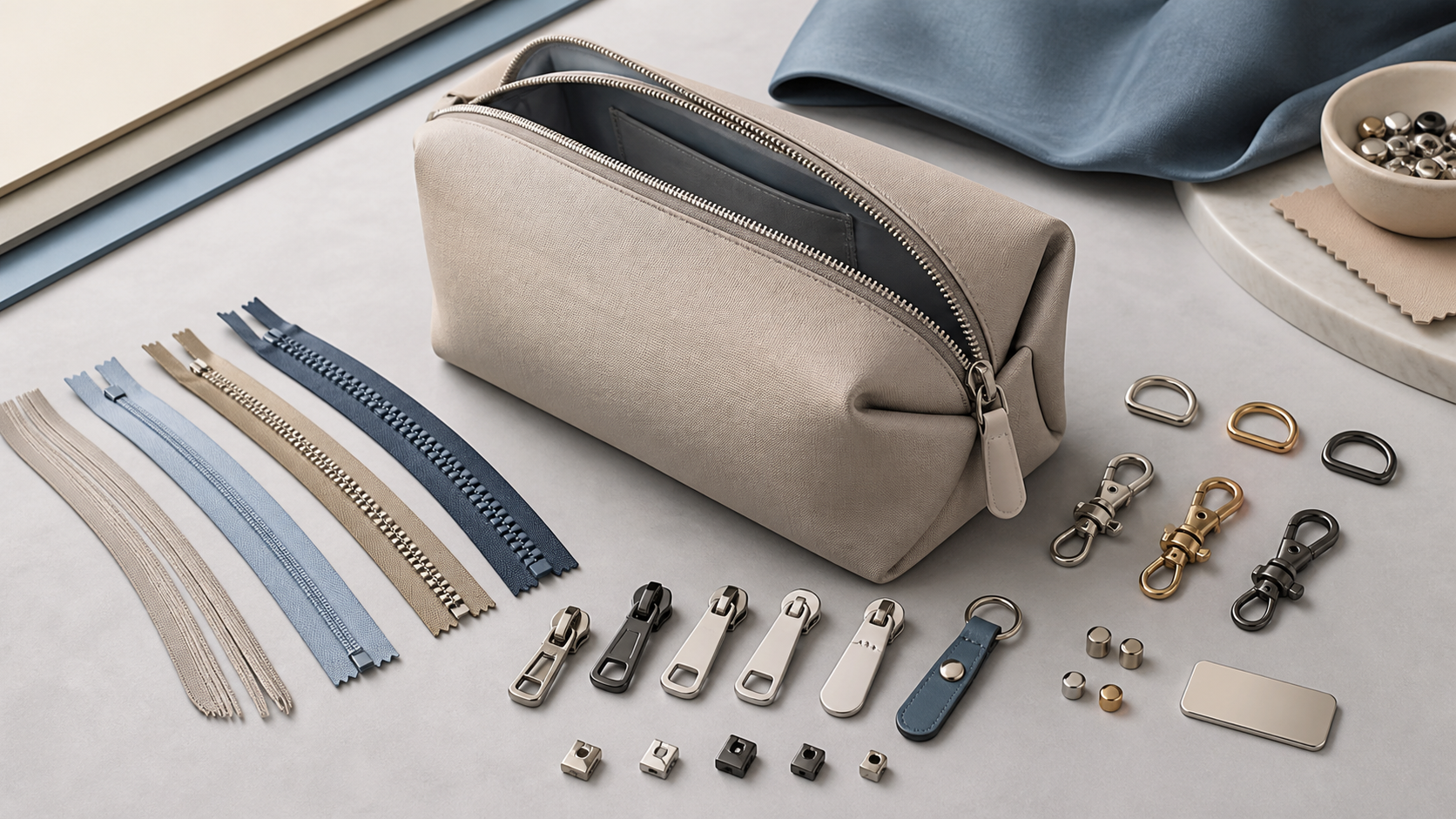
State the zipper construction, nominal size within the selected supplier’s system, tape material and color, chain or element color, slider type, puller, number of sliders, opening direction, finished path, stops and end treatment. Add the required appearance, loading conditions, water-resistance target if any, approved physical component and test or inspection criteria.
Do not treat the zipper as interchangeable parts. A slider has to match the chain type, size and supplier system. Stops must suit the assembly, while the puller connection must suit the slider bridge. Approve the assembled closure on the actual cosmetic bag, not only as loose components.
| Decision layer | Specify | Evidence to approve | Risk if omitted |
|---|---|---|---|
| Chain | Coil, reverse coil, metal, molded or coated construction; supplier series and size | Labeled component sample | Wrong flexibility, scale or appearance |
| Tape and color | Tape material, width, shade and chain/element finish | Physical color set on intended shell | Clashing shade or sewing incompatibility |
| Slider | Matched body, function, finish and quantity | Slider assembled to production-quality chain | Binding, separation or unintended movement |
| Puller | Standard/custom form, material, dimensions, weight and connection | Actual puller plus finished-bag operation | Sharp edge, twisting, breakage or imbalance |
| Opening | Path, clear opening, start/stop, direction and end treatment | Loaded sample review | Products fit inside but cannot enter |
| Quality | Visual limits, operation, attachment and relevant tests | Approved reference and inspection record | Subjective release decisions |
1. Understand the zipper as a complete assembly
The visible closure contains several dependent parts. The tape carries the elements or coil. The slider opens and closes them. The puller gives the user leverage.Top and bottom stops control travel, while zipper ends are covered, folded or captured in seams. The bag pattern determines the path and the surrounding fabric controls how evenly the tape is supported.
When a zipper feels poor, the cause may not be the chain itself. Uneven sewing can create waves. Excess lining can enter the slider. Padding can crowd a tight corner. A heavy puller can make a light slider hang awkwardly. Diagnose the complete assembly before changing one component.
| Part | Function | Cosmetic-bag review point |
|---|---|---|
| Tape | Supports chain and provides sewing area | Shade, width, seam coverage, puckering and substrate compatibility |
| Coil/elements | Interlock to close the opening | Scale, flexibility, appearance and performance on the path |
| Slider body | Engages and separates the chain | Correct matching, movement and finish |
| Puller | Transfers finger force to the slider | Grip, weight, edge, rotation and branding |
| Stops | Limit slider travel and retain it on the chain | Secure position and covered ends |
| Sewn path | Controls opening shape and tape support | Symmetry, radius, lining clearance and seam bulk |
2. Compare coil, reverse coil, metal and molded zippers
No zipper type is automatically “best.” The right construction depends on bag size, curve, material, opening behavior, appearance, target price and expected use. Flexible coil is common for pouches and curved cases. Reverse coil presents the smoother tape side outward. Metal elements create a distinct visual line but may add weight and need suitable geometry. Molded elements give a more pronounced technical look and typically prefer a less demanding path.
A coated or laminated zipper can reduce water entry through the closure area, but it does not make the finished bag waterproof by itself. Sewing holes, ends, seams and the slider junction remain part of the system.
| Zipper construction | Main character | Potential cosmetic-bag use | Watch carefully |
|---|---|---|---|
| Coil | Flexible chain that can follow many pouch and case shapes | Everyday pouches, box bags and curved clamshell cases | Abrasion, lining clearance and correct slider matching |
| Reverse coil | Coil faces inward while the smoother tape side is visible | Minimal or technical-looking beauty accessories | Correct orientation, slider and seam protection |
| Metal elements | Distinct individual teeth and premium visual emphasis | Fashion-led pouches and structured retail cases | Weight, finish, radius, surface contact and oxidation risk |
| Molded plastic elements | Defined element profile and robust visual scale | Sporty, youth or larger travel formats | Bulk, bend radius and alignment |
| Coated water-resistant style | Surface treatment reduces direct exposure through tape/chain area | Travel or wipe-clean concepts with a stated resistance target | Operation, coating marks, seam leakage and claim wording |
3. Choose zipper size within one compatible supplier system
Zipper sizes are often expressed by a number that broadly relates to chain width. That number is not enough to guarantee compatibility across chain types, suppliers or series.A slider labeled for one nominal size may not operate correctly on another supplier’s coil or molded elements. Source chain, slider and stops as an approved matched set.
For a small pocket, a visually lighter system may be appropriate. A main closure on a structured travel case may need a more substantial system. The decision should reflect opening path, bag scale, loaded use, desired appearance and testing—not the belief that the largest zipper is always the strongest or most premium.
| Selection question | Why it matters | Buyer action |
|---|---|---|
| Which supplier series? | Defines chain and slider geometry | Record manufacturer/supplier reference or approved equivalent |
| Which chain type? | A nominal size does not cross between coil, metal and molded automatically | Name construction and orientation |
| Which bag zone? | Main closure and interior pocket have different scale and load | Assign component codes by placement |
| What opening path? | Tight curves and padded edges affect movement | Trial the sewn path at full scale |
| What visual balance? | A heavy chain can dominate a slim beauty pouch | Review on the finished silhouette |
4. Specify zipper tape, color and visible orientation
Tape color can blend into the shell, contrast intentionally or coordinate with the lining.Approve a physical sample under agreed viewing conditions; screen colors are not sufficient for textile and plated component matching. State whether chain, tape, stitching and puller should be tone-on-tone or intentionally different.
The tape must also sew cleanly into the selected outer material. A soft polyester shell, thick coated fabric and structured PU panel behave differently around a zipper. Review puckering, needle marks, seam coverage and how the finish responds when the opening flexes. Compare shell options through Best Materials for Custom Cosmetic Bags and PU vs Polyester Cosmetic Bags.
| Color/appearance control | Specify | Approve on |
|---|---|---|
| Tape shade | Physical reference, supplier shade or approved dye target | Actual tape beside outer and lining |
| Chain color/finish | Tone, gloss level and intended variation limit | Full zipper set under consistent lighting |
| Stitching | Thread shade and visible stitch line | Sewn sample on production-quality material |
| Orientation | Conventional, reverse or concealed construction | Section detail and finished sample |
| Colorway matrix | Tape, chain, slider and puller by SKU | Complete component board for every colorway |
5. Select the correct slider and opening behavior
The slider body is engineered for a specific chain. Confirm the correct orientation and whether a locking or non-locking function is required. Many bag openings prioritize smooth manual movement, while a different application may need the slider to resist unintended movement. Discuss the actual bag use rather than copying an apparel specification.
Decide between a single slider and two sliders. Two pullers can meet at a chosen point and provide flexible access, but they add weight, cost and another junction to inspect. Show where each puller rests when the bag is closed; that position changes logo visibility, user handedness and contact with the shell.
| Slider decision | Single-slider option | Double-slider option | Approval focus |
|---|---|---|---|
| Access | One defined opening direction | Opening can begin from either side or meet centrally | Natural use with intended contents |
| Visual balance | Cleaner, lighter appearance | Symmetrical or more technical appearance | Closed puller positions |
| Weight/cost | Fewer components | Additional slider and puller | Value to the user |
| Inspection | One travel path | Both paths plus meeting point | Smooth operation and chain alignment |
6. Design the opening path around real products
Chain length is not the same as clear opening. Zipper ends may be hidden in tabs or seams, and curves can reduce the usable passage. The bag should be tested with the largest rigid bottle, jar or palette in the intended orientation. Use the Cosmetic Bag Size and Capacity Guide for Beauty Brands to connect opening clearance with actual contents.
Curved openings need enough radius for the chosen chain, slider and surrounding layer stack. Tight geometry, thick foam, piping and binding can crowd the path. The sample should open empty and fully loaded without the user pulling the fabric away from the slider.
| Path variable | Specification | Sample test |
|---|---|---|
| Clear opening | Usable distance between stops | Insert and remove largest item without force |
| Corner radius | Finished curve and layer treatment | Operate slowly and at normal user speed |
| Start/stop position | Closed rest point and maximum opening | Check access, appearance and end security |
| Lining clearance | Lining attachment and keep-clear zone | Repeated operation with pockets loaded |
| Edge bulk | Foam stop, piping/binding and seam allowance | Feel for local resistance and twisting |
7. Choose between standard and custom zipper pullers
A standard puller avoids dedicated tooling and can support faster, lower-risk development. Branding can appear through color, print, an external label or another component. A custom zipper puller adds a repeated touchpoint but requires engineering beyond a logo outline.
For a custom metal puller, specify overall dimensions, thickness, relief, logo area, connection opening, edge radius, base material, finish and acceptable orientation. Fine lettering and narrow bridges may not reproduce reliably at small scale. For PU, fabric, webbing or molded soft tabs, define cut shape, layers, edge treatment, attachment and color.
| Puller route | Branding potential | Development needs | Review risk |
|---|---|---|---|
| Standard metal | Low to moderate; finish can coordinate | Select compatible form and finish | Edge, finger clearance and unwanted rotation |
| Custom die-cast/stamped metal | High logo visibility | Drawing, tooling, prototype and finish sample | Small-detail loss, weight and tooling lead time |
| PU or leather-like tab | Shape, color and deboss/print options | Material, layer, edge and attachment approval | Peeling, edge wear and color transfer |
| Fabric/webbing loop | Printed or woven brand detail | Width, fold, sewing and label construction | Fraying, twisting or inconsistent length |
| Molded soft pull | Shape and color customization | Material, mold, color and connection approval | Odor, tear, migration or surface change |
8. Review grip, weight and connection—not only the logo
A puller must be large enough to grip but proportionate to the bag. A long or heavy metal piece can swing into coated fabric, leave marks in transit or pull a slider to the lowest point. A small elegant puller can become difficult to use with wet hands or a full bag. Test the component in realistic use.
The connection between puller and slider deserves close attention.It should move without detaching, cutting into the bridge or creating excessive side play. If the puller is assembled through a ring or link, identify whether that connection is open, closed, welded or otherwise secured, and approve its appearance from every side.
| Puller check | What to assess | Failure mode |
|---|---|---|
| Finger clearance | Opening size, thickness and grip angle | Difficult opening or pinching |
| Edge condition | Radii, burrs, casting line and underside | Sharp feel or scratched shell |
| Weight/balance | Effect on slider rest and bag silhouette | Sagging, noise or unintended movement |
| Connection | Bridge fit, link closure and range of motion | Detachment, jamming or twisting |
| Surface contact | Where puller touches outer, piping or packaging | Abrasion, indentation or finish transfer |
9. Specify D-rings, hooks, buckles, rivets and logo plates
Not every cosmetic bag needs additional hardware. Add a component only when it supports carrying, organization, removable straps, opening or brand presentation. Every extra part creates an attachment, cost, finish match and inspection point.
D-rings and O-rings should be sized to the strap or tab that passes through them. Swivel hooks need enough rotation and opening clearance. Rivets require compatible post length for the actual material stack.A metal logo plate needs a back structure and reinforcement that do not expose sharp points inside the bag.
| Hardware | Possible role | Key specification | Approval focus |
|---|---|---|---|
| D-ring/O-ring | Strap or wristlet connection | Internal width, wire thickness, finish and seam tab | Strap fit, movement and reinforcement |
| Swivel hook | Removable strap or accessory | Opening, eye width, swivel action and load context | Gate closure, rotation and edge smoothness |
| Buckle/adjuster | Length adjustment | Webbing match, slot size and thread path | Grip without cutting or slipping |
| Rivet | Attachment or decorative reinforcement | Cap, post, base material and stack thickness | Set security, rotation and protected back |
| Metal logo plate | Visible brand signature | Dimensions, thickness, logo relief, finish and back attachment | Alignment, surface contact and interior protection |
10. Match the base material and finish to use
Finish names such as “gold,” “silver” and “black” are not complete specifications. Record the hardware base material, surface process, tone, gloss, texture and approved physical reference. Two components described as gold may differ in warmth or reflectivity because they use different substrates or coating routes.
Review all visible components together: zipper elements, slider, puller, rings, hooks, rivets and logo plate. Decide whether exact matching is required or a controlled mixed-metal effect is intentional. Consider contact with cosmetics, skin oils, moisture, cleaning products, coated textiles and retail packaging when establishing the review plan.
| Finish variable | Specify | Verify |
|---|---|---|
| Base material | Actual substrate or approved construction | Supplier record and component sample |
| Color tone | Warm/cool reference and acceptable visual range | All components side by side |
| Gloss/texture | Bright, satin, matte, brushed or other approved surface | Physical finish chip and sample |
| Contact behavior | Expected exposure and protective packaging | Relevant rub, contact or conditioning review |
| Colorway assignment | Finish code by SKU and component | Approved component board and packed sample |
11. Prevent hardware from damaging the bag
Metal parts can scratch PU, transparent film, print or other hardware during use and shipment. Check every resting and swinging position. A puller may lie safely on an empty sample but press into the shell after the bag is packed. A rivet back or logo-plate prong can become visible through thin lining.
Use appropriate reinforcement, backing, washers or interior covers where the design needs them.Pack pullers and exposed plates so they do not rub against neighboring units. The Custom Cosmetic Bag Packaging for Beauty Brands explains how unit protection and retail presentation should be developed with the product.
| Contact zone | Possible issue | Control |
|---|---|---|
| Puller against shell | Scuff, dent or finish transfer | Edge control, weight review and transport protection |
| Ring/hook at tab | Abrasion or tab distortion | Matched width, reinforcement and movement clearance |
| Rivet back | Lining abrasion or visible hard point | Correct post, setting and interior cover |
| Logo plate prongs | Sharp interior or loose plate | Backing plate, reinforcement and covered construction |
| Packed units | Hardware-to-hardware or hardware-to-surface rubbing | Defined puller position and protective layer |
12. Do not confuse a water-resistant zipper with a waterproof bag
A coated reverse zipper may help reduce exposure through the closure area, but water can still enter at the slider junction, end stops, sewing holes, seams or material transitions. If resistance matters, define the whole-bag use case and test method. Avoid an absolute waterproof claim unless the finished construction has evidence supporting it.
Surface coatings can also change flexibility, appearance and opening force. Approve the zipper around the actual case geometry after conditioning relevant to the project. See Waterproof Cosmetic Bag Manufacturing for a whole-product approach to materials, seams and validation.
| Claim level | What it may mean | What to document |
|---|---|---|
| Wipe-clean appearance | Surface can be cleaned under stated conditions | Material and care test |
| Splash/water resistant | Designed to reduce entry under a defined exposure | Finished-bag procedure, duration and acceptance |
| Water-resistant zipper | Closure component uses a treatment intended to reduce entry | Zipper series plus assembled-bag performance |
| Waterproof | A strong whole-product claim | Specific test evidence for final construction and use |
13. Approve hardware through components, sample and use tests
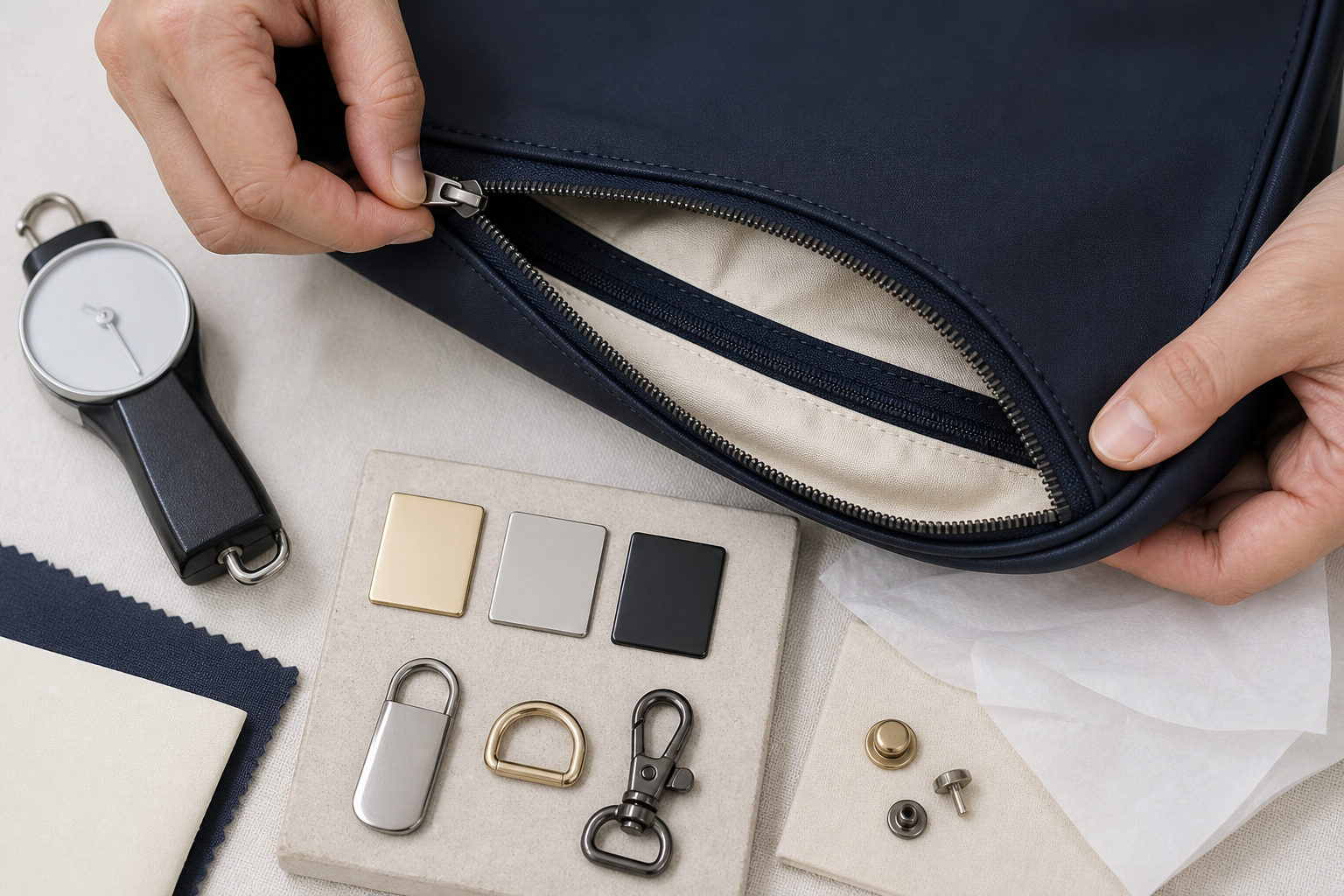
Begin with a labeled component board showing chain, tape, slider, puller and every additional hardware part. Then review them on the finished sample. Loose parts cannot reveal sewing distortion, puller contact, corner operation, lining capture or reinforcement behavior.
Define tests according to intended use rather than copying an arbitrary cycle count.Possible reviews include repeated opening, puller attachment, slider movement under a stated load, seam and tab attachment, finish rubbing, relevant exposure and packed transport. Agree on setup, sample condition, duration or cycles and pass/fail criteria before testing.
| Review stage | Evidence | Decision |
|---|---|---|
| Component selection | Labeled matched zipper set and hardware board | Type, size, finish and feasibility |
| Strike-off/tool trial | Custom puller or logo plate before full sample | Shape, logo, edge, connection and finish |
| First sample | Complete sewn/welded bag with intended path | Operation, access, alignment and contact |
| Loaded test | Bag with defined cosmetic assortment | Closing, opening and carry behavior |
| PP sample | Production-intended components and pack-out | Release reference for bulk |
Use the Custom Cosmetic Bag Sample Development Process to connect these approval stages with controlled revisions.
14.Define zipper and hardware quality limits
Inspection should cover identity, appearance, assembly and function. Confirm that the correct chain, slider, puller and finishes were used for each SKU. Check zipper waves, skipped sewing, exposed ends, asymmetric paths, rough operation, loose pullers, sharp edges, finish defects and insecure attachments.
Inspect the bag in its delivered condition. Protective film, paper wrapping and final puller position should match instructions. The Cosmetic Bag Quality Control Checklist provides the wider incoming, in-line and final inspection framework.
| Inspection area | Check | Example issue |
|---|---|---|
| Component identity | BOM code, chain, slider, puller and finish by SKU | Correct color bag with wrong metal tone |
| Zipper installation | Symmetry, tape exposure, stitching, stops and ends | Wavy path or exposed raw end |
| Operation | Full travel empty and in stated loaded condition | Binding at corner or lining caught in slider |
| Puller/hardware | Attachment, movement, edge, finish and alignment | Loose rivet, sharp edge or twisting plate |
| Packed condition | Protection, puller rest and surface after unpacking | Indentation, scratch or finish transfer |
15.Record every component in the tech pack and BOM
Assign a component code to each zipper and hardware item. The BOM should record placement, supplier or approved source, construction, size/series, material, color/finish, quantity and approval reference. The drawing should show the opening direction, puller rest position, end treatment and attachment details.
If a substitution is allowed, define what must remain equivalent and require written approval before use. “Similar gold zipper” is not sufficient when compatibility and appearance depend on the whole set. The How to Prepare a Cosmetic Bag Tech Pack explains how to connect BOM lines with technical views, measurements and revision control.
| BOM field | Example content | Linked document |
|---|---|---|
| Placement/code | Main closure Z1; internal pocket Z2; ring H1 | Numbered drawings |
| Construction/system | Chain type, supplier series, size and matched slider | Approved component board |
| Appearance | Tape shade, element color, base material and finish | Physical swatches/chips |
| Dimensions/quantity | Finished or cut length basis, puller dimensions and units per bag | POM and detail drawings |
| Approval/status | Sample version, strike-off and open issue | Change log |
16.Understand cost, MOQ and tooling trade-offs
Standard in-stock components usually reduce development complexity. Custom colors, special finishes, proprietary pullers and logo plates may introduce component minimums, tooling, additional samples and longer approval time. The bag order quantity and the component minimum may not be the same; confirm both.
Do not compare quotations until the zipper and hardware basis is aligned. One supplier may price a standard coil and puller while another assumes custom plated components. Review the broader cost structure in How Much Do Custom Cosmetic Bags Cost? and planning constraints in Cosmetic Bag MOQ and Production Time.
| Customization level | Development impact | Best use | Confirm before order |
|---|---|---|---|
| Standard chain and puller | Lowest tooling exposure | Promotions, lower-volume launches and fast validation | Stock shade, finish and repeat availability |
| Custom tape/finish | Color or plating approval and possible minimum | Coordinated brand colorways | Batch tolerance, sample timing and component MOQ |
| Custom puller/logo plate | Drawing, tooling, prototype and finish approval | Signature retail or repeat collection | Tool ownership, lead time and replacement supply |
| Special performance zipper | Compatibility and whole-bag testing | Defined functional requirement | Test method, availability and claim wording |
Common zipper and hardware mistakes
- Specifying “gold zipper” only. Define chain, tape, slider, puller, base material, finish and physical reference.
- Mixing components by nominal size. Approve chain, slider and stops as one compatible supplier system.
- Choosing from loose samples. Review operation on the finished bag and around every curve.
- Ignoring the lining. Establish attachment and keep-clear zones so fabric cannot enter the slider.
- Making a puller too heavy. Balance brand visibility with grip, noise, slider behavior and surface contact.
- Calling a coated zipper waterproof. Define and test the complete bag construction.
- Forgetting hardware backs. Reinforce and cover rivet posts, prongs and attachment plates.
- Approving finish from a screen. Use physical samples under consistent lighting.
- Leaving protection until packing. Trial how every puller and plate rests during shipment.
Why choose LUCKYSTAR for zipper and hardware development?
LUCKYSTAR can review the closure as part of the entire cosmetic bag, connecting material, size, opening path, lining, pockets, reinforcement, branding and packaging. That approach helps identify issues a component catalog cannot show—such as a slider that operates well on straight chain but catches after thick foam is sewn around a corner.
Brands may start with standard components, adapt an existing bag construction or develop a signature puller and hardware set. LUCKYSTAR can organize the open decisions, source representative options, prepare samples and document the approved route for production. Browse the wider Product Range or use How to Choose a Cosmetic Bag Manufacturer as your supplier evaluation checklist.
The best specification fits the product’s real use and price position.A promotional pouch may need a simple smooth closure, while a premium retail case may justify custom plated hardware and more approval stages. The Custom Bag Manufacturer Guide explains how to align those decisions with OEM/ODM sourcing and production control.
RFQ checklist for cosmetic bag zippers and hardware
| Product information | Zipper/hardware information | Commercial and approval information |
|---|---|---|
| Bag format, finished size and intended contents | Chain type, supplier system/size and tape color | Order quantity and SKU/color breakdown |
| Outer, lining, foam and edge construction | Slider function, number, direction and finish | Custom tooling and component MOQ expectations |
| Opening path, radius and clear access | Puller form, material, dimensions and logo | Required sample/strike-off stages |
| Carry points and loaded weight | Rings, hooks, rivets, plates and attachments | Quality tests, target market and claims |
| Retail and carton packaging | Finish reference and protection requirements | Destination, timing and repeat-order plan |
Frequently asked questions
Which zipper is best for a cosmetic bag?
There is no universal best type.Coil is versatile for many pouches and curved cases; metal emphasizes appearance; molded elements create a more technical look; coated styles may support a defined resistance goal. Select by geometry, material, use, appearance, cost and sample performance.
Are #3 and #5 zipper sliders interchangeable?
Do not assume so. Nominal numbers alone do not guarantee compatibility across chain constructions, suppliers or series. Obtain the chain, slider and stops as a matched system or have the proposed combination verified by the component supplier and finished-bag sample.
Should a cosmetic bag have one or two zipper pullers?
One puller creates a simpler, lighter system. Two can improve access and symmetry on a longer or clamshell opening. Test whether the additional component improves the customer experience enough to justify its weight, cost and inspection needs.
Can a custom logo puller be used on a low-MOQ order?
It depends on tooling and component minimums. A standard puller, PU tab or existing shape may be more practical at lower volume. Ask the manufacturer to separate the bag MOQ, component MOQ, tooling cost and expected repeat-order plan.
Does a water-resistant zipper make the bag waterproof?
No. The slider junction, ends, sewing holes, seams and materials all affect the finished bag. Define the exposure and test the complete construction before making a claim.
How should hardware colors be approved?
Review the actual zipper elements, slider, puller, rings, hooks, rivets and logo plate together under consistent lighting.Record base material, finish process, tone, gloss and the approved physical sample.
What should be checked before bulk production?
Confirm component identity, compatibility, opening path, puller attachment, finish match, lining clearance, loaded operation, hardware reinforcement, packaging protection and the exact PP sample or component board retained by both teams.
Build a closure system customers will notice for the right reasons
A reliable zipper feels natural because every part works together. The chain follows the opening, the slider matches it, the puller gives comfortable leverage, the lining stays clear and the hardware supports rather than damages the bag. Clear specifications and full-sample testing turn these small components into a consistent brand experience.
Review LUCKYSTAR’s custom cosmetic bag manufacturing options or send us your zipper and hardware brief for a sample and quotation review.

Discuss a zipper and hardware specification
Include the bag format, intended contents, opening path, chain and slider reference, puller, hardware finish, attachment method, approximate quantity, destination and timing.
Send your RFQ details through the contact form, or Email a project brief with this article already referenced. The email link opens a draft for your review before sending.
Component availability, tooling, MOQ, pricing, sample arrangements and delivery terms are subject to specification and written confirmation.