
Last reviewed: September 24, 2026
Buyer Quick Answer
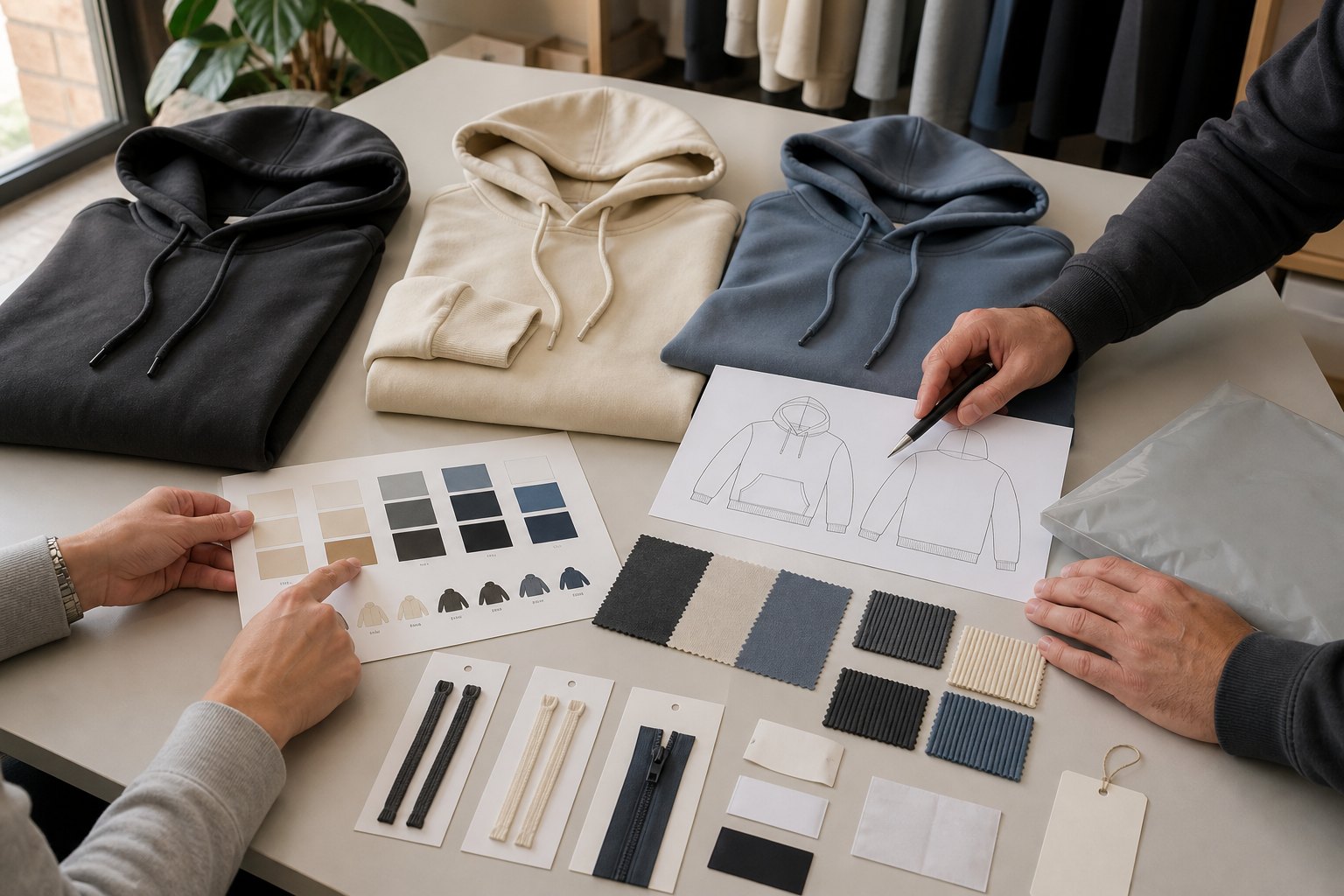
A private label hoodie factory should do more than attach a neck label. It should translate the brand brief into a controlled style, bill of materials (BOM), artwork and label pack, sample approvals, packing standard and reorder record. The buyer should know which parts are stock, modified or fully custom before comparing quotations.
This guide owns the brand-launch and production-handoff decision. For detailed fabric, fit, hood, rib and construction approval, use the hoodie fabric, fit and finish guide. For the broader supplier-selection framework across product categories, use the custom manufacturer sourcing pillar.
Send Your Private Label Hoodie Specification
Email a prefilled private-label brief
Choose the Manufacturing Model Before Asking for a Price
“Private label” can describe three very different projects. A quotation is only comparable when every supplier is pricing the same level of product ownership. Start by deciding whether the brand needs a proven garment platform, a modified block or a fully developed cut-and-sew style.
| Route | What is controlled | Best use | Main constraint to disclose |
|---|---|---|---|
| Stock platform + private label | Existing hoodie, approved decoration, brand label and packing | Fast validation, merchandise or a limited first drop | Fabric, fit, colors and trims may be platform-dependent |
| Modified existing block | Selected measurements, fabric, trims, decoration, labels and packing | Brands that need differentiation without a complete new pattern | Confirm exactly which pattern and grading changes are included |
| Full custom cut-and-sew | Pattern, grade, fabric route, construction, trims, decoration and presentation | A proprietary retail product and planned reorders | More sampling, material minimums and technical decisions |
The “best” route is the one that matches the brand’s actual commercial risk. A stock platform can be appropriate when speed and lower development complexity matter. Full cut-and-sew is appropriate when silhouette, material and repeatability are part of the product promise. Neither should be presented as the other.
Build the Collection Architecture Before Developing Samples
A factory cannot protect brand consistency if the buyer has not defined what must remain consistent. Create a simple launch matrix with style code, pullover or zip-up format, target wearer, fit direction, colorways, size range, decoration version, label set, packaging version, sales channel and destination market.
Separate brand constants from SKU variables. Logo rules, label hierarchy, tone of packaging and naming logic may remain constant. Body color, artwork, zipper color or size ratio may change by SKU. This distinction prevents a correction made to one colorway from silently changing the whole collection.
If hoodies will launch with T-shirts, caps or bags, use the global custom apparel working framework to coordinate shared brand assets, approvals and shipment milestones. The bags, caps and hoodies merchandise guide helps decide each category’s role rather than forcing one specification across all products.
Create One Factory-Ready Hoodie Brief
A useful brief eliminates guessing. It identifies the front and back of the garment, the intended silhouette, every colorway, measurement points, construction details, decoration zones, labels, trims and packing. It also shows which decisions are approved and which still require factory recommendations.
| Control file | Minimum content | Decision it protects |
|---|---|---|
| Style and measurement sheet | Views, points of measure, base size, grade and tolerance | Silhouette and size identity |
| BOM | Body fabric, rib, thread, zipper, drawcord, eyelets, labels and packaging | Material and trim repeatability |
| Artwork pack | Vector files, colors, finished size, placement and technique | Brand presentation and decoration setup |
| Label and packing pack | Main, size and care labels; hangtag; folding; bag; sticker and carton marks | Retail readiness and SKU identification |
| Revision register | File name, version, date, owner, change and approval status | One source of truth from sample to reorder |
The detailed fabric and fit engineering belongs in the hoodie approval standard. This page focuses on connecting that technical work to private labels, packaging, SKU identity and repeat orders. Buyers developing other knitwear can compare the crewneck fabric and bulk-QC guide and the T-shirt sample-to-scale guide without mixing their measurement rules into the hoodie file.
Lock the BOM, Labels and Packaging Together
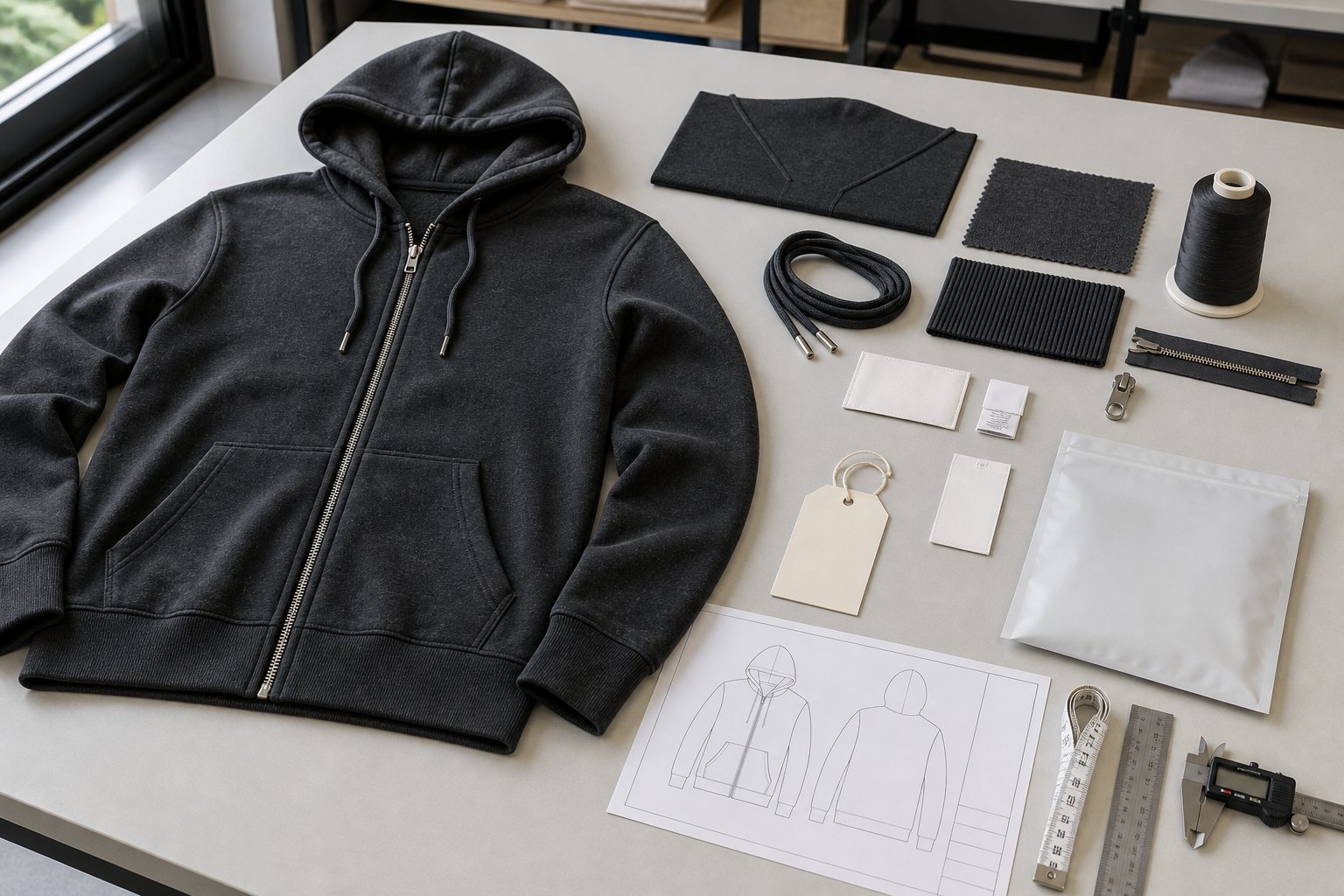
A BOM should name the approved component rather than describe it vaguely. “Black zipper” is not enough if puller shape, tape shade, tooth finish and length affect the garment. “Woven label” is incomplete if size, fold, color, position and sewing method are undefined. Record a supplier code or approved physical reference where possible, plus the rule for any equivalent.
Labels are part of the product, but they also carry information. The brand should own and approve its name, size convention, fiber and care statements, country-of-origin wording and destination-market requirements. A factory may help format the file, but the buyer must confirm the content required for the markets where the hoodie will be sold. Do not release production from placeholder label artwork.
Approve packaging as a physical sample: folding orientation, garment size after folding, protective bag, sticker position, barcode data, hangtag attachment and carton assortment. If the same hoodie serves retail, e-commerce and corporate channels, define separate packing versions instead of asking the packing team to infer them.
Approve Decoration as a Brand Asset
Screen print, transfer, embroidery, applique and patches can all work, but the method should follow the artwork, garment surface, intended hand feel and care route. Approve the real finished size and placement on the production-intended garment. A digital mockup cannot prove stitch pull, print opacity, hand feel or how a large graphic changes drape.
For embroidery-specific digitizing, backing and sew-out control, use the custom embroidery technical guide. For building a consistent logo language across garments, use the embroidered apparel brand-program guide. For print-led hoodie production, the custom print hoodie guide is the related decoration page. Keep this private-label page focused on how the approved decoration version connects to labels, SKU records and reorders.
Need the Factory to Review Your Handoff?
Send the hoodie reference, quantity by color and size, decoration files, label set, packaging requirement and target in-hand date. Mark every decision that is still open so the quotation can separate confirmed work from development work.
Use Sample Gates That Close Specific Decisions
Do not treat “the sample” as one event. Each stage should answer a named question, and the buyer should not ask a later sample to reopen an already approved area without recording the schedule and cost effect.
| Gate | What to approve | Evidence to retain | Do not release when |
|---|---|---|---|
| Concept / development | Route, silhouette, material direction and brand hierarchy | Comment sheet and selected references | The product model is still ambiguous |
| Fit and material | Block, measurements, fabric, rib, hood and care result | Measured sample, swatches and test notes | Sample components differ from the planned bulk route |
| Artwork and trim | Decoration, labels, zipper, drawcord, hangtag and packaging | Strike-off, trim card and packing sample | Artwork, label copy or trim color is provisional |
| Pre-production | Complete released product and pack-out | Sealed sample, BOM revision and signed release | Any substitution or comment remains open |
| First-off bulk | Actual bulk materials, workmanship, placement and measurements | First-off report and production sample | The line is not matching the sealed reference |
Quality control should check product identity as well as workmanship: correct style, color, size label, artwork version, hangtag, barcode, pack-out and carton assortment. For larger coordinated programs, the corporate uniform operations guide explains size allocation and replenishment, while the bulk promotional T-shirt guide covers campaign allocation rather than hoodie development.
Understand What Changes MOQ, Cost and Lead Time
There is no responsible universal hoodie MOQ, price or production time. The answer changes with the manufacturing model, fabric availability, custom dyeing, color count, size depth, pattern work, decoration setup, label minimums, packaging, testing, sample rounds and capacity at the time of order.
Ask the supplier to separate development charges, garment cost, decoration, labels, packaging, testing and freight assumptions. Request minimums by style, fabric, color and artwork—not just one headline number. Also ask which approval releases material purchasing and which change would restart the schedule.
A lower-cost option may use a stock fabric or established block, which can be a valid commercial choice when stated clearly. The real risk is an undisclosed substitution after approval. Compare quotations using the supplier-evidence questions in the core manufacturer guide, then apply the hoodie-specific approval stack on this page.
Freeze a Reorder Package Before the First Shipment
A successful first production run is only the beginning. Save the final tech pack, BOM, pattern and grade revision, approved color references, artwork files, label and packaging files, sealed sample identity, inspection result, carton plan and approved change log. Record which inputs came from named suppliers and which may require an approved equivalent.
For the next order, issue a new purchase order against the frozen revision and require the factory to declare changes before sourcing. Recheck fabric and color when a new lot is used. Do not assume that “same as last time” is a production specification.
Private Label Hoodie RFQ Checklist
- Product: pullover or zip-up, target wearer, use, fit direction and reference sample.
- Materials: composition or desired hand feel, fabric structure, color, rib and key trims.
- Quantity: total units plus breakdown by style, color and size.
- Branding: artwork files, finished dimensions, location, colors and preferred method.
- Private labels: main, size and care labels; hangtag; required copy and placement.
- Packaging: folding, bag, sticker, barcode, retail or e-commerce requirements and carton assortment.
- Approval: required sample stages, testing questions, measurements, tolerances and QC evidence.
- Destination and date: selling market, ship-to location and required in-hand date.
Related Apparel and Sourcing Guides
- Hoodie Supplier: Fabric, Fit & Finish Approval Guide — technical fabric, pattern and construction approval.
- Custom Print Hoodie Factory Guide — print-led decoration planning.
- Reliable Custom T-Shirt Manufacturer — sample-to-scale continuity for T-shirts.
- Wholesale Crewneck Sweatshirts — crewneck-specific fabric, rib and bulk QC.
- Custom Embroidery T-Shirt — digitizing, backing and sew-out control.
- Custom Embroidered Apparel Brand Programs — brand consistency across garments.
- Global Custom Apparel Partnerships — shared approvals across a collection.
- Basic Wear Versatility — category-level fit and merchandising context.
- Custom Bags, Apparel & Accessories — browse LUCKYSTAR product capabilities.
Frequently Asked Questions
Is private label the same as printing a logo on a blank hoodie?
Not always. A logo on a proven blank can be one private-label route. A more controlled program may include a modified or custom pattern, specified fabric and trims, brand labels, hangtags, packaging and a reorder record. Define the route before comparing prices.
What should be approved before bulk production?
Approve the final product specification, BOM, measurements, construction, colors, artwork, decoration, labels, care copy, packaging, size and color quantity matrix and pre-production sample. Every file should show one released revision.
Who should own the label and care information?
The brand should own and approve the content for its destination markets. The factory can help prepare production files, but a supplier’s default wording should not replace the buyer’s market-specific review.
Why do hoodie MOQs vary?
Minimums can be created by the garment platform, fabric mill, dye lot, rib, zipper, custom labels, decoration setup or packaging. Ask for the minimum at each level and see whether colors or styles can share controlled components.
How can a brand make reorders more consistent?
Freeze the approved BOM, pattern and grade, artwork, labels, packaging, sample identity and inspection record. Require declared substitutions and a new-lot comparison instead of using “same as last time” as the instruction.
Company and project contact
Ningbo Luckystar Commodities Co., Ltd. reviews private label hoodie projects against the submitted product, BOM, artwork, labels, sample, QC and packing requirements. Capability and commercial terms are confirmed for the specific order.
Review custom hoodies, use the core manufacturer guide, or contact the project team.






