
Custom jute tote shopping bags are easy to describe with warm words: natural, rustic, elegant and eco-friendly. The harder—and more useful—work is deciding exactly what the bag contains, how it will be used, which parts affect performance and which environmental statements the available evidence can support.
This guide treats “eco-friendly elegance” as a design direction that must be qualified, not as a blanket product fact. It gives buyers a component-by-component method for verifying a custom jute tote before artwork approval, quotation comparison and public marketing. Final material, construction, claims, testing, MOQ, price and timing remain subject to the approved specification and written confirmation.
Buyer quick answer
Do not approve a jute tote from appearance or a one-line material name. Build a component ledger for the body, backing or lamination, handles, binding, thread, base insert, decoration, labels and packing. Match every proposed environmental claim to evidence that identifies the exact material, percentage, product, supplier chain, date and market context.
Scope: this is the material-identity and environmental-claim evidence guide. For panel construction and seam decisions, use the Jute Shopping Bag Construction Guide. For jute versus non-woven and paper options, use the material comparison guide. The Custom Bag Manufacturer Guide is the core OEM/ODM sourcing pillar.
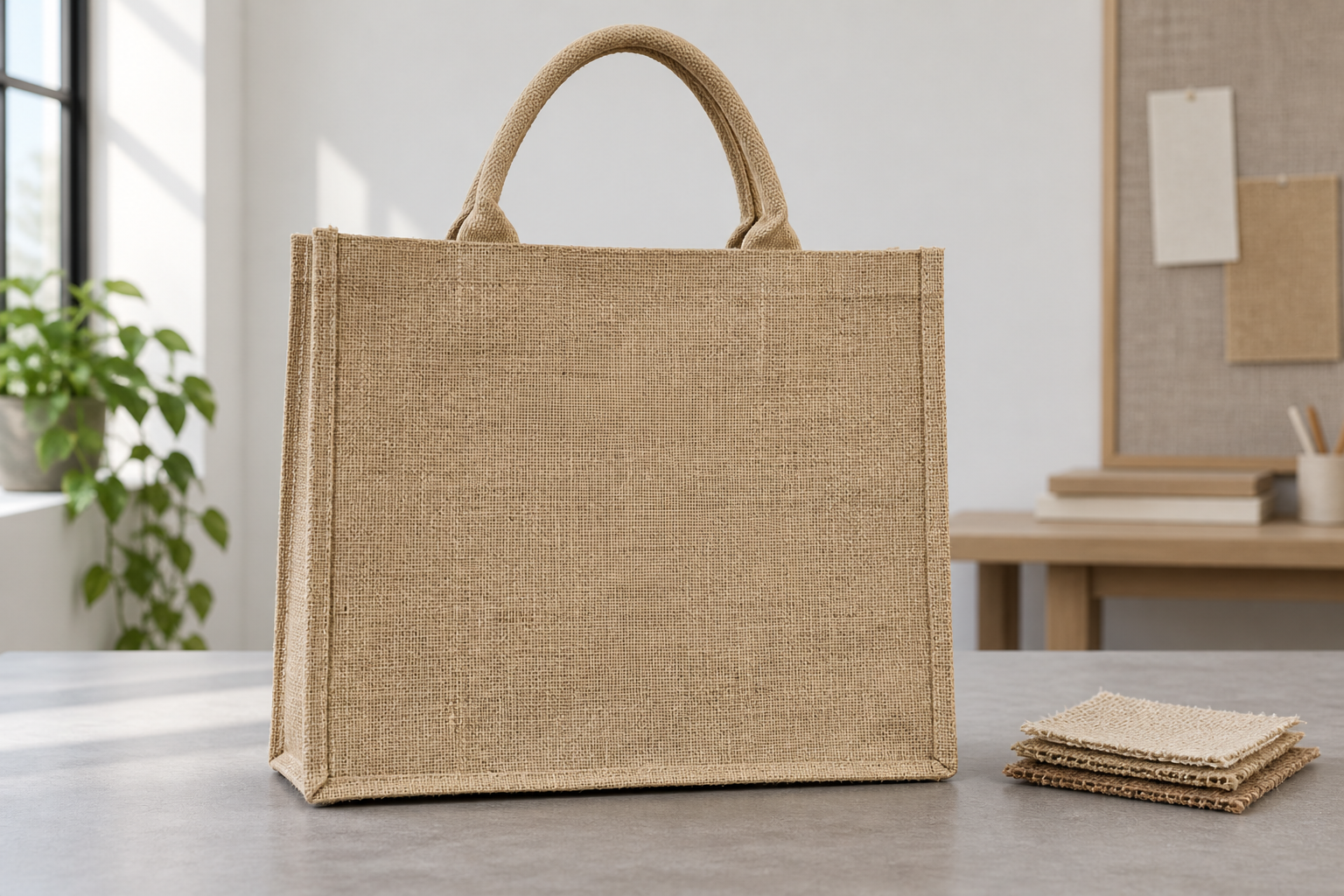
Start by identifying the product, not the mood
“Jute bag” may refer to several visibly similar products. A bag can use a jute body with cotton webbing handles, a jute-cotton blend, a coated woven panel, a laminated back, a synthetic lining or a mixed-material label and closure. Those distinctions change print behavior, cleaning instructions, reuse performance, recyclability and the wording of environmental claims.
ISO 6938:2012 provides generic names and definitions for natural fibres and remains current after confirmation in 2022. It is useful for vocabulary, but naming a fibre is not the same as proving the composition of a finished bag. Use the applicable supplier declaration, specification, test report or chain-of-custody record for the actual product and claim.
Separate jute, burlap and blended constructions
“Burlap” commonly describes a coarse woven appearance, while “jute” names a fibre. “Juco” is often used commercially for jute-cotton blends. These terms should not be treated as interchangeable proof. Record the declared fibre composition, weight or construction reference, finish, backing and every added component. If the blend percentage is unknown, leave it open in the brief rather than guessing from the texture.
| Product layer | Specification to record | Useful evidence | Why it affects a claim |
|---|---|---|---|
| Main body | Declared fibre(s), percentage, fabric weight or construction, dye and finish | Material specification, supplier declaration, applicable test report and approved sample | Determines whether “jute,” “natural fibre,” blend or content language is accurate |
| Backing or lamination | Material, thickness, coverage and purpose | Cross-section or construction record, bill of materials and physical sample | Can change disposal, biodegradation, recyclability,stiffness and print behavior |
| Handles and binding | Fibre or polymer, width or diameter, length, color and attachment | Component sheet, approved sample and attachment test plan | A jute body does not make the complete bag 100% jute |
| Thread, labels and closure | Material, location and removability where relevant | Bill of materials, label proof and component declaration | Small components can invalidate whole-product or disposal claims |
| Base insert or lining | Material, dimensions, coating and whether removable | Construction drawing,sample and material record | Hidden components affect whole-product statements and end-of-life instructions |
| Decoration | Ink, transfer, embroidery, patch, coating or hardware | Technical data, actual-material strike-off and approved artwork | Decoration can affect composition, wash or handling guidance and disposal |
| Packing | Individual bag, carton, insert, label and protective material | Packing specification and pack-out sample | A product claim should not be silently extended to its packaging |
Build a material identity file before writing claims
A usable evidence file connects the words on a webpage, hangtag or quotation to a defined product revision. It should answer: which bag, which components, which supplier or material source, which batch or date, which market and which claim version? A generic certificate image, an expired document, a test for one fabric or an unrelated sample cannot automatically support every bag in a collection.
Use a clear evidence hierarchy
Prioritize current documents tied to the exact product or material: approved specifications, purchase and batch records, material declarations, recognized certificates within scope, relevant test reports and signed production approvals. Product-page descriptions and photographs help locate an option, but they sit below product-specific primary records. A filename such as “eco jute” is not evidence.
Check scope, issuer, dates and chain
For each document, record the issuing organization, certificate or report number, holder, product or material scope, site or operation if applicable, issue and expiry dates, standard or method, tested result and any transaction-level requirements. If a document names a different legal entity, material or finished product, do not bridge the gap with an assumption.
Turn “eco-friendly” into a specific, supportable statement
ISO 14021:2026 sets principles and requirements for self-declared environmental claims and describes evaluation and verification methods. In the United States, the FTC Green Guides summary cautions marketers against broad, unqualified “green” or “eco-friendly” claims and calls for clear qualification with a specific environmental benefit that can be substantiated.
The practical rule is simple: replace a broad halo word with a narrow factual statement.Say what part of the bag has what attribute, how much, under which conditions and according to which record. Then ensure the qualification is close to the claim and understandable to the intended buyer.
| Proposed message | Questions before use | Evidence direction | Safer drafting approach |
|---|---|---|---|
| “Made with jute” | Which component? What percentage? Is it a blend? | Composition record tied to the body fabric and product revision | Identify the relevant component and declared content instead of implying the entire bag is jute |
| “Natural” or “renewable” | Does the statement concern the fibre or the complete product? | Fibre identity plus component ledger and defined calculation basis | State the limited material attribute and disclose significant non-qualifying parts |
| “Biodegradable” | Which components, method, environment, conditions and timeframe? | Applicable test method and results for the claimed material or finished product | Do not extend raw-fibre expectations to a coated or mixed finished bag |
| “Reusable” | What intended use and performance basis support reuse? | Use definition, construction record and order-specific performance plan | Describe intended repeated use and the relevant validation; avoid an invented universal cycle count |
| “Recycled content” | Pre- or post-consumer, which component and what percentage? | Traceable content documentation within the relevant supply chain | State type,percentage and component only when supported |
| “Certified” | Certified by whom, for what, held by which entity and until when? | Current certificate, scope and chain or transaction documents as required | Name the specific certification and scope; do not call the company or entire range certified |
| “Lower impact” | Lower than what baseline and across which life-cycle stages? | Valid comparative method, equivalent function and disclosed assumptions | Avoid comparison unless the study and boundary support it |
Distinguish material identity from environmental outcome
A natural fibre is a material category. It does not by itself calculate water use, emissions, land effects, transport, service life or end-of-life performance for a finished custom tote. Dyeing, backing, coating, decoration, trims, packing, distance and actual reuse can change the outcome. Keep identity statements separate from life-cycle comparisons.
Do not infer the entire bag from the front panel
The visible panel may be jute while the handles, thread, backing, label or base board use other materials. A claim about the body fabric must not be presented as a whole-product claim. Create a percentage or component basis only when the calculation method and records are defined.
Handle biodegradability and compostability with care
Raw fibre behavior does not automatically predict the behavior of a finished, printed and stitched product. Coatings, laminations, synthetic thread, ink systems, labels and inserts may behave differently. “Biodegradable” also needs an environment, conditions, method and timeframe; “compostable” may invoke a different standard and collection system. Do not combine these terms casually.
Write disposal instructions for the complete construction
If parts must be removed, say which parts and whether ordinary users can separate them safely. Verify that the intended market actually provides the relevant collection or treatment route. When evidence is incomplete, provide neutral care and disposal guidance instead of promising a specific environmental end point.
Do not assume recycled, organic or certified content
Jute appearance does not prove recycled content, organic cultivation or certification. Each is a separate claim with a separate evidence chain. If a buyer requires one, place the exact requirement in the RFQ before material selection and confirm the entity, material, percentage, transaction evidence, geography and validity needed for the program.
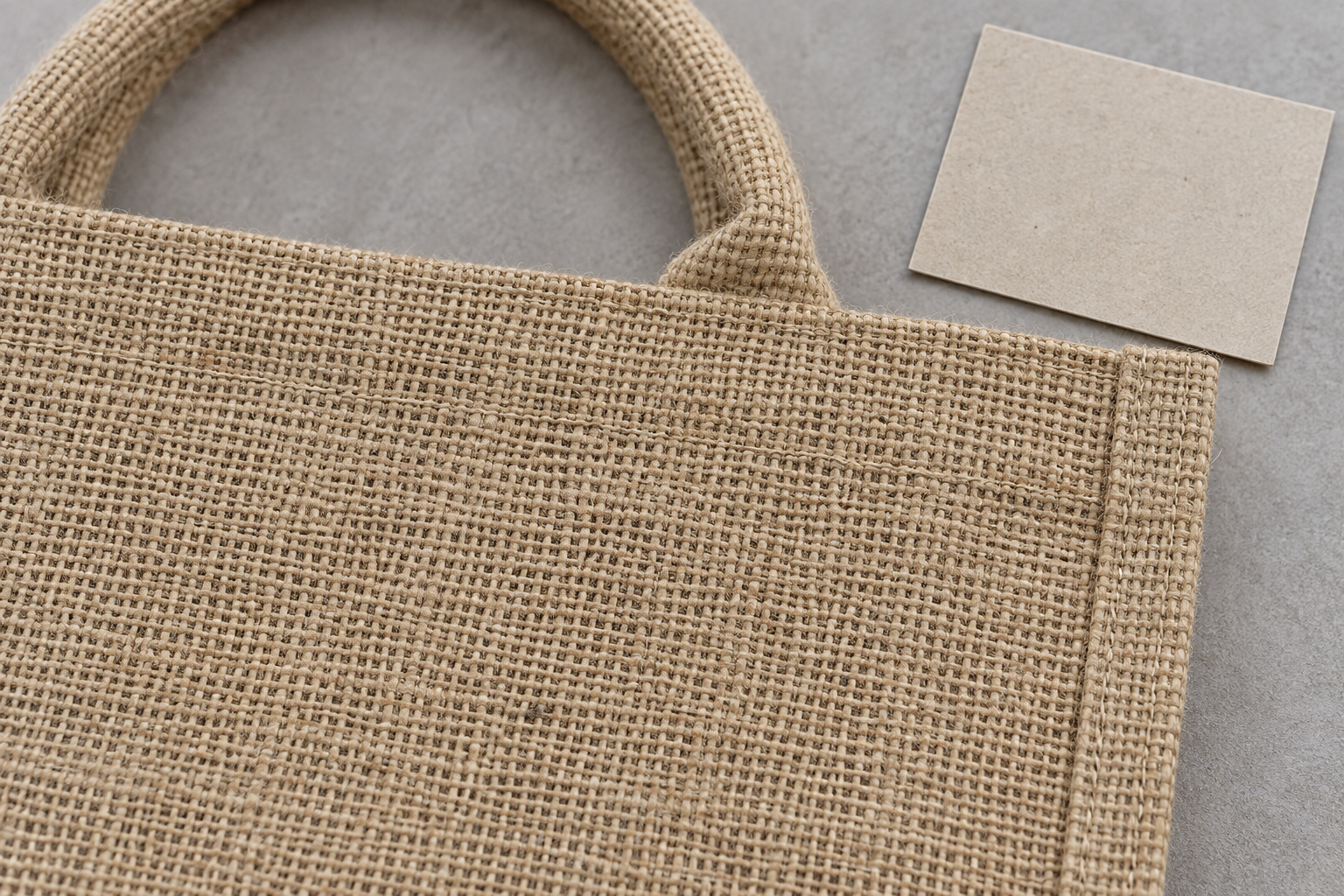
Map coating and lamination before approving the look
Backing can help a coarse open weave hold shape or create a more usable inner surface, but its identity and coverage need to be disclosed. Ask whether the panel is unbacked, partially coated, fully laminated or combined with a separate lining. Record opacity, odor or sensory requirements where relevant, folding behavior, surface finish and how the treatment affects printing and end-of-life language.
Use the actual material for print trials
Open texture can interrupt fine lines and small type. Surface irregularity, backing, ink penetration, opacity and cure can change the result. Start with How Shopping Bag Materials Affect Print Quality, compare options in Custom Shopping Bag Printing Methods, and turn the approval into measurable checks with the printing quality-control checklist.
Support reusable positioning with a use and test plan
“Reusable” should connect to intended repeated use, not simply a thicker-looking bag. Define contents, working load, loading pattern, carry distance, frequency, environment, cleaning or care assumptions and acceptable appearance after use. Then select relevant tests. Avoid a universal reuse-cycle promise unless an appropriate protocol and result support the exact finished bag.
| Risk to validate | Define before testing | Possible evidence direction | Approval output |
|---|---|---|---|
| Handle or attachment failure | Working load, load distribution, lift pattern and safety basis | Order-specific static, dynamic or cyclic load method as appropriate | Method, sample size, result and approved construction |
| Seam opening | Critical seams, stitch construction and allowed opening | Finished-product loading and seam inspection | Visual limit,measurement rule and retained sample |
| Panel or backing damage | Fold, abrasion, flex, moisture and temperature exposure relevant to use | Material or finished-bag conditioning and handling checks | Accepted surface, delamination and distortion limits |
| Print change | Artwork, ink or transfer, contact surfaces and handling | Actual-material adhesion, abrasion or flex checks suited to the system | Approved strike-off and defect reference |
| Dimensional or appearance change | Assessment state,tolerance and care instructions | Conditioning or care trial appropriate to the product | Measured report and approved appearance |
| Odor or restricted substances | Market, end use, material and legal or customer requirements | Applicable current requirement and qualified laboratory method where needed | Report tied to the specified material or product scope |
The Reusable Shopping Bag Durability and Reuse Testing guide explains how to define use conditions and evidence without inventing a universal pass number. For claim architecture, pair it with How to Make Defensible Sustainability Claims and How to Avoid Greenwashing.
Approve the physical sample in layers
A digital rendering cannot confirm fibre identity, hand feel, weave irregularity, backing, print interaction, handle comfort or packed appearance.Use a staged route: material or color reference, print strike-off, construction sample, revised or pre-production sample where risk requires it, and an approved reference for bulk. The Custom Shopping Bag Sample Development Process explains how to close decisions before bulk release.
Record changes instead of approving “similar”
Version the specification, bill of materials, artwork, sample comments and approval photographs. If a fibre blend, fabric weight, backing, binding, handle, ink or packing item changes, assess the effect on appearance, performance, claims and documentation. A convenience substitution may require a new sample or evidence review.
Turn the approved sample into bulk quality controls
Bulk inspection should cover identity and workmanship separately. Verify the released material and components, then inspect dimensions, gusset, seam formation, thread ends, handle alignment and attachment, print location and appearance, cleanliness, labels, quantity and packing. The Custom Bag Quality Inspection Checklist gives a broader framework, while How to Avoid Quality Problems in Large-Volume Orders focuses on prevention.
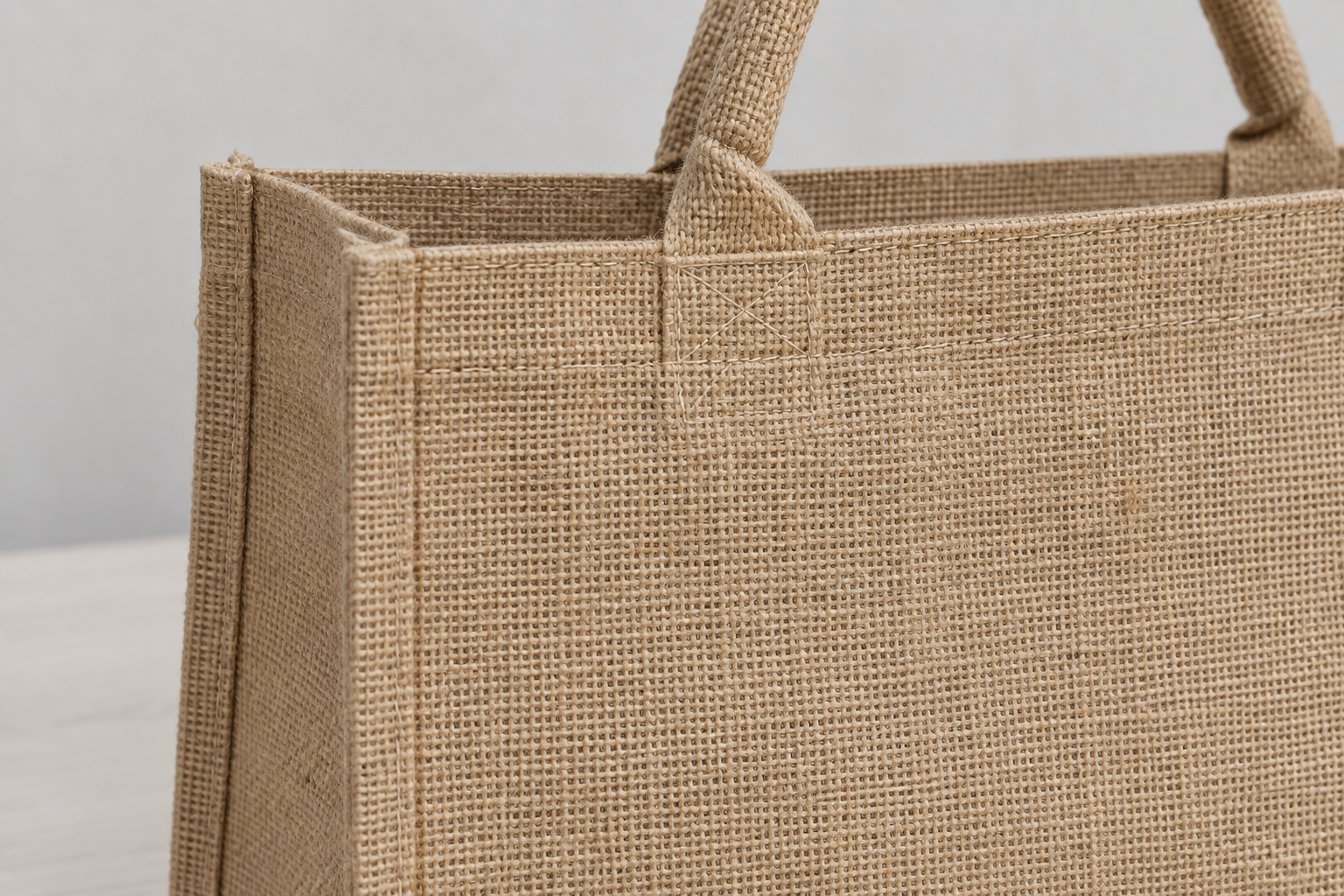
Define visual tolerances for a naturally irregular surface
Natural-looking woven surfaces may show fibre variation, slubs and small color differences. Buyers should decide which variations are expected, which are cosmetic defects and which create functional risk. Use approved limit samples or clear photographs when practical. Do not write “perfectly uniform” if the intended material is visibly irregular.
Connect claims to every SKU and market
A program can contain unlaminated and laminated versions, different handle materials, several print methods or market-specific labels. One evidence file may not cover all combinations. Build a claim matrix by SKU and market, identify the responsible approver, and freeze the released wording with the same discipline used for artwork.
Keep product and packaging claims separate
If a hangtag, carton or individual bag uses a different material, write separate packaging statements. Do not let a recycled carton claim appear to describe the jute tote, or let a body-fabric claim appear to cover the shipping pack. The same rule applies to online icons and marketplace bullets.
Compare quotations on an equivalent basis
A low unit price can hide a different blend, lighter fabric, alternate backing, shorter handle, simpler print, looser inspection or different packing. Ask every supplier to quote the same revision, list exceptions and separate setup, sampling, tooling, testing, labels, packing and freight. The custom bag pricing guide explains cost drivers, and the custom bag MOQ guide shows why a single universal minimum is unreliable.
| RFQ field | Buyer input | Supplier confirmation | Claim-control reason |
|---|---|---|---|
| Product identity | Drawing, size, gusset, intended contents and target use | Feasible construction and declared exceptions | Defines which finished product the evidence must cover |
| Material ledger | Required fibre, percentages, backing, handles, trims and packing | Component-by-component proposed specification | Prevents a body-fabric statement becoming a whole-product claim |
| Claims | Exact proposed wording, market,channel and evidence expectation | Available documents, scope, holder, dates and gaps | Exposes unsupported language before artwork release |
| Decoration | Artwork, color, dimensions, position and desired effect | Method, actual-material sample route and limitations | Connects design claims and print feasibility to the real surface |
| Performance | Working load, reuse scenario, care and critical risks | Proposed sample and test plan | Turns “reusable” or “durable” into defined validation |
| Commercial structure | Quantity by SKU, target date, destinations and packing | MOQ basis, quote validity,sampling and production sequence | Keeps claims and material revisions aligned with the quoted order |
Prepare a useful tech pack
Include a dimensioned drawing; bill of materials; declared composition fields; fabric, color and finish references; backing or lining; handle and attachment; artwork files; print location; labels; pack-out; intended use; working load; claim matrix; evidence list; sample stages and quality criteria. The Custom Bag Tech Pack guide provides the wider structure.
Choose a supplier by evidence control, not adjectives
Ask how the supplier identifies materials, manages document scope, controls substitutions, records sample approval, builds a bulk inspection plan and separates its own role from that of production partners. Use How to Choose a Custom Shopping Bag Manufacturer for shopping-bag-specific checks and the 2026 custom bag manufacturer checklist for broader due diligence.
The manufacturing sequence also matters. Review the shopping bag design-to-delivery process and the wider custom bag manufacturing process to place material, claim, sample and inspection gates before the stages where changes become expensive.
How this guide differs from LUCKYSTAR's other jute articles
This page is deliberately limited to material identity and environmental-claim evidence. It does not repeat the full construction guide or the material comparison. Buyers planning store or wholesale programs can use custom jute shopping bags for retail and wholesale, while Bulk Burlap Shopping Bags addresses retail, gifting and promotion contexts.
The earlier inspiration pages—Elevate Style with Custom Jute Tote Shopping Bags, Discover Elegance in Custom Jute Tote Shopping Bags, Custom Jute Tote Shopping Bags: Elegant & Eco-Friendly and Enhance Your Brand with Custom Jute Tote Shopping Bags—remain design and branding references. This guide supplies the evidence gate that their marketing ideas require.
For campaigns, connect the approved claim and product revision to Custom Printed Shopping Bags for Retail Brand Campaigns. Do not launch a headline, leaf icon or hangtag until the component ledger and evidence file support the exact wording.
Why include LUCKYSTAR in your jute tote review?
LUCKYSTAR is relevant when a buyer wants to coordinate a jute-style shopping bag with the wider custom-bag brief: dimensions, gusset, handles, decoration, sample approval, quality checkpoints, packing and sourcing communication. The independent site publicly presents a custom shopping bag category, a custom tote bag category, the broader custom bag range, a current product overview, a custom supermarket shopping bag reference and a downloadable tote bag catalogue.
The reason to contact LUCKYSTAR is not a promise that every visible jute-style item has one composition, a universal certification, the lowest price, fixed MOQ, fixed lead time or guaranteed environmental outcome.It is the opportunity to review the project at specification level, identify missing component and claim evidence, connect artwork to sampling, and define what must be confirmed in writing before an order. Public pages show product directions; the final product and claims are order-specific.
Send enough information for a useful review
- Target market, sales channel, intended contents and use scenario.
- Finished size, gusset, working load, handle preference and packing method.
- Required body fibre or blend, backing or lamination, lining, binding, thread, insert and labels.
- Artwork, print colors, dimensions, location and desired surface effect.
- Exact environmental wording under consideration and the evidence standard or customer rule.
- Quantity by SKU, color and artwork; destination; target date; sampling and inspection needs.
Material availability, composition, evidence, sample method, performance validation, MOQ, price, production timing, testing and compliance are subject to the final specification and written confirmation.
Official LUCKYSTAR channels
Product listings, platform terms and commercial details can change. Confirm the current project basis through the LUCKYSTAR contact page or review the company's public international storefronts:
- LUCKYSTARCREATION on Alibaba.com
- ECOGREENBAG on Alibaba.com
- NB-ECOGREEN on Alibaba.com
- NB-LUCKYSTAR on Alibaba.com
- LUCKYSTAR on Made-in-China.com
Frequently asked questions
Is a jute tote automatically eco-friendly?
No. “Eco-friendly” is broad and needs qualification. Verify the specific material attribute, product components, evidence scope, intended use and relevant market rules. A natural-looking front panel does not establish the environmental outcome of the complete bag.
Can I call the whole bag 100% jute?
Only if reliable composition evidence supports the entire claimed basis and the wording is not contradicted by handles, thread, backing, lining, labels, decoration or inserts. More often, it is clearer to identify the jute-containing body component and separately list other materials.
Are burlap and jute the same?
Not exactly. Jute identifies a fibre; burlap commonly describes a coarse woven material or appearance and can be used inconsistently in commerce. Confirm the declared fibre content rather than inferring it from the word or photograph.
Does lamination cancel every environmental benefit?
That conclusion is also too broad. Lamination changes the construction and may affect disposal, separation, recyclability, biodegradation and use performance. Identify the lamination and evaluate the exact proposed claim and product use with suitable evidence.
What proof should I request for a material claim?
Ask for records tied to the actual material and product revision: a controlled specification, declared composition, supplier and batch references, applicable current certificate or report, and transaction evidence where the scheme or customer requires it. Check holder, scope, dates and chain.
How should “reusable” be validated?
Define the intended use, contents, working load, handling pattern, environment and care. Select a relevant performance plan for the finished bag and retain the method and results. Do not borrow an unsupported cycle number from another product.
Can one certificate cover every jute tote design?
Not automatically. Coverage depends on the certificate holder, scope, material, product, site or operation, supply chain, dates and any transaction requirement. Review each SKU and current order against the exact document.
When should environmental wording be approved?
Draft it during specification development, verify it before artwork release, confirm it after any material or supplier change, and lock the final text with the approved SKU and evidence file. Do not wait until the hangtag is already printed.
What controls a custom jute tote MOQ and lead time?
Fabric and component availability, color, size, print setup, tooling, SKU split, sample revisions, evidence or testing needs, packing and the current production schedule all matter. Request a written project-specific quotation; avoid treating a platform listing as a permanent commitment.
Turn the jute concept into a verifiable specification
Send the bag dimensions, intended use, complete material direction, backing, handles, artwork, proposed claims, quantity split, destination and target date. LUCKYSTAR can review the missing decisions and evidence questions before a sample and written quotation.
Contact LUCKYSTAR about your custom jute tote shopping bag project. Or email a prefilled evidence brief.

Editorial review: September 8, 2026. This article provides sourcing and claim-control guidance, not legal advice or certification. Product material, construction, performance, claims, documentation, MOQ, price and timing are project-specific and subject to the final specification and written confirmation.





