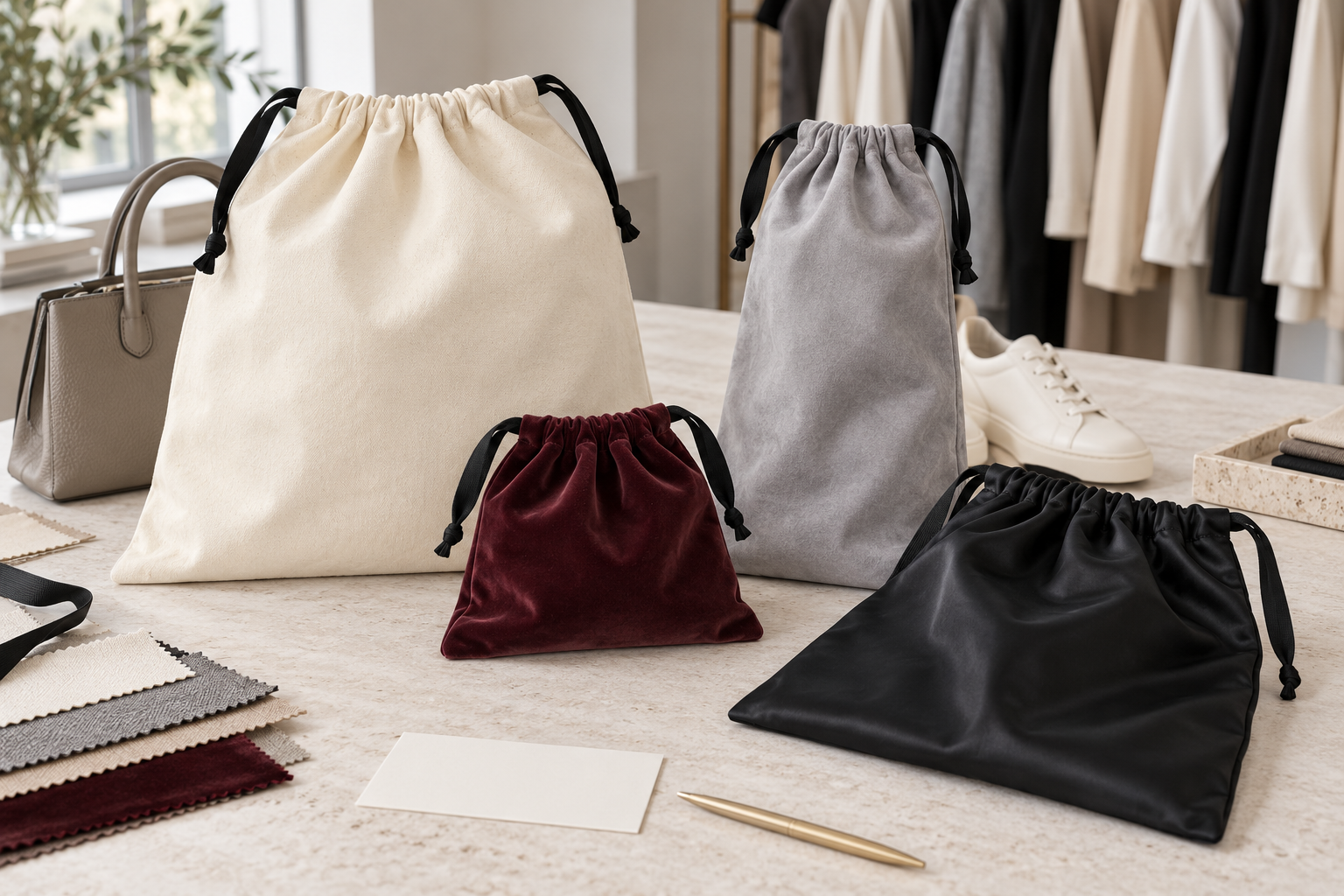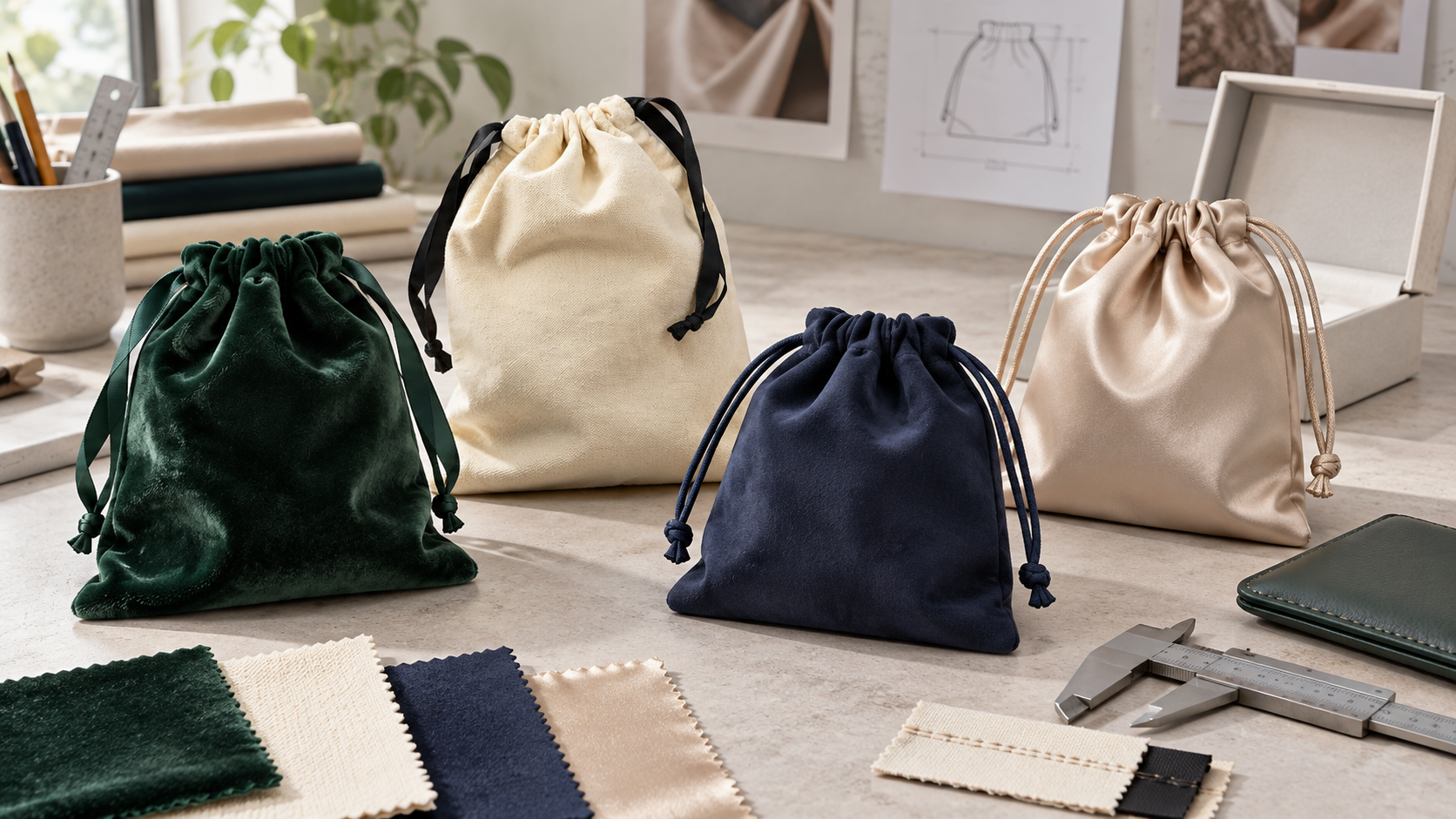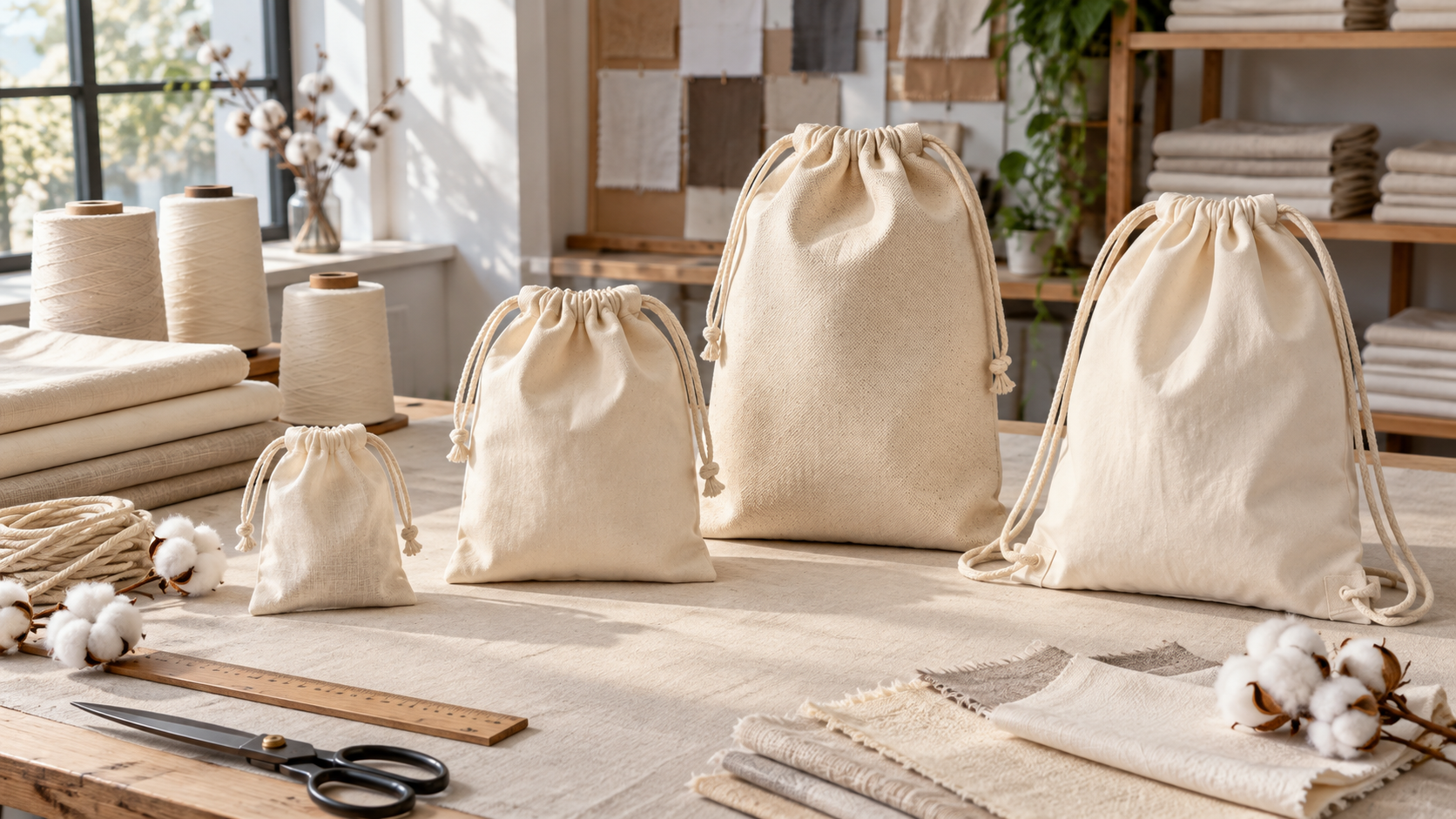
A jute shopping bag is simple only when viewed from a distance. At the sewing table, its coarse yarns, open spaces, natural slubs and tendency to fray change almost every construction decision. A strong-looking panel can still fail where a short handle ends, a gusset crosses a bottom seam or an unfinished edge loses yarn after repeated loading.
This Jute Shopping Bag Construction guide is for retail, grocery, gift and promotional buyers who need a quotation-ready build—not another comparison of jute with paper or non-woven polypropylene. It explains how to specify the body cloth, pattern, seams, edges, handles, backing, branding, tests and packing controls that determine whether the finished carrier works.
Start with LUCKYSTAR’s custom shopping bags product page. Use the construction decisions below with How to Choose a Custom Shopping Bag Manufacturer and the wider Custom Bag Manufacturer Guide when qualifying a supply partner.
Planning an order? Send a construction-led jute bag brief. Include intended basket/load, finished size/gusset, composition and weave reference, backing/lining, seams/edge finish, handle path, base insert, artwork, quantity by SKU, tests, odor/moisture rules, packing, destination and required date.
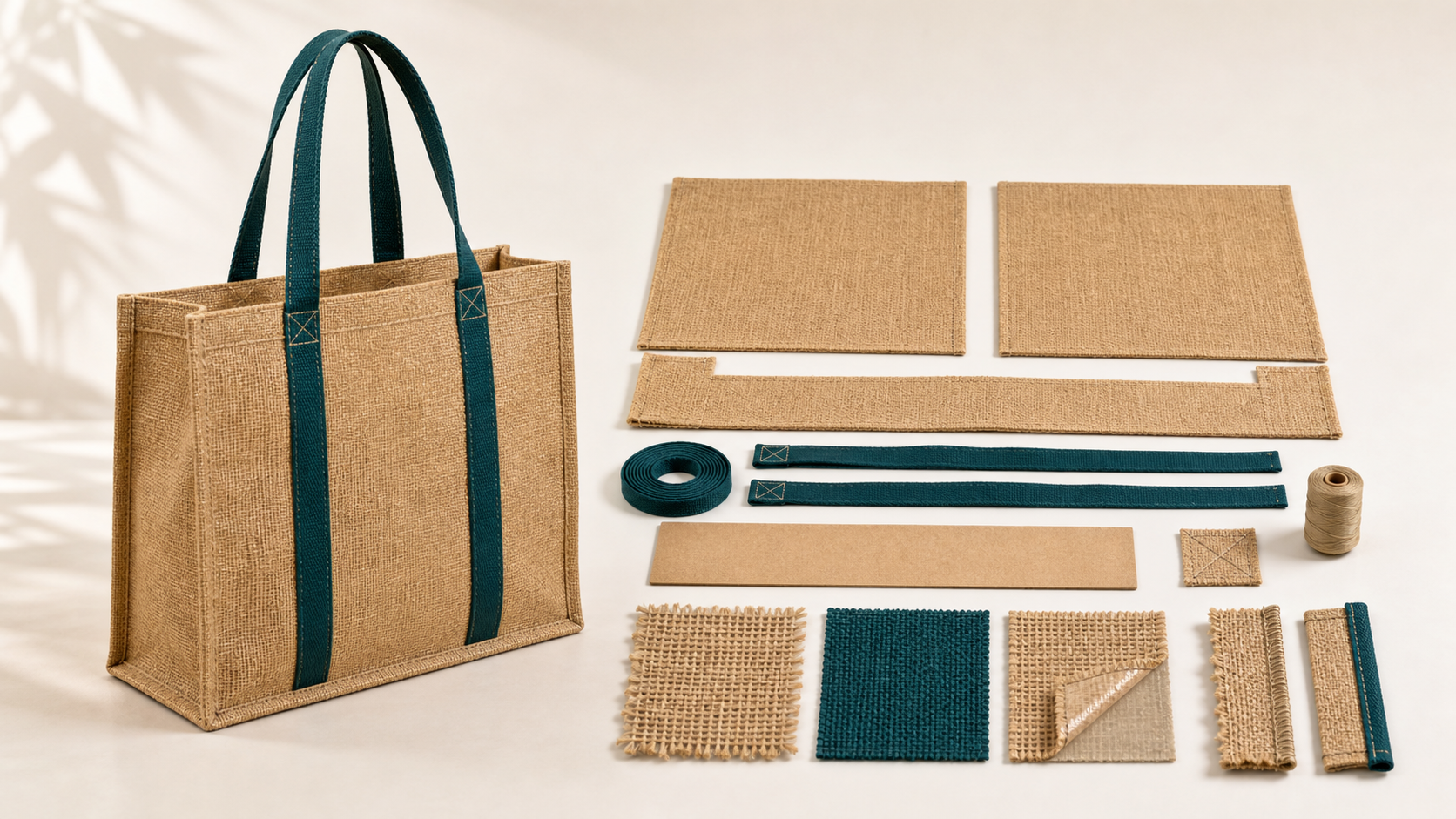
A dependable jute bag begins with a controlled material, a load-aware pattern and deliberate treatment of every raw edge.
Page role: This construction guide owns jute shopping bag architecture and process control: fabric route, gussets, squaring and cutting, raw-edge control, handle load paths, base or lining options, coarse-surface artwork, moisture, testing, QC and packing. Use the worldwide shopping bag manufacturer guide for a supplier shortlist, and the custom shopping bag collection for specification and quotation planning.
1. Treat jute as a family of constructions, not one cloth
“Jute” can describe an open hessian-style fabric, a tighter decorative weave, a jute-cotton blend often called juco, dyed cloth, or a jute face bonded to a film or backing. These routes differ in print definition, stiffness, fiber shedding, edge stability, needle response and appearance. They also create different cost and end-of-life questions.
Do not approve a small presentation swatch with only a color name. The bulk specification should state fiber composition, weave reference, usable width, mass per unit area, finish, color tolerance, roll direction and the handling of slubs, knots, hairiness, contamination, bow and skew. A sealed reference swatch is useful because natural shade and surface variation are difficult to communicate through photographs alone.
| Construction route | Useful retail role | What it changes | Main approval risk |
|---|---|---|---|
| Open hessian / burlap look | Rustic gifts, markets, events and visible natural texture | More open yarn spacing; bold graphics and strong edge control suit it better than fine detail | Variable aperture, lint, distortion and logo show-through |
| Tighter woven jute | Structured retail shopper and neater branded presentation | Denser surface, generally better shape and more consistent print ground | A denser appearance may be mistaken for proof of finished-bag strength |
| Juco / jute-cotton blend | Finer artwork, softer hand or fashion-led programs | Composition, handle and print behavior differ from pure jute | Calling a blend simply “jute” or approving an unverified ratio |
| Dyed jute | Seasonal colors and coordinated retail campaigns | Adds shade, crocking, odor and lot-consistency controls | Dry approval only, with no wet-rub or packed-contact check |
| Laminated or backed jute | Stiffer basket, lower shedding or more wipeable inner surface | Adds a composite layer, fold memory, bond and seam-hole questions | “Waterproof” or “plastic-free” claim based on the visible face alone |
2. Choose the bag architecture around the actual shopping basket
Finished width, height and gusset are not interchangeable volume numbers. A tall flat bag can hold a boxed bottle but performs poorly with a broad takeaway container. A deep base may improve loading yet increase leverage at the lower handle attachment. Ask the buyer to provide representative products, their dimensions, the maximum intended combined mass and the way staff will load the bag.
A continuous strip forming both side and bottom gussets reduces the number of separate pattern pieces, but creates turns and seam intersections that require control. Separate side panels and a base can produce a more defined box, while adding joins. A one-piece folded body is efficient for some sizes but can put the fold or seam in an unsuitable load position. Pattern choice must follow contents, print placement, fabric width and production repeatability.
- Flat gift, book or apparel: use a flat or shallow-gusset body with a controlled opening. Protect side seams from rigid pack corners and reinforce short or medium handles locally.
- Grocery and mixed retail items: a box gusset, stable base and broad opening help loading. Full-length webbing can spread force, but the bottom turn and gusset intersections still need proof.
- Bottles or tall cartons: keep the base proportionate and place handle attachments to hold the load upright. Check swing, base pressure and any divider.
- Premium hampers: lining or backing, a separate base and a removable board can create structure. Control board abrasion, lining creep and layer bonding.
- Promotional giveaways: a simplified flat or modest-gusset pattern suits bold branding. Do not meet a price target by quietly reducing seam allowance, edge treatment or reinforcement.
Put the pattern, finished measurements, seam allowances, grain direction, notch positions and tolerance rules into a Custom Shopping Bag Tech Pack. State whether the gusset is measured folded, opened or at the finished base; otherwise two suppliers can quote different internal volumes from the same three numbers.
3. Relax, square and cut the fabric before sewing
Jute responds to moisture and handling. Rolls can relax, distort or show bow and skew after arrival, and loose constructions can move while spreading. Establish an agreed conditioning period and environment before the production team confirms dimensions or cuts the lot. The aim is not to make every natural yarn identical; it is to keep variation from becoming a random pattern error.
Mark warp and weft direction on the approved pattern. Cut repeated components in a consistent orientation, especially paired front and back panels, printed patches and long gusset strips. Use registration notches or templates for handle positions and gusset turns. A cutter who squares the artwork but ignores the weave can make the bag look twisted after loading.
ISO 139 specifies standard atmospheres for conditioning and testing textiles. It is a useful reference for comparable laboratory measurements, but production relaxation time and warehouse control still need to be defined for the actual material and climate.
| Incoming/cutting item | What the specification should contain | Factory check | Hold condition |
|---|---|---|---|
| Fiber and weave | Declared composition, construction reference and approved physical swatch | Supplier lot documents, visual weave match and identity segregation | Composition or construction is not the ordered route |
| Mass and usable width | Mass per area, usable width and agreed tolerance | Roll sampling using an agreed method; ISO 3801 is one current reference for woven-fabric mass | Yield, hand or load assumptions no longer match the sample |
| Shade and surface | Master swatch, acceptable range and rules for slubs, knots, hairiness and stains | Lot grouping under controlled light plus face/back review | Mixing creates visible front/back or carton-to-carton mismatch |
| Bow, skew and grain | Panel orientation and maximum acceptable distortion for artwork and assembly | Square sample and directional marks before cutting | Logo or finished bag cannot be held square |
| Moisture, odor and contamination | Dry-storage expectation, odor reference and prohibited contamination | Receiving sensory check, moisture-risk review and quarantine of suspect rolls | Damp, musty, oily or contaminated material enters cutting |
4. Control raw edges before they control quality
A cut jute edge can lose yarn during handling, sewing and use. A wider seam allowance is not enough if the edge remains free to unravel toward the stitch line. Select the edge treatment with the weave, seam visibility, lining and expected abrasion in mind.
Overlocking is useful for hidden internal edges when the stitch formation and bite are tuned to the yarn spacing. Binding gives a cleaner protected edge and can become a design feature at the top or side seam. A turned edge may work where the fabric and thickness allow an even fold. A lining can enclose loose fibers but introduces its own creep, seam and composition requirements.
Set needle size, point, thread, stitch type and stitch density using the production fabric. Excessive density can perforate or cut coarse yarns; too little bite can leave an open seam. Inspect the seam after flexing and loading, not only while it lies flat.
| Edge or seam route | Best use | Approval details | Likely failure mode |
|---|---|---|---|
| Overlocked internal edge | Economical protection inside unlined bags | Bite width, stitch balance, seam allowance, thread and trimmed edge | Loop misses open yarns or unraveling reaches the seam |
| Bound seam or top edge | Visible finish, high-touch rim and coarse open weaves | Binding composition/width, turn accuracy, splice position and stitch margin | Binding rolls off the edge, puckers or opens at a join |
| Folded / turned top | Clean opening on suitable tighter fabric | Fold depth, bulk at side seams, top circumference and handle overlap | Uneven rim, yarn cracking or excessive thickness at intersections |
| Lining-enclosed seam | Premium inside, reduced loose-fiber contact and pocketed formats | Lining ease, turn opening, anchoring, trim compatibility and cleanability | Lining pulls, twists, balloons or exposes raw jute |
| Reinforced bottom intersection | Box gussets and high-bulk baskets | Corner turn, stitch continuity, backtack policy and seam stack | Skipped stitches or tear initiation at the thickest point |
5. Engineer the handle as a load path
The body does not carry a shopping load by itself. Force travels from the consumer’s hand through the webbing or rope, across the attachment stitches, into the front and back panels, and down toward the base. Every transition needs enough material around it.
Full-length webbing that continues toward or around the base spreads force over a larger area and can suit grocery or hamper formats. Short handles preserve a cleaner front but need a patch, sufficient insertion depth and a stitch pattern placed away from a fragile cut edge. A box-X pattern is useful only when its dimensions, thread, stitch margin and underlying fabric are appropriate. More stitches are not automatically stronger if they create a perforation line.
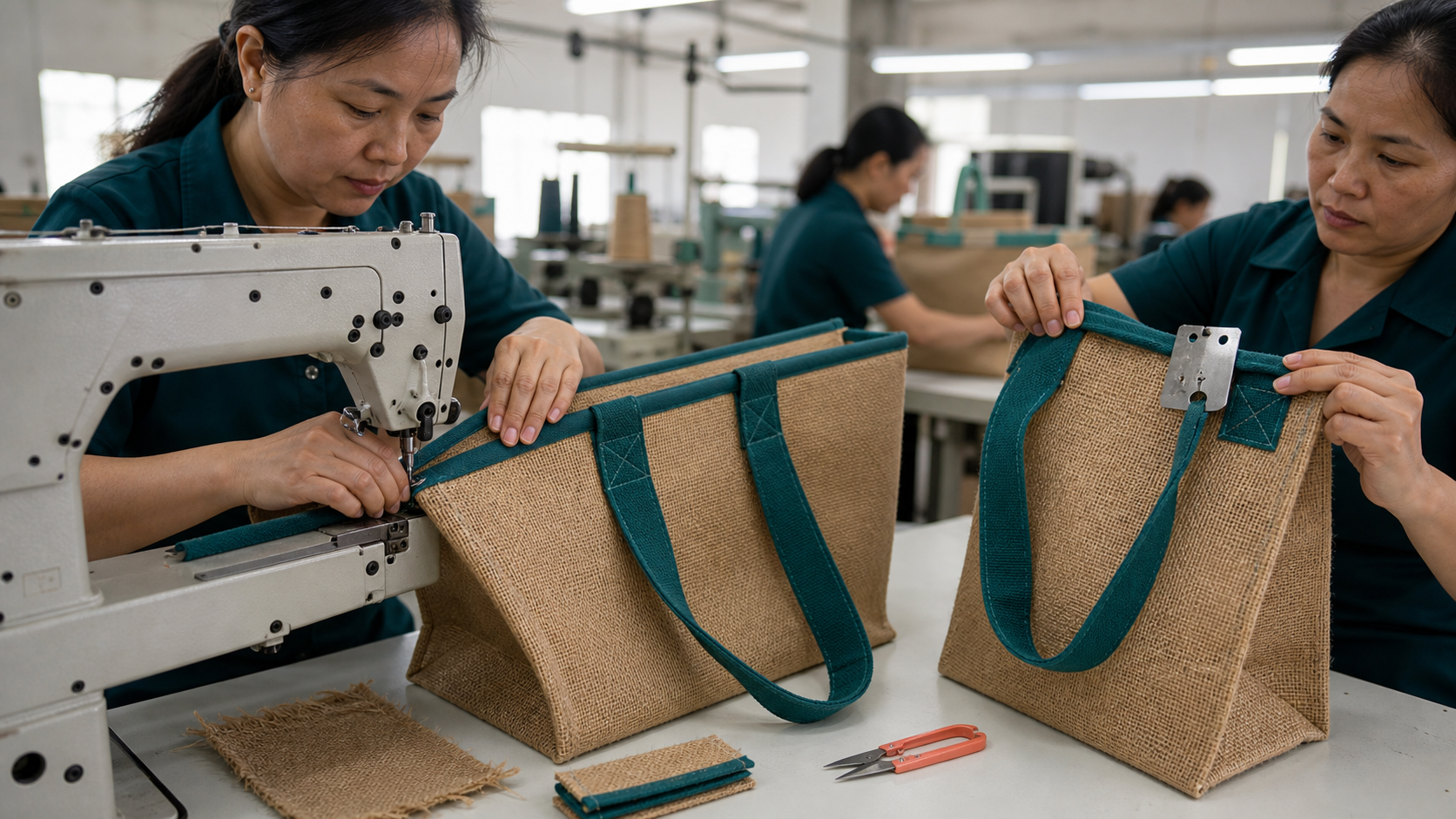
The production sample should prove that binding, handle webbing, reinforcement and jute body work as one system.
| Handle route | Good fit | Reinforcement to define | Test focus |
|---|---|---|---|
| Full-length cotton or polyester webbing | Grocery, wide-gusset and heavier retail basket | Webbing path, lower termination or wrap, top-edge crossing and stitch rows | Load distribution, bottom turn, peel at ends and visual straightness |
| Short webbing handles | Gift, apparel and logo-led front panel | Insertion depth, patch size, box-X or multi-row geometry and edge distance | Pull-out, local body tear and asymmetric carry |
| Jute tape / self-material handle | Coordinated natural appearance at moderate duty | Layering, edge finish, splice, hand comfort and attachment interface | Fraying, stretch, yarn loss and fold fatigue |
| Rope handle through eyelets | Premium gift look and selected low-cycle use | Eyelet/washer, local patch, hole spacing, rope termination and metal finish | Hole growth, eyelet pull-out, abrasion and hardware contact |
| Padded or wrapped handle | Higher perceived value or comfort-led hamper | Core, cover, end transition and bulk-control method | Cover slip, seam rotation and end detachment |
Use the intended basket for static, cyclic and asymmetric carrying. The wider test logic in Which Tests Should Reusable Shopping Bags Pass? helps match material, join and complete-bag evidence to the failure mechanism.
6. Use a base insert, lining or lamination for a defined job
A removable baseboard can flatten the loading platform and improve shelf presentation, but its corners must not abrade the body or lining. Specify material, thickness, dimensions, corner radius, orientation and whether the consumer can remove it. Test the bag both with the insert correctly positioned and after realistic movement inside the base.
Lamination or backing can reduce fiber shedding, add stiffness and improve resistance to incidental surface moisture. It does not automatically make the bag waterproof: the opening, seams and needle holes remain possible ingress routes. Bond strength, flex whitening, cracking, odor and delamination should be checked after folds and packed storage.
A lining can provide a smoother interior, hide construction and support pockets. Freeze its composition, color, ease and anchoring. If the brand is making a low-plastic or recyclability claim, include film, adhesive, lining, board, webbing, print and labels in the review. A natural outer fiber does not make a multi-material bag automatically recyclable or lower impact.
| Surface / internal option | Purpose | What to approve | Claim or quality caution |
|---|---|---|---|
| Unlaminated jute | Natural texture and simpler layer stack | Shedding, edge stability, print penetration, odor and spot-clean response | Do not promise water resistance or zero fiber release without evidence |
| Inner film/backing | Stiffness, lower shedding and a wipeable internal face | Layer identity, mass, bond, folding, seam behavior and migration/odor risk | Composite structure changes environmental and material claims |
| Textile lining | Finished interior, pockets or product separation | Fiber, color, ease, anchoring, seam enclosure and cleaning compatibility | Lining can trap moisture or twist if its dimensions are wrong |
| Removable baseboard | Flat loading surface and shape retention | Board material, thickness, rounded dimensions, cover and placement | Sharp edges or an undersized insert can damage the body |
| Screen print on jute | Bold logos and larger flat color areas | Actual bulk cloth, mesh/ink route, coverage, cure, rub and registration | Open weave limits tiny type and can produce irregular edges |
| Printed patch / woven label / embroidery | Fine identity, premium detail or repeatable small mark | Patch base, edge, placement, needle/backing and attachment durability | Added layers and needle holes affect feel, claims and recycling route |
7. Design artwork for a coarse, variable surface
Artwork that looks crisp on a monitor may lose counters, fine lines and small text on open jute. Set minimum feature sizes after a print trial on the actual production-intent fabric. Treat natural yarn irregularity as a defined aesthetic range, not as permission for uncontrolled registration or incomplete curing.
For screen printing, approve ink film, penetration, hand, opacity, cure and dry/wet transfer. Keep the print zone away from seam ridges, handle stacks and gusset folds unless the artwork is intentionally designed around them. A printed cotton patch or woven label can carry finer information; embroidery can work for selected designs but needs backing, needle and puckering trials.
Use ISO 105-X12 as one recognized reference for dry and wet rubbing colorfastness on textile color. The buyer still has to define the relevant substrate, face, number of colors, packed-contact surfaces and acceptance criteria. A passing fabric result does not prove a complete printed bag after folding and use.
8. Control moisture, odor and carton storage
Jute’s moisture response makes timing important. Store rolls and finished goods in a dry, ventilated area; do not seal items while print, coating or cleaning moisture remains. Inspect for musty, chemical or oily odor at receiving, after printing and before carton closure. Quarantine suspect lots instead of masking odor with fragrance.
Pack samples should be held under a defined temperature, humidity, compression and time profile that reflects the shipping route. After the hold, open cartons and check odor, surface transfer, creasing, mold evidence, metal tarnish, laminate bond, dimensional recovery and immediate load function. Add desiccant or ventilation only through a controlled pack specification; these measures do not rescue damp goods.
A “machine washable” claim is risky for many jute builds because washing can change dimension, color, stiffness, backing and shape. If cleaning is important, develop an evidence-based instruction on the complete bag. A conservative spot- or wipe-clean statement still needs verification with the intended surface and print.
9. Test the material, seam and finished bag separately
One pull number cannot explain every risk. Fabric tensile and tear results characterize the textile in a stated direction. Seam tests characterize a defined straight join. A finished-bag program challenges handle attachments, gusset corners, base, opening and interactions under realistic loading. The methods complement each other.
ISO 13934-1 covers maximum force and elongation by the strip method and is mainly intended for woven textiles; ISO 13937-2 covers single-tear force using the trouser method. ISO 13935-2:2026 measures maximum force to seam rupture by a grab method for straight seams in woven textiles. Its published scope notes that it is not normally applicable to coated fabrics and certain other structures. Ask a competent laboratory to confirm method suitability for laminated jute rather than copying an uncoated-fabric method onto a composite.
| Gate | Evidence | Sample condition | Release question |
|---|---|---|---|
| Incoming textile | Composition route, mass/width, shade, weave, surface, odor, bow/skew and roll identity | Representative conditioned samples in both directions where relevant | Does bulk match the approved construction and cutting yield? |
| Body tensile / tear | Method suited to uncoated or composite material, direction, specimen count and result distribution | Production-intent finish after agreed conditioning | Is there margin for the actual panel and likely damage mechanism? |
| Straight seam | Fabric, seam type, allowance, thread, needle, stitch density and rupture mode | Production-machine specimens cut in defined orientation | Did fabric, yarn, stitch or seam allowance fail first? |
| Print / dyed surface | Dry/wet rub, adhesion, cure, color, transfer and appearance after flex | Actual color lot and artwork coverage | Can the print contact clothing or adjacent bags without unacceptable transfer? |
| Handle attachment | Symmetric pull, asymmetric pull, cyclic lift/swing/set-down and failure location | Finished bag with production webbing, reinforcement and top finish | Does the load path survive beyond the declared consumer load? |
| Complete bag / pack | Representative basket, static and cyclic load, base insert, fold/abrasion plus packed hold | Production-intent article and retail carton | Does the bag remain safe, square, clean and saleable after the route? |
10. Build quality control around seven practical gates
At receiving, verify the material lot before cutting. At printing, approve a first-off on the correct face and lot. At cutting, control direction, dimensions and notches. At sewing, inspect edge capture, seam allowance, stitch balance and gusset intersections. At handle attachment, verify position and reinforcement. At final inspection, check dimensions, appearance, function and load sampling. At packing, preserve dryness, SKU identity and carton traceability.
The Custom Shopping Bag Quality Control Checklist gives a broader defect-classification and inspection framework. For this material, add jute-specific defects: excessive shedding, dropped yarns, unstable edge, unacceptable slub/knots, oil or plant contamination, musty odor, weave distortion, shade mixing and backing separation.
Retain a sealed approval sample, material swatch, print standard and construction record. Record the roll lots, cutting bundles, line and carton allocation used for the order. When an exception appears, this trail lets the team contain affected cartons instead of guessing across the whole shipment.
11. Understand what changes MOQ, cost and lead time
Exact weave and mass, custom dyeing, lamination, lining, binding, full-length webbing, baseboards and complex print coverage all change the commercial route. Natural shade sorting can reduce yield. Multiple artwork versions or colorways fragment material and production lots, even when total order quantity looks large.
Ask suppliers to separate material, conversion, print, testing and packing assumptions. Compare quotations only after the same fabric, measurement convention, handle path, reinforcement and inspection scope are aligned. The 2026 Shopping Bag Pricing Guide explains the wider cost stack, while the Shopping Bag MOQ and Production Time guide helps plan sample and bulk gates.
Do not save a few cents by deleting the element that protects the failure point. Simplifying a pocket, standardizing binding colors or consolidating SKUs may reduce cost with limited performance impact. Narrowing handle insertion, reducing seam allowance or removing edge treatment can create a disproportionately expensive field failure.
12. Send a construction-led RFQ
A useful RFQ describes the product the factory must build and the evidence required to approve it. Attach representative basket dimensions, artwork files and photographs only as supporting references. The written specification remains the source of truth.
| RFQ field | Information to provide | Supplier response required | Why it matters |
|---|---|---|---|
| Use and load | Products, dimensions, maximum intended mass, carry style and reuse expectation | Recommended construction plus declared test plan and margin | Prevents a visual sample from becoming the only performance brief |
| Finished geometry | Width × height × gusset, open/folded convention, opening and tolerance | Pattern route, seam allowances, internal volume assumptions and dieline | Makes supplier dimensions comparable |
| Jute specification | Composition, weave/mass, width, finish, color, variation range and backing | Mill/source route, MOQ, lead time, bulk tolerance and swatch | Stops “standard jute” substitution |
| Seams and edges | Pattern diagram, seam type, binding/overlock, allowance and top finish | Stitch/needle/thread proposal, critical intersection sample and QC method | Targets the material’s fray risk |
| Handles and base | Material, width, length, path, attachment, reinforcement and base insert | Load-path drawing, pull/cycle result and substitution limits | Connects the declared load to the actual joins |
| Branding and claims | Artwork, print colors, placement, environmental wording and care instruction | Production trial, tolerances, evidence gaps and claim exclusions | Keeps appearance and marketing within the verified build |
| Quality and logistics | Tests, sampling, defect limits, odor/moisture rules, packing, destination and delivery boundary | Inspection plan, carton specification, timing, price breakdown and assumptions | Normalizes total landed risk, not just unit price |
Use the production-intent sample route in the Custom Shopping Bag Sample Development Process. For overseas purchasing, connect material, inspection and document ownership to How to Import Custom Shopping Bags from China before the deposit is released.
Company-claim boundary: LUCKYSTAR statements in this section are publisher self-description, not third-party verification, a test result, environmental claim, proof of composition or assurance that one construction is heavy-duty, waterproof, lower impact, lower cost or suitable for every use. Confirm the contracting entity, assigned production site and subcontracting; final composition/weave, backing, seams, handles and base; production sample; methods/limits; claim evidence; packing; and release terms for each order.
13. How LUCKYSTAR describes its jute construction review
LUCKYSTAR states that its project team can translate the intended basket, bag geometry, artwork, SKU split and pack-out into a construction comparison, subject to specification and written confirmation. The review can distinguish open hessian, tighter woven jute, juco, dyed, backed or lined directions and identify which details require physical approval.
- Body cloth: record composition, weave/mass, usable width, shade, variation limits, direction and moisture/odor condition.
- Pattern and edges: allow relaxation, square the grain, define allowances and protect raw edges before assembly.
- Load path: connect handle material/path, attachment, reinforcement, top edge, gusset/base and any insert.
- Backing or lining: state the material, purpose, layer boundary, fold/bond/seam risks and effect on claims.
- Converted artwork: approve production-size print on the actual fabric and inspect texture, show-through, rub and position.
- Pack-out: control dryness, odor, contamination, compression, abrasion, fold recovery, desiccant decision and carton conditions.
Review the public custom shopping bag options. Teams still qualifying suppliers can use the manufacturer selection guide and Custom Bag Manufacturer Guide. Then send the construction and evidence requirements for a project-specific review.
Frequently asked questions
What is the best jute weight for a shopping bag?
There is no universal best number. Mass per area interacts with weave density, yarn quality, backing, pattern, seam and handle reinforcement. State the basket and load, compare candidate fabrics in both directions and validate the finished bag. Do not select by GSM alone.
Should jute shopping bags be laminated?
Use backing when it serves a defined need such as stiffness, lower shedding or a more wipeable internal face. Approve bond, fold and odor performance, and account for the added layer in environmental claims. Lamination does not automatically make seams or the open top waterproof.
Which seam finish is best for jute?
Bound edges give strong visual and physical control for many open weaves; overlocking can be efficient for hidden internal seams; folded or lined routes suit selected structures. The correct option depends on weave openness, visibility, thickness, abrasion and cost. Test the actual seam, not a generic fabric strip.
Can a jute bag carry heavy groceries?
It can be engineered for a defined load, but the finished design must prove it. Full-length or properly patched handles, protected edges, a stable gusset/base and cyclic/asymmetric bag tests matter more than a broad “heavy-duty” label.
Can we print fine artwork directly on jute?
Open, irregular yarns limit tiny lines and small type. Trial the artwork on the exact bulk-intent fabric. Simplify features, increase line weight or use a printed patch or woven label when consistent fine detail is essential.
Are jute shopping bags automatically sustainable?
No single fiber name proves a lower overall impact. Durability, reuse, manufacturing losses, dye/finish, lining, laminate, trims, transport and realistic end-of-life all matter. Use specific, supportable claims and avoid treating “natural” as a complete environmental assessment.
What should an approval sample include?
Use production-intent fabric, backing, thread, binding, handle, reinforcement, print and base/lining. Record finished dimensions, material lot, construction settings, visual limits, load result, odor/packing result and all approved deviations before bulk release.
Build the specification before requesting the price
Reliable Jute Shopping Bags come from the way the parts work together. Define the basket, lock the fabric and grain, protect every cut edge, spread handle forces, approve the actual artwork, control moisture and prove the complete carrier. These decisions make supplier quotations comparable and give inspectors objective release criteria.
For broader supplier capability and cluster planning, return to the Custom Bag Manufacturer Guide. Then share the basket, size, target load, artwork, quantity, destination and construction preferences through LUCKYSTAR’s custom shopping bags page.

Request a construction-led jute shopping bag proposal
Define the body cloth, pattern, edges, seams, complete handle path, backing/lining, artwork, evidence and pack-out before comparing prices.
Review LUCKYSTAR custom shopping bag options, then send your project details through the contact form or Email a project brief. The email link opens a draft for your review before sending.
Factory assignment, fiber composition, weave/mass, backing/lining, performance, moisture/odor or environmental claims, samples, testing, inspection, price, MOQ, packing, schedule and release terms are subject to due diligence, specification and written confirmation.