A cotton mesh shopping bag changes shape as soon as it begins to work. The empty bag may look narrow and short on a table, then lengthen, round out and close around a grocery basket under load. After laundering, the cotton yarn and the open-loop construction may contract, skew or recover at different rates. That makes a single “40 × 45 cm” line on a quotation incomplete.
This guide explains how retail buyers should specify Cotton Mesh Shopping Bags by relaxed size, loaded envelope, yarn and mesh architecture, handle load path, wash shrinkage, inspection and care claims. It is deliberately narrower than a cotton-versus-canvas comparison or a general fabric-weight article: the subject here is the behavior of an open mesh carrier as a complete product.
Review possible formats on LUCKYSTAR’s custom shopping bags product page. Combine this guide with How to Choose a Custom Shopping Bag Manufacturer and the broader Custom Bag Manufacturer Guide when selecting and qualifying the production route.
Planning an order? Send a test-ready cotton mesh bag brief. Include the products or basket, relaxed size, loaded envelope, intended consumer load, yarn and mesh reference, handles and joins, exact wash/dry route, dimensional-change limits, artwork, quantity by SKU, packing, destination and required date.
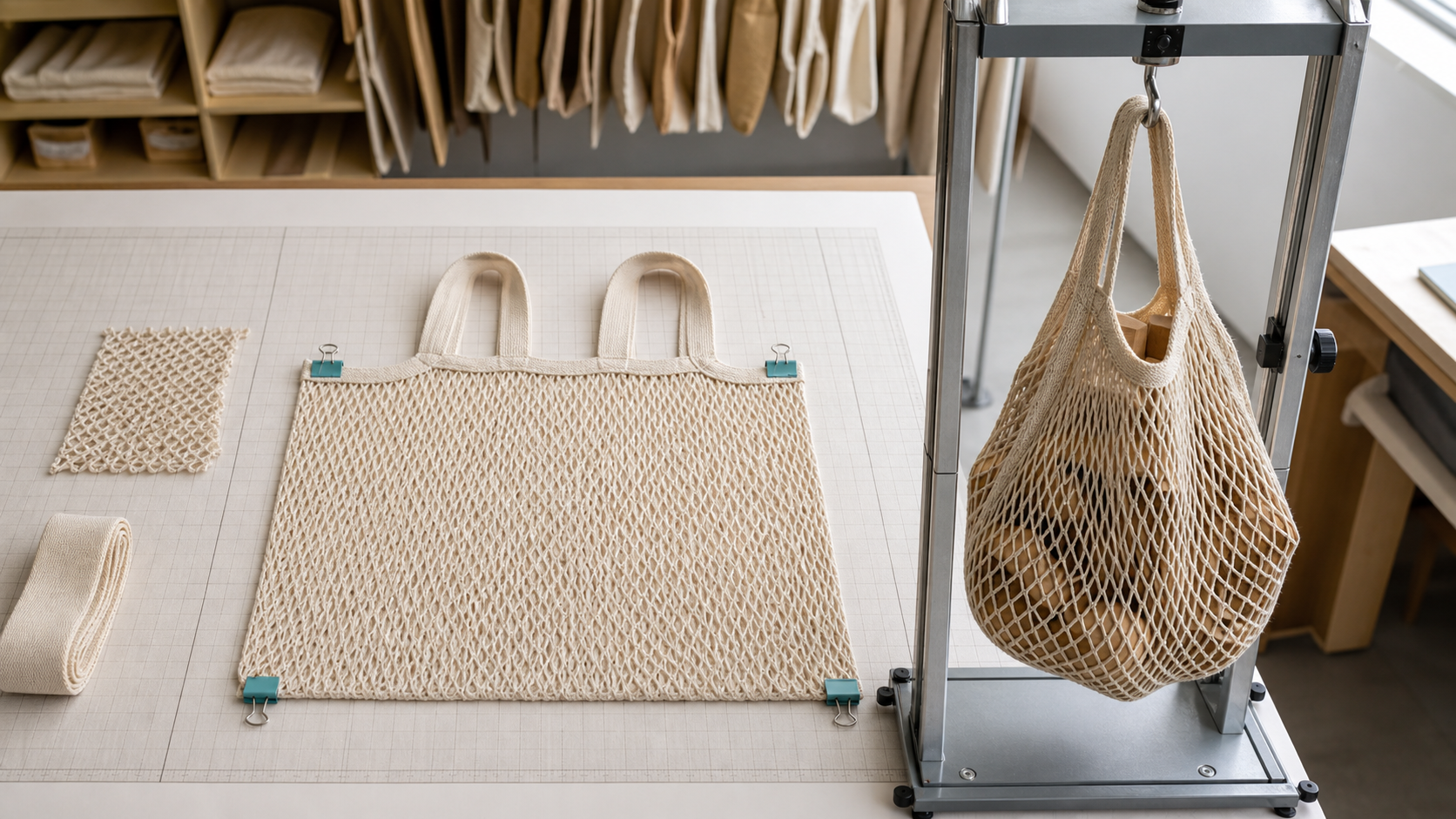
Relaxed dimensions identify the product; a defined load reveals the usable carrying envelope and the most stressed interfaces.
1. Define the cotton mesh construction before discussing size
“Cotton mesh” can describe several products. Some use a knitted, knotless diamond net attached to a solid top band and webbing handles. Some integrate the handle and body in one knitted structure. Others use knotted netting, a woven leno-style open fabric, or a cotton-blend mesh. The route changes how the bag elongates, how an opening grows around a rigid object, where damage runs and how branding can be applied.
Fiber content is only the first specification layer. Add yarn count or linear density, number of plies, twist, knitting or weaving route, mesh geometry, opening gauge, body mass, finish, color, top-band construction and handle material. If the supplier uses a named stock quality, attach a physical swatch and the relevant internal code. “Natural cotton mesh, standard quality” is not repeatable enough for a branded program.
| Mesh route | Typical behavior | Useful application | Main approval risk |
|---|---|---|---|
| Knitted knotless diamond mesh | Opens and elongates readily; load redistributes through loops | Foldable grocery, market and everyday carry | Bag becomes much longer and narrower than the buyer expected |
| Dense small-opening knit | More surface coverage and less protrusion, usually with a firmer hand | Smaller packaged goods, promotional retail or logo patch formats | Higher material use is assumed to prove handle or seam strength |
| Knotted cotton net | Distinct craft texture; knots create local bulk and stress points | Selected artisan, gift or visual merchandising programs | Knot consistency, snagging, discomfort or local yarn break |
| Open woven / leno-style mesh | More fabric-like plane and directionality than a loose net | Flat retail carrier, produce sack or combined solid-panel design | Cut-edge fray and seam stability differ from knitted mesh |
| Cotton-blend mesh | Shrinkage, recovery, hand and claim scope depend on the blend | Programs seeking a specific performance, cost or recycled-content route | Sold as pure cotton or compared with a cotton approval sample |
The stand-alone fabric guides Canvas vs Cotton Tote Bags and Best Fabric Weight for Custom Tote Bags explain fiber, weave and mass for conventional totes. A mesh buyer must add opening geometry and load-induced shape change; GSM alone cannot describe an open net.
2. Separate relaxed size from loaded size
A useful Cotton Mesh Bag Size specification describes the same article in controlled empty and loaded conditions. Those states answer different questions and should never be collapsed into one nominal width-and-height claim.
The finished specification should state how the empty bag is prepared and placed for measurement. A useful baseline is a conditioned bag laid flat on a horizontal surface, smoothed only enough to remove accidental folds, with no deliberate stretching. Measure body width, body height, overall height, opening width or circumference, handle drop and any solid band or base separately.
Mesh edges are rarely as straight as a canvas panel. Define measurement points: inside or outside the binding, centerline or extreme edge, and which loop or seam forms the boundary. Use a template or diagram. If two inspectors choose different outer loops, their results can differ while the actual products are identical.
Loaded measurements answer a different question. Specify the test basket or smooth blocks, total mass, distribution, suspension points, dwell time and whether the bag is measured while hanging or after unload/recovery. Record vertical extension, maximum loaded width, opening behavior, handle drop and permanent set. Do not use the loaded figures to calculate washing shrinkage.
| Dimension / state | Measurement definition | Why buyers need it | Common mistake |
|---|---|---|---|
| Relaxed body width | Conditioned, flat, no tension; fixed boundary loops or band edges | Identifies the made-up product and supports packing checks | Pulling the mesh sideways until it resembles a rectangle |
| Relaxed body height | Top body seam/band to lowest mesh point along a stated centerline | Controls empty appearance and pre/post-wash comparison | Including the handles in one supplier’s result but not another’s |
| Handle drop / overall drop | Top opening to handle apex, and handle apex to body low point, under defined placement | Determines hand, forearm or shoulder carry and shelf presentation | Measuring a twisted handle or stretching soft tape |
| Opening | Flat width, internal circumference or fit over a named loading fixture | Shows whether products can be inserted without overstressing the top band | Assuming flat width equals a rigid circular or rectangular opening |
| Loaded envelope | Maximum width, hanging length and depth with stated contents, mass and dwell | Reveals real capacity, product protrusion and carrying profile | Advertising a fixed liter capacity without a load fixture |
| Post-load recovery | Relaxed size after unloading for a specified recovery time | Separates elastic/recoverable extension from permanent deformation | Calling temporary extension a strength failure or ignoring permanent set |
Put the measurement sketch, states, fixtures and tolerances into the Custom Shopping Bag Tech Pack. A target should not be tighter than the measurement system can reproduce.
3. Select size around product geometry, not a catalog name
“Small,” “standard” and “large” are merchandising labels, not universal dimensions. A compact bag can expand around several round items, while a large open net may fail to protect a thin carton corner or small loose product. Begin with a representative basket: dimensions, shapes, hard edges, maximum intended mass and the order in which items are loaded.
The following matrix gives development directions, not guaranteed industry sizes. Exact dimensions depend on mesh extension, top opening and handle route. Validate each shortlisted construction with the intended contents.
| Use case | Starting relaxed-size direction | Design priority | Fit proof to request |
|---|---|---|---|
| Small produce or personal carry | Compact body, controlled opening and shorter handle | Small-opening mesh and containment of narrow items | Load with smallest product plus a mixed-shape basket |
| Standard grocery / market | Medium body with broad accessible top and comfortable hand/forearm drop | Balanced extension, top-band strength and handle comfort | Realistic mixed load, walk/swing cycle and unload recovery |
| Large family shopping | Wider body with controlled vertical extension; reinforced top and handles | Prevent excessive hanging length and local overstretch | Volume fixture plus declared mass, rigid corners and asymmetric carry |
| Retail promotion / gift-with-purchase | Size aligned to the gift set and branding panel | Empty presentation, logo visibility and repeatable packing | Pack-out sample, shelf display and actual gift-set loading |
| Bottle or boxed products | Depth and opening selected around the exact rigid product | Corner protrusion, stability and base concentration | Product-shaped smooth fixture plus controlled edge simulation |
4. Specify yarn and mesh openings as a system
Opening size controls containment and stretch, but it cannot be specified without the yarn. Record yarn linear density/count, ply, twist, composition and finish with the mesh geometry. A visually similar opening made with a different yarn or knitting tension can show a different loaded profile and laundering response.
Define how the opening is measured: for example, the clear distance across a representative diamond or the repeat from junction to junction, under a stated low tension. Sample several locations and directions. Include rules for dropped loops, enlarged openings, yarn splices, thick/thin places, knots, contamination and edge transitions.
Natural, bleached, dyed, mercerized or garment-washed cotton may behave differently. A “pre-washed” or “pre-shrunk” statement does not mean zero further change. Require the exact finish route and test the production-intent lot after the same decoration and making-up sequence.
5. Follow the load from the handle into the net
The mesh may survive a broad load while the solid top band tears at a handle end, the body-to-band seam opens, or one loop runs from a needle hole. Strength therefore needs a failure map rather than one headline kilogram number.
Solid cotton tape handles offer a stable grip and a defined attachment area. Integrated mesh handles reduce components but may stretch, roll or feel narrow under load. A knitted solid yoke can distribute force if the transition into open mesh is consistent. Separate webbing should have enough insertion depth, edge distance and reinforcement; multiple stitches do not help if they perforate the same yarn line.
| Load-path zone | Likely failure | Engineering control | Evidence |
|---|---|---|---|
| Mesh body | Yarn rupture, loop run, opening growth or snag from rigid contents | Yarn/ply, opening gauge, controlled knitting and basket compatibility | Fabric burst or suitable strength test plus complete-bag basket cycles |
| Top band / yoke | Band curls, seam grins or mesh pulls from the transition | Band width, layer/knit route, seam bite and junction quality | Opening pull, band-to-body join test and loaded visual inspection |
| Webbing attachment | Thread break, tape peel, local tear or perforation line | Insertion, patch, stitch geometry, thread and edge distance | Symmetric and asymmetric handle pull plus cyclic complete-bag load |
| Integrated handle | Excessive stretch, rolling, hand discomfort or narrowing at transition | Handle width, reinforced knit, length and transition geometry | Loaded handle drop, grip comfort and repeated carry cycle |
| Side/bottom join | Opening at seam, yarn escape or concentration at the lowest point | Seam type, allowance, binding and consistent loop capture | Join specimens plus rigid-corner and uneven-load tests |
| Label / logo patch | Needle holes initiate a run or patch stiffens one stress area | Placement on solid zone, rounded corners, backing and stitch margin | Loaded and washed bag inspected around every patch edge |
ISO 13938-2:2019 describes pneumatic bursting-strength and distension testing and is applicable to knitted, woven, nonwoven and laminated fabrics. It can help characterize a cotton mesh candidate if the laboratory confirms that clamping, diaphragm contact and specimen geometry suit the open structure. It does not replace a finished-bag test: the consumer loads a carrier with seams and handles, not a circular fabric specimen.
Use the multi-level method selection in Which Tests Should Reusable Shopping Bags Pass? to separate fabric, join, handle, complete-bag and packed-distribution evidence.
6. Build a reproducible wash-shrinkage protocol
Cotton Mesh Bag Shrinkage is meaningful only when the before/after measurement points, conditioning, wash cycle, drying route and number of treatments are stated together.
Cotton can change dimension as yarns swell, relax and consolidate during washing and drying. An open mesh adds another mechanism: loops and diamonds can rotate or redistribute, so one direction may contract while the other grows. The solid top band, webbing handle, sewing thread and logo patch can change differently from the body.
The protocol begins before washing. Condition the sample, lay it without tension, mark or identify stable measurement points and record relaxed dimensions. ISO 3759:2011 covers preparation, marking and measurement for dimensional-change tests and applies to woven and knitted fabrics and made-up textile articles.
Next, freeze one washing and drying route. ISO 6330:2021 provides multiple domestic washing procedures and six drying procedures; one complete test combines a wash and a dry. Machine type, detergent, ballast, temperature, agitation and drying route can affect the outcome. ISO 5077:2007 provides the method for calculating dimensional change after the selected treatment.
A clear calculation is:
Dimensional change (%) = (dimension after treatment − dimension before treatment) ÷ dimension before treatment × 100.
Negative values indicate contraction; positive values indicate growth. Report body width, body height, opening, handle drop and overall drop separately. Do not average opposite-direction results into one attractive “total shrinkage” number.
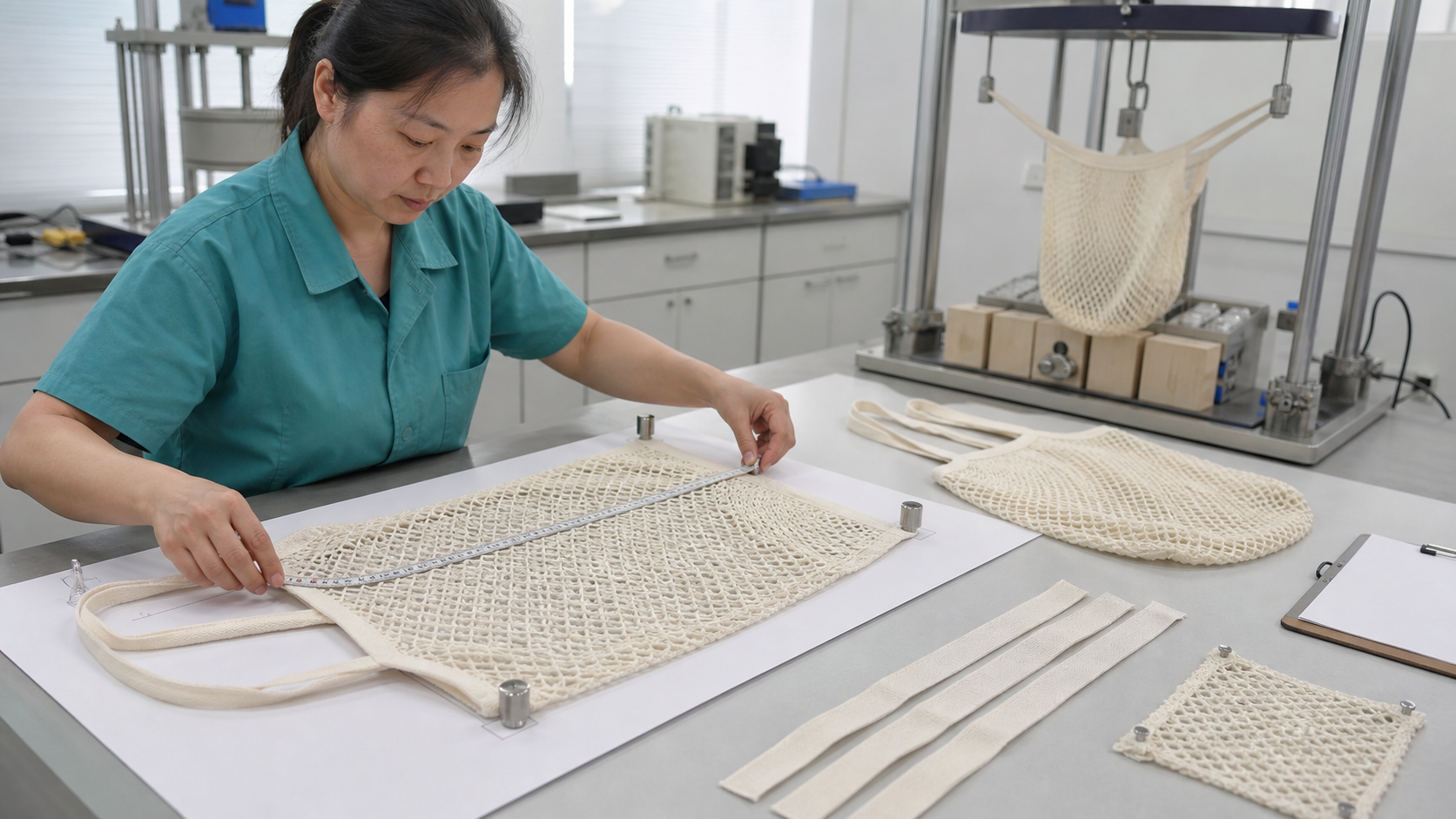
Measure the complete, conditioned bag after the specified wash/dry route, then recheck load function—not only a loose fabric coupon.
| Protocol item | What to lock | Report separately | Reason |
|---|---|---|---|
| Sample identity | Material lot, color, finish, decoration, making-up route and sample count | Every specimen and any exclusion | A loose undyed coupon cannot represent a dyed finished bag |
| Preconditioning and layout | Atmosphere/time, flat placement, no-tension rule and measurement points | Initial body, opening and handle dimensions | Mesh recovery time can change the apparent baseline |
| Wash procedure | Machine type, program, temperature, detergent, ballast and cycle count | Each cycle or selected cumulative checkpoints | One mild wash cannot support an unspecified washable claim |
| Drying procedure | Line, flat, drip, press or tumble route and parameters | Dry route plus completion criteria | Tumble and flat drying can produce different dimensions |
| Post-treatment recovery | Conditioning period, layout and smoothing limit | All directional changes and specimen variation | Measuring wet or deliberately stretched mesh gives a misleading result |
| Appearance / color | Twist, puckering, handle curl, opening distortion, shade, patch/print and seams | Visual rating and failure photographs | Correct dimensions do not mean the bag remains saleable |
| Post-wash function | Declared basket, load cycle, opening fit and recovery method | Strength, loaded profile and damage location | Washing can change yarn, joins and handle geometry together |
7. Convert repeated shrinkage data into the pattern
A development team may compensate a pattern when a stable, repeatable treatment consistently reduces one dimension. Do this with several production-intent samples, not one hand-made prototype. Separate mesh body, solid band and handles; they may need different pre-treatment or pattern allowances.
Do not simply add the observed percentage to every pattern dimension. Seam take-up, loop distribution, edge finishing and handle attachment make the final article nonlinear. Use the measured trend to revise a prototype, run the complete wash/dry sequence again, and approve the resulting finished dimensions. Keep the unwashed sellable size within tolerance as well; an oversized “shrinkage-compensated” bag may look wrong before its first wash.
If the buyer does not intend the bag to be laundered, the factory still needs to understand exposure during dyeing, garment washing, steam, wet finishing and storage. Production process moisture can change dimensions before the consumer receives the bag.
8. Check strength before and after washing
Run the declared load program on unwashed samples and again after the required care cycles. Include static dwell, repeated lift/swing/set-down, asymmetric handle loading and a basket with realistic shapes. Record maximum extension, opening growth, handle drop, seam appearance, broken yarns and permanent set after recovery.
A good requirement states the consumer load and the laboratory test load separately. The test may include an agreed margin, but an arbitrary extreme weight can distort the mesh in a way unrelated to normal use. Approval should state what constitutes failure: rupture, handle separation, opening beyond a limit, product escape, unacceptable permanent set or loss of saleable appearance.
For dyed or printed cotton, evaluate color through the chosen care route. ISO 105-C06:2010 covers colorfastness to domestic and commercial laundering. Match the test conditions and adjacent materials to the intended claim; colorfastness evidence does not by itself prove dimensional stability.
9. Design branding around solid zones
An open net is a poor surface for small printed type or a conventional large screen print. Build branding into a solid top band, a cotton patch, a woven label or a hangtag. A patch should not become a stiff stress concentrator in the most highly stretched part of the body.
Approve patch dimensions, fiber, finish, edge treatment, placement, stitch type, color and behavior after load and laundering. Rounded corners and a flexible substrate often integrate better than a rigid large rectangle. If the logo must remain readable while the bag is loaded, inspect it on the declared basket, not only on the empty table sample.
Decoration development still follows the wider principles in Custom Tote Bag Printing Methods, but mesh usually shifts the artwork onto a separate solid component.
10. Write care instructions from evidence
“Machine washable” is incomplete.Consumers need temperature, cycle, detergent restrictions, drying route, reshaping guidance and any warning about color transfer or product use. Choose care wording only after the finished bag, handles, labels and decoration pass the intended cycles.
If flat drying and gentle reshaping are required to meet the approved size, state that plainly. Do not publish a tumble-dry claim based on a flat-dry test. Likewise, do not market an unbleached natural-color bag as stain resistant or food-contact suitable unless those separate properties are supported.
Cotton content does not by itself prove organic status, low impact, recyclability or absence of chemical treatments. Define the exact claim, component boundary, evidence and destination-market review separately from strength and shrinkage testing.
11. Use production QC to stop variation early
At receiving, verify yarn/material identity, color, hand, odor and lot. At knitting or mesh inspection, control opening geometry, dropped loops, joins and body mass. At cutting/sewing, confirm relaxed dimensions, top-band alignment, seam capture and handle placement. During finishing, control washing, dyeing or pressing parameters. At final inspection, measure both empty dimensions and a defined loaded sample.
| QC gate | Critical checks | Record | Stop condition |
|---|---|---|---|
| Yarn / material receipt | Composition route, yarn/ply, color, finish, lot, contamination and odor | Supplier lot and internal identity | Bulk is not the approved yarn or finish |
| Mesh formation | Opening gauge, width/length direction, loop security, dropped stitches, splices and mass | Machine/lot, inspection sample and defect map | Unstable openings or runs cannot be contained |
| Band, seams and handles | Dimensions, insertion, loop capture, stitch balance, reinforcement and symmetry | First-off reference and line checks | Load path differs from approved construction |
| Dye / wash / finish | Recipe, machine load, time, temperature, dry route, shade and recovery | Batch parameters and post-process measurements | Lot dimensions or color move outside approval range |
| Decoration | Patch/label identity, position, stitch margin, readability and wash response | Artwork revision and first production approval | Attachment damages mesh or branding distorts under load |
| Finished-bag release | Relaxed size, opening, loaded profile, handle/joins, appearance, odor and cycle sampling | Inspection lot, samples, results and failure locations | Bag cannot contain the declared basket or recover acceptably |
| Packing / shipment | Fold method, count, compression, moisture, carton identity and recovery after hold | Carton range, pack sample and environment controls | Packed goods remain creased, damp, odorous or misshapen |
Use the Custom Shopping Bag Quality Control Checklist for sampling and defect classification. Keep a sealed production reference plus a wash-tested and load-tested reference so inspectors can distinguish natural mesh movement from unacceptable construction variation.
12. Plan MOQ, cost and timing around the mesh route
Stock natural yarn and an established mesh program may support a more accessible minimum than custom-dyed yarn, a new opening geometry or an integrated handle knit. Custom color, organic or traceable cotton routes, special washing, contrast bands, multiple patches and retail packing can create separate material or process minimums.
Cost depends on yarn consumption, knitting speed, rejected/opening defects, solid bands, webbing, sewing, dye/wash/finish, branding, testing and carton volume. An open-looking bag is not automatically cheap: tighter openings, heavier yarn or integrated structures may use more material and slower operations.
Use Custom Shopping Bag MOQ and Production Time and the 2026 Shopping Bag Pricing Guide to separate development, material, conversion, testing and logistics assumptions. Keep wash testing early enough that a pattern or care correction can be made before bulk.
13. Send a mesh-specific RFQ
A useful request includes the basket, unwashed sellable dimensions, wash/care intent and loaded performance. Invite supplier recommendations, but require every alternative to be returned as a named, measurable construction.
| RFQ field | Buyer input | Supplier return | Approval evidence |
|---|---|---|---|
| Use and basket | Products/shapes, smallest item, maximum intended mass and carry mode | Recommended body, opening and handle route | Loaded fit sample and failure-margin plan |
| Relaxed size | Body width/height, opening, handle drop, overall drop and measurement sketch | Tolerances, conditioning and measurement method | Conditioned pre-production sample record |
| Loaded profile | Fixture, mass, distribution, suspension, dwell, extension and recovery limits | Expected envelope and test setup | Photos/dimensions during and after declared load |
| Mesh specification | Fiber claim, yarn direction, opening preference, color, finish and certification needs | Exact yarn/ply, construction, opening gauge, mass, source and substitution rule | Labeled swatch and bulk-lot checks |
| Bands, handles and branding | Material, width/drop, attachment, logo route, label and placement | Load-path drawing, seam/stitch proposal and artwork limits | Production-intent join and branded sample |
| Shrinkage / care | Target market, exact wash/dry cycles, dimensional and appearance criteria | Pre-treatment route, expected directional change and care proposal | Conditioned before/after data plus post-wash load test |
| Commercial / delivery | Quantity by color/artwork, packing, destination, arrival and Incoterm | MOQ, price ladder, sample/bulk milestones, testing, carton and assumptions | Normalized quotation and dated production plan |
Develop the complete construction through the Custom Shopping Bag Sample Development Process, then connect bulk gates to the Custom Shopping Bag Manufacturing Process. For overseas orders, assign document, inspection and shipment responsibilities using How to Import Custom Shopping Bags from China.
Company-claim boundary: LUCKYSTAR statements in this section are publisher self-description, not third-party verification, a laboratory result, proof of fiber composition or organic/recycled status, or assurance of a universal size, load, shrinkage, washability, price, MOQ or delivery time. Confirm the contracting entity, assigned production site and subcontracting; exact yarn, mesh, bands, handles and joins; production sample; methods and limits; claim evidence; packing; and release terms for each order.
14. How LUCKYSTAR describes its cotton mesh bag review
LUCKYSTAR states that its project team can translate an intended basket, carrying mode, artwork, SKU split and pack-out into a construction comparison, subject to specification and written confirmation. The review can separate conditioned relaxed dimensions, a defined loaded envelope and post-care dimensional change so each supplier response can be compared on the same basis.
- Construction reference: record fiber claim, yarn/ply, mesh route and opening, color/finish, solid bands, handles, joins and substitution rules.
- Size states: define relaxed measurement points, loaded fixture/mass/dwell, maximum envelope and unload recovery.
- Load path: review the mesh body, top transition, handle material, attachment, seam or integrated-handle geometry and rigid-content risks.
- Care route: state conditioning, exact wash and dry procedures, cycles, recovery time, dimensions and appearance limits.
- Artwork and claims: approve decoration on the production-intent material and keep composition, care and environmental wording tied to valid evidence.
- Bulk release: connect the approved sample to material identity, dimensional checks, join and complete-bag tests, appearance and packing.
Review the public custom shopping bag options. Teams still qualifying suppliers can use the manufacturer selection guide and Custom Bag Manufacturer Guide. Then send the construction, size states and evidence requirements for a project-specific review.
Frequently asked questions
What size cotton mesh bag is best for groceries?
There is no universal standard size because the loaded envelope depends on yarn, opening geometry and contents. Start with a medium relaxed body and test the actual grocery basket for access, extension, product containment and handle comfort. Specify both empty and loaded states.
How much weight can a cotton mesh shopping bag hold?
The answer belongs to one finished construction, not cotton mesh as a category. Yarn, loops, top band, seams, handles and rigid contents all influence failure. Declare the intended consumer load and verify it with a complete-bag protocol and appropriate margin.
Why does a mesh bag become longer when loaded?
Open loops rotate and redistribute as contents push outward and gravity pulls downward. The same amount of material can trade width for length. Opening geometry, knitting tension and product shape control how pronounced this change becomes.
Do cotton mesh bags shrink in the wash?
They can contract, grow or distort by different amounts in different directions. Cotton yarn relaxation, mesh geometry, bands, handles, dyeing and the drying route all matter. Test the finished bag through the exact care cycle and report each dimension separately.
Does “pre-shrunk cotton” mean the size will not change?
No. It indicates a processing intention, not zero movement. Ask for the treatment route, before/after data and repeat results on production-intent bags. Confirm both the sellable unwashed size and the post-care size.
Is bursting strength enough to approve a mesh bag?
No. It can characterize a suitable fabric specimen, but it does not include handles, seams, opening behavior or real contents. Add join tests and static, cyclic and asymmetric complete-bag loading before approval.
Where should a logo go on a cotton mesh bag?
Use a solid top band, flexible cotton patch or woven label sized for the artwork. Keep it away from the highest-extension zone and check readability, attachment and distortion after loading and laundering.
Specify the moving shape, not only the empty bag
A reliable cotton mesh bag brief connects five things: the conditioned empty dimensions, the declared basket, the loaded envelope, the post-wash change and the strength of every interface between hand and contents. When those states are measurable, suppliers can quote comparable constructions and inspectors can release bulk against evidence.
For the wider sourcing framework, return to the Custom Bag Manufacturer Guide. Then send LUCKYSTAR the basket, relaxed dimensions, target load, wash route, artwork, quantity and destination through the custom shopping bags page.

Request a test-ready cotton mesh shopping bag proposal
Define the moving shape: relaxed dimensions, declared basket, loaded envelope, recovery, wash/dry route and every interface between the hand and contents.
Review LUCKYSTAR custom shopping bag options, then send your project details through the contact form or Email a project brief. The email link opens a draft for your review before sending.
Factory assignment, fiber composition, organic/recycled or other claims, mesh construction, size, load, dimensional change, care, artwork, samples, testing, inspection, price, MOQ, packing, schedule and release terms are subject to due diligence, specification and written confirmation.