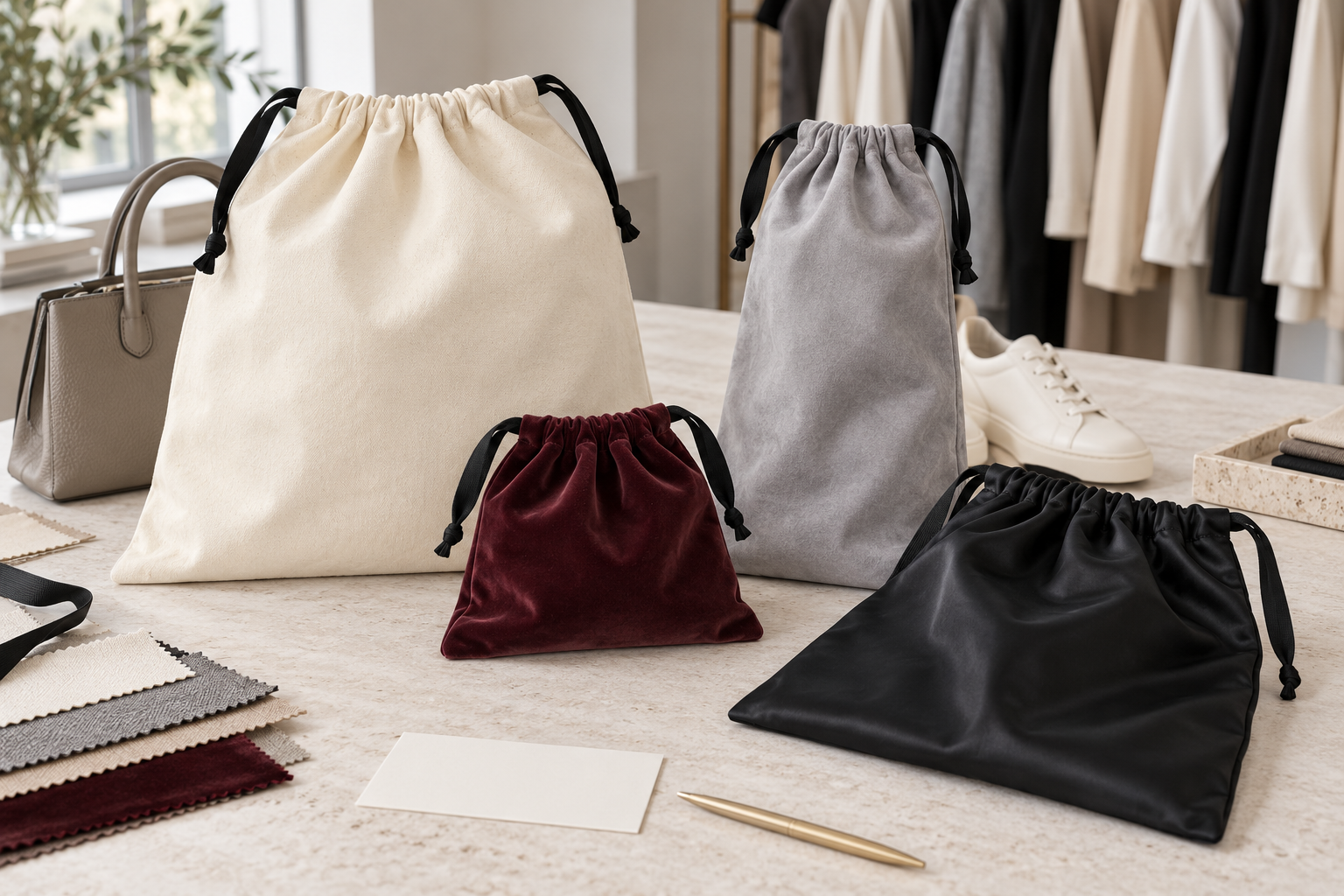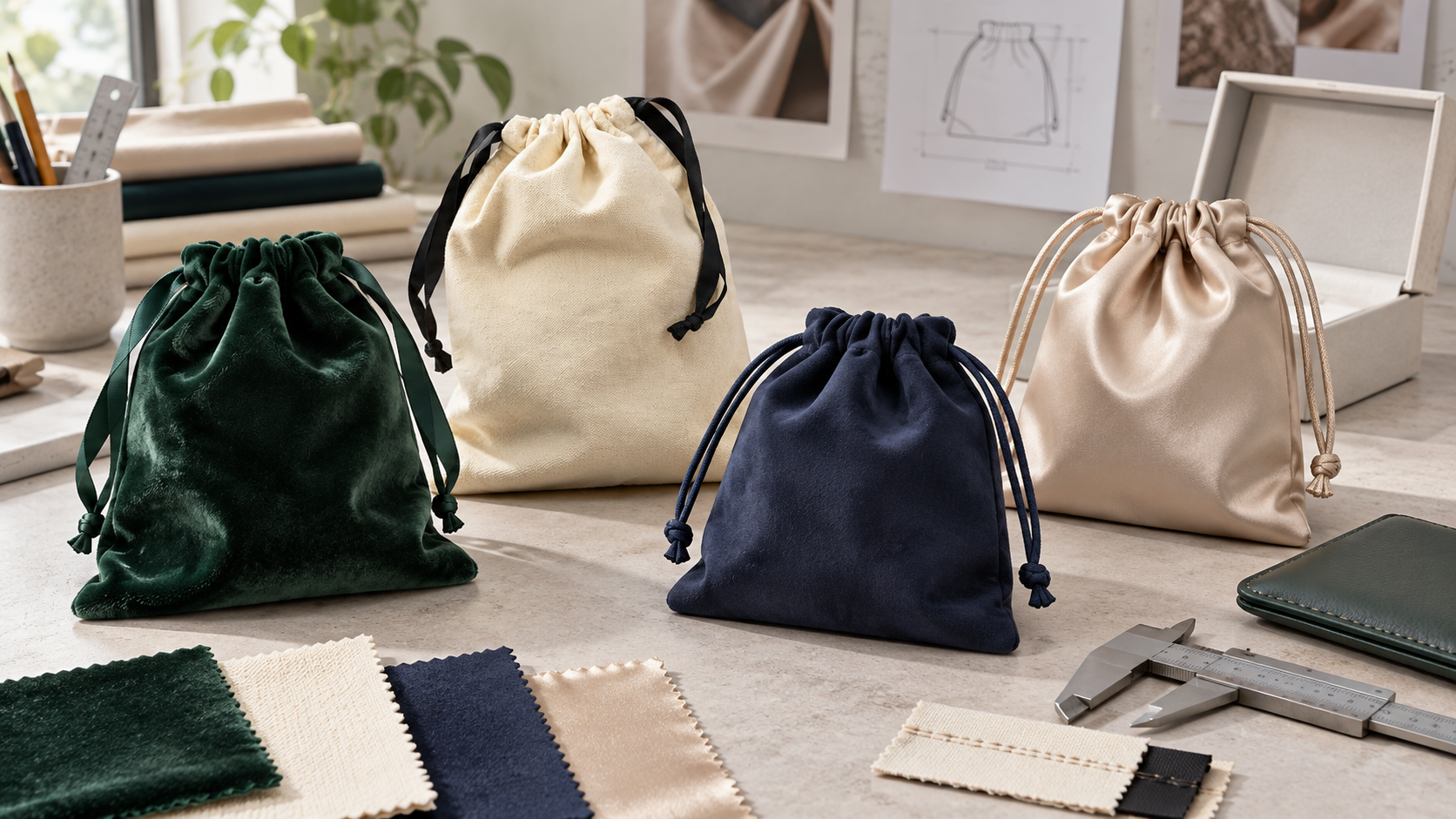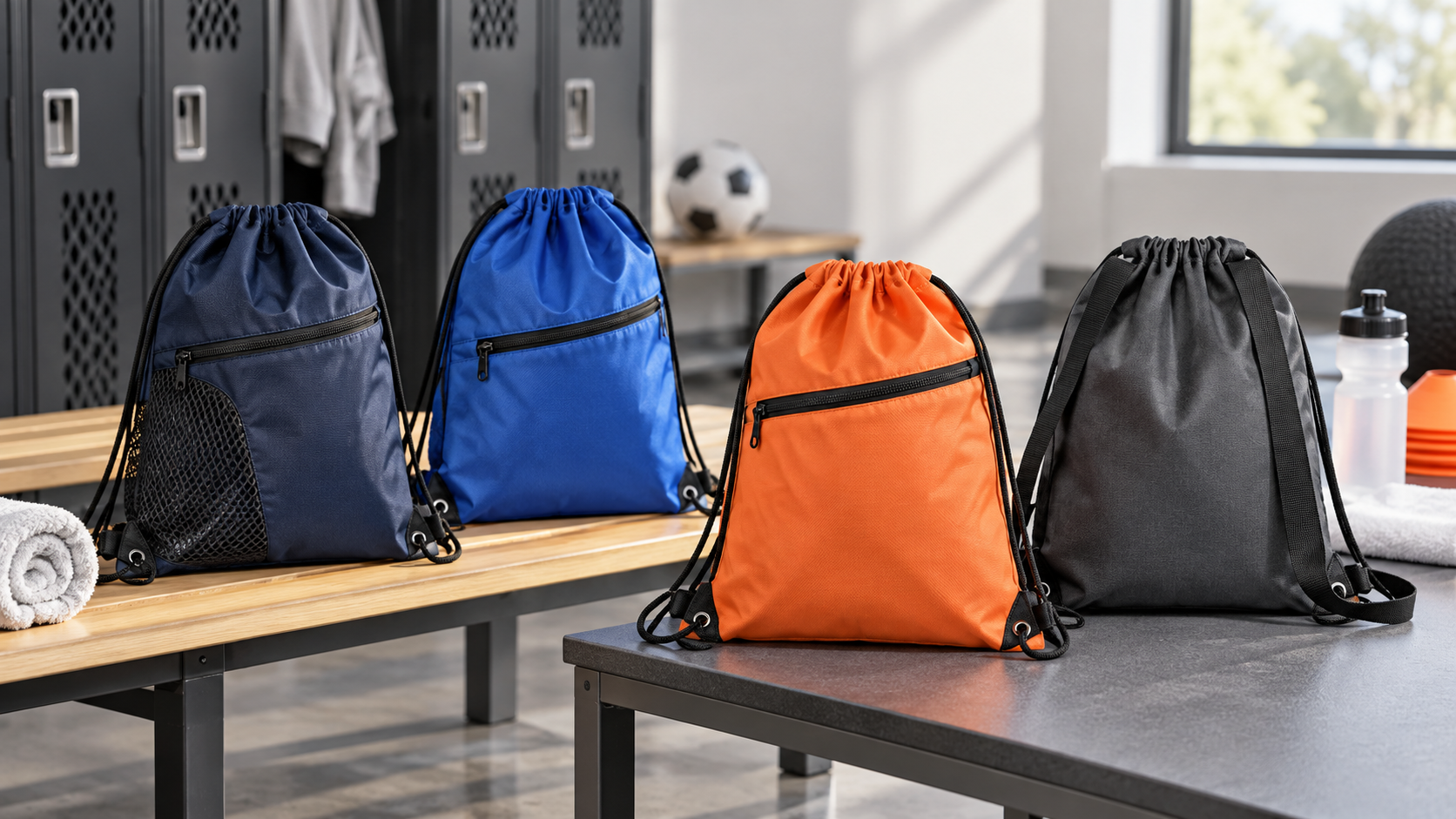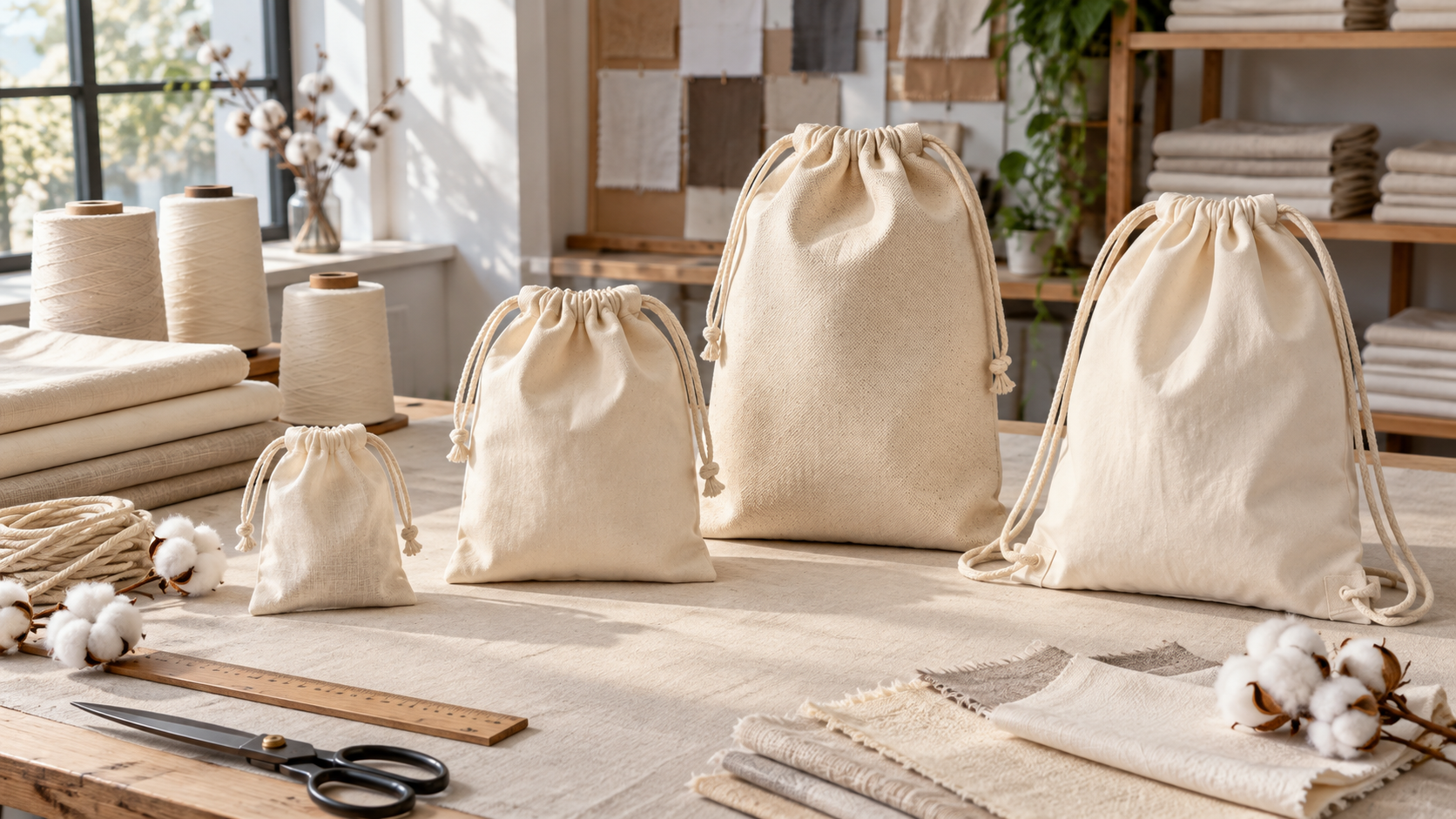
The right tote bag size starts with what a customer will carry, how the bag will sit on the body, and how the retailer will display, pack and ship it. “Medium” is not a production specification. One supplier may interpret medium as a flat 35 x 38 cm promotional bag, while another imagines a gusseted 40 x 34 x 12 cm retail tote. Both can sound reasonable and still produce very different products.
This tote bag size guide gives retail brands a practical method for defining finished width, height, gusset, handle drop and usable capacity. It also explains how dimensions affect artwork, material yield, carton size and customer comfort. If you are still selecting the factory and development model, begin with the Custom Bag Manufacturer Guide. To compare the constructions available for the examples below, browse LUCKYSTAR's custom tote bag collection.
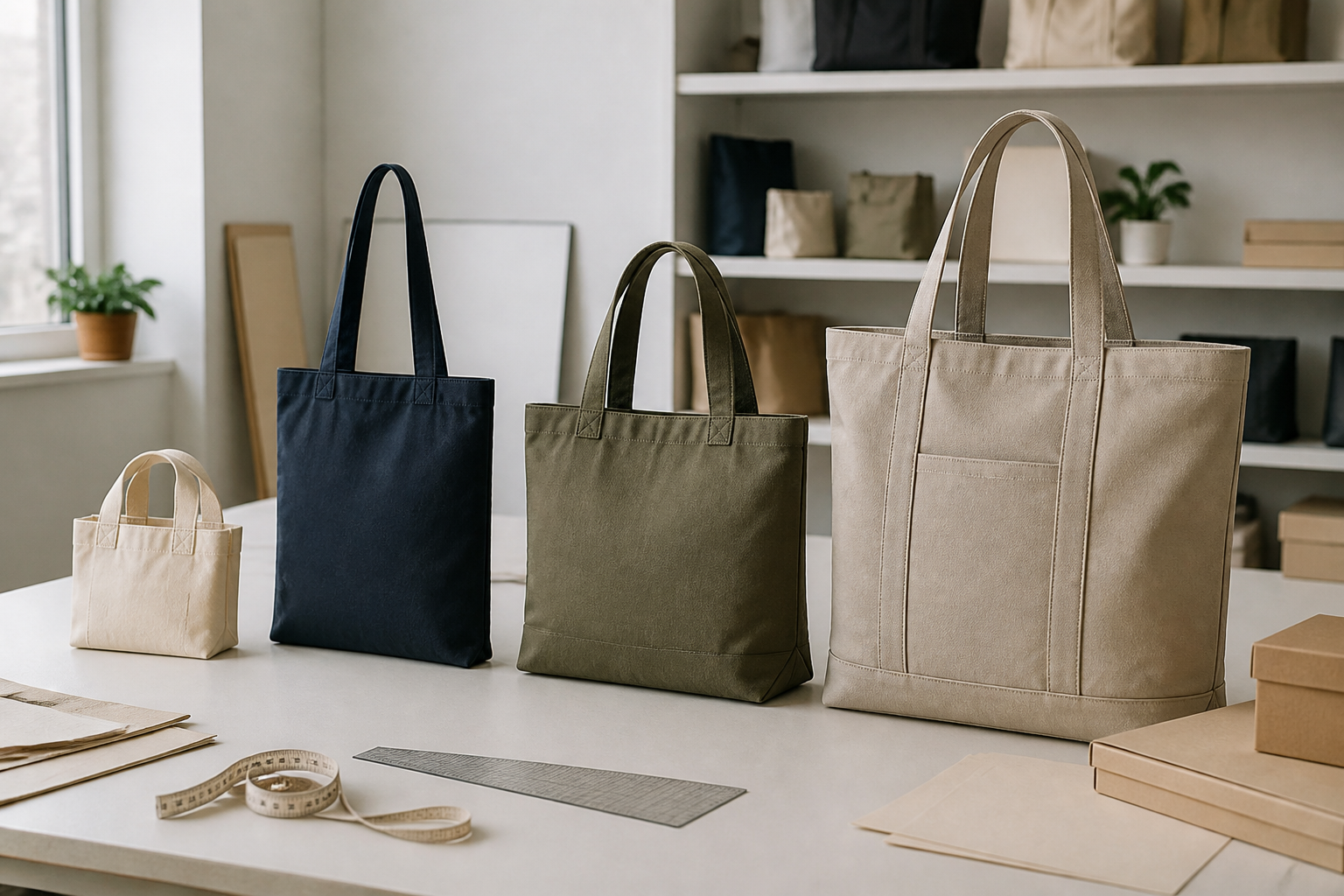
A useful size range changes proportion and function—not simply the scale of one drawing.
Need a quote-ready tote size specification? Send the largest merchandise/load set, product and opening dimensions, carry mode, target customer, finished width/height/gusset and handle convention, material and construction, artwork, quantity by size, packing, destination and required arrival date. LUCKYSTAR can return missing inputs and its own order-specific proposal.
Tote bag size guide: practical starting points
The ranges below are planning references, not universal standards or fixed LUCKYSTAR specifications. Finished dimensions should be validated against the actual merchandise and target customer. Width is measured horizontally across the bag body, height from the base to the top edge, and depth as the usable bottom or side gusset.
| Retail tote format | Indicative finished size (W x H x D) | Typical use | Main sizing risk |
|---|---|---|---|
| Mini gift tote | 20-26 x 20-25 x 7-10 cm | Beauty sets, candles, small accessories and event gifts | Opening becomes too tight for boxed products or tissue packing |
| Flat book or promotional tote | 32-38 x 36-42 cm, no constructed gusset | Books, documents, lightweight merchandise and campaigns | Large printed area suggests more capacity than the flat bag provides |
| Medium everyday retail tote | 36-42 x 32-38 x 10-15 cm | Apparel, lifestyle products, daily carry and brand merchandise | Excess depth makes the opening collapse without enough structure |
| Commuter tote | 38-44 x 30-36 x 10-14 cm | Laptop, notebook, bottle and everyday essentials | A nominal laptop size fits on paper but not through the opening |
| Large shopping or carryall tote | 42-50 x 35-44 x 15-20 cm | Grocery, bulky apparel, travel and high-volume retail use | Overloading, uncomfortable handles and expensive packed volume |
First define how the factory will measure the bag
Measurement disagreements often begin before sampling. A tapered tote may have a wider top than bottom. A boxed-corner tote can be described using a bottom depth, while another drawing shows a side gusset. Some teams state overall handle length; others state handle drop. A dimension sheet should show the measurement points directly on front, side and top views.
| Measurement | Clear definition | Common ambiguity | Better specification |
|---|---|---|---|
| Top width | Straight distance across the opening when laid flat | Assumed to equal bottom width on a tapered shape | Mark top and bottom width separately |
| Body height | Base seam or bottom fold to finished top edge | Handles accidentally included | State “excluding handles” beside the value |
| Depth/gusset | Finished usable distance across the side or base | Panel width confused with finished depth after seams | Show the finished side view and seam position |
| Handle drop | Vertical distance from top edge to the inside top of the handle | Replaced by full strap length | Specify both drop and strap width; add overall length if needed |
| Opening | Usable entry after zipper, facing, snap or inward folds | Assumed to match top width | Measure the clear opening on the approved sample |
Choose size from the merchandise, not a generic label
Retail brands should build a “load set” from the actual products or accurate mock-ups. A cosmetics carton, folded sweatshirt, hardcover book and laptop use space differently even when their external volumes are similar. Rigid items need entry clearance. Soft apparel compresses. Bottles require vertical stability. Sharp box corners can stress a light fabric or catch at the opening.
| Merchandise | Dimension that usually controls fit | Allowance to evaluate | Sample test |
|---|---|---|---|
| Folded apparel | Stack width and thickness | Natural compression plus room to remove items | Load the expected piece count without forcing the opening |
| Books and catalogues | Largest cover dimensions | Binding thickness and seam clearance | Insert the largest format and check corner stress |
| Beauty or gift boxes | Rigid box width, height and stack arrangement | Tissue, protective wrap and easy removal | Pack the complete presentation exactly as sold |
| Bottle or drinkware | Item height and base diameter | Closure clearance and upright support | Walk test with the bottle full or accurately weighted |
| Laptop or tablet | Actual device or sleeve width and height | Rounded corners, zipper opening and protective sleeve | Insert through the final closure, not only into an open body |
Width, height and gusset do different jobs
Increasing width improves access for books, folded garments and boxed goods, but a very wide flat tote can sag in the center. Increasing height contains tall objects and creates a strong logo field, yet a deep vertical bag makes small items hard to find. A gusset adds three-dimensional capacity and allows a stable base, but it also changes fabric consumption, print placement and folding.
| Dimension change | Functional benefit | Possible downside | Design response |
|---|---|---|---|
| Add body width | Fits broader products and enlarges the front panel | Bag may bow or look underfilled | Review base structure, handle spacing and intended load |
| Add body height | Contains tall products and improves retention | Poor access to items at the bottom | Add an interior pocket or reduce depth |
| Add side gusset | Creates flexible capacity and a wider opening | Side folds can interfere with artwork or closure | Set print safe areas after the sample is folded |
| Add bottom depth | Supports boxes and helps the tote stand | Base can sag under concentrated weight | Use appropriate fabric, reinforcement or a removable insert |
| Reduce top opening | Improves security and silhouette | Largest product may not pass through | Validate the clear opening with the real load set |
The material must support the chosen geometry. Our Best Fabric Weight for Custom Tote Bags guide explains why increasing size without reviewing fabric and reinforcement can produce a bag that looks correct when empty but performs poorly when loaded. If the fiber choice is still open, compare Canvas vs Cotton Tote Bags.
Handle length and drop determine how the size feels
A tote can have the right body capacity and still be uncomfortable. Short handles suit hand carry and compact gift bags. A shoulder tote needs enough drop to clear clothing and the upper arm. Longer handles improve access but let a loaded bag hang lower and can make a large body swing while walking. Strap width, spacing and reinforcement matter alongside length.
| Carry style | Indicative handle drop | Suitable body | Validation point |
|---|---|---|---|
| Hand carry | About 8-13 cm | Mini gift, cosmetics and compact retail tote | Knuckle clearance and balance when the bag is full |
| Short shoulder carry | About 20-25 cm | Medium book, shopping and merchandise tote | Fit over light and heavier seasonal clothing |
| Long shoulder carry | About 26-33 cm | Large everyday and soft carryall tote | Bag height above the knee and control while walking |
| Two-length handle set | One short and one shoulder option | Multi-use retail programs | Extra straps do not tangle, block artwork or distort the opening |
These ranges are starting points only. Target customer, clothing, body size, load and regional preference can change comfort. A fit review should include several users and the planned merchandise, not an empty sample held for a photograph.
Calculate capacity carefully
For a rectangular gusseted tote, width × height × depth gives a theoretical bounding-box volume. NIST identifies 1 litre as 1,000 cubic centimetres, so the arithmetic conversion is straightforward. The resulting number is not automatically the usable capacity of a sewn tote: seams, rounded corners, facing, lining, closure, gusset behaviour and the shape of the contents reduce or redistribute practical space. A soft flat tote has no fixed depth, so a litre claim derived from an imagined box can be misleading. State the method and validate any capacity claim with an agreed load set.
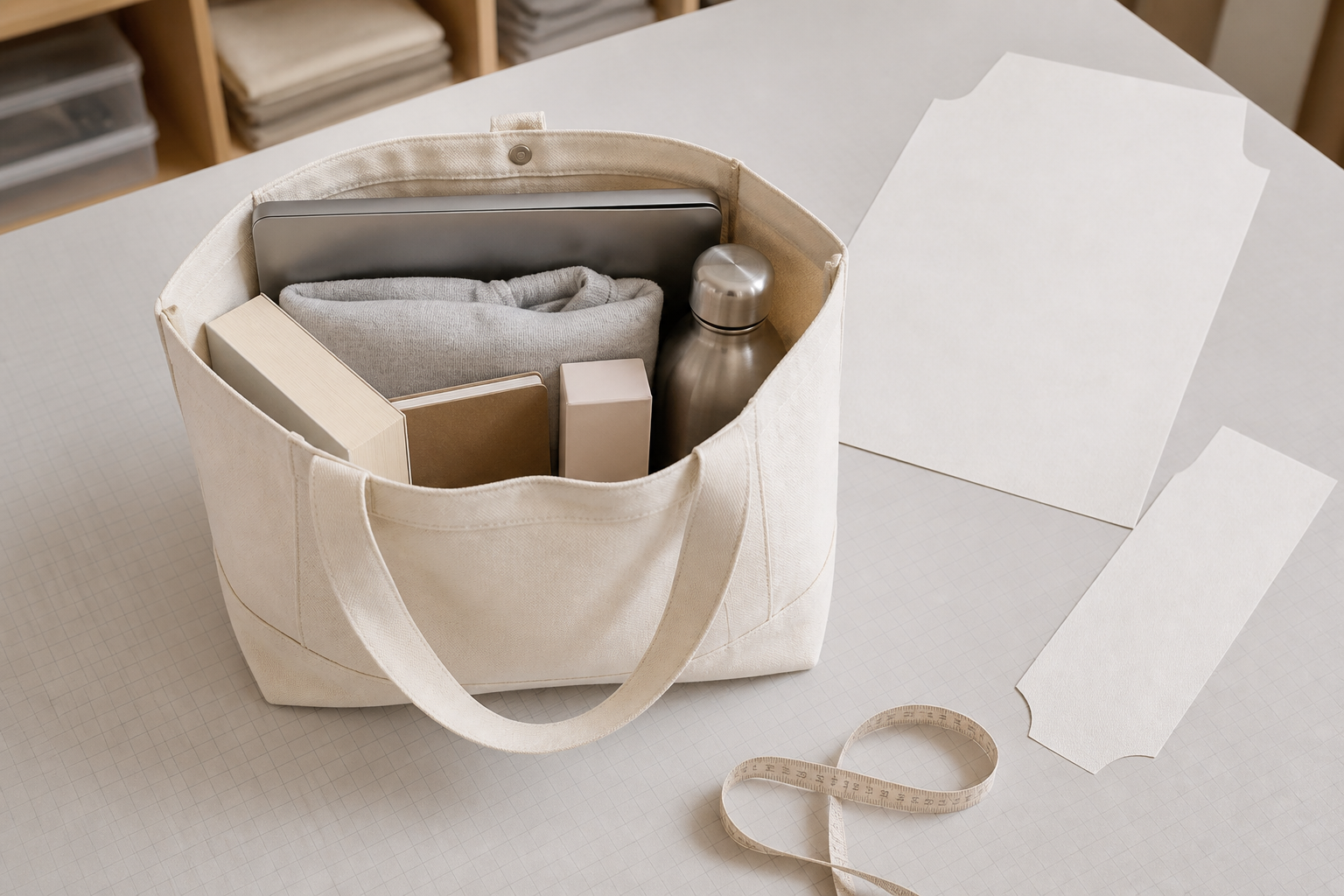
A physical load set reveals opening, clearance and balance problems that a theoretical volume cannot show.
| Capacity check | What it answers | Why a calculation is not enough | Approval method |
|---|---|---|---|
| Opening test | Can the largest product enter easily? | Zipper ends and top facing reduce access | Insert and remove the real product repeatedly |
| Loaded shape | Does the tote keep an acceptable silhouette? | Soft fabric redistributes volume | Photograph front, side and base when fully packed |
| Balance test | Does the load hang evenly from the handles? | Item weight is rarely distributed as a perfect box | Carry and set down the loaded sample |
| Closure test | Can a zipper, snap or tie close without strain? | Nominal body volume ignores closure clearance | Operate the final closure at the target load |
| Retrieval test | Can customers find and remove common items? | Tall narrow volume can hide small products | Review pocket position and hand access |
Size affects logo placement and perceived scale
Artwork should be sized against the finished front panel, not the raw cut piece. Top hems, side seams, boxed corners and bottom folds reduce the clean print area. A logo that looks balanced on a flat digital mock-up can sit too close to the base once the gusset opens, or disappear around the side when the bag is loaded.
| Artwork decision | Size-related issue | Production check | Retail check |
|---|---|---|---|
| Centered front logo | Visual center changes when the base opens | Mark placement from finished seams | View empty, filled and carried |
| Large graphic | May cross gusset folds or heavy seam zones | Create a panel map with print exclusions | Confirm no important detail wraps out of sight |
| Small premium mark | Can appear lost on an oversized tote | Approve actual-size artwork, not a zoomed screen | Review at shelf and carrying distance |
| Interior label | Deep bags can hide the label | Set distance from top edge and pocket | Check visibility when the bag is opened |
Decoration constraints also depend on process. Review Custom Tote Bag Printing Methods after the body dimensions and safe area are fixed.
Retail display, e-commerce and packaging dimensions
The customer is only one part of the size decision. A large structured tote may look impressive but occupy too much shelf depth, hang below the planned fixture or require an expensive shipping carton. A flat tote can fold compactly but may crease a large print. Packaging should protect the approved shape without creating needless freight volume.
| Commercial stage | Dimension to confirm | Failure if ignored | Practical check |
|---|---|---|---|
| Store fixture | Overall height including handles and loaded depth | Bag drags, overlaps or hides adjacent products | Place the sample on the intended hook, shelf or table |
| Stockroom | Folded size and pieces per inner/carton | Allocated storage holds fewer units than planned | Approve a packing trial and carton data |
| E-commerce parcel | Packed length, width, height and billable weight | Fulfilment cost exceeds the product margin model | Run a parcel test using the intended protective packing |
| Retail presentation | Fold lines relative to print, hardware and structure | Creased artwork or distorted opening on arrival | Open a packed sample after realistic storage time |
| Master carton | Carton volume, gross weight and stacking strength | Damage, wasted freight space or unsafe handling | Confirm carton dimensions after the final fold is approved |
Build a size family without simply scaling everything
A small, medium and large retail range should share a design language, but equal percentage scaling rarely produces three equally useful totes. Handle width may need to stay constant for comfort. A mini bag may require a proportionally wider opening for a gift box. A large bag may need more reinforcement and a shallower height-to-width ratio so it does not become difficult to carry.
| Feature | Keep consistent across sizes | Review independently | Reason |
|---|---|---|---|
| Brand identity | Material family, colors, stitch language and label style | Logo scale and vertical placement | Visual balance changes with panel area |
| Handles | Webbing quality and design character | Drop, width, spacing and reinforcement | Load and carry mode change by size |
| Closure | Common hardware finish where possible | Opening length and access | Rigid merchandise requires different entry clearance |
| Interior | Lining and trim family | Pocket count, position and size | A pocket useful in a commuter tote can crowd a mini tote |
| Structure | Overall construction quality | Base support and stress reinforcement | A larger body and load produce different forces |
Set measurement tolerances before production
Textile products are not machined components. Cutting, seams, pressing, fabric relaxation and manual handling create variation. The specification should state a target and tolerance for every critical dimension, with tighter control only where function demands it. An unrealistically tight universal tolerance can increase rejection without improving customer value.
| Critical point | Why it matters | Inspection approach | Decision to record |
|---|---|---|---|
| Body width and height | Controls product fit and visual consistency | Lay flat without stretching and use defined landmarks | Target, tolerance and conditioning method |
| Gusset/depth | Controls usable capacity and base shape | Open the bag naturally and measure the defined finished zone | Whether the value is panel, fold or usable depth |
| Handle drop | Controls comfort and symmetry | Align the top edge and measure both handles | Drop target plus left/right difference allowed |
| Handle spacing | Affects balance and logo clearance | Measure attachment points from the same centerline | Inside or center-to-center convention |
| Pocket and logo placement | Controls appearance and access | Measure from fixed finished seams | Horizontal and vertical placement tolerances |
Use the Custom Bag Quality Inspection Checklist to connect dimension checks with materials, workmanship, function and packing.
Sample approval checklist for tote dimensions
- Confirm whether the drawing uses centimetres or inches and finished—not cut—dimensions.
- Measure top width, bottom width, height, gusset, clear opening and handle drop from defined points.
- Load the exact product assortment and operate the closure without forcing it.
- Test hand and shoulder carry with representative users and realistic clothing.
- Review the bag empty, fully loaded, carried, placed on a counter and displayed on the retail fixture.
- Check logo and label position after the gusset opens and after the bag is folded for packing.
- Approve the final packing method, folded size, carton quantity and carton dimensions.
- Record every critical target and tolerance in the signed production specification.
A photo with arrows is useful, but it is not the whole production reference. The Custom Bag Sample Development Process shows how comments should move from prototype to an approved sample and controlled specification.
How size changes cost, MOQ and lead time
Larger dimensions normally use more fabric, but price does not rise in a simple straight line. A slightly wider panel may reduce cutting yield across the fabric width. A deeper gusset adds seams and can require stronger packing. A large structured tote may use reinforcement that a flat bag does not need. Size variants can also behave like separate styles if they require different patterns, closures or handle constructions.
| Commercial factor | How size affects it | Question to ask |
|---|---|---|
| Material yield | Panel width and height change how pieces nest across a roll | Does this dimension cross a fabric-yield threshold? |
| Sewing | Longer seams and added structure increase operation time | Which feature—not just area—adds the most work? |
| MOQ | Each size can require a separate cutting and production lot | Can sizes share fabric and decoration setup within the order? |
| Packing | Folded size and stiffness affect pieces per carton | What are the confirmed packed and carton dimensions? |
| Timeline | More size samples and load tests add approval steps | Which size is the master construction and when are all variants approved? |
For budgeting, see How Much Do Custom Tote Bags Cost?. For quantity splits across a size family, use the Custom Tote Bag MOQ Guide.
Company-claim boundary: the following section is LUCKYSTAR publisher self-description and a commercial service proposal. It is not independent proof of factory ownership, material or capacity availability, universal fit, ergonomic performance, sample or bulk quality, MOQ, price or delivery. Legal seller, nominated production sites, materials, dimensions, tolerances, samples, tests, packing and schedule depend on the exact order and written confirmation.
How LUCKYSTAR describes its retail tote sizing review
LUCKYSTAR states that it can review a retailer’s merchandise and operating constraints and prepare an order-specific proposal connecting size, construction, artwork, sampling and packout.
- Start with the load: record the largest items, arrangement, protective packing, weight distribution, insertion direction and retrieval needs.
- Define measurement: show top and bottom width, finished body height, gusset or fold, opening, handle length/drop and reference points.
- Validate fit: check merchandise entry, closure, carry comfort, balance, silhouette, fixture, fold and final carton with production-equivalent materials.
- Control artwork: approve safe zones and placement after gussets, seams, pockets and closures are represented.
- Release each size: specify targets, tolerances, sample identity, quantity matrix, packing and reapproval triggers separately for every SKU.
Review the custom tote bag range and sample-development guide, then send the load set and measurement drawing for an order-specific response.
Frequently asked questions
What is the most common retail tote bag size?
The 36-42 cm width, 32-38 cm height and 10-15 cm depth shown above is this guide’s editorial planning reference for a medium gusseted retail tote. It is not a universal standard, market-sales statistic or fixed supplier size. Apparel, books, beauty boxes and laptops require different proportions, opening clearance, construction and load validation.
How are tote bag dimensions written?
They are commonly written as width x height x depth or gusset. The specification should define top and bottom width separately when the bag tapers, state that body height excludes handles, and show exactly how depth and handle drop are measured.
What handle drop works for a shoulder tote?
This guide uses 20-25 cm as an editorial starting range for a shorter shoulder drop and 26-33 cm for a longer drop. These are not ergonomic standards. Comfort and access depend on body size, clothing, tote height, handle width, attachment spacing and load, so representative users should test the filled production-equivalent sample.
How much clearance should I add around a boxed product?
There is no safe universal allowance because fabric thickness, opening construction, packing material and the direction of insertion all matter. Use an accurate box mock-up, add the intended tissue or protection, and test entry and removal through the final closure.
Should a laptop tote match the advertised laptop screen size?
No. Screen size is diagonal and does not define the device's external width or height. Specify the actual laptop or sleeve dimensions, then confirm that it passes through the finished opening and sits without pressing the zipper or corners.
Can one pattern be scaled into three retail sizes?
It can provide a visual starting point, but each size should be reviewed independently. Handle drop, pocket usefulness, opening, reinforcement, logo scale and packed dimensions may need different adjustments.
When should final carton dimensions be confirmed?
After the final bag construction, folding method, individual packing and carton quantity are approved. Early carton estimates are useful for budgeting, but structured material, handles and protective packing can change the actual volume.
Turn the merchandise load into a measurable tote specification
Connect the actual products to defined finished landmarks, opening and closure clearance, handle geometry, load and carry trials, artwork safe zones, size-specific tolerances and final packout.

Review LUCKYSTAR custom tote bag options, then send the load set and size brief through the contact form or Email a project brief. The email link opens a prefilled draft for your review before sending.
Legal seller and facility, material and capacity availability, dimensions, fit, tolerances, samples, tests, price, MOQ, packing, schedule and delivery terms are subject to current evidence, final specification, contract and written confirmation.