Top 10 Shopping Bag Manufacturers in the USA in 2026
Last reviewed: September 16, 2026
For a US retail shopping-bag program, start with the bag that must work at the checkout: the products it holds, how staff open and pack it, the appearance customers expect, and how stores replenish it. Only then decide whether the supplier needs paper-converting equipment, textile sewing, nonwoven conversion or film-bag production.
Our 2026 shortlist includes American Paper Bag, Novolex/Duro, ProAmpac, Ross & Wallace, Fischer Paper Products, Enviro-Tote, Unionwear, Bagmasters, Universal Plastic and Excellent Poly. Each has an official description of a relevant US manufacturing operation or US-made shopping-bag offering. Those descriptions do not establish domestic origin for every item in their catalogs.
This guide gives priority to retail paper carriers, grocery carryout and merchandise bags, then covers reusable and film alternatives. Buyers focused specifically on sewn promotional totes can also consult our USA tote-bag manufacturer comparison.
Editorial disclosure and review date: LUCKYSTAR publishes this commercial buying guide. Company information was reviewed on September 7, 2026 using official manufacturer pages. The numbered list reflects product fit and the evidence available to a purchasing team; it is not an audited quality league table or the result of comparative purchase orders. LUCKYSTAR is based in Ningbo, China and appears separately as an import sourcing option for American buyers.
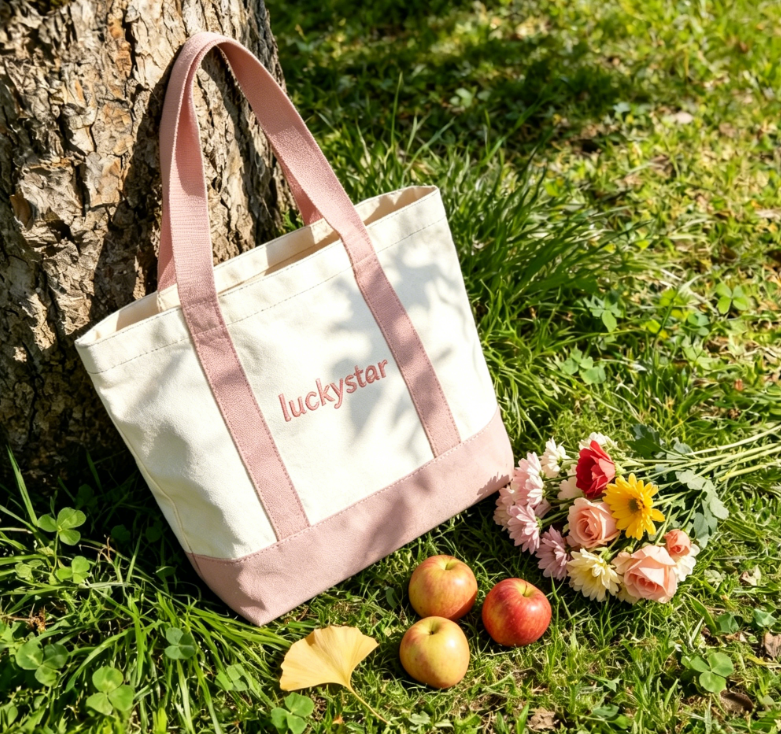
A cream-and-pink LUCKYSTAR tote shown on our Alibaba company channel. Product photos in this article illustrate LUCKYSTAR sourcing options, not products or factories belonging to the ten US companies.
Need a US retail bag program compared on origin, specification and delivered cost? Send the intended checkout use, destination states, origin or domestic-processing requirement, dimensions, material, handles, artwork, quantity by SKU, testing, case pack, delivery point and required date. LUCKYSTAR can prepare an import-route proposal and a comparison-ready specification; a requirement for substantiated US manufacture must be quoted through a verified domestic route.
Page role: This page is responsible for U.S. shopping bag manufacturing, domestic-processing evidence and American retail-program fit. Compare other sourcing regions in the worldwide shopping bag manufacturer guide, then use the custom shopping bag collection for an international custom route.
The USA shopping-bag shortlist at a glance
Use the table to identify the appropriate material group before requesting prices. The first five companies address paper converting and carryout applications. The remaining entries cover sewn, nonwoven and film shopping bags.
| No. | Company | Relevant US manufacturing evidence | Shopping-bag focus | Purchasing fit |
|---|---|---|---|---|
| 1 | American Paper Bag | Paper-bag production identified in Pennsylvania and Nevada | Custom paper retail carriers | Distinctive shape, handles and printed presentation |
| 2 | Novolex / Duro | Multiple US Duro facilities; the group also lists Mexico | Paper shoppers, merchandise and grocery bags | Replenishment programs with several paper formats |
| 3 | ProAmpac | Shopping-bag page identifies US production facilities | Printed kraft and white-paper carriers | Retail, grocery and broader packaging procurement |
| 4 | Ross & Wallace | Company states production occurs in Hammond in Louisiana | Grocery sacks and merchandise paper bags | Functional carryout and checkout supply |
| 5 | Fischer Paper Products | Company describes US manufacturing and printing | Handle bags and foodservice/retail paper bags | Branded carryout through eligible trade channels |
| 6 | Enviro-Tote | Cutting, sewing and printing in New Hampshire | Reusable textile totes | Merchandise and repeat-use retail bags |
| 7 | Unionwear | Manufacturing described in Newark in New Jersey | Custom sewn and printed totes | Union purchasing and branded merchandise |
| 8 | Bagmasters | Selected shopper SKU states US manufacture using imported fabric | Nonwoven grocery shoppers within a mixed catalog | Buyers selecting a documented domestic-conversion item |
| 9 | Universal Plastic | California manufacturing facility described | Custom poly shopping and trade-show bags | Film carriers for permitted uses and destinations |
| 10 | Excellent Poly | Company states its products are manufactured in the USA | Printed die-cut handle film bags | Larger customized film-bag programs |
Sources and the limitations of each production statement are linked in the individual profiles below. Confirm the quoted SKU, plant, buying channel and availability directly before committing.
What qualified a company for inclusion
We looked for three essentials: an official shopping or carryout bag offering, identifiable US manufacturing activity, and enough product information to form a useful sourcing question; a supplier offering only a US sales address without manufacturing evidence did not qualify.
There are no invented numerical scores. Ordering favors the paper and checkout applications central to this guide, followed by reusable and film specialists. Within those groups, fit depends on the actual brief.
| Selection question | Evidence used in this guide | Evidence still needed for an order |
|---|---|---|
| Does it make a relevant shopping bag? | Product pages and current catalogs | A quoted SKU and representative sample |
| Is US manufacturing described? | Official process or facility statements | Assigned plant and order-specific origin confirmation |
| Can it support branding? | Stated printing, size or construction options | Artwork feasibility and decorated sample approval |
| Is the commercial route suitable? | Direct inquiry, distributor or catalog information | Minimums, account eligibility and delivery terms |
| Does the construction suit the store? | Material, handle and format information | Packing trials and acceptance criteria |
For the broader supplier relationship, our Custom Bag Manufacturer guide explains how development, manufacture and sourcing responsibilities can be organized. The companion shopping-bag manufacturer selection guide helps translate that understanding into supplier interviews.
1. American Paper Bag: custom retail paper carriers
American Paper Bag identifies manufacturing in Sugar Notch, Pennsylvania and Reno, Nevada. Its paper-bag offering includes customized shapes and dimensions, flat-paper, twisted-paper and die-cut handles, and water-based flexographic printing with up to eight colors. Interior printing and closure features also appear on its official paper-bag page.
When to shortlist it
Consider this route when the carrier is part of the retail identity and the structure needs to fit a specific product assortment. A bag for boxed cosmetics requires a different base and opening from a carrier for folded clothing.
What to settle in the RFQ
Request a structural sample that can hold the intended contents. Confirm the assigned plant, paper specification, handle configuration, print coverage, finish and packed-case dimensions. Have store staff test loading and carrying before approving a visually attractive design.
2. Novolex / Duro: paper formats for repeat replenishment
Duro is counted here within Novolex. The group's 2026 paper-bag catalog covers handle shoppers, merchandise bags and grocery/SOS formats, with different printing routes. Its facility list identifies several US Duro operations as well as Rio Bravo, Mexico. Buyers requiring US manufacture should therefore identify the actual plant and product.
When to shortlist it
This is a relevant starting point for a chain that needs a family of paper bags across departments or store sizes. Standardization can simplify replenishment when the assortment is mapped to the right bag sizes.
What to settle in the RFQ
Separate stock sizes from custom-converted items and identify the printing process for each. Ask how substitutions are controlled, whether different plants may supply the same SKU, and how changes in paper shade, case count or print appearance are communicated.
3. ProAmpac: paper shopping bags within a packaging program
ProAmpac's paper shopping-bag range identifies several US production facilities and offers natural-kraft or bleached-white constructions, multiple handles, printing up to eight colors and UV coating. Its stated applications include specialty retail, grocery, delivery and foodservice.
When to shortlist it
Consider ProAmpac when shopping bags sit inside a wider packaging procurement brief. The evaluation should still be specific to the carrier: expertise elsewhere in a group's portfolio does not establish suitability for a particular bag.
What to settle in the RFQ
Request paper weight and grade, the selected handle, gusset dimensions, printing and coating details, and a trial case. If the proposed bag carries recycled-content or certification wording, ask for documentation that supports that exact construction and order.
4. Ross & Wallace: practical grocery and merchandise bags
Ross & Wallace Paper Products states that its products are manufactured at its Hammond, Louisiana facility. The range includes SOS grocery bags and sacks, heavy-duty bags and merchandise bags, with custom printing offered for grocery and merchandise formats.
When to shortlist it
The product emphasis fits functional carryout and routine replenishment. This can be useful where a reliable pack size and practical checkout operation matter more than elaborate finishes.
What to settle in the RFQ
Confirm whether the exact structure requires handles and whether they are offered. Ask how the bag opens from the packed stack, how its base supports the basket, and whether the chosen paper and printing suit the contents. A grocery sack and a premium rope-handle carrier should be evaluated as different products.
5. Fischer Paper Products: branded carryout through trade channels
Fischer describes US manufacturing and printing and traces its production history to Antioch, Illinois. Its product range includes handle bags and custom paper formats, with graphic support for branding. Its company information also explains a commercial route involving eligible resale businesses and distributors.
When to shortlist it
Food-led retailers, bakeries and cafes may find this range relevant when the shopping bag connects retail presentation with takeaway service.
What to settle in the RFQ
Establish account eligibility or the appropriate distributor early. Then define how the bag will be used: a carrier holding wrapped products is different from packaging that directly contacts food. Request the paper, handle, print, intended-use documentation and distribution arrangement needed for the application.
6. Enviro-Tote: reusable bags with a documented domestic sewing route
Enviro-Tote describes cutting, stitching and screen printing at its Londonderry, New Hampshire plant. Its manufacturing overview discusses custom sizes and several textile options. It says most fabric is domestically sourced, which leaves the origin of a particular fabric or component to be confirmed.
When to shortlist it
This route is relevant to museum shops, bookstores and retail programs selling or distributing a bag for continued use. The brief often involves hand feel, useful proportions and decoration that suits the fabric.
What to settle in the RFQ
Verify the selected material's origin and composition, handle length, usable print area and care instructions. Test the finished bag with a realistic load. For a reuse proposition, agree on durability evaluation using our reusable shopping-bag testing guide.
7. Unionwear: sewn totes for union and merchandise programs
Unionwear describes manufacturing in Newark, New Jersey in its company story. Its bag range includes configurable sewn totes. A printed strap-and-pocket tote, for example, shows a gusseted base, printed handles, an adjustable strap and a zipper pocket.
When to shortlist it
Consider Unionwear when union procurement, a specific decoration treatment or a more developed merchandise bag is important to the brief.
What to settle in the RFQ
Confirm the union-label requirement, exact style, fabric and trim origins, decoration method and sales channel. A statement about US sewing does not by itself establish domestic origin for every component. Request a production sample in the intended material before committing to the print layout.
8. Bagmasters: selected domestic shoppers within a mixed catalog
Bagmasters offers a useful example of why origin must be checked by SKU. Its Grocery Shopper Tote Bag, item 1099-74, is described as made in the USA using imported fabric. The listed construction is a gusseted nonwoven-polypropylene shopper with reinforced handles. The broader catalog should be evaluated separately.
When to shortlist it
This route can suit buyers whose brief matches an existing shopper structure and who prefer catalog ordering over developing every structural detail from scratch.
What to settle in the RFQ
Identify which dimensions and components are fixed and which can change. Ask for the current minimum, decoration area, production schedule and origin statement. Confirm that an alternative color or substitute SKU carries the same substantiated origin description.
9. Universal Plastic: custom film shopping bags
Universal Plastic describes a California manufacturing facility and custom poly-bag production, including printed shopping and trade-show bags. Its company contact information identifies Ontario, California.
When to shortlist it
Consider a film specialist when the selected material is suitable and permitted for the destination and use. A merchandise carrier, event bag and regulated checkout bag may fall under different requirements.
What to settle in the RFQ
Specify resin construction, thickness, handle opening, reinforcement, gusset, seals, print and packing. Confirm the actual manufacturing location and evaluate the intended use against current state and local rules. A US manufacturing location does not establish permission to supply every retail checkout application.
10. Excellent Poly: larger printed handle-bag orders
Excellent Poly states that its products are manufactured entirely in the USA. Its die-cut handle bag page describes polyethylene/coextruded constructions, optional bottom gussets and custom printing. The company overview provides the manufacturing statement; buyers should request the current assigned facility address.
When to shortlist it
The product route is relevant to larger retail, event and promotional film-bag programs where specification and print setup can be planned in advance.
What to settle in the RFQ
Confirm the current quantity threshold and production window rather than treating website terms as permanent. Request a sample with the intended handle geometry, thickness and print coverage. Review local bag restrictions before allocating the style to a multi-state store rollout.
Match the supplier to the job at the checkout
A useful shortlist usually contains two or three comparable production routes. Sending the same vague request to ten very different companies produces quotations that are difficult to interpret.
| Store requirement | Material or production route to investigate | Trial that reveals suitability | Purchasing implication |
|---|---|---|---|
| Everyday merchandise carryout | Paper merchandise bag or handled paper carrier | Pack the normal basket; check opening, base and carrying | Standardize sizes around actual sales baskets |
| Grocery or prepared-order collection | Appropriately specified grocery/carryout paper bag | Test a full order, container stability and handling | Define store pack quantities and replenishment frequency |
| Premium branded presentation | Custom printed paper carrier | Review structure, finish and rubbing between packed bags | Approve physical samples and protective packing |
| Reusable retail merchandise | Sewn textile or suitable reusable construction | Assess comfort plus seam/handle performance and care | Plan performance requirements and customer instructions |
| Promotional event or trade-show carry | Approved film, nonwoven or textile format | Test intended load and print appearance after carrying | Confirm the rules for that venue, use and destination |
For artwork acceptance, use a focused shopping-bag printing checklist.Keep the full bag quality checklist for dimensions, construction, packing and functional acceptance.
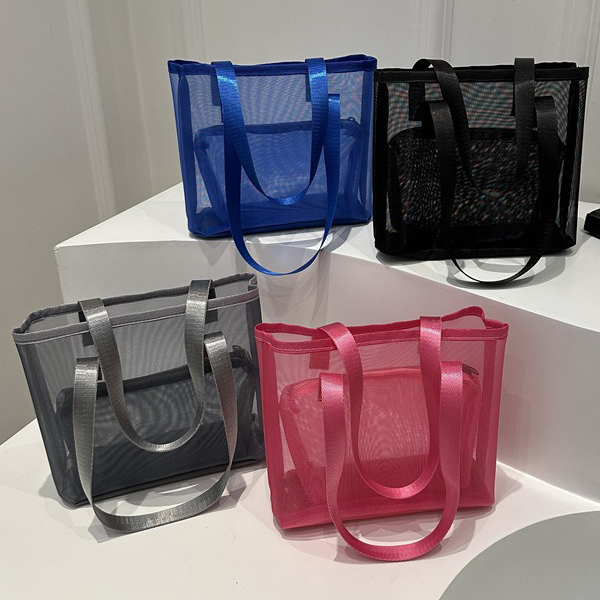
Mesh shopping-bag examples from LUCKYSTAR's Alibaba channel. Review handle attachment, usable capacity and the intended contents; a photograph does not establish load capacity or material composition.
What “Made in USA” establishes—and what buyers must still check
The FTC explains that an unqualified US-origin claim requires US final assembly or final processing, all significant processing in the United States, and all or virtually all domestic components and ingredients. Qualified claims can describe a more limited US contribution when they are truthful and supported.
A US warehouse or local printing operation alone is insufficient evidence for an unqualified claim. See the FTC's Made in USA guidance.
Ask the supplier for the wording it can substantiate on the quoted item. Keep three questions separate in the approval record: where the bag is made, where its important inputs originate, and what wording may appear on the product or marketing page.
| Supplier statement | What it tells the buyer | Next verification step |
|---|---|---|
| “We are a US company” | Corporate or commercial presence | Identify the manufacturing site for the quoted item |
| “Printed in the USA” | Location of a decoration step | Establish where the undecorated bag was made |
| “Made in the USA of imported fabric” | A qualified production description | Match the statement to the exact SKU and evidence |
| “Made in USA” without qualification | A broad origin claim | Request substantiation supporting that wording |
| “Ships from a US warehouse” | Stock or dispatch location | Check origin, inventory ownership and substitution rules |
These checks should happen before artwork is frozen. Changing an unsupported origin statement after printing can create an avoidable replacement or rework problem.
US checkout rules can change the material decision
California illustrates why retail location belongs in the RFQ. From January 1, 2026, covered stores generally may provide only compliant recycled-paper carryout bags at the point of sale, subject to the law's definitions and exclusions; customers may bring reusable bags. This is not a universal prohibition on every plastic bag in every setting. The paper requirement moves to at least 50% postconsumer recycled material in 2028. Check the current CalRecycle bag requirements for the intended store and use.
For a multi-state program, have the buyer's compliance team approve a destination matrix before purchasing. Record store category, bag function, required materials and markings, fee treatment where relevant, and the date of review. Reconfirm the applicable state and local requirements before rollout. This guide provides sourcing context rather than a nationwide legal determination.
Domestic production, US stock or direct import?
These are different purchasing choices, and some companies offer more than one. A domestic factory can have a queue; an imported bag can be immediately available from stock; a fully custom import can require advance development and transport planning. Ask for the actual schedule and availability behind the quote.
| Sourcing route | Why a retailer might choose it | Key limitation to resolve | Best comparison basis |
|---|---|---|---|
| US custom manufacture | Required origin, accessible production coordination or regional replenishment | Available materials, conversion minimum and factory schedule | Finished specification, delivered price and documented origin |
| US stock plus decoration | Existing inventory and a familiar structure | Limited changes to size, handles and material | Confirmed stock, imprint scope and release date |
| Direct overseas custom supply | Wider development brief across materials and structures | Import responsibility, transit, order planning and landed cost | Same acceptance specification and receiving location |
| Combined domestic and import program | Separate routine checkout and planned merchandise requirements | SKU ownership plus duplicate inventory and different lead-time calendars | Service requirement and cost by SKU rather than one blended price |
A two-route program can be practical: one bag handles daily checkout while another serves a planned reusable merchandise campaign. Evaluate both with a clear business purpose; do not substitute one for the other solely because it carries the same logo.
Readers comparing international production can use our worldwide shopping-bag shortlist and China shopping-bag manufacturer guide.
Company-claim and route boundary: the following LUCKYSTAR section is publisher self-description and a commercial alternative for international custom supply. LUCKYSTAR is not presented as one of the ten US manufacturers and does not claim a US factory or blanket US-origin, certification, material, performance, MOQ, capacity or delivery status across its range. A project requiring US manufacture must use a separately verified domestic offering. Any LUCKYSTAR proposal is subject to the exact order, assigned production route, evidence, samples, inspection plan, destination rules, final specification and written confirmation.
Why US buyers may choose LUCKYSTAR
LUCKYSTAR offers a China-based custom development and supply route for buyers able to import. The website's entity is Ningbo Luckystar Commodities Co., Ltd. Our shopping-bag collection includes canvas, jute, mesh, transparent and reusable formats that can serve as starting points for a project brief.
One discussion across product and packaging choices
Our OEM/ODM services include design- and sample-based customization across bags and packaging. This is useful when a buyer is still deciding on structure, material, handles, decoration or related packaging. Available options, samples and the assigned production route are confirmed for the order.
A specification that can be sampled and inspected
A request such as “premium reusable bag for our US stores” leaves too much unresolved. LUCKYSTAR can coordinate a more usable brief covering dimensions, material, artwork, handles, packing and tests. Share the fields in our shopping-bag tech-pack guide so the proposal can be reviewed against a common reference.
Practical preparation for import and reorders
American buyers need the shipment to match their warehouse and store operations. Discuss carton quantities, labels, destination, delivery basis and required arrival date during development. Use our shopping-bag import guide to frame responsibilities, and the reorder color and logo guide to maintain approved references between runs.
LUCKYSTAR is appropriate when this development and coordination model suits the brief. An order requiring substantiated US manufacture should use a verified domestic offering. We do not claim a US factory or blanket certification across our range. MOQ, samples, test documentation, facilities, price and timing remain subject to specification and written confirmation.
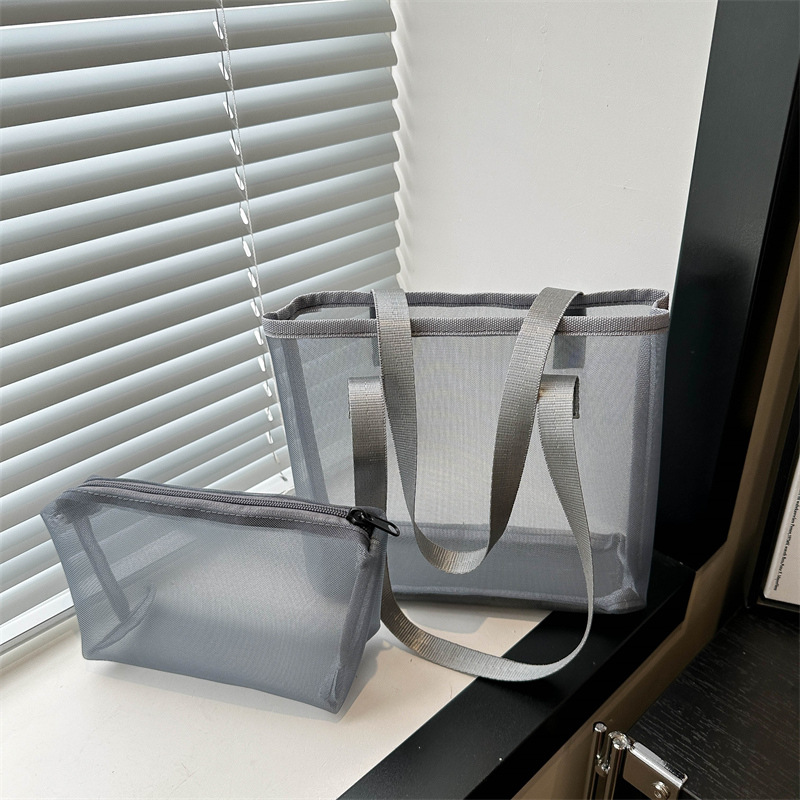
A gray mesh shopper with a matching zippered pouch, shown on LUCKYSTAR's Alibaba channel. A coordinated bag-and-pouch concept can be discussed in the same development brief; specifications and availability require written confirmation.
Compare quotations by usable bags delivered to the store
Unit price is only useful after quotations describe equivalent products and delivery obligations. For a store program, also consider the cost of rejected goods, oversized cartons and a bag that forces staff to double-bag ordinary purchases.
| Quote field | What to normalize | Why it matters in retail |
|---|---|---|
| Size and capacity | Measured width, height, gusset and handle drop | Determines which products fit and how customers carry them |
| Material specification | Paper grade/weight or fabric/film specification, plus relevant tolerances | Prevents an apparently cheaper alternative changing the product |
| Printing | Coverage, colors, faces, process and setup charges | Makes branding costs comparable |
| Quantity | Bags per SKU, design and release; overrun/underrun terms | Separates order minimum from store consumption |
| Quality and tests | Acceptance method, performance checks and inspection responsibility | Defines what counts as deliverable stock |
| Cartons | Pieces per carton, external dimensions, gross weight and labeling | Affects freight and storage as well as staff handling |
| Delivery | Named destination, Incoterm where applicable, freight and import responsibilities | Establishes the actual cost to the receiving point |
| Replenishment | Production lead time, stock ownership and reorder trigger | Reduces the risk of a checkout stockout |
Compare two quotations on that basis before requesting savings. Our shopping-bag cost guide discusses specification changes that can be evaluated without losing control of the finished item.
Run a store trial before approving a chain-wide order
Use a representative assortment of purchases and the actual packing space. Ask staff to open bags, load products, carry them and put them back into storage. Include the product combinations that expose weaknesses: a wide carton, a concentrated load, awkward corners or multiple packages with an unstable stack.
Record whether the opening stays accessible, the base remains stable, handles are comfortable and the print rubs against neighboring bags. Compare usable bags per shelf or drawer, rather than only bags per shipping carton.
Choose acceptance criteria before the trial. A paper bag may need a different handling and moisture test from a textile bag; reusable bags may need cleaning and repeated-carry evaluation.
A satisfactory store trial complements material and laboratory checks where required.
Keep environmental claims tied to the purchased SKU
Ask for the evidence behind the exact claim being considered: fiber or polymer composition, recycled percentage and its calculation basis, a current certificate where applicable, and the relationship between the documents and the shipment. A certification for an input or facility does not automatically cover the finished shopping bag.
Use our recycled-content verification guide when that attribute is part of the brief. For LUCKYSTAR, certifications and environmental wording must be reviewed against the specific supply route and order; historical or upstream documents are not presented as current company-wide credentials.
Frequently asked questions
Which US manufacturer should I contact first for printed paper shopping bags?
Start with a paper-focused candidate whose products match your application. American Paper Bag, Novolex/Duro and ProAmpac offer relevant paper carrier routes; Ross & Wallace and Fischer add practical grocery, merchandise and carryout options. Ask two or three suitable candidates to quote the same brief.
Are all products from these ten companies made in the USA?
No. The list identifies documented US manufacturing offerings. Origin may differ by product and facility, and some catalogs combine domestic and imported items. Obtain confirmation for the quoted SKU, including component origins when they affect the intended claim.
Is LUCKYSTAR one of the ten US manufacturers?
No. LUCKYSTAR is a China-based supply partner and is discussed separately for American buyers evaluating imports. This distinction allows a retailer to compare sourcing choices without confusing supplier market coverage with manufacturing origin.
Can a bag printed in America be labeled Made in USA?
Printing location alone does not establish the bag's origin. Review the bag's manufacturing and component evidence and choose a supported statement using the FTC guidance linked above. Get qualified advice when the intended label requires interpretation.
Is a reusable bag always suitable for checkout distribution?
No. Suitability depends on the store, destination rules and product function as well as performance. A bag sold as merchandise or brought by a customer can be treated differently from one provided at checkout. Confirm the intended use before selecting material.
Is buying from a US company faster than importing?
It can be, but the useful comparison is the actual order schedule. Confirm stock availability, artwork approval, materials, production queue, shipping and receiving requirements. A supplier's location alone does not establish the delivery date.
Can I buy directly from every manufacturer on the list?
Buying channels vary. Some accept project inquiries, some use distributors or resale accounts, and some offer catalog ordering. Confirm the commercial route before spending time on a detailed quotation request.
What minimum order should a retailer expect?
Minimums vary with conversion, material, dimensions, decoration and release structure. Request the minimum per design and color, then distinguish that from the quantity released to each store. A published minimum is a dated starting point for discussion.
What should be approved before the first production run?
Approve a written specification, physical sample where appropriate, artwork, origin and claim wording, inspection requirements, case pack and delivery responsibilities. Identify who can approve substitutions and how a material or plant change will be reported.
What should I send LUCKYSTAR for a US project?
Send the bag's role, destination states and store type, size, contents/load, material preference, artwork, quantity by design, packing instructions and required arrival date. Include origin restrictions and any claim or testing requirements at the start.
Request a shopping-bag proposal matched to your retail program
Choose the US shortlist when domestic manufacturing fits the requirement, and evaluate LUCKYSTAR when your brief supports an imported custom solution. In either case, the proposal should connect the product specification to store use, documented claims, acceptance and replenishment.
Explore LUCKYSTAR custom shopping bags and send your brief for a quotation.Include the application, artwork, quantities and US delivery location so we can review the appropriate material and development options.

LUCKYSTAR quotations, sampling, production arrangements and delivery terms are subject to the confirmed specification and written agreement.
Request a route-specific US retail bag proposal
Use one written specification to compare domestic manufacture, decorated US stock and direct-import routes by usable bag delivered to the receiving point.
Review LUCKYSTAR custom shopping bag options, then send your controlled RFQ through the contact form or Email a project brief. The email link opens a draft for your review before sending.
Origin wording, legal seller and production site, materials, certificates, testing, availability, price, MOQ, sample cost, packing, schedule and delivery terms are subject to current order-level verification, destination requirements, final specification and written confirmation.