Top 10 Non-Woven Shopping Bag Manufacturers in 2026
Last reviewed: September 16, 2026
A non-woven shopping bag looks simple, but its performance is decided long before the logo is printed. The polymer, fiber bonding, material weight, gusset, seam technology, handle reinforcement, print route and finished-bag test all affect whether the carrier survives real retail use. That is why a manufacturer shortlist should be based on the proposed construction—not on a generic claim that every bag is “reusable” or “eco-friendly.”
Ten companies worth investigating in 2026 are BAGFACTORY, BAG MAKERS, CPC Vietnam, Sapphire Packaging, Bright Vietnam, Vina Long Bag, Hariom PolyPacks, Sri Raja Bags, Rayson Nonwoven and Wenzhou Lianhai Bag. Their official sites describe relevant non-woven shopping-bag products and manufacturing activity. This guide identifies a useful buying angle for each company and the evidence to request before treating any website statement as applicable to your order.
How this list was prepared: LUCKYSTAR reviewed first-party manufacturer and product pages on September 7, 2026. The numbers organize the comparison; they are not independently measured quality positions. We have not completed comparative factory audits, laboratory tests or purchase trials. Buyers should verify the legal seller, production site, process scope, certification status, material composition, capacity and commercial terms for the exact SKU and order.
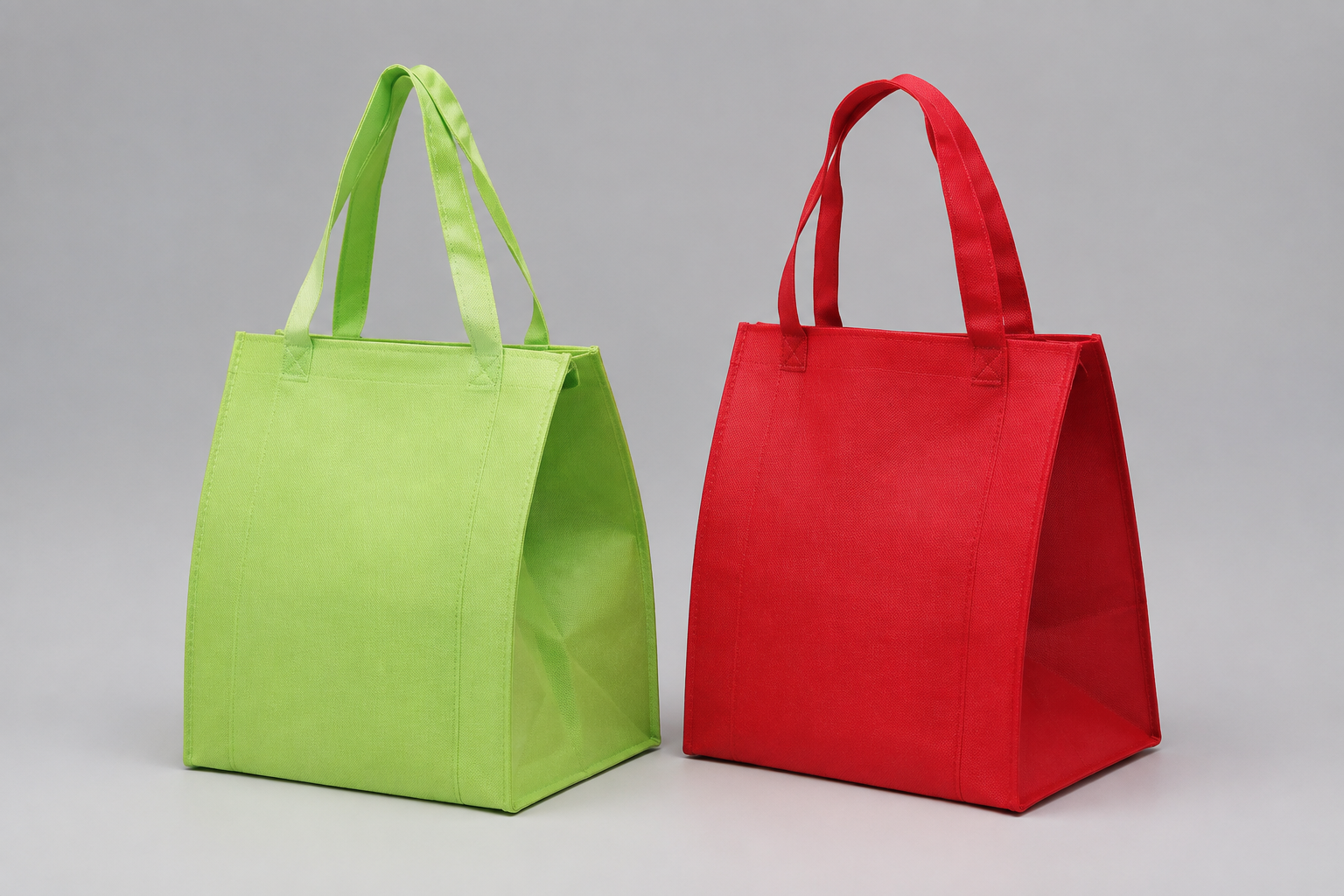
AI-assisted removal of historical sample logos and catalog graphics from real LUCKYSTAR company-catalog product photography. The image preserves the photographed box-bag form and non-woven appearance, but it is illustrative—not proof of a particular polymer, GSM, recycled content, load rating or certification.
Need non-woven bag quotations that use the same construction and test basis? Send the intended use and target load, finished dimensions, polymer/fibre and GSM, bonding or sewing route, handles and reinforcement, artwork, quantity by SKU, required claim evidence, tests, packing, destination and date. LUCKYSTAR can return an order-specific route, evidence gaps and written commercial assumptions.
Page role: This page is responsible for non-woven shopping bag conversion, joining, printing and verification. For a cross-material supplier shortlist, use the worldwide manufacturer comparison; for project development, review the custom shopping bag collection.
Quick comparison of 10 non-woven shopping bag manufacturers
The table is a route map, not a substitute for an RFQ. “Non-woven” may mean virgin or recycled polypropylene spunbond, recycled PET non-woven, a laminated composite, or another bonded-fiber construction. Ask suppliers to name the material and every layer rather than accepting the category name alone.
| Manufacturer | Manufacturing location described by the company | Capability worth investigating | First verification question |
|---|---|---|---|
| BAGFACTORY | Own manufacturing plant in Lithuania | Machine-made spunbond non-woven bags and bonding technology | Which Lithuanian line, material code and seam process will make the SKU? |
| BAG MAKERS | USA-made non-woven tote range; Union, Illinois fulfilment information | Shorter-route US stock formats with domestic decoration options | Which converting, stocking and printing steps are actually performed in the USA? |
| CPC Vietnam | Factories described in the Mekong Delta, southern Vietnam | PP non-woven, woven PP, RPET and other reusable-bag routes | Which named factory and line are assigned to the order? |
| Sapphire Packaging | Own factory identified in Vietnam | PP non-woven, woven PP, RPET and laminated shopping bags | Is the proposed fabric produced internally or purchased to specification? |
| Bright Vietnam | Factory in Dong Nai Province | Integrated non-woven fabric, cutting, printing and sewing route | Which processes are internal for this construction and print method? |
| Vina Long Bag | Factory address identified in Hung Yen Province, Vietnam | PP non-woven, laminated and multi-material reusable bags | What is the legal manufacturer and current capability at the stated site? |
| Hariom PolyPacks | Factory identified in West Bengal, India | D-cut, U-cut, handle and box bags with several printing routes | Which bag-making line fits the dimensions, GSM and artwork coverage? |
| Sri Raja Bags | Manufacturing unit identified at Dhone, Andhra Pradesh, India | Regional non-woven carry-bag production and multiple bag formats | Which registered entity will contract, manufacture and invoice the order? |
| Rayson Nonwoven | Manufacturing facility in Foshan, Guangdong, China | Spunbond material production plus non-woven bag conversion | Are the fabric, bag conversion and printing all controlled under one order plan? |
| Wenzhou Lianhai Bag | Company and production activity identified in Longgang, Wenzhou, China | PP/PET/PE non-woven shopping bags and broader custom bag range | What material/process/site combination is included in the quotation? |
If you are comparing this material with woven PP, start with Woven PP vs Non-Woven PP Shopping Bags and the later sustainability-focused comparison. For the wider responsibilities of a bag supplier, use our Custom Bag Manufacturer pillar guide.
1. BAGFACTORY: machine-made spunbond bags from Lithuania
BAGFACTORY states that it established its own manufacturing plant in Lithuania in 2015 and makes machine-produced bags from non-woven spunbond as well as paper. The company highlights a bonding process for reusable non-woven polypropylene bags and says it introduced recycled spunbond material into production in 2020.
This is a relevant European option for supermarket, department-store and promotional programmes built around repeatable machine-made formats. The most useful due-diligence question is how the bonding technology applies to the proposed bag: side seams, bottom formation, handle attachment and reinforcements can use different processes, and one successful seam does not establish the strength of the complete carrier.
Ask for the precise material code, polymer, GSM, layer structure and bonding settings or control limits relevant to the order. If recycled content or certification is required, request current scope and transaction evidence for the exact site and material. Do not generalize a company-level sustainability statement to every color, component or bag.
2. BAG MAKERS: a USA-made non-woven tote option
BAG MAKERS offers a USA-Made Non-Woven Patriot Tote and related formats. Its product page provides a defined stock construction, imprint area, packaging information and Union, Illinois FOB details. This makes the company useful to investigate for US programmes where a standard format and domestic production route may reduce overseas transit exposure.
The phrase “USA-made” still needs a process map. Ask where the spunbond fabric is produced, where it is cut and converted, where handles are attached, and where decoration occurs. Confirm whether the quoted item is the stock model, a modified version, or a fully custom bag following a different supply route.
For branded work, check the print method, maximum coverage, color count and tolerance on the chosen bag color. Stock availability and published production times are dynamic; require a dated written quotation tied to final artwork and quantity.
3. CPC Vietnam: multiple reusable-bag routes in southern Vietnam
CPC Vietnam describes factories in the Mekong Delta and a product range that includes non-woven PP, woven PP, RPET and other shopping bags. Its site also presents material handling, lamination, printing and assembly activities.
That breadth can help a retailer compare non-woven PP with an alternative material without starting a new supplier search. It also makes specification discipline essential. Woven PP, spunbond non-woven PP and RPET constructions have different surfaces, strength behavior, print routes and end-of-life considerations.
Ask CPC to identify the exact factory and line for each SKU, plus which operations are internal. Avoid relying on capacity totals, customer-logo galleries or certification badges without current supporting documents. A multi-factory group should provide change notification if production may transfer between sites.
4. Sapphire Packaging: PP non-woven and reusable formats from Vietnam
Sapphire Packaging describes an own-factory manufacturing route in Vietnam and lists PP non-woven shopping bags alongside woven PP, RPET, cooler and other reusable formats. The range is relevant to grocery and promotional buyers considering both unlaminated and printed/laminated constructions.
Before comparing prices, establish whether “non-woven” refers to PP spunbond or another material. For laminated bags, define the printed film, adhesive or thermal bond, base fabric and finish. A film-printed bag can deliver photographic graphics, but the extra layer changes stiffness, scuff behavior, fold recovery and recovery-route assumptions.
Ask for the current factory address, legal seller, fabric source and sample sequence. Any recycled-content statement needs a percentage boundary and order evidence; any certification needs the holder, site, scope, validity and transaction documents where applicable.
5. Bright Vietnam: a vertically coordinated non-woven route
Bright Vietnam states that it produces non-woven polypropylene fabric and manufactures shopping and promotional bags at a factory in Dong Nai Province. The company describes a coordinated route covering its own fabric, cutting, printing, sewing and finished products.
Vertical coordination can reduce ambiguity between material and bag conversion, especially when color consistency or material weight is critical. It does not eliminate the need for incoming and in-process controls. A manufacturer can produce its own spunbond and still purchase inks, film, thread, webbing or recycled feedstock from other sources.
Ask Bright to map every component and operation for the proposed bag. Confirm roll-level GSM tolerance, color reference, roll width, cutting orientation, seam type, thread specification and handle reinforcement. Where certificates appear on the website, obtain current documents and verify that their product and site scope apply to the order.
6. Vina Long Bag: Vietnamese factory address and broad bag assortment
Vina Long Bag identifies a factory in Hung Yen Province, Vietnam, and lists non-woven bags, PP non-woven bags, woven PP, RPET, cooler and other bag types. It can be investigated for buyers who need a straightforward non-woven carrier or a coordinated assortment across reusable constructions.
The published product range is a starting point, not proof that every process is performed at the stated factory. Ask whether fabric extrusion/spunbonding, film printing, lamination, cutting, sewing or ultrasonic bonding are internal or subcontracted. Name approved subcontract steps in the quality plan when they are critical.
Request a drawing and bill of materials with the sample. For a laminated box bag, confirm the film, base fabric, gusset, handle webbing, seam allowance and bottom reinforcement. For an unlaminated tote, focus on fabric uniformity, edge construction, print penetration and seam strength.
7. Hariom PolyPacks: Indian non-woven fabric and bag conversion
Hariom PolyPacks’ official non-woven bags page describes a factory in West Bengal and equipment for automatic bag making, flexographic, screen and offset printing. The company presents D-cut, U-cut, handle and box-bag formats.
This makes HPPL relevant to buyers comparing low-component punched-handle bags with more structured retail carriers. The production route should follow the intended service life. A light D-cut carrier for short use should not be evaluated by the same criteria as a gusseted box bag intended for repeated grocery trips.
Ask which line is compatible with the finished dimensions and GSM, and how handles or punched openings are reinforced. If the website’s recycled-material statement is relevant to the project, request the precise recycled percentage, feedstock basis and traceability evidence rather than repeating the general marketing wording.
8. Sri Raja Bags: regional Indian carry-bag manufacturing
Sri Raja Bags states that it manufactures non-woven fabric carry bags at Dhone in Andhra Pradesh. Its website also identifies several registered units trading under the Sri Raja Bags name.
The disclosure of operating names is useful, because it prompts an important procurement question: which entity will accept the purchase order, manufacture the bag, issue the invoice and stand behind a claim or test report? These should align, or their relationship should be documented.
For a regional retail programme, confirm available bag formats, artwork limits, production steps and delivery footprint. Do not infer export capability, certification or uniform capacity from domestic customer counts. If shipping outside India, add export packing, carton/pallet controls and destination documentation to the RFQ.
9. Rayson Nonwoven: spunbond production plus bag conversion in Foshan
Foshan Ruixin Non Woven Co., Ltd., marketed as Rayson, describes a manufacturing facility in Foshan, China, with spunbond non-woven production. Its company profile and non-woven carry-bag page present both fabric production and finished-bag conversion capability.
This route may suit a buyer who wants closer control of fabric color, width and GSM before the bag is cut. Ask whether the specific bag fabric will run on an internal line and how the roll is identified through cutting, printing and sewing. Material verticality is valuable only when traceability is maintained into the finished cartons.
Rayson’s product pages contain broad environmental, performance and certification wording. Treat those as company claims until the exact fabric/bag, standard, test report, holder, scope and validity are confirmed. Request a construction-specific load test rather than extrapolating from fabric tensile data.
10. Wenzhou Lianhai Bag: broad non-woven shopping-bag capability in China
Wenzhou Lianhai Bag Co., Ltd. states that it is located in Longgang, Wenzhou, and specializes in PET, PP and PE knitted and non-woven shopping bags along with other custom bag formats.
The range is relevant when a programme may need PP non-woven carriers, RPET options or related promotional products. Because the website spans several materials, insist on a separate specification and process route for each. Similar-looking bags can use different polymers, printing, coatings and seam methods.
Ask for the current producing site, equipment route, capacity allocated to the order and independent inspection access. Published daily output or “quick shipment” claims are dynamic marketing information; delivery should be defined from final approval and confirmed in writing for the exact quantity and season.
What “non-woven shopping bag” should mean in an RFQ
Non-woven describes a way of making a sheet from fibers or filaments without conventional weaving. It does not identify the polymer, recycled percentage or finished-bag construction. A credible RFQ names every layer and component.
| Material architecture | Visual/functional profile | Printing route to discuss | Buyer risk to control |
|---|---|---|---|
| Unlaminated PP spunbond | Matte, fibrous sheet; light and flexible | Screen print or flexographic print depending on bag/roll route | GSM drift, pinholes, fuzzing, ink penetration and weak handle joints |
| OPP/BOPP-laminated PP non-woven | Smooth film face over a non-woven base; high graphic coverage possible | Reverse-printed film, gravure/flexo film printing or another approved route | Delamination, scuffing, odor, crease whitening and mixed-layer recovery claims |
| Recycled-content PP non-woven | Similar basic structure with claimed recycled feedstock | Depends on surface and additive system | Percentage boundary, batch variation, odor/color consistency and transaction evidence |
| PET/RPET non-woven | Polyester-based bonded fiber sheet; properties depend on process | Screen, transfer or other process validated on the surface | Confusing RPET with PP, unsupported recycled percentage and heat sensitivity |
| Composite insulated bag | Non-woven exterior plus insulation, foil/film lining and closures | Often surface print or printed laminate | Calling a multi-layer cooler bag simply “recyclable” without pathway evidence |
Do not specify only a color and GSM. Include polymer identity, fiber/bonding technology where relevant, virgin/recycled basis, additive restrictions, thickness or mass tolerance, lamination, coating, handle material, thread and reinforcement.
Stitching, ultrasonic bonding and heat sealing are not interchangeable
The chosen joining process determines seam appearance, speed and failure mode. A buyer should approve the process as part of the construction—not let the supplier substitute it after sampling.
| Joining route | Where it is commonly used | What to inspect | Typical failure signal |
|---|---|---|---|
| Lockstitch or chainstitch sewing | Structured totes, box bags, webbing handles and complex gussets | Stitch density, seam allowance, backtack, thread, skipped stitches and edge finish | Seam opening, thread breakage or fabric tearing beside the stitch line |
| Ultrasonic bonding | Automated flat bags, D-cut/W-cut styles and some handles | Bond width, continuity, burn-through, alignment and local stiffness | Peel opening, brittle bond or holes beside the weld |
| Thermal sealing/bonding | Compatible polymer layers and certain automated constructions | Temperature/pressure window, dwell, seal width and distortion | Incomplete fusion, shrinkage, sticking or edge cracking |
| Hybrid construction | Bags combining automated body seams with sewn handles or reinforcement | Interface between processes and revision control | Strong body but weak handle patch, or inconsistent manual finishing |
Ask the supplier to test the complete bag in the same direction and loading pattern as actual use. A seam strip test alone may miss handle peel, gusset stress or bottom deformation.
Printing routes for non-woven retail bags
The surface determines the artwork strategy. Unlaminated spunbond is porous and textured; a laminated bag behaves more like flexible packaging. Fine type and photographic gradients cannot be assumed to reproduce equally on both.
Screen printing on cut panels or finished bags
Screen printing can give strong spot-color graphics, but ink deposit, mesh, curing and fabric texture affect edge definition. Confirm maximum print area around seams and handles. Check blocking, odor, rub resistance and ink cracking after folding.
Flexographic printing on roll material
Flexo can support repeating larger runs before conversion. Artwork must account for plate, anilox, trapping and material stretch. A digital layout proof validates content; it does not demonstrate production color or registration.
Printed film plus lamination
Reverse-printing an OPP/BOPP film can protect graphics and deliver high coverage. The film, ink and bond become part of the bag. Approve gloss/matte appearance, color, lamination adhesion and crease performance. If recyclability is claimed, evaluate the complete structure in the destination context.
Our Shopping Bag Printing Quality Control Checklist and guide to common printing defects provide practical press and inspection checkpoints. Also review How Shopping Bag Materials Affect Print Quality before approving artwork.
Build a non-woven shopping-bag RFQ that manufacturers can quote consistently
When ten suppliers receive ten incomplete briefs, their assumptions hide inside the prices. Use one controlled tech pack and require deviations to be listed.
| RFQ field | Minimum information | Why it matters |
|---|---|---|
| Bag geometry | Width × gusset × height, handle drop, seam allowance, bottom/side construction and tolerances | Establishes line compatibility, capacity and usable volume |
| Material | Polymer, process, GSM, color, virgin/recycled basis, layer structure and additives | Prevents PP, PET and laminated composites being compared as one fabric |
| Handles | Material, width, length, color, position, attachment and patch/reinforcement | Handle-system failures are often the first field complaint |
| Joining | Sewing/ultrasonic/thermal route, seam width or stitch density and critical controls | Prevents unapproved process substitution |
| Printing | Method, colors, coverage, sides, artwork revision, color standard and proof route | Aligns design with the actual surface and equipment |
| Intended use | Contents, nominal load, sharp edges, carrying time, reuse target and environment | Creates a defensible finished-bag test |
| Claims/evidence | Exact wording, material declarations, certificate/TC/test requirements and market | Keeps marketing claims inside documented scope |
| Quality plan | Sample stages, inspection level, measurements, tests and retained reference | Gives both parties a release standard |
| Packing | Fold method, pieces/carton, carton limits, pallet, marks and destination | Controls creasing, freight cube and store handling |
| Commercial basis | Quantity by SKU, currency, Incoterm, tooling, sample cost, timing definition and quote validity | Makes unit prices genuinely comparable |
Use How to Prepare a Custom Shopping Bag Tech Pack to convert the brief into one controlled revision. For the complete supplier evaluation, see How to Choose a Custom Shopping Bag Manufacturer.
Test the finished carrier, not only the fabric roll
Fabric tensile strength is useful process data, but users carry a bag through its handles. Finished-bag testing should represent the intended load and reuse pattern.
| Control point | Suggested evidence | What the result should be tied to |
|---|---|---|
| Material identity and weight | Roll label, supplier declaration and measured GSM sample | Approved polymer/material code and tolerance |
| Dimensions and handle position | Measurement record on a defined sample | Signed drawing revision |
| Handle pull / static load | Conditioned finished bags, defined load, duration and failure criteria | Exact handle, patch, seam and body material |
| Cyclic carry or lift | Repeated loading/lifting under an agreed method | Stated service target, not an unlimited “reusable” promise |
| Seam/bond integrity | Visual and functional test after load cycling | Joining route and machine settings/control plan |
| Print rub and adhesion | Dry/wet rub or agreed tape/flex test | Ink, laminate, cure and bag color |
| Lamination bond | Peel/visual test before and after folding or conditioning | Exact film, adhesive/bonding route and substrate |
| Carton/fold recovery | Packed simulation and unpacking inspection | Final fold pattern, carton quantity and transit duration |
Our Reusable Shopping Bag Durability and Reuse Testing guide explains how to define cycles, load and failure. The longer-service-life design guide shows how gussets, handles and reinforcement influence that test.
Environmental claims: avoid shortcuts with polypropylene
Claim boundary reviewed 16 September 2026: “non-woven,” “reusable,” “recycled,” “recyclable” and “eco-friendly” answer different questions. Define polymer identity, recycled percentage and calculation basis, traceability documents, intended service life, realistic reuse test, applicable collection route and the exact market wording. A heavier GSM, green colour, recycled-material certificate logo or supplier statement alone does not establish lower life-cycle impact or prove that the finished order qualifies for a particular claim.
Non-woven PP is still plastic. Reuse may improve performance per use, but the outcome depends on bag mass, service life, return behavior, washing, transport and end-of-life infrastructure. “Non-woven,” “reusable” and “recyclable” are not equivalent statements.
If a recycled-content claim is proposed, define the percentage denominator and whether it covers the fabric or the entire bag. Obtain supplier and transaction documents appropriate to the programme. If a recyclability claim is proposed, assess the complete bag—lamination, ink, thread, handles, board, zipper and labels—and the actual collection route in the target market.
Avoid icons or claims that imply compostability or biodegradability unless the complete product has suitable evidence under an applicable standard and disposal condition. Read How to Avoid Greenwashing in Reusable Shopping Bag Marketing and How Material Weight Affects Shopping Bag Environmental Performance before finalizing packaging copy.
Company-claim and route boundary: the following LUCKYSTAR section is publisher self-description and a commercial custom-supply option. It does not independently prove factory ownership, polymer identity, recycled content, certificate status, load or reuse performance, capacity, MOQ, price, timing or superiority over a ranked company. The legal seller, assigned material and conversion sites, construction, evidence, samples, test and inspection plan, packing, schedule and delivery terms are subject to the exact order, final specification and written confirmation.
Why choose LUCKYSTAR for custom non-woven shopping bags
LUCKYSTAR provides a China-based custom development and supply-coordination route for branded shopping bags. On this website, the operating entity is Ningbo Luckystar Commodities Co., Ltd. The production partner, material source and process route depend on the approved order. We do not present every non-woven bag as coming from one self-owned factory.
Specification-first development
We begin with the intended contents, dimensions, load, service target, material, GSM, joining process, handle, printing and pack method. That prevents an inexpensive but unsuitable D-cut bag from being compared with a reinforced sewn box carrier. See our custom shopping bags product page for the broader development scope.
Material and process coordination
LUCKYSTAR can coordinate fabric, printing, bag conversion, handles, reinforcement and packaging through one controlled brief. We can help identify where a machine-made bonded bag is appropriate and where sewing or a laminated graphic route better fits the design. Options and availability remain subject to the final specification and written confirmation.
Practical sample and QC gates
We support a sequence that distinguishes artwork approval from construction approval: material/print references, a physical sample, a pre-production reference where needed, in-process checks and pre-shipment inspection. Our custom shopping-bag manufacturing process describes how these gates fit together.
Evidence boundaries that protect the buyer
We do not promote GRS, GOTS, BSCI, ISO, REACH, RoHS or other certificates as universal current LUCKYSTAR coverage for every non-woven bag. When a project needs recycled-content, chemical, social-audit or performance evidence, it should be verified for the relevant holder, site, scope, material, batch and order. This is a safer foundation for customer-facing claims than copying a supplier badge.
Export and reorder control
We can align artwork revisions, signed samples, inspection criteria, packing and shipment details. For repeat orders, retain material codes, color standards and approved construction references; use our shopping-bag reorder consistency guide. Carton design should also be confirmed early because bulky non-woven bags can create high freight volume; see the carton optimization guide.
LUCKYSTAR may not be the best route for every order. A domestic stock-bag producer can be preferable for very short replenishment, while a vertically integrated spunbond producer can be advantageous when fabric control dominates. LUCKYSTAR is especially useful to evaluate when the buyer needs custom coordination, multi-component sourcing, export handling and specification-led QC.
Twelve questions to send with every supplier inquiry
- What legal entity will sell the bags, and what named facility will make them?
- Is the material PP spunbond, PET/RPET non-woven or another construction?
- What is the GSM tolerance, roll-width plan and color-control method?
- Which material and components are internally produced versus purchased?
- Are body seams and handles sewn, ultrasonic-bonded, heat-sealed or hybrid?
- What equipment limits apply to our dimensions, gusset and handle position?
- Which print route fits our coverage, gradients and brand-color tolerance?
- What physical sample becomes the signed approval standard?
- What finished-bag load/reuse method, conditioning and pass criteria are proposed?
- What evidence supports each recycled-content, recyclability or certification statement?
- What are pieces per carton, carton dimensions, gross weight and pallet assumptions?
- How are material, site, process or subcontractor changes communicated before production and reorders?
Frequently asked questions
What is a non-woven shopping bag made from?
Many retail non-woven bags use polypropylene spunbond, but the category can also include polyester/RPET or composites. The fibers or filaments are bonded rather than conventionally woven. Ask for the polymer, manufacturing process, GSM and every additional layer.
Is non-woven PP the same as woven PP?
No. Woven PP uses tapes interlaced into a fabric; spunbond non-woven PP bonds filaments into a sheet. Woven bags often suit heavier structured formats, while non-woven bags can be lighter and economical. Performance depends on the finished construction, not the category name.
What GSM is best for a reusable non-woven bag?
There is no universal best GSM. Bag size, polymer, fiber bonding, seam method, handle reinforcement, load, reuse target and humidity matter. A heavier sheet can still fail at a poorly designed handle. Specify performance, then validate the complete bag.
Are laminated non-woven bags stronger?
Lamination can add stiffness, print protection and moisture resistance, but it does not automatically solve seam or handle failures. The film-to-fabric bond, bag geometry and joining method must be tested. Lamination can also change recovery and recyclability considerations.
Is sewing better than ultrasonic bonding?
Not always. Sewing can suit structured gusseted bags and webbing handles; ultrasonic bonding can suit compatible automated constructions. The correct route is the one validated for the material, geometry, load and service target. Approve it as part of the specification.
Can a non-woven polypropylene bag be called eco-friendly?
That broad claim is risky. Use specific statements supported by evidence, such as a verified recycled-content percentage or a defined durability test. Consider material mass, actual reuse, transport and local end-of-life systems. Do not imply biodegradability or universal recyclability.
How many times should a reusable non-woven bag be used?
The answer depends on what it replaces and the impact method used. From a product perspective, define an intended number of load cycles and validate it with a finished-bag test. Our guide on how many times a reusable shopping bag must be used explains why one universal number is misleading.
What information produces an accurate custom quote?
Provide dimensions, polymer/material, GSM, color, lamination, joining, handle, artwork, print method, intended load/reuse, quantity by SKU, testing, evidence, packaging, destination and Incoterm. MOQ, price, sample cost, lead time, capacity and testing availability are order-specific and require written confirmation.
Request a specification-led non-woven shopping-bag quote
Choose manufacturers by process fit, then compare the same bag, evidence list and delivery basis. LUCKYSTAR can help convert your retail concept into a controlled non-woven shopping-bag specification covering material, construction, artwork, samples, testing, packing and claim support.

Click the GET QUOTE image and send your bag dimensions, expected contents/load, material or GSM target, artwork, quantity, destination and required evidence. Final specifications and commercial terms are subject to written confirmation.
Request a specification-controlled non-woven bag quote
Use one written specification for every candidate so polymer, GSM, bonding/sewing route, handles, printing, evidence, QC, packing and delivered-cost assumptions can be compared on the same basis.
Review LUCKYSTAR custom shopping bag options, then send your controlled RFQ through the contact form or Email a project brief. The email link opens a draft for your review before sending.
Material and conversion route, claims and certificates, testing, capacity, availability, price, MOQ, sample cost, packing, schedule and delivery terms are subject to current order-level verification, final specification and written confirmation.