Last reviewed: September 28, 2026
What Does "Sustainable Bags That Last" Mean?
It means a buyer has connected intended reuse to measurable product requirements. The answer is not automatically a heavier bag. Extra material may add strength, cost, shipping weight and manufacturing impact without solving the real weak point. A durable design uses enough construction in the places that control useful life.
The relevant unit is the finished bag in a defined service. A light event tote, grocery carrier, retail shopper and commuting bag should not share one generic durability promise. Each needs its own load, handling, cleaning and presentation assumptions.
Define Use Life Before Selecting Construction
Write a one-paragraph use-life brief before choosing fabric weight, handle type or reinforcement. Identify who receives the bag, what it carries, how often it is expected to travel, the normal trip length and the environment in which it is stored. State whether the program values compact folding, retail appearance, washability, moisture resistance or repair access.
A useful-life target should be a design requirement, not a guaranteed consumer behavior. A factory can control construction and agreed test conditions. It cannot guarantee how every user loads, cleans or stores the product.
Build a Use-Life Requirement Sheet
| Requirement area | Buyer input | Specification output | Approval evidence |
|---|---|---|---|
| Use channel | Retail sale, gift, grocery, event or subscription program | Presentation and reuse priority | Approved use statement |
| Contents | Typical and demanding items with dimensions | Usable size, opening and internal support | Loaded sample photographs |
| Load pattern | Normal mass, peak mass and object shape | Test load and placement method | Recorded load trial |
| Carry route | Hand, shoulder, cart, commute or short event use | Handle length, width and attachment | Fit and carry review |
| Care exposure | Wipe, hand wash, machine wash, rain or dry storage | Care method and preconditioning | Before-and-after comparison |
| End condition | Acceptable wear and unacceptable failure | Pass, monitor and fail criteria | Signed sample record |
Map the Real Carry Route
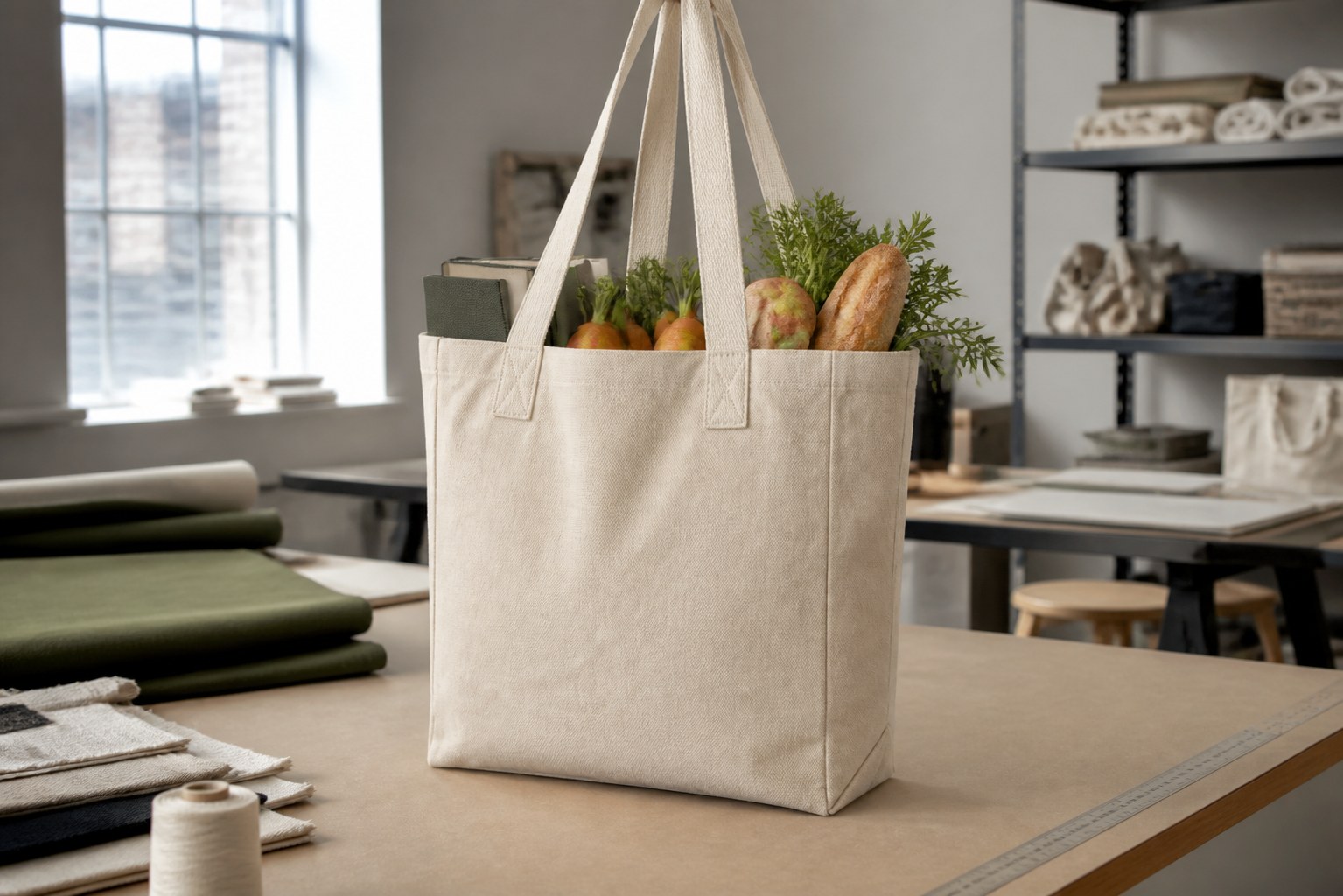
Follow the bag from handout or sale to filling, lifting, transport, unloading, folding and storage. A grocery tote may experience dense loads and repeated lifting. A gift-with-purchase bag may carry lighter products but must remain attractive. A foldable shopper is repeatedly compressed, so fold lines and pouch attachment can matter as much as the main body seam.
Use real or dimensionally equivalent contents during development. A uniform steel weight reveals structural weakness but may not show how a bottle corner, book edge or retail box stresses one panel.
Set Normal and Peak Load Conditions
Define a normal load that represents intended use and a peak load that challenges the design without pretending the bag is unlimited. Record how the weight is distributed, how long the bag is held and whether the test includes repeated lifts. A result without these conditions cannot be repeated or compared.
Avoid publishing a universal kilogram claim based on one sample. The allowed claim should match the tested construction, production controls and market wording.
Identify the First Likely Failure Mode
Ask what is most likely to make the bag leave service: handle detachment, bottom seam opening, fabric tear, zipper failure, coating damage, print cracking, odor retention, loss of shape or uncomfortable carry. The first failure may be functional or presentational.
This step prevents random overengineering. Reinforcing every seam cannot correct a print system that fails during cleaning, and a stronger body fabric cannot compensate for a narrow handle that users avoid.
Allocate Strength Where the Load Travels
Trace the load from the contents through the bottom and side seams into the handle attachment. Check whether the handle is sewn only to the top hem or extends farther down the body. Review stitch pattern, seam allowance, edge finishing and the relationship between webbing and shell strength.
Construction should be reviewed as a system. An extremely strong handle attached to a light unsupported panel may move the tear to the fabric beside the seam.
Separate Material Claims From Durability Evidence
A transaction certificate, composition report or supplier declaration may support a material claim. It does not demonstrate finished-bag strength, wash response or print life. Keep two evidence paths: one for what the input is and another for how the assembled bag performs.
The sustainable packaging decision guide explains why operational fit can outweigh a material label. This page turns that principle into a product-specific durability record.
Choose Fabric by Use, Not by a Green Ranking
Cotton, canvas, recycled polyester, nonwoven material, jute and other constructions behave differently under load, abrasion, moisture, folding and cleaning. There is no universal winner without a defined function and comparison boundary.
Request the fabric identity needed for repeat production: composition, weight or thickness convention, width, finish, color reference and approved supplier or equivalent route. Then verify the finished sample rather than approving a loose swatch as proof of useful life.
Engineer Handles for Both Strength and Use
Handle length controls where the bag sits and how it is lifted. Width and edge feel affect comfort. Attachment area, stitch layout and backing affect load transfer. Review the handle with the intended contents and user clothing, not only on an empty display sample.
If one bag must work in both hand and shoulder carry, confirm that the compromise remains practical. A technically strong handle that slips, twists or presses uncomfortably can reduce actual reuse.
Check Closures, Pockets and Added Features
Zippers, snaps, drawcords, internal pockets and folding pouches introduce more failure points. Test them under realistic fill because a closure that works on an empty bag may bind when the side panels are under tension.
Every feature should justify its material, assembly time and maintenance burden. Remove decorative complexity that does not improve the intended use or brand function.
Match Decoration Life to Product Life
A long-lasting body with a logo that cracks, peels, transfers or fades early creates a mismatch. Approve decoration on the actual material, color and finish. Include flexing, rubbing or cleaning exposure relevant to the program.
Record the method, ink or thread reference, dimensions, location and curing or process assumptions in the custom bag tech pack. A visual artwork approval alone is not a durability specification.
Design Care and Storage Into the Brief
Cleaning advice must match the tested bag, including decoration and trims. Do not label a product machine washable because the base cloth tolerates washing when the print, interlining or hardware has not been reviewed under the same condition.
Storage matters too. Repeated tight folding may create permanent creases or coating stress. Damp storage can affect odor and appearance. Provide only care instructions supported by the approved construction.
Precondition the Sample Before Testing
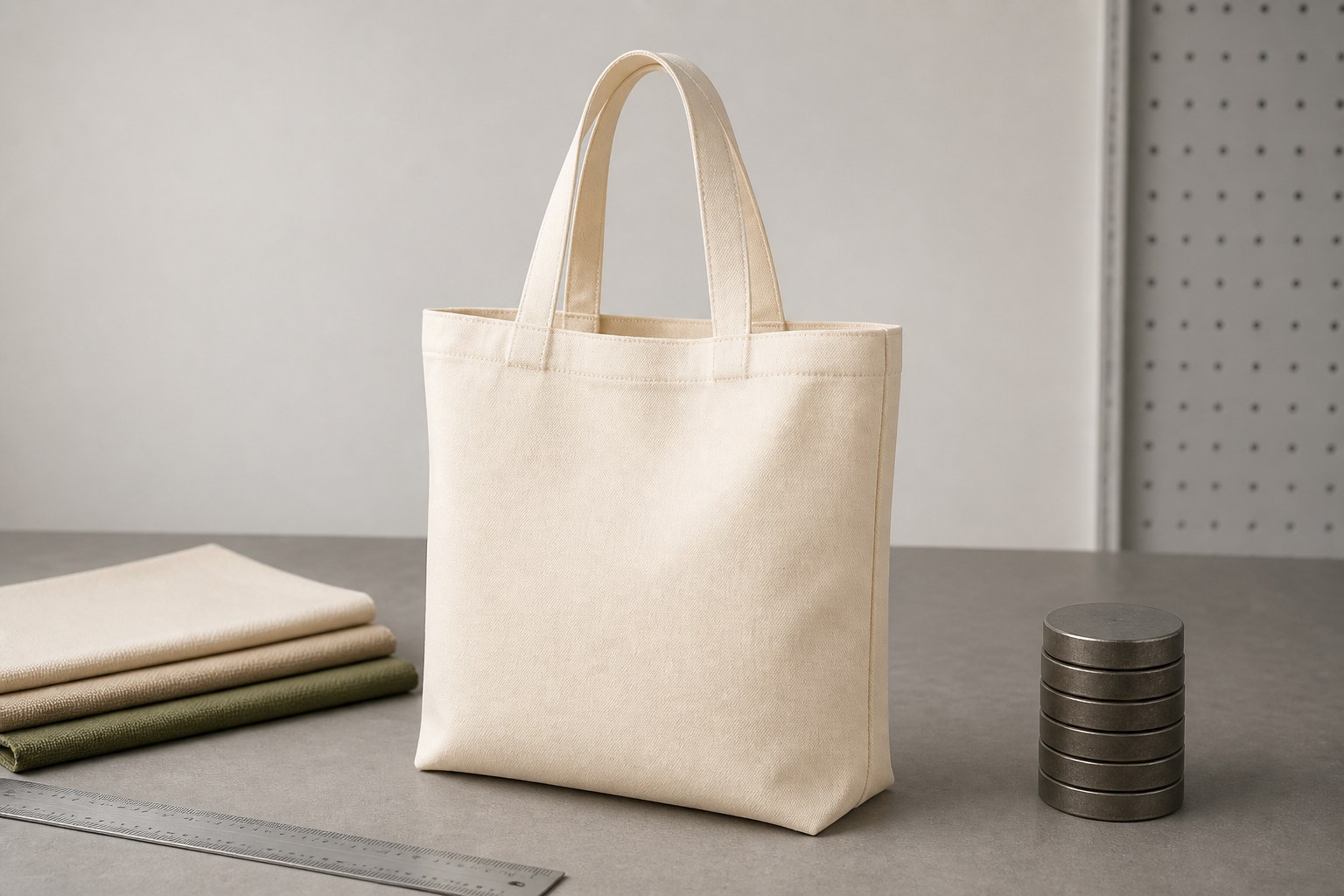
Some failures appear only after folding, moisture exposure, cleaning or a period under load. Define any preconditioning before the main test. Photograph and measure the sample before and after so shrinkage, distortion, color transfer and seam change can be understood.
Use the same sequence when comparing revisions. Changing both the sample and test conditions makes improvement impossible to isolate.
Build a Product-Specific Test Sequence
| Test stage | Question answered | Condition to record | Possible evidence |
|---|---|---|---|
| Loaded fit | Do intended contents fit and remain accessible? | Item set, arrangement and closure state | Photos and dimensional notes |
| Static hold | Does the structure remain stable under sustained load? | Load, distribution, duration and position | Before-and-after seam photos |
| Repeated lift | Do handles and load paths tolerate recurring use? | Load, lift distance, pace and cycles | Cycle record and damage log |
| Abrasion or rub | Do high-contact surfaces and decoration remain acceptable? | Contact surface, pressure and repetitions | Controlled visual comparison |
| Care exposure | Does the approved care method change function or appearance? | Method, temperature, detergent and drying | Measurements, color and function review |
| Post-test function | Does the bag still carry, close and present as intended? | Original loaded-use route | Pass, monitor or fail decision |
Define Pass, Monitor and Fail Criteria
Pass does not have to mean no visible change. A reusable textile item can show acceptable wear while remaining safe and useful. Define which changes are cosmetic, which require monitoring and which end service.
Examples of fail conditions may include an opening seam, detached handle, sharp exposed hardware, unusable closure or unacceptable color transfer. Criteria must be agreed for the specific bag and test route.
Separate Development Tests From Shipment Inspection
Development testing asks whether the design is fit for its intended use. Final inspection asks whether production matches the approved specification and reference. A small inspection sample cannot recreate an entire lifetime for every unit.
Use the Custom Bag Quality Inspection Checklist for lot release. Keep the use-life test method in the approved reference package so inspectors can check the features that support it.
Control Sample Revisions
Give each sample a revision, date and change list. If the handle attachment, fabric, thread, seam or decoration changes, record whether the relevant tests must be repeated. Do not allow an improved prototype to stand in for a later cost-reduced production specification.
The Custom Bag Sample Development Process covers the complete sampling route. Here, the critical output is a retained sample linked to the use-life requirements it passed.
Translate the Approved Sample Into Bulk Controls
Production needs measurable inputs and workmanship requirements: material references, measurement points, stitch and reinforcement details, trim specifications, decoration settings, tolerances and packing. Name critical-to-life features so they are not treated as ordinary visual details.
The custom bag manufacturing process explains the wider handoff from design to shipment. A useful-life record connects development intent to that process.
Approve Sustainability Claims Separately
Keep a claim register that states the exact wording, product scope, market, evidence owner and supporting document. Avoid vague statements such as "planet safe" or "lasts forever." Durability, reusability and recycled-content statements require different proof.
Evidence should match the actual product, not a material family or an earlier construction. If the claim changes, review whether the current documents and test records support the new wording.
Plan Maintenance and End of Use
Simple care information can help a bag remain useful, but it must be practical for the user. If small parts can be replaced or damage can be repaired, decide whether the program will provide that route. If not, do not imply service that does not exist.
End-of-use instructions depend on local systems and the assembled materials. Avoid universal recyclability or compostability language when coatings, threads, labels, zippers or local collection routes have not been considered.
Pilot the Bag With Real Users
A small controlled pilot can reveal behaviors that bench tests miss: users overload one corner, carry bottles upright, reject an uncomfortable handle, forget a foldable pouch or clean the bag differently than expected. Record what happened rather than collecting only general satisfaction.
Feed consistent observations into the next revision. Field feedback complements defined tests; it does not replace repeatable approval criteria.
Balance Durability, Cost and Material Use
The lowest unit price may remove reinforcement or reduce material control. The heaviest construction may overspend and add transport volume. Compare options against the same use-life requirement so cost changes have a visible consequence.
Use the Custom Bag Cost Guide to structure price variables and the cost and lead-time guide for planning trade-offs. Do not hide a product downgrade inside a sustainability narrative.
Use an Approval Decision Matrix
| Finding | Decision | Required action | Claim impact |
|---|---|---|---|
| All critical use-life criteria pass | Approve the defined construction | Freeze specification and retained sample | Use only reviewed wording |
| Cosmetic wear appears but function remains | Review against acceptance limit | Clarify expected appearance after use | Avoid "like new" implications |
| One structural weak point fails | Revise and retest | Change the load path or component | Do not publish durability claim |
| Material document is available but bag test is missing | Material claim only | Complete finished-product validation | Do not convert input proof into life claim |
| Bag passes but production input changes | Conditional hold | Assess equivalence and repeat affected checks | Reconfirm evidence scope |
| Care exposure causes failure | Change product or care direction | Retest the selected route | Remove unsupported care wording |
Warning Signs in a Durability Proposal
- The supplier uses "eco-friendly" as a substitute for a material specification.
- A load claim is provided without distribution, duration or cycle conditions.
- Only the body fabric is discussed while handles and seams remain undefined.
- The decoration is approved visually but never exposed to intended care.
- A changed bulk material is treated as equivalent without evidence.
- Every market receives the same recycling or care statement.
- Testing is promised, but no sample identity, result or decision record exists.
How Luckystar Supports Use-Life Validation
Luckystar can review the use channel, intended contents, load pattern, handle and seam construction, decoration, care route, sample revision and production handoff. The test plan and evidence level should be agreed for the specific program rather than presented as a universal guarantee.
Buyers comparing capability, communication and evidence can use the manufacturer selection checklist and the core Custom Bag Manufacturer Guide. Teams sourcing totes can also review the Custom Tote Bag Supplier Guide.
Information to Send for a Durability Review
- Bag type, target user and sales or distribution channel.
- Typical contents, normal load, peak load and object shapes.
- Carry method, trip length, frequency and storage route.
- Material, construction and decoration preferences.
- Expected cleaning, moisture and folding exposure.
- Critical failure concerns and acceptable appearance change.
- Target market, claim wording and available evidence.
- Quantity, sample deadline, delivery target and cost range.
Send the use scenario, contents, load, construction direction, care exposure, quantity and market. Luckystar can review the information needed for sampling and a product-specific quotation.
Email a prefilled use-life specification

Frequently Asked Questions
Is a heavier reusable bag always more sustainable?
No. Extra material can improve some failure modes but also changes cost, weight and production inputs. The correct construction is the one that meets a defined use-life requirement with evidence and without unnecessary material.
What should a reusable bag durability test include?
At minimum, define the sample, load, load distribution, hold or lift method, repetitions or duration, preconditioning and pass criteria. Add abrasion, closure, cleaning or fold checks when the intended use requires them.
Does recycled or organic material prove the bag will last?
No. Material documentation can support an input claim. Finished-product durability also depends on fabric performance, seam design, handles, components, decoration, care and production consistency.
Can one test support every bag made from the same fabric?
Not automatically. Size, shape, handle attachment, seams, lining, decoration and production inputs can change performance. Define when a variation is equivalent and when affected tests must be repeated.
How should buyers describe a long-lasting bag without greenwashing?
Use specific wording tied to the actual product and evidence. State tested conditions or controlled features where appropriate, avoid absolute environmental promises and keep material, durability and end-of-use claims separate.
When should use-life requirements be agreed with the manufacturer?
Agree them before the first functional sample. Late durability requirements may change fabric, pattern, reinforcement, decoration, cost and lead time, so they should be part of the initial brief.
Make Useful Life a Controlled Product Requirement
Review the current custom tote bag range to identify the exact construction that needs a use-life specification. A sustainable bag does not become credible because its description contains the right environmental words. It becomes credible when a buyer can explain the intended use, identify likely failure, approve a proportionate construction, repeat the relevant tests and control the same result in production. That use-life record gives materials, durability and claims their proper roles.