Choose a supplier for your cosmetic bag brief. Use this checklist to compare construction, samples and quotation scope. For the wider sourcing process, read the China Cosmetic Bag Manufacturers Guide.
Planning an order? Discuss your cosmetic bag supplier requirements. Start with the details you know; undecided specifications can be discussed.
A cosmetic bag can look convincing in a supplier photograph and still disappoint the moment someone fills it. The opening may be too narrow for a palette, a bottle may fall out of an elastic loop, the lining may trap a spill, or the zipper may snag where several seam layers meet. Those are not styling problems. They are signs that the product, the factory route and the approval process were never matched.
This guide explains how to choose a cosmetic bag manufacturer by using evidence rather than catalogue size or a low opening price. It is deliberately different from a general China sourcing overview or a list of popular cosmetic bag materials. The focus here is the selection decision: which factory model fits the product, what a sample must prove, and what should be written down before a deposit is paid.
If you are comparing several bag categories, begin with the Custom Bag Manufacturer Guide. Buyers with a confirmed beauty-accessory brief can also review LUCKYSTAR’s custom cosmetic bag range while working through the checks below.
Quick answer: choose the factory that can prove product fit
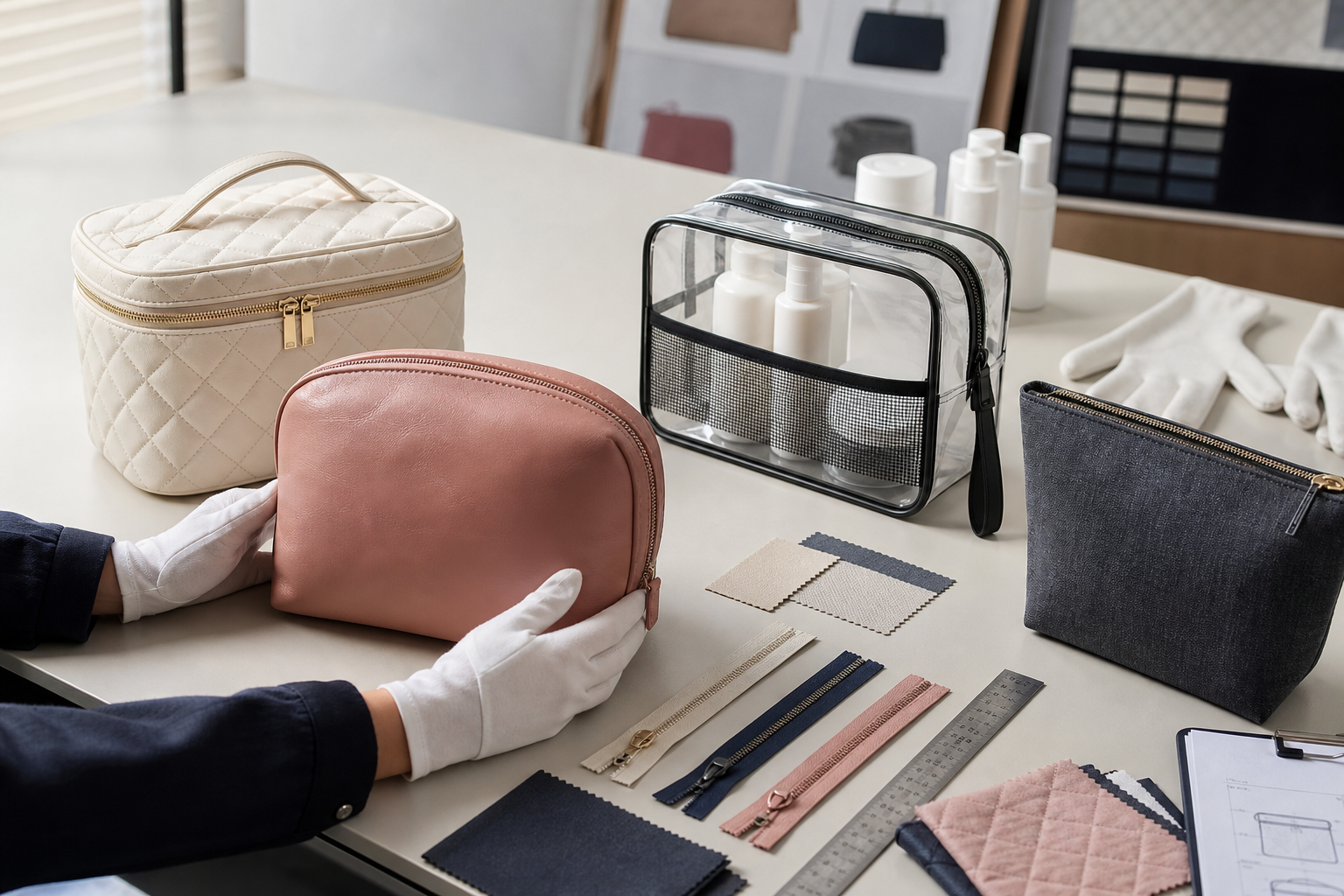
Shortlist manufacturers that have recent experience with a construction similar to yours, ask useful questions about the contents and sales channel, build a controlled sample, explain which processes are subcontracted, and accept measurable quality requirements. Compare candidates on the same specification and landed scope. A supplier should not receive extra credit for saying “yes” quickly; it should receive credit for identifying a risk before fabric is cut.
| Decision gate | Evidence to request | Reason to pause |
|---|---|---|
| Relevant construction | Inside and outside views of recent comparable bags, plus an explanation of the production route | Only flat promotional pouches are shown for a structured vanity-case project |
| Functional sample | A sample tested with the buyer’s actual bottles, brushes, palettes or travel items | The sample is approved from photographs without a capacity or handling check |
| Material and trim control | Physical swatches, zipper reference, lining specification and color approval method | Material names are descriptive but no measurable purchase specification is provided |
| Bulk quality plan | Style-specific checkpoints, tolerances, defect examples and final-inspection record | The only quality statement is “100% inspection” |
| Commercial clarity | Written inclusions, MOQ by variant, milestone dates, Incoterm and payment triggers | A unit price is presented without the assumptions behind it |
1. Define what the cosmetic bag must do
Start with the user, the contents and the route to market. A gift-with-purchase pouch may need fast packing, a generous logo area and a fixed campaign date. A retail vanity case may need a stable shape, clean interior binding, a mirror or divider, retail labeling and protection from shelf handling. A transparent airport pouch has a different set of material, seam and market-rule questions.
If a supplier opens the conversation by asking for dimensions but never asks what will go inside, pause. Outside measurements alone do not describe usable capacity. Curved corners, padding, seam allowance, lining, dividers and zipper position all consume space.
| Program type | Likely manufacturing challenge | Prototype test |
|---|---|---|
| Gift-with-purchase pouch | Branding consistency, pack-out speed and quantity by artwork | Fill with the promotional set, close it, and time the real packing sequence |
| Structured retail case | Shape retention, layered seams, binding, handle attachment and presentation | Load, carry, open and repack repeatedly; inspect whether the case twists or collapses |
| Travel organizer | Compartment access, bottle security, cleanability and zipper travel around corners | Use the actual container set in upright and packed positions |
| Clear TPU or PVC-style pouch | Film thickness, odor, cold flex, surface marking, edge binding and legal suitability | Inspect after folding, temperature exposure and repeated opening; confirm destination requirements separately |
| Brush or tool roll | Slot dimensions, tip protection, wipe-clean surfaces and closure position | Insert the intended tools and check removal without snagging adjacent items |
2. Match the factory to the construction route
“Cosmetic bag factory” can describe several operating models. A decorator may print a logo on an existing pouch. A cut-and-sew factory may develop a buyer-defined pattern. An OEM/ODM partner may coordinate fabrics, linings, molded panels, mirrors, hardware, labels and retail packing through several specialized vendors. None of these routes is automatically best.
The right route depends on how much is changing. Stock decoration is sensible when speed and a small launch quantity matter more than proprietary construction. Full development becomes more valuable when dimensions, compartments, structure, hardware, packaging and repeat-order identity all need control.
| Supplier route | Best fit | What to verify |
|---|---|---|
| Stock or semi-custom supplier | Fast tests and simple logo programs | Stock continuity, decoration location, repeat availability and limits on changes |
| Cut-and-sew OEM factory | Buyer-controlled pattern, materials and workmanship | Similar construction, pattern ownership, sample control and outsourced operations |
| Structured-case specialist | Padded, molded or multi-compartment vanity cases | Layer build-up, binding equipment, foam or board forming, zipper setting and shape tolerances |
| OEM/ODM project partner | Concepts needing engineering, sourcing and coordinated packaging | Who owns technical decisions, design files, tooling, supplier approvals and corrective action |
For a China-specific factory comparison, use the separate China Cosmetic Bag Manufacturers: 2026 Buyer Guide. Keeping geography and supplier-selection evidence in separate articles prevents a country overview from replacing product-specific due diligence.
3. Ask for construction evidence, not just finished photos
A front view hides most of the risk. Ask to see the bag open, empty, filled and turned as far inside out as the design allows. Look at the seam allowance, edge binding, pocket attachment, zipper ends, thread cleanup and the point where several layers meet. For structured cases, compare the left and right profiles and place the bag on a flat surface.
Relevant experience is specific. A factory that produces high volumes of unlined polyester pouches may still need a learning curve for a quilted case with foam, piping, double zippers and internal elastic. Ask which recent style used a similar operation sequence and which step caused the most rework. A detailed answer is more useful than the number of years printed on a company profile.
4. Turn materials and lining into measurable specifications
Names such as nylon, polyester, canvas, velvet, PU and “waterproof fabric” are not complete purchase descriptions. The supplier should state the construction, weight or thickness convention, backing or coating, color reference, finish and acceptable variation. The lining needs equal attention because it is the surface most likely to encounter powder, oil or a leaking container.
Do not use “waterproof” as a shortcut. A coated fabric can resist moisture while needle holes, zipper openings and bound seams still allow liquid to pass. Decide whether the real requirement is a wipe-clean lining, short-term spill containment, water resistance from the outside, or a fully sealed construction. Then agree on a test that represents that claim.
| Component | Specify | Approve or test |
|---|---|---|
| Outer material | Fiber or polymer, construction, weight/thickness, backing, finish and color | Physical swatch, shade range, abrasion or colorfastness test where use requires it |
| Lining | Surface, coating, color, seam treatment and cleaning expectation | Controlled stain-and-clean trial with representative cosmetic products |
| Padding or structure | Material type, thickness, density and panel location | Loaded shape, compression recovery and symmetry |
| Mesh and elastic | Width, stretch, recovery, pocket size and attachment | Container retention after repeated insertion and removal |
| Transparent film | Polymer, thickness, surface finish, odor expectation and applicable compliance | Clarity, flexing, blocking, marking and destination-market document review |
5. Evaluate zippers as a system
A zipper is not only a tooth size and color. Tape, slider, puller, end stops, opening length, seam layers and the route around corners determine how it feels in the finished bag. A premium puller cannot compensate for a zipper path that is too tight.
Operate the physical sample one-handed, fully loaded and from awkward angles. Check whether the lining enters the slider, whether two sliders meet cleanly and whether the puller strikes the bag body. Repeat the cycle rather than accepting one smooth opening. If a custom puller is proposed, verify its attachment and finish as well as its appearance.
6. Use a sample to answer written questions
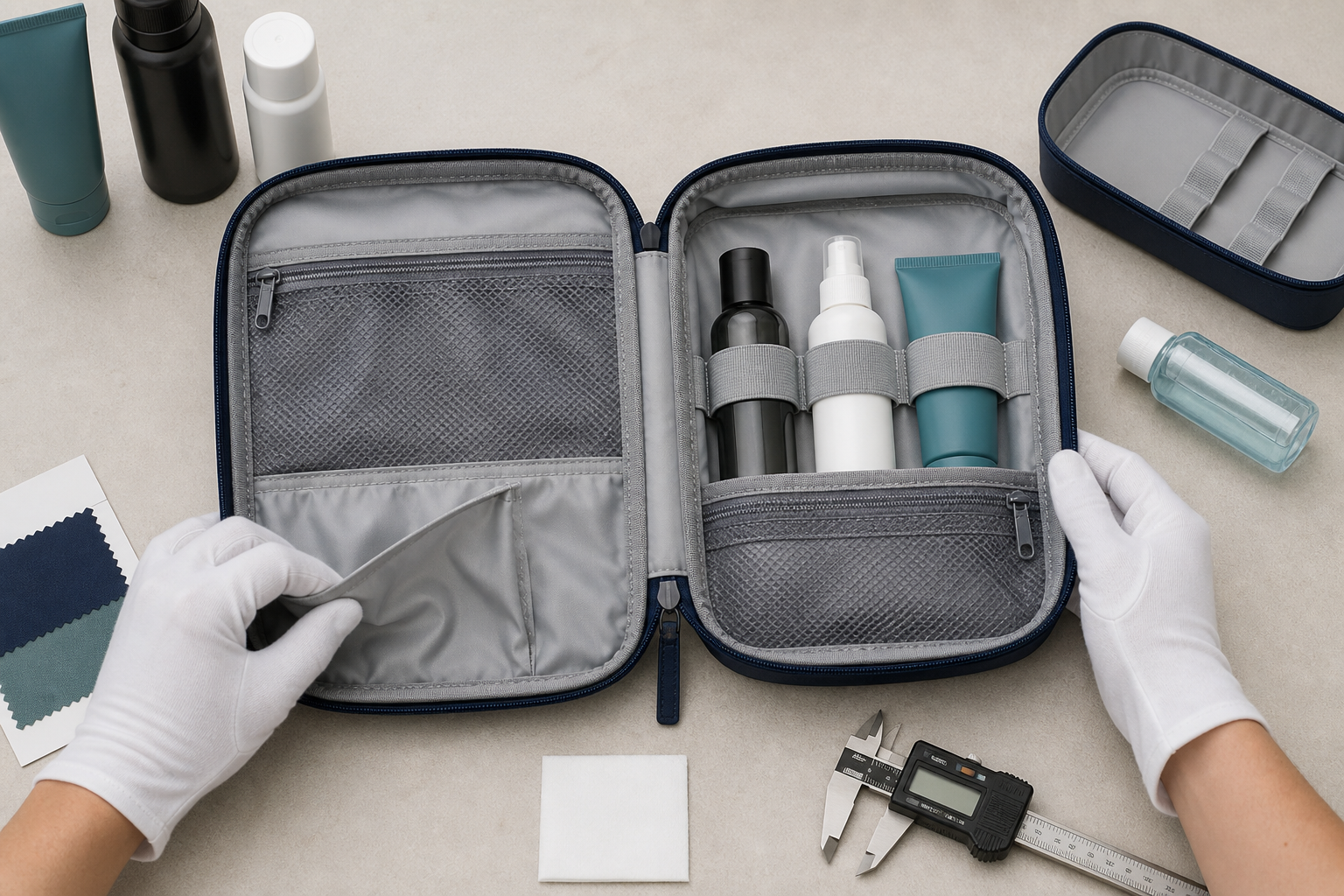
A sample should close decisions, not create a vague feeling of approval. Before it arrives, prepare a review sheet with measuring points, contents, closure checks, workmanship criteria, color references, logo position, packing and unresolved questions. The same sheet can later become part of the pre-production and final-inspection record.
| Sample question | Pass evidence | Typical correction |
|---|---|---|
| Do the intended items fit and remain accessible? | Recorded container set fits without distorting the closure or hiding key items | Change internal dimensions, opening, loop spacing or divider position |
| Can the interior be cleaned as promised? | Agreed test material is removed without visible damage or residue outside the accepted limit | Change lining surface, color, seam treatment or claim wording |
| Does the zipper work under realistic load? | Repeated cycles without snagging, excessive force or seam distortion | Adjust zipper length, corner radius, tape, slider or seam build-up |
| Does the bag keep its intended shape? | Left-right symmetry and stable loaded appearance after handling | Revise pattern, reinforcement, quilting, padding or assembly sequence |
| Is branding repeatable? | Artwork version, size, position, color and surface performance are recorded | Change method, backing, artwork size or placement tolerance |
The Custom Bag Sample Development Process provides a broader sequence for prototype, revision and pre-production approval. For this category, always add the real contents and cleaning expectation to the review.
7. Make cleanliness part of the quality plan
Beauty accessories are handled close to products, counters, bathrooms and luggage. Loose threads, adhesive marks, lint, dust, odor and fingerprints on clear panels can become customer complaints even when the stitching is strong. Define cleanliness at incoming, assembly and packing stages rather than relying on a final wipe.
A style-specific quality plan should also cover dimensions, symmetry, zipper operation, pocket position, seam and binding workmanship, logo placement, color, packing and assortment. Agree on defect categories, inspection sample size and the response if the lot fails. The Custom Bag Quality Inspection Checklist is a useful starting framework.
8. Normalize MOQ, cost and timing before comparing suppliers
A low unit price can come from an existing pattern, available material, standard zipper and simple bulk packing. A higher quote may include a custom lining, foam structure, molded panel, plated puller, printed box and more inspection work. Both may be reasonable, but they are different products.
Ask each supplier to state MOQ by bag style, body color, lining, zipper tape, hardware finish, artwork and packaging version. Then compare the same trade term and destination. Separate sample, tooling, testing, packaging, inspection, freight and duty from the production price. Our guides to typical custom bag MOQ and custom bag cost explain the wider commercial logic.
| Quote item | Question to ask | Common hidden difference |
|---|---|---|
| Pattern and sample | How many revisions and which courier costs are included? | One supplier prices only the first prototype |
| Materials and trims | Are lining, padding, zipper and hardware identical across quotes? | Descriptions sound similar but weight, finish or construction differs |
| Decoration | What artwork size, color count, tooling and approval sample are included? | A custom metal plate is compared with a printed logo |
| Packing | Does the price include inserts, barcode labels, retail box and carton protection? | Bulk polybag packing is compared with shelf-ready packaging |
| Delivery basis | Which Incoterm, location, readiness date and shipment mode apply? | EXW, FOB and delivered quotations are placed in one price column |
Lead time should begin from a defined event, such as approval of the pre-production sample and receipt of the deposit. Ask for dated milestones covering material, decoration, assembly, inspection and shipment. The guide How Long Does Custom Bag Production Take? shows how those stages connect.
A weighted cosmetic bag manufacturer scorecard
Use one scorecard for all finalists and attach a sentence of evidence to every score. Adjust the weights to match the order; for example, a deadline-driven gift-with-purchase campaign may place more weight on schedule, while a premium retail case may emphasize sample accuracy and construction.
| Evaluation area | Suggested weight | Score 1–5 from |
|---|---|---|
| Comparable construction experience | 20% | Recent evidence, process explanation and control of specialized operations |
| Functional sample and revision control | 20% | Fit, access, cleaning, zipper, shape and documented corrections |
| Material, lining and trim control | 15% | Measurable specifications, physical approvals and substitution prevention |
| Quality and cleanliness plan | 15% | Style-specific checks, tolerances, defect examples and records |
| Commercial transparency | 10% | Complete scope, MOQ drivers, exclusions, payment and repeat-order logic |
| Capacity and milestone plan | 10% | Order-specific output, current constraints, inspection time and delivery basis |
| Communication and ownership | 10% | Questions, version control, escalation and accountability across teams |
Why choose LUCKYSTAR for a custom cosmetic bag project?
LUCKYSTAR is a useful choice when a cosmetic bag must be developed as a product system rather than treated as a logo pouch. We help buyers connect the outside material, lining, structure, compartments, zipper, decoration, labels, packing and inspection requirements in one controlled brief. That is especially valuable when a beauty launch includes several sizes or related promotional products.
Our OEM/ODM support starts with the bag’s use and target contents. We can compare practical material and construction routes, coordinate sampling, record revisions and prepare the order for bulk quality control. If a proposed feature adds cost, MOQ or timing, the goal is to make that trade-off visible before approval—not after production starts.
- Category-focused development: cosmetic pouches, vanity cases, travel organizers and gift-set bags require different patterns and operations.
- Coordinated components: body material, lining, padding, mesh, elastic, zipper, puller, labels and packaging are reviewed together.
- Controlled samples: comments can be tied to actual contents, measuring points and numbered revisions.
- Multi-product support: buyers can combine beauty accessories with selected items from the required Product Range while keeping brand presentation coordinated.
- Export project management: production, inspection, packing and shipment requirements can be planned from the agreed specification.
Browse the LUCKYSTAR custom cosmetic bag collection for product starting points. Every final quotation remains project-specific because materials, construction, quantity, artwork, packaging, testing and destination change the production route.
Questions to send with the first RFQ
- Which recent product has the closest structure, lining, zipper path and compartment layout?
- Which steps will be completed by your own team, and which will be subcontracted?
- What information is missing from our brief before you can quote accurately?
- Which material or component creates the MOQ for each color and SKU?
- How will bulk material, zipper, hardware and color be linked to the approved sample?
- Which functional checks do you recommend for the intended contents and cleaning claim?
- What revisions, tooling, testing, packaging and freight are excluded from the price?
- What event starts the production lead time, and where is the current bottleneck?
- Which records are produced during incoming, in-process and final inspection?
- Who owns the controlled specification after the project moves from sales to production?
Frequently asked questions
Should I choose a stock cosmetic bag or full OEM production?
Choose stock or semi-custom production when speed, a lower starting quantity and a proven shape matter most. Choose OEM development when dimensions, capacity, lining, compartments, hardware and retail presentation must be specific to the brand. Compare the cost of limits as well as the unit price.
How many suppliers should receive a sample brief?
After basic screening, two or three serious candidates are usually enough for a controlled comparison. Sending a weak brief to many factories produces more prices, not more evidence. Use the same inputs and scoring method for each finalist.
Which cosmetic bag material is best?
There is no universal winner. The right material depends on hand feel, structure, cleaning, decoration, durability, market requirements, price and intended lifespan. Approve the full material system—outer, backing, lining and reinforcement—rather than selecting from a name alone.
What must be approved before mass production?
Approve the controlled specification, pattern and dimensions, materials and colors, zipper and hardware, logo, compartments, workmanship, functional checks, labels, packing, quality standard, milestone plan and a physical reference sample. List any open point with an owner and deadline.
Can LUCKYSTAR help develop a cosmetic bag from a sketch?
Yes, subject to project review. A sketch becomes more useful when it includes the intended contents, approximate dimensions, preferred material direction, quantity, artwork and target date. LUCKYSTAR can then identify missing decisions and propose a sampling route.
Make the choice auditable
The best cosmetic bag manufacturer is not necessarily the factory with the longest catalogue or the fastest first reply. It is the partner whose process makes the product repeatable: the contents fit, the surfaces behave as promised, the zipper works, the sample decisions reach the production line, and the quotation matches the order actually being made.
Use the scorecard, retain the evidence and make unresolved risks visible. For related sourcing decisions outside cosmetic bags, return to the Custom Bag Manufacturer Guide.

Discuss your cosmetic bag supplier requirements
You do not need a complete specification to start a conversation. Include these details in your message:
- Intended contents and sales channel.
- Approximate quantity and destination.
- Reference design and the construction details you need reviewed.
Discuss your cosmetic bag supplier requirements using the contact form, or Email a project brief with this article already referenced. The email link opens a draft in your email app; you can add artwork or a specification before sending.
MOQ, pricing, sample arrangements and delivery terms are subject to specification and written confirmation.