Intent boundary: This page covers USA production, assembly and supplier-model comparison. It is not the broad China supplier hub. For the complete sourcing workflow, use the China Cosmetic Bag Manufacturers Guide.
“Made in the USA,” “American manufacturer,” and “ships from a U.S.warehouse” describe three different supply chains. A cosmetic pouch may be cut and sewn in New Jersey, designed in Utah and produced in Asia, or imported as a blank and decorated in Illinois. Each route can serve a legitimate buying need, but the quotation, origin claim, minimum quantity and development control are not interchangeable.
This 2026 guide compares ten cosmetic bag manufacturers in the USA and U.S.-based sourcing partners using that distinction as the starting point. It helps beauty brands, promotional distributors, retailers and product teams choose between domestic cut-and-sew, a domestic/global manufacturing network, a decorated-stock route and U.S.-led offshore development. Buyers can first review LUCKYSTAR's custom cosmetic bag manufacturer options; for an international shortlist, see the Top 10 Custom Cosmetic Bag Manufacturers Worldwide in 2026.
Planning an order? Compare domestic and offshore routes with one controlled RFQ. Include the required origin claim, exact SKU construction, materials and component origin, quantity by SKU/color, branding, packing, evidence, target date and delivered-cost basis.
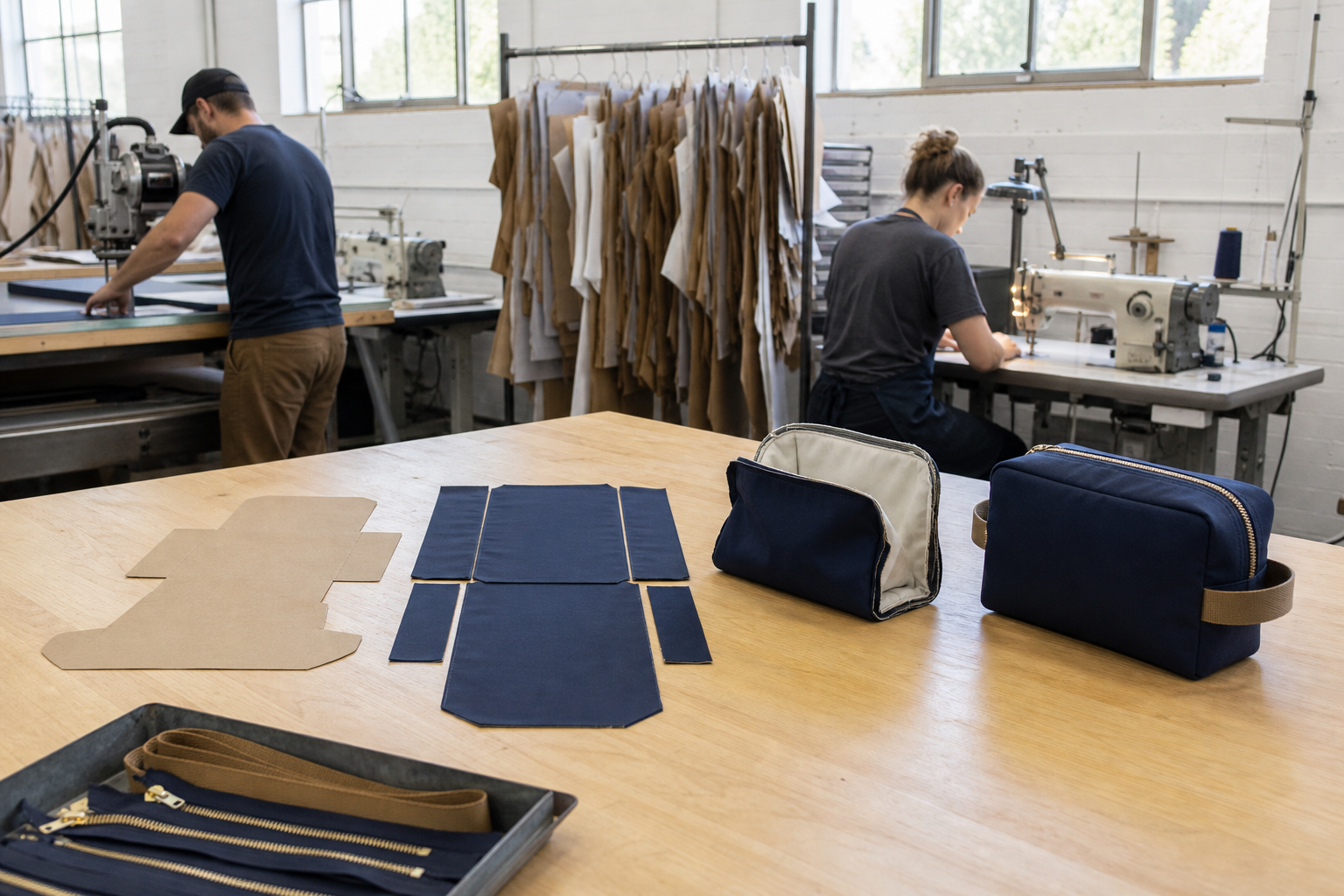
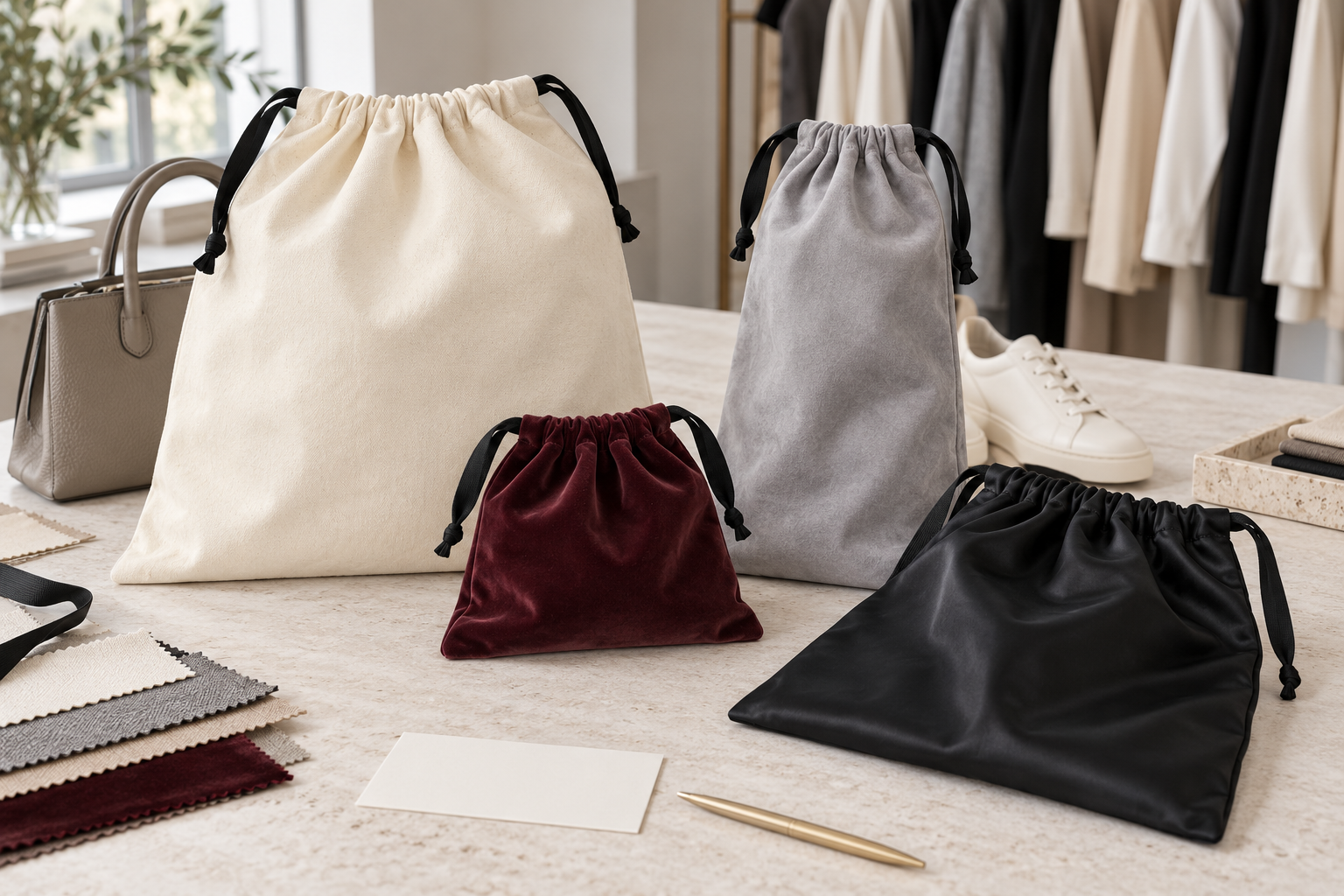
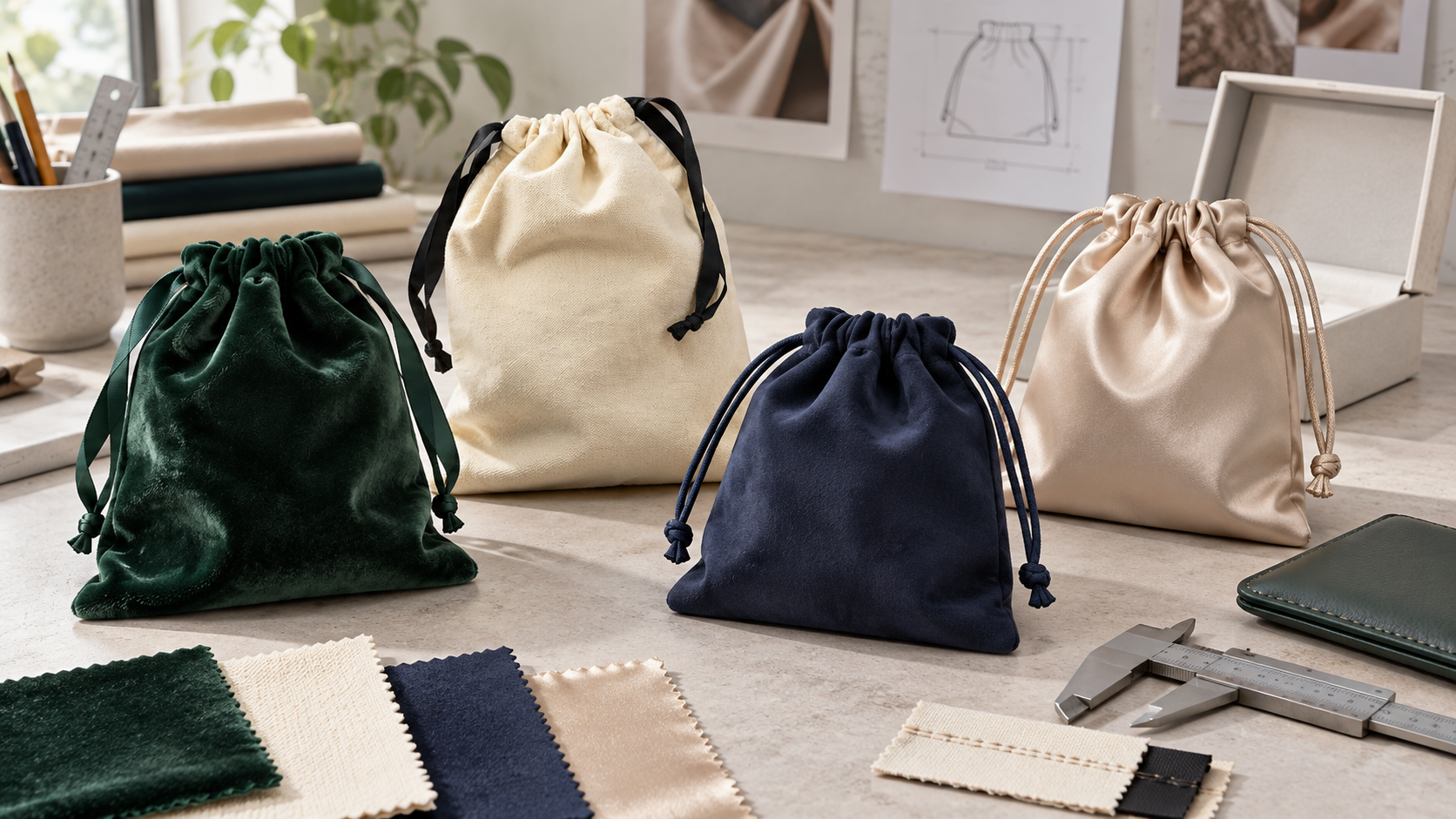
Domestic product development can combine pattern making, cutting, sewing and sample approval in one visible workflow.
Quick comparison: the 2026 USA shortlist
The sequence organizes different operating models for screening; it does not identify a universal winner. Unionwear publishes a cosmetic-specific domestic route. Allen Manufacturing and other contract sewers may fit when a brand owns, or is prepared to develop, a complete product specification. Royal Case publishes domestic and global options. Bag Makers and Uinta describe different U.S.-managed routes that must not be confused with fully domestic production.
| Company | Operating model | Potential fit to verify | Verify before ordering |
|---|---|---|---|
| 1. Unionwear | Newark, New Jersey; union-made domestic factory | USA-made cosmetic pouches, dopp kits and branded campaigns | Exact style, fabric origin, customization boundary and quantity tier |
| 2. Allen Manufacturing | Lewiston, Maine; domestic contract cutting, stitching and assembly | New patterns, small-to-growing runs and beauty accessories | Development fee, material sourcing, sample revisions and production slot |
| 3. Royal Case | Texas headquarters; U.S. and wholly owned global production network | Soft cosmetic cases, structured organizers and scalable programs | Order-specific factory, origin wording, MOQ and tooling ownership |
| 4. CustomFab USA | Southern California; large domestic white-label soft-goods factory | Engineered retail bags and established brands needing process depth | Cosmetic-specific finish, forecast, development readiness and test plan |
| 5. Bearse USA | Chicago and Puerto Rico; domestic non-apparel sewing contractor | Durable canvas, nylon and polyester pouches around 250+ units | Facility allocation, consumer finish and first-run minimum |
| 6. Gary Manufacturing | San Diego area; domestic sewing with selected overseas support | Responsive sampling, lower-volume nylon or vinyl bags | Whether the project is domestic or offshore and who controls QC |
| 7. A. Rifkin Co. | Wilkes-Barre, Pennsylvania; in-house contract sewing | Zippered pouches, cases and practical private-label sewn goods | Material/finish fit for beauty retail and current available capacity |
| 8. Fieldtex Cases | Rochester, New York; domestic contract sewing and kitting | Complex organizers, protective structures and kit assembly | Retail-aesthetic capability, line allocation and inspection standard |
| 9. Bag Makers, Inc. | Illinois; U.S. printing/supply plus domestic and global custom routes | Promotional cosmetic bags, stock decoration and distributor programs | Blank origin, manufacturing country and actual custom scope |
| 10. Uinta Design | U.S.-led design; production stated in China and Vietnam | 3D-led private-label development with managed offshore production | Factory country, legal seller, IP ownership and total landed cost |
Searches for cosmetic bag manufacturers in USA frequently blur these models. The same caution applies when a catalog advertises Made in USA cosmetic bags: confirm that the claim belongs to the selected item, not merely to another product in the supplier's range.
How we selected the ten companies
Google results for this topic often mix formula laboratories, consumer beauty brands, wholesalers and anonymous import websites with actual soft-goods manufacturers. We excluded companies that only manufacture creams or color cosmetics. Candidates needed public evidence of cosmetic bags, custom pouches, cases, contract sewing, product development or a managed bag-sourcing program.
| Evaluation area | Evidence reviewed | Buyer question |
|---|---|---|
| Production identity | Named U.S.facility, explicit overseas network or a documented mixed model | Where will this exact SKU be cut, sewn, decorated and packed? |
| Cosmetic-bag relevance | Cosmetic cases, toiletry kits, zip pouches, organizers or comparable soft cases | Can the supplier show a recent sample with similar finish and construction? |
| Development depth | Pattern making, prototyping, engineering, sourcing and revision support | Does the quote cover a new product or decoration of an existing body? |
| Process range | Cutting, sewing, welding, printing, embroidery, assembly, inspection and packing | Which operations are controlled in-house? |
| Commercial fit | Quantity guidance, sample path, domestic responsiveness and ability to scale | Can the route meet the launch date and target cost without changing the specification? |
| Transparency | Clear language about domestic, global or mixed manufacturing | Can the origin claim be substantiated for the final bag and its components? |
This is a research shortlist, not a certification or paid award. A polished web page cannot replace factory due diligence, controlled samples and a written quality agreement. Use our cosmetic bag manufacturer selection checklist to compare finalists consistently.
Made in USA, assembled in USA or U.S.-based supplier?
The distinction is more than marketing language. The Federal Trade Commission Made in USA Rule says an unqualified “Made in USA” claim should be supported when a product is “all or virtually all” made in the United States. The FTC also explains that qualified statements—describing U.S. and imported inputs or a specific domestic process—must be truthful and clear. This article is not legal advice; brands should review their actual facts and current requirements before approving labels, packaging or advertising.
| Claim or description | What it usually signals | Evidence to request |
|---|---|---|
| Made in USA | An unqualified domestic-origin statement | Factory route, significant processing, component origin and supplier substantiation |
| Made in USA of U.S.and imported components | A qualified claim acknowledging foreign inputs | Component map and wording reviewed against the actual bill of materials |
| Sewn or decorated in USA | A specific U.S. process, not necessarily domestic product origin | Origin of the blank, fabric, zipper and other major components |
| Designed in USA | Development location only | Bulk production country and final country-of-origin marking |
| U.S.-based supplier | Sales, design, warehousing or project management in the United States | Legal seller, manufacturer, origin, importer of record and QC responsibility |
1. Unionwear — listed for cosmetic-specific domestic option
Location and model: Newark, New Jersey; union-made custom wearables and bags produced at the company's U.S. factory.
Unionwear publishes a dedicated cosmetic and makeup bag category rather than asking buyers to infer capability from industrial cases. Its listed directions include polyester cosmetic cases, canvas dopp kits, zip pouches and travel toiletry formats. The company states that its custom bags are made at its Newark factory and offers wholesale customization.
Unionwear may be a screening candidate when domestic or union production is a non-negotiable campaign requirement. Its catalog-based bodies may also reduce pattern-development risk. Yet buyers should still distinguish a catalog adaptation from a completely original pattern, and ask which fabrics or components are domestic or imported before repeating an origin claim.
- Possible fit: political, union, institutional, promotional and beauty programs requiring U.S. production.
- Public profile signal: cosmetic-specific catalog, domestic factory statement and decoration options.
- Verify: style-specific MOQ, fabric/component origin, logo method, lining options and full-custom limits.
2. Allen Manufacturing — listed for domestic development from pattern to packing
Location and model: Lewiston, Maine; family-run contract cutting, stitching, assembly and kitting.
Allen Manufacturing describes a workflow that can cover pattern making, sampling, die making, production, inspection, packaging and shipping. Its published capability sheet explicitly lists cosmetic bags and says projects may begin around 100 units before growing into larger programs. That makes Allen particularly relevant to an emerging brand that has a real design but is not ready for a large offshore minimum.
Contract manufacturers often expect more technical input than promotional catalog suppliers. Bring target dimensions, material direction, closure, lining, sample reference and annual forecast. Confirm who purchases components, how development time is charged and whether the first sample is built with production-intent materials.
- Possible fit: original small-batch cosmetic pouches and founders scaling a proven domestic product.
- Public profile signal: cosmetic bags are named in its capability material and the workflow covers development through packing.
- Verify: active minimum, sample/revision charges, sourcing responsibility and scheduled capacity.
3. Royal Case — listed for scale and structured case capability
Location and model: Sherman, Texas headquarters with U.S. production plus wholly owned manufacturing facilities in several countries.
Royal Case says it was founded in 1982 and operates a large network spanning custom sewing, molded cases, foam fabrication, branding, packaging, warehousing and global logistics. Its public materials include cosmetic bags among the soft-case possibilities. This breadth is useful for a beauty brand developing a structured organizer or kit that sits between a soft pouch and a protective case.
The network is also why origin must be frozen in the quotation. “Made in USA and globally” is a capability statement, not the origin of a particular SKU. Ask where the approved sample and bulk order will be produced, how a factory transfer is controlled, and whether the quoted tooling or pattern belongs to the buyer.
- Possible fit: structured beauty storage, mixed soft/hard constructions and scalable national programs.
- Public profile signal: engineering depth, broad manufacturing network and logistics support.
- Verify: factory country, origin wording, MOQ, tool ownership, test plan and change-control process.
4. CustomFab USA — listed for engineered white-label soft goods
Location and model: Southern California; American contract sewing and white-label manufacturing.
CustomFab USA states that it has operated since 1990, employs more than 300 people and uses a 77,000-square-foot facility with dedicated R&D and quality teams. Its process list includes sewing, laser cutting, RF welding, sublimation and stitchless seam taping; although its visible markets lean medical, military, sporting goods and luggage, those capabilities can translate to demanding beauty organizers when the project has a developed technical brief.
A factory optimized for engineered soft goods may not automatically produce the delicate binding, decorative hardware or luxury hand feel a beauty buyer expects. Request a cosmetic-specific sample and cosmetic defect board rather than assuming industrial durability equals retail finish.
- Possible fit: established brands needing advanced processes, domestic development and repeatable construction.
- Public profile signal: large U.S. white-label operation and unusually broad equipment base.
- Verify: beauty-retail finishing experience, forecast requirement, development readiness and decoration partners.
5. Bearse USA — listed for durable domestic pouches around 250+ units
Location and model: Chicago, Illinois and Mayagüez, Puerto Rico; domestic non-apparel sewing contractor.
Bearse USA traces its history to 1921 and describes U.S. production across bags, pouches, cases and covers. Its capability page lists a 50,000-square-foot Chicago facility, a 23,000-square-foot Puerto Rico facility, in-house sample making and a typical minimum of 250 pieces. The quote form covers canvas, vinyl, nylon, polyester and cotton, plus zippers, linings, labels, embroidery and screen printing.
Those inputs make Bearse practical for a robust toiletry pouch or functional beauty kit. For a soft luxury bag, the buyer should define seam appearance, stitch density, lining cleanliness, zipper-wave limit and hardware protection; rugged construction alone does not create a premium retail result.
- Possible fit: durable travel, hospitality, institutional and utility-led cosmetic bags.
- Public profile signal: century-scale sewing experience, documented domestic facilities and clear RFQ inputs.
- Verify: selected facility, current MOQ, production materials, retail finish and packaging.
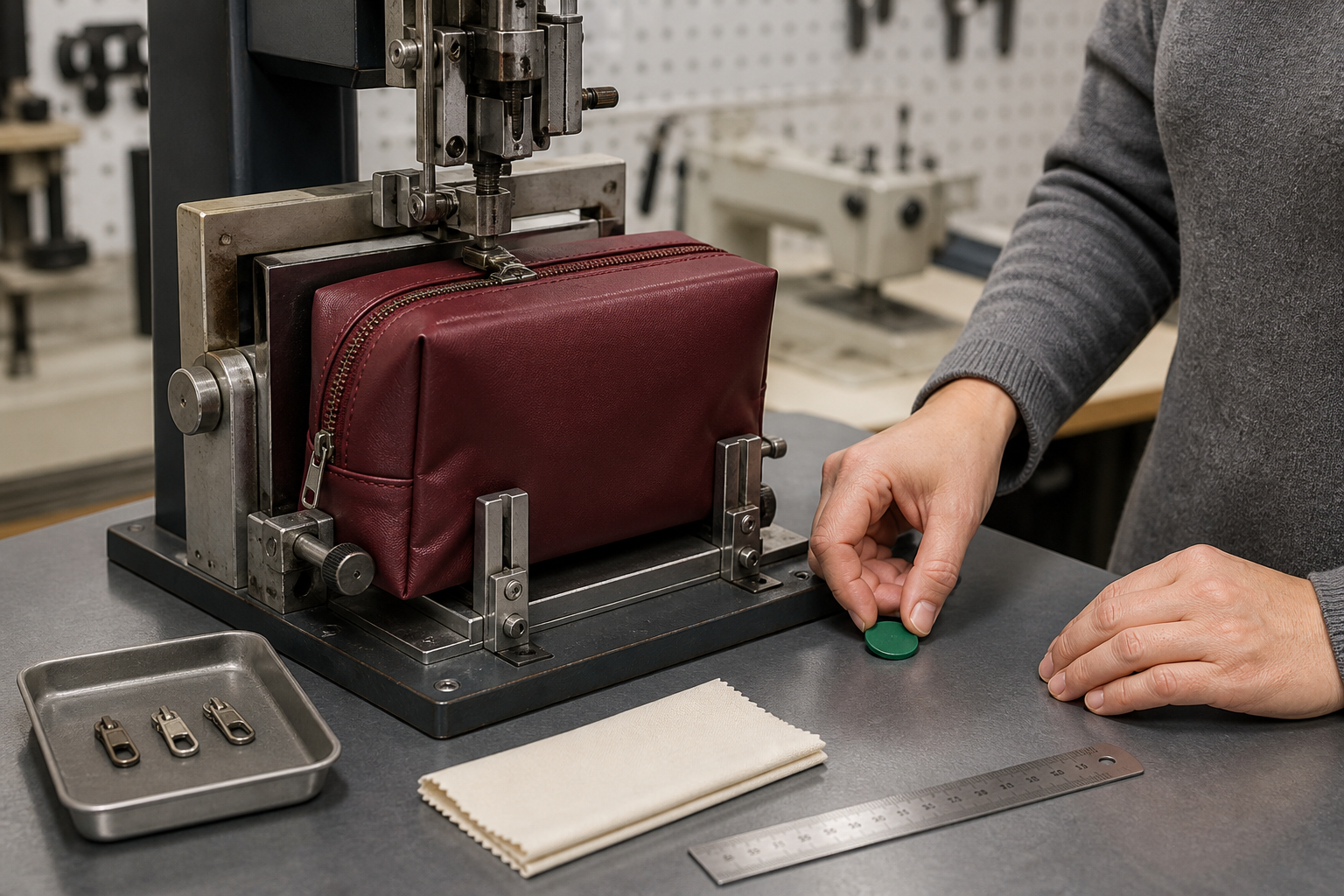
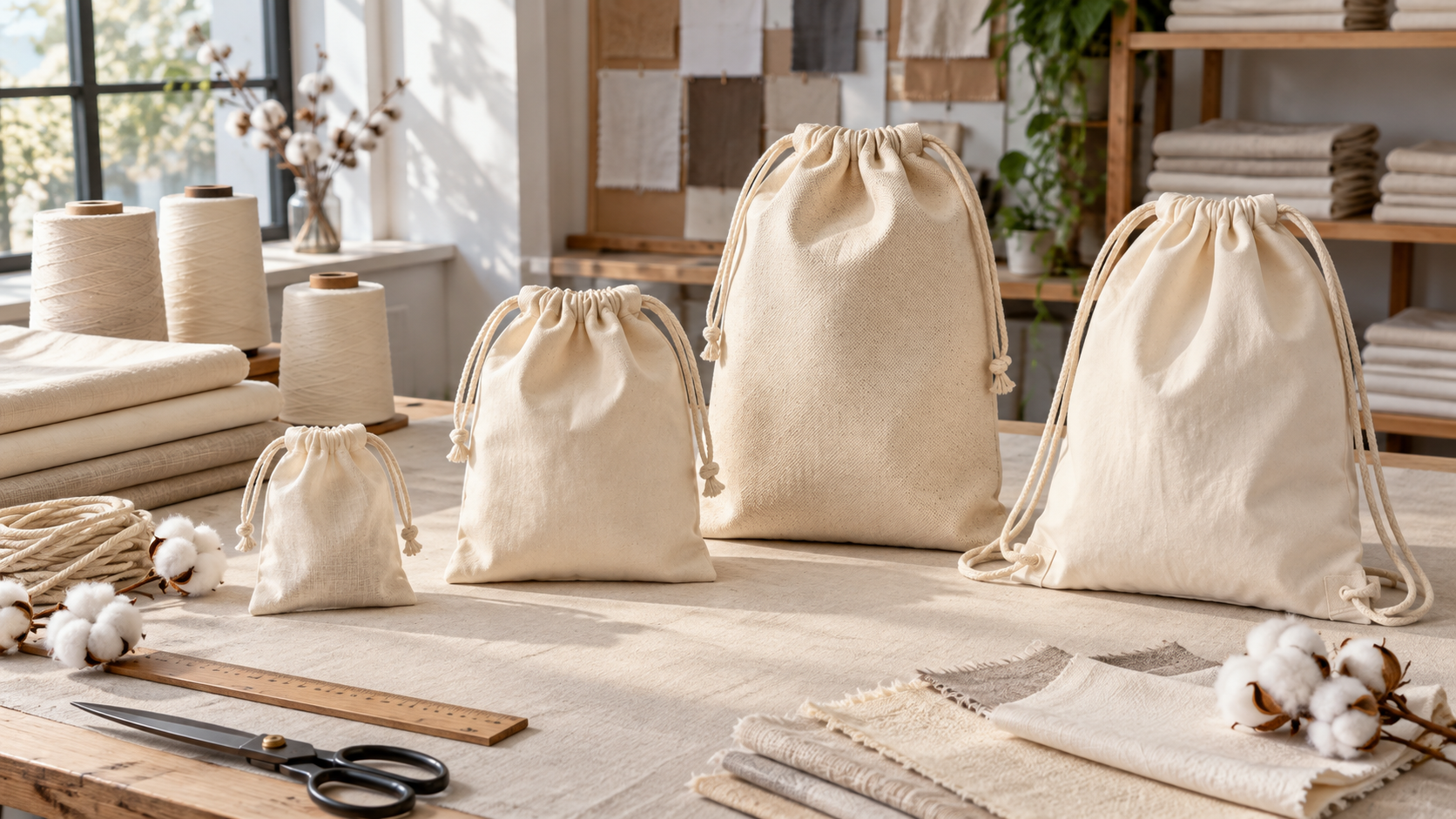
A domestic factory can shorten feedback loops, but the buyer still needs measurable zipper, seam and appearance criteria.
6. Gary Manufacturing — listed for responsive domestic custom sewing
Location and model: San Diego area, California; U.S. production with selected overseas coordination for some private-label programs.
Gary Manufacturing says it has manufactured sewn products since 1958 and operates cutting, sewing, finishing, inspection and shipping from a 10,000-square-foot California facility. Its custom bag information highlights nylon, vinyl, promotional decoration, in-house design and relatively low minimums. The company also transparently notes that selected high-volume or cost-sensitive private-label projects may use overseas partners.
That transparency creates a useful choice: pay for domestic responsiveness or request a managed offshore route when volume and target cost justify it. Put the route in writing before sample approval. A U.S.-sewn sample should not silently become an overseas bulk order without transfer controls and buyer consent.
- Possible fit: practical nylon/vinyl pouches, lower-volume development and programs evaluating domestic versus offshore supply.
- Public profile signal: long-running U.S. sewing operation and explicit mixed-route disclosure.
- Verify: production country, sample origin, supplier-managed QC, MOQ and approved material source.
7. A. Rifkin Co. — listed for zipper-heavy pouches and cases
Location and model: Wilkes-Barre, Pennsylvania; contract cutting, sewing, customization and assembly.
A. Rifkin Co. states that its textile manufacturing history dates to 1892 and describes a specialization in fabric security bags. Its contract-sewing page lists consumer and commercial textile goods, with sewing described as in-house at a 69,000-square-foot Pennsylvania facility. Security products are not cosmetic bags, but repeated zipper installation, pouch construction, identification and durable assembly are relevant process signals.
The gap is aesthetic specialization. A beauty brand should send a finish standard, not just a drawing. Evaluate exposed seam ends, zipper corners, lining fit, binding joins, logo position, surface cleanliness and retail packaging. Ask whether the factory can source fashion hardware or expects customer-supplied components.
- Possible fit: functional zip pouches, organized kits and brands prioritizing domestic construction.
- Public profile signal: deep zipper-bag experience and substantial in-house U.S. operation.
- Verify: beauty-grade component sourcing, available capacity, sample finish and final inspection criteria.
8. Fieldtex Cases — listed for complex organizers and kit assembly
Location and model: Rochester, New York; domestic contract sewing, engineering and fulfillment.
Fieldtex Cases describes U.S. contract manufacturing from prototype through production, with an in-house design team and more than 125 sewing machines. Its background is medical, military and industrial soft cases rather than beauty fashion. That becomes an advantage when a cosmetic organizer needs removable inserts, padded brush storage, elastic loops or a complex kit pack-out.
Fieldtex may offer more engineering depth than a basic promotional flat pouch requires. It becomes more relevant when organization and failure resistance justify engineering work. Ask for retail-facing samples and define acceptable material hand feel, color, decoration and interior cleanliness.
- Possible fit: professional makeup organizers, protective beauty-device cases and assembled treatment kits.
- Public profile signal: domestic design/engineering, scalable sewing and kitting experience.
- Verify: beauty-retail finish, prototyping cost, production line, material minimum and kit-count controls.
9. Bag Makers, Inc. — listed for distributor-led promotional programs
Location and model: Illinois-based printed bag supplier using U.S. decoration, USA-made product lines and global custom manufacturing.
Bag Makers, Inc. says it was founded in 1980, employs nearly 300 people and offers more than 230 packaging products with many printing processes. It sells through promotional-product distributors rather than directly to every end buyer. Its Design Centre supports custom dimensions, pockets, closures and accents through domestic and global capabilities.
This may be a practical route when speed, stock availability and campaign printing matter more than original product engineering. It is essential to identify the blank's origin. A bag printed in Illinois is not automatically a U.S.-made bag, while specific catalog items may have a substantiated domestic claim.
- Possible fit: promotional cosmetic pouches, event kits and distributors managing decoration.
- Public profile signal: broad printing capability, inventory and custom design services.
- Verify: blank origin, exact manufacturing route, distributor margin, stock allocation and decoration tolerance.
10. Uinta Design — listed for U.S.-led design with offshore production
Location and model: U.S.-based development with offices in North America, Amsterdam and China; manufacturing stated in China and Vietnam.
Uinta Design offers cosmetic bag development beginning with 3D mockups, followed by sourcing, sampling, private-label production and quality control. It is included because U.S. buyers often search by supplier location when they actually need local design communication and managed offshore economics. Uinta does not present the listed cosmetic bags as Made in USA.
The model may simplify product visualization and vendor management, but it adds a layer between buyer and factory. Confirm the legal seller, factory country, pattern and artwork ownership, sample-revision limit, inspection standard and whether the factory can be disclosed or visited.
- Possible fit: brands wanting U.S.-time-zone development support and lower offshore unit costs.
- Public profile signal: cosmetic-specific design workflow and visible private-label process.
- Verify: production site, origin marking, IP ownership, fees, MOQ and landed-cost responsibility.
Which U.S. manufacturing route fits your cosmetic bag?
| Project situation | Route to evaluate | Candidates to verify | Main trade-off |
|---|---|---|---|
| Verified domestic or union-made campaign | Domestic catalog/custom factory | Unionwear | Higher unit cost and narrower component library |
| Original small-batch beauty pouch | Domestic pattern-to-production contractor | Allen Manufacturing or Gary Manufacturing | Development cost must be spread over fewer units |
| Engineered or professional organizer | Technical case and contract-sewing factory | Royal Case, CustomFab USA or Fieldtex | May need extra work to reach a beauty-retail finish |
| Durable utility pouch | Non-apparel domestic sewer | Bearse USA or A.Rifkin | Fashion trims and delicate materials may require sourcing |
| Fast branded promotion | Stock blank plus domestic decoration | Bag Makers | Less structural exclusivity and variable product origin |
| U.S.design support with offshore economics | Managed global sourcing | Uinta Design | Less direct factory access and longer physical supply chain |
| Fully custom higher-volume OEM/ODM | Direct China manufacturing/export partner | LUCKYSTAR | International freight, import planning and longer replenishment path |
Comparison boundary: every supplier description on this page is a screening summary of public, supplier-controlled information. Manufacturing route, origin, facilities, capabilities, certificates, customer references, MOQs, capacity, prices and schedules must be verified for the exact legal entity, site and order. LUCKYSTAR statements are publisher self-description and remain subject to the same order-specific verification.
When U.S. buyers may consider LUCKYSTAR
Domestic production is valuable when origin, proximity, rapid iteration or a smaller run outweigh unit cost. For a fully custom beauty program at larger volume, a direct OEM/ODM route can open a wider selection of shell fabrics, coated linings, zippers, molded pulls, metal hardware, printing, quilting and pack-out options.
LUCKYSTAR describes its role as coordinating development, sampling, production, inspection, packing and export support from Ningbo, China; the exact production route remains order-specific. A U.S. buyer can share the commercial target and technical brief, then compare specification and cost alternatives while keeping required features visible in the quotation. Its broader Product Range is useful when a launch combines cosmetic pouches with totes, travel bags, apparel or promotional gifts.
The right comparison is not domestic unit price versus offshore unit price. It is domestic total cost versus offshore landed cost, including tooling, inspection, freight, duty, inventory, reorders and delay risk. Buyers considering a China route can compare the Top 10 Cosmetic Bag Manufacturers in China in 2026 or ask LUCKYSTAR to review the brief.
Build one RFQ for fair domestic-versus-offshore comparison
| Cost or control item | Domestic quote | Offshore quote | Normalize before deciding |
|---|---|---|---|
| Product specification | May use locally available materials or catalog bodies | May offer more custom components at larger minimums | Same dimensions, material grade, lining, zipper, decoration and packing |
| Development | Faster physical feedback; higher local labor cost | Lower sample labor but longer shipping/revision cycle | All pattern, tooling, sample, courier and revision charges |
| Inspection | Easier buyer visit, but inspection still needed | Third-party or supplier inspection normally planned before shipment | Equivalent AQL, tests, defect definitions and reinspection cost |
| Logistics | Domestic parcel or freight | International freight, customs, duty and inland delivery | Delivered or landed cost to the same destination |
| Inventory | Potentially smaller replenishment lots | Usually larger economic runs and longer replenishment | Cash tied up, storage, forecast error and obsolete stock |
| Origin claim | May support a qualified or unqualified U.S. claim if substantiated | Must carry correct foreign origin | Value of origin positioning plus compliance evidence |
A serious RFQ should state quantity by color, desired origin, finished dimensions, shell/lining, reinforcement, closure, branding, packing, destination, mandatory tests and launch date. Attach the revision-controlled specification described in How to Prepare a Cosmetic Bag Tech Pack.
Sample and quality checks for any U.S. supplier
- Confirm the sample's origin. A U.S.-sewn prototype and overseas bulk run are two production systems; the transfer must be documented.
- Seal the reference. Sign or tag the approved sample and connect it to the current specification and bill of materials.
- Measure function. Check zipper cycling, handle load, seam strength, lining fit, pocket access and usable capacity.
- Define appearance defects. Establish limits for skipped stitches, puckering, zipper waves, color variation, scratches, glue, loose thread and logo position.
- Test the actual materials. Restricted substances, colorfastness, coating performance and cleaning tests must apply to the production-intent components.
- Inspect packing too. Verify labels, origin marking, barcodes, unit protection, carton quantity and transit resistance.
| Checkpoint | Simple verification method | Release record |
|---|---|---|
| Zipper function | Cycle representative samples and examine slider, teeth, end stops and surrounding seam | Cycle count, failures and approved zipper specification |
| Seam construction | Compare stitch type, density, allowance, reinforcement and pull resistance with the approved sample | Construction photos and defect limits |
| Interior finish | Turn out the lining where possible and inspect binding, pocket alignment and clean assembly | Interior standard and appearance board |
| Branding | Measure position and check color, adhesion, stitch-out or hardware orientation | Artwork revision, tolerance and signed color target |
| Origin and labeling | Match sewn labels, packaging and carton marks to the approved production route | Approved claim wording and label artwork |
| Pack-out | Confirm unit protection, barcode scan, carton quantity and transit condition | Packing instruction and inspection report |
The Custom Cosmetic Bag Sample Development Process explains the approval gates. For bulk release, combine the Cosmetic Bag Quality Control Checklist with the custom cosmetic bag testing guide.
Frequently asked questions
Are all companies on this list Made in USA cosmetic bag manufacturers?
No. The table distinguishes domestic factories, mixed domestic/global networks, U.S. decoration suppliers and U.S.-led offshore development partners. Unionwear makes an explicit domestic claim for its listed bags. Every buyer should confirm the exact SKU and wording rather than generalize from a company address.
Which USA cosmetic bag manufacturer is best for low quantities?
Allen Manufacturing publicly describes projects that can begin around 100 units, while Bearse states a typical 250-piece minimum and Unionwear publishes quantity tiers for catalog styles. These are screening indicators, not guaranteed current offers. Material, artwork and pattern complexity can raise the minimum.
Why are American-made cosmetic bags more expensive?
Labor, overhead, smaller material purchases and shorter production runs often raise unit cost. The premium may purchase smaller replenishment quantities, easier visits, faster feedback and an origin story. Compare total inventory and risk, not only sewing price.
Can a U.S. manufacturer source imported fabric or zippers?
Yes. Domestic cutting and sewing do not automatically mean every component is American-made. That distinction affects both product specification and origin marketing. Obtain a component map and use accurate qualified language where needed.
What is the difference between a contract sewer and a full-service cosmetic bag factory?
A contract sewer may excel at patterns, cutting and assembly while expecting the buyer to provide detailed specifications or source unusual beauty hardware. A full-service factory usually integrates more material, trim, decoration and export sourcing. Confirm responsibilities instead of relying on the label.
Can a U.S. company manufacture my bags overseas?
Yes. Royal Case, Gary Manufacturing, Bag Makers and Uinta describe different global or mixed capabilities. The purchase agreement should identify the actual country, factory or approved supplier route, quality control and origin marking.
Should a startup choose domestic or China production?
Domestic production can suit smaller validation runs and rapid hands-on development. China production becomes attractive when customization depth, component access or scale lowers total cost. Use the same specification to compare both routes and protect enough cash for marketing and reorders.
How do I verify a U.S. manufacturer?
Check its legal entity and facility address, request a live production walkthrough, identify in-house and outsourced steps, review a relevant sample and place origin requirements in writing. If the program needs a formal audit or certification, confirm the document covers the actual site and dates.
Final recommendation
Start with the operating model, not the company name. A domestic campaign pouch, professional beauty organizer and high-volume private-label case require different suppliers. Send the same controlled RFQ to two or three relevant candidates, compare equivalent samples and insist that origin follows the actual production route.
For the broader OEM/ODM decision framework, return to the Custom Bag Manufacturer Guide, or reopen the worldwide manufacturer comparison before fixing the production country. If your project needs a fully customized cosmetic bag, coordinated merchandise and export support from China, review LUCKYSTAR's cosmetic bag collection and share the quantity, design, target market and launch date.

Request a custom cosmetic bag quotation
Request a domestic-versus-offshore comparison RFQ
Use one specification for every candidate: required origin claim, SKU construction, materials and component origin, quantity by SKU/color, branding, packing, evidence, target date and the same delivered-cost basis.
Review LUCKYSTAR custom cosmetic bag options, then send your project details through the contact form or Email a project brief. The email link opens a draft for your review before sending.
Supplier fit, factory route, country of origin, materials, construction, branding, samples, testing, documentation, packaging, inspection, MOQ, price, schedule and delivery terms are subject to due diligence, specification and written confirmation. Origin and advertising claims remain the buyer's and marketer's responsibility.