Two non-woven shopping bags can use the same polypropylene web and still behave like different products. Leave the web exposed and the bag has a soft, matte, textile-like surface that suits direct branding and compact packing. Add a film or coating and the surface can become smoother, stiffer, more graphic and easier to wipe—but the laminate also creates new interfaces that can wrinkle, block, scuff or separate.
This guide treats Laminated vs Unlaminated Non-Woven Bags as a comparison of complete surface-and-construction systems. It explains what buyers need to specify, which claims require evidence and why a fully converted bag—not a flat swatch—must approve the final choice.
See available formats on LUCKYSTAR’s custom shopping bags product page. For factory qualification, use this material guide together with How to Choose a Custom Shopping Bag Manufacturer and the broader Custom Bag Manufacturer Guide.
Planning an order? Send one surface-system comparison brief. Include the base web, intended basket/load, dimensions, artwork and coverage, bare/coated/film preference, quantity by size/color/artwork/finish, care or water claim, tests, packing, destination and required date.
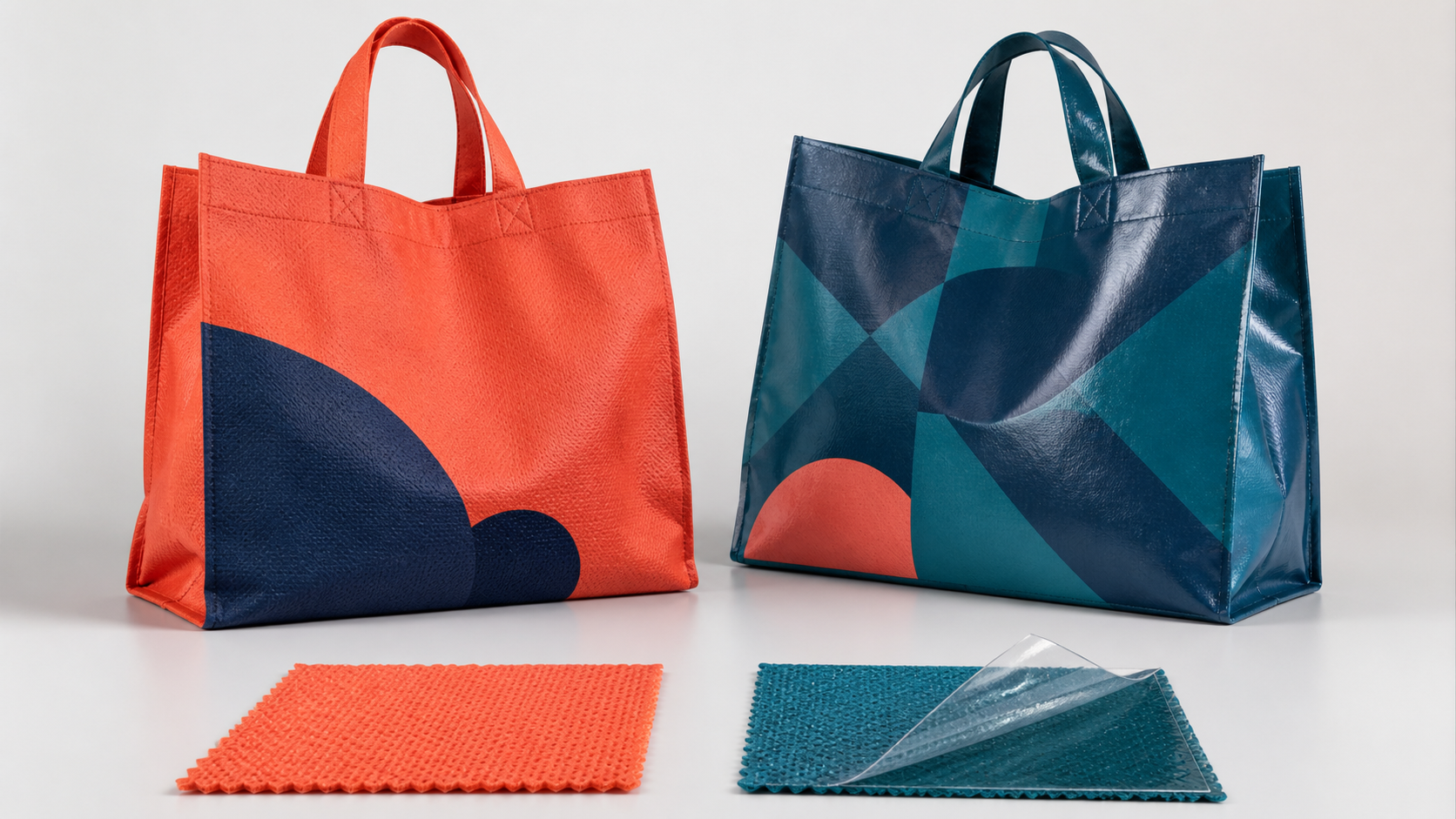
The base web may be similar; the added surface layer changes appearance, conversion and failure modes.
| Buying question | Unlaminated non-woven | Laminated non-woven | Approval focus |
|---|---|---|---|
| Desired hand and look | Soft, matte, visible bond-point texture | Smoother, more structured; gloss, matte or texture depends on film | Physical surface reference under retail lighting |
| Artwork | Often best for simple direct marks and moderate coverage | Can support full coverage, gradients or photographic printed-film graphics | Production-substrate proof plus converted registration map |
| Surface moisture | Open web can admit moisture through pores and interfaces | Film-covered panel may resist surface wetting; edges and joins remain | Claim-specific panel and finished-bag exposure |
| Cleaning | Gentle spot or wipe method only after validation | Often easier to wipe, but cleaner can affect print, gloss and bond | Defined cleaner, repetitions, drying and post-clean function |
| Packing | Usually compact; watch print transfer and web creasing | May occupy more cube; watch blocking, scuff and fold whitening | Production fold and packed-hold carton trial |
| Commercial route | Fewer surface operations can suit simple programs | Film print, lamination and conditioning add run constraints | MOQ by artwork × size × body build, not total PO alone |
1. Lamination is a layer system, not a quality grade
A nonwoven is not a woven fabric with missing threads. ISO 9092:2026 defines nonwovens and supplies terminology that distinguishes them from other materials. In common spunbond polypropylene shopping-bag stock, filaments are laid into a web and given structural integrity through bonding. The small embossed points visible on the surface are part of that web architecture.
“Laminated” adds another question: exactly what is attached to the web, on which side, by what process and at what build? The answer may be a transparent film over direct print, a reverse-printed film bonded to the web, a surface coating applied through extrusion, or a two-sided decorative construction. Film polymer, ink position, tie layer or adhesive, surface treatment and curing/conditioning can differ.
Therefore, the words laminated non-woven are not a complete purchase specification. A glossy printed-film product and a thin clear-coated promotional bag may share the label while having different hand, graphics, joins, minimums and risks.
2. Name the exact surface architecture
The first RFQ decision is not simply yes/no lamination. It is the layer architecture. Buyers should state whether both faces need the same finish, whether artwork sits above or below the film, and whether exposed non-woven at the inside or gusset is acceptable. A single vague line such as “PP non-woven, laminated” transfers these decisions to the supplier and makes quotes hard to compare.
| Surface architecture | What the build means | Typical reason to consider it | Distinct risk to control |
|---|---|---|---|
| Bare unlaminated web | Bonded non-woven remains the exposed surface; artwork is applied directly where specified | Matte hand, stock body colors, simple logo, compact pack | Print opacity/rub, fuzz, surface treatment and local thin zones |
| Extrusion-coated web | A polymer layer is formed directly onto one or both web faces | Continuous surface, controlled finish or process-specific conversion | Uneven coat, pinholes, heat effect, edge curl and coating adhesion |
| Clear film over printed web | Directly decorated web receives a transparent protective film | Retain visible web/print while changing cleanability or gloss | Silvering, bubbles, optical distortion and print/film compatibility |
| Reverse-printed film + web | Artwork is printed on the film side that becomes protected inside the composite | Full coverage, high color density, gradients and repeated patterns | Wrong print orientation, registration drift, weak bond and fold whitening |
| Two-sided/special finish | Different or matching layers cover both faces, possibly with matte or embossed finish | Finished interior, stronger structure or premium presentation | Higher stiffness/mass, sealing window, cube and material complexity |
For each option record: base composition and mass per area; web formation, color and direction; film/coating composition and thickness or mass; one- or two-sided application; ink position; adhesive or extrusion route; gloss/texture; total build; and target bond. Add a small diagram to the tech pack. The Custom Shopping Bag Tech Pack guide explains how to connect those material notes to panels, folds, handles and artwork datums.
3. The manufacturing sequence creates different approval gates
An unlaminated bag may move from web approval to surface treatment, direct printing, cutting/forming and joining. A printed-film laminated bag adds film preparation, color control, web alignment, lamination, conditioning and inspection before the material can be converted. A defect created early can repeat across every panel cut from the affected roll.
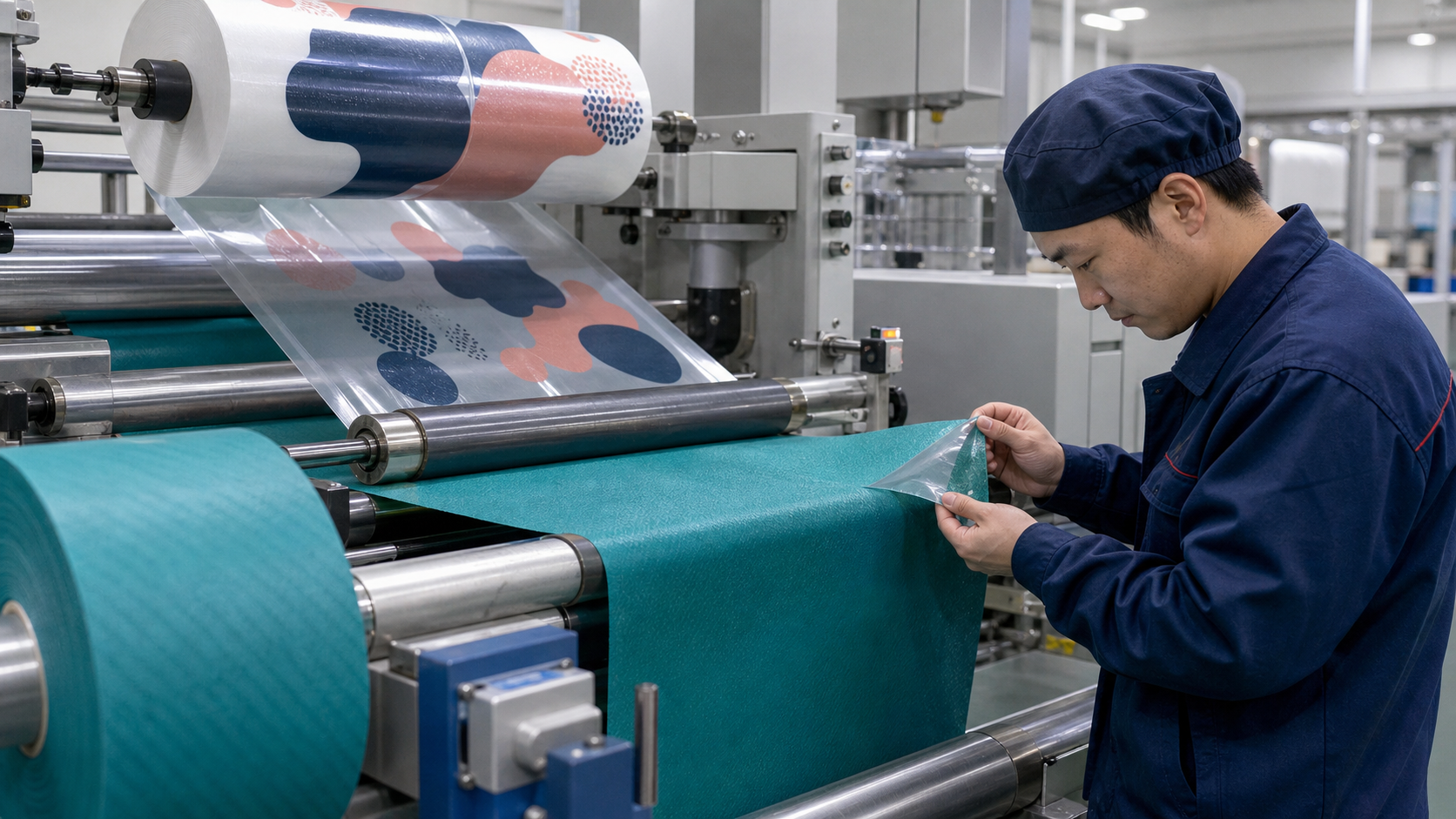
Web tension, registration, nip conditions and clean surfaces determine whether a laminated roll converts consistently.
| Stage | Unlaminated route | Laminated route | Release evidence |
|---|---|---|---|
| Base web | Approve formation, mass, color, surface treatment and direction | Approve the same base inputs; they remain load-bearing beneath the film | Lot/roll ID, representative swatch and agreed readings |
| Artwork preparation | Separate direct-print screens/plates and color drawdown | Film artwork, repeat, print side, color sequence and laminate orientation | Signed proof tied to substrate/film and ink system |
| Surface operation | Treat and print the exposed web where required | Align film/web, apply tie/adhesive or extrusion layer, nip and condition | First-off for bond, bubbles, curl, register, shade and blocking |
| Cut and form | Cut roll/panels; form gussets; keep print and web direction controlled | Cut composite against artwork datum; fold without cracking, tunnelling or edge lift | Converted panel and fully formed bag, not flat roll only |
| Join and handles | Ultrasonic/thermal bond or sewing within the approved web window | Revalidate sealing/bonding; sewing/binding may be selected around film behavior | Join cross-section, handle pull and complete-bag load result |
| Pack-out | Control ink transfer, folds, odor and handle tangles | Control blocking, scuff, fold whitening, compression and edge deformation | Actual bundle/carton hold followed by recovery inspection |
The end-to-end Custom Shopping Bag Manufacturing Process provides the wider design-to-delivery framework. Here, the critical distinction is that laminated material must be stable and released before conversion begins. A beautiful film proof cannot approve gusset alignment, folds, joins or finished-bag balance.
4. Branding: simple direct print versus a designed film surface
Unlaminated non-woven is often a practical canvas for a clear one- or two-color logo. However, the textured web can interrupt fine lines, reduce opacity and change how ink sits on light versus dark body colors. Surface energy can also decline over storage, so print compatibility should be checked on production material, not assumed from an old swatch.
A reverse-printed film can give a laminated bag dense color, continuous patterns and detailed retail graphics. It also changes the artwork job. The designer must place folds, side gussets, bottom turns, seam allowances and handle attachments on a converted map. A motif that looks centered on a flat rectangle can disappear into a gusset or split at a seam after conversion.
| Brand objective | Route that often fits | What to specify | What to approve on the bag |
|---|---|---|---|
| Simple high-contrast logo | Direct print on unlaminated web | Ink system, color, size, location, opacity and rub requirement | Edges across bond texture, set-off, shade and location tolerance |
| Fine detail or small type | Film route may reproduce more consistently; confirm minimum line/type | Final-scale vector/raster requirements and viewing distance | Legibility after laminate, fold and retail handling |
| Photographic/full coverage | Reverse-printed film laminated to web | Film finish, print side, repeat, color reference and ink coverage | Color, registration, smoothness and no trapped contamination |
| Gusset or wraparound design | Mapped film or carefully registered direct panels | Front/side/base datums, safe zones and tolerance at joins | All converted views while open, flat and loaded |
| Matte premium appearance | Bare web or specified matte-film laminate | Physical gloss/hand limit; “matte” alone is subjective | Scuff, fingerprints, fold marks and color under store light |
| Multiple artwork SKUs | Compare direct setups with film print minimum per exact artwork | Quantity by body color × size × artwork × surface | Separate signed reference and pack identification for every SKU |
5. What lamination changes—and what it cannot guarantee
Lamination usually changes surface feel and bending behavior more than the base-web label suggests. A thin film can smooth the dot texture and give the panel more body. It can also concentrate stress at sharp folds, create visible whitening and alter the ultrasonic or thermal joining window. Depending on the stack, the film may stretch differently from the web and show tunnel-like separation after flexing.
On an unlaminated bag, abrasion may produce fuzz, light polishing or direct-print wear. On a laminated bag, the visible issue may be film scuff, gloss change, scratch, edge lift or bond failure. Neither is universally more durable; the relevant question is which surface remains acceptable through the buyer’s actual handling, packing and reuse cycle.
Handles still transfer load into the non-woven body. A laminate can distribute some local force or stiffen a panel, but it does not replace an adequate attachment patch, seam/bond width or balanced gusset. If the film interferes with heat flow or ultrasonic energy, simply copying settings from bare web can create a weak joint or a brittle burned edge.
| Use condition | Unlaminated response to check | Laminated response to check | Claim-safe evidence |
|---|---|---|---|
| Rain splash / wet counter | Web wetting, liquid passage, print bleed/transfer, seam or bond | Panel beading plus entry at top, edge, needle hole, gusset and handle | Defined exposure, duration and finished-bag pass criteria |
| Wipe cleaning | Fuzz, color/ink transfer, tide mark and web distortion | Gloss change, clouding, cleaner attack, edge lift and delamination | Named cleaner/dilution, repetitions, drying and post-clean load |
| Repeated folding | Crease memory, bond-point damage and direct-print cracking | Film whitening, crack, tunnel, bond loss and permanent curl | Specified fold geometry/cycles and visual/function limit |
| Counter/carton abrasion | Fuzz, thinning, ink rub and color change | Scuff, scratch, print exposure and gloss variation | Material/surface rub plus actual packed distribution trial |
| Loaded carry | Web extension, notch growth, bond/seam and handle patch | Same load path plus laminate stress at folds and attachments | Progressive static/cyclic finished-bag test; record failure mode |
| Warm compressed storage | Print set-off, odor, crease and blocking from ink/additives | Film blocking, print transfer, curl and bond change | Agreed packed-hold condition, recovery time and inspection |
ISO 1420:2016 describes methods for water-penetration resistance of rubber- or plastics-coated fabrics under hydrostatic pressure. Its scope can help evaluate an applicable laminated material, but a competent laboratory must confirm whether the specific composite fits the method. The result does not replace a finished-bag exposure test.
Likewise, do not call either route machine washable without validation. Heat, agitation and drying can affect bond points, direct ink, laminate, adhesive/tie layer, sewing thread, handles, inserts and shape. A carefully defined wipe-clean instruction is often more defensible.
6. Test the layer bond, the converted interfaces and the complete bag
Good testing follows the failure mechanism. For the base web, ISO 9073-3:2023 addresses strip tensile strength and elongation for nonwovens, while ISO 9073-4:2021 covers trapezoid tear resistance. These methods can characterize the web, but they do not prove handle retention or bag capacity.
For an applicable coated or laminated composite, ISO 2411:2024 specifies a coating-adhesion method. ISO 5981:2007 evaluates resistance to combined shear flexing and rubbing, and ISO 5470-1:2016 describes a Taber abrasion method for coated fabrics. These are method candidates, not automatic requirements for every shopping bag. Confirm scope, specimen preparation, conditioning, direction, endpoint and buyer limit with a qualified laboratory.
Finished-bag tests should reproduce the retail load path. Use the intended basket—including awkward or rigid products where relevant—then lift, carry, swing, set down and repeat under defined conditions. Record whether progressive damage begins in the web, laminate edge, fold, bond/seam, handle or patch. The Reusable Shopping Bag Testing guide helps turn intended use into a risk-based protocol.
| Quality gate | Checks for unlaminated web | Additional checks for laminate | Decision / record |
|---|---|---|---|
| Incoming roll | Composition evidence, mass, formation, holes, shade, contamination, treatment | Film/coating build, side, gloss, curl, bond, bubbles and blocking | Approve/quarantine by roll and retain swatch/readings |
| Print or laminate first-off | Opacity, edge, position, rub, set-off and body-color interaction | Color/register, orientation, silvering, wrinkle, tunnel and trapped particles | Signed first-off tied to machine, material, ink/film and time |
| Conditioned composite | Not applicable beyond defined print cure/hold | Adhesion/peel behavior, flex, blocking, curl and edge stability after hold | Release composite before bulk cutting |
| Cut and form | Direction, size, die-cut corners, gusset, print and patch location | Artwork map, fold whitening, cracking, edge lift and film damage | First fully converted piece plus in-line frequency |
| Join / handle | Bond width/continuity, heat damage or sewn seam, attachment geometry | Revalidated energy/heat window, film displacement, needle/interface damage | Destructive interface sample and failure-mode record |
| Finished and packed bag | Dimensions, appearance, static/cyclic load, print rub and recovery | All base checks plus scuff, flex, delamination, blocking and carton compression | Lot release tied to sample plan, defects, results and cartons |
The Custom Shopping Bag Quality Control Checklist gives the wider sampling and release framework. Add photographs that distinguish bubbles from trapped contamination, edge lift from a cut edge, intentional matte texture from scuffing, and fold whitening from an actual crack.
7. Lamination changes MOQ, cost and the critical path
A simple unlaminated program can avoid film printing and lamination setup, particularly where a stock body color and limited direct logo meet the brief. That can reduce process stages and make small artwork splits easier. It does not guarantee the lowest unit price: web mass, color, printing, bag geometry, handle, joining, order size and factory route still matter.
Laminated programs add variables that suppliers must schedule and yield. These can include film tooling/setup, ink coverage, film minimum, lamination width/run, adhesive or extrusion conditions, curing/conditioning, composite inspection, artwork registration through cutting and extra protection in packing. High graphic coverage can also change color and surface inspection effort.
Ask for MOQ per runnable combination—not a headline quantity for the total purchase order. If one order contains three sizes, four designs and two finishes, the factory may be planning 24 production combinations. The Shopping Bag MOQ and Production Time guide explains how setup and SKU fragmentation affect the critical path. The 2026 Shopping Bag Pricing Guide separates setup, unit, inspection, packing and delivery costs.
8. Reduce cost by simplifying the right variable
Cost engineering should protect the retail function. If the brand needs only a bold front logo, an unlaminated stock-color web with direct print may remove film and lamination without reducing useful performance.If the campaign depends on full-coverage artwork, forcing it onto a textured bare web can create repeated color corrections and rejects; a well-engineered printed-film route may be the more reliable total-cost choice.
Other useful levers include consolidating artwork versions, sharing one film finish, keeping bag dimensions inside efficient web/print widths, simplifying exact color matching where acceptable, designing a common handle/attachment platform and avoiding a two-sided laminate unless the interior finish has a real purpose. Never reduce base-web mass or handle reinforcement until load-path evidence shows adequate margin.
The Shopping Bag Cost Optimization guide shows how to run these changes through risk, samples and total delivered cost. Use the Shopping Bag Sample Development Process to compare production-intent surface options before bulk approval.
9. Recycled content and recyclability are separate decisions
A laminated bag may use a polypropylene web and a polypropylene film, but this does not prove that the complete product is accepted by local collection and sorting systems. The ink, adhesive/tie layer, coating, thread, webbing, label, fastener and insert all belong in the design review. If the film uses another polymer, the material combination changes again. Ask the supplier for the exact bill of materials instead of relying on “PP bag” as a recyclability claim.
Recycled content also needs chain-of-custody evidence. Textile Exchange’s current GRS 5.0 and transition information describes third-party certification requirements for recycled content and chain of custody. Confirm the applicable version, certificate holder, validity and product scope, then obtain shipment-level transaction evidence where applicable and approve the exact claim/label for the production date and entities involved. This evidence does not by itself prove recyclability, useful life or lower impact.
Do not combine unrelated environmental statements. Recycled content, recyclability, useful reuse, lower mass and lower impact are different propositions. A lighter bare web is not automatically lower impact if it fails the intended service; a durable laminate is not automatically sustainable if its material/collection claim is unsupported.
10. Build an RFQ that makes quotations comparable
Give every supplier the same intended load, geometry, handle mode, artwork and surface objective. Then require the layer stack, joining route and assumptions to be declared. This reveals whether one quote is based on a 75 gsm bare web while another includes a heavier base plus printed film, binding and webbing—products that should never have been placed in the same unit-price column.
| RFQ field | Minimum information to send | Supplier must return | Common ambiguity removed |
|---|---|---|---|
| Retail use | Products/basket, nominal and peak load, carry mode, reuse and surface exposure | Proposed construction and validation plan | “Heavy duty” without a load path or test |
| Dimensions / structure | Finished W × H × gusset, opening, closure, handle/drop, attachments and folds | Tolerance, usable volume and construction drawing | Flat size versus finished usable size |
| Base web | PP/non-woven requirement, color, target hand and claim need | Composition, mass, formation, treatment, direction and source/lot control | Total laminated gsm presented as base gsm |
| Surface stack | Bare/coated/film, one/two side, gloss/matte, print position and inside finish | Film/coating type/build, tie/adhesive route, total build and bond basis | All laminates treated as one material |
| Artwork / SKUs | Files, colors, coverage, safe zones and quantity per exact size/color/design/finish | Print route, setup, registration tolerance and MOQ by runnable SKU | Total PO quantity hiding fragmented runs |
| Evidence / delivery | Test, inspection, claim/certificate, pack, destination, incoterm and required date | Included/excluded scope, sample path, critical path, carton data and quote validity | Low EXW unit price compared with delivered, verified program |
For sourcing from China, align the material stack, sample, inspection and shipping records described in How to Import Custom Shopping Bags from China. Never let a freight deadline remove the conditioning and converted-sample gates from a laminated program.
11. Which non-woven shopping bag should you choose?
Choose unlaminated non-woven when:
- A soft matte promotional look and simple direct branding fit the brief.
- Low packed bulk and efficient flat distribution are important.
- The surface will not be described as waterproof or routinely machine washable.
- The selected web, print and join pass the actual basket and handling sequence.
- Artwork versions or quantities do not justify a printed-film route.
Choose laminated non-woven when:
- Full-coverage graphics, photographic detail or a smooth branded surface is central to the program.
- A more structured hand or validated wipe-clean panel is useful.
- The order scale supports film printing, lamination and SKU-level setup.
- The film, bond, flex and converted joins can be tested for the intended use.
- The pack plan can protect the surface from blocking, scuff and crease damage.
If the real decision is between tape-woven and bonded-web PP—not between two non-woven finishes—read Woven PP vs Non-Woven PP Shopping Bags. It addresses the different load-bearing architectures, conversion routes and testing logic.
Company-claim boundary: LUCKYSTAR statements in this section are publisher self-description, not third-party verification, a laboratory result, certification or assurance that lamination makes a bag stronger, waterproof, washable, recyclable, premium, cheaper or suitable for direct food contact. Confirm the contracting entity, assigned production site and subcontracting; final base web and layer stack; production sample; joining/handle construction; artwork; claim evidence; current tests and limits; packing; and release terms for each order.
12. How LUCKYSTAR describes its non-woven surface comparison
LUCKYSTAR states that its project team can compare bare-web, clear-film and printed-film routes against the same dimensions, basket, artwork, SKU split and pack requirement, subject to specification and written confirmation. Each proposal can identify the base web, surface stack, printing, joining, handle attachment and approval gates so the buyer can see what the price covers.
- Base identity: record composition, mass, formation, color, direction and surface treatment before adding layers.
- Layer stack: identify film/coating, print side, tie/adhesive or extrusion route, one/two-side coverage and total build.
- Converted artwork: approve color, repeat, registration, safe zones, folds, joins and all visible panels on the finished bag.
- Interface evidence: assess layer bond, flex, abrasion, blocking, scuff, seams/bonds, handle attachment and complete load path.
- Packing: verify folds, compression, transfer, blocking, edge lift and recovery after a production-representative carton hold.
- Claims: approve care, water, recycled-content, recyclability and food-contact statements through separate evidence tracks.
Review the public custom non-woven shopping bag options. Teams still qualifying suppliers can use the shopping bag manufacturer selection guide and complete manufacturer guide. Then send one brief for clearly separated laminated and unlaminated proposals.
Frequently Asked Questions
Are laminated non-woven bags stronger than unlaminated bags?
Not automatically. Lamination can change stiffness and surface behavior, but finished strength still depends on the base web, folds, joins, gussets, handles and attachments. Test both proposals with the same basket and failure criteria.
Does lamination make a non-woven shopping bag waterproof?
No. The laminated panel may resist surface wetting, while an open top, seams, needle holes, cut edges, gussets or handle attachments admit water. Use a narrower claim only after defined material and finished-bag testing.
Which finish is better for full-color printing?
A reverse-printed film laminate often suits photographic or full-coverage graphics. Direct printing on bare non-woven is often efficient for simpler marks. The best route depends on detail, coverage, body color, quantity per artwork and desired hand.
Can laminated non-woven bags be wiped clean?
Often they can be easier to wipe than exposed web, but the cleaner can affect gloss, ink, film or laminate bond. Approve the exact cleaner, dilution, repetitions and drying method, then check the bag’s appearance and load function.
Why can laminated bags have a higher MOQ?
The program may need film-print setup, a minimum film run, lamination width/run, conditioning and registered conversion. MOQ is normally determined per exact size, artwork, body build and finish rather than by the total order.
What causes delamination?
Possible causes include incompatible or contaminated surfaces, inadequate treatment, incorrect adhesive/tie layer, poor nip/temperature/tension, insufficient conditioning, sharp folding, heat during joining or ageing. Diagnose the failure interface before changing settings.
Are unlaminated non-woven bags recyclable?
Material simplicity may help, but local collection and sorting determine practical acceptance. Composition, ink, thread, handles, labels, fasteners and contamination all matter. Obtain the exact bill of materials and use destination-specific claim advice.
What samples should I approve?
Approve a layer-stack swatch, artwork proof on the production surface, fully converted sample with actual joins and handles, load/function result, cleaning or moisture result where claimed, and final pack-out reference. A flat material sheet is not enough.
Choose the surface system that serves the brief
Lamination is useful when it solves a defined branding, surface or structural requirement. It is unnecessary complexity when a matte direct-printed web already meets the retail brief. Keep the intended basket and brand outcome constant, compare declared layer stacks, approve converted samples and test the interfaces most likely to fail.
Send LUCKYSTAR your dimensions, product basket/load, artwork, quantity by SKU, preferred hand/finish, surface exposure, packing and required date through the custom shopping bags page. We can return clearly separated unlaminated and laminated options with the assumptions visible.

Request a laminated and unlaminated surface comparison
Keep size, basket, artwork, SKU split, claims, evidence, packing and delivery boundary consistent so the two non-woven systems can be compared fairly.
Review LUCKYSTAR custom shopping bag options, then send your project details through the contact form or Email a project brief. The email link opens a draft for your review before sending.
Factory assignment, base web/layer stack, performance, water/care/food-contact or environmental claims, certification, samples, testing, inspection, price, MOQ, packing, schedule and release terms are subject to due diligence, specification and written confirmation.