
A luxury shopping bag can look restrained from a distance and become memorable in the hand. A small metallic wordmark catches the light. A blind-embossed symbol appears when the bag is tilted. A gloss motif emerges from a matte background. Foil stamping, embossing and spot UV create those different signals, but they are not interchangeable decorations.
This guide explains how to specify Foil Stamping, Embossing and Spot UV for Luxury Shopping Bags as production processes. It focuses on paper bags because paper and paperboard provide the most established platform for these effects. It covers substrate compatibility, artwork layers, die and screen logic, register, process order, sampling, cost and defect approval. For the wider menu of handles, laminations and retail details, use the Luxury Retail Shopping Bag Finishing Guide; this article goes deeper into only the three focal effects.
See LUCKYSTAR’s custom shopping bag options for material and construction directions. The shopping bag manufacturer selection pillar explains supplier qualification, while the main custom bag manufacturer guide covers broader sourcing decisions.
Planning an order? Send a luxury-finish brief. Include exact paper/surface/laminate stack and bag construction, foil/emboss/deboss/spot-UV references, effect dimensions/positions/sides, separate artwork layers, operation order, crease/handle/glue clearances, quantity by SKU, flat and converted samples, register/adhesion/fold/blocking rules, packing, destination and required date.

A real LUCKYSTAR paper gift bag listing with metallic lettering on kraft and white constructions, shown on the company’s Made-in-China product page. Reflectivity, edge definition and shade still need approval on the exact production stock.
1. Start with the sensory job, not the process name
| Finish | What it adds | Strongest use | Primary risk |
|---|---|---|---|
| Foil stamping | A transferred decorative layer with directional reflectivity or dense colour | Wordmarks, borders, icons, seals and limited high-contrast accents | Pinholes, incomplete transfer, fill-in, flaking or weak edges |
| Embossing | A raised image formed in the paper or board | Blind logos, crests, patterns and registered foil relief | Cracking, weak relief, show-through or misregister |
| Debossing | A recessed image that creates shadow and a tactile edge | Minimal wordmarks and quiet premium branding | Panel deformation, shallow detail or pressure marks |
| Spot UV | A local clear coating; gloss, matte or raised expression depends on the system | Tone-on-tone patterns, photographs, lettering and texture contrast | Poor adhesion/cure, blocking, scuffing or registration drift |
| Registered combination | Two or more optical/tactile effects in one controlled composition | A focal mark that must look and feel dimensional | Accumulated tolerance, compatibility and extra setup |
Metallic ink is not the same as foil. Printed metallic ink contains reflective pigment, while foil places a separate decorative layer. Conventional embossing changes the paper topography; a raised clear digital enhancement may create a similar visual cue but uses a different material and production route. Spot UV describes selective coating, not one universal chemistry or height. Ask the supplier to name the actual route rather than approving a finish label alone.
2. What hot foil stamping physically transfers
In a conventional hot-stamping route, a heated die, pressure and dwell transfer selected layers from a carrier film onto the substrate. The carrier itself is not normally the visible decoration left on the bag. KURZ’s 2024 sustainability report diagrams a typical graphic hot-stamping construction with a carrier and release layer, plus decorative/protective, metallized and adhesive layers involved in transfer. Exact foil formulation and conditions remain supplier-specific.
Gold and silver are familiar, but the decision can also involve coloured metallic, pigment, holographic or diffractive foils. The foil shade should be approved from a physical swatch and then on the nominated paper, because paper colour, coating, pressure and surrounding ink change perception. Large solids, fine reverses and hairline details do not transfer identically. The converter should set minimum line, gap and knockout rules for its die, foil and stock.
BOBST’s hot foil stamping equipment overview identifies stable stamping force, heating and register as core controls and lists paper, carton board and other substrates. That does not make one machine mandatory; it illustrates why pressure, temperature, dwell and sheet movement must be controlled as a system.
3. Embossing changes structure, not just appearance
Embossing raises a selected area; debossing presses it below the surrounding plane. Blind embossing uses no printed or foil layer in the relief. Registered embossing aligns the relief with print or foil. Depending on the relief and equipment, a matched male-and-female die set or another engineered tooling arrangement forms the feature. Buyers should approve the achieved result, not prescribe an unsupported tooling shortcut.
Relief height is not simply “the deeper the better.” A high or sharply sculpted feature can crack coated ink, foil, laminate or brittle paper. It can telegraph through the reverse side, interfere with reinforcement or produce pressure marks. A small shopping bag panel may not remain visually flat around an aggressive die. The correct depth balances tactile clarity, artwork size, stock caliper and bag construction.
Keep high relief away from creases, top turns, gussets, glue seams, handle holes and reinforcement edges. If the bag is lined or has a pasted turn-top, confirm whether the effect is applied before those layers are assembled. A successful flat-sheet sample is necessary, but the converted bag is the approval reference.
4. Spot UV is a local coating decision
Spot UV applies a clear coating only where the artwork calls for it, then cures that coating with ultraviolet energy. A gloss spot over a matte surface is common because the contrast is visible without another ink colour. Matte, textured or raised clear effects may be possible, but the converter must confirm the available coating and application route. IST METZ’s UV curing overview describes ultraviolet curing of inks and varnishes and notes immediate downstream processing as a key benefit; cure performance still depends on formulation, dose, substrate and equipment.
Spot UV can outline a logo, pick out a photograph, build a repeating monogram or create a hidden-on-first-glance pattern. It needs a clean boundary and a background that makes the contrast worthwhile. On a high-gloss laminate, ordinary gloss spot UV may disappear visually. On an unsealed, absorbent or strongly textured paper, the coating can lose edge clarity or gloss unless the surface is prepared appropriately.
Digital enhancement systems can build varnish and relief without conventional screens in some production environments. Scodix’s packaging enhancement workflow description distinguishes digital foil, embossed foil, UV emboss and spot varnish applications. The useful sourcing lesson is that “spot UV” may be implemented through different workflows; MOQ, setup, height and registration capability should be quoted for the actual route.
5. Match the effect to the substrate stack
| Substrate / surface | Foil assessment | Emboss assessment | Spot UV assessment |
|---|---|---|---|
| Coated art paper | Often gives clean, sharp transfer when foil and surface are matched | Good detail potential; test cracking in printed/coated areas | Strong gloss contrast after suitable print/laminate preparation |
| Uncoated or kraft paper | Texture can create character but may challenge fine solids | Natural tactile result; fibre and caliper affect edge definition | Absorption/roughness may reduce gloss and boundary sharpness |
| Matte-laminated paper | Check foil adhesion and whether stamping occurs before or after lamination | Check laminate stretch, whitening and cracking | Common contrast platform; verify coating-to-film adhesion |
| Textured specialty paper | A larger/simple motif may transfer more consistently than micro detail | Existing texture can soften shallow relief | Texture may break the coating film or alter gloss |
| Metallized / pearl surface | Foil needs enough contrast from the base to earn its cost | Relief can carry the premium signal without another reflective layer | Use controlled clear contrast; inspect under several angles |
| Fabric, non-woven or woven PP bag | Standard paper hot foil assumptions do not transfer; ask about a compatible heat-transfer or film-level route | Conventional paper relief is generally not equivalent; consider embroidery, patch or structured material | Film/coating options are project-specific and require adhesion/flex testing |
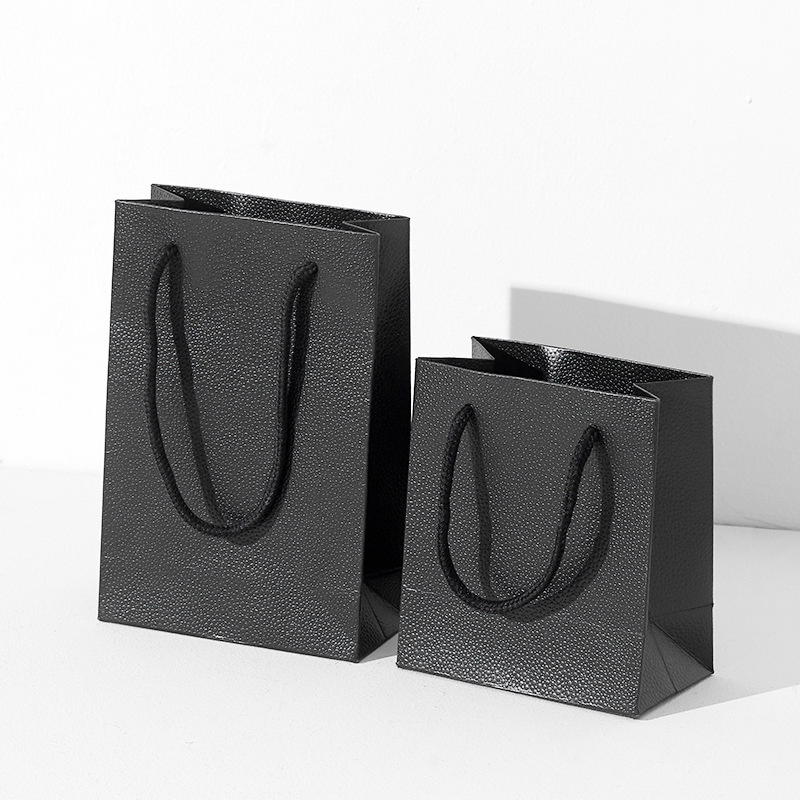
A real textured black paper shopping bag image from LUCKYSTAR’s company product page. It demonstrates why surface texture and sheen must be selected before the finish. The photograph alone does not prove a particular foil, emboss or UV specification.
6. Build the operation order before artwork release
The finish cannot be planned separately from printing, lamination, die cutting, creasing and bag conversion. One project may foil a printed and laminated sheet, then emboss in register. Another may foil before lamination to protect the decoration, accepting that the film changes reflectivity. Spot UV usually needs a compatible surface and a clean cure before stacking or conversion. There is no universal best order.
| Stage | Decision | Evidence to approve | Typical failure if ignored |
|---|---|---|---|
| Background density, trap, overprint/knockout and dry/cure state | Production proof or drawdown on nominated stock | Colour halo, weak adhesion or visible gaps | |
| Lamination / coating | Whether decoration sits above or below the film/coating | Layer-stack sample with the real finish | Dulled foil, delamination, UV rejection or cracking |
| Foil | Foil family, die, temperature/pressure/dwell window and register | Stamped sheet and edge-detail inspection | Voids, bridges, fill-in, flake or shade mismatch |
| Emboss / deboss | Blind or registered, relief direction, depth and reverse-side effect | Front/back flat sheet plus converted bag | Cracks, crushed board, weak relief or panel distortion |
| Spot UV | Coating type, height/gloss, cure and stacking condition | Cured production-condition sample | Blocking, odour, scuff, tack or misregister |
| Convert | Creases, folds, glue, top turn, reinforcement, handles and packing | Complete bag loaded, folded and carton-packed | Finish crossing a fold, rub marks or hidden distortion |
Ask the converter for a one-page routing map. It should state which face is printed, coated, foiled, embossed and spot-varnished; which steps are inline or offline; how the sheet is oriented; and which reference controls registration. That routing map is more useful than a generic statement such as “gold foil + emboss.”
7. Separate production layers in the artwork
Create finish layers as vector spot-colour objects, clearly named and set to the converter’s requested overprint/knockout logic. Do not simulate foil with a gold gradient in the production layer. Do not represent embossing only with a Photoshop bevel. Do not leave spot UV embedded in a flattened CMYK image. The visual mock-up and the manufacturing file can coexist, but they serve different purposes.
The shopping bag artwork and dieline guide covers bleeds, safe areas and dieline discipline. Add dedicated finish layers and a legend for this project.
| Layer | Recommended content | Buyer instruction | Preflight question |
|---|---|---|---|
| DIELINE | Cut, crease, glue, top turn, gusset, handle holes and reinforcement zones | Non-printing reference, locked and versioned | Does the finish clear all structural zones? |
| CMYK / SPOT INK | Background print, images and ink-only marks | State colour standard and proof route | Is the finish overprint or knockout intentional? |
| WHITE | White underprint where required on coloured/metallized material | Define opacity and trap | Will white show as a halo? |
| FOIL_1 / FOIL_2 | Solid vector shapes for each foil type | Name physical foil reference and viewing approval | Are positive/reverse details manufacturable? |
| EMBOSS / DEBOSS | Separate relief geometry and direction | State blind or registered and desired tactile hierarchy | Does the relief cross print, foil, fold or reinforcement? |
| SPOT_UV | Solid vector/raster mask at required resolution | State gloss/matte/raised intent and target contrast | Is the mask trapped for real register tolerance? |
Use the Shopping Bag Logo Placement and Print Size Guide to set the visual zone. Then ask the converter for process-specific minimum line, gap, reverse, clearance and register tolerances. Those limits depend on tooling, stock and finish; copying a number from another supplier can create a file that cannot run reliably.
8. Design for register instead of demanding impossible perfection
Every separate operation introduces tolerance. A foil outline that exactly kisses a printed edge can expose a coloured halo. A relief aligned to a hairline border can appear off even when the press is within its normal capability. Spot UV placed on tiny type may lose the intended edge. Robust artwork hides normal movement instead of making it the focal defect.
Use deliberate overlap, trap, inset or a shared neutral boundary. Avoid placing micro registration features on creases or textured zones. If foil and emboss must register, allow the foil field and relief geometry to work together: a slightly inset emboss can preserve the foil edge, while an embossed perimeter may need extra foil coverage. The converter should propose the geometry after trial.
9. Combine effects with one clear hierarchy
| Concept | How it works | Best brief | Control point |
|---|---|---|---|
| Foil only | Reflective or opaque accent on a controlled surface | Small logo with immediate visual recognition | Transfer completeness and edge definition |
| Blind emboss | Unprinted raised symbol uses shadow and touch | Quiet luxury and monochrome identity | Relief strength, paper cracking and reverse-side appearance |
| Registered foil + emboss | Metallic layer and relief occupy one focal mark | Crest, seal or premium wordmark | Accumulated register and foil cracking on relief |
| Spot UV over matte field | Clear gloss builds tonal contrast without another hue | Monogram pattern, photographic highlight or large lettering | Surface adhesion, cure, gloss and scuff resistance |
| Foil + spot UV | Separate reflective and clear effects create two light responses | Campaign artwork with one metallic focal point and a secondary pattern | Chemical compatibility, operation order and visual separation |
| Debossed uncoated stock | Recessed identity uses fibre texture and shadow | Craft, fragrance, jewellery or artisanal retail positioning | Panel flatness and depth consistency |
More finish does not automatically mean more luxury. If foil, emboss, spot UV, ribbon, edge colour and a strong print compete on one panel, the result can look like a sample board. Give each effect a job: recognition, tactility or secondary discovery. Remove any effect that does not improve that hierarchy.
10. The sample must prove light, touch and conversion
A digital rendering can communicate position and scale, but not real metallic direction, gloss contrast, coating height, relief depth or surface adhesion. Begin with stock and finish feasibility, then move through an actual decorated sheet and a converted bag. Follow the Custom Shopping Bag Sample Development Process and name each approval gate.
| Gate | Physical evidence | Decision | Do not accept as substitute |
|---|---|---|---|
| Material swatch | Nominated paper, print/coating/laminate and finish trials | Choose compatible substrate stack | Unfinished paper chip or screen colour |
| Tool / process trial | Actual foil transfer, relief and/or UV on the real surface | Approve detail, depth, gloss and adhesion | Mock-up with metallic gradient or drop shadow |
| Flat-sheet proof | Printed and finished sheet with production layers aligned | Approve colour, register and finish interaction | Finish sample on a different design |
| Converted bag | Complete bag with handles, reinforcement, folds and glue | Approve appearance in use and construction interaction | Flat sheet only |
| Packed sample | Bag folded/packed in intended count and carton | Approve rub, blocking and pressure exposure | Unpacked presentation sample |
| Bulk first-off | First production sheets and converted bags against the signed reference | Release run and set inspection frequency | Pre-production sample alone |
View foil and spot UV under diffuse light and directional light, then tilt the sample. Inspect embossing by sight and touch from both faces. Photograph defects, but retain a signed physical reference because a photograph cannot preserve relief or reflectivity.
11.Quality control needs finish-specific defect language
| Process | Inspect | Practical check | Acceptance record |
|---|---|---|---|
| Foil | Coverage, pinholes, fill-in, bridges, edges, scratches, flaking and shade | Compare at multiple angles; rub/flex or adhesion test as specified | Golden sample, defect images and allowed size/frequency |
| Emboss / deboss | Position, relief, crushed zones, cracking, reverse show and panel distortion | Measure placement; compare front/back and filled-bag appearance | Approved depth/appearance range and register tolerance |
| Spot UV | Register, boundary, gloss/texture, voids, cure, tack, scuff and blocking | Adhesion/rub/fold checks and stacked-sample conditioning | Approved appearance plus method, time and load |
| Combination | Interaction between layers and cumulative misregister | Compare process sequence and composite first-off | One signed combined reference, not separate swatches only |
| Converted bag | Finish near folds, mouth, gussets, glue, handles and packing rub points | Open, fill, carry, fold and carton-pack the bag | Finished-product checklist and AQL/inspection plan |
Integrate these checks with the Custom Shopping Bag Quality Control Checklist. A flawless foil logo does not compensate for weak handle reinforcement, wrong dimensions or unstable glue seams.
12. Cost is driven by setup, coverage and positions
Premium finishes add fixed preparation and variable production cost. A foil job may require a die, foil roll setup and make-ready. Conventional embossing adds relief tooling and register work. Spot UV can require a screen/plate or digital enhancement setup, depending on the route. A second side or second position can add another setup even when the artwork is identical.
| Cost driver | Why it matters | Buyer lever | Quote separately |
|---|---|---|---|
| Tool / screen / plate | Fixed cost before saleable units run | Reuse a controlled design and document ownership/storage | New setup, revision and replacement |
| Finish area | Affects foil consumption, coating deposit, pressure and throughput | Use a smaller focal mark instead of decorative overcoverage | Area by effect, not total logo box |
| Number of foils/effects | Adds material, passes, setup and registration | Assign one primary and one secondary signal at most | Each foil shade, UV type and relief operation |
| Positions / sides | Front, back, gusset or handle zones may require separate handling | Concentrate premium effect on the shopper-facing panel | Per side and per artwork |
| Stock and surface | Difficult textures can increase trial, spoilage or special materials | Compare an engineered smooth zone with full textured coverage | Paper, laminate/coating and compatibility trial |
| Run and SKU matrix | Short runs carry setup over fewer units; artwork changes interrupt production | Consolidate body stock and finish while varying lower-cost elements | Quantity per construction × colour × artwork × finish |
Compare quotations with the same artwork dimensions, substrate stack, number of sides, finish references, tooling policy, sample route, inspection level and packing. A low unit price that excludes tooling, rejects or sample proof is not comparable to a fully itemized programme.
13. Luxury effects do not create an automatic sustainability claim
A paper base does not make the complete bag recyclable everywhere. Laminates, transferred decorative layers, UV coatings, adhesives, handles and reinforcements change the material stack. Local collection and recycling systems differ. Ask suppliers for the composition and mass/coverage information relevant to the claim, then confirm the applicable market guidance before publishing a recyclability statement.
Use the smallest finish area that delivers the brand effect, design the bag for repeated use, avoid unnecessary layers and request evidence for recycled content or certified fibre claims. Do not describe foil as “plastic-free,” spot UV as harmless or embossing as automatically sustainable without a defined product and verified basis.
Company-claim boundary: LUCKYSTAR statements in this section are publisher self-description, not third-party verification, KURZ/BOBST/IST/Scodix authorization, equipment ownership, laboratory result or assurance of a particular foil/relief/gloss effect, register, adhesion, recyclability, MOQ, price or delivery date. Confirm the contracting entity, assigned paper/printing/finishing/converting sites and subcontracting; exact materials, tools, process order, samples, tests, inspection, packing and release terms for the order.
14. How LUCKYSTAR describes its luxury-finish review
LUCKYSTAR states that its project team can connect foil, emboss/deboss and spot-UV choices with one locked shopping-bag construction, artwork package and staged approval plan, subject to specification and written confirmation.
- Lock the substrate stack: record paper grade/caliper/colour/texture, print/coating, film/laminate, reinforcement and the surface that receives each effect.
- Separate the operations: name foil shade/type, emboss/deboss or combination die, spot coating/UV workflow, white/print layers, operation order and whether effects overlap or knock out.
- Return manufacturing limits: require minimum positive/reverse detail, foil fill, relief depth/appearance, UV deposit/gloss/texture, clearances, trap and achievable register for the actual stock and tools.
- Protect conversion: map top turn, folds/creases, gussets, glue, handle holes/attachments and packing rub points; approve any deliberate overlap or inset.
- Approve physical stages: separate material/foil/coating swatch, flat-sheet trial, combined converted golden bag and bulk first-off under agreed light, touch and viewing angles.
- Inspect by finish: define foil pinhole/fill/edge/flaking, relief position/cracking/distortion, UV boundary/cure/tack/scuff/blocking and cumulative register/converted-bag rules.
Review the public custom shopping bag options, the luxury finishing guide and the artwork-and-dieline guide. Then send the stack, finish references, separated artwork and SKU matrix for a route-specific proposal.
15. Send a finish-ready RFQ
| RFQ field | Information to provide | Supplier deliverable |
|---|---|---|
| Bag construction | Finished size, gusset, paper/caliper, surface, laminate/coating, top turn, reinforcement, handle and target load | Finish-compatible material and construction review |
| Artwork | Vector master, dieline version, named print/foil/emboss/UV layers and target dimensions | Preflight, traps, clearances and manufacturable-detail feedback |
| Effect reference | Physical foil swatch, relief intent, gloss/height target and brand priority | Actual process/material proposal and limitation statement |
| SKU matrix | Units by bag size, body colour, artwork, finish, side/position and destination | MOQ, setup, unit cost and consolidation options |
| Approval | Swatch, flat-sheet, converted-bag and bulk-first-off gates | Sample price, tool plan, schedule and golden-reference method |
| Quality | Register, appearance, adhesion/rub/fold/blocking, construction and packing criteria | Test methods, tolerances, inspection frequency and report |
| Commercial | Deadline, Incoterm, packing, artwork/tool ownership, reorder horizon and compliance market | Itemized quotation, critical path and validity assumptions |
Frequently asked questions
Is foil stamping the same as metallic ink?
No. Metallic ink prints reflective pigment in a binder, while foil transfers a separate decorative layer. They differ in reflectivity, edge behaviour, colour options, setup and cost.
Can foil stamping be embossed at the same time?
Some equipment and tooling workflows can combine or closely register the effects. The converter should confirm the exact route, substrate, die construction and achievable register, then prove it on a physical sample.
Should a luxury shopping bag use embossing or debossing?
Embossing gives a raised highlight; debossing creates a recessed shadow. Choose by brand character, paper, logo geometry, reverse-side appearance and proximity to structural zones. Neither is universally more premium.
Does spot UV work on uncoated kraft paper?
It may, but absorption and texture can reduce gloss and edge definition. A sealed or otherwise prepared surface may be needed. Test the nominated kraft stock and coating system rather than assuming a coated-paper result.
Can spot UV be applied over matte lamination?
Often this is used for gloss contrast, but coating-to-film adhesion and cure must be qualified. The laminate surface treatment, UV formulation and process conditions matter.
What artwork files are needed?
Supply the bag dieline and clean artwork with separate named layers for print, each foil, emboss/deboss and spot UV. Include physical colour/finish references, finished dimensions, placement and the converter’s requested trap/overprint logic.
How close can a finish be to a crease or handle hole?
There is no universal clearance. Paper caliper, relief, die, fold geometry, reinforcement and equipment determine the limit. Ask the converter to mark the project-specific keep-out zone on the production dieline.
Why does the sample look different from the digital mock-up?
A screen cannot reproduce true foil direction, clear-coat gloss, relief shadow or surface texture. Use mock-ups for composition and physical samples for finish approval.
What are the most common rejection defects?
Foil defects include pinholes, incomplete transfer, fill-in and flaking. Emboss defects include weak relief, cracking and misregister. Spot UV defects include poor register, weak adhesion, tack, blocking and scuffing.
Do foil, embossing and spot UV affect recyclability?
They change the product’s material stack and may affect local recyclability, especially with laminates, handles, adhesives and reinforcements. Assess the finished bag in the intended market and avoid unsupported claims.
Conclusion
Luxury Shopping Bag Finishes work when each one has a clear role. Foil provides concentrated reflectivity or opaque colour. Embossing and debossing create relief and shadow. Spot UV creates selected surface contrast. The premium result comes from matching the effect to the paper stack, designing for real register, proving the operation order and inspecting the converted bag.
Discuss the finish stack through LUCKYSTAR’s custom shopping bag product page. Use the Shopping Bags sourcing pillar for category supplier decisions and the main custom bag guide for broader manufacturer evaluation.

Send LUCKYSTAR your bag dieline, paper/lamination stack, artwork layers, foil or relief reference, quantity by design, deadline and target market for a finish-ready quotation.
Request a finish-ready luxury bag proposal
Use one material stack, separated artwork package and SKU matrix so foil, relief and spot-coating assumptions can be compared.
Review LUCKYSTAR custom shopping bag options, then send your project details through the contact form or Email a project brief. The email link opens a draft for your review before sending.
Site assignment, substrate/laminate, foil/adhesive, die/counterforce, coating/curing route, tools, samples, register, performance/claims, inspection, price, MOQ, packing, schedule and release terms are subject to due diligence, specification and written confirmation.