A shopping bag can look generously sized while still refusing the product it was meant to carry. A rigid box catches in a shallow side fold, bottles roll toward a soft center, a paper base opens at one corner, or a bottom card slides until its edge cuts the body. These are not simply material-weight problems. They are geometry and load-path problems.
This Shopping Bag Gusset and Bottom Reinforcement Guide explains how side gussets, bottom gussets, boxed bases, separate bottom panels, local patches and bottom boards work across paper, non-woven, woven-PP, canvas, jute and clear-film shopping bags. The aim is to turn “make the bottom stronger” into dimensions, components, process controls and tests that a factory can reproduce.
Start by reviewing the available formats in LUCKYSTAR’s custom shopping bag collection. For supplier capability and project ownership, use the Custom Shopping Bag Manufacturer selection guide together with the wider Custom Bag Manufacturer pillar.
Planning an order? Send a base-geometry brief. Include largest and normal product sets, product dimensions and mass, rigid corners, mouth and opened footprint, side/bottom gusset datums, material route, bottom panel/patch/board/sling direction, sag or standing criteria, artwork, load/carry tests, quantity matrix, pack-out, destination and required date.
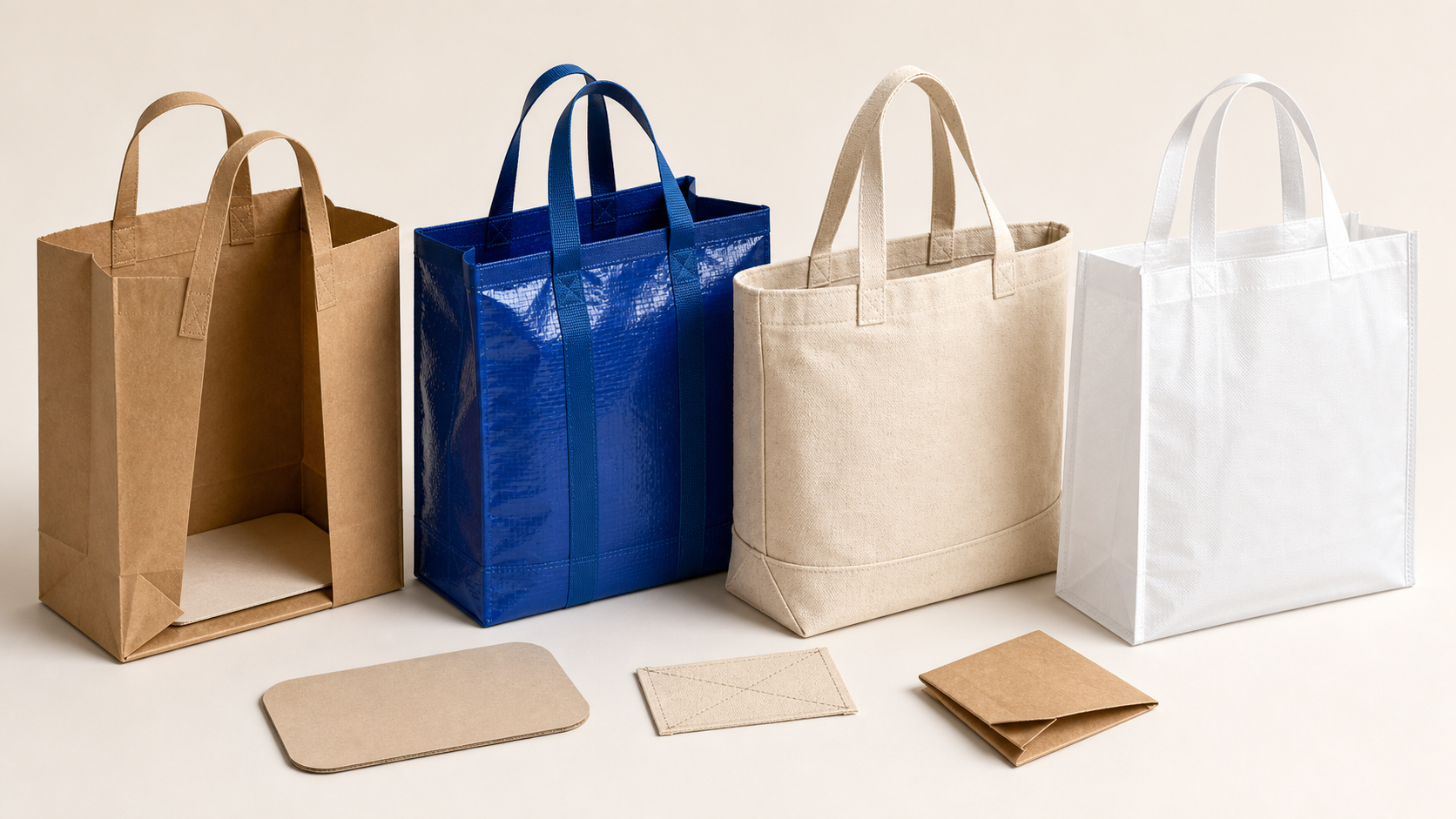
The useful comparison is not “gusset or no gusset”; it is the complete relationship between product footprint, fold geometry, bottom structure and carry system.
1. Gusset depth creates space; it does not prove load capacity
A gusset is a folded or inserted section that allows a flat bag to expand. A side gusset increases front-to-back depth along the body. A bottom gusset opens beneath the contents. A side-and-bottom construction forms a more defined rectangular volume, while a boxed or separate base can give sewn bags a stable footprint. These choices change loading access, artwork, cutting yield, joining, folding and carton cube.
Capacity and strength must be specified separately. Increasing depth may let a bag accept two shoe boxes, but it also moves load toward the bottom corners and makes the filled bag project farther from the user. A wide base can stand well yet buckle if the bottom panel is too flexible. A rigid insert can reduce sag while concentrating pressure at its edges. The correct question is not “How many kilograms can this gusset hold?” but “How does this opened structure carry the defined product set?”
Use cubic volume only as an early screen. Soft folds, seam allowances, panel stiffness, inward creases and the top opening all reduce usable space. A calculated rectangular volume cannot prove that a rigid carton passes through the mouth or settles flat on the base.
2. Choose the gusset architecture before placing artwork
Architecture should follow the retail job and production route. Flat bags suit documents, apparel or very slim gifts. Side gussets support vertical loading and front-face presentation. Bottom gussets are useful where a soft bag must expand beneath the load. Side-and-bottom or boxed constructions suit boxy products and organized checkout loading, but they create more fold intersections and artwork transitions.
| Gusset / base architecture | Useful direction | What it changes | Design risk to resolve |
|---|---|---|---|
| Flat, no gusset | Documents, thin apparel, cards and lightweight giveaways | Lowest structural bulk and simple print face | Little product depth; contents can distort the face or top opening |
| Side gussets only | Paper retail carriers and upright packs | Expands body depth while retaining broad front and back panels | Base must close the opened footprint; side folds can hide graphics |
| Bottom gusset only | Soft non-woven, fabric, mesh and lightweight reusable shoppers | Allows the lower body to open without separate side panels | Filled shape can become rounded; the bag may not stand independently |
| Side and bottom gussets | Boxed retail products, groceries, beauty sets and multi-item baskets | Creates a defined W × H × D volume and a clearer base | Fold intersections, corner alignment and converted artwork registration |
| Separate side and base panels | Canvas, jute, polyester and structured reusable bags | Allows different material, lining or reinforcement at the base | More seams, pattern pieces, labor and corner matching |
| Boxed corners from one body | Sewn totes and compact fabric shoppers | Converts a simple body into a three-dimensional base | Corner triangles create internal bulk or require controlled trimming |
| Rigid or semi-rigid inset base | Premium gift, bottle, grocery and box-carrying applications | Spreads point loads and improves base shape or standing | Board edges, movement, moisture, cleaning, removability and recycling separation |
Do not approve artwork on a generic rectangle. The converted layout must show front, back, side gussets, base, seam or glue lap, fold direction, trim, binding and board pocket where relevant. Review the graphic with the bag flat and again with the gussets opened around the actual products.
3. Work backward from the product footprint
Collect the largest rigid item, the most frequent basket and the heaviest credible combination. Record their width, height, depth, mass, sharp corners, surface sensitivity and preferred orientation. If physical products are unavailable, use dimensionally accurate dummies with realistic mass distribution. Flexible foam blocks do not reveal how a perfume box catches on a fold or how bottles press into a base corner.
Add operating constraints. Store staff need enough clear mouth to load at checkout speed. A customer needs the filled base to remain reasonably level during carrying. Back-of-house staff need bags to open after compressed storage. E-commerce teams may need flat outbound packs, while event teams may prioritize compact transport over independent standing.
| Product / retail situation | Gusset direction to prototype | Bottom question | Physical trial |
|---|---|---|---|
| Folded apparel | Flat, shallow side gusset or soft bottom gusset | Is reinforcement necessary, or does it only add bulk? | Load and remove garments without snagging folds or crushing presentation |
| Shoebox or rigid gift carton | Side-and-bottom or defined rectangular base | Does the box sit fully inside the base without bridging a corner? | Insert the largest box through the real opening and carry it level |
| Skincare or fragrance cartons | Controlled side gussets with a flat, clean base | Can a board prevent tipping without scuffing premium packs? | Arrange the normal set and inspect gaps, tip, rub and bag silhouette |
| Bottles or jars | Boxed base or separate bottom panel | How are concentrated circular footprints distributed? | Walk, turn and set down a filled bag; inspect board deflection and corner pressure |
| Mixed grocery basket | Deep side-and-bottom gusset or structured woven-PP base | Can heavy items remain below light or fragile items? | Pack the normal sequence, perform repeated lifts and inspect sag |
| Promotional kit | Sized to the fixed kit footprint, not a vague litre target | Will a removable insert improve assembly and presentation? | Time kit loading, close the pack and check opening on receipt |
| Foldable spare shopper | Soft bottom gusset compatible with the pouch fold | Can local reinforcement protect the base without making a hard lump? | Repeat fold, unfold, load and repack using production-intent layers |
The bag can then be sized within LUCKYSTAR’s shopping bag product range. If compact storage is part of the job, coordinate gusset nesting, reinforcement and pouch thickness with the Foldable Shopping Bag Manufacturing Guide.
4. Specify geometry in measurable states
“40 × 35 × 12 cm” is ambiguous unless the drawing identifies which dimension is width, height and depth and how the bag is positioned. A folded side gusset can be measured as the full opened depth or as one pleat half. A paper base may be referenced from score lines, while a sewn bag may use seam lines or finished outer edges. Even correct samples can appear out of tolerance when two inspectors use different datums.
Create separate sketches for the bag laid flat, lightly opened and filled with the approved load. Name the finished points of measure and the production inputs that create them. For converting routes, include score-to-score and glue-lap geometry. For sewn routes, include pattern dimensions, seam allowance, boxed-corner line, base-panel notch and the finished dimensions after turning.
| Geometry field | Measurement instruction | Manufacturing input | Reason to control it |
|---|---|---|---|
| Finished face width | Named top or body datum, bag flat, without stretching | Cut/web width, side fold, seam or glue lap | Product entry, artwork scale and bilateral symmetry |
| Finished height | Top finished edge to base datum, excluding handles | Cut length, top turn/binding and bottom fold/seam | Product containment and visual proportion |
| Opened side-gusset depth | Full distance between defined fold, seam or outer-face planes | Score spacing, pleat depth or separate side-panel width | Rigid-product fit and opened footprint |
| Bottom-gusset depth | Opened base depth between named folds or seams | Bottom fold, boxed-corner dimension or panel geometry | Base area, standing behavior and product support |
| Usable mouth | Clear opening under the defined hand action | Top stiffness, side folds, handle position and closure | Checkout speed and box insertion |
| Bottom board size | Length, width, thickness and corner radius; identify tolerance and orientation | Board die-cut, sleeve/pocket and opened internal base | Prevents buckling, edge cutting, rattle and insertion errors |
| Filled base deflection | Reference load, support condition, time and measurement point | Panel stiffness, seam, board and load distribution | Makes “no excessive sag” an objective approval |
Dimension these relationships in the Custom Shopping Bag Tech Pack guide. A factory may refine a dieline or pattern for its machinery, but the revised geometry and finished points of measure should be approved before print or bulk material is released.
5. Map the bottom load path
Contents first press on the bottom panel, folded base or insert. Force then reaches the bottom seams, bonds or paper folds, turns through the corners and side panels, and finally enters the handle attachments. Failure often starts where that path changes direction: a board corner, fold intersection, stitch end, ultrasonic-bond termination, binding miss or paper glue flap.
Draw this path on the construction section. Mark the heaviest products and their contact areas. A large soft load may create broad, moderate pressure; a small bottle base or carton corner can create severe local pressure at the same total mass. Reinforcement should spread the known concentration, not simply add material everywhere.
Base reinforcement cannot correct an unrelated weakness. A strong board does not repair an incomplete paper bottom glue pattern. A doubled fabric base cannot compensate for a seam allowance that slips outside the stitch. A continuous webbing sling can move load away from the body, but its alignment, base crossings and handle length become critical. Review the bottom and the handle system as one structure.
6. Select construction by material route
The same finished shape is produced differently across materials. Paper converting depends on grain direction, creasing, folding, adhesive application and controlled compression. Bonded non-woven depends on web behavior, fold guides and bond geometry. Laminated woven PP depends on film registration, tape-yarn structure, binding and sewing. Cut-and-sew fabric uses patterns, seam allowances, notches, turning and reinforcement. Clear film depends on weld or seam compatibility and scratch protection.
| Bag route | How gusset / base is formed | Useful reinforcement direction | Route-specific control |
|---|---|---|---|
| Paper carrier | Scored side folds plus sequenced bottom flaps, glue and compression | Correct paper orientation, complete glue area, folded base layers and optional bottom card | Score quality, false folds, adhesive placement/cure, base opening and humidity condition |
| Bonded non-woven PP | Roll- or cut-panel pleats joined by ultrasonic or heat-bond operations | Wider or layered local bond, compatible patch or redesigned fold intersection | Energy, pressure, speed, horn/anvil condition, bond width and heat damage |
| Sewn non-woven | Folded body or separate gusset/base captured by seam or binding | Patch, binding, controlled seam allowance or insert sleeve | Needle/thread, stitch density, skipped stitches, seam margin and fold symmetry |
| Laminated woven PP | Converted fold or separate base with bound/sewn edges | Bound junction, doubled base, board, patch or extended webbing route | Film-to-body registration, laminate integrity, yarn distortion and binding capture |
| Cotton / canvas / polyester | Boxed corners, continuous body fold or separate side and bottom patterns | Doubled panel, lining, internal patch, base sleeve or webbing sling | Material orientation, seam type, allowance, corner matching, puckering and turning |
| Jute / mesh | Sewn panels with edge binding or lining to contain open/fraying structure | Closed-weave base, larger patch, lining, bound seam or removable insert | Yarn loss, skew, seam slippage, abrasive edges and natural-material variation |
| Clear PVC / TPU film | Welded, bound or sewn gusset and base panels | Rounded insert, textile-bound edge, compatible patch or double-film zone | Weld/seam width, perforation, film blocking, scratch, trim compatibility and sharp edges |
For a detailed discussion of route choice and handoffs, see Custom Shopping Bag Manufacturing Process: From Design to Delivery. Route must be frozen before the base artwork, tooling, insert size and production control plan can be finalized.
7. Compare bottom reinforcement options
Reinforcement can be structural, presentational or both. A second flexible layer may resist abrasion while preserving foldability. A separate base panel can improve geometry and enable a different material. A local patch can protect a known point load. A board can create a flat platform. A sling can transfer weight around the base. Each option adds interfaces that must be controlled.
In sourcing language, Shopping Bag Bottom Reinforcement can mean any of these routes; the phrase is not a material specification. Buyers should name the physical build, dimensions, attachment and intended performance instead of leaving the factory to interpret “reinforced bottom.”
| Reinforcement option | Best reason to use it | Trade-off | Approval evidence |
|---|---|---|---|
| Folded or doubled body layer | Adds local thickness without a separate rigid component | Can create bulky corners and does not automatically distribute point loads | Section, fold recovery and filled-base comparison |
| Separate flexible bottom panel | Controls footprint, material orientation and replaceable pattern geometry | Adds seams, joining labor, alignment and potential water/soil traps | Panel specification, seam section and corner symmetry |
| Local patch | Protects a predictable bottle, carton corner, board edge or seam intersection | Missed placement can create a new stiffness edge or cosmetic show-through | Position tolerance, attachment and destructive section |
| Paperboard bottom card | Supports paper carriers and light premium gift packs | Moisture response, edge wear and limited repeated-use suitability | Board grade/thickness, die-cut size and conditioned filled trial |
| Polymer sheet or fluted board | Improves reusable-bag stiffness and resistance to incidental damp conditions | Adds mass, rigidity, edge and material-separation questions | Composition, thickness, orientation, corner radius, deflection and removal check |
| Board inside a sleeve / pocket | Controls insert position and can allow removal for cleaning | Pocket adds layers and labor; loose fit permits rattle or migration | Insertion method, retention, wash/care instruction and repeated-use trial |
| Continuous webbing or sling under base | Transfers load through a defined textile path into the handles | More material, alignment, seam crossings, visual impact and carton bulk | Full path drawing, hidden-operation inspection and loaded-cycle result |
8. Engineer the bottom board as a component
A bottom board should be slightly smaller than the usable internal base, with enough clearance to insert and remove it without buckling the gusset. Excessive clearance permits migration; insufficient clearance makes the board bow, abrade the lining or push into a corner. Rounded corners and smooth edges reduce cutting risk, but the radius must still fit the internal base geometry.
A Shopping Bag Bottom Board is one possible reinforcement, not proof that the entire base is strong. Its benefit depends on the support beneath it, the location of the products and the way its edges transfer force into the gusset or side panels.
Specify material construction, thickness, length, width, corner radius, color where visible, surface, orientation, mass, permitted warp, odor and edge condition. If the board is removable, define which face points upward and how the user reaches it. If it is enclosed, specify the sleeve or lining, insertion stage and how inspectors confirm the correct component after closing.
Test stiffness under the actual support condition. A board spanning a flexible fabric base behaves differently from the same board placed on a solid table. Record load positions and time before measuring deflection. For bottles, include concentrated footprints and walking movement; for cartons, inspect whether sharp edges damage the body where the board ends.
A board also changes care and end-of-life handling. A washable textile bag with a non-washable enclosed card is a contradictory design. A permanently captured mixed-material insert may make separation harder. Decide removability, cleaning guidance and evidence for any environmental claim before approving the construction.
9. Protect artwork across folds and the opened base
Folded geometry changes what the customer sees. Text may disappear inside a side gusset when the bag is flat, then split across two planes when filled. Full-coverage print on woven PP can misregister at fold or seam datums. A paper glue lap may interrupt a repeating pattern. Base artwork is frequently hidden in use but may be visible during unboxing or flat display.
Place graphics on the route-specific dieline or pattern and label every panel, fold, seam, binding and glue area, then establish a primary viewing state: flat on a shelf, open at checkout or carried around the intended product. Approve critical marks in all relevant states.Keep small text, barcodes and fine borders away from variable folds and seam intersections.
For laminated woven PP, include the printed-film orientation and converted registration datum. For paper, account for crease cracking and finish behavior at fold lines. For fabric, control pattern orientation and seam take-up. Artwork approval must reference the physical transformed bag, not only a flat digital proof.
10. Sample the base before approving appearance
A first mock-up can confirm rough fit, but a production-intent sample must close material, joining, fold geometry, insert, artwork and packing differences. Open the bag, place the largest product, arrange the normal basket, lift it, walk it, set it down and remove the contents. Then flatten and reopen it. Record the observations rather than approving “looks good.”
Measure both side gussets, both base diagonals where applicable, corner symmetry, board fit and opening clearance. Inspect internal folds and hidden seams before loading. After the trial, look for whitening, cracking, glue opening, bond separation, stitch growth, board shift, lining abrasion, puncture and permanent base set.
Use the stage gates in the Custom Shopping Bag Sample Development Process.If the sample uses substitute board, hand-folded paper, digital print or different seam equipment, record the variance and close it in a later production-reference sample.
11. Control formation and reinforcement during production
Production controls begin before assembly. Incoming paper, fabric, film, board, binding, adhesive and reinforcement must match the BOM. Cutting or creasing controls the starting geometry. Folding fixtures, seam guides or converting settings create the gusset. A separate operation may position the patch or insert. Each hidden feature should be checked before it disappears inside a closed base or lining.
Approve a first-off at line start and after a material lot, tool, operator group, setting or relevant maintenance change. Check fold direction, depth, symmetry, corner intersection, seam/bond/glue continuity, reinforcement identity and position, artwork relationship and opened footprint. A quick filled trial can reveal an inverted pleat or incomplete base that flat measurement misses.
Traceability should connect failures to paper or textile lot, board lot, cutting/creasing batch, machine, shift, line and carton range. When a base defect appears, isolate the production since the last verified check; measuring one replacement carton cannot locate all affected units.
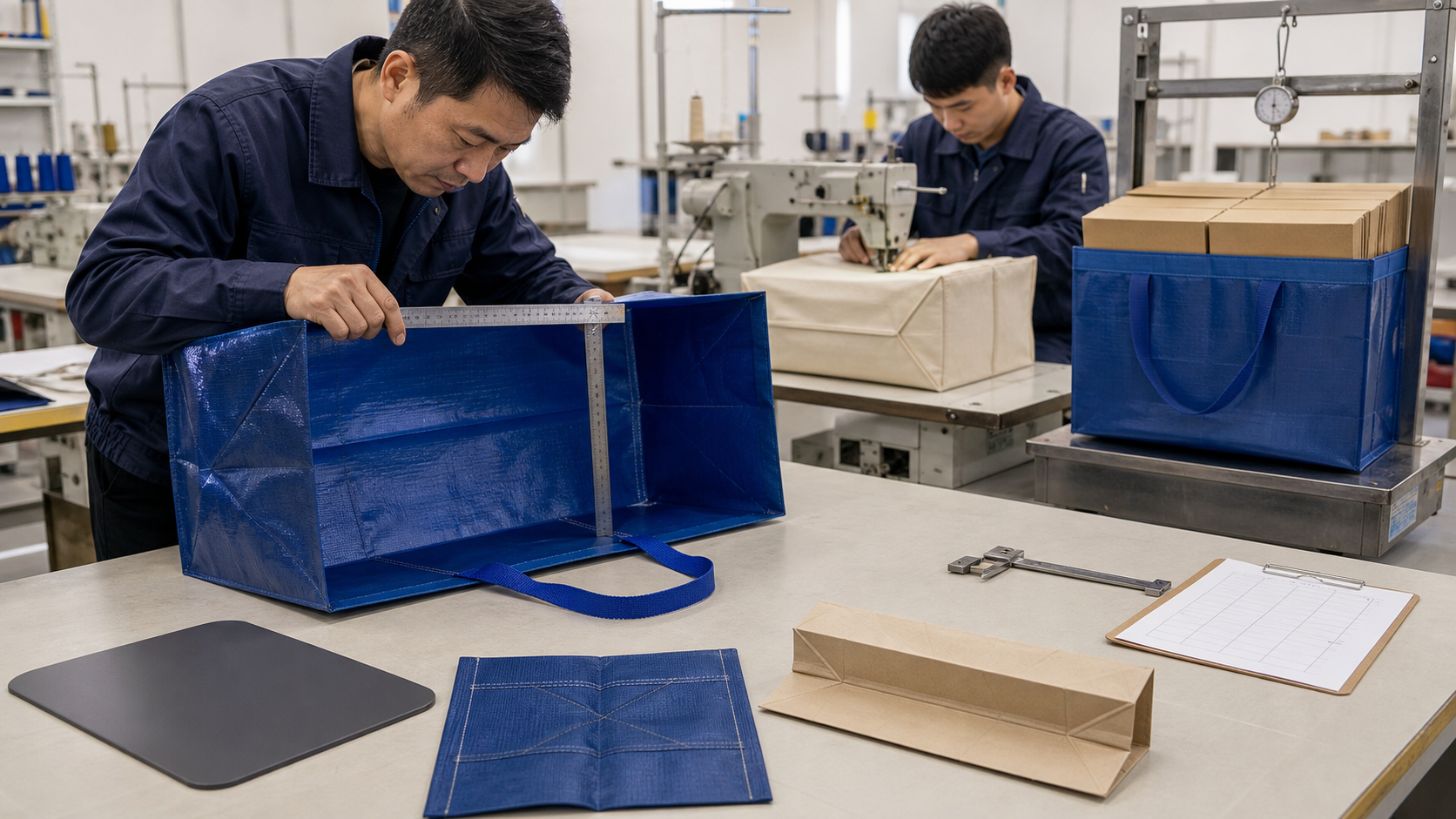
A useful first-off check combines geometry, hidden construction and a representative filled-bag trial.
12. Validate the material, junctions and complete bag
Material tests are useful for screening and supplier control, but their scope matters. ISO 1924-2:2008 specifies tensile-property measurement for paper and board. It does not prove the folded, glued shopping-bag base. ISO 9073-3:2023 covers nonwoven breaking force and elongation by a strip method, while ISO 9073-4:2021 covers nonwoven tear resistance by the trapezoid procedure. Neither releases an ultrasonic gusset intersection or a finished carrier by itself.
For appropriate straight seams in woven textiles, ISO 13935-2:2026 determines maximum force to seam rupture with a grab method. Its stated scope is normally not applicable to nonwovens, coated fabrics or polyolefin tape-yarn fabrics, and it is limited to straight seams. A qualified laboratory should select the relevant coupon or seam method for the actual material; the buyer and manufacturer still need a complete-bag procedure for the retail job.
There is no meaningful universal “10 kg bottom test” without a method. Ten kilograms in a smooth distributed block is different from bottles or narrow cartons. State the filler, placement, total mass, bag condition, lift points, cycle or hold, set-down surface, duration, sample number and failure criteria. Where paper or natural material may encounter humidity, define conditioning and the time between conditioning and testing.
| Validation / QC check | Variables to define | Evidence to inspect | Likely source if it fails |
|---|---|---|---|
| Opened geometry and squareness | State, datums, depth, diagonals, tolerance and measuring support | Gusset symmetry, base footprint, false folds and corner match | Cut/score, fixture, feed, seam allowance or turning |
| Board fit and deflection | Board ID, orientation, support, load positions, time and maximum deflection | Bow, migration, edge cutting, rattle, crack or permanent set | Wrong grade/size/orientation, poor pocket or concentrated loading |
| Base junction pull / seam / bond | Applicable method, specimen location, direction, conditioning and failure record | Glue opening, stitch rupture, slippage, bond peel, body tear and crack origin | Adhesive, seam/bond settings, edge distance, material lot or reinforcement |
| Static filled-bag hold | Realistic filler, distribution, mass, suspension, time and set-down check | Sag, corner stress, fold opening, board movement and permanent distortion | Weak load path, insufficient stiffness, poor fit or incomplete joining |
| Repeated lift and carry | Mass, product geometry, stroke, speed, cycles, turns and rest interval | Progressive seam/bond growth, puncture, abrasion and load imbalance | Stress concentration, sharp contents, misaligned base or handle system |
| Checkout and standing trial | Counter, opening action, product sequence, fill level and observation time | Opening speed, product catches, tip, rocking and base recovery | Wrong depth, soft base, fold memory, board size or top geometry |
| Packed-storage recovery | Fold, pressure, carton orientation, temperature, time and unpack interval | Stuck gusset, false crease, board imprint, transfer and failure to open | Pack direction, excessive compression, material set or trapped components |
Integrate these checks with the Custom Shopping Bag Quality Control Checklist and the complete Reusable Shopping Bag Test Guide.
13. Diagnose common gusset and base defects
An asymmetric gusset usually points to cut/score variation, a drifting fold guide, uneven seam allowance or turning error. A false fold can originate in packed compression or weak crease definition. A base that opens may show missing adhesive, insufficient pressure or cure, a skipped stitch, incomplete bond or an incorrectly captured layer. Diagnose the first physical change instead of adding reinforcement after every complaint.
Bottom sag can be caused by insufficient panel stiffness, a board that is too small or flexible, widely spaced support, uneven product placement or a base that is larger than the load. Board-edge damage suggests inadequate radius, rough cutting, poor sleeve fit or migration. Puckered sewn corners may come from mismatched panel lengths, feeding, seam bulk or turning. Print misregistration can trace to fold drift rather than the printing unit.
Build a defect library with photographs of the flat, open and loaded state. Define whether the defect is cosmetic, dimensional, constructional or functional, and identify the viewing zone. Natural jute texture may be acceptable within an approved range; a yarn opening at the base seam is not the same kind of variation.
14. Account for packing, MOQ, cost and lead time
Deep gussets consume material and increase the converted fold stack. Separate panels add cutting, notching, joining and inspection. Custom boards add material sourcing, die-cutting, insertion, packing thickness and a second component tolerance. A hidden pocket can cost more labor than the insert itself. Calculate the landed structure, not only the visible body material.
Board and reinforcement minimums may differ from the bag MOQ. Several bag sizes often require several board dies or cutting programs. If one size has many artworks, the structural components may be shared; if one artwork has many sizes, they usually cannot. Freeze the size × material × board × artwork matrix before requesting a final price.
Run a physical carton trial early. Deeper folds and rigid inserts can reduce pieces per carton, increase cube and create uneven pressure. Specify whether boards ship inserted, loose in each bag, bundled separately or omitted from a foldable route. Check the first, middle and last bags after a representative storage interval.
15. Use reinforcement only where it improves the real service life
More layers do not automatically create a better environmental outcome. A bag may use extra material and freight while its actual failure remains at a fold, seam or handle. Conversely, a modest local patch or removable board may extend useful service when it protects a known high-stress area. Evaluate the complete design against intended use, durability evidence and care.
A removable insert can simplify cleaning or material separation, but only if the user can identify and remove it. A captured mixed-material board can complicate recovery. Paperboard may be suitable for one dry premium route and unsuitable for repeated damp use. Avoid broad claims based solely on a component name; retain supplier identity, composition and applicable certification or test evidence for the exact production lot.
Company-claim boundary: LUCKYSTAR statements in this section are publisher self-description, not third-party verification, a laboratory result, food-contact or waterproof proof, certification evidence, or assurance that a deeper gusset, heavier body or board makes every bag stronger, lower impact, lower cost or suitable for every product. Confirm the contracting entity, assigned production site and subcontracting; exact body, coating/laminate, lining, reinforcement and insert; production sample; methods and limits; claim evidence; packing; and release terms for each order.
16. How LUCKYSTAR describes its gusset and bottom review
LUCKYSTAR states that its project team can translate a physical product set into an opened bag geometry and base construction comparison, subject to specification and written confirmation. The review can connect the mouth, gusset, bottom footprint, handle load path, panel or insert, artwork, validation and pack-out in one production-intent build.
- Product evidence: record largest and normal baskets, dimensions, mass, rigid corners, loading sequence, carry time and standing need.
- Measured geometry: define flat, opened and filled datums, gusset depth, footprint, diagonals, seams/folds, tolerances and mouth access.
- Base construction: identify panel, doubled layer, patch, board, sleeve or sling material, orientation, dimensions, edges, retention and substitution controls.
- Load path: connect the products, base, corner/junction, side panels and handles; inspect sag, pressure points, migration, instability and permanent set.
- Artwork and claims: approve converted artwork in flat/open/filled states and keep performance, contact, moisture and environmental wording tied to evidence.
- Bulk and pack-out: control fold/score/seam/bond formation, insert identity and placement, carton stacking, board packing and recovery.
Review the public custom shopping bag options. Teams still qualifying suppliers can use the manufacturer selection guide and Custom Bag Manufacturer Guide. Then send the product footprint, base and validation requirements for a project-specific review.
17. What should the RFQ contain?
Send product evidence, not a single outside dimension. A useful RFQ includes the normal and maximum product combinations, expected load, material route, opened geometry, board or reinforcement direction, carry conditions, artwork, test expectations, quantity matrix and pack-out. Where a choice is open, state the decision priority and ask the supplier to quote clearly separated options.
| RFQ field | Buyer input | Manufacturer response | Release evidence |
|---|---|---|---|
| Products and retail operation | Largest item, normal/heaviest basket, dimensions, mass, corners, loading sequence and carry time | Recommended footprint, mouth, gusset and base architecture with constraints | Filled checkout and carry trial |
| Finished geometry | W × H × D, flat/open/filled states, datums and tolerances | Dieline/pattern, POM chart, production inputs and achievable variation | Measured production-intent sample |
| Material and route | Body, coating/laminate, lining, desired hand, care and destination | Exact BOM, conversion/joining route and route-specific limitations | Approved components and construction sections |
| Bottom reinforcement | Required standing, sag limit, removability, cleaning and sustainability constraints | Panel/patch/board/sling proposal, dimensions, material ID and attachment | Section, board master and loaded-base result |
| Artwork | Vector file, primary viewing state, colors, base/gusset coverage and critical safe zones | Route-specific template, fold/seam map and registration tolerance | Flat, opened and filled artwork review |
| Testing and quality | Conditioning, fillers, static/cycle/carry method, defect classes and report needs | Applicable lab methods, finished-bag procedure, first-off and inspection frequency | Approved report, defect library and control plan |
| Commercial and packing | Quantity by size × material × board × artwork, destinations, launch date and presentation | MOQ by component, tooling, schedule, unit basis, board packing, pieces/carton and measured cube | Normalized quotation and successful carton trial |
Frequently asked questions
What is a gusset on a shopping bag?
A gusset is a folded or inserted section that expands the bag from a flat form. It may be placed at the sides, bottom or both. Its useful depth is the opened finished dimension between defined folds, seams or panel planes—not merely the width of one flat pleat.
Is a side gusset or bottom gusset better?
Neither is universally better. Side gussets support a defined vertical depth and broad front face. Bottom gussets let a soft bag expand beneath the contents. Boxed products often benefit from a coordinated side-and-bottom or separate-panel base, while thin apparel may not need either.
Does a deeper gusset make a bag stronger?
No. Greater depth creates volume and changes the load path, but strength still depends on body material, folds, seams or bonds, bottom construction, reinforcement, handles and the product footprint. A deeper bag can increase corner stress if the base is not redesigned.
When does a shopping bag need a bottom board?
A board is useful when a flatter platform, reduced sag, organized product presentation or better standing is important. It may be unnecessary for light apparel or compact foldable bags. Decide with a filled prototype, then specify the exact board and test its edges, movement and deflection.
Should a bottom board be fixed or removable?
A removable board can support cleaning and material separation, but it needs controlled fit and retention. A fixed or enclosed board cannot be lost, yet its identity is harder to inspect and it may conflict with washing or recovery. The intended use and care route determine the better choice.
How should bottom gusset depth be measured?
Name the bag state and datums. A common method opens the base without stretching and measures the full finished depth between specified folds, seams or outer planes. The tech pack should relate this finished value to the score, pattern or boxed-corner dimension used in production.
How is shopping bag bottom strength tested?
Use the intended products or accurate fillers and define their placement, mass, lift and set-down action, hold or cycle, conditioning, sample count and failure criteria. Inspect sag, fold or seam opening, puncture, board movement, corner stress and permanent deformation. Material data alone is not enough.
Why does a shopping bag base sag even with a thick material?
Possible causes include a large unsupported span, concentrated products, poor board fit, flexible panel orientation, incomplete joining or an oversized footprint. Increasing body weight may not solve the real geometry. Compare the loaded base, support points and failure origin.
Can reinforcement affect carton cost?
Yes. Deeper gussets, layered corners, boards, sleeves and webbing paths increase folded thickness or create uneven stacks. A physical pack-out establishes pieces per carton, measured cube, board placement and recovery after storage before the quotation is frozen.
How can buyers avoid bottom-board substitutions?
Identify the construction, composition, thickness, dimensions, corner radius, orientation, surface, source reference and permitted warp or odor in the BOM. Keep an approved component master and verify incoming lots plus the board inside the finished bag.
Build the base around the products, not a generic load claim
The best gusset is the one that opens cleanly around the intended basket. The best bottom is the one that distributes that basket through a controlled structure without unacceptable sag, tearing, tipping or packed bulk. Freeze the geometry, reinforcement and test method together, then carry the evidence from sample approval into production.
LUCKYSTAR can translate your product set, retail handling and brand presentation into a route-specific shopping bag specification. Share the largest item, normal basket, load, dimensions, material direction, artwork, quantity matrix and destination to receive a construction and quotation review.

Request a product-shaped gusset and bottom proposal
Define the product footprint, opened geometry, base construction, load path and pack-out before comparing material weight or price.
Review LUCKYSTAR custom shopping bag options, then send your project details through the contact form or Email a project brief. The email link opens a draft for your review before sending.
Factory assignment, material/insert identity, contact/moisture/environmental claims, capacity, load, sag, standing, artwork, samples, testing, inspection, price, MOQ, packing, schedule and release terms are subject to due diligence, specification and written confirmation.