Screen printing and gravure printing can both put strong graphics on shopping bags, but they are rarely interchangeable operations. Screen printing often places ink directly onto a flat bag panel. Gravure usually prints a continuous film or web that is later laminated and converted into a bag. One decision therefore concerns decoration; the other can determine the entire material stack, tooling plan and production architecture.
This guide to Screen Printing vs Gravure Printing for Shopping Bags helps retail, promotional and packaging buyers decide which route fits the bag, artwork and order. It compares image capability, colour, white ink, tooling, minimum order quantity, speed, sampling, lamination, quality checks and reorder risk—without assuming that either process is automatically “premium” or “cheap.”
Review the available constructions in LUCKYSTAR’s custom shopping bag collection. The category-specific shopping bag manufacturer selection guide and the wider Custom Bag Manufacturer pillar explain how to qualify the supplier behind the selected print route.
Planning an order? Send a screen-versus-gravure brief. Include bag construction, substrate and laminate stack; finished size and print carrier; editable artwork, sides, coverage, colors and white; quantity by version and reorder plan; tooling ownership; physical color target; proof and sample stages; rub, flex, adhesion, blocking, agent and storage exposure; packing, destination and required date.
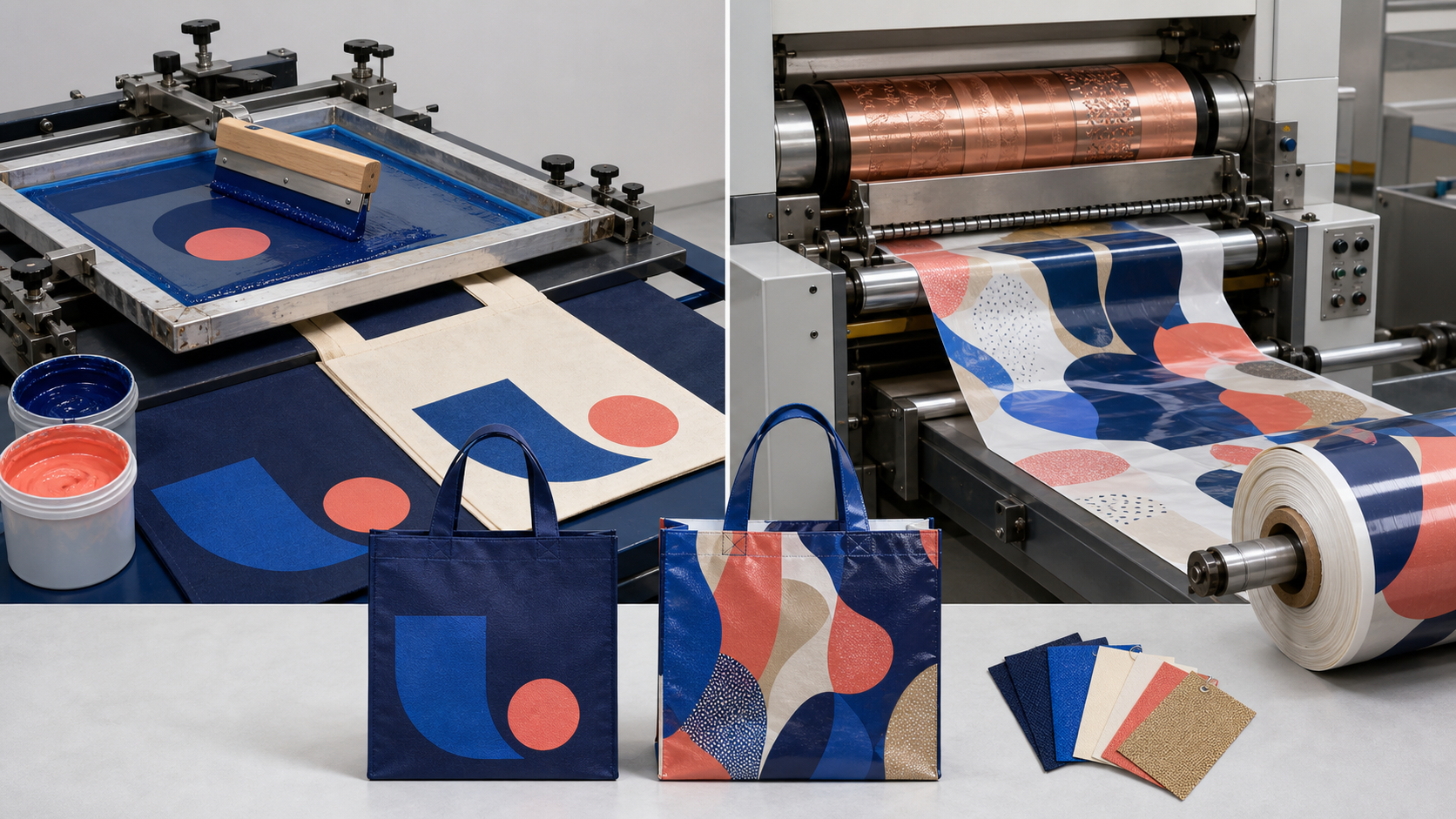
Screen printing commonly decorates flat panels directly; gravure commonly prints a web that becomes part of a laminated bag structure.
1. The real choice is panel decoration versus printed-web conversion
A method comparison becomes misleading if the two quotes do not describe the same bag. A screen-printed non-woven carrier may use coloured spunbond material with ink on its outer face. A gravure-printed carrier may use a transparent or white film printed in multiple colours, laminated to woven PP or non-woven PP, then cut, folded and sewn or sealed. Their surface feel, stiffness, appearance, water resistance, fold response and recyclability are different before ink price is considered.
Ask each supplier to state the complete layer sequence. “PP bag with full-colour printing” is not enough. The quote should identify base structure, film type and thickness, print side, white layer if any, adhesive or extrusion-lamination route, surface finish, joining method and when handles are attached. Only then can the buyer compare like with like.
The broader Custom Shopping Bag Printing Methods guide maps all major processes. This article deliberately narrows the lens to the two production routes and their crossover conditions.
| Decision factor | Screen printing | Gravure printing | Buyer’s interpretation |
|---|---|---|---|
| Typical print carrier | Flat cut panel, roll material or selected finished flat bag | Continuous film or packaging web | Confirm whether the quoted image is printed directly or viewed through laminate |
| Typical bag direction | Unlaminated non-woven, cotton, canvas, jute and qualified sheet materials | Laminated woven PP or laminated non-woven PP made from printed film/web | The two methods may imply different finished constructions |
| Artwork strength | Bold spot colours, simple brand marks and controlled image areas | Process colour, gradients, fine tonal work and high repeat coverage | Judge a production sample, not a digital mock-up |
| Tooling | Screen and stencil for each separation, plus jigs where needed | Engraved cylinder for each printing colour | Count underbase, varnish or special channels—not only visible brand colours |
| Economic direction | Often accessible for lower or medium stable quantities | Usually needs larger repeat volume to spread cylinder and press setup cost | Request a project-specific crossover calculation |
| Print speed after setup | Depends on manual, semi-automatic or roll equipment and drying | High-speed continuous production when press, ink and web are stable | Lead time also includes tooling, film, lamination and conversion |
| Primary quality risk | Opacity, screen register, texture, cure and rub | Cylinder/colour register, web direction, residual solvent, lamination and converting register | Quality plan must follow the complete route |
2. How screen printing works on shopping bags
A screen carries a stencil with open areas where ink is intended to pass. A squeegee moves ink across the mesh and through those openings onto the substrate. Each separation normally needs its own screen and print station or repeated pass. The printed panel then dries or cures according to the ink system before cutting, sewing, sealing, stacking or packing.
Shopping Bag Screen Printing is attractive when the design is graphic rather than photographic. Solid logos, type, icons and large colour blocks can reproduce clearly. Ink deposit can provide useful opacity, especially when a compatible white underbase is used beneath colour on dark material. The process can tolerate many surfaces, but “printable” does not mean identical: rough jute, porous cotton, smooth non-woven PP and clear flexible sheet each need a different ink, mesh, treatment and test plan.
Texture creates a practical limit. Open mesh fabric can interrupt thin strokes. Coarse jute may turn a sharp edge into a deliberately rugged mark. Spunbond non-woven PP can show fibre variation or pinholes. Finished bags can be awkward on the platen because seams, handle patches and gussets alter contact pressure. Printing cut panels before assembly often improves access, but the mark must then survive later joining and handling.
3. How gravure printing works for shopping-bag films
In gravure, the image is engraved as cells in a metal cylinder. The rotating cylinder receives ink, a doctor blade removes ink from the non-image surface, and ink retained in the cells transfers to a moving web under pressure. Separate cylinders normally carry separate colours. Cell geometry, ink, viscosity, speed, drying and web tension work as one controlled system.
For shopping bags, gravure is commonly relevant to printed flexible film rather than a completed bag. The film may be reverse printed: the viewer looks through clear film at the ink after it has been laminated to woven or non-woven reinforcement. This can protect the graphic from direct rubbing and produce a glossy or matte branded surface. The printed laminate is then slit, cut and converted; every later operation must preserve image direction and registration.
Shopping Bag Gravure Printing can reproduce process colour, gradients and large-area repeated graphics efficiently at long-run scale. Its barrier is not simply machine availability. Engraved cylinders require lead time, capital and controlled storage. A redesign, size change or colour-channel change may make existing cylinders unusable. Short runs can carry heavy tooling cost per unit, while a stable repeat programme can benefit from the durability and consistency of reusable cylinders when they remain suitable and properly stored.
| Shopping bag construction | Screen route | Gravure route | Initial recommendation |
|---|---|---|---|
| Unlaminated non-woven PP | Direct spot-colour panel or roll printing is commonly feasible | Not usually selected unless a separate printed film/laminate changes the construction | Screen for a simple direct mark; reclassify the bag if lamination is introduced |
| Laminated non-woven PP | Possible on selected outer surfaces, but may give up the purpose of full printed film | Printed film can provide detailed coverage before lamination | Gravure becomes relevant for stable high-volume full graphics |
| Laminated woven PP | Suitable only for selected surface graphics after compatibility tests | Strong fit for detailed film artwork and long repeat production | Compare cylinder economics with flexographic film printing |
| Cotton or canvas | Strong candidate for bold artwork on flat panels | Not the normal route for printing the fabric bag directly | Screen, transfer, digital or other qualified textile process |
| Jute | Possible with artwork and ink adjusted for coarse texture | Not normally used directly on the jute bag | Screen or a separately printed label/patch after sampling |
| Clear PVC or TPU | Qualified direct screen ink can produce selected opaque marks | May print a compatible film component, not automatically the finished clear sheet | Define polymer, ink, white, adhesion, migration and flex tests first |
| Paper shopping bag | Can suit selected spot-colour work | Web gravure is possible in packaging, but often not the practical bag-converter route | Compare flexo, offset, digital and screen based on paper and volume |
Material architecture matters particularly for PP carriers. First compare woven and non-woven PP structures. If a spunbond carrier is shortlisted, separately decide whether the non-woven body needs lamination before choosing the print.
4. Compare artwork capability without oversimplifying
It is tempting to say “screen for simple, gravure for complex,” but the useful line is more specific. Screen printing can produce multi-colour and halftone work on suitable surfaces with skilled separation and register. Gravure can print spot colours as well as process work. The difference lies in the image requirement, substrate, number of stations, repeat volume and acceptable tooling—not an absolute technical prohibition.
For screen printing, prepare vector artwork where possible, identify each spot separation, set the physical print dimensions and agree minimum positive line, reverse line, text and halftone capabilities on the real mesh and material. Count white underbase as a separation. On rough substrates, simplify tiny features or make them heavier. Keep critical graphics away from seam ridges and handle stacks unless a finished-bag trial proves access.
For gravure, the artwork must fit the web repeat and eventual cutting map. Define process and spot channels, trapping, overprint, reverse-print orientation, opaque white strategy, laminate viewing direction, continuous-tone resolution and variable areas. A front and back panel may be nested on one web repeat, but side gussets, bottom panels, seams and handles still determine what becomes visible after conversion.
| Artwork feature | Screen-print planning | Gravure planning | Approval evidence |
|---|---|---|---|
| Solid logo | Spot separation, mesh, ink deposit and underbase | Spot channel or process build, cell specification and trap | Physical target on production-intent substrate |
| Photographic image | Qualified halftone/process setup; texture can reduce tonal detail | Process separations built for the gravure printing condition | Contract-like proof plus production web sample |
| Fine reverse text | Confirm minimum gap and risk of fill-in | Confirm engraving, ink and register limits | Printed size test, not enlarged artwork |
| Opaque white | Separate screen, deposit, choke and cure | Dedicated cylinder/channel, coverage and reverse-print order | View over light/dark backing and finished laminate |
| Edge-to-edge coverage | Panel setup, bleed and risk near edges or seams | Web repeat, slitting, cut and fold bleed | Converted bag in closed, open and filled states |
| Multiple artwork versions | New screens or changed separations for each version | New or modified cylinders may be required per version | Version matrix tied to tooling IDs |
| Wraparound motif | Difficult across separately printed/joined panels | Possible within repeat, but conversion register remains critical | Full-size bag, not a flat film strip alone |
5. Colour and opacity are properties of the complete stack
A brand colour on navy non-woven PP cannot be judged against the same reference as ink seen through glossy clear film. The base colour, ink deposit, opacity, surface gloss and viewing direction change the visual result. Define whether colour is approved on the unlaminated print carrier or after lamination. For reverse gravure, the film and adhesive can change contrast and perceived density; for screen printing, texture and absorbency can produce local variation.
White is often a structural colour layer. In screen printing, an underbase can support bright colours on a dark panel. In gravure, white can sit behind process imagery or create selected opacity in a reverse-printed laminate. In both routes, white adds tooling, ink, register and drying demand. Artwork should contain an explicit white layer and a rule for choke/trap so normal register variation does not create a visible halo.
ISO 12647-5:2015 addresses process control for four-colour screen printing. ISO 12647-4:2014 is written directly for publication gravure and states that it may be applied by analogy to process-colour gravure package printing. Neither standard automatically defines the right acceptance tolerance for a particular shopping bag; the parties still need to identify the printing condition, substrate, proof and measurement method.
6. Tooling changes the MOQ and reorder equation
Screen printing has front-loaded work: separations, screen preparation, colour mixing, registration and fixtures. Tooling normally rises with colour count and print positions, but the absolute investment is often lower than a complete set of engraved gravure cylinders. The press or workshop may therefore accept a smaller production batch, subject to material, bag conversion and factory policy.
Gravure cylinders are durable precision tools, yet each colour channel can require its own cylinder. Engraving, proofing, transport, mounting and storage add cost and time before the first acceptable roll is produced. The route becomes more attractive when a design and bag size will repeat over a large volume. It becomes vulnerable when marketing frequently changes graphics, languages, size proportions or mandatory information.
Do not compare only first-order unit price. Request cylinder or screen ownership, storage period, maintenance responsibility, reuse condition, replacement rule and disposal approval. Ask whether a reordered film can run on the same material and press specification. If the supplier changes substrate, ink or lamination, existing colour approval may no longer be sufficient even when the cylinder stays unchanged.
| Cost / MOQ driver | Screen-print effect | Gravure effect | Question for the quotation |
|---|---|---|---|
| Number of colours | More screens, passes, register and cure demand | More cylinders, stations, ink and drying demand | Does the count include opaque white and protective channels? |
| Print area | Affects screen size, ink deposit, handling and drying | Affects coverage, ink and web drying; cylinder cost follows repeat and engraving | Is coverage priced by panel, square area or web repeat? |
| Bag size | May change jig, screen or print access | Can change cylinder circumference/repeat and cutting layout | Can one tool serve more than one finished size? |
| Artwork versions | Each changed separation can add setup and a version MOQ | Changed channels can require new cylinders and separate web runs | What is the MOQ per artwork, not just total PO? |
| Material colour / film | Changes opacity and may change ink or underbase | Changes white strategy, laminate appearance and proof | Which substrate lot is included in approval? |
| Reorder tooling | Screens may need remaking after storage or damage | Cylinders may be reused if design, condition and press fit remain valid | Who owns, stores and inspects the tools? |
| Expected waste | Setup panels, colour adjustment and rejected pieces | Web threading, register, colour setup, lamination and slitting waste | Is waste included in unit price and quantity tolerance? |
Place these print drivers inside the full order economics in the 2026 Custom Shopping Bag Pricing Guide and the MOQ logic in Custom Shopping Bag MOQ and Production Time.
7. Compare lead time as a chain, not press speed
Once stable, a gravure press can run a continuous web quickly. That does not mean the first order is automatically faster. Cylinder engraving, ink formulation, film scheduling, press setup, drying, lamination, conditioning, slitting, bag conversion and inspection all sit on the critical path. A screen-printed bag may have shorter tooling preparation but slower decoration per piece or additional curing time.
For launch planning, request dates for artwork freeze, screen/cylinder approval, print strike-off, finished sample, material booking, print run, conversion, final inspection and dispatch. Reorders may be faster only if tools are serviceable, materials are available and no approval parameter has changed. A “same artwork” reorder on a new substrate lot still needs colour and adhesion checks.
| Schedule stage | Screen-print route | Gravure route | Release gate |
|---|---|---|---|
| Prepress | Separations, screen/stencil and placement jig | Separations, repeat map, proof and cylinder engraving data | Locked artwork and production dieline |
| Tooling | Screen preparation and register setup | Cylinder engraving, inspection and press readiness | Tool ID and version record |
| Print trial | Panel strike-off on intended body material | Web proof/press sample on intended film and white strategy | Signed print carrier sample |
| Post-print | Dry/cure, panel handling and assembly | Drying, lamination, conditioning and slitting | Adhesion, residual and laminate checks as applicable |
| Bag conversion | Cut/sew/seal printed panel without damaging the mark | Cut and join printed laminate to the repeat map | Converted first-off with position approval |
| Bulk control | Colour, opacity, register, cure and bag quality sampling | Web colour/register plus laminate and converted-bag sampling | Lot-linked inspection report |
8. Build a proof ladder that reflects the selected route
A file proof can confirm content, but it cannot demonstrate ink deposit on rough non-woven fabric or colour viewed through a laminate. A screen strike-off can approve the direct print, yet the panel must still be converted to check seam clearance. A gravure film sample can prove tonal work, but the laminate and finished bag may change gloss, colour and positioning.
Use a ladder: annotated digital proof, material-specific ink sample, production-process print carrier, converted pre-production bag and bulk first-off. The buyer’s signed sample should identify substrate, print side, colour reference, tooling version and date. Retain one protected reference with the buyer and one with the factory.
The practical workflow in Custom Shopping Bag Sample Development Process helps distinguish a visual mock-up from a sample that is representative enough to release tooling or bulk production.
| Approval object | Screen-print purpose | Gravure purpose | Limitation |
|---|---|---|---|
| Digital proof | Separation, size and panel location | Channels, repeat, reverse orientation and crop | Cannot prove production colour or adhesion |
| Ink drawdown | Ink direction and opacity on bag substrate | Ink/white direction on intended film | Does not prove press transfer or register |
| Production-process print | Actual mesh, deposit, edge and cure | Actual engraved cells, web, tonal scale and register | Still flat and not yet the finished bag |
| Laminated sample | Only relevant if a laminate/coating is part of the screen route | Confirms viewing direction, colour shift, gloss and bond | Does not prove cutting and bag placement |
| Converted golden bag | Confirms position around seams, handles and gussets | Confirms web-to-bag register and finished appearance | One sample cannot prove long-run consistency |
| Bulk first-off | Confirms actual production setup before continuing | Confirms production web, laminate and converting setup | Needs periodic checks after approval |
9. Quality control must follow different failure paths
Screen-print defects often originate at the stencil, mesh, squeegee, ink, substrate surface, register fixture or curing stage. Typical observations include pinholes, broken detail, filled reverses, shade variation, misregister, low opacity, tack, rub-off or cracking. Diagnose whether the defect is random, position-specific or linked to a material lot.
Gravure defects can originate at engraving, doctor blade, cylinder condition, ink viscosity, impression, web tension, drying or colour register. Streaks, haze, missing cells, doctor-blade lines, tonal imbalance and register movement can appear on the web. Lamination adds bond, curl, bubble, tunnel, odour and delamination risks. Conversion can then shift the graphic away from the intended bag face.
ISO 2836:2021 describes methods for assessing print resistance to selected liquid and solid agents across gravure, screen and other processes, but it does not cover consumer protection or release the complete bag. For coloured or printed textile panels, ISO 105-X12:2016 describes dry and wet rubbing tests. Select the relevant procedure and acceptance level for the actual market and material rather than writing “rub test: pass.”
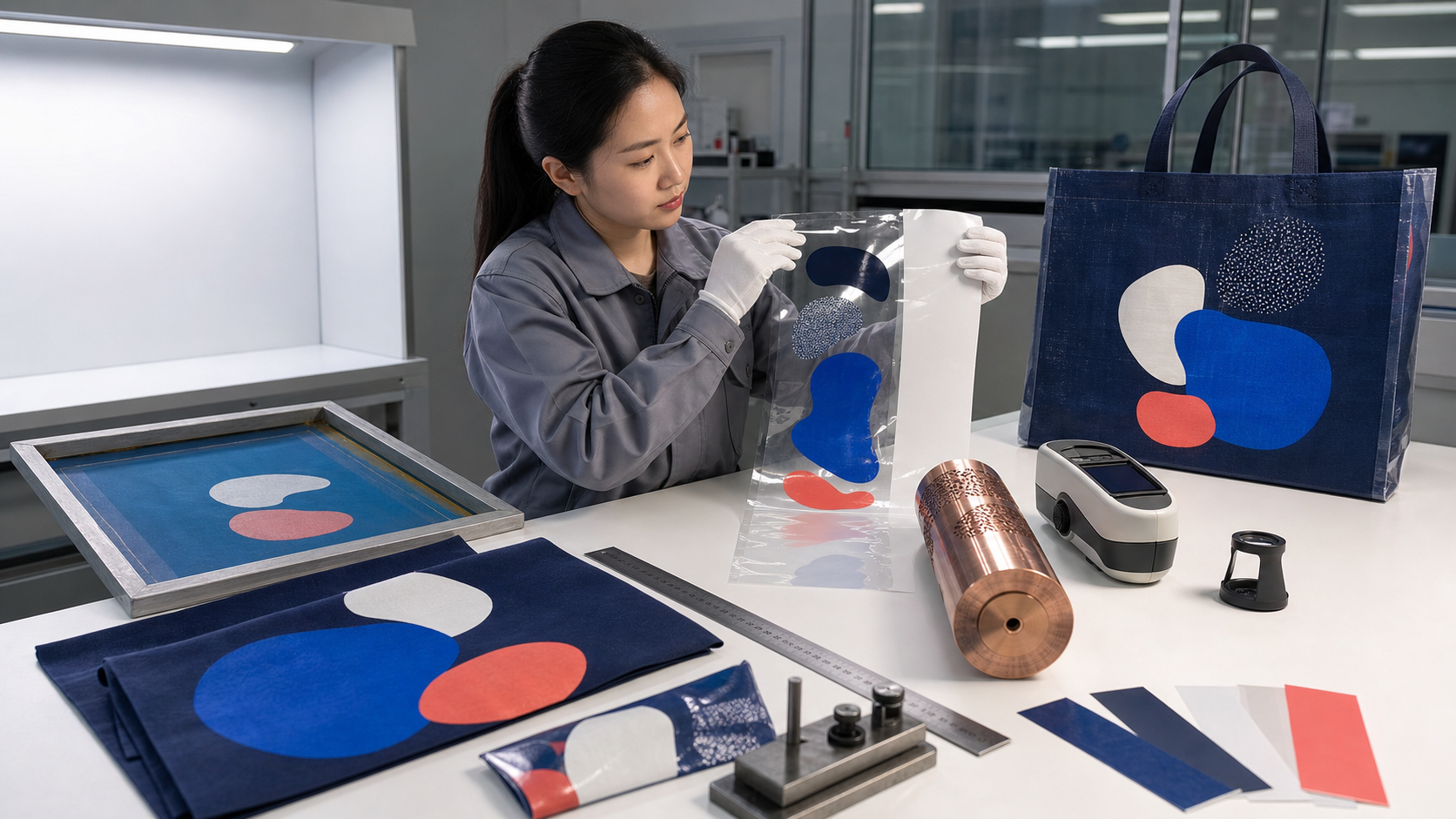
The print carrier and finished bag both need approval: a correct film or panel can still be damaged or misplaced during lamination and conversion.
| Control point | Screen-print focus | Gravure focus | Finished-bag evidence |
|---|---|---|---|
| Colour / opacity | Ink deposit, base colour show-through and underbase register | Process balance, spot colour, white density and laminate effect | Compare under agreed lighting and backing |
| Detail / register | Screen-to-screen alignment, edge and fill | Cylinder-to-cylinder register, tone and direction | Critical mark location from agreed bag datums |
| Drying / cure | Tack, blocking, rubbing and cracking | Drying, retained solvent/odour risk and blocking | Packed-stack trial under defined conditions |
| Surface resistance | Direct ink rub, scuff and wet transfer | Outer-surface scuff or protected reverse print condition | Carry and carton-contact simulation |
| Fold / flex | Ink cracking over panel fold or texture | Laminate whitening, ink/film behaviour and bond at gussets | Repeated opening, folding and filled-bag review |
| Lamination | Not applicable unless the selected screen system includes it | Bond, bubbles, tunnels, curl and edge separation | Cut edge, seam and stressed corner inspection |
| Conversion register | Panel orientation and distance from seam/handle | Web repeat aligned to cut, gusset, bottom and seam | Closed, opened and representative loaded views |
| General bag quality | Print cannot hide weak seams or handles | Laminate appearance cannot substitute for structural control | Dimensions, handles, seams, load and pack-out inspected together |
Integrate these print-specific controls with the Custom Shopping Bag Quality Control Checklist so the bag is accepted as a complete retail product.
10. Common decision mistakes
Comparing unlike constructions: a low-cost direct-print non-woven bag and a laminated photographic woven PP bag do not differ only in decoration. Normalize the material stack and use case first.
Using order quantity without artwork stability: a large total quantity may still be split among many sizes, languages or store graphics. Calculate the quantity per tooling version. Gravure can lose its scale advantage when every variant requires cylinders and separate web setup.
Approving gravure before lamination: reverse-printed film can change after adhesive, white backing, gloss and woven texture are introduced. Approve both print carrier and finished laminate.
Expecting one screen sample to represent every base colour: ink opacity and colour shift across navy, black, red and natural material. A shared logo design does not remove the need for substrate-specific approval.
Ignoring tooling custody: a reorder plan fails if nobody knows who owns the screens or cylinders, how long they are retained, or whether tooling can run on another press. Put custody and storage in writing.
11. Environmental claims require whole-bag evidence
Neither process is inherently sustainable. Screen printing may keep a bag unlaminated and structurally simple, but ink, rejects, cleaning and durability still matter. Gravure can deliver efficient long runs and a protected reusable surface, but cylinders, film, adhesive, setup waste and multi-layer end-of-life pathways must be considered. A heavier bag used many times and a lightweight single-event bag solve different problems.
Do not infer “recyclable,” “eco ink,” “non-toxic” or “solvent-free” from a process name. Document the actual substrate, ink, adhesive, coating and target-market disposal route. If recycled content or chemical claims are important, identify the evidence and scope instead of placing them in the artwork brief without verification.
Company-claim boundary: LUCKYSTAR statements in this section are publisher self-description, not third-party verification, print-house accreditation, a laboratory result, or assurance that screen or gravure is cheaper, more durable, more sustainable, faster, available at a stated MOQ, or suitable for the order. Confirm the contracting entity, assigned production/printing sites and subcontracting; exact bag and print stack; tooling ownership and condition; artwork and color references; production samples; test methods and limits; claim evidence; packing; and release terms.
12. How LUCKYSTAR describes its screen-versus-gravure review
LUCKYSTAR states that its project team can compare a direct panel-decoration route with a printed-web and lamination route, subject to specification and written confirmation. The comparison can connect bag architecture, artwork, quantity/version structure, tooling, proof ladder, converted samples, use checks and reorder controls.
- Construction route: identify body, coating/laminate, print carrier and side, surface treatment, gusset, seams, handles and the point at which printing enters conversion.
- Artwork and color: lock the dieline/repeat, separations, coverage, white/varnish channels, physical color target, viewing condition, traps, bleed and minimum features.
- Tooling and versions: return screens/cylinders by color and version, ownership, storage, maintenance, reuse condition, replacement and disposal terms.
- Approval ladder: define proof limitations, production-like strike-off or web sample, lamination review, converted-bag approval and retained references.
- Use and bulk checks: select adhesion, rub/scuff, flex/fold, blocking, storage or agent-resistance checks and control register, appearance, placement, defects and substitutions.
- Commercial comparison: compare tooling, setup/waste assumptions, MOQ per version, sample basis, pack-out and reorder horizon before price or lead-time decisions.
Review the public custom shopping bag range. Teams still qualifying suppliers can use the shopping bag sourcing framework and main custom bag manufacturing guide. Then send the bag stack, artwork and quantity/version matrix for a project-specific comparison.
13. What to include in the RFQ
Send the finished bag size and construction, not a logo alone. Identify the body material, weight or thickness, laminate, surface finish, handles, joining method, quantity per size and artwork version, destination, required delivery date and performance expectations. Attach editable artwork and state whether it is provisional or frozen.
Ask the supplier to return the recommended route, print carrier, print side, colour and white count, tooling list, MOQ per version, tooling ownership, sample path, mass-production lead time, quantity tolerance, test proposal and packing method. If screen and gravure alternatives use different constructions, require a side-by-side comparison of material, stiffness, unit weight, finish, load capability and end-of-life assumptions.
The Custom Shopping Bag Tech Pack guide provides the fields needed to freeze the three-dimensional artwork map. The Shopping Bag Manufacturing Process guide then places print approval in the full path from material booking to delivery.
Frequently asked questions
Which is better for shopping bags: screen printing or gravure?
Screen printing is usually the stronger starting point for direct, bold artwork on unlaminated non-woven or textile panels at low-to-medium stable volumes. Gravure is usually stronger for detailed printed film, lamination and large repeat volumes. The bag structure and quantity per artwork determine the final answer.
Is gravure printing applied directly to finished shopping bags?
Usually not in the laminated PP programmes discussed here. Gravure prints a continuous film or web, which is then laminated, slit, cut and converted into the bag. Ask the supplier to identify the print carrier and print side.
Can screen printing reproduce photographs?
Advanced screen printing can produce halftone and process-colour imagery, but substrate texture, screen resolution and register affect tonal detail. Compare a production-size sample against gravure or another qualified process when photographic fidelity is critical.
Why does gravure need a higher MOQ?
Every colour can require an engraved cylinder, and the press needs web setup, register, colour adjustment and drying before stable output. Larger volume spreads those front-loaded costs. The actual MOQ still depends on the converter, material, repeat and version split.
How many screens or cylinders will my design need?
Normally one tool is needed for each production colour or functional channel. Count process colours, spot colours, opaque white, varnish or other specified layers. The printer should confirm the separation plan before tooling.
Which process is more durable?
Durability depends on the complete system. Direct screen ink must achieve suitable adhesion, cure and rub resistance. Reverse gravure ink may be protected by film, but laminate bond, folds and seams can fail. Test the production construction in its intended use.
Can existing gravure cylinders be reused?
They may be reusable when the artwork, repeat, colour channels, cylinder condition and press fit remain valid. Confirm ownership, storage, inspection, proofing and any change in substrate or laminate before a reorder.
Should colour be approved before or after lamination?
For gravure-laminated bags, inspect the printed film and approve the final laminate because film, adhesive, backing and gloss can change appearance. For screen printing, approve the ink on the intended bag substrate and again on the converted bag.
Which route is better for multiple store or language versions?
Screen printing may be more flexible when each version is relatively small, although each changed separation still has setup. Gravure works best when each cylinder version carries enough volume. Price the version matrix, not only the grand total.
What quality checks should a buyer request?
At minimum define colour, opacity, detail, register, drying/cure, rub/scuff, fold performance and finished-bag placement. Gravure-laminated projects also need lamination and web-to-conversion checks. Always include general bag dimensions, seams, handles and load performance.
Conclusion
The best choice is the route that delivers the intended bag, not the method with the most impressive press. Screen printing gives brands a practical direct-print path for controlled artwork on many panels. Gravure supports high-detail printed webs and repeat scale when cylinder investment, lamination and conversion are justified. Define the material stack, quantity per version, artwork, proof ladder and finished-bag tests before comparing prices.
To compare both routes for a specific programme, review LUCKYSTAR’s custom shopping bag range, then use the shopping bag sourcing framework and the main custom bag manufacturing guide to evaluate the proposed production partner.

Request a screen-versus-gravure proposal
Compare the complete direct-print and printed-web structures, tooling, version matrix, approval ladder and use exposures before comparing unit price.
Review LUCKYSTAR custom shopping bag options, then send your project details through the contact form or Email a project brief. The email link opens a draft for your review before sending.
Factory/print-site assignment, bag/print stack, tooling, color, adhesion, resistance, residual-solvent controls, environmental/food-contact claims, samples, testing, inspection, price, MOQ, packing, schedule and release terms are subject to due diligence, specification and written confirmation.