A promotional tote succeeds when people choose to carry it after the event, purchase or campaign is over. That sounds obvious, yet many projects begin with a logo file and a quantity instead of a clear job for the bag. The result may be technically correct but visually forgettable, uncomfortable to use or difficult to produce consistently.
This guide explains how to design promotional tote bags as useful brand objects. It covers the campaign brief, audience, message hierarchy, physical construction, artwork safe area, color decisions, sampling, packing and performance review. For available constructions, visit LUCKYSTAR's custom tote bag collection. For the wider sourcing and supplier-selection framework, use the Custom Bag Manufacturer Guide.
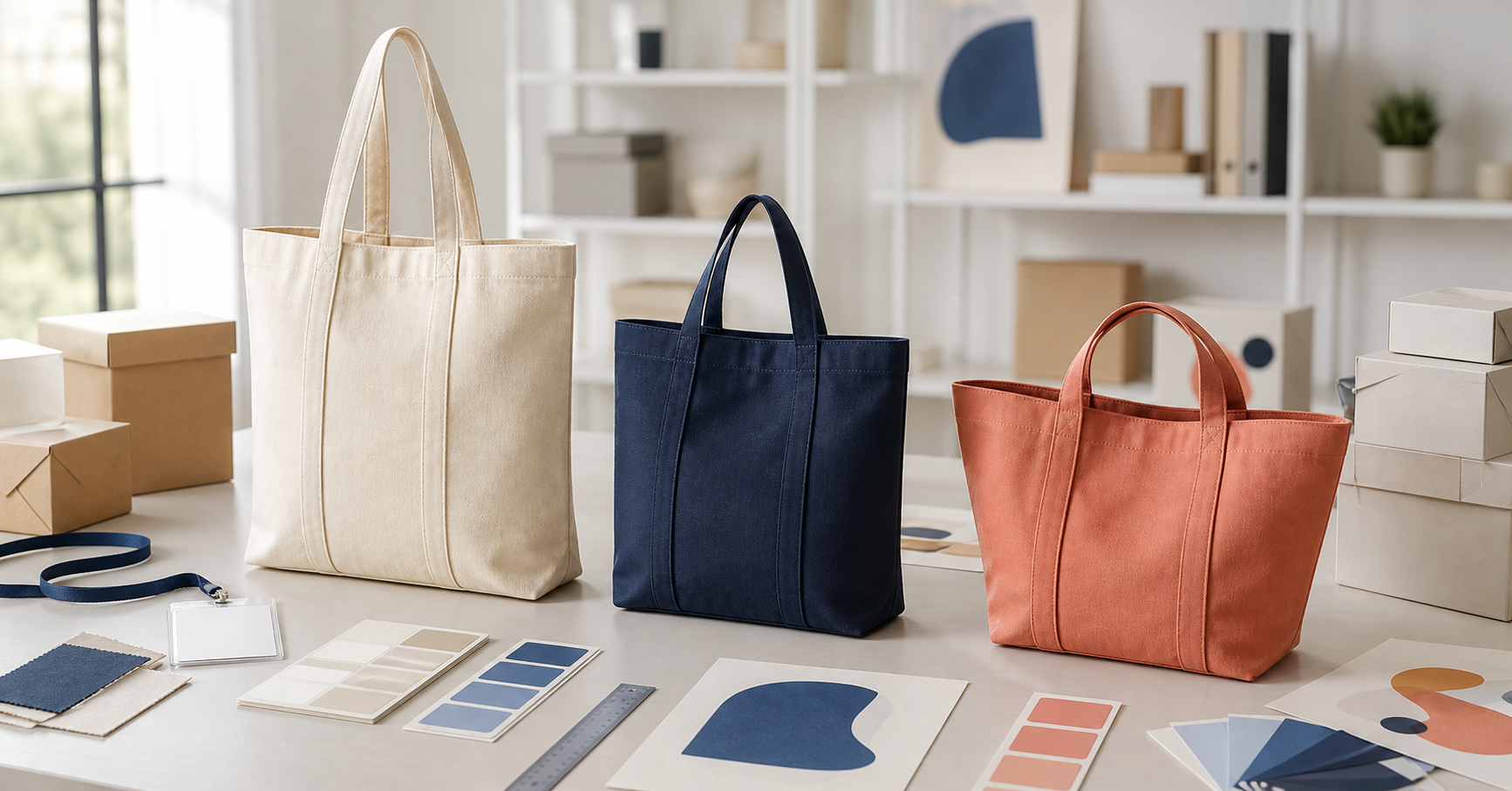
A good campaign brief connects the bag format, brand expression and distribution plan before artwork is finalized.
Need a promotional tote brief that suppliers can quote consistently? Send the campaign job, recipients, intended contents and load, finished size, material direction, artwork and rights owner, quantity by colour/artwork/market, packing, distribution date, destination and required arrival date. LUCKYSTAR can return missing inputs and its own order-specific proposal for comparison.
Begin with the campaign job, not the logo size
The same tote should not automatically be used for a trade show, customer gift, product launch and paid merchandise program. Each context changes how long the bag will be seen, what it must carry, what the recipient expects and how much brand messaging feels appropriate. Write one sentence that defines the job before discussing fabric or printing.
| Campaign type | Primary job | Design priority | Common mistake |
|---|---|---|---|
| Trade show giveaway | Carry brochures and samples during the event | Fast recognition, comfortable handles and event-floor capacity | A large logo on a bag too weak for collected materials |
| Retail gift with purchase | Extend the store experience beyond checkout | Perceived value, coordinated colors and useful proportions | Treating the tote like disposable packaging |
| Employee or partner kit | Unify several items and express belonging | Fit of the complete kit, discreet identity and repeat use | Approving the bag without loading the actual kit |
| Public campaign | Make a message visible in everyday settings | Readability, cultural context and image permissions | Trying to reproduce the whole campaign poster |
| Limited merchandise | Create a product customers value independently | Originality, finish, durability and retail presentation | Using giveaway specifications for a paid item |
Define the recipient and the moment of use
A tote is worn in public, so context matters. Consider the recipient's likely clothing, travel method, climate and willingness to display a brand. An oversized statement graphic may suit a music event but feel intrusive in a professional partner kit. A natural cotton bag may support a relaxed campaign, while a structured colored tote can feel closer to retail merchandise.
| Question | Why it changes the design | Evidence to collect |
|---|---|---|
| Who receives it? | Age, profession and style preference affect color, scale and carry mode | Audience profile, previous campaign response and market examples |
| What goes inside first? | The opening, gusset and handle reinforcement must suit the launch load | A complete physical load set or accurate mock-ups |
| Where is it handed out? | Counter, booth, mailer and outdoor distribution need different packing | Fixture dimensions, fulfilment limits and staff workflow |
| Where may it be reused? | Commute, grocery and leisure use require different strength and discretion | Short user interviews and realistic carry trials |
| How long must it remain relevant? | Dates and event-specific copy reduce future reuse | Campaign calendar and leftover-inventory plan |
If body dimensions are not fixed, work through the Tote Bag Size Guide for Retail Brands before finalizing the graphic. Artwork balanced on a compact flat tote can look lost on a wide gusseted bag.
Choose one message hierarchy
A promotional tote has less communication time than a webpage or brochure. People see it moving, partly folded and often from several metres away. Decide what must be noticed first, what rewards a closer look and what belongs somewhere else. The bag does not need to explain the whole campaign.
| Level | Possible content | Viewing condition | Approval test |
|---|---|---|---|
| Primary | Distinctive mark, short message or campaign symbol | Recognizable while the bag is carried | View an actual-size print from three to five metres |
| Secondary | Brand name, supporting phrase or visual detail | Readable at conversational distance | Photograph the loaded bag at waist and shoulder height |
| Tertiary | URL, campaign detail or small legal line | Available only during close inspection | Print at final size and check minimum detail |
| Off-bag | Long explanation, instructions and full partner list | Better on a hangtag, insert or landing page | Remove it from the tote mock-up and compare clarity |
When every element is given equal weight, the design usually becomes a small poster rather than a wearable object. A restrained composition often creates more recognition because the main signal survives motion, creasing and visual noise.
Design a tote people want to keep
Brand exposure depends on reuse. A bag with excellent artwork still fails if the handles are uncomfortable, the fabric feels temporary or the size is awkward. Build the promotional concept on a credible product. That may mean stronger seams, a useful gusset, an interior pocket, a closure or simply a better proportion.
| Product decision | Campaign benefit | Trade-off to review | Sample test |
|---|---|---|---|
| Shoulder-length handles | Supports hands-free event and everyday use | Long straps can let a deep tote hang too low | Carry the planned load over light and heavy clothing |
| Bottom or side gusset | Improves kit capacity and retail usefulness | Folds can enter the artwork area | Review the graphic empty and fully loaded |
| Interior pocket | Makes the gift feel considered and reusable | Adds sewing operations and placement requirements | Test a real phone, badge or key set |
| Closure | Improves security and perceived value | Reduces the clear opening and may affect packing | Operate with the target load inside |
| Heavier or structured material | Creates a more merchandise-like appearance | Raises weight, folded volume and possibly cost | Compare hand feel, drape and carton trial |
Use the fabric-weight guide to connect the intended use with an appropriate construction. For the U.S. market, the FTC Green Guides summary cautions against broad, unqualified environmental-benefit claims. State the specific product attribute and retain evidence for the actual material, component scope and order; useful life and reuse also depend on construction and real use.
Build the artwork on the finished bag
A digital rectangle is not the same as a sewn tote panel. Top hems, handle attachments, side seams, bottom folds, pockets and gussets reduce the clean area. Artwork should be located from defined finished reference points, not centered by eye on a cut piece. The most important detail should remain visible when the bag is filled.
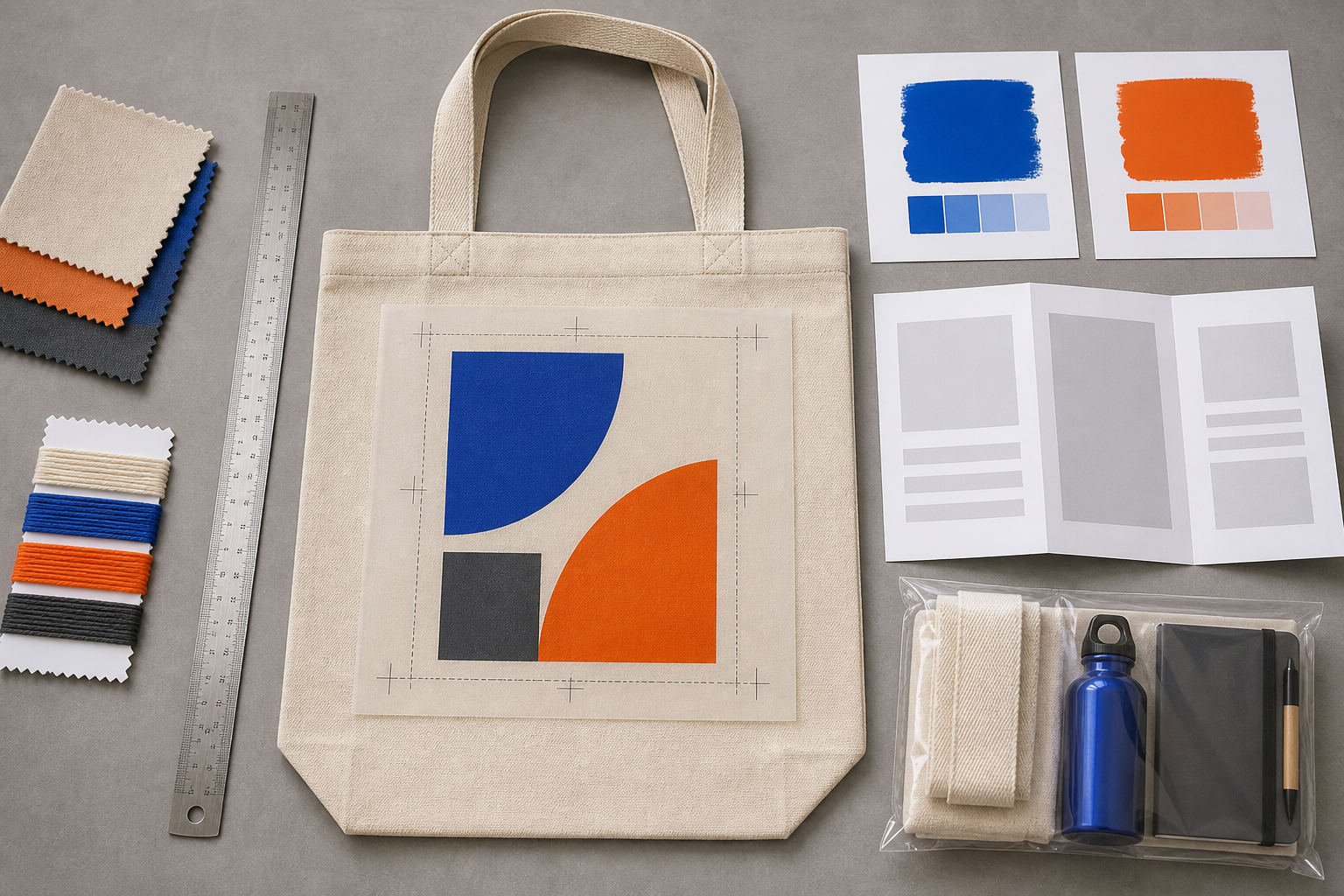
Approve artwork at actual size on the real construction, with safe margins measured from finished seams and folds.
| Artwork zone | What can interfere | How to specify it |
|---|---|---|
| Upper front | Top hem, handle boxes, facing or snap | Set a minimum distance from the finished top edge and attachments |
| Side edges | Seams, taper and side-gusset folds | Mark left and right exclusions on the approved panel map |
| Lower front | Bottom fold, boxed corners and loaded curvature | Check the lowest visible artwork point on a filled sample |
| Pocket area | Double layers, pocket seams and access opening | Define whether decoration is applied before or after pocket assembly |
| Reverse side | Different messaging, orientation or production sequence | Supply a separate named view and measurable placement |
Use color as a material decision
A color value on screen does not define the final tote. Fabric absorbs and reflects light differently from coated paper, while ink opacity, weave and base color change the graphic. Decide which color matters most: the shell, the printed mark, the handles or the combined impression. Approve physical swatches under practical lighting.
| Color decision | Main risk | Better control |
|---|---|---|
| Stock fabric color | Shade varies from the brand palette | Approve the available material swatch before artwork adjustment |
| Custom-dyed shell | Dye lot and MOQ implications are discovered late | Confirm target, tolerance, quantity and lab-dip process early |
| Light ink on dark fabric | Poor opacity or a visible underbase effect | Approve a physical strike-off on production-equivalent fabric |
| Tone-on-tone branding | Elegant on screen but nearly invisible in use | Review under indoor, daylight and photographic conditions |
| Multiple campaign colors | Registration, cost or inconsistent visual weight | Identify essential colors and simplify noncritical detail |
Select decoration after the design outcome is clear
Do not choose a process by popularity alone. Start with the desired artwork scale, color count, detail, hand feel, quantity and fabric. A simple bold mark at volume may suit screen printing; a detailed short-run graphic may point toward a qualified transfer or digital option; a small premium identity may suit embroidery or a patch. Each option must be sampled on the actual base.
For a method-by-method production comparison, read Custom Tote Bag Printing Methods. If the shortlist is specifically screen print or transfer, use Screen Printing vs Heat Transfer for Tote Bags. Keeping those technical details in dedicated guides prevents this design article from duplicating them.
Plan front, back, label and packaging as one system
The front panel is only one brand surface. A second side can carry a quieter message, an interior label can identify the program without affecting reuse, and packaging can hold information that would clutter the bag. Consider the full unboxing and handover sequence.
| Surface | Best role | Control point |
|---|---|---|
| Front | Primary recognizable campaign signal | Visibility when filled and carried |
| Back | Secondary artwork, partner acknowledgement or quieter alternative | Correct orientation and named artwork version |
| Interior label | Brand ownership, material or care information | Required wording, language and market compliance |
| Hangtag or insert | Campaign story, instructions or traceability detail | Attachment method and removal without damage |
| Individual packing | Protection, distribution control and kit identification | Material choice, label position and fulfilment workflow |
Control variants before they multiply
Campaign teams often request several colors, markets, languages or partner versions. Every variation can create separate artwork approval, setup, quantity allocation and packing risks. Establish a master system: fixed logo position, shared bag construction, controlled color pairs and a naming convention.
| Variant | Risk | Control |
|---|---|---|
| Several shell colors | Artwork contrast changes by base | Approve each color combination physically |
| Regional language | Wrong text packed for a destination | Use unique codes on artwork, cartons and packing lists |
| Partner logos | Inconsistent scale or unapproved relationships | Create a fixed lockup zone and signed matrix |
| Personalized names | Data, spelling and sequence errors | Define data ownership, proofing and replacement rules |
| Multiple distribution kits | Correct tote paired with the wrong contents | Run a full kitting trial with scannable or visual identifiers |
Variant counts also affect order planning. The Custom Tote Bag MOQ Guide explains why one total quantity can become several smaller production lots.
Give the factory a complete promotional tote brief
A useful brief removes assumptions while leaving room for manufacturable recommendations. It should connect creative intent with measurable product information.
| Brief field | Minimum information | Why it matters |
|---|---|---|
| Campaign and audience | Purpose, recipient, distribution date and reuse context | Guides construction and presentation decisions |
| Bag specification | Finished size, material, color, handles, gusset, closure and features | Defines the product underneath the artwork |
| Artwork | Controlled files, final dimensions, colors, sides and orientation | Prevents scaling and version errors |
| Placement | Distances from named finished edges with tolerance expectations | Makes approval measurable |
| Quantity matrix | Units by color, artwork, market and delivery | Reveals actual lot sizes and packing complexity |
| Packing and delivery | Folding, individual packing, labels, carton limits and required date | Connects production with the campaign launch |
| Approval route | Decision owner, strike-off, sample and final sign-off dates | Prevents conflicting comments and schedule drift |
Approve the physical sample in a realistic sequence
A screen mock-up can confirm direction, but it cannot prove color, fabric feel, print hand, opening, balance or packed appearance. Approve progressively and keep one controlled final sample. The Custom Bag Sample Development Process provides the broader framework.
| Stage | Decision | Do not approve from |
|---|---|---|
| Dimensioned mock-up | Scale, hierarchy, orientation and nominal placement | A perspective rendering without dimensions |
| Material and color swatch | Weave, weight, finish and shell color | A monitor or unrelated catalogue photo |
| Decoration strike-off | Color, detail, opacity, edge and hand feel | Artwork alone |
| Finished tote sample | Construction, placement, carry comfort and complete appearance | A loose printed panel |
| Packed sample | Fold marks, kit fit, labelling and opening experience | An empty unwrapped tote |
| Signed control sample | Reference for bulk production and inspection | Scattered email comments without a final version |
Inspect what the audience will notice
Bulk inspection should compare production against the signed sample and specification. Begin with the overall impression at normal distance, then measure critical details. Placement, color, clean printing, handle alignment, seams and packing all influence whether the campaign feels credible.
| Check | What to compare | Campaign consequence |
|---|---|---|
| Overall visual balance | Approved filled and empty sample | Brand mark looks misplaced in photographs or use |
| Artwork placement | Defined reference points and tolerance | A row of giveaway bags appears inconsistent |
| Color and coverage | Physical target under consistent light | Campaign assets no longer look coordinated |
| Construction | Seams, handle symmetry, reinforcement and dimensions | Bag fails during distribution or reuse |
| Packing accuracy | Variant, label, insert, fold and carton matrix | Wrong bags reach the wrong event or market |
Integrate these items with the Custom Bag Quality Inspection Checklist rather than treating artwork as a separate final glance.
Company-claim boundary: the following section is LUCKYSTAR publisher self-description and a commercial service proposal. It is not independent proof of factory ownership, in-house control of each operation, material availability, rights clearance, sample or bulk quality, campaign performance, capacity, MOQ, price or delivery. Legal seller, production route, materials, samples, tests, inspection, packing, quantity and schedule depend on the exact order and written confirmation.
How LUCKYSTAR describes its promotional tote review
LUCKYSTAR states that it can review a campaign brief and prepare an order-specific proposal connecting intended use, tote construction, artwork, sampling, quality controls and packing.
- Campaign job: record recipient, distribution context, intended contents, load, reuse objective and required arrival date.
- Product route: define finished dimensions, material, handles, gusset, closure, pockets, labels and proposed production sites.
- Artwork control: identify rights owner, approved files, colours, sides, finished reference points, safe zones, QR destination and version codes.
- Approval gates: agree material or colour references, strike-off where applicable, construction sample, pre-production sample, packed sample and reapproval triggers.
- Bulk and handoff: set measurable tolerances, appearance checks, quantity matrix, individual pack, carton mark, destination and inspection record.
Review the custom tote bag range and other product categories, then send the campaign matrix for an order-specific response.
Measure the campaign without unrealistic exposure claims
Promotional products are often sold with impressive “impression” estimates, but a useful evaluation begins with observable behavior. Measure how many bags were distributed, how many remained, whether recipients carried them during the event, what feedback appeared and whether the format is reordered. If a QR code or landing page is used, track it as one signal—not as proof of every offline view.
| Measure | What it can show | Limitation |
|---|---|---|
| Distribution rate | Whether the planned quantity matched demand | Does not prove later use |
| On-site carry observation | Immediate usefulness and visibility | Event behavior may not continue |
| Recipient feedback | Perceived quality, comfort and preferred features | Small samples may be biased |
| Tracked landing-page visits | Direct response from a specific code or URL | Many people will never scan |
| Repeat order or redesign notes | Operational success and lessons for the next campaign | Other business factors affect reorder decisions |
Common promotional tote design mistakes
- Starting with the largest possible logo instead of a clear audience and use case.
- Copying a campaign poster onto the bag without simplifying the hierarchy.
- Approving artwork on a flat rectangle rather than the finished, loaded tote.
- Ignoring handle boxes, seams, gusset folds and bottom curvature.
- Choosing fabric and decoration separately, then discovering poor compatibility.
- Adding an event date so prominently that leftover bags cannot be reused.
- Creating too many color and partner variants for the available quantity.
- Leaving individual packing, kit assembly and carton labels until production is complete.
- Judging a sample empty when recipients will carry heavy brochures or products.
- Making sustainability claims without confirming material evidence and practical durability.
Frequently asked questions
How large should a logo be on a promotional tote bag?
There is no universal percentage. The correct size depends on the finished panel, viewing distance, message hierarchy and decoration process. Print the artwork at actual size, place it on the physical tote and review the bag empty, filled and carried.
Should promotional totes use one side or two sides?
One side can be sufficient for a focused, economical design. Two sides may support a primary mark and secondary message, but each side adds artwork, setup and inspection requirements. Decide whether the second surface improves the campaign enough to justify the complexity.
What makes a promotional tote look premium?
Premium perception comes from the whole product: appropriate fabric, balanced proportions, comfortable handles, clean seams, controlled color, disciplined artwork and thoughtful packing. A special decoration cannot compensate for a weak base tote.
Can a QR code be printed on a tote bag?
It can, but scan performance must be tested at final size on production-representative fabric after printing, sewing, folding and loading. Contrast, distortion, weave, ink spread and folds can interfere. Keep the destination under the campaign owner’s control, provide a readable fallback URL and define devices, lighting, distances and pass criteria. If the code carries GS1 identifiers, build and validate the URI against the current GS1 Digital Link URI Syntax; an ordinary marketing URL does not become a GS1 Digital Link merely because it is printed as a QR code.
How many design variants should a campaign use?
Use the fewest variants that serve a real audience, language or partner requirement. Every additional shell color and artwork version reduces the quantity per combination and increases approval, production and packing risks.
When should the promotional tote sample be approved?
Approve the finished sample after the material, color, artwork and construction are physically represented, but before bulk production. If packing or kitting matters, also approve a packed sample with the real contents and labels.
What information is needed for a quotation?
Provide finished size, material or target feel, construction, handles, artwork, decoration size and colors, quantity by variant, individual packing, delivery destination and required date. Missing details can make quotations difficult to compare. For budget variables, see How Much Do Custom Tote Bags Cost?.
Turn the campaign plan into a controlled tote brief
Connect the recipient and load to one released construction, artwork map, quantity matrix, approval path, packout plan and required arrival date. This makes supplier responses easier to compare and keeps later changes visible.

Review LUCKYSTAR custom tote bag options, then send the campaign brief through the contact form or Email a project brief. The email link opens a prefilled draft for your review before sending.
Legal seller and facility, material and capacity availability, rights, claims, samples, tests, inspection, price, MOQ, packing, schedule and delivery terms are subject to current evidence, final specification, contract and written confirmation.