Two transparent shopping bags can look identical in a supplier photograph and behave very differently at checkout. One film may hold a crisp box shape but stiffen after a cold delivery. Another may feel soft and rebound well yet sag around a wide retail basket. Either can fail if its weld, bound edge, handle patch or packing method does not suit the selected grade.
This Clear PVC vs TPU Shopping Bags guide is an engineering and sourcing comparison. It does not rank the materials by trend or declare a permanent winner. Instead, it shows how to compare exact film grades in the same thickness and bag construction, then validate clarity, flexibility, tear behavior, joining, chemical documentation, load performance and packed appearance.
Explore transparent formats on LUCKYSTAR’s custom shopping bags product page. Use this guide with How to Choose a Custom Shopping Bag Manufacturer and the broader Custom Bag Manufacturer Guide when qualifying the film converter and bag assembly route.
Planning an order? Send a grade-specific clear bag brief. Include use and market, contents/load, finished geometry, exact PVC or TPU grade direction, thickness and surface, temperature and cleaning exposure, joining and handle route, artwork, restricted-substance scope, quantity by SKU, packing, destination and required date.
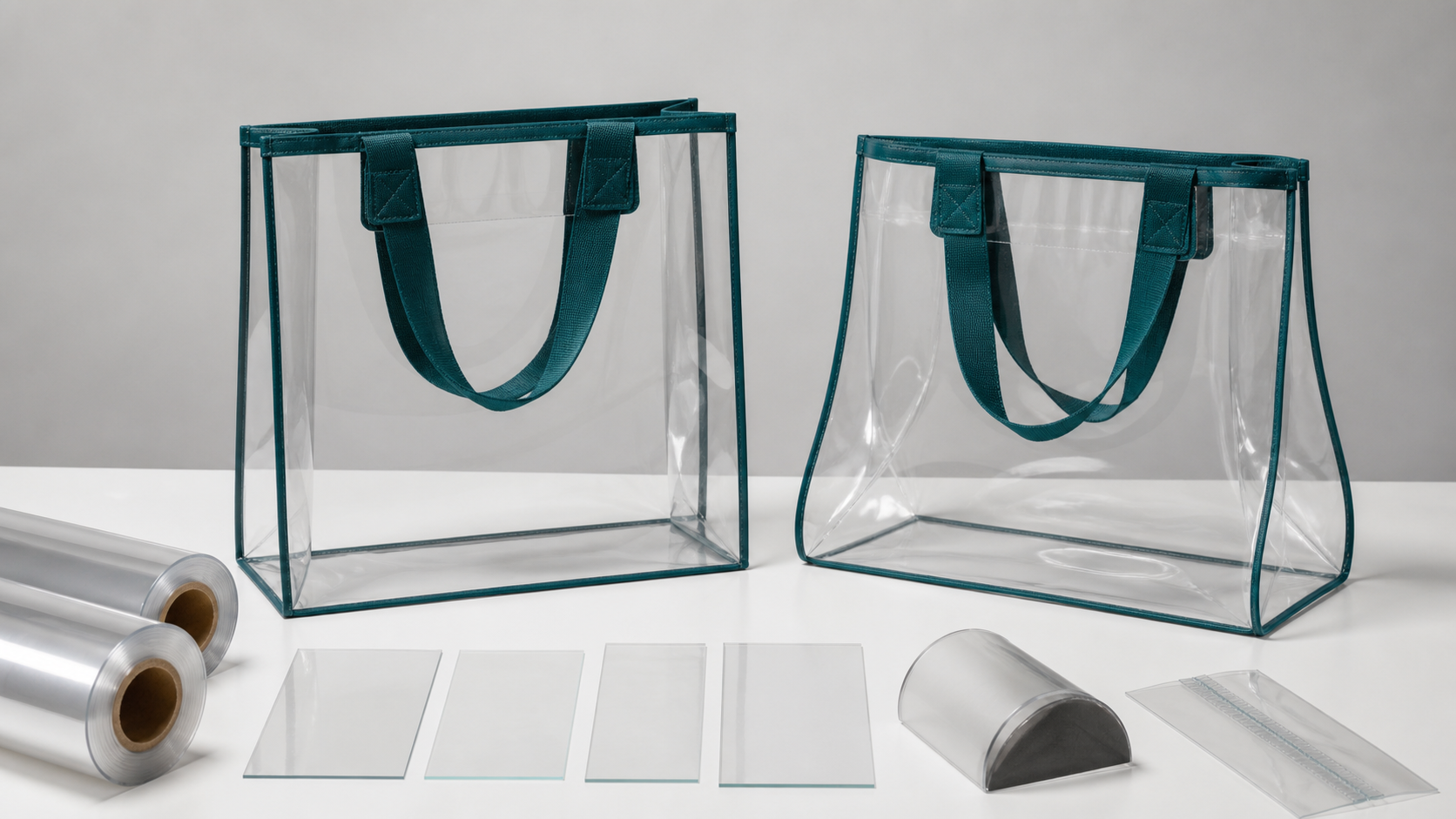
Compare the same bag geometry, trim and thickness before attributing a difference to PVC or TPU.
1. Compare exact film grades, not polymer names
Flexible PVC is a formulation: PVC resin is combined with plasticizing, stabilizing and processing components to reach a target hardness, clarity and manufacturing behavior. Different plasticizer and additive packages can change odor, low-temperature flexibility, blocking, migration, print compatibility and restricted-substance status.
TPU is also a family rather than one film. Polyurethane chemistry, hardness, film extrusion, surface treatment and additives affect clarity, yellowing, hydrolysis resistance, elasticity and heat or radio-frequency welding response. Polyester- and polyether-type TPU films, for example, are selected for different environmental exposures; a buyer should ask the film producer to name the grade and its intended-use limits instead of assuming that every TPU shares one performance profile.
Do not compare a 0.25 mm soft PVC film with a 0.50 mm hard TPU sheet and conclude that the polymer caused all differences. Ask for matched nominal thickness and a similar target hand, then evaluate the converted bag. If the commercial design requires different thicknesses to reach the same function, record those production-intent builds and compare total material use, joining, pack volume and performance.
| Decision dimension | Flexible PVC route | TPU route | How to decide |
|---|---|---|---|
| Shape and hand | Can range from soft to relatively crisp; structured clear totes are widely available | Many grades provide a softer, elastic or rubber-like hand; firmness still varies | Approve hardness/hand, empty recovery and loaded geometry on matched bag samples |
| Low-temperature use | Formulation controls cold stiffening and flex; generic room-temperature approval is insufficient | Some grades are selected for good cold flexibility, but the usable range is grade-specific | Condition complete bags at the declared low temperature, then flex and load promptly |
| Abrasion and flexing | Can be suitable for normal retail handling when surface and pack protection are controlled | Often shortlisted for repeated flex or abrasion performance, subject to grade and surface | Use the actual contact surface, fold radius, cycle and post-test clarity criteria |
| Joining | Established RF/high-frequency, heat and sewn/bound routes are common | Weldable grades exist, but temperature/window, tooling and surface treatment must be confirmed | Approve material-specific weld/seam coupons and a complete load-bearing joint |
| Compliance evidence | Plasticizer and stabilizer package needs destination/use-specific review | Do not assume “phthalate-free,” non-toxic or compliant from the TPU name alone | Freeze the BOM, market, user group and test/report scope for the exact order |
| Cost and supply | Often benefits from mature supply and conversion routes | Frequently carries a higher film cost, but grade, thickness and volume control the gap | Normalize usable yield, scrap, conversion speed, test, packing and freight—not film price only |
2. Define the shopping job before choosing the film
A stadium or event carrier, a beach shopper, a retail presentation bag and a security-screening tote share visibility but not the same risk. State what goes inside, maximum mass, rigid corners, use temperature, carry duration, expected reuse, cleaning, privacy level and destination. For venue entry, obtain the current bag policy from the venue or event owner: size, number of pockets, tint, branding and closure rules can change, and a generic “stadium-approved” claim is not reliable.
A film can resist surface water while the finished bag admits water at the open top, zipper, needle holes or imperfect welds. Decide whether the requirement is wipe-clean, splash resistance, temporary rain exposure or a verified water-protection level. Do not call the whole shopper waterproof solely because PVC or TPU film is not readily permeable to liquid water.
| Shopping application | Primary requirement | PVC development question | TPU development question | Complete-bag proof |
|---|---|---|---|---|
| Venue / security carrier | Contents visibility, exact permitted size and controlled pocket/branding layout | Can the selected film remain clear, square and crack-free through seasonal use? | Will the softer grade sag beyond the policy envelope when loaded? | Current venue-policy check plus loaded dimensions and visual inspection |
| Retail gift or display bag | Optical presentation, shape, clean welds and product arrangement | Does structure justify the hand and packing fold? | Does flexible film preserve display shape around the insert? | Pack-out sample, shelf hold, scuff/blocking and opening access |
| Beach / pool shopper | Wet-item handling, repeated flex, sunscreen/cleaner contact and corrosion-resistant trim | How do formulation and print respond to heat, sun and chemical contact? | Which TPU grade addresses hydrolysis, UV and chemical exposure? | Conditioned contact/flex testing plus rinsing, drying and load cycles |
| Promotional event tote | Reliable load at controlled cost and artwork visibility | Can an established stock film and trim meet the evidence scope? | Does the added material cost support a measurable user benefit? | Production-intent print, handle pull, cycle and carton recovery |
| Premium reusable shopper | Hand feel, recovery, refined interfaces and repeat-use appearance | Can a suitable soft PVC grade achieve the desired flex and odor target? | Can the selected TPU control yellowing, scratch display and structure? | Repeated fill/carry/fold/clean sequence with post-test optics |
3. Freeze thickness, hardness and surface together
Thickness changes stiffness, weight, cost, weld energy, corner bulk and carton recovery. Hardness changes drape and fold behavior even at the same thickness. Surface finish changes tack, blocking and perceived clarity. These variables belong in one approval set.
Specify nominal thickness and tolerance, plus the sampling locations across the roll and finished panels. ISO 4593:1993 remains current and describes mechanical scanning of film/sheet thickness; its scope notes that it is not suitable for embossed film. A supplier’s “0.3 mm” description needs an agreed method, instrument foot/pressure where relevant and an actual bulk distribution, not one reading on a smooth center point.
Hardness should name the method, scale, conditioning and specimen build. A thin bag film may require stacked specimens or a supplier-specific hand standard; the test laboratory should confirm method suitability. Retain a sealed film swatch and a converted bag because numerical hardness does not fully capture noise, rebound, fold whitening or perceived quality.
| Film specification field | What to state | Why it matters in a shopping bag | Approval evidence |
|---|---|---|---|
| Polymer / grade | PVC or TPU, film-maker grade/code, resin/chemistry details relevant to the use | Connects performance and compliance to one reproducible input | Technical data, supplier declaration and labeled bulk lot |
| Thickness | Nominal, tolerance, test method and across-width sampling plan | Controls structure, weld, tear propagation, weight and cost | Roll map plus finished-panel readings away from joins |
| Hardness / hand | Method/scale where applicable, conditioning, sample build and physical master | Controls drape, recovery, grip comfort and cold feel | Conditioned data plus side-by-side bag bend/recovery review |
| Optical standard | Transmittance, haze, tint/yellowness, surface and viewing setup | Determines security visibility and retail presentation | Instrument data and light-box master against actual contents |
| Surface / protection | Gloss/matte, anti-block or treatment, protective liner and removal stage | Influences scratch visibility, sticking, print and weld contamination | Packed hold, peel-off review and decoration/joining trial |
| Color / odor | Colorless or tint reference, odor protocol, conditioning and timing | Transparent products expose small tint shifts and trapped odor | Lot comparison after sealed-carton hold and ventilation period |
| Additive / claim scope | Restricted-substance target, plasticizer statement, stabilizers and intended claims | Polymer name alone does not prove legal or marketing suitability | BOM-level declarations and order/market-specific test reports |
4. Measure clarity instead of approving a bright photograph
Transparency has more than one dimension. Total luminous transmittance describes how much visible light passes through; haze describes wide-angle scattering that makes a view look cloudy. Tint, surface waviness, scratches, welds, fold marks and multiple overlapping layers affect the user’s actual view.
ISO 13468-1:2019 covers total luminous transmittance for planar transparent and substantially colorless plastics, including films and sheets within its stated limits. ISO 14782:2021 covers haze below the specified method range. Use the same thickness, conditioning, protective-film status and measurement face when comparing candidates.
Instrument data should be paired with a visual standard: view the bag against high-contrast text, representative product labels and skin/clothing colors under defined lighting. Examine one panel, two overlapped panels, a weld and a folded gusset. A bag can have acceptable flat-film haze while the converted corners look cloudy because of heat history, contamination or stress whitening.
5. Test flex, cold, heat and ageing for the actual route
Room-temperature hand samples hide seasonal behavior. Condition finished bags at the lowest declared handling/storage temperature, then perform a controlled bend, open the gusset and run the load test before the sample warms significantly. Repeat at the upper storage or use condition if heat can soften the film, increase tack or transfer print.
TPU selection may need specific hydrolysis, humidity, UV and yellowing questions; PVC selection may need specific plasticizer migration, cold-crack, odor and blocking questions. Neither list applies equally to every grade. Ask the film producer or competent laboratory to match ageing conditions to the exact chemistry and intended exposure.
ISO 4892-3:2024 specifies fluorescent-UV, heat and water exposure methods for plastics. An accelerated exposure is a comparison under defined apparatus conditions, not a direct promise of years outdoors. Define what to measure afterward: tint/yellowness, haze, tensile/tear change, tack, cracking, weld integrity, print and finished-bag load.
6. Choose the joining route with the film supplier and factory
Transparent film can be welded, sewn with binding, adhesively joined in selected details, or combined in a hybrid. The material grade must be compatible with the equipment and trim. “RF weldable TPU” and “PVC suitable for high-frequency welding” are useful starting declarations, but production still needs a window for power, time, pressure, cooling and electrode geometry.
A clear weld should have defined width, overlap, location, appearance and strength. Too little fusion can split under peel or load. Excessive energy can thin, distort, burn, yellow or embrittle an edge. Contamination, protective liner, print, anti-block surface and humidity can change results. Record the production machine and setup with the approved joint.
Sewing permits textile binding and familiar handle construction, but every needle hole punctures the film. Needle, stitch length, thread, binding width, feed and seam allowance must avoid a perforation tear path. Combine welding and sewing only after confirming that the operations do not damage each other’s heat-affected or perforated zones.
| Joining route | Useful design role | Critical setup | Failure to reproduce |
|---|---|---|---|
| RF / high-frequency weld | Clear panel seams, patches and structured gussets on compatible polar films | Grade compatibility, electrode, power, time, pressure, cooling, overlap and cleanliness | Channel, bubble, under-fusion, thinning, yellowing or split at weld edge |
| Contact heat / impulse seal | Selected straight seams and thermally compatible grades | Temperature, dwell, pressure, bar profile, release surface and cooling | Narrow seal, sticking, distortion, cloudy heat line or peel |
| Sewn and bound seam | Textile-trimmed retail aesthetic, curved edges and reinforced openings | Needle, stitch length, thread, binding, feed, allowance and backtack policy | Perforation tear, skipped stitch, cut edge escape or binding miss |
| Welded patch + sewn webbing | Spreads handle force through a compatible clear or opaque reinforcement | Patch area, weld field, stitch location, material stack and edge distance | Stitch enters the weld edge, patch peels or local film tears |
| Hybrid textile yoke / clear body | Moves handles, zipper or branding into a stable textile component | Film-to-textile interface, seam/binding, migration and differential stiffness | Film pulls from yoke, trim stains/tacks or body creases at a hard transition |
Draw the panel overlaps, weld widths, seam allowances, binding and handle reinforcement in the Custom Shopping Bag Tech Pack. Validate the same build through the Custom Shopping Bag Sample Development Process before ordering bulk film.
7. Engineer handles around the film—not through it
A narrow webbing end attached directly to clear film concentrates force. Reinforcement should spread the load without creating a sharp stiffness step. Options include a larger welded patch, a textile yoke, binding that carries the attachment, or webbing continuing toward the base. The correct route depends on film elongation, bag load and desired transparency.
Specify webbing width, handle drop, insertion, patch dimensions, weld/stitch geometry and loaded position. Test symmetric and asymmetric pulls, then repeated lift, walk/swing and set-down cycles with representative rigid contents. Inspect around every needle hole, weld perimeter and patch corner under transmitted light.
Material tensile and tear data cannot certify the handle. The complete load path runs through trim, thread or weld, patch, film panel, gusset and base. Use the finished-bag approach in Which Tests Should Reusable Shopping Bags Pass?.
8. Protect the transparent surface through production and packing
Clear bags reveal fingerprints, dust, fibers, scratches and pressure marks. Decide which film face carries a protective liner and when it is removed. Cutting, printing, welding, sewing and inspection stations need clean surfaces and controlled stacking. A liner left too long may block or transfer; removed too early, it no longer protects the panel.
Blocking occurs when film surfaces stick under heat, pressure or storage. Test the actual fold, interleaf, bag count, carton compression, temperature and hold time. After unpacking, check separation force, surface transfer, odor and recovery. Tissue or interleaf can help, but adds material, labor and possible lint. Select it through a pack trial.
A large clear shopper folded into a small carton may develop white stress lines or permanent creases. Approve the fold diagram, handle position, insert and carton count during sampling. If the bag is a retail product, verify how quickly it returns to saleable shape after the expected distribution hold.
9. Build a test matrix around failure mechanisms
ISO 527-3:2018 specifies tensile-test conditions for plastic films and sheets below 1 mm, within its stated scope. ISO 6383-1:2015 covers trouser-tear resistance for film/sheet below 1 mm and notes suitability limits for very rigid or irreversibly deformable materials. A competent laboratory should confirm specimen direction, conditioning and method fit for the exact PVC or TPU film.
Flat-film numbers are useful for incoming comparison, but the converted shopper adds welds, holes, trim and multi-axial stress. Test virgin film, processed film near the joint, joint coupons and finished bags separately. Record the failure location; “passed 10 kg” is not enough to improve the design or contain a bulk issue.
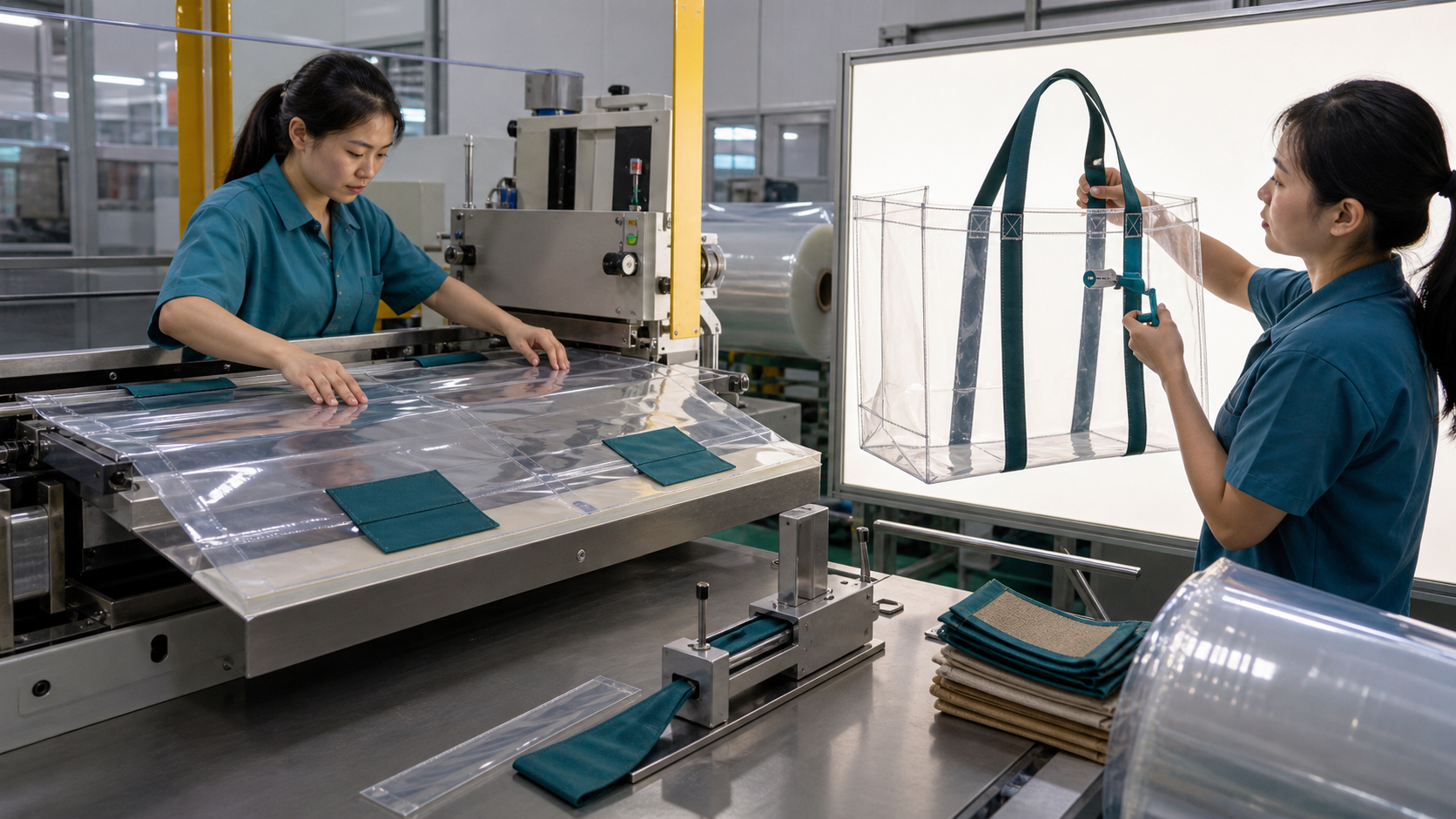
Transparent-bag quality combines film identity, controlled joining, illuminated appearance checks and load-bearing interface tests.
| Risk | Test level | Condition / fixture | Record after test |
|---|---|---|---|
| Thickness / grade drift | Incoming roll | Mapped thickness, identity, appearance and protected/unprotected surface | Distribution, lot, outliers and release/hold decision |
| Tensile / tear / puncture | Film and processed panel | Both production directions, declared temperature and method-appropriate specimens | Strength, extension, tear path, conditioning and specimen location |
| Weld or seam opening | Joint coupon | Peel/shear or bag-specific pull across normal and aged/cold-conditioned joins | Maximum force, displacement and adhesive/cohesive/film failure location |
| Handle pull-out | Subassembly and complete bag | Symmetric, asymmetric and cyclic pull with exact patch/webbing | Permanent set, hole/weld growth, thread/patch/film failure and margin |
| Cold / heat behavior | Complete bag | Declared conditioning followed by bend, opening and load within controlled timing | Crack, tack, whitening, noise, recovery, weld and load result |
| Optical ageing / scratch | Flat film and converted bag | Defined abrasion/contact or light exposure with actual tint/print/trim | Haze/transmittance/tint change, visible damage and post-test strength |
| Distribution / retail recovery | Packed shipment unit | Approved fold, interleaf, carton compression, temperature and duration | Blocking, odor, scratches, crease recovery, count and ready-to-sell appearance |
10. Turn chemical compliance into a BOM exercise
Restricted-substance requirements follow the destination, user group and component—not a simple PVC-versus-TPU slogan. The bag BOM can include film, plasticizers/additives, print/ink, adhesive, binding, webbing, thread, zipper, coated hardware, labels and packaging. A passing film report does not automatically cover the trim or complete article.
For the EU, the current ECHA Annex XVII conditions of restriction include Entry 51 restrictions for DEHP, DBP, BBP and DIBP in plasticized material in articles at the stated 0.1% threshold, individually or in combination, subject to the entry’s conditions and exemptions. Do not reduce this to “PVC is banned” or “TPU is automatically exempt.” Have a competent compliance professional define the applicable materials, tests and documentation for the order.
If the bag is intended for children, direct food contact, medical use or another regulated application, additional requirements may apply. Carrying sealed groceries is not the same as authorizing direct food contact. Ask the buyer to state the intended contact and age group before the laboratory scope is issued.
| Compliance / claim file | Minimum content | Common gap | Release owner |
|---|---|---|---|
| Market and use brief | Countries, channel, user age, contact, temperature and claims | Testing a generic adult bag while marketing later targets children or food | Brand compliance / legal |
| Component-level BOM | Film grade, formulation declaration, trims, inks, adhesives, hardware and packaging | Only the clear body film is listed | Product development + supplier quality |
| Supplier declarations | Legal entity, site, material code, lot/order, regulation version and authorized signatory | Undated template for an unrelated grade | Sourcing / compliance |
| Test reports | Accredited/competent laboratory, sample identity, methods, limits, results and dates | Report cannot be reconciled with the bulk material or finished BOM | Brand quality / compliance |
| Change control | No-substitution rule, approval path and retest triggers for grade/color/trim/process changes | Bulk uses an “equivalent” film or plasticizer package after approval | Buyer + supplier quality |
| Consumer / B2B claims | Exact wording, evidence boundary, market review and approval record | “Non-toxic,” “eco-friendly,” “biodegradable” or “recyclable” inferred from TPU/PVC name | Brand legal / sustainability |
11. Avoid unsupported environmental shortcuts
TPU is not automatically biodegradable, bio-based, recyclable in local systems or lower impact. PVC is not automatically unsuitable for every long-life application. The useful comparison considers exact mass, additives, manufacturing yield, durability, reuse, packaging, take-back or recycling infrastructure and substantiated end-of-life routes.
A “PVC-free” bag claim needs a defined boundary. The body may be TPU while binding coatings, print, patch, zipper or packaging contains PVC. Likewise, “phthalate-free PVC” should be supported by formulation and/or testing appropriate to the intended statement and destination—not treated as a reason to skip all other restricted-substance review.
Make narrow, verifiable claims. “Body film: TPU grade X” or “body film tested for the listed restricted phthalates under report Y” is more auditable than “green material.” Keep marketing approval separate from performance approval.
12. Understand MOQ, cost and lead time
Film MOQ may be driven by grade, thickness, tint, embossing or surface treatment. A stock clear PVC film can follow a different minimum from a custom TPU grade; the reverse can occur when the supplier already stocks the required TPU. Binding, webbing, zipper, print and welding tools create their own minimums.
Compare quotations after matching finished size, material code, nominal/actual thickness, usable yield, joint route, handle reinforcement, printing, tests, surface protection, packing and delivery basis. TPU’s per-kilogram or per-square-meter premium does not translate directly into the same percentage at bag level. A softer film may require another thickness, pattern, reinforcement or packing route; a cheaper film can become expensive if scratch rejection or blocking loss is high.
Use the Shopping Bag MOQ and Production Time guide and 2026 Shopping Bag Pricing Guide to normalize commercial assumptions. Add time for grade confirmation, compatibility coupons, production-intent samples, chemical testing and packed holds.
13. Build film-specific QC gates
At receipt, quarantine film until identity, thickness, tint, haze/visual standard, odor, surface, blocking and protective liner are confirmed. Preserve roll/lot codes through cutting and joining. At first-off, approve the weld or seam on the correct material face, then build and load a complete bag before the setup is released.
During production, check electrode/seal conditions, contamination, alignment, trim compatibility and handle reinforcement. Use transmitted light to inspect bubbles, channels, scratches, dust, whitening and heat distortion. At final inspection, measure dimensions, load function, edges, hardware, cleaning response and packed recovery.
The Custom Shopping Bag Quality Control Checklist provides sampling and defect-classification logic. Add clear-film defects to the approved standard: haze/tint shift, tack, odor, scratch, weld clouding, exposed sharp edge, migration stain, split joint and handle-patch distortion.
14. Send an RFQ that forces an equivalent comparison
| RFQ field | Buyer input | Supplier return | Normalization check |
|---|---|---|---|
| Use / environment | Contents, maximum mass, venue/retail role, temperatures, contact/cleaning and expected reuse | Recommended grade/build plus stated limitations | Both routes are evaluated against the same basket and conditions |
| Finished geometry | Width × height × gusset, opening, handles, pockets/closure and tolerances | Dieline, measurement method, reinforcement and loaded dimensions | No smaller, flatter or less reinforced “comparison” bag |
| Film | PVC and/or TPU direction, target hand, optics, temperature and claim needs | Maker/grade, chemistry where relevant, thickness/tolerance, hardness, surface, tint and MOQ | Named production grades, not generic resin descriptions |
| Joining / handles | Preferred look, weld/seam, binding, webbing, patch and load | Machine/process, joint dimensions, materials, settings record and test proposal | Film, joint and handle stack are quoted together |
| Branding / appearance | Artwork, print method, placement, tint, haze, scratches and weld-appearance limits | Print/weld trial, visual master, optical data and pack protection | Both samples use the same content/viewing and artwork conditions |
| Compliance / claims | Markets, user group, intended contact, restricted substances and exact wording | BOM declarations, test plan/reports, exclusions and change controls | Evidence matches the order, grade, components and destination |
| Commercial / logistics | Quantity by SKU, packing, destination, arrival and Incoterm | MOQ, ladder, tooling, sample/test/bulk timing, yield, carton data and assumptions | Compare total landed and quality risk, not film unit price |
Run the selected build through the Custom Shopping Bag Manufacturing Process. For overseas programs, assign test, inspection, documentation and shipment-release owners using How to Import Custom Shopping Bags from China.
Company-claim boundary: LUCKYSTAR statements in this section are publisher self-description, not third-party verification, laboratory evidence, legal advice, proof of compliance or assurance that a PVC or TPU route is safer, lower impact, stronger, waterproof, lower cost or suitable for every application. Confirm the contracting entity, assigned production site and subcontracting; exact film maker/grade, additives, thickness, surface, trims, inks, adhesives and process; production sample; test and legal scopes; packing; and release terms for each order.
15. How LUCKYSTAR describes its clear shopping bag review
LUCKYSTAR states that its project team can translate a defined retail use into comparable PVC and TPU development routes, subject to specification and written confirmation. Each route can record the named production film, matched geometry, joint and handle build, appearance limits, evidence plan, pack trial and commercial assumptions.
- Material identity: record film maker and grade, relevant chemistry, nominal thickness and tolerance, hardness/hand, surface, tint, lot and substitution controls.
- Optics and ageing: define viewing conditions, haze/transmittance or visual master, scratch, fold, temperature and exposure sequence only where relevant.
- Joining and load path: approve production-face weld/seam coupons, handle interfaces and complete bags under symmetric, asymmetric and cyclic loading.
- Compliance file: map destination, use, age/contact category and exact claim wording to the complete BOM, declarations, reports, dates and change control.
- Pack-out: validate liner/interleaf, fold, count, carton pressure, blocking, odor, scratches, crease recovery and ready-to-sell appearance.
- Commercial comparison: normalize usable yield, tooling, scrap, testing, surface protection, carton data and delivery basis for the same approved construction.
Review the public custom shopping bag options. Teams still qualifying suppliers can use the manufacturer selection guide and Custom Bag Manufacturer Guide. Then send the grade, BOM, performance and compliance requirements for a project-specific review.
Frequently asked questions
Is TPU always better than PVC for clear shopping bags?
No. A suitable TPU may offer a softer or more flex-oriented profile, while a suitable PVC may offer efficient structure and an established conversion route. Exact grade, thickness, use conditions, joining, compliance and total cost determine the better build.
Are all Clear PVC Shopping Bags made with restricted phthalates?
No. Flexible PVC formulations vary. The buyer should define the restricted-substance scope for the destination and use, obtain formulation declarations where appropriate, test the actual order components and control substitutions. Do not infer compliance or non-compliance from the PVC name alone.
Are TPU Shopping Bags automatically phthalate-free or eco-friendly?
No automatic claim follows from “TPU.” Confirm the exact grade, additives, components, test scope and evidence. Environmental claims also require a defined boundary and support for material mass, manufacture, durability and realistic end-of-life.
Which material stays clear for longer?
There is no universal answer. Grade chemistry, UV stabilizers, thickness, heat history, cleaning, abrasion, sunscreen/oil contact and storage all affect haze and yellowing. Compare production-intent films after a relevant ageing and handling sequence.
Can PVC and TPU use the same welding settings?
Do not assume so. Welding window depends on grade, thickness, surface, machine, electrode, pressure, time and cooling. Approve separate coupons and settings for each production material, then verify the complete joint and bag.
Does thicker clear film always make a stronger bag?
No. Thickness can improve stiffness or some film properties, but handle patches, weld geometry, perforations, gussets and rigid contents can remain the weak points. Choose the thinnest or thickest route only after the complete bag meets its declared load and appearance.
Can a clear shopping bag be called waterproof?
Only if the complete construction passes a test that supports that exact claim. An open top, zipper, sewn seam, needle hole or incomplete weld can admit water even when the body film itself is water resistant.
Choose the verified construction, not the favored acronym
The useful outcome of a PVC vs TPU Bags review is not “PVC wins” or “TPU wins.” It is a controlled specification that explains why one named grade, thickness, surface, joint, handle and pack protects the retail job better—and proves the result after temperature, flex, load, ageing and distribution.
Return to the Custom Bag Manufacturer Guide for the wider supplier framework. Then share the use, dimensions, load, temperature, appearance target, market, artwork, quantity and destination through LUCKYSTAR’s custom shopping bags page.

Request a grade-specific clear shopping bag proposal
Compare named production films in the same bag geometry, then qualify the joint, handle path, complete BOM, evidence file and pack-out.
Review LUCKYSTAR custom shopping bag options, then send your project details through the contact form or Email a project brief. The email link opens a draft for your review before sending.
Factory assignment, film grade and formulation, restricted-substance or environmental claims, optics, temperature/flex/ageing, load, waterproofing, artwork, samples, testing, inspection, price, MOQ, packing, schedule and release terms are subject to due diligence, applicable legal review, specification and written confirmation.