Cotton vs RPET Shopping Bags: Sustainability and Performance Comparison
Last reviewed: September 15, 2026
Choosing between cotton and recycled polyester is not a contest between a “ natural” material and an automatically “ green” one. A shopping bag creates value only when its material, construction and care instructions help people use it repeatedly for the job it was designed to do. Cotton can offer a familiar hand feel, a premium textile appearance and a versatile print surface. RPET can support lightweight, compact and quick-drying constructions. Neither description, by itself, proves a lower environmental impact.
The defensible comparison is equal carrying service: two finished bags sized for the same load, used in the same market, tested to the same acceptance criteria and assessed over realistic use. That approach changes the buying question from “ Which fiber sounds greener?” to “ Which finished specification is most likely to deliver the required service with the evidence our brand can substantiate?”
This guide gives retail, promotional and procurement teams a practical way to answer that question. It covers sustainability variables, physical performance, printing, care, traceability, testing and request-for-quotation data. For a broader program overview, start with LUCKYSTAR’ s custom shopping bags and use this comparison to narrow the material route for sampling.
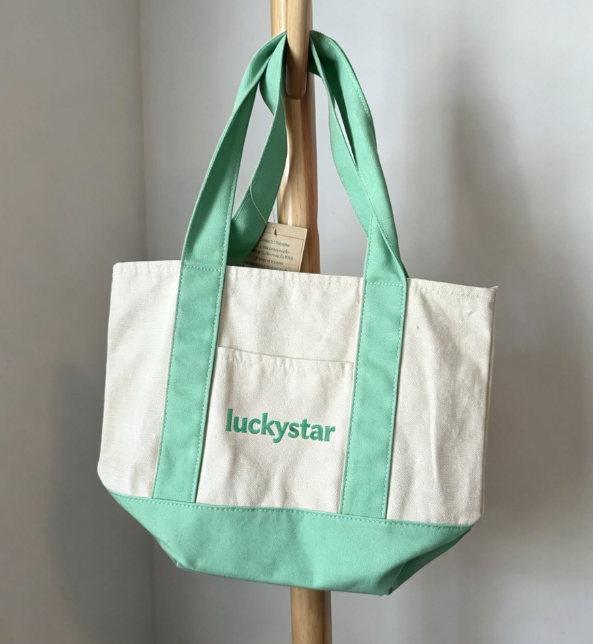
A cotton-route LUCKYSTAR product sample shown on the company’ s public Alibaba channel. The image documents visible construction and branding capability; fiber composition, weight and performance still require the approved order specification.
Need a cotton-versus-RPET shopping bag RFQ comparison? Send the common carrying task, target market, dimensions and payload, component construction and finished weight for each route, artwork and care expectations, reuse target, required tests or chain-of-custody evidence, quantities, packing, destination and required date. LUCKYSTAR can return missing specification fields, matched sample checkpoints and commercial questions for written review.
The short answer: match the material to the service
Cotton is often the stronger candidate when tactile quality, a substantial textile appearance, embroidery, easy decoration on an absorbent surface or a familiar canvas-like presentation is central to the campaign. RPET is often worth evaluating when low finished mass, compact storage, quick drying, abrasion-oriented performance or a recycled-input claim backed by transaction-level documentation matters.
Those are starting hypotheses, not purchasing conclusions. Fabric weight, weave or knit, recycled percentage, coatings, dyeing, print coverage, handle construction, seams, closures, washing behavior and user habits can reverse a simple material-level assumption. A heavy cotton bag that is seldom reused may underperform a lighter bag used weekly. An ultralight RPET bag that fails at the handle early may also be a poor result.
The practical rule is:
Select the lightest, simplest finished design that reliably survives the intended load and realistic number of uses— then support every environmental statement with material, transaction and performance evidence.
That rule is consistent with the context-sensitive approach in the UN Environment Programme life-cycle review of single-use plastic bags and alternatives. The review shows why geography, use count and end-of-life assumptions matter and why a universal material winner is not credible.
What exactly are you comparing?
“ Cotton bag” and “ RPET bag” are incomplete specifications. Before asking for price or impact data, define both candidates at finished-product level.
Define the cotton candidate
Record whether the fabric is conventional cotton, organic cotton, recycled cotton, a cotton blend or an unverified cotton-like textile. Specify weave, fabric mass, color, dye or finish, bag dimensions, gusset, handles, reinforcement, pockets, closure, lining, printing and packing. If an organic or recycled claim is planned, treat it as a separate evidence route rather than an attribute implied by appearance.
Cotton canvas and lighter cotton sheeting can behave very differently. Our canvas vs cotton tote bags comparison explains the terminology; this article focuses on the decision between a defined cotton construction and a defined recycled-polyester construction.
Define the RPET candidate
Record the polymer and recycled-content percentage for every claimed component: shell fabric, lining, handles, webbing, thread, zipper tape, labels and any coating or lamination. “ RPET bag” should not silently mean that every component is recycled polyester. If only the shell fabric is covered, say so.
Also state the fabric formation— woven, knitted, felt-like non-woven or another structure— plus denier or yarn data where relevant, fabric mass, coating, color, print process and finished dimensions. Recycled content is an input claim; it does not establish strength, repeated-use performance, recyclability or a lower whole-life impact by itself.
Compare like with like
Give both prototypes the same usable volume, target load, handle drop, closure requirement, print brief, safety margin and test sequence. Do not compare a reinforced 12 oz cotton tote with a thin foldable RPET pouch and then attribute every difference to fiber. The two products provide different service.
Cotton vs RPET at a glance
The table below is a screening tool. Every row contains variables that must be confirmed on the actual sample.
| Decision factor | Cotton route | RPET route | What the buyer should verify |
|---|---|---|---|
| Feedstock claim | Conventional, organic, recycled or blended cotton are distinct claims | Recycled polyester percentage and claimed components must be identified | Supplier declaration, composition report, scope documents and order-level records |
| Typical design opportunity | Natural-looking, textured or substantial retail tote | Lightweight, foldable, smooth or performance-oriented bag | Approved material swatches and finished samples |
| Moisture behavior | Usually more absorbent; drying and wet dimensional change need checking | Usually lower moisture uptake and quicker drying, subject to fabric and finish | Wet conditioning, drying method and post-care inspection |
| Dimensional stability | Shrinkage or distortion may occur depending on fabric and care | Often more dimensionally stable, but heat can affect fabric, coating and print | Agreed wash/dry cycle and dimensional-change limits |
| Decoration | Screen, transfer, embroidery and other methods may be feasible | Screen, transfer or sublimation may be feasible on suitable substrates | Production-intent print trial, adhesion, color and heat compatibility |
| Durability drivers | Fabric mass, weave, abrasion, seam allowance and reinforcement | Filament/staple route, denier, fabric construction, coating and reinforcement | Finished-bag load, seam, handle and abrasion testing |
| Finished mass and pack cube | Can be higher for substantial constructions | Can be lower or more compressible for some designs | Weigh and pack real finished units, not just compare GSM |
| Care | Washing can consume resources and may alter size, color or print | Lower-temperature care may be possible; heat sensitivity and microfiber release require consideration | Care-label validation and realistic cleaning frequency |
| End of life | Fiber route alone does not guarantee collection, sorting or recycling | Recycled content does not automatically make the finished bag recyclable | Actual local collection route and component compatibility |
| Best use case | Programs where tactile value helps drive long-term retention | Programs where portability, low mass and quick drying support repeat use | User trial and achieved-use evidence |
Sustainability begins with a functional unit
A material comparison needs a unit of service. For shopping bags, a useful functional unit might be: “ carry up to 8 kg of mixed retail goods over 50 shopping trips within two years.” Your number should reflect the actual program— not a number borrowed from another brand or study.
With that unit defined, compare:
- finished mass per bag, including handles, print, closure, label and packaging;
- units needed to deliver the service, including expected failures and replacements;
- material composition and claimed recycled or certified content;
- production and finishing assumptions that can be documented;
- transport pack-out and route;
- care frequency, water/energy assumptions and drying method;
- realistic reuse rate and loss or disposal behavior; and
- available end-of-life collection in the target market.
The framework follows the life-cycle principles described in ISO 14040 and ISO 14044: define goal and scope, keep system boundaries transparent and do not present unlike assumptions as a precise comparison. A full third-party life-cycle assessment may not be necessary for every bag order, but disciplined scoping is necessary for credible decision-making.
Feedstock impacts are only one part of the decision
Cotton is a plant-derived cellulosic fiber, but cultivation route, location, irrigation, yield, energy, chemistry and processing conditions vary. A generic “ natural” label cannot substitute for evidence about a particular supply chain. Organic cotton is also a specific claim, not a visual characteristic. Buyers considering that route should use the documentation questions in our organic cotton bag supply-chain guide.
RPET is polyester made using recycled feedstock. That recycled input can reduce dependence on virgin feedstock, but the finished-product conclusion still depends on recycled percentage, processing, durability, care, transport and end of life. A bottle-to-fiber narrative does not prove that the bag is recyclable, closed loop or superior in every impact category.
For procurement, the most useful distinction is between verified attributes and assumed benefits. A verified composition percentage is an attribute. “ Lower impact” is a comparative conclusion that needs defined boundaries and evidence.
Finished mass can change the result
Fabric GSM is useful for controlling a fabric, but it is not the mass of a finished bag. Two bags with identical panel dimensions can still differ because of gussets, double layers, pockets, webbing, zipper, binding, reinforcement patches, print deposits, coating and packaging.
Ask the supplier to weigh a statistically sensible set of finished samples and report the average and range. Then calculate material used per unit and actual units per export carton. A heavier bag may be justified if it survives more uses or carries a higher load; unnecessary mass is simply extra material and freight.
This topic has its own calculation method in How Material Weight Affects Shopping Bag Environmental Performance. Use that page for mass normalization rather than relying on GSM labels alone.
Performance comparison: where differences appear in use
Material identity does not carry groceries; the finished structure does. Buyers should evaluate body fabric, handle system, seams, base and closures as one load path.
| Performance area | Cotton specification questions | RPET specification questions | Useful acceptance evidence |
|---|---|---|---|
| Body strength | Weave density, fabric mass, yarn condition, wet strength behavior | Woven/knit route, denier, filament or staple, fabric mass, coating | Fabric tensile results plus finished-bag load test |
| Handle security | Self-fabric or webbing, attachment length, stitch pattern, reinforcement | Webbing composition, heat-cut edges, attachment geometry, reinforcement | Cyclic loading and inspection for stitch or fabric damage |
| Abrasion | Surface fuzzing, edge wear and print wear | Pilling, coating wear, snagging and print wear | Agreed abrasion method and visual rating |
| Wet use | Absorption, increased wet mass, drying time, shrinkage | Water shedding or absorption by construction, coating behavior, drying time | Wet-load trial and measured recovery after drying |
| Heat response | Pressing and wash conditions can alter color, finish or size | Excess heat may affect polyester, coatings or transfer print | Controlled print and care trial at agreed settings |
| Dimensional change | Width, height, gusset and handle drop after cleaning | Heat-related distortion or relaxation after cleaning | Pre/post measurements using a defined wash/dry procedure |
| Print retention | Ink penetration, crocking, cracking and wash fastness | Surface adhesion, migration, heat compatibility and coating interaction | Production-intent print sample before and after conditioning |
| Shape retention | Creasing, sagging and base deformation | Creasing, coating set and seam distortion | Loaded standing/handling trial and photo record |
Tensile strength is not bag load capacity
A fabric strip test can help compare body materials. ISO 13934-1 describes maximum force and elongation testing using a strip method for applicable textile fabrics. But a strong fabric does not rescue a short handle attachment, narrow seam allowance or poorly positioned reinforcement.
The commercial acceptance criterion should therefore include a finished-bag load test with the intended contents or a defined load surrogate. Record load, duration, cycle count, conditioning, failure mode and pass/fail limit. Avoid an isolated “ holds X kilograms” statement without the method.
Seams and handles are common weak links
Inspect the top hem, side seams, gusset corners, handle ends and any pocket or zipper insertion. ISO 13935-2:2026 describes a grab method for maximum force to seam rupture in applicable sewn textile articles, but the correct method and applicability should be agreed with the laboratory. Finished-bag cycling remains important because repeated flexing and load transfer are not fully described by one straight-seam result.
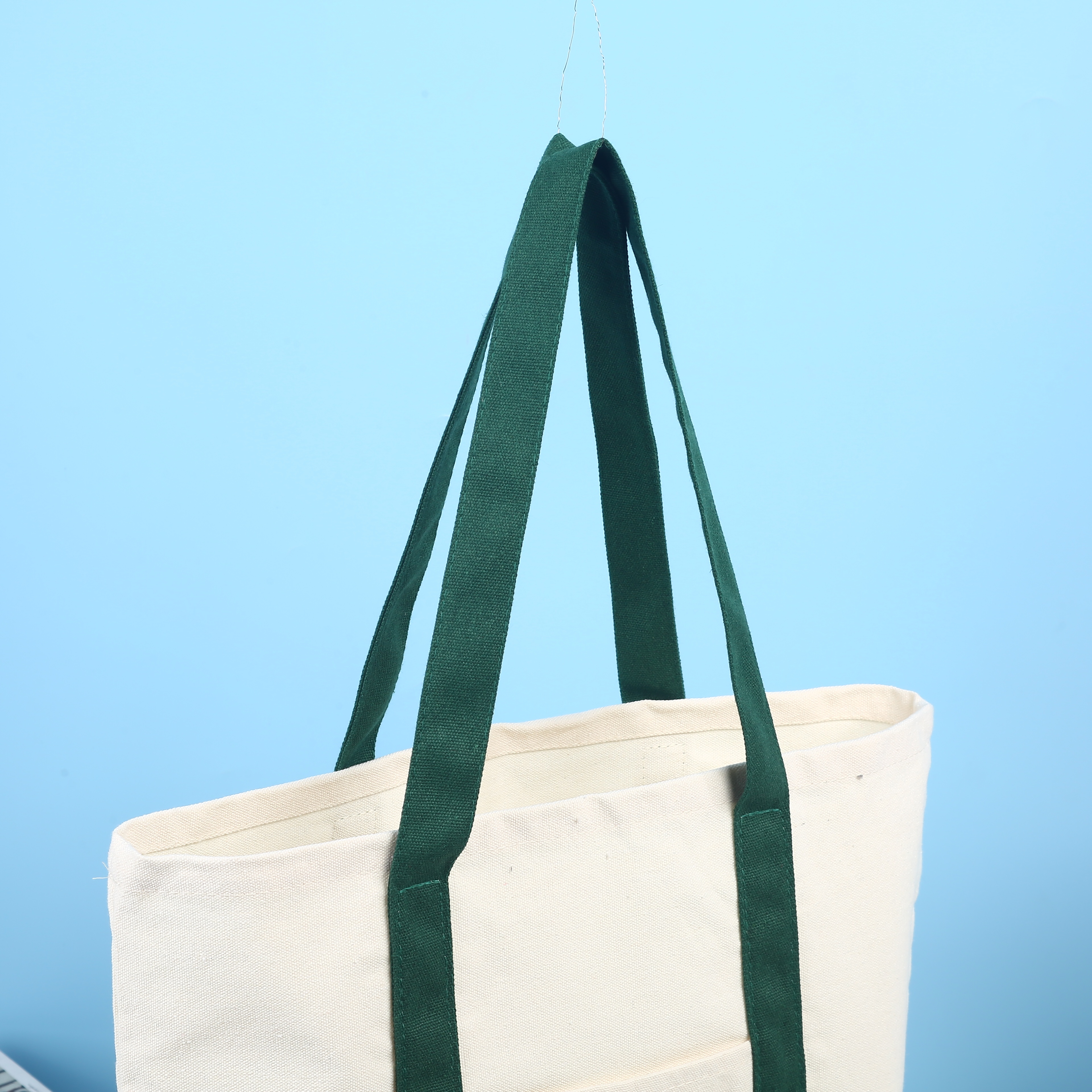
A real product-channel close-up used to discuss handle placement and stitching. The public image is a construction reference only; it does not verify cotton/RPET composition, recycled percentage or test performance. Source: LUCKYSTAR Alibaba product listing.
Abrasion, snagging and surface aging
Cotton surfaces may soften or fuzz; polyester constructions may pill, snag or show coating wear. Print and bag surface should be assessed together because an intact bag with an unreadable campaign mark may no longer deliver the intended brand service.
Do not specify “ abrasion resistant” without a method, endpoint and visual scale. For appropriate fabrics, the ISO 12947 Martindale series provides standardized abrasion approaches. A buyer can also add route-specific handling— such as repeated contact with carton edges— when it represents actual retail use.
Moisture, drying and cleaning behavior
Cotton typically takes up more moisture than polyester and may remain damp longer under comparable conditions. That can affect carry comfort, odor, storage and the energy or time needed for drying. RPET constructions often dry faster, but a dense lining, coating, foam, zipper or multi-layer base can slow the finished bag.
The test must therefore use the complete product. Wet the bag under a defined procedure, record mass gain, hang or lay it according to the proposed care instruction, and measure time to return to a defined condition. Inspect color transfer, print, seam puckering, corrosion on metal parts and odor.
Validate care instructions instead of copying them
ISO 6330:2021 specifies domestic washing and drying procedures for textile testing. It does not mean every bag should be machine washed. The brand and supplier should choose a realistic care route— spot clean, hand wash or an agreed machine cycle— then test that exact procedure.
Over-promising washability can shorten life if users apply temperatures, detergents or tumble drying that the print or structure cannot tolerate. Under-specifying care can also reduce reuse if a stained bag is discarded. A clear, tested instruction helps convert potential reuse into achieved reuse.
Print quality and brand appearance
Cotton’ s absorbent, textured surface can support many screen-print and transfer concepts, while surface irregularity may reduce the apparent sharpness of very fine detail. RPET fabrics range from smooth woven surfaces to textured structures and coated textiles. Ink adhesion, dye migration, heat sensitivity and show-through can differ dramatically.
Do not approve a print method only from a digital mockup. Produce a sample on the exact fabric color and finish, using intended ink or transfer chemistry and production settings. Then evaluate color tolerance, edges, opacity, rub, flex, wash or wipe care, blocking and odor.
For a process-focused review, use the Shopping Bag Printing Quality Control Checklist and How Shopping Bag Materials Affect Print Quality. Those pages cover print control in depth; the decision here is whether each material route can meet the same campaign standard without adding unnecessary complexity.

A plain-back polyester-route shopping-bag construction from LUCKYSTAR’ s public product channel. The photo supports visual discussion of panels, gusset and handles; it does not prove recycled content or GRS status. Source: LUCKYSTAR Alibaba product listing.
Reuse is achieved behavior, not a design label
“ Reusable” should refer to intended and demonstrated repeated service, not merely a thicker material. Three questions matter:
- Can the bag survive the required load and care cycle?
- Will the target user keep and carry it?
- Can the brand substantiate the claim in the intended market?
Large, stiff cotton totes may feel valuable but can be inconvenient to carry when empty. Foldable RPET bags may stay in a handbag or car, improving availability, but an undersized handle or poor closure can frustrate use. Design influences behavior as much as nominal durability.
Build a pilot that records actual trips, typical loads, cleaning events, damage and reasons for retirement. Our Reusable Shopping Bag Durability and Reuse Testing guide explains how to connect laboratory checks with field use. For a wider test menu, see Which Tests Should Reusable Shopping Bags Pass?.
RPET evidence: verify the claimed component and transaction
If the marketing claim says “ made with recycled polyester,” the technical file should identify the percentage, calculation basis and covered component. A fabric certificate or scope document is not automatically evidence for the finished bag or a specific shipment.
Textile Exchange’ s Recycled Claim Standard and Global Recycled Standard overview describes third-party certification of recycled materials and chain of custody. Standards and transition rules evolve, so procurement teams should check the current Textile Exchange standards resources at the time of ordering.
For an RPET claim, request and review, as applicable:
- current scope documentation for the relevant organizations and process stages;
- transaction or shipment-level documentation linking the material to the order;
- composition and percentage for the claimed fabric or component;
- bill of materials showing non-RPET parts;
- purchase-order, lot and production-record alignment; and
- approved claim wording and artwork for the intended market.
LUCKYSTAR does not treat GRS, GOTS, BSCI, ISO, REACH, RoHS or similar names as blanket company-wide claims. Applicability must be verified for the relevant entity, facility, product scope and order. Use our dedicated RPET Shopping Bags: Certification and Sourcing Checklist and GRS-Certified RPET Shopping Bags: What Buyers Should Verify before approving certification language.
Cotton evidence: distinguish fiber identity from preferred-fiber claims
A cotton composition statement, an organic claim and a recycled-cotton claim require different evidence. A natural-colored fabric is not proof of organic production. A hangtag is not a substitute for traceable order documentation. If the bag uses blended fabric, state the composition and avoid presenting the whole bag as one fiber.
Your evidence file may include composition test results, supplier declarations, relevant scope and transaction records, dye/finish information, bill of materials and approved labeling. The exact package depends on the claim, market and buyer policy. Keep certification logos out of artwork until license, scope and approval requirements are confirmed.
This evidence boundary is important because material images and swatches can support color, texture and construction approval, but they cannot prove farm practices or chain of custody.
End of life: local infrastructure outranks generic labels
Cotton is cellulosic and polyester is synthetic, but neither finished bag should automatically be called biodegradable, compostable or recyclable. Dyes, prints, coatings, blended yarns, labels, sewing thread, webbing, zippers and contamination can change the route. Municipal systems also differ.
For cotton, biodegradation or composting claims require defined conditions and evidence for the complete printed bag. For RPET, recycled input does not guarantee another recycling cycle. A mixed-component bag may be difficult to sort or process even if its main fabric is polyester.
Ask the intended market’ s collector or recycler whether the finished configuration is accepted. If no reliable route exists, emphasize durable use and clear disposal instructions rather than an unsupported circularity statement. Our Recyclable vs Reusable Shopping Bags article separates these two concepts.
A production-intent prototype is the turning point
Material swatches help shortlist options, but only a complete prototype reveals handle comfort, seam loading, pocket interference, print scale, packability and cleaning behavior. Use production-intent material, thread, reinforcement, print and hardware wherever possible.
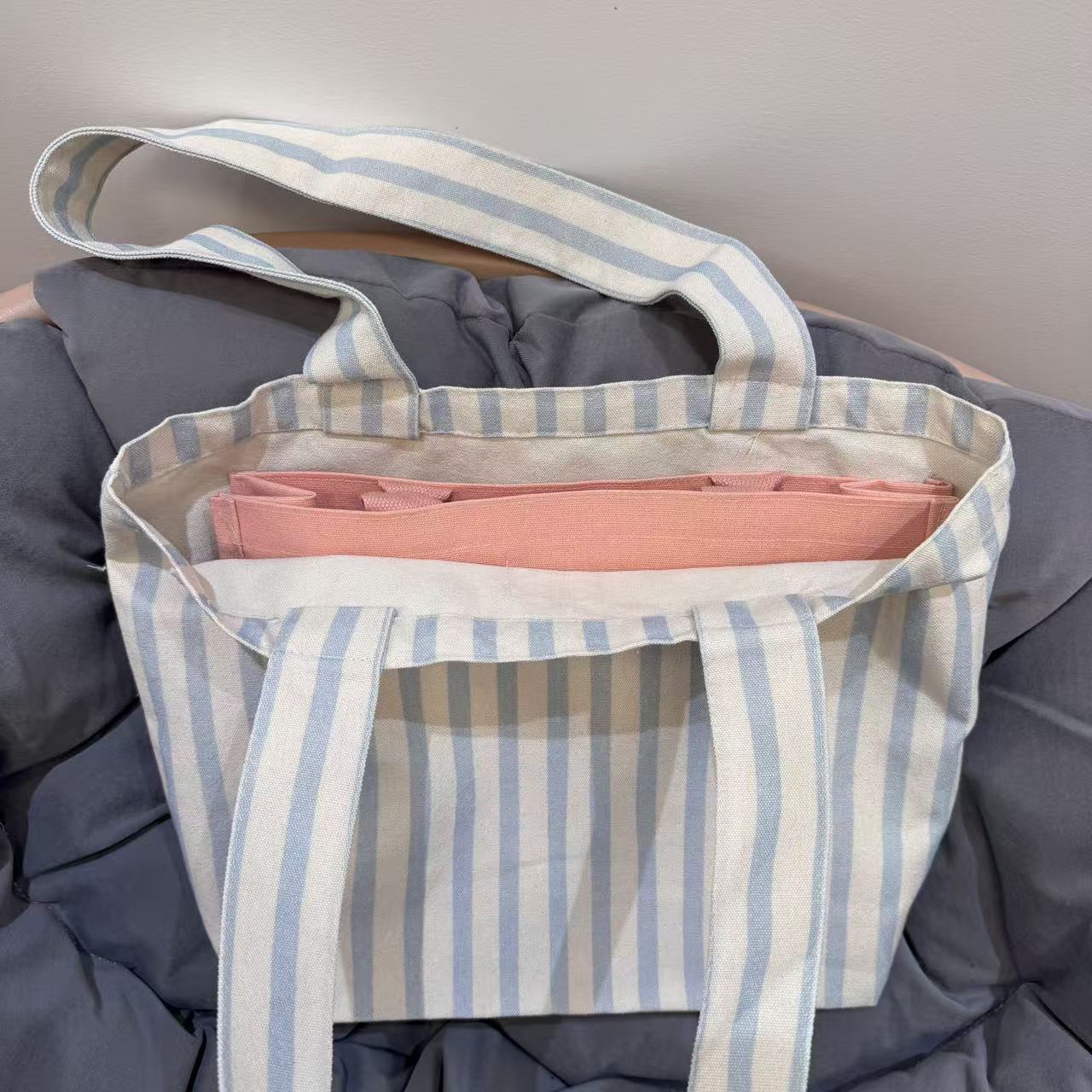
A company-channel product image illustrating why pockets, bindings and handles belong in the finished specification. Visual appearance alone does not establish fiber content or sustainability performance. Source: LUCKYSTAR Alibaba polyester shopping-bag listing.
Test the two routes under the same protocol
| Test stage | Same condition for both prototypes | Record | Example decision rule |
|---|---|---|---|
| Incoming specification | Condition samples under the agreed atmosphere; measure finished dimensions and mass | Mean, range, fabric/trim identity and visible defects | Both routes meet approved tolerances before stress testing |
| Static load | Same distributed load, fill shape, duration and suspension method | Elongation, seam opening, handle damage and permanent deformation | No functional failure; deformation within buyer limit |
| Cyclic carry | Same load, lift distance, cycle rate and cycle count | Cycle to damage, location and failure mode | Meets target service with stated safety margin |
| Abrasion/handling | Same contact surface, pressure or route-specific simulation | Surface change, hole formation, pilling and print damage | Rating remains above approved visual/function threshold |
| Wet and dry | Same water exposure; drying follows each proposed care instruction | Mass gain, drying time, odor, color transfer and deformation | Returns to usable condition within program requirement |
| Cleaning | Validated procedure for each route, with comparable use-life intent | Dimensional change, print, seam, handle and closure condition | Care label remains truthful and bag remains serviceable |
| Print durability | Same target artwork and brand tolerance; method may differ by substrate | Color, opacity, edge definition, rub and post-care result | Both meet the approved artwork and durability standard |
| Field pilot | Same user group, load mission and tracking period | Trips, loss, cleaning, complaints and retirement reason | Select by achieved service, not laboratory survival alone |
The pass/fail values belong in the purchase specification and must be agreed before bulk production. Standard references should be selected for the actual fabric and target market; they are not generic claims about every LUCKYSTAR bag.
Decision matrix for common brand programs
The matrix below helps teams shortlist a route. It is not a material guarantee.
| Program brief | Cotton may be the better prototype when… | RPET may be the better prototype when… | Do not decide until… |
|---|---|---|---|
| Premium retail tote | Texture, drape, embroidery or a substantial textile feel drives retention | A clean technical look, weather handling or lower pack mass matters more | Both samples pass appearance and handle-comfort review |
| Grocery or everyday carry | A robust canvas-like format is likely to stay in repeated household use | Foldability and quick drying make the bag easier to keep available | Repeated-load and field-use results are compared |
| Event giveaway | The audience is likely to value and retain a tactile bag after the event | Low unit mass and compact distribution improve practical use | Retention assumptions and real pack-out are checked |
| Beauty, apparel or lifestyle campaign | Natural texture supports the creative concept | Smooth surface and saturated graphics suit the artwork | Production print trials meet color and rub requirements |
| Outdoor or travel program | The user accepts slower drying in exchange for feel and structure | Low moisture uptake and compact storage are key | Wet-use, drying and hardware tests pass |
| Evidence-led recycled-content campaign | The cotton route has the specific preferred-fiber evidence claimed | RPET documentation covers the claimed percentage, component and transaction | Legal/claims review approves the exact wording |
Cost comparison should use cost per successful use
Unit price is only one input. Add sampling, printing, testing, packaging, freight, expected rejects, replacements and program administration. Then divide by the realistic number of successful uses delivered.
Cost per successful use = total landed program cost ÷ verified or reasonably evidenced successful uses
This calculation discourages two common mistakes: buying an overbuilt bag because it feels safer, or buying a light bag that cannot meet the service target. It also makes differences in packing efficiency visible. Prices, MOQ, sample fees and lead times depend on the approved specification and should be confirmed in writing for each order rather than copied from a marketplace listing.
How to write defensible marketing claims
Prefer specific, bounded statements over broad labels. For example:
- Better: “ The main body fabric contains X% recycled polyester, supported by [named document] for [order/lot].”
- Risky: “ This is a 100% sustainable eco bag.”
- Better: “ Designed and tested for repeated use under our stated load protocol.”
- Risky: “ Zero-impact reusable bag.”
- Better: “ Finished bag mass reduced by X% versus our named prior specification, measured on production samples.”
- Risky: “ Uses less material than cotton bags.”
Comparative claims need a named baseline, measurement method, date and scope. Certification references need current authorization. Recyclable, biodegradable, compostable, carbon-neutral and water-saving claims require their own evidence. The review process in How to Make Defensible Sustainability Claims for Reusable Shopping Bags is designed for this step.
Company-claim boundary: the following section is LUCKYSTAR publisher self-description. It does not prove fiber composition, organic or recycled content, certification, environmental superiority, recyclability, biodegradability, achieved reuse, test performance, or current material/capacity availability for either route. Materials, construction, tests, chain-of-custody evidence, claims, MOQ, price, schedule and delivery are subject to the actual order, qualified review, final specification and written confirmation.
Why source cotton and RPET shopping bags with LUCKYSTAR?
LUCKYSTAR can help buyers move from a vague material preference to an order-specific bag brief. Cotton/canvas and polyester or recycled-material routes are available for evaluation subject to the approved specification, supply route and written order confirmation.The value is not a one-word material recommendation; it is coordinating the decisions that determine whether the bag works.
One brief covering product, print and evidence
We can review dimensions, usable volume, body material, fabric weight, handles, gusset, pockets, closure, reinforcement, print area, artwork, packing and target tests as one specification. This prevents a sustainability choice from being separated from the construction that delivers reuse.
Side-by-side sampling for a real decision
Where the project permits, request cotton and RPET-route samples built to comparable service requirements. Evaluate them with the same load mission and brand standard. LUCKYSTAR can coordinate available material swatches, artwork confirmation and production-intent sampling, with final feasibility and terms confirmed per project.
Claim discipline instead of blanket certification language
We distinguish material appearance from composition evidence and distinguish supplier or material documentation from a finished-bag or company-wide certification claim. Any recycled, organic, performance, environmental or certification statement remains subject to document review, entity/scope matching and written confirmation for the specific order.
Quality controls tied to the approved sample
The approved sample, specification and order requirements provide the comparison baseline. Relevant checks can include dimensions, finished mass, workmanship, print position/color, handle attachment and agreed performance tests. The exact inspection plan and acceptance limits must be confirmed before production.
For supplier evaluation beyond materials, use our two pillar resources: Custom Bag Manufacturer Guide and How to Choose a Custom Shopping Bag Manufacturer.
What to include in your RFQ
A useful RFQ reduces assumptions. Send:
- target market, use scenario, planned quantity and delivery destination;
- bag width, height, gusset and usable volume;
- target load and intended number of uses;
- cotton route and/or RPET route, composition and evidence expectations;
- fabric construction, weight, color and finish;
- handle material, width, drop and attachment requirements;
- pockets, lining, zipper, snap, binding and reinforcement;
- artwork files, print colors, placement, tolerances and durability target;
- care instruction and cleaning validation requirement;
- testing method, conditioning, acceptance limit and sample quantity;
- packing method, unit packaging and carton constraints; and
- exact claim wording that needs support.
If the design is still developing, the Custom Shopping Bag Sample Development Process helps organize material approval, artwork proof, prototype review and pre-production confirmation.
Frequently asked questions
Is RPET always more sustainable than cotton?
No. RPET describes recycled polyester input; cotton describes a fiber family. A sustainability comparison also depends on finished mass, processing, durability, achieved reuse, care, transport, replacement and end-of-life conditions. Compare equal service and disclose assumptions.
Is cotton automatically biodegradable?
No. A finished printed bag may contain dyes, finishes, synthetic thread, labels, closures, coatings or blended fibers. Any biodegradability or compostability claim needs evidence for the complete product under stated conditions.
Does “ made from recycled bottles” prove GRS certification?
No. Feedstock storytelling, composition evidence and chain-of-custody certification are different things. Verify the relevant organizations, scope, claimed component, percentage and transaction documents. Do not infer a finished-bag certification from a fabric image or generic certificate.
Which material is stronger?
There is no universal answer. Strength depends on fabric construction and mass, yarn or filament, coating, seam allowance, stitch pattern, handles and reinforcement. Test finished prototypes to the same load protocol.
Which one prints better?
Both can produce effective branded bags, but the appropriate process may differ. Cotton texture and absorbency affect fine detail and ink uptake. RPET surface, color, coating and heat response affect adhesion, migration and transfer processes. Approve a production-intent print sample.
Which bag dries faster?
Polyester routes often absorb less moisture and may dry faster than comparable cotton constructions. A lined, coated or multi-layer finished bag can behave differently, so measure the complete prototype under the proposed care instruction.
Can cotton and RPET be blended in one bag?
Yes, different materials can be used in panels, handles, linings or trims when feasible. The bill of materials and public claim must state what each percentage covers. Mixed construction can complicate end-of-life pathways.
Should we choose the lowest GSM?
No. GSM controls fabric mass per area, not total product service. Choose a construction that passes the target load and use-life tests without unnecessary material. Verify finished mass and component design.
Can LUCKYSTAR provide cotton and RPET options?
LUCKYSTAR can evaluate cotton/canvas and polyester or recycled-material directions for custom shopping-bag projects. Availability, material details, documentation, MOQ, price, sampling and lead time are subject to the specific specification and written confirmation.
Final recommendation
Choose cotton when a validated cotton construction best supports the tactile, visual and repeated-use needs of the program. Choose RPET when a validated recycled-polyester construction better supports portability, drying, mass or evidence-led recycled-content goals. Choose neither until the complete prototype passes the same service test and the intended claim has an evidence file.
The best procurement decision is not “ cotton” or “ RPET” in isolation. It is a controlled specification with measurable service, verified inputs, realistic care, suitable print, clear acceptance limits and transparent claim wording.
Ready to compare two production-intent routes? Share your dimensions, target load, artwork, destination market and evidence requirements through the LUCKYSTAR inquiry page. We will review feasible options and confirm order-specific terms in writing.

Request a matched cotton and RPET sample review
Send one carrying task and both proposed constructions so the samples, tests, evidence and quotations can be reviewed against equivalent service.
Review LUCKYSTAR custom shopping bag options, then send your cotton and RPET comparison brief through the contact form or Email a project brief. The email link opens a draft for your review before sending.
Materials, composition, finished weights, tests, reuse performance, certification/transaction evidence, environmental conclusions/claims, availability, price, MOQ, packing, schedule and delivery terms are subject to order-specific evidence review, final specification and written confirmation.