A retailer rarely needs “some shopping bags.” It needs the right quantities of specific sizes and artworks, packed for a launch and ready at a named destination. That is why Custom Shopping Bag MOQ and production time must be planned together. A low minimum can be useless if the print route cannot meet the date; a fast factory run can still miss the launch if material color or store allocation remains open.
This guide focuses on retail carriers across different production systems: converted paper, bonded or sewn non-woven PP, laminated woven PP, jute, cotton/canvas, mesh and clear film. It does not repeat the category-wide answer in What Is the Typical MOQ for Custom Bags? or the general milestone framework in How Long Does Custom Bag Production Take?. Instead, it shows how shopping-bag construction, SKU allocation and checkout launch dates alter both numbers.
Start with LUCKYSTAR's custom shopping bag range. Buyers still qualifying a partner can use How to Choose a Custom Shopping Bag Manufacturer; the wider Custom Bag Manufacturer Guide connects this decision to supplier capability, quality and commercial control.
Planning an order? Send one quote-ready MOQ and schedule brief. Include dimensions, material, construction, handles, printing, quantity by SKU, packing, destination, required arrival date and approval status.
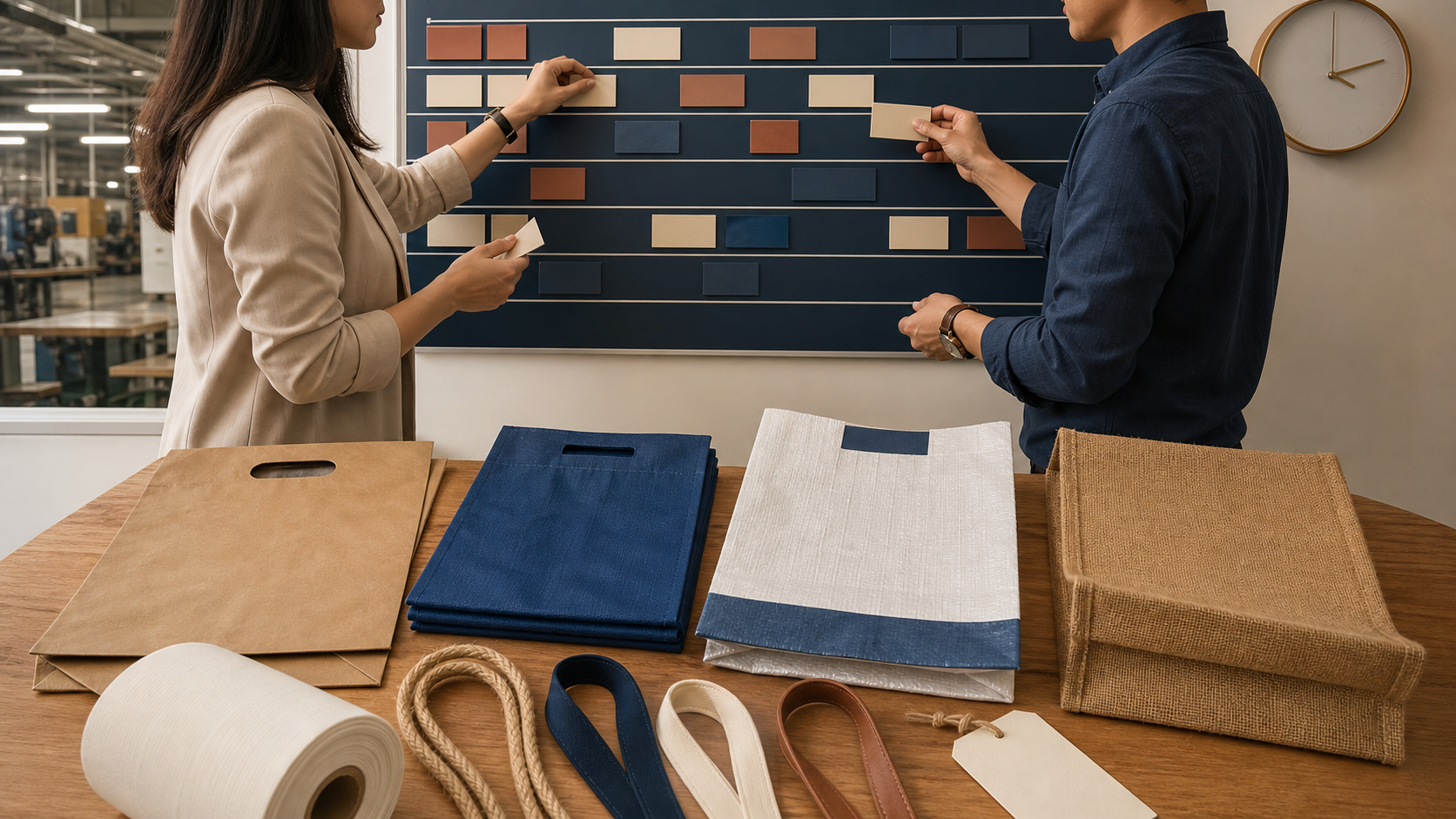
MOQ and schedule become manageable when material, print, approval and production milestones are shown on one route-specific plan.
Page role: This commercial-planning guide owns route-specific shopping bag MOQ drivers, runnable SKU minimums, material and process critical paths, production-clock gates, backward scheduling and ways to reduce quantity or time without turning examples into standing commitments. Use the worldwide shopping bag manufacturer guide for a supplier shortlist, and the custom shopping bag collection for specification and quotation planning.
Custom shopping bag MOQ and production time: current supplier snapshots
There is no defensible universal minimum or production duration. The binding batch may come from paper, fabric, printed film, lamination, dyeing, handles, decoration, assembly or packing. The schedule also depends on when the supplier considers the job released.
| Supplier-controlled page checked 15 Sep 2026 | What that page currently states | Required buyer check |
|---|---|---|
| Teal Packaging custom paper bags | 50-unit minimum and production from about seven business days after proof approval | Confirm the exact bag construction, delivery scope, proof status and whether the offer applies to the destination |
| Gentle Packing non-woven bags | MOQ usually from 500 pieces; sample 5–7 days after artwork/specification confirmation; bulk 15–25 days after sample approval | Confirm GSM, construction, print, quantity per SKU, capacity and finish point |
| ZHONGJIN woven-PP tote page | 3,000-piece MOQ, sample 6–10 days and lead time 18–25 days depending on purchase quantity | Confirm printed-film/lamination scope, artwork split, approval trigger, packing and current capacity |
| CORPMIND custom jute bags | 500 minimum and four-week lead time, with a note that MOQ may vary by design | Confirm size, jute grade, construction, decoration, packing, start trigger and finish point |
These statements demonstrate variation; they do not establish a route-wide benchmark. Send the same controlled brief to shortlisted suppliers and compare written answers on the same commercial basis.
First separate three different numbers
Procurement conversations become clearer when the buyer stops using MOQ as a single label. There is a commercial minimum the supplier is willing to quote, a technical batch that printing or material suppliers need, and a runnable SKU quantity that can move efficiently through conversion and packing. The highest binding constraint determines the real plan.
Production time also has three clocks. Development time begins when the brief is usable. Bulk preparation begins when the body material, artwork and commercial commitment are released. Assembly time begins only when the required inputs and an available line meet. The promised handover date should state which clock it includes.
Which minimum controls each shopping bag route?
The finished-bag factory is not always the source of the minimum. A paper mill, printer, laminator, handle supplier or packaging converter may set a higher batch than the assembly line. Ask the quotation to identify the constraint instead of simply repeating “factory policy.”
| Route | Likely binding minimum | Why it binds | Possible low-MOQ route |
|---|---|---|---|
| Digital/stock paper | Printer batch and available blank format | Digital setup can be short, but size and stock options are limited | Use an available structure and accept the route's paper/finish choices |
| Custom paper conversion | Paper order, press make-ready and die/finishing efficiency | Sheet yield and several converting operations need scale | Standardize size, handle and paper; simplify premium finishes |
| Direct-print non-woven | Stock fabric color plus print/assembly batch | Stock spunbond may be flexible; each artwork and sewing/bonding setup still repeats | One stock body color, one print and a proven bag shape |
| Laminated PP | Printed film and lamination run | Cylinder/plate, film width and lamination setup favor larger continuous lots | Reuse one body artwork and vary a small label or handle color |
| Jute/canvas | Material lot, cutting yield and sewing-line setup | Natural material grade, custom dye and many sewing operations create commitments | Available fabric/jute, shared pattern and standard webbing/rope |
| Clear PVC/TPU | Film/trim lot and specialized joining setup | Film thickness, binding, zipper and welding/sewing compatibility must align | Existing film/trim references and a simple rectangular structure |
When a custom input has a larger minimum than the finished order, document the balance: quantity, ownership, payment, shelf life, storage terms and how a later reorder will consume it. “We can keep the extra material” is not enough without an identified lot and commercial agreement.
MOQ is calculated per runnable SKU, not only per purchase order
A national retailer may order 12,000 bags and still create a short-run problem. Four sizes × three body colors × two artworks produce 24 variants, or only 500 pieces each if divided evenly. The material total looks healthy, but print changes, cutting lots, handle matching, quality records and store-specific cartons multiply.
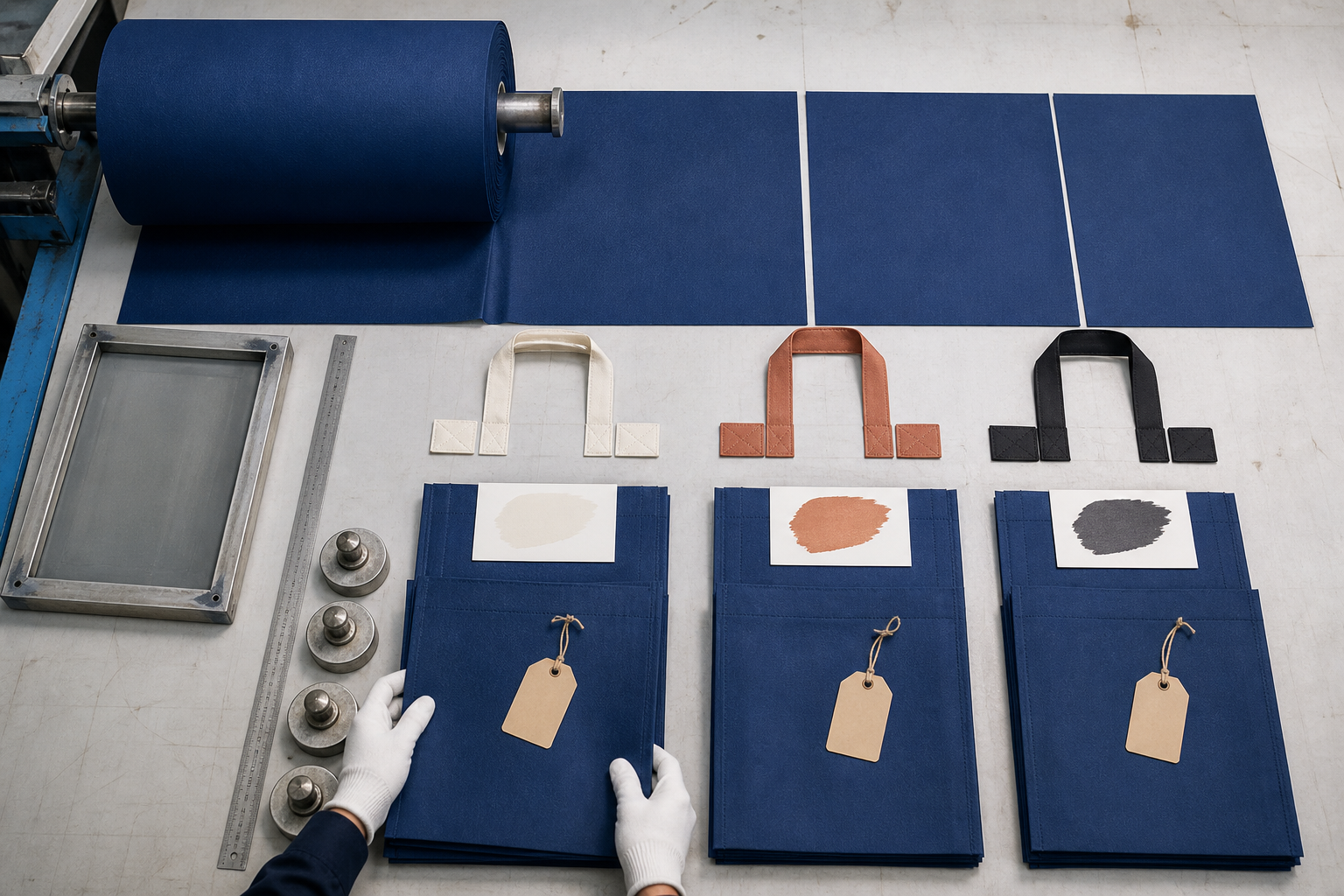
One shared body material can support controlled variants, but each handle, artwork and packing split still needs an identified production batch.
| 12,000-piece retail program | Runnable split | MOQ/schedule effect | Better architecture |
|---|---|---|---|
| One size, one body color, one artwork | 1 × 12,000 | Continuous material, print and assembly run | Suitable for a universal grocery or campaign bag |
| Three sizes, common body/print | 3 × 4,000 | Cutting/conversion changes; material and artwork can pool | Share paper/fabric, handles and print color |
| Three sizes × two artworks | 6 × 2,000 | Each artwork needs its own release, identification and print control | Use one master artwork and vary a removable campaign element |
| Four sizes × three colors × two artworks | 24 × 500 | May fall below film, paper or material batches; many changeovers and cartons | Launch core sizes first; add local variants after demand is proven |
| One bag, 60 store cartons | One production SKU, 60 packing allocations | Manufacturing stays efficient; packing/label time increases | Freeze allocation data early and use one controlled carton file |
Do not confuse store allocation with a production SKU. If identical bags are divided among warehouses or stores, production can remain one batch while packing changes. If the logo, body, handle or size changes, the factory needs separate production control.
Production time follows the material route's critical path
After the order architecture is clear, map the longest dependency. Paper carriers often wait on print, lamination, die cutting and drying/conditioning between processes. Direct-print non-woven may move faster, while laminated PP cannot be cut and assembled until printed film and laminate are complete. Sewn natural-fiber bags depend on material availability, cutting and balanced sewing operations. Clear film adds surface protection and compatible welding or trim work.
| Route | Typical critical-path sequence | Schedule gate that deserves attention | Late surprise |
|---|---|---|---|
| Custom paper | Paper/handle → print → laminate/finish → die/crease → glue → handle → pack | Final dieline, print proof and finish compatibility | Artwork at a fold/glue lap or handle component arrives late |
| Direct-print non-woven | Fabric → cut/print → bond or sew → reinforce handle → inspect → pack | Fabric color/GSM and first printed panel | A “simple” bag needs sewn gussets or load reinforcement |
| Laminated woven/non-woven PP | Film artwork → print → laminate → condition → cut → bind/sew → pack | Printed film approval and lamination slot | Gusset artwork fails to register after conversion |
| Jute/canvas/mesh | Material/trim → relax/inspect → cut → decorate → sew → shape/finish → pack | Material lot and approved construction sample | Natural shade/width, fraying or specialty handle supply |
| Clear film | Film/trim → condition → cut → print → weld/sew/bind → clean/protect → pack | Film, trim and joining compatibility | Scratches, blocking or protective packing adds work |
The full production sequence is explained in Custom Shopping Bag Manufacturing Process: From Design to Delivery. Use that process map to decide which tasks can overlap and which must remain sequential.
When does the production clock start?
“Thirty days” means little without a start trigger and finish point. A credible Custom Shopping Bag Lead Time states both. A supplier may count from deposit, approved artwork, approved pre-production sample or receipt of all custom materials. The buyer may think it starts from the first email and ends at its warehouse. Write both endpoints in the purchase order or schedule.
| Bulk release item | What must be frozen | If still open | Evidence |
|---|---|---|---|
| Product specification | Finished dimensions, gusset, body, handles, reinforcement, closure and tolerance method | Consumption, tooling, strength and packing can change | Approved tech pack and revision |
| Visual standard | Artwork version, color, placement, substrate and finish | Printing cannot safely release | Signed proof/strike-off and physical color reference |
| Production reference | Material, construction, function, fold and appearance | Bulk line has no single acceptance target | Sealed pre-production sample or agreed equivalent |
| Quantity allocation | Units by size × color × artwork and allowed over/under tolerance | Material and print batches cannot be scheduled correctly | Controlled SKU matrix |
| Packing/store plan | Fold, inner pack, carton count, labels and destination allocation | Finished goods may wait for labels or be mixed | Approved pack-out and carton file |
| Commercial release | Price, payment trigger, trade basis, named place and change rules | Material or capacity may remain unbooked | Accepted order/contract and payment record |
Material can sometimes be reserved before the final sample, but the risk must be explicit. Stock material with a frozen color is different from custom-printed film or specially dyed fabric. Record who owns a committed lot if the sample or artwork later changes.
Build backwards from the retail arrival date
A production completion date is not a store-ready date. Build one dated critical path from the required warehouse receipt, then identify the owner and evidence for every release gate.
| Reverse-planning gate | Evidence to freeze | Dependency to confirm |
|---|---|---|
| Warehouse receipt and allocation | Receiving appointment, store quantities and exception plan | Destination working calendar and retailer booking rules |
| Main transport and destination handling | Mode, route, booking, documents, named place and contingency | Carrier schedule, customs/import responsibility and inland delivery |
| Inspection, packing and handover | Release criteria, approved pack-out and carton data | Correction allowance and carrier handover requirements |
| Bulk production | Line release, first-off approval and change freeze | Current capacity, material availability and production sequence |
| Material and print preparation | Approved material, color, artwork, film and custom components | Supplier batch, tooling and make-ready requirements |
| Sample and commercial release | Signed reference, controlled specification, quantity matrix and payment record | Named start trigger and consequences of a revision |
The supplier should return dates for this exact route. Do not infer a promised total program duration from an editorial example or another supplier's page.
How to lower MOQ without turning the project into a rush order
Successful low-MOQ projects remove dependencies. They do not merely ask the factory to absorb them. Use stock material colors, one proven structure, standard handles, one artwork, ordinary bulk packing and an available decoration method. Keep variation in a removable tag, sleeve or store allocation when that solution fits the brand.
For laminated PP, preserving one printed body design may be more valuable than changing several handle colors. For paper, a standard format and digital route may reduce the minimum, but it can limit paper, finish and unit economics. For jute or canvas, one pattern and shared trim can keep sewing efficient. Every simplification should be confirmed on a sample.
How to shorten production time safely
- Send a complete brief. Dimensions, load, material direction, artwork, allocation, destination and required arrival date should arrive together.
- Choose the route before polishing artwork. The final dieline or pattern determines safe areas, gussets and handles.
- Nominate one approval owner. Consolidated numbered comments prevent contradictory sample changes.
- Approve packaging early. Labels and store cartons can hold finished bags at the last stage.
- Book capacity against real decision dates. A line reservation is useful only when material and approval gates can be met.
- Check first production output. Early print, bond, seam and handle checks reduce systemic rework.
- Separate production from transport. Decide the freight route and document cut-offs while bags are being made.
Compare supplier MOQ and schedule offers on one basis
Two hypothetical offers—“500 pieces in 25 days” and “2,000 pieces in four weeks”—are not comparable until the product, quantity split and endpoints are aligned. Ask each supplier to complete the same fields. Then combine the result with the cost model in How Much Do Custom Shopping Bags Cost? 2026 Pricing Guide.
| Quotation field | Required answer | Why it matters |
|---|---|---|
| MOQ scope | Per route, size, body color, artwork, handle/trim and packing version | Reveals the actual runnable batch |
| Binding minimum | Material, print/lamination, assembly, component or packaging constraint | Shows which design change can reduce the floor |
| Surplus input | Expected balance, ownership, storage and next-order use | Exposes hidden commitment beyond finished quantity |
| Sample route | Sample type, inputs, duration, revisions, charge and approval evidence | Separates development from bulk time |
| Bulk start trigger | Named approval, payment, material and capacity conditions | Prevents two parties counting from different dates |
| Production milestones | Material, print, conversion, first-off, completion, inspection and pack-out | Makes the critical path and progress visible |
| Finish point | Packed at factory, handed to carrier/port or delivered to named destination | Separates manufacturing from logistics |
| Change rule | Which revision resets MOQ, cost or schedule | Connects late decisions to consequences |
Company-claim boundary: LUCKYSTAR statements in this section are publisher self-description, not third-party verification, not a standing MOQ, not a capacity guarantee and not a delivery promise. Confirm the contracting entity, assigned production site, subcontracting, material and process route, capacity, sample, quality scope, packing, quantity, schedule and commercial terms for each order.
How LUCKYSTAR describes its MOQ and schedule review
The public custom shopping bag collection presents paper, reusable PP, jute, mesh, canvas and transparent directions that buyers can use to frame a route comparison. LUCKYSTAR states that its project team can discuss material and print batches, quantity per SKU, sample route, approval packet, production milestones, quality gates, packing allocation and shipping handover, subject to specification and written confirmation.
- Route-level review: identify whether material, printing, assembly, component or packing creates the minimum.
- SKU matrix: separate production variants from store allocation.
- Milestone schedule: name the owner, evidence, start trigger and finish point for each gate.
- Approval reference: agree the production-representative sample or equivalent controlled standard.
- Campaign coordination: connect the bag brief to the stated Product Range where relevant.
Ask for a project-specific MOQ and schedule review by sending the shopping basket, size/structure, body material, handles, printing, quantity matrix, packing allocation, destination and required arrival date.
Frequently asked questions
What is the usual MOQ for custom shopping bags?
There is no universal MOQ. Confirm which material, print, component or assembly batch controls the minimum; whether it applies per size, body color, artwork and packing version; and whether any surplus input must be purchased, stored or consumed later.
Can one MOQ be divided among sizes or colors?
Sometimes. Common body material, artwork and components may allow controlled splits. A new size requires separate cutting or converting; custom body color creates another material lot; a new full-coverage artwork can create a new film or print batch. Ask for the permitted allocation in writing.
How long does shopping bag production take?
There is no universal production duration. Ask for a dated route-specific schedule with the exact start trigger and finish point, and show sampling, approvals, material preparation, bulk production, inspection, packing and delivery separately.
Does production time start when I pay the deposit?
Not always. Payment can reserve commercial capacity, but bulk may still wait for the approved sample, final artwork, material confirmation and SKU allocation. Put the exact start trigger and finish point in the schedule.
Can a rush fee reduce MOQ?
A fee may help with overtime, priority handling or express transport, but it cannot always change a paper, film, dye-lot or component minimum. First identify the binding constraint; then ask whether another material or print route is technically suitable.
Can LUCKYSTAR produce a pilot order?
A pilot may be possible using an available construction, stock materials and flexible decoration, depending on the project. It will usually carry a higher unit cost and does not guarantee that every custom input can be reproduced below its supplier minimum. Request a route-specific review.
Are repeat orders faster?
They can be when the approved pattern, artwork, components and packing remain available. Confirm the previous order reference, retained standards, material lot availability and current capacity. “Same as last time” should not replace an updated controlled specification.
Should transit be included in production lead time?
Keep it separate unless the quotation explicitly defines a delivered endpoint. Production, inspection/packing, origin handover, main transport, import/destination work and inland delivery should each have their own assumption and buffer.
Turn MOQ and time into a retail launch plan
A useful MOQ tells you which batch controls the quantity and how variants can be divided. A useful Shopping Bag Production Time tells you the starting release packet, the critical path, the handover point and the effect of a late change. Together, they convert a supplier promise into a plan that can be monitored.
Review the custom shopping bags product page, use the shopping bag manufacturer selection guide and connect the program to the broader Custom Bag Manufacturer Guide. When the SKU matrix and arrival date are ready, request an MOQ and timeline review from LUCKYSTAR.

Request a route-specific MOQ and dated schedule
Send the specification, quantity matrix, approval status, packing, destination and required arrival date. Ask the reply to identify the binding minimum, permitted SKU split, sample route, start trigger, finish point and milestone dates.
Review LUCKYSTAR custom shopping bag options, then send your project details through the contact form or Email a project brief. The email link opens a draft for your review before sending.
Factory and subcontracting, material and process route, capacity, claims, samples, testing, inspection, MOQ, price, packing, schedule and delivery terms are subject to due diligence, specification and written confirmation.