Last reviewed: September 24, 2026
Retail packaging bags can support a launch, promotion or loyalty program, but only when the bag works first as packaging and the campaign has a defined distribution and measurement plan. Treat the bag as shared physical media: specify the carry experience, creative hierarchy, response path, store allocation and evidence before production.
Buyer Quick Answer
Start with one campaign job, one audience, one response action and one measurable denominator. Then choose a bag that fits the real basket, survives the carry route and presents the message at walking distance. Give each channel or store group an identifiable response path, count bags actually distributed, compare results with a baseline or control, and keep a claims register for every objective statement printed on the bag.
Scope: This guide is about planning and measuring retail packaging bag campaigns. It does not replace a general supplier audit, a product catalog or a universal return-on-investment promise. Use the Custom Bag Manufacturer Guide for the complete sourcing framework and the custom shopping bag factory guide for production capability checks.
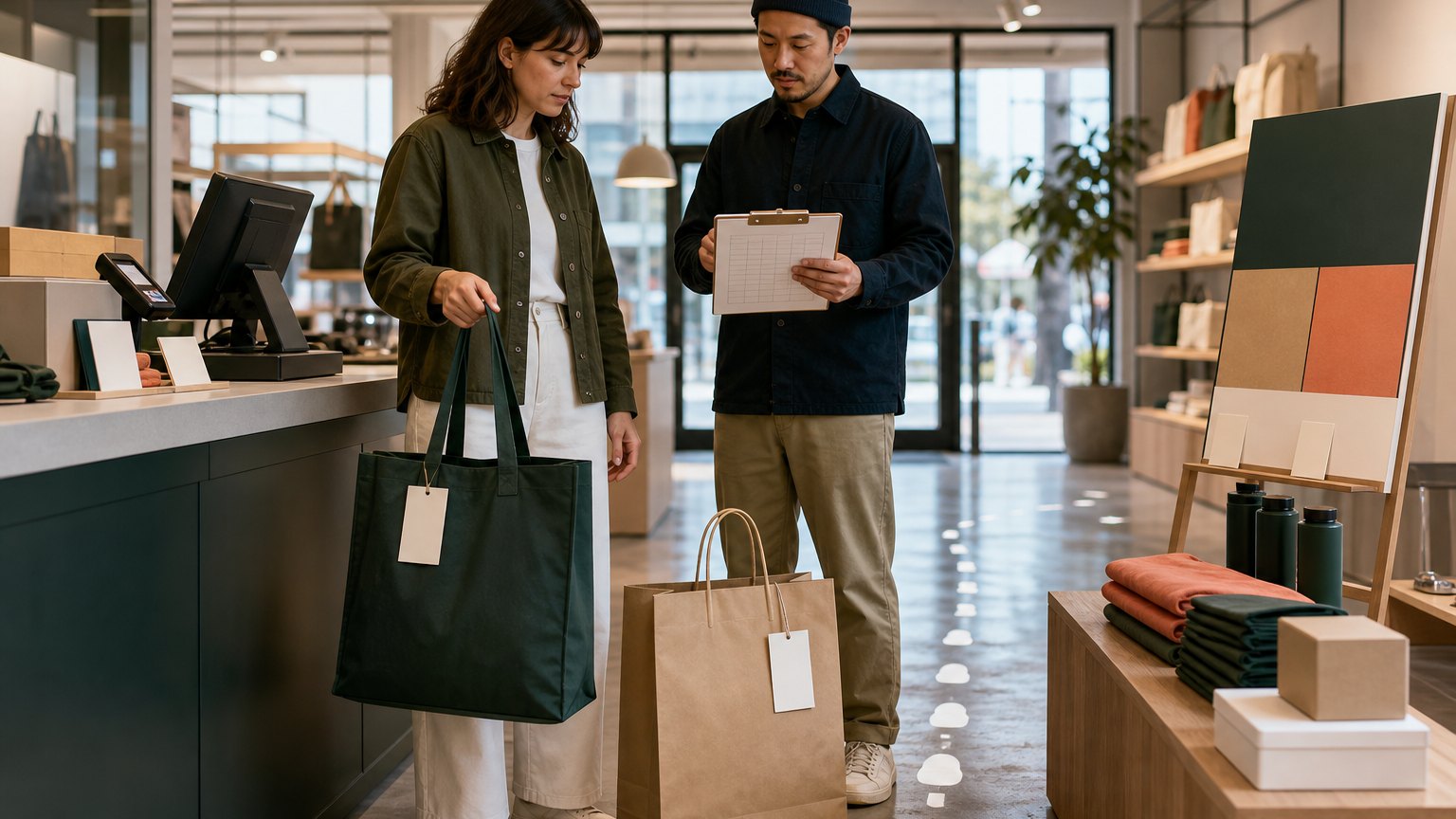
What This Page Owns
Search results for retail bags commonly emphasize customization, premium finishes, reuse and the idea of a bag as a walking advertisement. Those points describe possibilities, but they do not tell a campaign owner how many bags reached shoppers, whether the offer was noticed or whether the result exceeded normal store behavior. This page owns that missing operating layer: the campaign brief, field test, allocation plan, metric definitions and evidence trail.
For product-specific selection, use what buyers should compare in logo shopping bags. For promotion design fundamentals, see the promotional tote bag design guide. Keeping these intents separate prevents several pages from competing for the same broad keyword.
Set One Campaign Job
A bag cannot simultaneously maximize premium presentation, explain a complex sustainability story, drive a coupon redemption, promote a seasonal event and remain visually quiet. Choose the primary job: increase launch recognition, support an offer, move shoppers to a destination, identify a membership benefit or reinforce a brand code. Secondary information can remain, but it should not compete with the primary action.
Map the Retail Carry Journey
Document where the bag is selected, packed, handed over, carried, stored and potentially reused. Note viewing distance, dwell time, weather, public transit, privacy needs and whether both hands are available. A message that works on a counter may disappear when handles pull the side panels inward. A beautiful flat proof does not represent a filled bag moving through a street or station.
Write an Evidence-Ready Brief
The brief should name the campaign owner, audience, store groups, dates, bag format, expected basket, distribution rule, primary message, response action, landing page, approval owners, evidence for claims and success metric. Record assumptions separately from requirements. If the expected distribution is a forecast, label it as a forecast instead of presenting it as a committed quantity.
Use a Message-to-Measurement Gate
| Campaign job | Physical proof | Response evidence | Release gate |
|---|---|---|---|
| Launch recognition | Message remains visible on a filled bag | Prompted awareness or assisted response | Carry-distance review passes |
| Offer activation | Action and expiry are legible | Redemption tied to campaign ID | Offer and destination match |
| Store traffic | Destination is understandable | Visits versus a baseline | Attribution rule is documented |
| Reuse program | Bag passes intended use tests | Observed or surveyed reuse | Claim evidence is approved |
Choose the Bag Format by Its Job
Paper can provide a structured retail presentation; reusable fabric can support longer service; drawstring formats can suit events or lightweight kits. The right choice depends on product weight, protection, destination rules, distribution model and intended next use. Do not select a format only because it appears premium in a mockup. Compare the operating tradeoffs with reusable shopping bags for retail and promotions.
Size Around the Actual Basket
Build a basket set for typical, high-value and awkward purchases. Record product dimensions, orientation, protective packaging, closure space and safe headroom. Oversized bags waste material and allow products to move; undersized bags slow checkout and deform artwork. If one campaign serves several departments, decide whether one compromise size is acceptable or whether size variants need separate artwork and allocation records.
Test Load, Handles and Packing Time
Test representative packed weights, not an empty sample. Check handle attachment, edge comfort, bottom support, seam or adhesive performance and how quickly staff can open and pack the bag. Observe the full route from stockroom bundle to counter and door. A format that adds several awkward steps at checkout may undermine the customer experience even if the print is excellent.
Protect Privacy and Product Concealment
Some purchases should not be identifiable in public. Review opacity, openings, closures and the amount of product information implied by the design. A transparent window or highly specific campaign message may create an unwanted disclosure. Treat concealment as a defined requirement when the retail category, location or customer context makes it relevant.
Design for Carry Distance
Create a hierarchy for three conditions: a quick glance from several steps away, a closer view while standing and an intentional scan or read. Keep the primary visual or phrase away from folds, gussets, handle holes and expected creases. Print a full-size proof, pack it, photograph it at the planned distance and review it in motion. That test is more useful than enlarging a logo without context.
Control Color and Print Tolerance
Define the reference color, material, print process, acceptable variation and viewing condition. Ink on natural kraft, coated paper and woven fabric will not appear identical. Fine reversed type, gradients and large solid areas may expose different process limits. Use the custom printed tote bag guide when decoration method and artwork durability are the main decision.
Decide Evergreen Versus Seasonal Architecture
An evergreen shell protects useful stock after the event; a fully seasonal bag can create stronger campaign distinction but raises surplus risk. A practical system may keep structural specifications stable and vary one controlled print panel, tag, sleeve or insert. Compare unit economics together with write-off risk, storage and the cost of handling multiple versions.

Give Every Response Path an Identifier
A short URL, campaign code, coupon or privacy-reviewed QR destination can distinguish bag traffic from ordinary visits. Use identifiers at the level needed for decisions: campaign, channel, store group or test cell. Do not create hundreds of codes that staff cannot deploy correctly. The printed destination, redirect, analytics record and final landing page should share one version owner and retirement plan.
Match the Offer and Landing Page
The printed promise, eligibility, geography, expiry and destination must agree. Test the route on common devices and a slow connection, then provide a readable alternative when scanning is not possible. If the bag may remain in use after an offer ends, redirect visitors to a clear campaign-expired page instead of an error or an unrelated homepage.
Respect Attribution Limits
A retail bag is shared physical media. A scan may occur after another ad, a store visit or a recommendation, and many viewers will never scan. Report direct responses as direct responses, not as total influence. If awareness matters, pair response data with an appropriate survey or test design. State what the method can and cannot establish before reviewing results.
Establish a Baseline Before Launch
Record normal store traffic, offer uptake, destination visits or repeat behavior over a comparable period. Where practical, use matched stores, staggered timing or another control cell. Document seasonal events and concurrent media that could affect the result. A before-and-after change without a stable baseline is an observation, not proof that the bag caused the change.
Define the Metric Dictionary
| Metric | Numerator | Denominator | Important limitation |
|---|---|---|---|
| Distribution rate | Bags handed to shoppers | Eligible transactions | Needs staff compliance record |
| Response rate | Qualified campaign responses | Bags actually distributed | Does not measure all exposure |
| Redemption rate | Valid redeemed offers | Offers distributed | Eligibility must be stable |
| Cost per response | Agreed campaign cost | Qualified responses | Cost scope must be declared |
Count Bags Actually Distributed
Ordered quantity is not exposure. Reconcile opening inventory, store receipts, transfers, damaged stock, staff use, remaining stock and shopper handoffs. Use point-of-sale data when reliable or a simple daily log for a pilot. If staff may choose between campaign and standard bags, record the eligibility and selection rule so the denominator remains meaningful.
Separate Visits, Responses and Redemptions
A page visit, completed form, coupon save and purchase are different events. Define deduplication, invalid activity, time window and store attribution. Report the sequence rather than collapsing it into one engagement number. When the action is a purchase, decide whether revenue is gross, net of returns or incremental to a control; never imply a calculation rule that was not used.
Allocate Inventory by Store Evidence
Build quantities from eligible transactions, expected distribution rate, campaign days, pack multiple, buffer and replenishment frequency. Group stores by volume and delivery route, not only by geography. An even split can create shortages in busy stores and surplus elsewhere. Link each carton or transfer record to its artwork version so an old campaign does not re-enter the network.
Write Replenishment Rules
Define the reorder point, responsible person, count method, transfer authority and latest useful replenishment date. Decide whether stores can substitute an evergreen bag and how that change will be reported. A replenishment after the measurement window may protect packaging operations but should not be mixed into the campaign result without a clear rule.
Build the Calendar Backward
Start from store-ready date and include transit to the distribution center, store delivery, packing, inspection, production, material release, proofing, sample review, legal review, response-path testing and contingency. Approval time belongs in the schedule. For manufacturing-stage detail, see the shopping bag design-to-delivery process and the shopping bag MOQ and production-time guide.
Run a Real Sample Field Test
Pack the approved basket, carry the bag through the planned route and ask store staff to open, load and hand it over. Photograph front, back, gusset and handle area under normal lighting. Test the response path from the printed-size proof. Record observations as pass, fail or change request with an owner. A desk review should not close a physical-use requirement.
Test Weather and Transit Conditions
Where relevant, expose samples to humidity, light rain, abrasion, stacking and transit vibration. Check whether ink rubs, handles stretch, closures open or products distort the side panels. Select tests based on the actual route and product risk; do not claim a universal performance rating. Keep the method, sample count and acceptance criteria with the approved specification.
Release Only After Quality Gates
Define incoming material, first-off, in-process, pre-packing and final checks. Critical characteristics may include dimensions, load path, handle attachment, print position, color reference, barcode or response-path legibility, packing count and version marks. The custom bag quality inspection checklist helps turn these requirements into evidence instead of a generic inspection promise.
Create a Claims Register
List every objective or implied statement on the bag, hangtag, campaign page and staff script. For each claim, record exact wording, reasonable interpretation, evidence owner, evidence file, approval market, approval date and expiry or review trigger. This applies to performance, origin, recycled content, reuse, charity, savings and comparative claims, not only environmental language.
Substantiate Environmental Claims
The U.S. Federal Trade Commission says environmental claims about products or packaging need competent and reliable evidence, and its substantiation policy requires a reasonable basis before objective claims are disseminated. Avoid broad, unqualified terms such as green or eco-friendly. State the specific attribute, scope, basis and relevant conditions. For supplier-side evidence planning, use the eco-friendly bag manufacturer audit guide.
Check Destination Packaging Rules
Requirements depend on where the packaging is placed on the market. The European Commission states that Regulation (EU) 2025/40 covers all packaging regardless of material or origin and generally applies from August 12, 2026. That does not create one global specification. Confirm current obligations, markings, fees, restricted substances and records with qualified local advisers for every destination before artwork and materials are frozen.
Control Locale and Legal Copy
Maintain approved language, price or offer conditions, terms location, dates, contact details and mandatory marks by market. Review accessibility: essential instructions should not depend only on color, tiny type or scanning. If the same artwork serves several countries, ensure extra copy remains legible and does not obscure the primary campaign hierarchy.
Secure Artwork and Promotion Rights
Confirm ownership or licensed use of logos, illustrations, photographs, fonts, slogans, partner names and campaign assets. Record territories, media, duration and modification rights. Supplier possession of an artwork file is not evidence that the buyer may print it. Remove expired partner assets from controlled libraries so repeat orders cannot accidentally reproduce them.
Use Version Control From Proof to Store
Give every artwork, dieline, material specification, response destination and store allocation file a revision identifier. Approvals should refer to that identifier. Mark cartons when visually similar campaigns coexist. After launch, archive the released files and record any deviation. Version control connects campaign reporting to what shoppers actually received.
Compare Formats With the Same Decision Rules
| Format | Useful when | Validate before approval | Common campaign risk |
|---|---|---|---|
| Paper shopper | Structured counter presentation | Handle, bottom, coating and wet route | Artwork creases when filled |
| Reusable fabric bag | Intended continued service | Construction, print durability and claim basis | Reuse is assumed, not measured |
| Drawstring bag | Events and lightweight kits | Cord comfort, closure and load | Public visibility may be overestimated |
| Evergreen plus campaign tag | Demand or timing is uncertain | Attachment, removal and stock control | Tag and bag versions separate |
Budget the complete campaign: Compare bag production, samples, artwork adaptation, testing, packing, freight, distribution, analytics, store labor, surplus and disposal or repurposing. State whether costs are incremental or include normal packaging. Unit price alone cannot answer cost per distributed bag or qualified response. Use the custom shopping bag pricing guide for the manufacturing cost structure.
Plan Surplus Before Production
Define useful life, transfer rules, storage owner and end-of-campaign disposition before ordering. An undated design may be reusable in a later wave; a dated offer may not. If over-labeling or inserts are possible, validate appearance and compliance. Record remaining inventory in the final campaign report so response rates and future forecasts are not based on an assumed full distribution.
Pilot Before Full Rollout
A pilot should test the operating system, not merely produce a small batch. Include representative stores, staff instructions, inventory counting, basket types, carry route, response destination, legal copy and data review. Set advance criteria for continue, change or stop. The pilot is valuable when it changes a decision before the remaining quantity is committed.
Hand Off a Controlled Manufacturer Pack
Send the approved dimensions, materials, construction, handles, artwork revision, color references, response-path proof, claims approval, quantities by version, packing, inspection plan, destinations and backward calendar. Ask the supplier to return assumptions, dependencies, sample scope and change-control route. For a repeatable private-label system, compare the private label bag supplier guide.
Use the right internal sourcing path: If the project is mainly a reusable tote assortment, use the wholesale tote bag assortment guide or the custom tote supply system guide. If the goal is general promotion rather than retail packaging operations, use custom tote bags as a promotional product. This campaign-measurement page should remain the authority for allocation, denominators, response evidence and end-of-campaign reconciliation.
Watch for Retail Campaign Red Flags
Red flags include a creative brief with no bag-use requirements, a response rate using ordered quantity without distribution records, a QR route that was not tested, one code across channels that need separate decisions, sustainability language without evidence, store allocation based on an even split, fixed campaign dates with no surplus plan and an approval that does not identify the released artwork revision.
Also reject universal performance or return claims. A bag may increase visibility without producing a directly measurable sale, and a scan may reflect several media exposures. A responsible report shows method, denominator, comparison period, invalid traffic, concurrent activity and limitations. It is better to learn from a small, well-defined signal than to publish a large number that cannot be reproduced.
Official References for Claims and Compliance
Use current primary sources for the market where the bag will be distributed: the FTC's environmental marketing guidance, its advertising substantiation policy, and the European Commission's packaging waste and PPWR overview. These are starting points, not project-specific legal advice.
Frequently Asked Questions
Are retail packaging bags a measurable marketing channel?
They can produce measurable direct responses when the campaign has an identifiable route and a reliable distribution denominator. Broader awareness or influence needs a suitable comparison or research method. Do not treat scans as total exposure or attribute every downstream sale to the bag.
What should be measured first?
First verify execution: eligible transactions, bags delivered to stores, bags actually distributed, correct version use and response-path availability. Outcome metrics are difficult to interpret when stores did not receive or distribute the planned bag consistently.
Should every store use a unique QR code?
Only if store-level differences will drive a decision and operations can manage the versions. Store groups or test cells are often enough. Use a readable fallback destination, review privacy and analytics settings, and maintain redirects after printed material has left the business.
How do I choose between seasonal and evergreen artwork?
Compare campaign distinction with forecast uncertainty, production timing, storage and surplus risk. An evergreen bag with a controlled campaign layer can reduce write-off risk; a fully seasonal design may be justified when the quantity and distribution window are well supported.
Can I print eco-friendly on a retail bag?
Avoid broad unqualified environmental claims. Identify the specific attribute and scope, hold appropriate evidence before printing, and check the applicable market guidance. Certification or a supplier statement does not automatically substantiate every message a shopper may reasonably take from the claim.
What should I send for a campaign-ready quotation?
Send the basket and load profile, bag dimensions, material and construction, artwork versions, print references, quantities by store or channel, destination, store-ready date, packing, test plan and claims requirements. Ask the supplier to return assumptions, sample plan, production gates and evidence for any objective material or performance statement.
Next Step: Request a Campaign Feasibility Review
Send the campaign brief, expected basket, store groups, planned quantity and store-ready date. We can help turn them into a sample, allocation, quality and measurement plan before bulk approval. Request a retail packaging bag review, review the current custom shopping bag range, then use the core manufacturer guide to complete the wider supplier decision.
Email a prefilled retail campaign brief