Last reviewed: September 24, 2026
Mesh Shopping Bag Manufacturer: Specification and QC Guide
Buyer Quick Answer
Choose a mesh shopping bag manufacturer by the evidence it can build around one finished specification. Define the shopping job, mesh construction, fiber content, aperture, stretch direction, top band, edge binding, seam, handle load path, branding carrier and care route. Approve the exact fabric and a loaded pre-production bag, then turn the approval into measurable bulk checks. A mesh bag can look simple while failing at an open edge, needle line or handle junction if those interfaces are not engineered together.
Scope: this guide owns mesh-shopping-bag product engineering and quality release. For complete supplier selection, commercial terms, project planning and shipment, use the custom bag manufacturer pillar guide.
Scope: What This Guide Owns
This page answers one precise buying question: how should a manufacturer convert an open-mesh shopping-bag idea into a repeatable specification and quality plan? It does not repeat the market-demand discussion in the mesh shopping bag wholesale guide, the regional supplier checks in the China mesh bag sourcing guide, or the material comparison in the cotton mesh grocery bag article. Here, every section connects a mesh-specific decision to evidence for sampling and bulk release.
Define the Shopping Job First
State what will go into the bag, the target working load, item shape and size, carry duration, retail channel, expected reuse, cleaning, branding purpose and packing route. A produce shopper, a beach tote and a premium retail carry bag may all use mesh, but they do not share one safe specification. Identify whether visibility, ventilation, low packed volume, washability or brand presentation leads the design. This use case becomes the reference for every later trade-off.
Choose the Bag Architecture Before the Material
Decide whether the product is an open tote with separate handles, a die-cut handle bag, a string-net shopper, a mesh body with solid side panels or a drawstring produce bag. Architecture determines how load enters the material and where branding can sit. It also changes the available sewing equipment, cutting yield and inspection method. Sketch the load path and opening before requesting a material swatch; otherwise the supplier may optimize a mesh that cannot support the intended construction.
Separate Mesh Type From Fiber Name
"Cotton mesh," "polyester mesh" and "rPET mesh" identify fiber or feedstock claims, not the complete fabric. Knitted, woven, knotted, raschel and other net structures can differ in opening stability, stretch, snag response, edge behavior and appearance even when the fiber is the same. Record both the material composition and the construction. A purchase order that says only "cotton mesh" leaves too much room for an unapproved substitute.
A Mesh Name Is Not a Finished Specification
Ask for the supplier's article code, producer, structure, nominal mass, usable width, aperture method, color, finish and lot reference. Retain a labeled cutting. If the supplier cannot make the swatch traceable to bulk procurement, the sample cannot control repeat orders.
Specify Fiber Content and Finish
Record each fiber percentage and every relevant finish, coating or treatment. Cotton can deliver a natural hand; polyester and nylon constructions may offer different recovery, moisture behavior and color routes. These are starting characteristics, not automatic performance rankings. Test the actual article after dyeing and finishing. If textile labeling applies in the target market, review the current requirements for fiber identity, origin and responsible company rather than relying on informal catalog language.
Compare Mesh Structures
| Structure | Useful starting point | Risk to evaluate | Evidence to approve |
|---|---|---|---|
| String or knotted net | Expandable grocery carrying and natural visual language | Large openings, local knot stress and unpredictable loaded shape | Aperture, extension and loaded silhouette |
| Stable woven mesh | More controlled panels and branding carriers | Edge fray, seam slippage and directional behavior | Cut-edge trial, seam assembly and dimensional record |
| Knitted or raschel mesh | Lightweight synthetic shopping and sports formats | Stretch, snagging, runs and heat sensitivity | Direction map, snag review and conditioned sample |
| Mesh plus solid panels | Clear logo area and controlled reinforcement | Differential shrinkage and stress at material interfaces | Full finished bag after care and load tests |
Knotted or String-Net Structures
String nets may expand dramatically around the contents. Measure their empty and loaded dimensions, confirm whether knots migrate, and check if small products escape through enlarged openings. Approve the silhouette with representative contents, not only flat measurements.
Woven or Knitted Industrial Mesh
Structured mesh can provide a cleaner panel, but the supplier must record direction. Cut specimens in both principal directions because stretch, strength and curl may differ. Binding and stitch settings should be sampled on the actual finished material.
Measure Aperture Instead of Saying Fine or Coarse
Define how opening size is measured and whether the specimen is relaxed, under a small agreed tension or loaded. Record shape as well as dimension because square, diamond and irregular openings interact differently with product corners. Set a tolerance based on containment and appearance, then compare several positions across the roll. A catalog photograph cannot reveal whether an opening grows after handling or washing.
Control Fabric Mass, Yarn and Density Together
Nominal GSM can help compare lots, but it does not identify yarn size, opening density or strength. Two meshes at the same mass can distribute material very differently. Add yarn description where available, courses and wales or other construction count where relevant, usable width and visual reference. If a value cannot be measured reliably on an open structure, define an alternate method with the mill and inspector instead of inventing false precision.
Record Stretch and Cutting Direction
Mark the machine direction, cross direction and outward face on the approved cutting. Decide which direction runs vertically on the finished bag. Excess vertical extension can change handle drop and loaded height; excess horizontal extension can widen the opening and distort a logo panel. The cutting plan and tech pack should prevent operators from rotating panels for yield without approval.
Design the Top Band and Opening
The top band stabilizes the opening and often carries handle loads. Specify finished height, fold layers, internal reinforcement, stitch rows and transition into the mesh. Check whether the opening remains flat when empty and does not roll or stretch excessively under use. For die-cut handles, the opening geometry, edge finish and local reinforcement need a separate prototype because the hand applies concentrated repeated stress.
Engineer Seams for an Open Structure
A conventional seam may catch only a few mesh yarns. Define seam type, allowance, binding, thread, needle, stitch density and whether a solid reinforcement strip sits inside. Inspect which yarns the stitch actually captures and how the load spreads beyond the needle line. The bag quality CTQ guide helps express this interface as a measurable critical feature instead of a vague workmanship expectation.
Stabilize Cut Edges and Corners
Open mesh may fray, curl, run or unravel when cut. Trial heat cutting only on materials and processes where it is safe and does not leave hard, sharp or discolored edges. Otherwise compare folded binding, overlock, enclosed seams or solid-panel capture. Pay special attention to bottom corners, side-gusset ends and places where binding stops. Every raw end should have an approved finishing route.
Design Handles Around the Load Path
Choose handle material, width, thickness, drop, surface feel and attachment route from the working load and carrying time. Handles that continue down the body can distribute force differently from tabs sewn only to the top band. Define whether handle ends are boxed, crossed, bartacked or captured inside a reinforced panel. Approve comfort and access with representative contents, not just an empty bag hanging from a hook.
Reinforce the Junction, Not Only the Stitch
A strong thread does not help if the mesh tears immediately outside a stiff patch. The reinforcement should spread load over enough stable material and avoid a sharp stiffness boundary. Compare backing size, edge shape, stitch path and mesh direction. During testing, inspect yarn displacement, hole growth, binding movement and tearing beside the reinforcement—not only whether thread broke.
Set Dimensions and Capacity in Two States
Record relaxed bag width, height, gusset and handle drop, then record the loaded profile using representative contents. Highly extensible mesh may hold more volume while becoming much longer and narrower. State the maximum practical item size and containment requirement. If the retail program needs a precise folded pack or shelf-facing shape, include those states in the dimensional approval.
Use Visibility and Airflow as Design Inputs
Mesh can reveal contents and permit air movement, but the benefit depends on opening, product geometry, lining, packing and actual use. Do not promise freshness or moisture control without a relevant test. Decide how much visual exposure the brand wants and whether privacy or product protection requires a partial solid panel. The general mesh bag use guide covers broader storage applications; this page converts those needs into shopping-bag specifications.
Protect Small, Sharp or Fragile Contents
Test the smallest item and the most angular package planned for the bag. Corners can protrude, labels can catch and small units can escape as the mesh stretches. Consider a denser lower panel, internal base, partial lining or smaller aperture where needed. Check that any insert cannot cut the mesh at its edge and that the solution still meets ventilation and packing objectives.
Create a Brandable Surface Before Choosing Ink
Open holes interrupt ink deposit and can make fine artwork unreadable. Decide whether the brand should appear on a solid woven patch, top band, separate label, webbing handle or a sufficiently dense mesh. Define the available print window after seams and handles are assembled. Route general process mechanics to the custom tote printing methods guide; here, the key decision is the carrier surface.
Compare Decoration Routes on Mesh
| Route | Best starting use | Mesh-specific risk | Approval evidence |
|---|---|---|---|
| Print on solid panel | Logos needing clean edges and repeat color | Panel distorts or shrinks differently from mesh | Strike-off plus finished cared-for bag |
| Direct mesh print | Bold, tolerant marks on sufficiently dense mesh | Broken image, bridging, bleed and blocked openings | Same-lot production-size trial |
| Woven or printed label | Compact identity and care information | Hard edge, poor attachment or reverse-side abrasion | Attached label pull and comfort review |
| Embroidery or patch | Tactile premium mark on reinforced carrier | Puckering, stiffness and local mesh damage | Finished assembly with backing |
Direct Printing Has a Physical Limit
A digital mockup fills empty holes with imaginary color. Approve actual line width, negative space, opacity and ink behavior on the production mesh. If the mark depends on detail smaller than the yarn-and-opening pattern, change the artwork or carrier.
Transfers and Embroidery Add Stiffness
Any bonded film, dense stitch field or patch changes drape and local stress. Flex, wash and load the decorated assembly. The method succeeds only if the carrier remains secure without turning its edge into a tear-initiation point.
Use a Solid Panel as a Controlled Brand Carrier
A solid panel can improve print clarity, hide reinforcement and stabilize shape. Specify its fiber, weight, finish, grain direction, dimensions, seam allowance and relationship to the handle system. Test differential shrinkage and color transfer between the panel and mesh. A branding panel is structural when it intersects the load path, so it belongs in the bill of materials and performance test—not only the artwork file.
Approve Labels and Embroidery on the Assembly
Check label size, edge softness, fold, attachment stitches, reverse finish and placement away from stretch zones. For embroidery, specify backing, stitch count, thread and reinforcement. Examine puckering and yarn damage after conditioning. A clean standalone badge does not prove that the open mesh can carry it through repeated use.
Control Color Across Mesh and Solid Components
Open structure changes perceived shade because the background shows through. Approve mesh, binding, handles, thread, panel and print together under agreed lighting. Set a physical standard and decide whether components must match or deliberately contrast. Dye-lot variation may be more visible where a solid top band sits beside an airy mesh body, so bulk approval should include the actual component combination.
Build Samples in a Risk-Reducing Sequence
Begin with traceable material cuttings and seam/handle assemblies, then build a size prototype, a decorated sample and a final pre-production bag. Each stage should answer an unresolved question. The custom bag sample guide explains why a presentation sample is not automatically a production standard. Freeze the bill of materials only after the relevant interfaces pass.
Select Fabric Tests for the Actual Structure
Ask an accredited or competent laboratory which method fits the structure and intended claim. For example, ISO describes ISO 13938-1:2019 as a hydraulic method for bursting strength and distension that can apply to knitted, woven, nonwoven and laminated fabrics in conditioned or wet states. That does not mean every mesh must use it; the buyer, laboratory and supplier should select the method, specimen orientation and acceptance level before testing.
Test Seams as Mesh Assemblies
Test the production seam with its binding, thread, allowance and direction. ISO states that ISO 13935-2:2026 covers maximum force to rupture for straight sewn seams under specified scope and conditions. Open or knitted mesh may require another agreed method, so do not cite the standard without confirming applicability. Record the failure mode: thread break, seam opening, yarn slippage, mesh tear or binding release.
Load-Test the Finished Bag
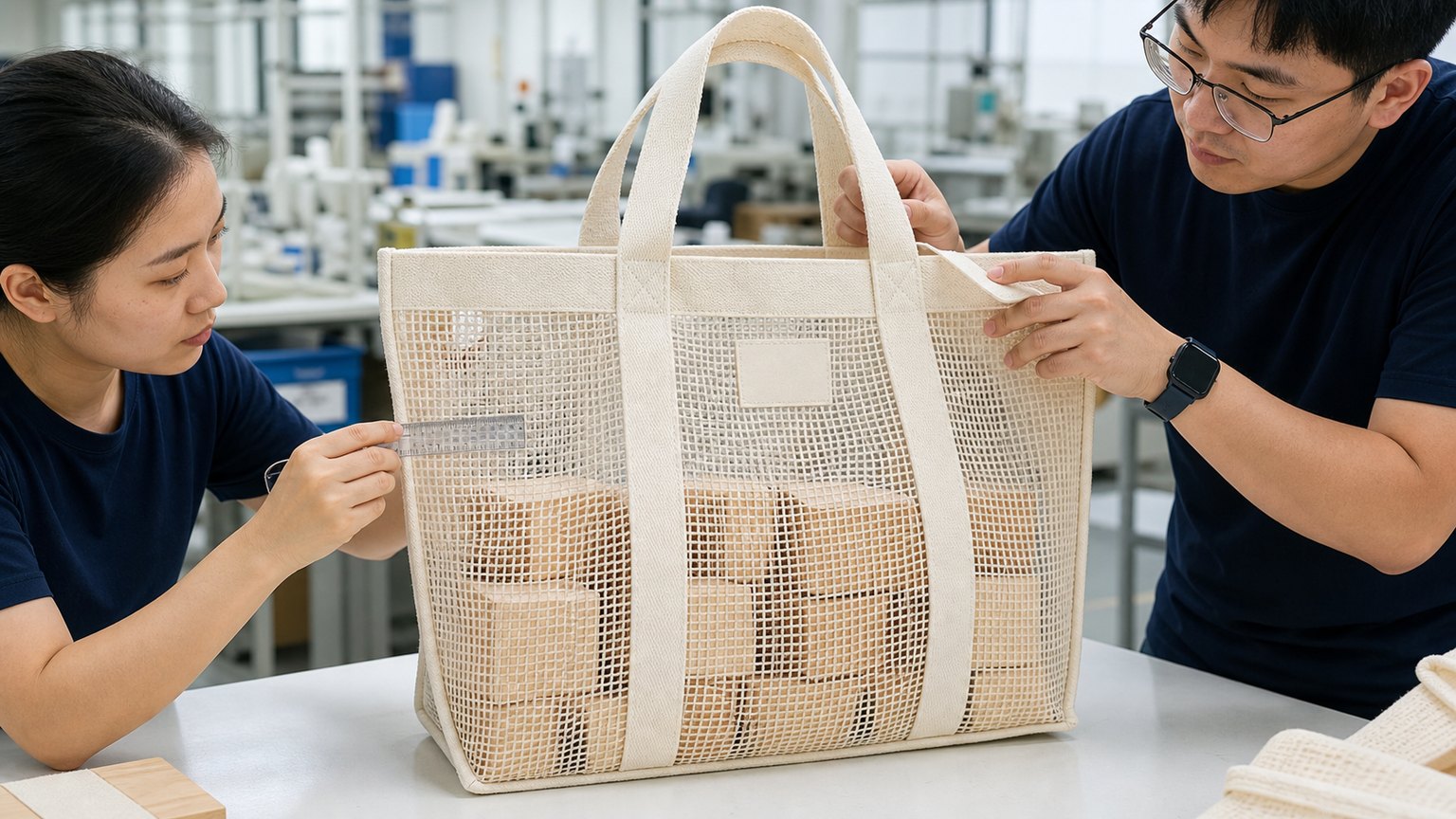
Define a realistic working load and an agreed test margin rather than copying a universal kilogram claim. Use representative block sizes, distribute them as the customer would, and specify dwell, lifting or carry cycles and post-test inspection. Measure handle drop, body extension and permanent deformation. Inspect the top band, handle ends, side seams and bottom corners. The finished bag passes only when its entire load path meets the written criteria.
Test Snagging and Abrasion Where Use Creates Risk
Open loops can catch shelves, packaging corners and hardware. Build a fit-for-purpose snag review with representative contacts and define prohibited runs, pulled loops or broken yarns. For suitable textile fabrics, ISO 12947-2:2016 specifies a Martindale procedure for determining abrasion specimen breakdown, but its listed limitations matter. Select an applicable method for the exact mesh or assembly rather than claiming abrasion resistance from the standard's name alone.
Validate Washing and Care on the Whole Bag
Define water temperature, detergent, agitation, rinse, extraction and drying only if the product will carry a wash claim. Test every component, decoration and colorway through the same route. Inspect shrinkage, stretch recovery, mesh distortion, seam behavior, label curl, print change and color transfer. If only spot cleaning is supported, marketing and care copy should say so. A washable mesh fabric does not make untested handles, panels or inserts washable.
Measure Dimensional Recovery After Conditioning
Record the relaxed dimensions before care, immediately after drying and after an agreed recovery period. Measure body width and height, aperture, handle drop, opening and panel alignment. Mesh can recover slowly or retain local distortion around heavy contents. The acceptance limit should distinguish expected flexible behavior from permanent change that prevents normal use or shifts branding visibly.
Turn Mesh Risks Into CTQs
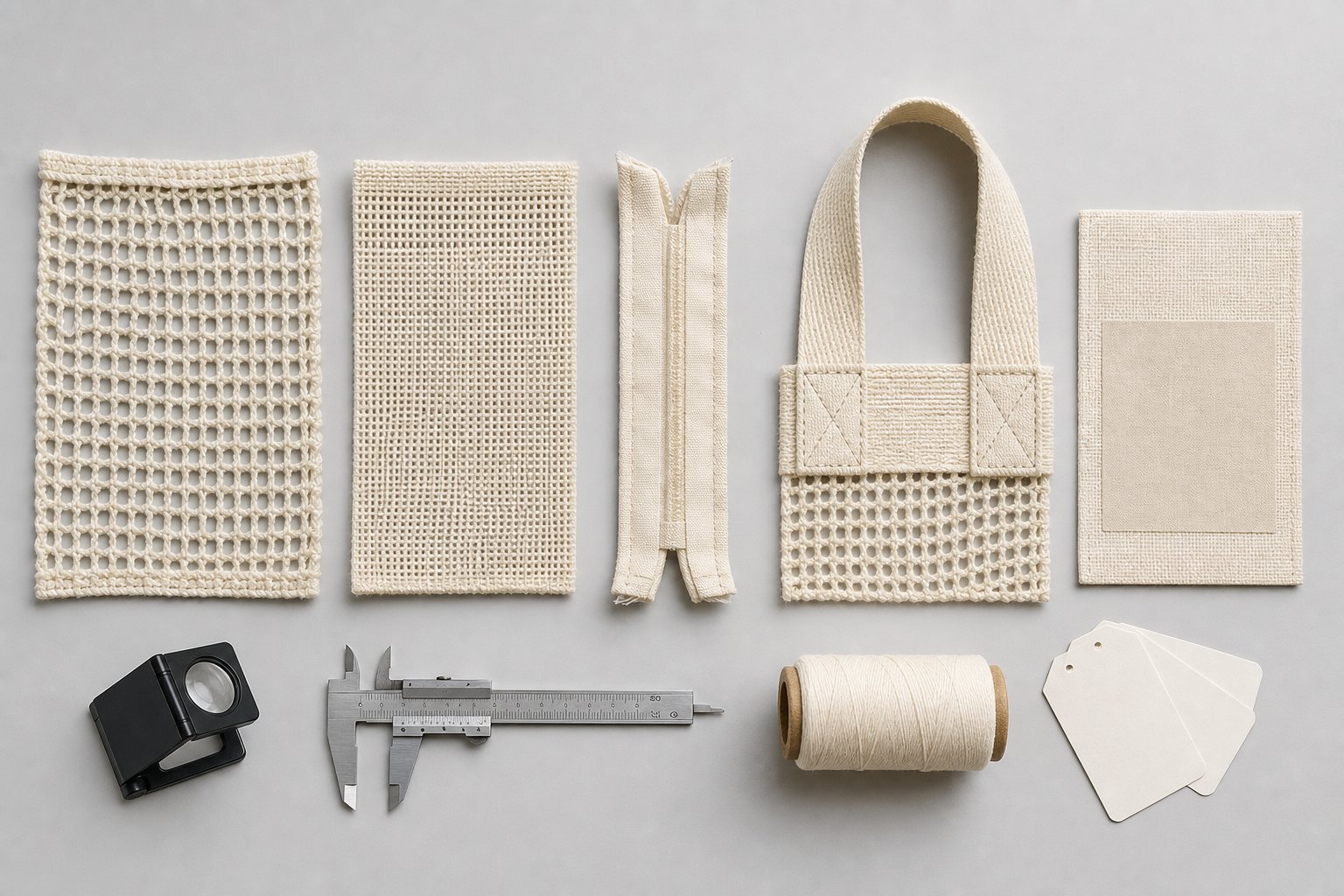
Create critical-to-quality lines for fiber and article identity, aperture, orientation, dimensions, top band, edge finish, seam construction, handle attachment, working-load result, decoration, care and pack-out. Each line needs a method, sample state, tolerance or defect definition and record owner. Connect this plan to the custom bag inspection checklist so the bulk inspector can make decisions without guessing the designer's intent.
Compare Approval Gates
| Gate | Decision | Required evidence | Do not release when |
|---|---|---|---|
| Material | Is the mesh article viable? | Traceable swatch, aperture, direction and relevant tests | Article or test state is unknown |
| Construction assembly | Do seams and handles spread load? | Production seam, binding and attachment samples | Yarn pullout or local tearing remains |
| Pre-production bag | Does the complete product perform? | Dimensions, branding, care and finished-load result | BOM, artwork or criteria are open |
| First-off bulk | Does the line match the approval? | Lot identity, measurements, workmanship and retained unit | Substitution or process drift appears |
Freeze the Golden Sample and Its Records
Label the approved bag, mesh cutting, test report, artwork revision and technical file with one control reference. State whether the sample is unwashed or represents an approved recovered state. Factory, buyer and inspector should compare the same evidence.
Control Mesh Lots and Substitutions
Require written approval before changing producer, article, construction, fiber, color, finish, nominal mass, aperture or width. Decide which change needs a swatch check, construction retest or full bag reapproval. A visually similar replacement can behave differently at a seam or after washing. Tie purchase orders and receiving records to the approved lot or traceable material code.
Use First-Off Production as a Release Gate
Inspect the first units after bulk mesh, binding, handles and decoration reach the line. Confirm orientation, dimensions, aperture appearance, raw-end control, stitch capture, handle placement and branding. Retain an approved first-off unit and compare later production intervals with it. The broader custom bag manufacturing process shows how this gate fits between pre-production approval and packing.
Inspect Bulk by Failure Mode
Classify defects before inspection: wrong material or direction, aperture variation, run or broken yarn, exposed raw end, missed mesh at seam, binding twist, handle misplacement, weak attachment, distortion, branding error, stain and pack-out damage. Set critical, major and minor categories according to use and contract. Random inspection is more defensible when the inspector knows which mesh-specific failures threaten containment or carrying safety.
Substantiate Recycled and Environmental Claims
Do not treat polyester mesh as recycled unless the specific input and supply chain support that claim. Textile Exchange explains that RCS and GRS provide third-party recycled-material certification and chain-of-custody requirements, with GRS adding processing criteria. Confirm current scope, transaction documents and claims policy for the finished order. The FTC's Green Guides summary also cautions against broad, unqualified environmental-benefit claims.
Normalize MOQ, Cost and Lead Time
Mesh mill minimums, stock versus custom color, binding and handle materials, panel printing, sample rounds, testing, sewing complexity, size mix and packaging can all change the quotation. Compare suppliers against one frozen specification. Use the custom tote MOQ guide and custom tote cost guide for commercial analysis, while keeping technical approvals visible on the schedule.
Recognize Manufacturer Red Flags
- The quotation says only "mesh" without article, fiber, structure, aperture or direction.
- The supplier presents a flat swatch but no seam, edge or handle attachment trial.
- Load claims omit the finished bag, load shape, state, duration and acceptance result.
- The logo is approved in a mockup but not on the actual carrier surface.
- Bulk material can be substituted without written reapproval.
- Recycled, eco-friendly or biodegradable claims appear without applicable chain-of-custody and claim evidence.
Route Adjacent Questions to the Right Guide
For a weighted supplier decision, use the custom shopping bag manufacturer selection guide. For repeat-order ownership, use the custom tote supplier program guide. For general sustainability claims and evidence, use the eco-friendly bag manufacturer guide. These pages own their respective intents so this article can remain the engineering reference for mesh shopping bags.
Send a Mesh-Specific RFQ
Provide the use case, target working load, representative contents, architecture, finished dimensions, mesh article or required structure, fiber content, aperture, direction, color, top band, edge finish, seam, handles, reinforcement, branding carrier, artwork, care, target market, quantity, packing and delivery destination. Ask the factory to identify open risks and propose a staged test plan. Compare the current custom shopping bag range, then assess the response with the complete custom bag sourcing framework.

GET A MESH BAG QUOTE
Email a prefilled mesh bag brief
Include the intended contents, working load and preferred branding surface so sampling can answer the real product risk.