
Last reviewed: September 24, 2026
Buyer Quick Answer
Choose a workwear uniform manufacturer by evidence that the garment suits the actual job: documented fabric and finish, usable movement, correct pocket architecture, reinforced stress points, decoration compatible with laundering, an inclusive measurement system, physical sample gates and bulk inspection against one approved reference.
This page owns product engineering and factory selection. For wearer entitlement, stock, employee issue, exchanges and replenishment, use our separate corporate uniform supplier program guide. General branded workwear must also be kept distinct from regulated PPE.
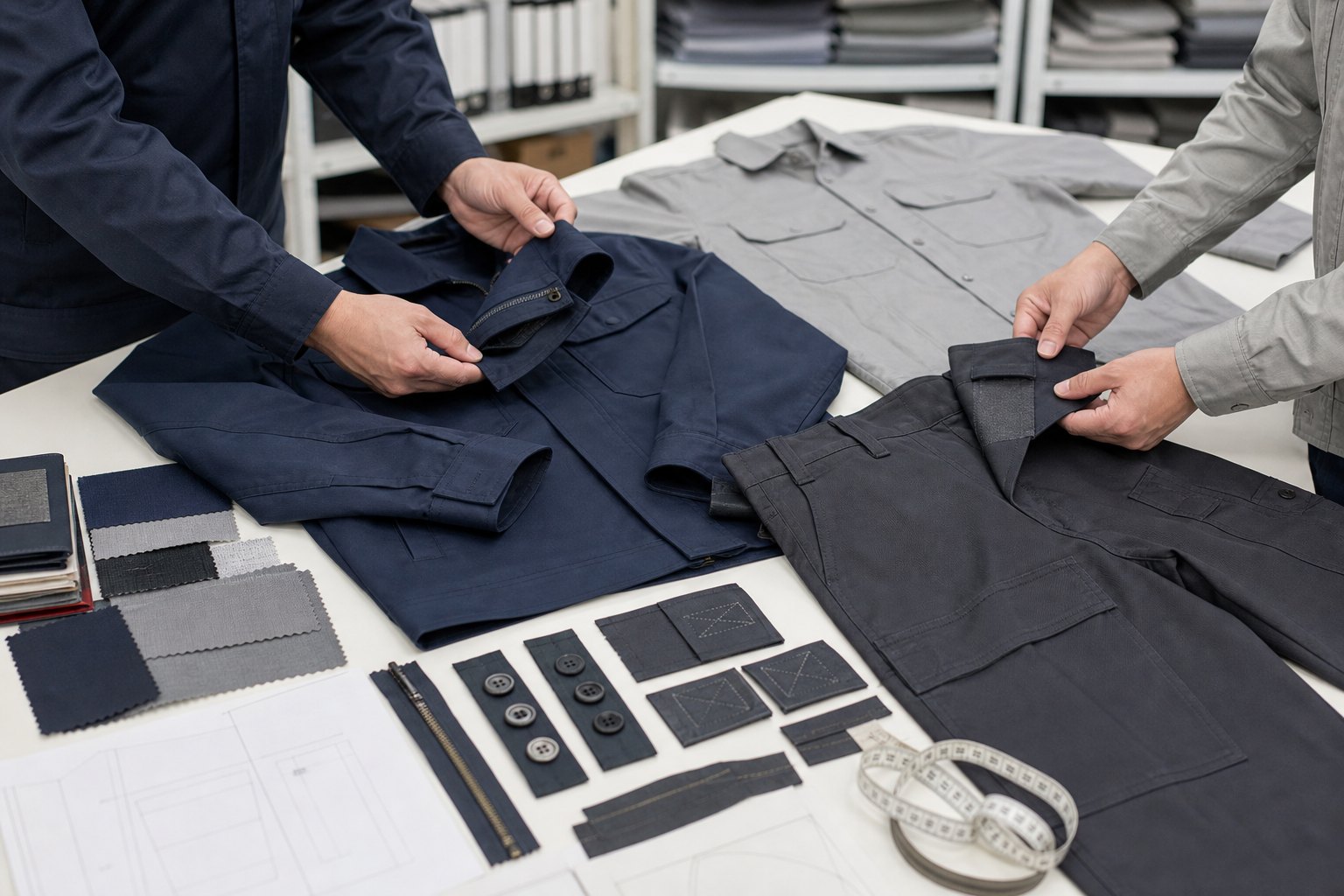
Start With the Work, Not the Logo
A warehouse picker, service technician, maintenance team and front-of-house supervisor may all wear a company identity, but the same uniform specification will not serve every role. Build a wearer-task brief before choosing a catalog style or asking for a price. Record movement, contact surfaces, climate, indoor or outdoor use, tool access, wash frequency, appearance standard and layering needs.
This role brief is a product-development input. It does not replace a workplace risk assessment or local regulatory review. If a garment is expected to provide protection against a defined hazard, treat it as a separate protective-clothing project with the applicable standards, test evidence, labels and traceability.
Turn Each Role Into a Verifiable Specification
| Work condition | Specification question | Evidence to approve |
|---|---|---|
| Frequent reaching or bending | Where is extra mobility needed without excess fabric? | Wear trial, reach test and measurements in motion |
| Contact and abrasion zones | Which knees, elbows, cuffs or pocket edges fail first? | Fabric data plus reinforced garment sample |
| Tools and carried items | What must fit, stay secure and remain accessible? | Full-size pocket template and loaded-use check |
| Repeated washing | What care route and appearance life are expected? | Approved wash protocol and after-care sample |
| Brand identification | Which marks must remain legible without harming comfort? | Decoration trial on the named garment fabric |
When uniforms are part of a multi-location issue program, link this product specification to the role, quantity and distribution logic in the uniform program operations guide. The two pages should work together rather than compete.
Choose the Garment Architecture by Job
A work shirt, jacket, trouser, coverall and apron solve different combinations of coverage, mobility and storage. Decide whether the program needs separate garments or a coordinated set. Record closure type, cuff, collar, waistband, hem, pocket position, ventilation or layering needs before the first sample.
Do not add pockets merely because they look functional. Each pocket should have a named content, opening direction, securement method and load expectation. A pocket that catches on equipment, sits under a belt or becomes inaccessible while bending is a design problem even if the stitching is strong.
Specify Fabric as a Performance System
Fiber content alone does not define workwear. Record construction, finished weight, yarn and surface character, stretch if relevant, finish, shade reference and care method. Ask the manufacturer how the chosen material behaves after the intended wash route, not only how it feels as a new swatch.
Different roles may require a soft shirt, stable trouser twill or more robust outer layer. Avoid universal claims that one fiber or one GSM is always best. Evaluate comfort, abrasion exposure, dimensional stability, color behavior, drying needs, decoration compatibility and replacement expectations together.
For sweatshirt or layered workwear, the hoodie fabric, fit and finish guide explains fleece, loopback, rib and hood controls. For polos, use the custom polo shirt manufacturing guide.
Engineer Fit for Movement and Layering
Approve fit in the movements the wearer performs. Check forward reach, overhead reach, bending, kneeling, sitting, pocket access and closure tension. A static front-view photo can hide sleeve pull, back restriction, waistband drop or a pocket that becomes unusable when the wearer moves.
State whether the garment is worn directly over a base layer or over other clothing. Build the measurement chart around that wearing condition. Define key points of measure and tolerances, then confirm grading across the real size range instead of approving only one middle size.

Control Seams, Reinforcement and Hardware
Map likely failure points from the job brief. Pocket corners, belt loops, crotch seams, zipper bases, cuffs and high-load joins may need reinforcement, but the correct construction depends on the garment and use. Specify seam type, stitch density where relevant, reinforcement position, zipper or button specification and the acceptable finished appearance.
| Component | Common failure to prevent | Useful sample check |
|---|---|---|
| Pocket corner | Tearing or seam opening under repeated load | Inspect reinforcement position and loaded pocket behavior |
| Crotch and seat | Restriction, seam strain or opening during bending | Movement trial plus inside seam inspection |
| Zipper and closure | Jamming, pull-off, distortion or difficult use | Cycle manually and inspect attachment at each end |
| Cuff and hem | Fraying, twisting, shrinkage or poor closure alignment | Measure and compare before and after the approved care test |
| Button or snap | Loose attachment, cracking or misalignment | Functional check on first-off and bulk samples |
Need the Manufacturer to Review Your Workwear Brief?
Send the wearer roles, job movements, garment set, fabric expectations, pocket contents, branding, care method, size range, quantity and required date.
Make Branding Compatible With the Uniform
Choose decoration after the fabric, garment zone and care route are known. Embroidery, screen print, transfer and patches place different loads on the material and fail in different ways. Approve finished size, color, position, inside comfort and after-care appearance on the actual garment.
For detailed embroidery engineering on knit tops, use the custom embroidery T-shirt guide. For one identity system across shirts, polos, hoodies and related apparel, review the embroidery brand-program guide.
Separate General Workwear From PPE
Do not allow a generic uniform, reflective-looking trim or supplier claim to imply protective performance. First decide whether the garment is for identity and everyday durability or is intended to protect against a defined hazard. Protective clothing may require market-specific standards, finished-garment tests, controlled materials, markings and documentation.
For U.S. workplace context, the OSHA PPE overview explains the employer's responsibility to assess hazards and select appropriate PPE. Buyers in other markets should identify the applicable local requirements. LUCKYSTAR should only quote protective performance when the exact scope and required evidence are defined.
Use Samples as Decision Gates
| Gate | Decision closed | Evidence retained |
|---|---|---|
| Material review | Fabric, color, finish, trims and proposed care route | Named swatches, trim references and comments |
| Fit prototype | Measurements, movement, layering and pocket access | Measured sample and wear-trial record |
| Decoration trial | Logo method, position, color, hand and inside comfort | Physical sew-out, print or transfer sample |
| After-care sample | Dimensional change, shade, twisting, trim and decoration behavior | Before/after measurements and photographs |
| Pre-production sample | All approved inputs combined in one release reference | Golden sample, BOM and signed specification |
A sample is useful only when it closes named questions. Record every approval and revision so that bulk production does not depend on memory or message history.
Request a Sample and Test Plan
Inspect Workwear After the Intended Care Route
Inspect the new garment and the after-care sample. Measure critical dimensions, compare body and component shrinkage, check seam torque, zipper and button function, pocket shape, reinforcement, color and decoration. The approved care process should reflect the buyer's actual use rather than an unspecified generic wash.
Bulk QC should follow the named critical-to-quality points: garment identity, size, measurements, shade, construction, pocket and closure function, decoration and packing. Record defects by failure type so corrective action addresses the process that created them.
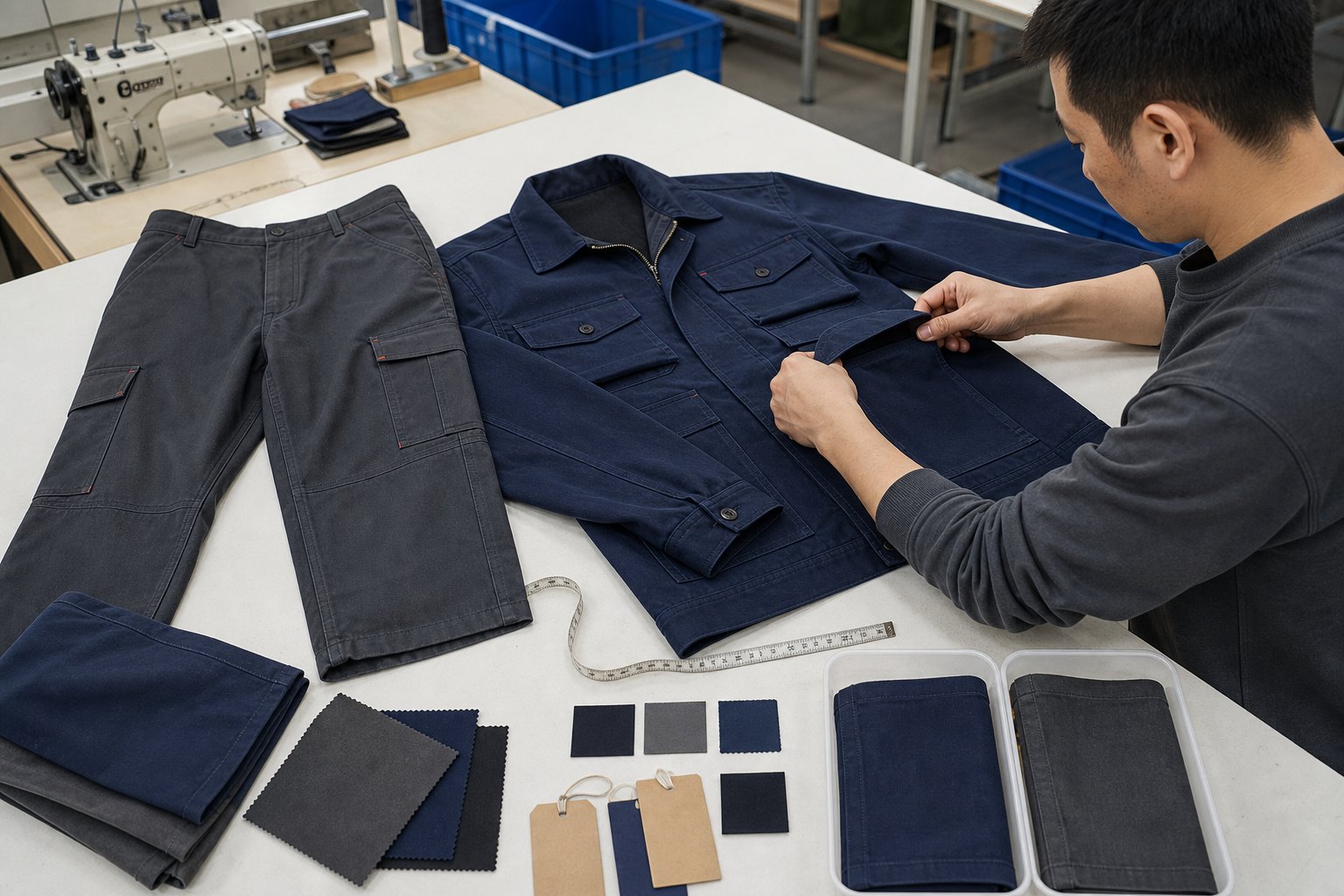
Ask for a Workwear-Specific QC Plan
Identify the job-critical seams, pockets, measurements, wash result, logo positions and functional trims that must be checked during and after production.
Compare Manufacturers on Evidence
| Capability area | Strong evidence | Weak answer |
|---|---|---|
| End-use understanding | Asks about roles, movement, wear and care before recommending a garment | Offers one generic uniform for every job |
| Specification control | Names fabric, measurements, trims, seams, pockets, decoration and tolerances | Relies on catalog photos and broad quality claims |
| Sampling | Uses staged physical approvals with revision records | Treats one attractive sample as proof of bulk control |
| Quality control | Explains material, in-line, final and after-care checks against the approved reference | Says only that every piece is high quality |
| Change and reorder control | Preserves the BOM, sample, color and revision history | Cannot explain how a repeat order will match |
Use this product-level evidence alongside the broader manufacturer capability and sourcing framework, which explains sampling, quality systems, commercial comparison and supplier verification.
Understand MOQ, Cost and Lead-Time Drivers
Do not rely on a universal price, MOQ or delivery promise. The quotation changes with the garment set, custom fabric or stock route, number of colors, size range, pocket and reinforcement complexity, trims, decoration positions, labels, packaging, testing and destination.
Ask where the MOQ applies: per garment, color, fabric lot, logo method or total program. Lead time should be shown as a sequence from specification and sample approval through materials, production, inspection and shipment. A factory should explain the variables for the exact brief instead of supplying an unsupported fixed number.
Request a Scope-Matched Workwear Quote
Workwear Uniform RFQ Checklist
- Wearer roles, working conditions and required movements
- Garment set: shirts, polos, jackets, trousers, coveralls or aprons
- Fabric, color, finish, stretch and intended care route
- Measurement chart, fit intent, layering and size range
- Pocket contents, placement and securement needs
- Seams, reinforcement zones, closures and hardware
- Logo artwork, decoration method and placement
- Any protective function and the exact required standard or evidence
- Sample gates, quality tests and acceptable tolerances
- Quantity by style, color and size; packaging; destination; required date
- Expected reorder model and documents that must be retained
Send Your Workwear RFQ to LUCKYSTAR
Email a prefilled workwear brief
Related Apparel and Sourcing Guides
- Corporate uniform supplier: issue, stock and replenishment operations
- Custom polo shirt manufacturer guide
- Hoodie fabric, fit and finish approval
- Reliable custom T-shirt manufacturing
- Custom embroidery digitizing and QC
- Global custom apparel working framework
- Coordinated apparel, caps and bag merchandise
- Core manufacturer sourcing guide
Frequently Asked Questions
What should a buyer send a workwear uniform manufacturer first?
Send the roles, working conditions, garment set, movements, pocket contents, wash route, size range, branding, quantity and required date. This gives the manufacturer a reasoned basis for recommending materials and construction.
Is heavier fabric always more durable?
No. Weight alone does not prove abrasion resistance, seam durability, comfort or wash stability. Evaluate the complete material and garment construction for the named job.
How should workwear fit be approved?
Approve key measurements, intended layering and real movements such as reaching, bending, sitting and pocket access. Review more than one size when grading risk is important.
Can ordinary branded workwear be treated as PPE?
No. Protective performance must be tied to a defined hazard, applicable requirements and suitable evidence. A visual feature or generic supplier statement is not enough.
What should be checked after washing?
Check critical measurements, shade, twisting, seam and pocket shape, closure function, reinforcement, decoration and overall appearance using the approved care route.
How is this different from a corporate uniform supplier guide?
This page controls garment design and manufacturing evidence. The corporate uniform guide controls who receives which approved SKU, stock policy, exchanges, replacements and replenishment.
Company and project contact
Ningbo Luckystar Commodities Co., Ltd. reviews workwear projects against the submitted role, garment, care, sample, inspection and packing requirements. Any protective function and supporting evidence must be scoped to the exact project.
Learn more about LUCKYSTAR, review product capabilities, use the core sourcing guide, or contact the project team.






