Last reviewed: September 28, 2026
OEM bags create a competitive advantage only when a brand can turn one successful product into a controlled family without restarting development for every new size, channel or use. The edge is not simply access to custom colors and logos. It is a repeatable product platform: shared materials, components, interfaces and production decisions combined with deliberate points of difference.
This guide shows how buyers can build that platform with an OEM partner. It focuses on product-family architecture, module boundaries, variant control, change impact and line-extension economics. For a complete introduction to supplier types, manufacturing, quality, MOQ and quotations, use the Custom Bag Manufacturer Guide.
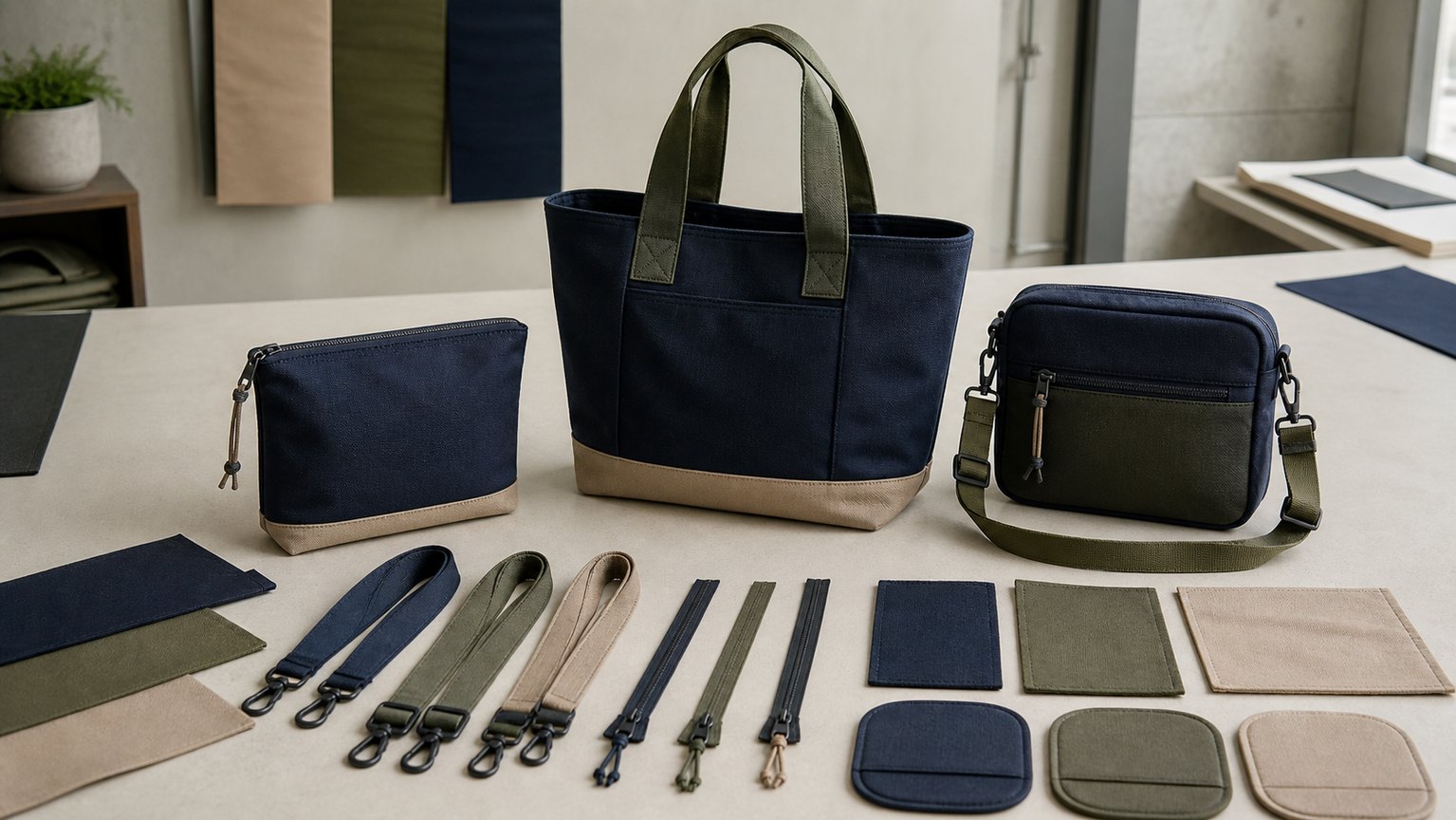
A useful OEM bag platform shares selected modules while preserving the function and identity of each finished variant.
Buyer Quick Answer
Scope: Product-Family Architecture, Not a Generic OEM Overview
This article does not repeat the difference between OEM and ODM, general factory selection, sampling steps or broad customization benefits. Read OEM vs ODM Bag Manufacturing when choosing the development route, How to Choose a Custom Bag Manufacturer for supplier due diligence, and the custom bag manufacturing process for the end-to-end production sequence. Here, the question is narrower: how can a brand design several differentiated OEM bags as one manageable system?
Define the Competitive Advantage as Controlled Extension
A one-off bag can succeed, but it does not yet create a platform. A platform exists when the records, components and production knowledge from the first product can support a second product without copying hidden mistakes. Define the desired advantage in measurable terms: faster approved line extensions, fewer new components per launch, shorter replenishment decisions, lower obsolete component exposure, or more consistent brand cues across categories.
Do not use vague goals such as "more customization." A competitive objective should tell the team which forms of variety are valuable and which forms are operational noise.
Know the Difference Between a Platform and a Portfolio
A portfolio is a group of bags sold together. A platform is the shared architecture beneath selected members of that group. Two products may look coordinated while using unrelated zipper sizes, fabric bases and handle constructions. Conversely, a tote and a crossbody bag may share webbing, zipper tape, lining, hardware finish and approval methods while looking deliberately different.
MIT describes platform commonality as reuse of architectures, components, manufacturing processes, interfaces and infrastructure across a product family. That definition is useful for bags because it moves the discussion beyond visual similarity.
Establish One Anchor SKU
Choose a product with a clear customer job, stable forecast and representative manufacturing route. The anchor should not be the most decorative or complex concept. It should reveal the core material, hardware, seam and quality decisions the future family is likely to reuse. Complete its use-case and approval logic before extending it.
If the anchor is still changing weekly, adding variants multiplies uncertainty. The sample bag guide explains why a prototype must answer named questions before a bulk commitment.
Map Customer Jobs to Planned Variants
List each planned bag and the job it must perform: daily carry, small-item organization, checkout packaging, beauty kit, travel accessory or event distribution. Record the required contents, load, opening behavior, carry method, storage, channel and price position. A variant earns a place only when it solves a different job or serves a distinct commercial channel.
This step prevents a color or pocket change from becoming a new SKU without commercial purpose. It also shows when one platform is being stretched across incompatible uses.
Separate Brand Constants From Product Variables
Brand constants might include a hardware finish, edge shape, stitch color, webbing family, label location or a repeated proportion. Product variables may include size, closure, pocket layout, carry mode and protection level. Put each decision in one category. If everything is variable, reorders drift. If everything is fixed, the products cannot do different jobs.
The custom bags branding guide covers customer-facing identity. A platform brief should translate those visible cues into reproducible component and placement rules.
Break the Bag Into Reviewable Modules
A practical module map makes the product family visible before detailed drawings multiply. Use modules that match how design and production decisions are actually controlled.
| Bag module | Possible shared element | Likely variant decision | Interface to freeze |
|---|---|---|---|
| Outer shell | Fabric family and base colors | Weight, coating, panels and size | Seam allowance, reinforcement and edge finish |
| Carry system | Webbing type and hardware finish | Handle drop, shoulder strap or drawcord | Attachment width, load path and anchor geometry |
| Opening | Zipper family and pull finish | Open top, zipper, drawstring or flap | Tape width, end treatment and opening length |
| Interior | Lining family and label system | Pockets, padding and organization | Attachment points and finished volume |
| Base | Reinforcement material | Flat, gusseted or structured base | Panel perimeter and seam stack |
| Decoration | Color standard and artwork governance | Method, scale and placement by surface | Safe area and approved production file |
| Pack-out | Shared protection and carton system | Retail, promotional or e-commerce pack | Fold state, SKU identity and receiving unit |
Define Interfaces Before Sharing Components
An interface is where one module meets another. For bags, that includes a strap attached to the shell, a zipper installed into an opening, a lining joined at the top edge, or a base panel joined to the body. Specify the dimensions, seam stack, hardware compatibility and performance expectation at each important interface.
A shared strap is not truly shared if every bag needs a different attachment tab, box stitch and hook opening. Freeze the connection as carefully as the component itself.
Choose Components Worth Sharing
Good candidates have stable demand, acceptable performance across several variants and limited effect on customer-facing differentiation. Webbing, zipper tape, selected pulls, label constructions, thread colors and packing materials often deserve review. The decision must still be tested against each product's load, appearance and care conditions.
Do not share a component merely because it is inexpensive. A low-cost part that causes a second tooling path, special inspection or frequent substitution can add more complexity than its unit price suggests.
Protect Differences That Customers Value
Commonality should not flatten the range into three sizes of the same bag. Preserve the attributes that explain why each variant exists: a pouch opening that exposes contents, a tote handle that carries comfortably, a crossbody strap that adjusts reliably, or a cosmetic bag interior that cleans appropriately. Share beneath the promise, not at the expense of it.
Research on product families consistently describes a trade-off between commonality and distinctiveness. The correct target is not maximum sharing. It is the highest useful sharing that still protects each product's job.
Build a Variant Tree Before the SKU List
Start with the platform, then branch only at deliberate decision points: bag form, size, body color, carry option, closure, decoration and packaging. Mark which combinations are permitted and which are prohibited. A tree exposes the combinatorial explosion that a flat concept board hides.
For example, three sizes x four colors x two straps x three artworks already create 72 combinations before packaging changes. If only twelve have real demand, release twelve. Do not make every technically possible configuration orderable.
Count Sellable and Production Variants Separately
A sellable SKU is not always a unique production setup. Several retail SKUs may share one unprinted shell and diverge at decoration or packing. Conversely, one customer-facing style may contain separate production variants because colors use different materials or processes. Record both counts.
This distinction makes capacity, MOQ and inspection discussions more accurate. It also helps the buyer decide where delayed differentiation is practical.
Connect Commonality to Runnable Quantity
MOQ is created by material purchasing, dyeing or printing setup, cutting, line changeover, decoration and packing, not by the product name alone. Shared components can pool purchasing volume only when specifications and timing genuinely match. Ten bag variants that use visually similar but technically different navy fabrics do not create one material run.
Use the custom bag MOQ guide for MOQ fundamentals. In a platform, ask for minimums by shared component, production setup and finished SKU.
Pool Materials Without Losing Identity
A shared material record should include composition, construction, weight or thickness, finish, approved color reference, usable width and test scope. State which variants may use it and which require a different grade. "Same canvas" is not a platform rule.
Review cutting yield by variant. A wider tote panel and a compact pouch may use the same roll but produce different waste. Pooling purchase volume does not guarantee equal material economics.
Share Production Processes Deliberately
Academic research on product platforms notes that shared product modules and shared manufacturing processes must be considered together. That matters for bags: two components can look common while requiring different preparation, machinery or assembly sequence. Map cutting, lamination, printing, embroidery, welding, sewing, finishing and packing paths for each variant.
Commonity is more valuable when it reduces real setup or creates repeatable work, not only when the bill of materials contains the same name.
Use Delayed Differentiation Where It Is Safe
Delayed differentiation keeps a base product common until a later stage, then adds the variant-specific feature. Examples may include decorating an approved blank shell, applying a channel-specific label, or packing the same bag for two destinations. It can reduce early fragmentation when demand by variant is uncertain.
Do not delay a feature that changes construction strength, dimensions or the approved quality route. A pocket or strap anchor added after the shell is complete may need a different assembly sequence and may not be a safe late-stage option.
Stage Customization in Layers
Separate platform-level decisions, product-level decisions and order-level decisions. The material family and hardware finish may belong to the platform. The shape and opening belong to the product. Artwork and destination packing may belong to the order. Give each layer an approval owner and effective date.
This structure lets a marketing artwork change proceed without reopening the handle-load specification. It also stops a material substitution from being treated as a simple artwork revision.
Launch the Anchor Before Extending the Family
A controlled platform can be planned early, but evidence should be collected from the anchor SKU before every extension is released. Review real assembly behavior, bulk defect patterns, packing recovery and user feedback. Then update the module library before approving the second design.
A first launch that reveals zipper distortion should improve the shared opening module, not silently pass the same weakness to three future products.
Validate the Worst-Case Variant
Shared modules should be tested in the variant that creates the highest relevant stress. The longest strap may create the highest leverage at its anchor. The largest tote may create the greatest seam load. The smallest pouch may be hardest to sew cleanly around a shared zipper curve.
Do not assume a module proven on one easy configuration is proven across the family. Name the worst-case condition and retain its evidence.
Test the Interfaces, Not Only the Parts
A zipper may pass component checks and still fail when installed around a tight opening. Webbing may have adequate strength and still create shell tearing at the chosen attachment. Review the assembly under intended load, repeated opening, wear, care and packing conditions. When a defect occurs, identify whether it belongs to the part, the interface or the process.
Build a Change-Impact Matrix
Every change should answer four questions: which modules are affected, which released SKUs use them, which evidence becomes invalid, and what stock or work in progress is exposed. Use a simple impact level rather than allowing changes to travel through informal messages.
| Change | Likely impact | Minimum review | Do not assume |
|---|---|---|---|
| Artwork only, same method and safe area | Order-level decoration files | Artwork proof and production placement | Color will match without a physical reference |
| Handle length, same webbing | Carry module, pack-out and user fit | Prototype, attachment and packing review | Material sameness means performance sameness |
| Zipper supplier or tape | Opening module across several SKUs | Compatibility, assembly and function test | A matching size code is equivalent |
| Body fabric finish | Shell, decoration, sewing and care | Material, process and finished sample review | Composition alone defines the material |
| Base size or gusset | Pattern, yield, volume and carton | Pattern revision, sample and pack-out | A small dimension change is commercially small |
| Packaging channel | Fold, protection, label and carton | Pack trial and receiving review | The product approval covers delivery condition |
Protect Design and Data Ownership
Record who owns the artwork, patterns, molds or dies, digitized files and platform documents, and what happens after the relationship ends. The commercial agreement should also define supplier confidentiality, approved subcontracting and the return or transfer of buyer-owned assets where applicable.
Ownership language is jurisdiction- and contract-specific. Obtain appropriate legal advice instead of treating a purchase order note as universal protection.
Control the Approved Module Library
The library should show each module's code, specification, approved suppliers or sources, compatible SKUs, approval evidence, current status and permitted substitutions. Retire obsolete versions rather than leaving several apparently active files in circulation. A module is not approved simply because it appeared in a previous sample.
Preserve the Component and Process Record
For each released SKU, retain the exact bill of materials, pattern revision, module versions, artwork, placement, sample status, test decisions, packing and accepted deviations. Link the finished product to the platform library by revision. The custom tote bag supplier guide explains the broader record needed for repeatable supply.
Manage End-of-Life and Substitution
A shared component creates leverage and concentration risk. If one zipper or fabric is discontinued, several SKUs may be affected at once. Require notice where practical, identify exposed products and inventory, and approve a successor through interface and worst-case testing. Do not let a supplier substitute a shared component independently on each order.
Quote Platform Alternatives Transparently
Ask the supplier to separate the anchor SKU, shared development or setup, variant-specific development, finished-SKU cost and one-time tooling. Request alternatives that show the commercial effect of common modules without hiding a change in product performance. The custom bag cost guide helps normalize quotation assumptions.
Compare Three Product-Family Strategies
The right architecture depends on market demand and the differences customers actually value.
| Strategy | What remains common | Best use | Primary risk |
|---|---|---|---|
| One base, late decoration | Nearly complete blank bag | Artwork or channel variants with the same function | Range appears different but solves no new job |
| Shared modules, distinct forms | Selected materials, hardware, interfaces and processes | Coherent line with genuine functional differences | Interfaces are not controlled across forms |
| Independent engineered SKUs | Brand rules and governance only | Products with incompatible loads, materials or processes | Repeated development and fragmented purchasing |
Track the Competitive Effect With Evidence
Useful metrics connect product architecture to commercial behavior. Track time from approved brief to released extension, percentage of released modules reused without change, new components per SKU, change-driven resampling, MOQ fragmentation, obsolete shared inventory, first-bulk defect rate and reorder deviation. Use trends, not an unsupported claim that the platform always lowers cost.
A platform can fail when the range becomes too large, when demand does not justify common inventory, or when shared parts are forced into unsuitable products. Review the architecture after every significant launch.
Keep Related Search Intents Separate
This page is about product-family leverage. Use the Private Label Bag Supplier guide for retail-ready launch assets and packaging, Wholesale Tote Bags for assortment allocation and reorders, and the lead-time and cost guide for schedule compression. Buyers developing specialized categories can then move to the China cosmetic bag manufacturer guide or custom drawstring bag supplier guide.

The development table should show which materials and modules are common, which are optional and which belong to one product only.
What to Send for a Useful Platform Review
Send the anchor SKU specification or sample, planned product family, customer job for each variant, target channel, quantity by SKU, forecast launch sequence, brand constants, proposed variable features, material and hardware preferences, test needs, packaging, destinations and required in-hand dates. Identify existing buyer-owned patterns, tooling and artwork.
Ask the supplier to respond with a proposed module map, incompatible combinations, component-level minimums, shared and unique process steps, sample plan, change-control route and assumptions that affect the quotation.
How LUCKYSTAR Can Support OEM Bag Platform Development
LUCKYSTAR can review a buyer's product-family brief, develop anchor and extension samples, and help identify where materials, hardware, decoration or packing may be shared. The useful output is not a promise that every bag should use the same component. It is a transparent proposal showing common elements, variant-specific elements and the approvals each extension still requires.
Exact development, tooling, testing, sourcing and inventory services depend on the project and written quotation. Return to the Custom Bag Manufacturer Guide to place the platform discussion inside the complete supplier and production workflow.
Frequently Asked Questions
Is an OEM bag platform the same as using one bag in several colors?
No. A color family can be one simple form of variety, but a platform may share architecture, components, interfaces and processes across products that perform different jobs. The buyer must define which elements are common and which are variant-specific.
Should every OEM bag share the same material?
No. Share a material only when its appearance, construction, performance, decoration compatibility and care behavior suit every named variant. Some products need a different weight, coating, lining or reinforcement even when the visual palette stays coordinated.
Can shared components reduce MOQ?
They may pool component purchasing or reduce repeated setup, but finished-SKU minimums can still come from cutting, printing, sewing, assembly and packing. Ask for minimums at component, setup and finished-product level rather than assuming one family total applies.
What should be tested on a shared module?
Test the module within the finished interface and under the hardest relevant condition across planned variants. A strap, zipper or base panel can behave differently depending on attachment, geometry, load, care and assembly sequence.
How many variants should an OEM platform launch?
Launch only the combinations supported by a clear customer job, forecast and operational plan. A variant tree may reveal dozens of technically possible combinations, but technical possibility is not demand. Begin with an anchor and a small number of justified extensions.
Who should control product-platform changes?
The buyer and supplier should name approval owners and use a shared revision process. A change to a common module must be reviewed across every released SKU that uses it, including tests, open orders, work in progress, inventory and future reorders.
Turn OEM Capability Into a Repeatable Market Edge
Review the current custom bag range to define the anchor category and extension route. OEM capability becomes strategically useful when the second and third products benefit from the knowledge created by the first. A controlled product platform makes that reuse visible: modules have identities, interfaces have rules, variants have commercial jobs, and changes have traceable effects.
Send LUCKYSTAR your anchor SKU and planned variant map for a platform review. Include volumes and launch sequence so shared-component proposals can be evaluated against real demand rather than an abstract catalog.
Email a prefilled OEM platform brief