
Last reviewed: September 24, 2026
A custom bag exporter should not be judged by promises of fast delivery or unlimited capacity. The useful test is whether one accountable team can control specifications, materials, production, shipment release and exceptions against a dated order file.
Buyer Quick Answer
Choose a custom bag exporter that can show four synchronized clocks: design approval, material readiness, production execution and export release. Require SKU-level capacity, a controlled sample handoff, dated quality gates, an exception register and reconciled shipping documents. Define speed as decision latency, scale as repeatable output under the same specification, and stability as the ability to contain and recover from change without hiding it.
Scope: This page evaluates export delivery control, not general factory selection or a universal production lead time. Use the Custom Bag Manufacturer Guide for the complete sourcing framework and the custom bag production timeline guide for stage-level duration planning.
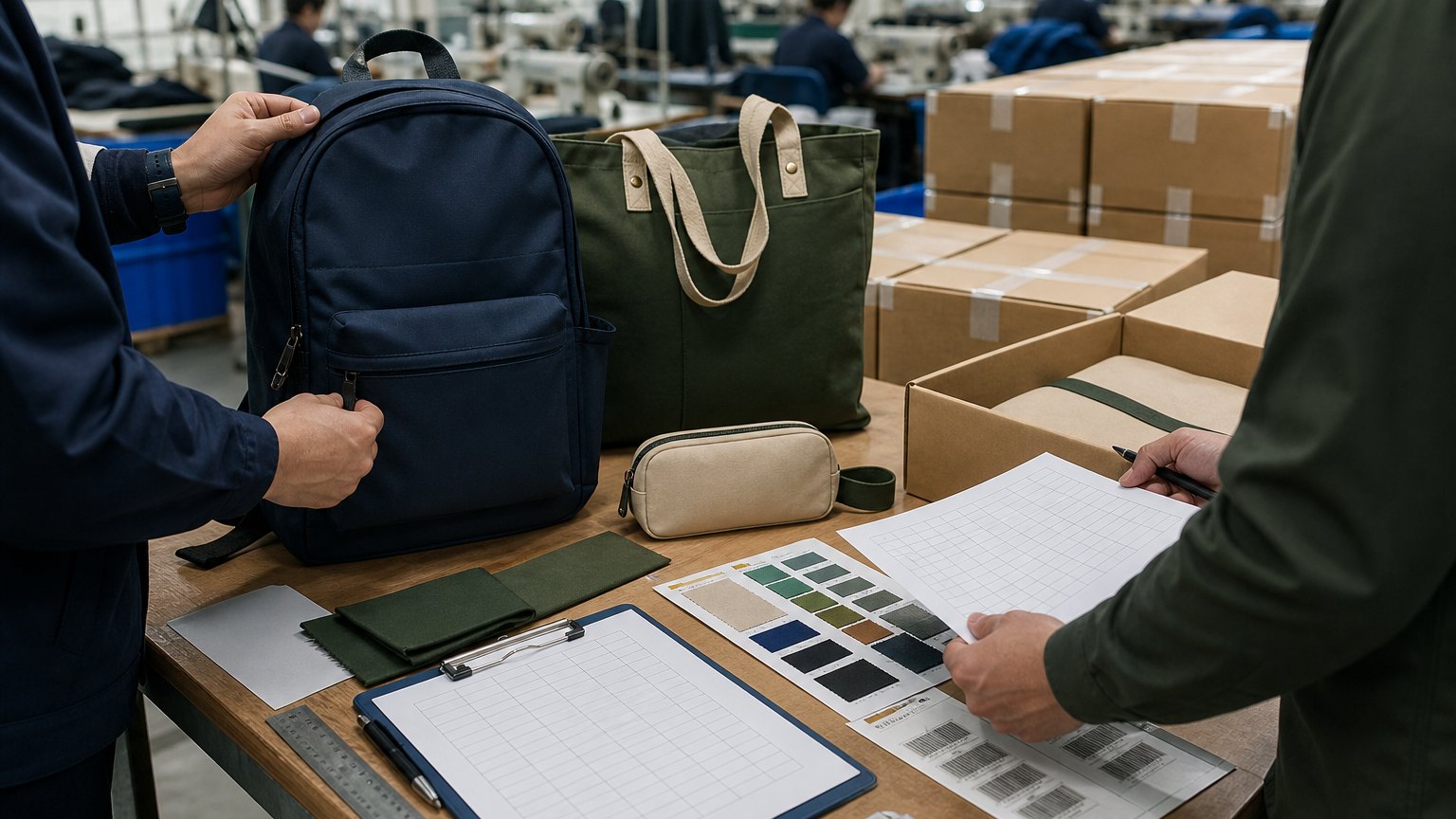
What This Page Owns
Google results for custom bag exporters usually emphasize factory size, fast samples, global shipping, certifications and broad product ranges. Those claims help discovery, but they rarely define the operating evidence behind delivery. This guide owns a narrower intent: how a buyer tests whether an exporter can convert one approved order into an on-time, in-full and document-ready shipment at increasing volume.
Define the Exporter Operating Model
The seller, factory, export entity, consolidator and freight forwarder may be separate companies. Record who contracts, invoices, manufactures, inspects, files export information, books freight and appears as shipper. An export coordinator can add value without owning a factory, but the relationship must be disclosed. Compare this structure with the operating-model checks in how to choose a custom bag manufacturer.
Build One Order Control File
The control file is the single source for specification revision, approved sample, bill of materials, artwork, quantities, material status, production plan, quality gates, packing, destination requirements, Incoterm, shipment instructions and exceptions. Each record needs an owner and date. Email fragments and chat screenshots are evidence inputs, not a controlled system.
Use Four Clocks, Not One Lead Time
A single promise such as "35 days" hides dependencies. Measure design approval, material readiness, production execution and export release separately. A clock starts only when its required inputs are complete, and it stops at a defined output. This makes delay ownership visible and prevents a late artwork approval from being reported as a sewing delay.
Four-Clock Delivery Map
| Clock | Valid start | Stop evidence | Typical hidden delay |
|---|---|---|---|
| Design | Complete brief and sample scope | Approved build record | Unclosed comments |
| Material | Approved BOM and forecast | Released production lots | Color or trim minimum |
| Production | Materials, line and first-off ready | Packed quantity passes release | Ramp-up bottleneck |
| Export release | Final data and booking available | Cargo and documents accepted | Invoice or carton mismatch |
Clock One: Freeze Design Inputs
The exporter should identify missing dimensions, materials, artwork, color standards, label copy and packing decisions before promising a sample date. Approvals need version numbers and closed comments. The custom bag sample SOW guide explains how to define deliverables, revisions and production handoff.
Clock Two: Prove Material Readiness
Material readiness means the approved fabric, lining, webbing, zipper, hardware, labels and packaging are available in released lots, not merely that suppliers have been contacted. Record purchase quantity, color lot, inbound date, inspection status and approved alternatives. Imported materials and custom colors require their own dependency line.
Clock Three: Plan Real Production
Start the production clock after materials, approved sample, line allocation and first-off method are ready. The plan should show cutting, decoration, subassembly, sewing, finishing, inspection and packing. Use the custom bag manufacturing process to check that no operation has disappeared from the schedule.
Clock Four: Release the Shipment
Finished sewing is not export readiness. The cargo still needs final acceptance, complete packing data, commercial documents, booking instructions and handoff confirmation. Build the release checklist backward from the carrier cutoff, including buyer review time. A booking date is not proof that the shipment file is ready.
Define Speed as Decision Latency
Fast sewing cannot recover days lost to unanswered questions. Measure response time for a clear RFQ, time to identify missing inputs, time to contain a defect and time to issue a corrected document. Exclude weekends or time zones only if the calculation rule is agreed. Speed should expose decisions, not reward premature promises.
Test Capacity at SKU and Week Level
Ask which line, operators and week will produce each SKU. Record expected output after ramp-up, planned efficiency, bottleneck operation, changeovers and competing orders. Company-wide monthly capacity is not relevant if the correct equipment or operators are unavailable during your window. The Vietnam factory feasibility guide applies the same principle to a country route.
Request a Ramp Curve
A new bag rarely reaches steady output on day one. Ask for planned units by day or shift, quality checks during learning and the trigger for adding operators. Compare first-off, early-line and stable-line results. The ramp curve reveals whether a high-volume promise depends on immediate efficiency that has not been demonstrated.
Scale One Approved Version
Bulk consistency requires a controlled bill of materials, pattern, artwork, seam construction, tolerances, packaging and inspection method. If a second line or facility is added, qualify it against the same critical requirements. Scaling two slightly different versions creates rework and inventory disputes even when total output increases.
Build Stability With Controlled Buffers
Useful buffers are tied to known risks: safety stock for a nominated trim, protected line time before a launch, an approved backup printing source or extra document-review time for a new destination. A vague schedule cushion hides problems. State what the buffer protects, who may consume it and when escalation starts.
Maintain an Exception Register
Every material, quality, capacity, packaging or documentation exception should have an ID, discovery time, affected lots, containment, root-cause owner, corrective action, decision deadline and closure evidence. The buyer should see material exceptions before substitutions occur, not after inspection.
Measure Time to Contain and Close
Time to contain measures how quickly affected material or production is isolated. Time to close measures how long it takes to confirm root cause and prevent recurrence. A fast temporary sort is not a closed corrective action. Both measures make "stable exporter" a testable claim.
Control Every Input Change
Changes to a site, line, subcontractor, material source, color process, construction, artwork, packing or ship point need written review. State affected SKUs, evidence required, cost and time impact, approval owner and effective lot. The OEM bag product-platform guide shows how controlled common components can support scale.
Use Forecasts as Assumptions
A forecast helps mills and factories plan, but it is not automatically a purchase commitment. Mark forecast confidence, firm horizon, flexible horizon and cancellation terms. For event-driven programs, distinguish campaign quantities from replenishment quantities. This prevents suppliers from treating a rough annual estimate as evidence that every month has reserved capacity.
Reserve Capacity With Conditions
Capacity reservation should name the line or resource, period, quantity range, required material readiness date and consequence if buyer inputs are late. If a deposit is used, define what it secures. A promise to "prioritize" an order without these fields is not a reservation.
Use Quality Gates Before Output Multiplies
Incoming, first-off, in-line and final checks should use agreed methods, tolerances and records. Put the strongest gate immediately after the highest-risk operation. The custom bag quality inspection checklist provides a product-level base, while the bag quality pillars connect specification, process and evidence.
Prove Sample-to-Scale Handoff
Record where the approved sample was made, which material lots it used and how its construction was converted into bulk instructions. Keep a controlled golden sample or equivalent build record at the production site. A development-room result is not a scale result until the assigned bulk line reproduces it.

Delivery Metrics Buyers Can Audit
| Metric | Definition to freeze | Evidence | Misleading shortcut |
|---|---|---|---|
| Approval latency | Complete input to decision-ready output | Timestamped revision log | Date of first email |
| Plan attainment | Accepted output versus dated line plan | Daily accepted quantity | Units sewn before inspection |
| OTIF | Agreed date event and complete accepted quantity | Release and handoff records | Cargo left the factory |
| Containment time | Discovery to affected-lot isolation | Exception register | Date complaint was answered |
| Document right-first-time | Files accepted without exporter-caused revision | Document review log | Documents eventually issued |
Define OTIF Before Measuring It
Decide whether "on time" means factory-ready date, forwarder handoff, port gate-in, vessel departure or buyer receipt. Define "in full" as ordered quantity, accepted quantity or quantity within an agreed tolerance. Exclude buyer-caused changes only through a documented rule. Without this definition, two exporters can report incompatible OTIF results.
Reconcile the Shipment Document Set
Commercial invoice, packing list, shipping instruction, transport document, origin record and destination-specific files should describe the same goods, quantities, weights, parties and marks. The U.S. International Trade Administration's common export documents guide notes that document requirements depend on the destination and shipment. Confirm the actual list with the importer and forwarder.
Control the Commercial Invoice
Freeze seller, buyer, consignee, goods description, quantity, value, currency, trade term, named place and any classification fields requested by the importer. The invoice should match the contract and packing list. Do not let an unreviewed template become the final customs description.
Make the Packing List Carton-True
The packing list should reconcile SKU, color, units per carton, carton count, net and gross weight, dimensions and shipping marks. Use final measured data rather than early estimates. A carton-level check also exposes assortment or barcode mistakes before the cargo leaves the site.
Freeze Shipping Instructions Early
Confirm legal names, addresses, notify party, marks, goods description, payment or document terms and release method before the forwarder's cutoff. Review the draft transport document against the approved instruction. Exporters should not invent destination data when buyer input is missing.
Control Container Weight Responsibility
For applicable packed containers, the International Maritime Organization explains that verified gross mass is a condition for loading and identifies the shipper's responsibility. Define who calculates or weighs, who submits, the cutoff and the record retained. Carton-weight estimates should be reconciled before submission.
Use Incoterms With a Named Place
Record the rule, named place and version, then map pickup, export clearance, terminal handling, main carriage, insurance, import clearance and final delivery. A supplier's ability to arrange freight does not transfer importer responsibilities automatically. Compare quotes on the same basis using the custom bag import workflow.
Confirm Destination Requirements Before Bulk
The import market may require specific product, labeling, origin or document evidence. The exporter should request the importer matrix rather than claim one universal "export compliant" status. The WTO's Trade Facilitation Agreement addresses publication and clearance procedures, but each shipment still follows applicable national rules.
Compare Speed, Scale and Stability Together
| Scenario | Speed evidence | Scale evidence | Stability evidence |
|---|---|---|---|
| First launch | Decision and sample clocks | Pilot ramp curve | Exception and document file |
| Large campaign | Backward gate calendar | Line and material reservation | Recovery and partial-release rules |
| Repeat order | Change review latency | Proven accepted output | Fresh material and document verification |
| Dual source | Transfer decision gates | Each site qualified independently | Equivalent specifications and alternates |
Use Expedite Decisions Carefully
Before paying an expedite charge, identify the actual constraint and the gate that changes. Air freight does not repair late artwork, unavailable fabric or an unapproved sample. Compare the saved days, added cost, quality risk and downstream cutoff. The custom bag lead-time and cost guide covers broader schedule compression.
Write a Recovery Playbook
Define triggers and owners for material delay, quality hold, capacity shortfall, missed booking and document rejection. Pre-agree acceptable alternatives, partial-shipment rules, inspection after rework and communication frequency. Stability is the quality of recovery decisions, not the absence of all disruption.
Requalify Repeat Orders
Do not assume that an unchanged SKU uses unchanged inputs. Confirm site, line, material source, color lot, artwork, packing, destination file and capacity window. Review the last order's exceptions before accepting the new plan. Repeatability is demonstrated one controlled lot at a time.
Use an Exporter Scorecard
Score evidence quality, decision latency, plan attainment, accepted output, containment time, document accuracy and OTIF using a stable denominator. Weight critical failures separately from minor administrative errors. Include buyer-caused delays transparently rather than deleting them from history. For commercial comparison, combine the scorecard with custom bag cost drivers and the MOQ guide.
Watch for Exporter Red Flags
Red flags include a lead time with no start condition, company capacity with no SKU allocation, a sample made at an undisclosed site, production updates without accepted quantities, substitutions after use, certificates unrelated to the ordered lot, shipping instructions requested after cutoff, and OTIF claims with no date event or denominator.
Also compare what changes when the order is late. A reliable exporter names the affected gate, updates the critical path, separates buyer and supplier decisions, and provides recovery choices with cost and risk. A weak update simply replaces the promised date, reports an unsupported completion percentage or blames freight before the cargo has passed its own release requirements.
Set the Right Commercial Boundary
An exporter may coordinate multiple qualified factories, but it must identify the real production and document chain. A broad product portfolio can support a private label bag program, a repeatable tote supply system or wholesale tote assortment planning. None removes the need for order-specific controls.
Frequently Asked Questions
What is the difference between a bag manufacturer and a bag exporter?
A manufacturer performs production processes. An exporter contracts or coordinates the cross-border sale and shipment and may or may not own the factory. The buyer should map legal, manufacturing, inspection and freight responsibilities rather than assume one company performs every role.
How can I verify that an exporter is fast?
Ask for definitions and recent anonymized evidence: complete-input-to-quote time, sample revision latency, containment time, document right-first-time and OTIF. Compare like projects and exclude buyer waiting time through a written rule.
How do I verify scalable capacity?
Request a SKU-level line plan, material readiness, ramp curve, bottleneck process, accepted daily output and quality results. Test the system through a pilot before assuming that company-wide capacity can be assigned to the order.
Which export documents are always required?
There is no universal list for every destination and shipment. Commercial invoices, packing lists and transport documents are common, but origin, inspection, product or destination records vary. Confirm the list with the importer, forwarder and current official sources before bulk release.
Does DDP mean the buyer has no import responsibility?
No. Contract terms do not erase legal responsibilities, product obligations or the need to know the importer and customs arrangement. Review the named place, entities, tax and clearance responsibilities with qualified advisers before accepting the route.
What should I send for an export-ready quotation?
Send the controlled specification, materials, artwork, quantities by SKU and color, packing, destination, required date, quality plan and trade term. Ask the exporter to return assumptions, exclusions, assigned site, four-clock schedule, material route and shipment-document owner.
Next Step: Request a Delivery-Control Review
Send one SKU's specification, target quantity, destination and required in-hand date. We can help separate assumptions from evidence and build an order-control checklist before you award production. Request a custom bag export review, review the current custom bag range, then use the core manufacturer guide to complete the wider sourcing decision.
Email a prefilled export delivery brief