Last reviewed: September 24, 2026
Vietnam can be a strong production route for custom bags, but a country label is not a capability statement. Buyers need to verify the exact legal entity, assigned site, process ownership, material route, origin evidence and production handoff before treating a quotation as comparable.
Buyer Quick Answer
A custom bag factory in Vietnam is a good fit only when the assigned site can prove it owns or controls the required processes, can source approved materials on the promised schedule, and can support the origin and export records required by the destination market. Start with one controlled feasibility file: product specification, process map, material origin, site identity, sample plan, capacity window, subcontracting disclosure, quality plan and Incoterm. Do not select a supplier from country, unit price or an unverified capacity number alone.
Scope: This page is a Vietnam-route feasibility and evidence guide. It does not rank Vietnamese factories, promise a tariff outcome or replace a general custom bag manufacturer selection checklist. For the full sourcing framework, use the Custom Bag Manufacturer Guide.
What This Guide Adds
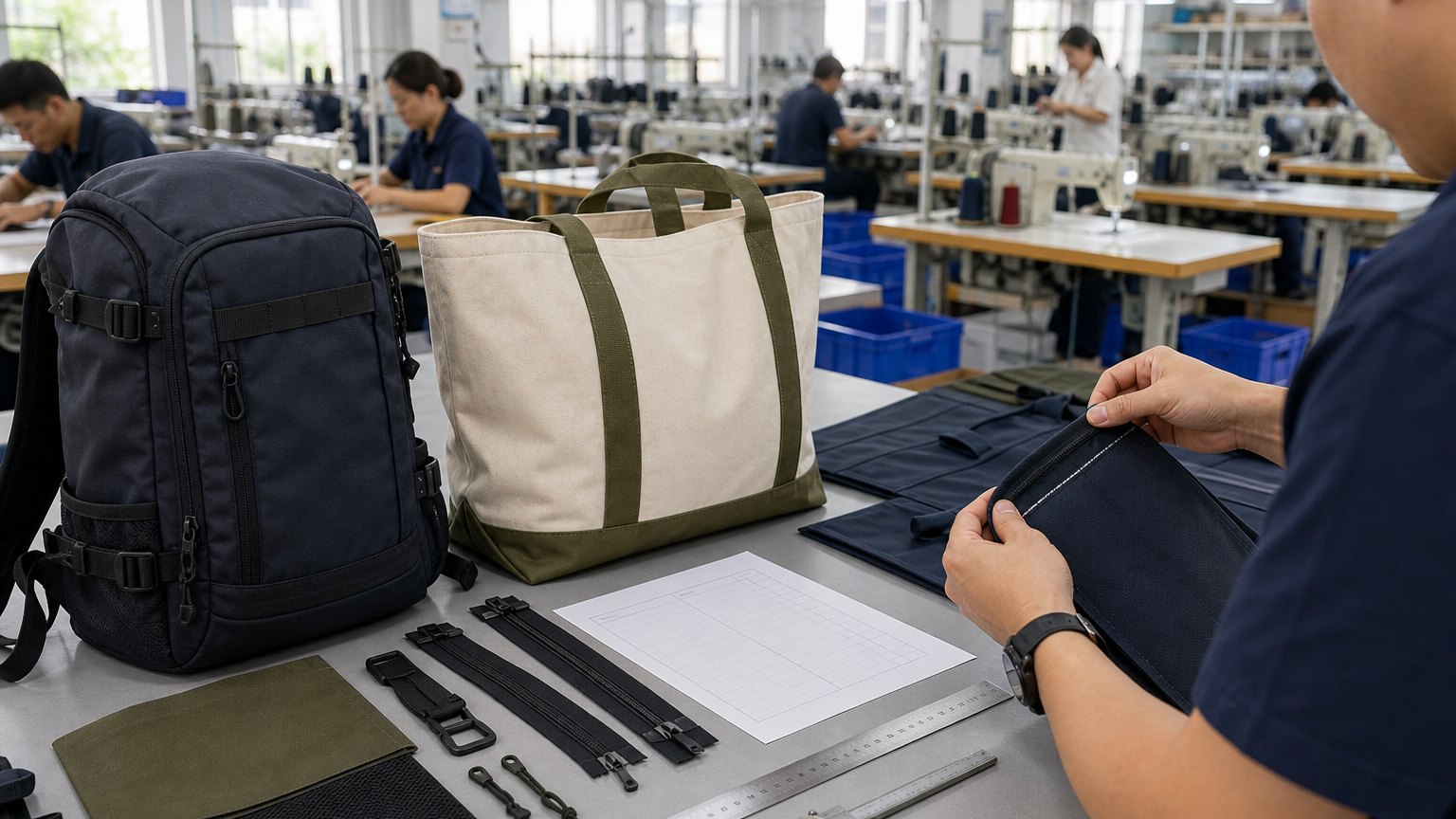
Search results for Vietnam bag manufacturing commonly discuss product categories, factory locations, MOQ, certifications and headline capacity. Those details help discovery, but they do not answer the approval question: can this specific site reproduce your approved bag with the declared materials, controls and origin route? This guide turns that gap into an evidence-based decision process.
Define the Production Entity
Ask the seller to identify the contracting company, invoice issuer, export entity and physical production site. These may be different organizations. Record their legal names, addresses and responsibilities in the supplier file. A representative office, trading company, sourcing coordinator and owned factory are different operating models; none is automatically bad, but the contract must match reality.
Verify the Assigned Site
A website can show one workshop while an order is placed elsewhere. Request a live or recent site walkthrough tied to your project, a floor plan, key equipment list and the name of the production manager. During sampling and bulk planning, repeat the assigned address on the purchase order and approval record. If the location changes, require written approval and a new risk review.
Build a Vietnam Feasibility File
The file should connect claims to evidence. Include legal-entity records, site identity, product and process fit, nominated material sources, sample status, line allocation, quality checkpoints, origin documents, packaging responsibilities and shipping terms. Give each item an owner and an expiry or review date. This is more useful than a folder of unrelated certificates.
Evidence Gate Before Quotation Approval
| Claim | Minimum evidence | Decision if missing |
|---|---|---|
| Direct factory | Legal entity, site address, process walkthrough and contract map | Treat as an intermediary until verified |
| Bag capability | Comparable construction sample, equipment and operator evidence | Run a development sample before pricing bulk |
| Local material | Named mill or converter, specification and available lot | Price an imported-input route separately |
| Monthly capacity | Line plan for your SKU and week, not a company total | Do not reserve launch dates |
| No subcontracting | Process ownership list and approved-site clause | Assume external processing may occur |
| Preferential origin | HS-specific rule, material origin and proof workflow | Model normal duty until confirmed |
Match the Factory to Bag Construction
A simple promotional tote, structured cosmetic pouch and technical backpack do not use the same risk profile. Break the bag into operations: cutting, printing, embroidery, lamination, foam handling, binding, zipper setting, bartacking, edge paint, assembly, cleaning and packing. Ask which operations occur at the assigned site and which are external. Product fit is process fit, not a photo gallery match.
Audit Material Availability
Vietnam has substantial cut-and-sew capability, but a particular fabric, coating, zipper, buckle or recycled input may still be imported. Ask for two routes: approved locally available material and nominated imported material. Record source country, specification, minimum purchase, color setup, transit time, currency and substitution rule. This prevents a low unit quote from hiding an unpriced material delay.
Treat Origin as a Product Test
A supplier address in Vietnam does not by itself establish country of origin or preferential status. Origin depends on the destination's rule, HS classification, transformation performed and input history. The correct question is not "Is this a Vietnam factory?" but "What origin rule applies to this SKU, and what records prove that the production route satisfies it?"
Classify the Product Before Modeling Duty
Bag classification can change with use, construction and outer-surface material. A cosmetic pouch, insulated cooler, backpack and reusable shopping bag may not follow the same tariff line. The importer and customs broker should confirm classification and destination requirements before landed-cost approval. A factory quotation is not a customs ruling.
Do Not Assume an FTA Benefit
Vietnam participates in multiple trade agreements, including the EU-Vietnam agreement, CPTPP and RCEP. Participation does not mean every bag automatically qualifies for a lower rate. Product-specific origin rules and proof procedures still apply. The European Commission agreement texts and the Vietnam Trade Portal are starting points; use destination-specific professional advice for the order.
Create an Origin Evidence Chain
Link purchase orders for fabric and trims to goods-received records, cutting tickets, work orders, line records, packing lists and export documents. If a preferential claim is planned, assign who checks the product-specific rule and who obtains or issues the proof of origin. Store the records with the shipment file. Evidence should be reproducible after delivery, not reconstructed during a customs query.
Separate Compliance from Capability
A social audit, material certificate or management-system certificate covers a defined entity, site, scope and validity period. It does not prove that the current material lot or current product complies. Match every document to the issuer, facility, material, test method and destination requirement. Use the broader bag quality pillars to connect specification, process and evidence.
Map Every Outsourced Process
Printing, embroidery, washing, lamination, metal finishing and special coating are often external even when sewing is in-house. Request the subcontractor name, address, process, lead time and control method. State whether unapproved subcontracting is prohibited or subject to buyer approval. A concealed process move can change color, performance, schedule and origin documentation at once.
Verify Capacity at SKU Level
Headline monthly output is not an order promise. Ask for the proposed line, operators, expected daily output after ramp-up, changeover assumptions, bottleneck process, planned start week and competing commitments. Compare that plan with the bag's standard minute value or another transparent workload estimate. Reserve capacity only after sample approval and material readiness are dated.
Normalize Every Quotation
Use one RFQ revision and compare the same quantity per color, material source, printing coverage, hardware, packing, quality plan, testing, tooling, sample treatment, Incoterm and named place. Separate recurring unit cost from one-time charges and destination cost. For a deeper cost model, see how custom bag prices are built and the custom bag MOQ guide.
Compare Vietnam, China and Dual-Source Routes
| Decision factor | Vietnam route | China route | Dual-source route |
|---|---|---|---|
| Best use | Proven site and material fit | Broad component and development ecosystem | Resilience after both routes are validated |
| Main evidence need | Assigned site, imported inputs and origin file | Supplier, process and destination import file | Equivalent specifications and approved alternates |
| Hidden risk | Material transit or undisclosed subcontracting | Tariff or concentration assumptions | Two uncontrolled versions of one SKU |
| Approval rule | Pilot at the named Vietnam site | Use a complete China import workflow | Qualify each route independently |
Transfer the Sample to the Real Site
A sample made by a development room, overseas partner or different plant does not prove the bulk site can reproduce it. Identify where each sample was made and which materials were used. Require the pre-production sample or a controlled replication to pass through the assigned Vietnam site. The sample scope and handoff guide explains how to define deliverables and approval evidence.
Freeze a Golden Sample and Build Record
Approval should freeze dimensions, construction, seam allowance, stitch density, reinforcement, material lot, color, logo position, hardware, labeling and packing. Keep a signed or digitally controlled golden sample with an annotated build record. Photographs alone are not enough for handfeel, coating, zipper action or seam strength.
Use a Site-Specific Quality Plan
Translate critical-to-quality requirements into receiving, first-off, in-line and final checks. Set methods, sample sizes, tolerances, owners and records before bulk starts. Do not copy a generic checklist without adapting it to the Vietnam site's actual process map. The custom bag inspection checklist provides a useful base.
Control First-Off Production
Review the first complete units after the real material lot, operators, machines and logo process are loaded. Check the highest-risk seams and assembly sequence, then close deviations before the line scales. A first-off gate catches a misunderstood drawing or replacement trim earlier than a final random inspection.
Plan Testing by Risk
Testing should follow end use, destination and claim. Possible checks include seam strength, strap attachment, zipper cycling, colorfastness, coating performance, restricted substances or packaging marks. Agree who selects the lab, which sample is tested and what happens after failure. Never describe a material option as compliant until the relevant evidence matches the ordered lot and claim.
Control Packing and Export Data
Freeze unit packing, carton dimensions, carton weight limits, assortment, barcode, shipping marks and document fields. Confirm which entity supplies the commercial invoice, packing list and origin proof. Packaging changes can affect freight, retail receiving and labeling even when the bag itself passes inspection.
Use an Incoterm With a Named Place
FOB, FCA and EXW are incomplete without the named place and current Incoterms version. Record who handles pickup, export clearance, terminal charges, booking, insurance and document corrections. Compare landed scenarios with the same assumptions; do not compare a Vietnam FOB number with a China EXW number and call the difference factory cost.
Build a Tet and Peak-Season Calendar
Vietnam's Tet period and other production peaks can affect staffing, material movement and approvals. Ask the supplier for its actual closure, ramp-down and ramp-up plan rather than using a generic holiday estimate. Lock artwork, materials and inspection windows backward from delivery. The lead-time and cost control guide helps expose dependency dates.
Define Change Control
Any change to site, subcontractor, material source, construction, color process, packing or ship point should trigger a written change request. State the reason, affected SKUs, samples or tests required, cost and schedule impact, approval owner and effective lot. Silence is not approval.
Qualify Dual Sources Independently
A China-plus-one plan is not complete when a supplier name is added to a spreadsheet. Each route needs its own approved sample, material path, capacity proof, quality plan, origin file and pilot result. Then define equivalence: what must be identical and which controlled differences are acceptable. The OEM product platform guide shows how common specifications reduce uncontrolled variants.
Know When Vietnam Is a Strong Fit
The route is attractive when the assigned site has comparable bag experience, the approved materials are locally available or reliably imported, volumes justify development and setup, the buyer can support clear English documentation, and destination-origin analysis is complete. It is especially useful as part of a deliberate sourcing portfolio rather than a rushed relocation.
Know When It Is Not Yet Ready
Pause if the supplier will not disclose the site, the approved sample came from elsewhere, key materials have no confirmed route, the order is below the real economic batch, the delivery date assumes instant material availability, or tariff savings are the only business case. A well-qualified custom bag manufacturer in another country may be safer than an unverified Vietnam label.
Use a Pilot as an Evidence Run
A pilot should exercise the same site, material source, tooling, print method, quality records, packing and document flow planned for scale. Set success criteria and a maximum acceptable deviation list before starting. The purpose is not merely to receive a small batch; it is to prove the operating system and reveal corrections before commercial volume.
Score Routes With Stop Rules
| Gate | Pass evidence | Stop rule |
|---|---|---|
| Site | Named address and verified process ownership | No bulk PO if the site is undisclosed |
| Product | Assigned-site sample meets frozen CTQs | No scale after unresolved critical failure |
| Materials | Approved sources, lots and lead times | No launch date on assumed availability |
| Origin | Classification, applicable rule and record owner | No preference in the cost model without proof |
| Capacity | Dated line allocation and bottleneck plan | No deposit against a headline total |
| Commercial | Normalized quote and change terms | No award with unresolved scope exclusions |
Prepare a Complete RFQ Pack
Send drawings, dimensions, bill of materials, material performance, artwork files, color standards, construction notes, CTQs, testing, packing, quantity by SKU and color, destination, required delivery date and commercial terms. Ask the factory to mark every exception. If the project is private label, align retail packaging and ownership through the private label bag launch guide.
Ask Questions That Reveal Operations
Instead of asking whether the factory has "good quality," ask who receives fabric, who releases the first-off unit, which operation limits daily output, where logo work occurs, how a failed seam is contained, and which records connect the carton to the production lot. Operational answers are harder to imitate than adjectives.
Watch for Vietnam Sourcing Red Flags
Red flags include copied factory photos, a contract entity unrelated to the visited site, refusal to name subcontractors, a sample made in another country without disclosure, an FTA promise without product-specific analysis, capacity stated only as a company total, a quote that omits material origin, and pressure to pay before the assigned site or specification is frozen.
Keep the Commercial Boundary Clear
A sourcing partner can help convert specifications, coordinate sampling and compare production routes, but the final manufacturing claim must identify the real site. Luckystar should not be described as a Vietnam factory unless a specific owned or contracted Vietnam facility and its scope are documented for the order. Buyers can use a shopping bag factory workflow or tote supplier workflow for category details without changing this country-route test.
Official Sources to Recheck
Trade and customs rules change. Recheck the International Trade Administration's Vietnam trade agreements page, destination tariff tools, the Vietnam Trade Portal and the relevant agreement protocol before shipment. For U.S. origin concepts, consult current CBP guidance and a broker; "substantial transformation" is a legal test, not a marketing phrase.
Frequently Asked Questions
Is Vietnam always cheaper than China for custom bags?
No. Country-level labor assumptions do not decide the final cost. Material imports, MOQ by color, process fit, productivity, scrap, testing, packing, inland logistics, duty and rework can outweigh a nominal labor difference. Compare normalized landed scenarios after both routes have priced the same specification.
What MOQ should I expect from a Vietnam bag factory?
There is no reliable country-wide number. Economic MOQ depends on material purchase units, color setup, printing or embroidery setup, construction complexity, line changeover and packing. Ask for the constraint behind the MOQ and separate prototype, pilot and commercial volumes.
Does sewing a bag in Vietnam make it Vietnamese origin?
Not automatically for every destination or preference program. The result depends on the applicable legal rule, classification, input origin and operations performed. Have the importer or broker analyze the specific production route and retain supporting records.
How can I verify that a supplier owns the factory?
Match the legal entity, site address, contract, invoice and export role; review business records; conduct a live or independent site audit; and trace one sample through the actual process. If ownership is not proven, document the relationship as trading, coordination or contract manufacturing instead.
Can I transfer an approved China sample directly to Vietnam?
You can use it as a reference, but the Vietnam site must rebuild and validate it with its own process and material route. Differences in mills, equipment, patterns and subcontractors can change the result. Freeze equivalence criteria and approve the assigned-site sample before bulk.
What should I send to request a quote?
Send a controlled specification, material and trim requirements, artwork, quantities by SKU and color, quality and testing plan, packing, destination, date and Incoterm. Request written exceptions, the assigned site, material source, sample plan and capacity window. A quote without those fields is a budget indication, not an award-ready offer.
Next Step: Request a Route Review
If you are comparing Vietnam, China or a dual-source plan, send one SKU's specification, target quantity, destination, required date and current material assumptions. We can help structure the questions and identify missing evidence before you compare production options. Request a custom bag route review, review the current custom bag range, then use the core manufacturer guide to complete the wider supplier decision.
Email a prefilled production-route brief